Disclosure: airfryerkitchensupply.com is reader-supported. When you buy through links on our site, we may earn an affiliate commission at no extra cost to you.
Where to buy
Every pick in this guide that carries a verified Amazon listing is linked below and again inside its review. Prices move constantly, so we never print a fixed price in the article — use the links to check the current price on Amazon before you buy. If a pick is marked as unlinked, it means we could not confirm a matching live listing at verification time, so we describe it honestly without a buy link rather than guess at one.
- Soniclean Soft Carpet Upright Vacuum Cleaner — check the current price on Amazon
- Miele Classic C1 Pure Suction Canister Vacuum — check the current price on Amazon
- Simplicity Jill Lightweight Bagged Canister Vacuum Cleaner — check the current price on Amazon
- Sebo Airbelt K2 Kombi Canister Vacuum — check the current price on Amazon
- Miele Classic C1 Turbo Team Canister Vacuum — check the current price on Amazon
- Kenmore 600 Series 81615 Bagged Canister Vacuum Cleaner — check the current price on Amazon
Introduction: The Wrong Vacuum Unmakes a Loose Woven Rug
Searching for the best vacuum for loose woven rugs usually starts with a small disaster: a fringe wound around a brushroll, a corner stretched out of square, or a bin full of the rug’s own fibres. Loose woven rugs — flatweaves, hand-loomed wool, open-weave and lightly constructed area rugs — fail differently from ordinary carpet. Their loops and warps are not locked into a dense backing, so a stiff motor-driven brushroll at full suction can pull loops long, distort the weave, fuzz the surface and eat fringe. The fix is not to stop vacuuming; grit left inside a weave saws through fibres with every footstep, and a never-vacuumed rug dies from within. The fix is the right mechanism: suction without a brushroll, suction you can turn down, a brush designed for soft carpet, or an air-driven turbo used with judgement.
Every pick below was verified — the Miele, Sebo, Kenmore and Simplicity models were freshly verified for this guide on 2026-11-22 — and each review claims only what its listing states, including two places where the Amazon title is truncated, which we flag openly rather than completing the sentence ourselves. The six picks form a safety ladder: start at the suction-only end if your rug is precious or fragile, and move toward gentle agitation only as your rug’s construction allows — and only after a corner test and a bin inspection have given you evidence, rather than optimism, that the move is safe for the rug you actually own and love. Prices and ratings are never printed; check the current price on Amazon through the links.
In this guide
Quick Picks
Six verified machines arranged as a safety ladder for loose weaves — from pure suction with no brushroll at all, through adjustable suction and soft-carpet design, to gentle turbo agitation for sturdier woven rugs.
Best Overall: Soniclean Soft Carpet Upright Vacuum Cleaner — an upright designed specifically for soft carpet — the category of delicate, loosely woven flooring that standard aggressive uprights can chew, stretch and fringe-damage. — Check on Amazon
Best Suction-Only Safety: Miele Classic C1 Pure Suction Canister Vacuum — a bagged canister whose name states its method — pure suction, no rotating brush — listed for hard floors and low-pile carpet, which makes it the safest powered way to clean a loose weave. — Check on Amazon
Best Adjustable Suction: Simplicity Jill Lightweight Bagged Canister Vacuum Cleaner — a lightweight bagged canister whose listing states certified HEPA filtration and adjustable suction — the control that lets you dial cleaning power down to what a loose weave can accept. — Check on Amazon
Best for Bare Floors and Area Rugs: Sebo Airbelt K2 Kombi Canister Vacuum — a German-engineered canister with a combination nozzle that its listing describes as made for bare floors and area rugs, plus a stated 7-year motor warranty. — Check on Amazon
Best for Low-Medium Pile Woven Rugs: Miele Classic C1 Turbo Team Canister Vacuum — a canister listed for hard floors and low-to-medium pile carpet, adding an air-driven turbo brush for rugs sturdy enough to benefit from gentle agitation. — Check on Amazon
Best Canister Versatility: Kenmore 600 Series 81615 Bagged Canister Vacuum Cleaner — a two-motor bagged canister with HEPA filtration and a powered Pet PowerMate head — included for mixed homes, with clear guidance on when to use its floor tool instead of its power head. — Check on Amazon
Key Takeaways
- The brushroll is the hazard: motor-driven brushes can pull loops, distort loose weaves and eat fringe. Suction-only cleaning is the safest default.
- Adjustable suction is the second line of defence — enough pull for grit, not enough to lift or strain the rug.
- Grit is the silent hazard: never vacuuming is also destructive, because trapped grit saws fibres from inside.
- Vacuum from the centre of the rug outward, and never run a powered head over fringe.
- Match the machine to the most delicate rug you own, not the average floor.
- Two listings in this guide have truncated Amazon titles; we flag them rather than guess the missing words.
How These Picks Were Chosen
The selection rule was mechanism first. We searched Amazon listing data for machines whose listings demonstrate a weave-safe mechanism: a pure-suction head with no brushroll, adjustable suction, a soft-carpet design brief, an air-driven turbo brush, or a canister architecture that separates suction from brush drive so the floor tool can be used alone. Mainstream uprights with fixed aggressive brushrolls — excellent machines in our other guides — were excluded here on principle, because this search’s entire problem is the mismatch between standard agitation and loose construction.
Verification was done in two waves: part of the list comes from this site’s API cache with recorded dates, and the canister models were verified fresh on 2026-11-22 through a single rate-limited API session, with the results stored in this programme’s cache. Where an Amazon title arrived truncated — it happened twice — the review claims only the visible words and says so. No prices, ratings or sales claims appear anywhere; each pick is positioned by tier in words and linked for a current price check on Amazon.
The 6 Best Vacuums for Loose Woven Rugs
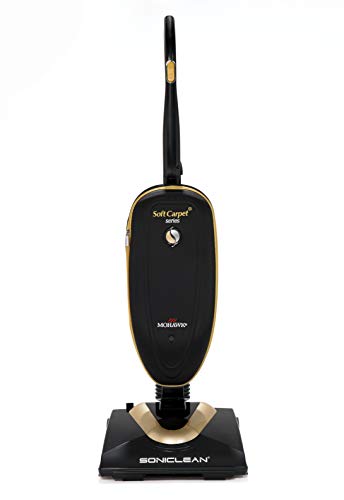
Soniclean Soft Carpet Upright Vacuum Cleaner — Best Overall
Most vacuums are designed for the average carpet and merely tolerated by delicate ones. The Soniclean Soft Carpet upright inverts that: its entire stated brief, per the verified listing, is soft carpet — the plush, loosely constructed flooring that ordinary uprights handle worst, because a stiff brushroll at full suction can pull loops, stretch a loose weave out of square and shred fringe. A machine designed from that brief outward is the natural first pick for this search, and its listing confirms the format (upright) and the brief (soft carpet) in so many words. Beyond that, the Amazon title is brief, and this review claims nothing the title does not state; the product page is the place for its detailed specifications.
Who needs it is easy to picture: the household that bought a beautiful hand-loomed or high-pile rug and then watched a conventional vacuum tug at its edges, or heard the alarming rattle of loose fibres being harvested into the bin. With a soft-carpet machine, weekly cleaning stops being a risk calculation. You vacuum the rug the way you vacuum everything else — regularly, unhurriedly — which is itself protective, because grit left sitting in a loose weave saws at the fibres from inside every time the rug is walked on.
The honest limits are specialisation and information. A specialist is rarely the best answer to every floor in a mixed house, and buyers whose homes are mostly hard floor with one sturdy rug should take a suction canister below instead. And because the verified title is short, treat this review as positioning: the right machine class, from the right design brief, with its fine specification to be confirmed on the listing before you buy.
Strengths
- The only pick whose entire design brief, per its listing, is soft carpet — gentle handling is its starting point, not a setting
- Upright format keeps the familiarity and storage simplicity most households want
- Lets owners of delicate rugs stay with one full-size machine instead of maintaining a special-occasions canister
Trade-offs
- The Amazon title is brief, so detailed specifications should be confirmed on the product page — we claim only its format and design brief
- A specialist upright is less versatile across very deep pile and heavy pet homes than the mainstream machines in our other guides
- Premium positioning for a niche brief
| Format (per Amazon title) | Upright vacuum |
| Design brief (per Amazon title) | Soft carpet |
Best for: homes whose main rugs are soft, plush or loosely woven and need an upright that was designed for them rather than adapted to them / Not suited for: buyers who mostly clean hard floors and only own one sturdy low-pile rug
Check the current price on Amazon

Miele Classic C1 Pure Suction Canister Vacuum — Best Suction-Only Safety
The safest vacuum for a loose woven rug is the one with nothing in it that can grab the rug. The Miele Classic C1 Pure Suction states its method in its name: pure suction, with no rotating brushroll in the head, and its verified listing positions it for hard floors and low-pile carpet. On a flatweave kilim, a hand-knotted wool rug or anything with visible warp and weft, that absence is the feature. The head glides, the suction lifts surface grit and hair, and the weave is never beaten, twisted or wound around a roller.
Canister technique suits delicate rugs in a second way: the heavy motor unit sits off the rug while only the light head crosses it, so the rug is not being dragged by a full upright’s weight at its edges. Work from the centre outward, as the how-to section describes, and fringe is pushed away from the machine rather than drawn into it. Miele’s bagged system adds a housekeeping virtue — the bag seals on removal, so the grit you extracted from a precious rug does not puff back into the room at the bin.
Know what you are trading. Suction alone is the gentle option and the slower one: grit that has worked deep into a pile needs the shake-out and underside techniques in this guide to fully leave, and thick plush carpet is simply outside this model’s brief. But for the rugs this search exists for — loose, woven, valued — the Pure Suction is the pick that lets you clean weekly without ever apologising to the rug.
Strengths
- No brushroll means nothing rotating can snag, pull or fuzz a loose weave — the safest mechanism in this guide
- Canister format follows you around the rug rather than being pushed over its fringe again and again
- Miele’s canister line is the reference class for this format, with bags that seal dust away on disposal
Trade-offs
- Suction-only cleaning is slower on embedded grit than brushroll agitation; the technique section compensates
- Bagged running costs apply, unlike the bagless machines in our other guides
- Low-pile positioning means it is not the tool for shag or deep plush carpet
| Format (per API fresh verify) | Bagged canister |
| Method (per Amazon title) | Pure suction |
| Surfaces (per Amazon title) | Hard floors and low-pile carpet |
| Brand (per API) | Miele |
Best for: owners of flatweave, hand-knotted and antique-style rugs where any brushroll is a risk / Not suited for: deep-pile carpet homes — suction alone cannot groom thick pile the way a brushroll can


Simplicity Jill Lightweight Bagged Canister Vacuum Cleaner — Best Adjustable Suction
Ask a rug conservator what destroys woven rugs at home and the answer is rarely dirt — it is suction with no judgement. A fixed-power vacuum treats a silk-inlay flatweave and a doormat identically. The Simplicity Jill’s verified listing states the corrective feature by name: adjustable suction. Dialled down, the head lifts surface grit without bowing a light rug upward, straining its weave or swallowing its fringe; dialled up on the surrounding hard floors and sturdy runners, the same machine cleans at full strength. One machine, two manners — which is what a mixed home actually needs.
The listing also states a certified HEPA filter, and we use its exact level of claim: a certified filter, which is the claim about the filter itself. For households emptying rug grit weekly, good filtration keeps the finest dust — the fraction that makes rooms smell stale — out of the exhaust air. The lightweight canister format completes the picture: it trails behind you, parks on a stair, and stores in a cupboard that would never fit an upright.
Transparency about the data: the Amazon title returned for this product is truncated mid-phrase, so beyond adjustable suction, certified HEPA filtration and the canister format, this review asserts nothing further — the product page holds the complete specification. Even on those confirmed facts alone, the Jill earns its badge: adjustable suction is the feature this search most depends on, and this is its clearest verified expression at an accessible tier.
Strengths
- Adjustable suction is the single most useful control for loose weaves: enough pull to lift grit, not enough to lift the rug or distort it
- Certified HEPA filtration is stated in the listing — the filter claim at its most explicit
- Lightweight canister body is easy to carry between rooms and floors
Trade-offs
- The Amazon title we received is truncated mid-phrase, so a full feature list should be confirmed on the product page; we claim only what is visible
- Bagged format carries ongoing bag costs
- A compact canister’s tools suit area rugs and floors rather than whole-house deep-pile carpet
| Format (per API fresh verify) | Lightweight bagged canister |
| Suction (per Amazon title) | Adjustable |
| Filtration (per Amazon title) | Certified HEPA filter |
| Brand (per API) | Simplicity |
Best for: mixed homes that clean delicate rugs and normal floors with one machine, turning suction up and down as they go / Not suited for: buyers who want an upright format or the deepest carpet agitation
Check the current price on Amazon

Sebo Airbelt K2 Kombi Canister Vacuum — Best for Bare Floors and Area Rugs
Sebo builds vacuums the way German firms build most things: conservatively, heavily and for the long term. The Airbelt K2 Kombi’s verified listing confirms a canister with a Kombi combination nozzle described as made for bare floors and area rugs — the exact mixed brief of this search — and a 7-year motor warranty stated in the title itself. (One disclosure: the Amazon title truncates at the word ‘Area’, so the nozzle’s full description should be confirmed on the product page; we report what is visible and flag the rest in our sources.) A combination nozzle matters here because it cleans by suction with a floor-and-rug head geometry, rather than by a powered brushroll — the same safety logic as the Miele Pure Suction, in a different engineering accent.
The ownership proposition is the other half of this pick. A stated long motor warranty, a bagged system that keeps dust sealed, and a canister built for service rather than replacement suit the buyer whose rugs are also long-term possessions. There is a coherence to maintaining a twenty-year rug with a ten-year vacuum, and an incoherence to maintaining it with the cheapest suction that happens to be on offer.
The costs are the tier and the format’s usual ones: this is premium money for suction-class cleaning, and bags are a running cost. Deep-pile carpet homes should look at powered-head models instead. But for hard floors scattered with woven rugs — the classic apartment and old-house layout — the K2 Kombi is arguably the most precisely aimed machine in this guide.
Strengths
- A combination nozzle is the right tool shape for this search: suction cleaning that treats rugs and bare floors in one pass pattern
- Sebo’s stated 7-year motor warranty signals the build class plainly
- Canister format keeps weight off the rug and the head light over fringe
Trade-offs
- Premium tier for a suction-class machine
- The Amazon title truncates at the word ‘Area’, so the exact nozzle wording should be confirmed on the product page — flagged here and in our sources
- Bagged running costs apply
| Format (per API fresh verify) | Canister |
| Nozzle (per Amazon title) | Kombi nozzle, for bare floors and area rugs (title truncates at ‘Area’) |
| Warranty (per Amazon title) | 7-year motor warranty |
| Brand (per API) | Sebo |
Best for: homes mixing hard floors with woven area rugs, and buyers who keep machines for a decade / Not suited for: deep-pile carpet households — the powered-head K3 class exists for them, at a higher tier
Check the current price on Amazon

Miele Classic C1 Turbo Team Canister Vacuum — Best for Low-Medium Pile Woven Rugs
Not every woven rug is fragile, and treating a sturdy low-pile wool rug as if it were silk wastes cleaning power it could safely use. The Classic C1 Turbo Team’s verified listing positions it for hard floors and low-to-medium pile carpet, and its turbo brush is the relevant mechanism: driven by airflow rather than a motor, it agitates with noticeably less violence than a powered brushroll. For woven rugs in that low-to-medium pile class — the majority of modern wool and wool-blend area rugs — that gentle agitation reaches the grit and pet hair that pure suction leaves behind, without the loop-pulling appetite of a full upright.
The discipline is in the matching, and this guide will be blunt about it: the moment a weave is open enough to see through, has loose or lifting loops, long fringe, or existing tears and worn patches, this pick is disqualified and the Pure Suction above takes over. Test any new rug in a corner first, on the machine’s gentler settings, and inspect what the bin collects — fibre in the bin is information, and it is telling you to stop.
Chosen correctly, the Turbo Team is the productivity pick: one canister that handles the hard floors, the sturdy woven rugs and the low-pile carpet in bedrooms, with Miele’s sealed-bag disposal keeping the extracted grit out of the air. It is also the natural upgrade path for Pure Suction owners whose rug collection grows sturdier over time.
Strengths
- An air-driven turbo brush agitates more gently than a motor-driven brushroll, a middle path between suction-only and full powerheads
- Extends the safe-cleaning envelope from flatweaves to low-medium pile woven rugs
- Same canister virtues as the Pure Suction: weight off the rug, sealed bag disposal
Trade-offs
- Any brush, however gentle, is wrong for open weaves, long fringe and rugs with existing damage — judgement still required
- Turbo heads need their own hair-clearing maintenance
- Bagged running costs apply
| Format (per API fresh verify) | Bagged canister |
| Head (per model name) | Turbo (air-driven) brush |
| Surfaces (per Amazon title) | Hard floors and low-medium pile carpet |
| Brand (per API) | Miele |
Best for: low-to-medium pile woven rugs that trap grit and pet hair below the surface and need more than suction alone / Not suited for: truly loose, open or damaged weaves — stay with the Pure Suction pick for those
Check the current price on Amazon
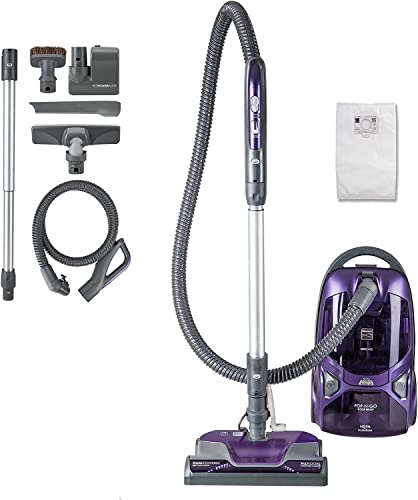
Kenmore 600 Series 81615 Bagged Canister Vacuum Cleaner — Best Canister Versatility
This pick comes with the clearest instruction in the guide, so it comes first: on a loose woven rug, use this machine’s floor tool with suction only, and keep its powered Pet PowerMate head for the sturdy carpets it was built for. The Kenmore 600 Series earns its place because its verified listing confirms a two-motor bagged canister with HEPA filtration — an architecture in which suction and brush drive are separate systems, which is precisely what makes disciplined suction-only cleaning on the delicate rug, and full powered cleaning everywhere else, possible from one machine.
The household it serves is the real-world mixed one: a cherished woven rug in the living room, wall-to-wall carpet upstairs, two shedding pets throughout. Suction-only specialists would leave the upstairs carpet under-cleaned; a mainstream upright would endanger the rug. A versatile canister with a genuine floor tool resolves the triangle, provided the owner follows the one rule above. The HEPA filtration statement in the listing is the finishing virtue in a pet home, where weekly vacuuming moves a great deal of dander-laden air.
Judge this pick by your own discipline. If different family members vacuum with different levels of care, a suction-only machine is the safer household choice because it cannot be misused against a weave. If the rule will be followed, the Kenmore is the most versatile single purchase in this guide — one machine, two manners, and a delicate rug that is cleaned by the gentle one.
Strengths
- Two-motor design separates suction from brush drive, so the machine can be run as a suction cleaner with its floor tool on delicate rugs
- HEPA filtration is stated in the listing, valuable in pet homes
- The powered Pet PowerMate handles the sturdy carpets and upholstery that share a house with the delicate rug
Trade-offs
- The powered head must be kept off loose weaves — this pick demands the most user judgement in the guide
- Full-size canister is the heaviest format here
- Bagged running costs apply
| Format (per API fresh verify) | Bagged canister |
| Motors (per Amazon title) | 2-motor system |
| Filtration (per Amazon title) | HEPA filter |
| Head (per Amazon title) | Pet PowerMate powered head |
Best for: pet homes with one delicate rug among otherwise demanding floors, needing a single versatile canister / Not suited for: homes where most rugs are delicate — a suction-first pick above is the safer main machine
Check the current price on Amazon
Comparison Table
| Pick | Badge | Weave-safe mechanism | Best for |
|---|---|---|---|
| Soniclean Soft Carpet Upright Vacuum Cleaner | Best Overall | Upright designed for soft carpet | homes whose main rugs are soft, plush or loosely woven and need an upright that was designed for them rather than adapted to them |
| Miele Classic C1 Pure Suction Canister Vacuum | Best Suction-Only Safety | Pure suction canister, no brushroll, for hard floors and low-pile carpet | owners of flatweave, hand-knotted and antique-style rugs where any brushroll is a risk |
| Simplicity Jill Lightweight Bagged Canister Vacuum Cleaner | Best Adjustable Suction | Lightweight canister, adjustable suction, certified HEPA filter per listing | mixed homes that clean delicate rugs and normal floors with one machine, turning suction up and down as they go |
| Sebo Airbelt K2 Kombi Canister Vacuum | Best for Bare Floors and Area Rugs | Kombi combination nozzle, canister, 7-year motor warranty per listing | homes mixing hard floors with woven area rugs, and buyers who keep machines for a decade |
| Miele Classic C1 Turbo Team Canister Vacuum | Best for Low-Medium Pile Woven Rugs | Canister with turbo brush, for hard floors and low-med pile carpet | low-to-medium pile woven rugs that trap grit and pet hair below the surface and need more than suction alone |
| Kenmore 600 Series 81615 Bagged Canister Vacuum Cleaner | Best Canister Versatility | 2-motor canister, HEPA filter, Pet PowerMate — floor tool for loose weaves | pet homes with one delicate rug among otherwise demanding floors, needing a single versatile canister |
How to Choose a Vacuum for a Loose Woven Rug
Interrogate your rug before the vacuum. Turn a corner over. If you can see the weave structure clearly, if loops lift when you scratch gently with a fingernail, if the rug is light enough to bow upward under a strong vacuum, it belongs at the suction-only end of this guide. Dense, heavy, low-pile woven rugs with a tight construction can accept the turbo class. Antique, silk-blend, damaged or visibly worn rugs should be cleaned by suction only and, for deep cleans, by a specialist — no vacuum purchase outranks the rug’s survival.
Prioritise the control, not the power. In this category, headline suction figures are anti-features. Adjustable suction, a suction-only head, or a soft-carpet design brief are the specifications that protect the weave. A machine that can be gentle on the rug and strong on the kitchen floor — the canister picks here — resolves the mixed-home problem better than two mediocre machines.
Consider format honestly. Canisters dominate this guide because they put only a light head on the rug and keep the motor’s weight off it, and because their tool sets include true floor tools. The one upright here earned its place by being designed for soft carpet specifically. A standard upright you already own can be used on sturdy woven rugs with its brushroll switched off if it offers that control — but if it does not, do not improvise; the rug is worth more than the convenience.
Plan the household rule, not just the purchase. A weave-safe machine only protects the rug if everyone who vacuums uses it the same way. If your household includes a cleaner, teenagers or a partner who reaches for whichever machine is charged, the safest purchase is the one that cannot be misused — a suction-only model — rather than the most versatile one. Write the rule where the machine lives if you must: floor tool on the woven rug, power head everywhere else. Thirty seconds of clarity at the cupboard door is worth more than any feature in this guide.
Budget for bags where they appear. Most weave-safe canisters are bagged. That is a running cost, and also a benefit: bags seal the extracted grit away, and the finest dust stays out of the room’s air. Count it as part of the tier when you compare against bagless alternatives.
How to Vacuum a Loose Woven Rug Safely
Step 1: take the rug’s temperature first — shake it outdoors or beat it gently over a rail to release the deep grit no vacuum reaches, especially before a first clean. Step 2: check the machine: brushroll off or floor tool fitted, suction set low to medium. Step 3: start in the centre of the rug and work outward, so fringe and edges are pushed away from the head rather than drawn under it; never vacuum over fringe with any powered head, and approach fringe only with a hand tool from the rug side outward. Step 4: use slow, overlapping passes and let suction do the work — do not press down, which grinds grit through the weave. Step 5: if the rug bows or lifts toward the head, reduce suction further or add your weight by standing on the rug’s far edge. Step 6: every month or so, vacuum the underside too, then flip and clean the floor beneath; grit migrates through loose weaves and abrades from below. Step 7: use a rug pad underneath — it stops creep, cushions the weave against the floor, and reduces the suction seal that makes light rugs lift. Step 8: inspect the bin afterwards. Fibre in the bin is the rug voting against your settings; change them. Step 9: finish with the room’s hard floors on the same outing, resetting suction and tools as you leave the rug — combining the jobs into one session is how weekly rug care stays weekly, because a special trip for one rug is a trip that gets postponed.
Common Buying Mistakes
Using the main upright because it is there. Convenience is how fringes die. Judging by suction power. In this category, control beats force every time. Never vacuuming a delicate rug. Grit destroys from within; gentle and weekly beats rare and heroic. Vacuuming fringe. Fringe is combed by hand or cleaned with a hand tool, never crossed by a head. Skipping the rug pad. Half the lifting, creeping and edge-curl problems blamed on vacuums are pad problems. Ignoring bin evidence. Your rug’s fibres in the dust bin are a diagnostic, not a coincidence — change machines or settings when you see them. Storing the rug dirty. A woven rug rolled away with grit inside keeps abrading itself in storage; clean both sides before any storage, and roll rather than fold. Chasing a deep clean with a stronger machine. When suction stops being enough, the answer is a professional wash, not more aggression at home — the boundary is real, and crossing it is how maintainable rugs become restoration projects.
Rug Types, Matched to the Ladder
Flatweaves — kilims, dhurries, flat cotton weaves: suction only, always. These rugs have no pile to protect the weave, so every pass of a brush lands directly on the structure. The Miele Pure Suction or the Jill at low suction is the whole answer, plus an outdoor shake monthly. Hand-knotted wool: suction only for older or fine pieces; a tight, sturdy modern hand-knot in low pile can graduate to the Turbo Team class with a corner test first. Machine-woven low-pile: the most forgiving woven class — adjustable suction or gentle turbo both work, and these rugs tolerate the Kenmore’s floor tool at moderate settings comfortably. High-pile and shaggy woven rugs: the problem reverses — suction alone cannot reach the base, and brushrolls tangle in the pile; the soft-carpet upright’s design brief is the closest fit, used slowly, in one direction, with the rug checked afterwards. Jute, sisal and other plant fibres: suction only, kept dry; these fibres are strong in tension but their woven structure loosens when fibres are repeatedly flexed by a brush, and they feature in our related rug guides. When in doubt about any rug’s class, start one rung safer than you think it needs — you can always move up the ladder after a clean bin check, and you cannot move a pulled loop back down it.
Deep Cleaning and Professional Help: Knowing the Boundary
Home vacuuming maintains a rug; it does not restore one. When a woven rug carries ground-in soil that suction no longer lifts, stains that have set into the fibre, or a smell that survives airing, the next step is not a stronger vacuum — stronger is precisely what the rug cannot take. It is a wash by someone who cleans woven rugs professionally, with the rug’s dyes and structure tested first. Between those events, spot accidents at home should be blotted, never scrubbed, with the rug dried flat and fully before it returns to the floor, because a damp woven rug stored or replaced wet invites mildew into exactly the fibres you are protecting. Treat vacuuming as the weekly hygiene that delays professional cleaning for years, and the economics and the conservation point in the same direction: gentle, frequent, and humble about its limits.
Storing and Rotating Woven Rugs
A rug’s life off the floor matters too. Rotate woven rugs a half-turn every few months so traffic and sunlight distribute across the whole weave rather than engraving one path and fading one end. When storing, roll — never fold — a woven rug, with the pile facing inward, in a breathable wrap rather than sealed plastic, and store it dry, because a rug put away with grit inside continues to abrade itself in the dark. Before it goes back down, vacuum both sides with the suction-only routine in this guide; storage shakes loose exactly the deep grit that a fresh start should not begin with. These habits cost nothing but attention, and together with the right vacuum they are the difference between a woven rug that is an heirloom in twenty years and one that is a memory in five.
Reading the Bin: A Diagnostic Habit for Rug Owners
Every clean ends with evidence, and owners of woven rugs should learn to read it. A healthy bin contains dust the colour of the room, grit that rattles, hair, and a modest amount of short, soft fluff — the surface fibres every textile sheds. Warning contents look different: long loops or threads, fibres in the rug’s exact colours in quantity, or grit volumes that suggest the floor beneath is being mined through the weave. Any of those means the current mechanism is harvesting the rug, and the correct response is immediate — drop a rung on this guide’s ladder, reduce suction, and re-test on a corner. Kept as a habit, bin-reading turns vacuuming from an act of faith into a monitored process, and it costs nothing but a glance before you empty. It is also the honest way to evaluate any vacuum in this guide in your own home: not by its first impression on the handle, but by what it took from your floors — and what it left of your rug — over its first month.
Final Recommendation
If your rug is genuinely loose, flat or precious, start at the safe end: the Miele Pure Suction is the default recommendation, with the Simplicity Jill as the adjustable-suction alternative for mixed homes. The Sebo K2 Kombi serves the hard-floor-and-area-rug layout at a premium tier, the Soniclean serves owners who want an upright designed for soft carpet, the Miele Turbo Team serves sturdier low-pile woven rugs that need gentle agitation, and the Kenmore 600 serves disciplined pet homes with one delicate rug among demanding floors.
Whichever you choose, run the safe-vacuuming routine in this guide from the first clean — technique is half the protection. Related guides cover the neighbouring territory:
Best Silent Vacuums Best Selling Upright Bagless Vacuums Best Canister Vacuums For Medium Pile Carpet Best Area Rug That Vacuums Easily Best Bagged Vacuums For Allergies Best Affordable Jute Rugs
Frequently Asked Questions
Can I use my regular upright on a loose woven rug?
Only if its brushroll can be switched off or it offers genuine suction control — and even then, test a corner and check the bin for fibres afterwards. A fixed, aggressive brushroll at full suction is the mechanism that pulls loops and eats fringe, and no amount of care in pushing it changes what the roller does.
Is a robot vacuum safe for loose woven rugs?
Robots use light suction and small brushes, which sounds gentle, but their brushes and wheels cross fringe constantly and their suction is too weak to extract deep grit. For a sturdy flatweave they can maintain the surface between proper cleans; for a genuinely loose or fringed rug, a suction-only machine used by a person is the safer tool.
How often should a loose woven rug be vacuumed?
Weekly, gently, is the rhythm that protects it: often enough that grit never accumulates to the fibre-sawing stage, gently enough that the cleaning itself does no harm. High-traffic placements may need a second light pass mid-week.
What should I do about fringe?
Keep every vacuum head off it. Straighten fringe by hand, comb it gently outward, and if it needs cleaning, use a hand tool with suction from the rug outward, or shake the rug outdoors. Fringe is the most fragile part of any woven rug and the first casualty of powered heads.
What is the safest way to clean a rug’s edges and corners?
Edges fail first because heads ride over them and suction seals against the floor beyond. Work from the centre outward so the head leaves the rug by rolling off its edge rather than climbing onto it, keep the head’s full weight on the rug rather than half on the floor, and finish the last strip with a hand tool if the edge lifts. A pad underneath, cut slightly smaller than the rug, keeps edges lying flat enough to clean safely.
My rug sheds fibres when I vacuum. Is that normal?
New wool rugs shed loose surface fibre for months, and that fluff in the bin is normal. The warning sign is different: long loops, warp threads or a bin that keeps filling with fibre from an older rug. That means the mechanism or suction is too aggressive — step down the safety ladder in this guide until the bin shows dirt, not rug.


