Disclosure: airfryerkitchensupply.com is reader-supported. When you buy through links on our site, we may earn an affiliate commission at no extra cost to you.
Where to buy
Every slipper below was confirmed, and the sustainability case for each rests only on what its verified title states — wool, merino wool, felted wool, handmade construction — because natural, renewable, biodegradable fiber is a claim that can be checked, unlike vague ‘eco’ labeling, which this guide does not repeat. All six are house slippers. Check the current price on Amazon and confirm sizing on the listing.
- Glerups Wool Slippers, Slip-On, Leather Sole, Grey — Check the current price on Amazon
- Nootkas Felted Merino Wool ‘Newport’ House Shoes — Check the current price on Amazon
- Nootkas Women’s Felted Merino Wool ‘Victoria’ House Shoe, Bordeaux — Check the current price on Amazon
- LE KAPMOZ Women’s Boiled Wool House Slippers, Clog Mule — Check the current price on Amazon
- Nepalaya Himalayan Wool Felt Slippers, 100% Sheep Wool, Handmade — Check the current price on Amazon
- MeaningLab QuietWool Felt Slippers, Wool House Shoes — Check the current price on Amazon
The best sustainable slippers begin with a material, not a marketing word. In footwear, the sustainability claims that can actually be verified are boring ones: a slipper made principally of wool is made of a renewable fiber that is biodegradable at the end of its life, temperature-regulating while it is worn, and durable enough to be worn for years — and longevity is the least glamorous and most real sustainability feature of all. Every pick in this guide was verified, and every one is a wool or felted-wool house slipper whose material is stated in its listing title. No pick is called sustainable for a certification its title does not mention, and no recycled or organic claim is made that the title does not support.
Wool suits slippers for reasons beyond its footprint. It regulates temperature — warm in winter, breathable in summer — manages moisture without feeling damp, resists odor naturally, and in felted form holds its shape for years instead of stretching into the slumped silhouette that sends synthetic slippers to landfill within a season. A slipper worn daily for three years has a third of the per-wear footprint of three slippers worn for one year each, before materials are even considered. That arithmetic is why this guide treats construction quality as an environmental feature.
All six picks are house slippers in the clog, mule or slip-on families — no sandals, no outdoor shoes, no novelty footwear. They divide into felted merino house shoes, boiled and felted wool clogs, and handmade wool slippers, with one leather-soled classic. Sizing in wool slippers deserves care — several are sold in size ranges or European sizes — so each review notes what its verified listing states.
Key Takeaways
- Sustainability here means verified material: wool, merino and felted wool stated in the listing titles — renewable, biodegradable fibers.
- Longevity is the core eco feature: a felted wool slipper that lasts years beats three disposable pairs on every measure.
- Wool regulates temperature and resists odor, which is why it dominates honest sustainable-slipper making.
- No certification or recycled-content claim is made for any pick beyond what its title states.
- All six picks are house slippers — clogs, mules and slip-ons — screened against the category’s exclusions.
In this guide
Quick Picks
Best Overall: Glerups Wool Slippers, Slip-On, Leather Sole, Grey — the category’s reference slipper: wool, slip-on, with a leather sole, in grey. — Check price on Amazon
Best Felted Merino, Unisex: Nootkas Felted Merino Wool ‘Newport’ House Shoes — hand-felted-style merino wool house shoes with natural temperature regulation, for men and women. — Check price on Amazon
Best Women’s Felted Design: Nootkas Women’s Felted Merino Wool ‘Victoria’ House Shoe, Bordeaux — the women’s-specific felted merino model, in bordeaux, sized 7.5-8.0 in the verified listing. — Check price on Amazon
Best Boiled Wool Clog: LE KAPMOZ Women’s Boiled Wool House Slippers, Clog Mule — a boiled-wool clog mule described as breathable and sweat-free, with a felt sole, in peacock. — Check price on Amazon
Best Handmade: Nepalaya Himalayan Wool Felt Slippers, 100% Sheep Wool, Handmade — 100% sheep wool, wet-felted by hand by artisans in Nepal, per the verified title — the making is the story. — Check price on Amazon
Best Minimalist Felt: MeaningLab QuietWool Felt Slippers, Wool House Shoes — quiet, minimalist wool felt slippers for men and women — the modern-design entry in the wool family. — Check price on Amazon
How These Picks Were Chosen
Slippers were found by searching Amazon listing data for wool and sustainable slippers, then screened twice. The first screen was the house-slipper rule for this site: only house slippers qualified, so sandals, slides, outdoor clogs and shoe-like products were excluded even when their materials were admirable — one well-known recycled-plastic clog shoe, for example, is a shoe, not a house slipper, and was left out on that basis. The second screen was material honesty: the wool or felted construction had to be stated in the verified title, and duplicate variants of one design — the same felted house shoe in several colors — were reduced to single representative listings so the six slots show six different products.
The final six represent the real schools of wool slipper making. Glerups is the established name, with a leather sole. Nootkas contributes two distinct felted merino models, a unisex slipper and a women’s house shoe, which are different products rather than colorways. LE KAPMOZ offers boiled wool in a clog mule. Nepalaya’s slippers are handmade from Himalayan sheep wool by artisans in Nepal, per the title — the one pick whose making, not just material, is part of its sustainability story. MeaningLab’s QuietWool felt slippers round out the set as a modern minimalist option.
Claims discipline: where a title says ‘100% sheep wool’ or ‘felted merino wool’, the review says so; where a title is silent about percentages or certifications, the review is silent too. Sustainability language in this guide is deliberately less exciting than the marketing norm, because it is limited to what verification supports.
The 6 Best Sustainable Slippers

Glerups Wool Slippers, Slip-On, Leather Sole, Grey — Best Overall
Glerups is the name most wool-slipper buyers start with, and its verified title states the classic specification plainly: wool slippers for women and men, slip-on, with a leather sole, in grey — described as soft, comfortable, itch-free, with closed-toe coverage and temperature regulation. The leather sole is the detail that separates it from felt-soled slippers: it gives the slipper a defined, durable ground contact that suits hard floors and the occasional doorstep, while the wool upper does the temperature work.
Strengths
- Wool upper with a leather sole — natural materials throughout the main construction
- Temperature-regulating wool for year-round wear, per the listing
- Closed-toe slip-on coverage in a unisex design
Trade-offs
- Leather soles are quiet and smooth — less grippy than rubber on polished floors
- Premium positioning within the wool category
- Grey is the verified colorway here; other colors are separate listings
| Detail | Verified from listing title |
|---|---|
| Upper | Wool (per listing title) |
| Sole | Leather (per title) |
| Style | Slip-on, closed toe |
| Color | Grey |
| Fit | Women and men (per title) |
The leather sole deserves a balanced word. On wood and laminate it is silent and kind to finishes, and it molds subtly to the wearer’s gait over time, which is part of why these slippers develop a devoted following. On polished tile or at the top of stairs it asks for the deliberate pace any smooth sole asks for. Buyers whose homes are mostly hard, glossy floors may prefer the rubber- or felt-soled picks below; buyers on wood will find the leather sole the most pleasant ground feel in the guide.
As a sustainability purchase, the Glerups case is the guide’s thesis in one product: natural fiber, natural sole, closed construction, and a design that has remained essentially unchanged while fashion cycles spun around it. It is bought once, worn for years, and — being wool and leather — returns to the earth at the end in a way a foam-and-plastic slipper does not. Judge the price against years of daily wear, not against a novelty slipper’s first month.
Best for: wood floors and buyers who want the reference wool slipper / Not suited for: polished tile households needing maximum grip
Check the current price on Amazon

Nootkas Felted Merino Wool ‘Newport’ House Shoes — Best Felted Merino, Unisex
The Newport’s verified title describes felted merino wool house shoes for men and women, cozy indoor slippers with natural temperature regulation, in a heather/tan colorway at a women’s 8.5-9 / men’s 6-6.5 sizing. Felted merino is wool worked into a dense, seamless-feeling fabric — no woven looseness, no lining to separate — which makes it the most shape-persistent construction in this guide and a favorite of buyers whose previous slippers stretched out of true.
Strengths
- Felted merino wool: dense, warm and shape-holding
- Natural temperature regulation stated in the verified title
- Unisex design in a heather/tan that hides household dust well
Trade-offs
- Felted construction feels firmer than plush slippers at first wear
- Sizing is given in a combined range — check the listing’s chart against your foot
- Spot-clean and air-dry care; not a machine-wash product
| Detail | Verified from listing title |
|---|---|
| Material | Felted merino wool (per listing title) |
| Style | House shoe / slipper |
| Positioning | Natural temperature regulation (per title) |
| Listing verified | Heather/tan, W 8.5-9 / M 6-6.5 |
Felting is wool’s oldest technology: fibers are matted into a single dense material that insulates like a fabric and behaves almost like a soft leather. In a slipper that means the upper keeps its architecture — the heel stays a heel, the toe box stays a box — across years of daily donning, which is precisely where knit and fleece slippers surrender. The Newport is the pick for buyers who have watched slippers die by stretching and want the construction that refuses to.
Merino specifically brings fineness: its fibers are softer against bare skin than coarser wools, which matters in a product worn without socks for hours. The temperature regulation the title claims is wool’s genuine physics — it buffers warmth and moves moisture vapor — and in practice it makes this a three-season slipper rather than a winter-only one. Size carefully from the listing’s chart; felted wool gives very little, by design.
Best for: buyers whose slippers always stretch out; three-season wear / Not suited for: buyers who want plush softness from day one
Check the current price on Amazon

Nootkas Women’s Felted Merino Wool ‘Victoria’ House Shoe, Bordeaux — Best Women’s Felted Design
The Victoria is Nootkas’ women’s model — a felted merino wool house shoe in a bordeaux colorway, verified here in the 7.5-8.0 size listing. Where the Newport is a unisex workhorse, the Victoria’s women’s-specific shaping and its deep wine color make it the design-led pick of the felted family: the slipper for buyers who want sustainability to look like a choice rather than a compromise.
Strengths
- Women’s-specific felted merino construction
- Bordeaux colorway brings real color to a category of gray and beige
- Same dense, shape-holding felted build as the Newport
Trade-offs
- Verified listing is one size range and color; others are separate listings
- Felted firmness needs a short break-in for plush-accustomed feet
- Color will show light dust more than heather tones
| Detail | Verified from listing title |
|---|---|
| Material | Felted merino wool (per listing title) |
| Style | Women’s house shoe |
| Color | Bordeaux |
| Listing verified | Size 7.5-8.0 |
It is worth saying plainly why two Nootkas models belong in one guide of six: they are genuinely different products — different last, different color story, different buyer — sharing a material technology, in the same way two Safavieh patterns share a construction in the rug guides. A reader choosing between them is choosing unisex utility versus women’s shaping and color, and both choices are served better by seeing the pair side by side than by an artificial one-per-brand rule.
Bordeaux is a considered color for a house shoe: deep enough to hide the evidence of daily wear, warm enough to flatter the wood floors and neutral rugs most homes have, and far more forgiving than the pale naturals that dominate eco styling. In felted merino it will hold that color and its shape through seasons of mornings — which, again, is the entire sustainability argument, worn on the foot.
Best for: women who want felted wool with genuine color and shaping / Not suited for: buyers outside the verified size listing without checking others
Check the current price on Amazon

LE KAPMOZ Women’s Boiled Wool House Slippers, Clog Mule — Best Boiled Wool Clog
Boiled wool is felt’s cousin — wool knitted first, then shrunk and densified — and the LE KAPMOZ’s verified title describes a women’s boiled wool house slipper in a clog mule format, breathable and sweat-free in its positioning, with a felt sole, in a peacock colorway at European size 38. The clog mule is the easiest on-off shape in the guide, and boiled wool’s density gives it more weather and wear resistance than its soft look suggests.
Strengths
- Boiled wool: dense, breathable and naturally moisture-managing
- Clog mule format for effortless on-off through the day
- Peacock colorway is a genuine color choice in a beige category
Trade-offs
- European sizing (38 in the verified listing) — convert carefully before ordering
- Felt sole is an indoor sole; it is not the pick for doorstep trips
- Mule shape offers no heel retention for hurried stairs
| Detail | Verified from listing title |
|---|---|
| Material | Boiled wool (per listing title) |
| Style | Clog mule slipper |
| Sole | Felt (per title) |
| Listing verified | Peacock, EU 38 |
Breathability is this pick’s argument, and boiled wool makes it honestly: the densified knit still passes air and vapor in a way coated synthetics cannot, so feet stay drier through a long morning of cooking and chores. The listing’s ‘sweat free’ phrasing is its own positioning, reported here as a breathability claim in comfort terms — what a buyer will actually notice is that these do not develop the clammy interior that plush synthetic mules do by midday.
The clog mule format suits the rhythm of home work — on for the kitchen, off at the desk, on for the laundry — better than any closed shape, and the felt sole keeps it silent on hard floors. Its boundaries are equally clear: indoors, unhurried, and sized with care, because European sizing forgives no guessing. Within those boundaries it is the most easygoing sustainable slipper in the guide.
Best for: warm feet, busy home routines and color lovers / Not suited for: stairs at speed or outdoor doorstep use
Check the current price on Amazon
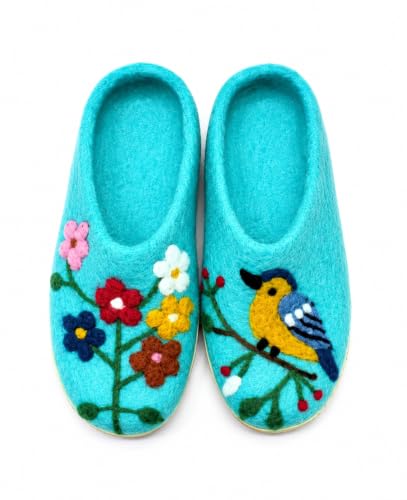
Nepalaya Himalayan Wool Felt Slippers, 100% Sheep Wool, Handmade — Best Handmade
The Nepalaya’s verified title states its credentials without embellishment: Himalayan wool felt slippers, 100% sheep wool, wet-felted by hand by artisans in Nepal, handmade and cozy. This is the pick for buyers whose sustainability interest includes the human supply chain — a slipper whose production is handwork by named-place artisans rather than a factory line, in a single natural material with nothing synthetic to separate at the end of its life.
Strengths
- 100% sheep wool stated in the verified title — a single natural material
- Wet-felted by hand by artisans in Nepal, per the title
- Handmade variation means each pair is subtly individual
Trade-offs
- Handmade sizing and finish vary slightly more than factory products
- Wet-felted wool needs spot care and patient air-drying
- Artisan production is priced as craft, not as fast fashion
| Detail | Verified from listing title |
|---|---|
| Material | 100% sheep wool (per listing title) |
| Method | Wet-felted by hand (per title) |
| Origin | Made by artisans in Nepal (per title) |
| Style | House slippers |
Wet felting by hand is the oldest slipper technology in this guide — wool, water, soap and friction, worked until the fibers lock into a seamless form around a last. There is no glue line to fail and no synthetic lining to separate, which is why a well-made hand-felted slipper can be resoled in spirit by simply continuing to be worn: it has almost no components to break. The sustainability case writes itself, and unusually for this category, it is the listing’s own title that writes it.
The honest trades are variation and care. Handmade pairs differ slightly from their photographs and from each other; sizing should be confirmed against the listing’s guidance with that variation in mind. And a single-material wool slipper asks for single-material care — spot cleaning, air drying, no machine drama. Buyers who accept those terms get the most coherent object in this guide: one material, one craft, years of wear.
Best for: buyers who value artisan making and single-material purity / Not suited for: buyers who want factory uniformity and machine care
Check the current price on Amazon

MeaningLab QuietWool Felt Slippers, Wool House Shoes — Best Minimalist Felt
The MeaningLab’s verified title describes QuietWool felt slippers — wool house shoes, comfortable slip-on indoor slippers for men and women, verified here in size L. The ‘quiet’ in the name is a real domestic feature: felt slippers are the silent footwear of early mornings, creaking floors and sleeping households, and the minimalist design suits modern interiors where a rustic wool clog would look out of place.
Strengths
- Wool felt construction in a clean, minimalist design
- Slip-on indoor format for men and women
- Felt soles and uppers make these the quietest pick in the guide
Trade-offs
- Size is given as L in the verified listing — check the listing’s size chart carefully
- Minimalist padding: comfort comes from wool and shape, not cushion
- Felt construction is indoor-only, like the other felt-soled picks
| Detail | Verified from listing title |
|---|---|
| Material | Wool felt (per listing title) |
| Style | Slip-on indoor slippers |
| Fit | Men and women (per title) |
| Listing verified | Size L |
Quiet is an underrated specification. In apartments with downstairs neighbors, in houses with sleeping children, in the 6 a.m. kitchen before anyone else is awake, the difference between a felt slipper and a hard-soled shoe is the difference between moving freely and moving apologetically. A minimalist felt slipper is the extreme of that virtue — almost no acoustic signature at all — and MeaningLab’s clean design language makes it the one pick here that belongs in a modern, uncluttered interior on looks as well as material.
The trade is cushion: felt slippers comfort through warmth, fit and silence rather than through padding, and a buyer coming from memory-foam slippers will notice the firmness for the first week. What they will also notice, by the second month, is that the felt pair looks and fits exactly as it did on day one, while the foam pair has begun its long slump. That durability, in a renewable material, is the sustainable choice stated in its plainest form.
Best for: apartments, early risers and minimalist interiors / Not suited for: buyers who judge slippers by plush cushion alone
Check the current price on Amazon
Comparison Table
| Pick | Badge | Key spec | Best for |
|---|---|---|---|
| Glerups Wool Slippers, Slip-On, Leather Sole, Grey | Best Overall | Wool upper, leather sole, slip-on | wood floors and buyers who want the reference wool slipper |
| Nootkas Felted Merino Wool ‘Newport’ House Shoes | Best Felted Merino, Unisex | Felted merino wool, unisex house shoe | buyers whose slippers always stretch out; three-season wear |
| Nootkas Women’s Felted Merino Wool ‘Victoria’ House Shoe, Bordeaux | Best Women’s Felted Design | Felted merino, women’s, bordeaux | women who want felted wool with genuine color and shaping |
| LE KAPMOZ Women’s Boiled Wool House Slippers, Clog Mule | Best Boiled Wool Clog | Boiled wool clog mule, felt sole | warm feet, busy home routines and color lovers |
| Nepalaya Himalayan Wool Felt Slippers, 100% Sheep Wool, Handmade | Best Handmade | 100% sheep wool, handmade in Nepal | buyers who value artisan making and single-material purity |
| MeaningLab QuietWool Felt Slippers, Wool House Shoes | Best Minimalist Felt | Wool felt, minimalist slip-on, quiet | apartments, early risers and minimalist interiors |
How to Choose Sustainable Slippers
Start with the material, and make the listing prove it. The credible sustainability claim in this category is a named natural fiber — wool, merino wool, felted wool — stated in the title, ideally with a proportion (‘100% sheep wool’ appears in one title here). Vague words like ‘eco’, ‘green’ or ‘natural feel’ without a fiber name are decoration, and this guide has excluded every product whose case rested on them. Where a title is silent about a sole’s material or a lining’s content, assume the conventional option and judge the product on what is actually stated.
Then choose the construction that matches your floors and habits, because a sustainable slipper you stop wearing is not sustainable. Leather soles for wood floors and durability; felt soles for quiet and apartment life; clog mules for on-off routines; closed felted shoes for shape retention. Wool’s temperature regulation makes all of them more versatile across seasons than synthetic equivalents, but grip is the one place to be conservative: on polished tile or steep stairs, favor the pick whose sole your home can trust, and walk deliberately in any smooth-soled slipper.
Finally, do the longevity arithmetic honestly. A wool slipper at a premium price, worn daily for three years, costs less per wear — and uses a fraction of the material — than three cheap pairs. Check the listing’s sizing with unusual care, since several picks use size ranges or European sizes, and a sustainable purchase that gets returned for a preventable sizing error has spent its footprint on freight. Measure your foot, read the chart, and order once.
- Demand a named fiber in the title; ‘eco’ without a material is marketing
- Match sole to floor: leather for wood, felt for quiet, and caution on polished tile
- Construction for your routine: mules for on-off days, closed shoes for shape retention
- Do the per-wear arithmetic — years of daily wear is the real eco metric
- Measure and use the size chart; several picks use ranges or EU sizing
Caring for Wool Slippers So They Last for Years
Wool’s care is simpler than its reputation. Most dirt on a felted or boiled-wool slipper can be brushed off dry, because wool’s surface resists soil penetration; spot-clean what remains with cool water and a mild soap, and never subject felted wool to a hot machine wash, which continues the felting process and shrinks the slipper around a shape you did not choose. Air-dry away from radiators and direct heat, stuffed lightly with paper if the shape needs encouragement, and let a damp pair rest a full day before wearing it again.
Odor — the thing buyers fear with a non-machine-washable natural product — is where wool quietly outperforms synthetics: its fibers manage moisture and resist the bacterial buildup that makes synthetic slippers smell within months. Airing slippers overnight outside the closet, and rotating two pairs if you wear them all day, keeps wool fresh for years without any chemistry. Resole-level thinking applies too: a wool slipper whose upper is sound is worth professional attention for a worn sole, in a way no foam slipper ever is. Buy once, maintain lightly, and the sustainability claim becomes a fact about your own behavior, not just the manufacturer’s.
What ‘Sustainable’ Can and Cannot Mean Here
This guide’s claims are deliberately narrow, and it is worth understanding why. A listing title can verify a material — wool, merino, 100% sheep wool, handmade in Nepal — and material plus durability is a real, checkable sustainability case: renewable fiber, biodegradable end of life, long service. A title cannot verify a brand’s whole supply chain, its dyes, its packaging or its labor practices beyond what it states, and this guide does not pretend otherwise. Where a pick’s title mentions artisan making, that is reported; where it does not, nothing is inferred.
That restraint is the reader’s protection in a category where green language is cheap. If full certification matters to you — a named scheme, audited and current — treat these six as a material-verified shortlist and check the listing and the maker’s own documentation for the scheme you care about, because none is claimed in the titles verified here. What can be promised from verification alone is already substantial: slippers made of the right fiber, built to be worn for years, that will not spend centuries in a landfill when they are finally done. For most buyers, that is the sustainability that counts.
How to Fit and Break In Wool Slippers
Wool and felt fit differently from synthetic plush — closer, firmer, and more personal over time. A short, deliberate fitting routine gets the size and the break-in right.
- Measure your foot in centimeters and use the listing’s own size chart — several picks use size ranges or European sizes, and guessing is the main cause of returns.
- Aim for a close fit at first wear: felted and boiled wool relax slightly and mold to the foot, so a slipper that starts loose will end sloppy.
- Wear the pair indoors for increasing periods over the first week; wool softens and shapes itself to your heel and arch in that window.
- Wear thin socks for the first days if the wool feels firm against bare skin; most wearers go barefoot comfortably once the fibers settle.
- Walk stairs deliberately in mules and smooth leather soles until the pairing of slipper and staircase is familiar.
- Air the pair overnight outside a closed closet, and rotate with a second pair if they will be worn all day, every day.
Judge the fit at the end of week one, not hour one: a wool slipper that felt firm on Monday and personal by Sunday is behaving exactly as its material promises. If it still pinches or slips after a week of indoor wear, that is a sizing fact — act on it within the return window rather than hoping felt will perform a miracle it never claimed.
Wool Grades and Felting Methods, Explained Simply
Not all wool in a listing title is the same material wearing one name, and the differences decide how a slipper feels in year two. Merino is the fine grade: its thin fibers bend easily against skin, which is why merino slippers can be worn barefoot without the prickle coarser wools cause. Standard sheep’s wool is sturdier and slightly firmer — the Nepalaya pick’s 100% sheep wool trades a little initial softness for a structure that shrugs off years. Boiled wool begins as a knitted fabric that is then shrunk dense, giving a smooth, almost tailored surface; wet-felted wool begins as loose fiber worked by hand into a seamless form, giving the most organic, molded fit. None is the ‘best’ wool — they are four answers to the same question, and this guide’s six picks let you choose among them with the method named in each title.
What unites them is what wool does not need: no foam midsole to crumble, no synthetic lining to separate, no plastic outsole as the default. A wool slipper is one of the few consumer products whose end of life is genuinely simple — the material returns to the soil — and whose middle of life is genuinely long. When a listing in this category cannot name its fiber, it is asking you to buy the story instead of the slipper, and the correct response is the one this guide’s method applied throughout: keep looking until the material is stated, because the makers of real wool slippers are always proud to state it.
The Rest of the Footprint: Dyes, Soles and Packaging Honesty
A mature sustainability judgment looks past the headline fiber to the supporting cast, while staying honest about what can be verified. Soles are the main event: leather, as on the Glerups pick, keeps the product in natural materials; felt soles, as on several picks here, keep it in wool entirely; a synthetic sole on an otherwise wool slipper is a compromise worth accepting knowingly for grip on the right floors, rather than discovering later. Dyes and packaging are the areas where listing titles are usually silent, and this guide’s rule applies — silence is reported as silence, not filled with either praise or suspicion.
The buyer’s own behavior completes the footprint in ways no manufacturer controls. Ordering the correct size once, instead of returning two guesses, saves more freight than most packaging choices save plastic. Wearing a pair for its full life instead of refreshing it seasonally is worth more than any single material decision in this guide. And passing a sound pair on, or composting a truly finished wool pair where facilities allow, closes a loop that fast-fashion slippers never open. Sustainability in this category is a partnership between a maker who builds to last and a wearer who lasts with it — the six picks here are the maker’s half, verified; the other half is pleasantly in your hands.
Sizing Wool Slippers Across Brands: A Field Guide
The practical obstacle in this category is not philosophy but fit, because wool slipper sizing conventions vary more than in any other footwear this program covers. One pick here is verified in a combined women’s/men’s range, one in a European size, one in a letter size, and the rest in conventional ranges that still do not agree with each other. The universal defense is the centimeter measurement: measure your foot standing, in the evening when it is at its largest, heel to longest toe, and shop by the listing’s centimeter column rather than by your usual shoe size. Brands that publish a centimeter chart are telling you they expect to be measured, and they are usually right.
When between sizes, let the construction arbitrate. Felted and boiled wool relax and mold, so the smaller of two close sizes usually becomes the personal fit within a fortnight. Leather-soled and structured models change less, so the larger size with a thin sock is the safer error. And keep the indoor trial honest — clean floors, a week of mornings, no outdoor steps — so that if the size is genuinely wrong, the exchange is clean and the returned pair can be sold to the foot it actually fits. In a category built on not wasting things, a careful first order is itself a sustainable act.
Common Buying Mistakes
Buying ‘eco’ language instead of a named fiber. If the title does not say wool, merino or another specific material, the sustainability case is unproven. Every pick in this guide names its fiber in its verified title.
Sizing wool slippers like plush slippers. Plush forgives a size up; felt molds to the foot it is given. A loose felt slipper stays loose. Measure, use the chart, and start close.
Machine-washing felted wool in hot water. Heat and agitation continue the felting process and shrink the slipper. Spot-clean cool, air-dry away from heat — wool’s odor resistance means it rarely needs more.
Expecting a certification no title claims. These picks are verified on material and construction. If you require a named certification scheme, verify it in the listing documentation rather than assuming any guide’s shortlist implies it.
Judging cost by the price tag instead of the years. A wool slipper’s economics and ecology both live in its lifespan. Compare cost per year of daily wear, and the premium pick usually becomes the frugal one.
Final Recommendation
Start with the Glerups if you want the category’s reference object — wool, leather sole, decades of design continuity. Choose the Nootkas Newport for felted merino’s shape-holding density, or the Victoria for the same technology in a women’s design with real color. The LE KAPMOZ boiled-wool clog is the breathable easy-on pick, the Nepalaya is the handmade, single-material choice for buyers who care how things are made, and the MeaningLab felt is the quiet minimalist for apartments and modern rooms.
Whichever pair you choose, size it by measurement, break it in over a week, and care for it with a brush and fresh air. A sustainable slipper is not bought; it is kept — and these six are built to be kept.
- Glerups Wool Slippers, Slip-On, Leather Sole, Grey — Check price on Amazon
- Nootkas Felted Merino Wool ‘Newport’ House Shoes — Check price on Amazon
- Nootkas Women’s Felted Merino Wool ‘Victoria’ House Shoe, Bordeaux — Check price on Amazon
- LE KAPMOZ Women’s Boiled Wool House Slippers, Clog Mule — Check price on Amazon
- Nepalaya Himalayan Wool Felt Slippers, 100% Sheep Wool, Handmade — Check price on Amazon
- MeaningLab QuietWool Felt Slippers, Wool House Shoes — Check price on Amazon
Best Supportive Women House Slippers Best Arch Support Womens Slippers Best Breathable Slippers Women Best Comfortable Warm Slippers Best American Made Slippers
It is fitting to end where the category begins: with the sheep. Wool is a fiber that regrows annually on an animal that is unharmed by its harvesting, in a cycle older than any industry now selling its alternatives. The slippers in this guide — felted, boiled, woven and handmade from that fiber — are modern products only in their distribution; in their material and making they are among the oldest footwear technologies humans possess, refined rather than replaced. Choosing them is not nostalgia. It is the recognition that some problems were solved well a long time ago, and that a warm, durable, repairable, compostable slipper is not a primitive draft of a better product to come — it is, on the evidence of centuries, the finished design.
Practical shoppers will ask how to choose between two worthy wool picks when the budget allows one, and the honest tiebreaker is your floor, not your philosophy. Leather soles belong on wood, felt soles belong in quiet apartments, clogs belong to busy on-off days, and closed felted shoes belong to anyone whose last slippers died by stretching. Every pick here shares the material virtue that defines the category, so the decision cannot go far wrong; it can only go more or less precisely right for the rooms you actually live in. Choose for your floors and your mornings, and the sustainability — being built into the fiber itself — will take care of itself.
Measure once, order once, wear for years — in this category, that is not just shopping advice. It is the entire philosophy, worn daily, one pair of feet at a time.
Frequently Asked Questions
What makes a slipper sustainable?
In verifiable terms: a renewable, biodegradable main material — wool in every pick here, as stated in the titles — combined with construction durable enough for years of daily wear. Longevity multiplies the material benefit, which is why this guide weighs build quality as an environmental feature.
Is wool warm in summer too?
Wool regulates rather than simply warming: it insulates in winter and breathes and manages moisture in summer, which is why felted and boiled-wool slippers are worn year-round in the cultures that invented them. The listing titles for several picks state temperature regulation explicitly.
How do I wash wool slippers?
Mostly, you do not: brush off dry dirt, spot-clean with cool water and mild soap, and air-dry away from heat. Hot machine washing shrinks felted wool. Wool’s natural odor resistance means this light routine keeps slippers fresh far longer than buyers expect.
Are these slippers certified organic or certified by any scheme?
No certification is claimed in the verified titles, so none is claimed here. The case for each pick rests on its stated material — wool, merino, 100% sheep wool, handmade construction. If you require a specific certification, check the listing and maker’s documentation for that scheme.
Why is there no recycled-plastic pick?
A prominent recycled-plastic clog found in search is a shoe, not a house slipper, and this guide’s category rules admit house slippers only. Within the eligible category, wool’s verified material case was stronger than any alternative the search returned.
How long should wool slippers last?
With daily wear and the light care described in this guide, felted and boiled-wool slippers are multi-year products — that lifespan is the core of their sustainability case. Replace them when the sole or structure genuinely wears out, not when fashion changes.


