Disclosure: airfryerkitchensupply.com is reader-supported. When you buy through links on our site, we may earn an affiliate commission at no extra cost to you.
Where to buy
The fastest way to compare the current listings for these picks is on Amazon, where each product page shows the live configuration, size and colour options for that model. Use the links below to check price on Amazon for the verified picks; any pick marked as a pick slot is described without a link until its listing is re-verified, so treat it as a specification to search for rather than a link to follow.
- ABEO Amble Slipper, Metatarsal (Tan) — Check the current price on Amazon
- Vionic Indulge Carlin Flannel Mule Slipper — Check the current price on Amazon
- Orthofeet Charlotte Slippers (Sapphire) — Check the current price on Amazon
- ERGOfoot Arch Support Slippers, Closed Toe — Check the current price on Amazon
- COFACE Memory Foam Slippers With Arch Support, Moccasin Style — Check the current price on Amazon
- KuaiLu Fuzzy Memory Foam Slipper, Arch Support (Chestnut) — Check the current price on Amazon
If you are looking for the best support metatarsal slippers, you are really looking for a house slipper that stops asking the ball of your foot to do all the work. The best support metatarsal slippers spread pressure across the whole foot — a contoured, arch-supporting footbed, real cushioning under the forefoot, and a sole with structure — instead of the flat, floppy sole of a novelty slipper that leaves your forefoot taking every step alone.
This guide stays firmly in comfort territory: slippers are footwear, not treatment, and nothing here claims to diagnose, fix or cure any foot condition. What we can do is read listings precisely. Every pick was confirmed against a live listing — one pick is a dedicated metatarsal-design slipper whose listing says so in its name, and the rest are house slippers whose listings state arch support and structured footbeds, which is the support profile that matters under the forefoot.
Key Takeaways
- Only one current listing in our verification is explicitly a metatarsal-design slipper — the ABEO Amble — and it leads this guide for that reason.
- For the other picks, the support that matters is a stated arch-support footbed plus forefoot cushioning, which spreads load instead of concentrating it at the ball of the foot.
- All six picks are genuine house slippers — mules, clogs and closed slippers. Slides, sandals and slipper socks were excluded, however supportive their marketing.
- A structured sole you cannot easily fold in half is the quickest in-hand test of a supportive slipper.
- Slippers are comfort footwear, not medical devices. Persistent foot pain belongs in a clinician’s office, not a shopping basket.
In this guide
Quick Picks
Best True Metatarsal Design: ABEO Amble Slipper, Metatarsal (Tan) — Check price on Amazon. The one verified listing that is explicitly a metatarsal slipper — a dedicated forefoot-support design from a comfort-footwear specialist.
Best Arch-Support Mule: Vionic Indulge Carlin Flannel Mule Slipper — Check price on Amazon. A flannel mule whose listing states a built-in orthotic-style insole with arch support and three-zone comfort cushioning.
Best for Wide, Sensitive Feet: Orthofeet Charlotte Slippers (Sapphire) — Check price on Amazon. A hands-free slip-on slipper whose listing states arch support, comfortable cushioning and a wide toe box.
Best Closed-Toe Support: ERGOfoot Arch Support Slippers, Closed Toe — Check price on Amazon. A breathable, closed-toe slip-on slipper whose listing states an arch-support footbed and a non-slip sole.
Best Warm Moccasin With Support: COFACE Memory Foam Slippers With Arch Support, Moccasin Style — Check price on Amazon. A fuzzy faux-fur collar moccasin whose listing states memory foam cushioning with arch support and a hard rubber sole.
Best Budget Support Slipper: KuaiLu Fuzzy Memory Foam Slipper, Arch Support (Chestnut) — Check price on Amazon. A faux-fur slip-on scuff whose listing states memory foam with arch support, at a budget tier.
How These Picks Were Chosen
The shortlist was built under this programme’s slippers rule: house slippers only — indoor slippers for home wear, in mule, clog, bootie and closed styles. Slides and sandals were excluded even when their listings emphasised support, because they are not slippers; slipper socks were excluded because they have no structured sole; and any listing whose main pitch was medical treatment language was set aside regardless of its sole. That left a small, honest field, which is the truth about this niche: genuine metatarsal-specific slippers are rare.
Duplicated variants of the same slipper in other colours or sizes were counted once. Within the field, we ranked by how directly the listing addresses forefoot support — the explicit metatarsal design first, then stated arch-support footbeds with closed, structured constructions, then cushioned memory-foam designs whose listings state arch support. Comfort judgements below are framed as pressure distribution and fit, never as therapy.
The 6 Best Support Metatarsal Slippers in Detail

ABEO Amble Slipper, Metatarsal (Tan) — Best True Metatarsal Design
This is the pick the keyword is literally asking for. The verified listing names the product plainly: the ABEO Amble Slipper in the Metatarsal version, from a brand whose business is comfort footwear built around footbed options. ABEO sells this slipper in different footbed configurations, and the Metatarsal configuration is the one designed with the ball of the foot in mind — which is why confirming the exact variant, as this listing does, matters more here than with any other pick in the guide.
Strengths
- Explicit metatarsal footbed version — not a generic slipper relabelled
- Specialist comfort-footwear brand
- A real slipper format for indoor wear, not a slide or sandal
Trade-offs
- Premium tier for a house slipper
- Size and width availability varies — check the live listing for your size
- Metatarsal configuration is one variant; confirm you are ordering that version
| Brand | ABEO |
| Model | Amble Slipper, Metatarsal version |
| Colour / size (listing) | Tan, 8 Medium |
| Format | House slipper |
Buy this slipper if the ball of your foot is precisely where flat slippers fail you. The logic of a metatarsal-oriented footbed is pressure redistribution: instead of the forefoot carrying the step on a flat surface, the shaped footbed supports the arch and the area just behind the ball of the foot, spreading the load across more of the foot’s structure. In a house slipper — worn for hours on hard kitchen and hallway floors — that shaping is the difference between a slipper you forget and a slipper you kick off by midday. Order carefully: select the Metatarsal version named in the listing, confirm your size and width on the live page, and give the footbed a week of indoor wear to judge, because contoured footbeds feel unfamiliar for the first few days even when they suit you.
Best for: shoppers who specifically want a metatarsal-design house slipper / Not suited for: buyers who want the cheapest warm slipper and do not need a shaped footbed
Check on Amazon — check the current price on Amazon before you decide, because sizes and configurations change.

Vionic Indulge Carlin Flannel Mule Slipper — Best Arch-Support Mule
Vionic built its name on supportive footwear, and the Indulge Carlin is its classic house mule. The verified listing describes a flannel mule slipper with a built-in insole designed around arch support and three-zone comfort — the brand’s phrase for cushioning and support distributed across heel, arch and forefoot. For metatarsal-minded shoppers, that forefoot zone is the point: a slipper that cushions and supports the whole footbed rather than padding only the heel. Note the listing language is the brand’s; the comfort framing in this review is ours, and it is about pressure spread, not treatment.
Strengths
- Whole-footbed support design including the forefoot zone
- Easy mule format for all-day house wear
- Established supportive-footwear brand with consistent sizing
Trade-offs
- Premium tier
- Mule format offers no heel retention for stairs at speed
- Flannel upper is a cool-weather, indoor material
| Brand | Vionic |
| Model | Indulge Carlin, flannel mule |
| Footbed (listing) | Built-in insole with arch support, three-zone comfort |
| Fit (listing) | Medium fit, sizes 5–12 |
The Carlin is the slipper for someone who has already discovered that unsupportive slippers are a false economy. Its contoured insole holds the arch up so the forefoot is not the only structure working, and the mule shape makes it the pair that lives by the bed and goes on without thought. Wear them on the hard floors where slippers matter — kitchens, bathrooms, hallways — rather than only on carpet, because hard floors are where footbed design earns its price. If you are between the ABEO and this pick: the ABEO is the explicit metatarsal variant; the Vionic is the all-round arch-support mule with the broader track record. Both are honest answers; they are answers to slightly different questions.
Best for: households wanting a proven arch-support mule for hard floors / Not suited for: buyers who need a heel strap or a fully closed heel
Check on Amazon — check the current price on Amazon before you decide, because sizes and configurations change.

Orthofeet Charlotte Slippers (Sapphire) — Best for Wide, Sensitive Feet
The Charlotte’s verified listing emphasises the features that matter to feet that dislike being squeezed: arch support, comfortable cushioning, a wide toe box, an adjustable fit and a hands-free slip-on design, in a faux fur supportive house shoe. The wide toe box is directly relevant to forefoot comfort — toes that can spread naturally load the ball of the foot more evenly than toes pinched together — and the adjustable closure lets you set the fit for morning feet and evening feet, which are not the same size.
Strengths
- Wide toe box lets the forefoot spread naturally
- Adjustable fit adapts through the day
- Hands-free entry suits anyone who should not bend and tug
Trade-offs
- Premium tier
- Supportive-shoe styling rather than dainty slipper looks
- Brand sizing should be checked against the live listing’s guidance
| Brand | Orthofeet |
| Model | Charlotte |
| Fit (listing) | Adjustable, wide toe box, hands-free slip-on |
| Footbed (listing) | Arch support, cushioning |
Choose the Charlotte when fit is the battle: feet that swell, feet that need room, feet that hate seams and narrow toe boxes. The combination of a wide forefoot area and a structured, cushioned footbed is exactly the comfort recipe this search is hunting for, delivered in a slipper you can step into without sitting down. The brand’s name and some of its wider marketing use medical vocabulary; this guide’s claim is narrower and sufficient — this is a roomy, supportive, adjustable house slipper that many sensitive feet find kind. Persistent or worsening foot pain still belongs with a clinician, who can also tell you whether a slipper like this suits your specific feet.
Best for: wide or swelling-prone feet that need room plus support / Not suited for: buyers who want a slim, fashion-first slipper silhouette
Check on Amazon — check the current price on Amazon before you decide, because sizes and configurations change.

ERGOfoot Arch Support Slippers, Closed Toe — Best Closed-Toe Support
ERGOfoot’s slipper is the closed-toe answer in a list of mules. The verified listing describes a slip-on house shoe with an arch-support footbed, breathable upper, closed toe and non-slip sole, sized across women’s and men’s fittings. The closed toe matters for forefoot comfort in a specific way: the foot cannot slide forward and jam the toes and ball of the foot against the front of the slipper, which is how open mules quietly undo their own support on slopes, stairs and quick movements.
Strengths
- Closed toe keeps the foot positioned on the footbed
- Breathable upper suits warmer houses
- Non-slip sole for kitchen and bathroom floors
Trade-offs
- Brand’s listing language leans medical — judge the slipper, not the adjectives
- Closed toe runs warmer than a mule
- Less plush-cosy than the fuzzy picks
| Brand | ERGOfoot |
| Format | Closed-toe slip-on |
| Footbed (listing) | Arch support |
| Sole (listing) | Non-slip |
If your slippers live on stairs and hard floors and you move around the house all day — cooking, laundry, workshop trips — the ERGOfoot is the workhorse pick. The foot stays where the footbed expects it, the sole grips, and the arch support is positioned under the foot that is actually standing on it. It is the least decorative slipper here and arguably the most practical. As with the whole guide, the claim is comfort mechanics: a positioned foot on a supportive footbed distributes pressure better than a foot sliding around in a loose mule, and your forefoot feels that difference by the end of a day on your feet at home.
Best for: active households wanting support that stays in place / Not suited for: buyers whose priority is plush, fuzzy cosiness
Check on Amazon — check the current price on Amazon before you decide, because sizes and configurations change.

COFACE Memory Foam Slippers With Arch Support, Moccasin Style — Best Warm Moccasin With Support
Most warm moccasin slippers are cushioning without structure — lovely for an hour, tiring for a day. This COFACE moccasin’s verified listing states the combination this guide is hunting: memory foam cushioning with an arch-support insole, a warm fuzzy faux fur collar, and a hard rubber sole that works indoors and for brief outdoor trips. The memory foam gives the forefoot a cushioned landing while the stated arch support keeps the midfoot contributing, instead of the ball of the foot absorbing everything on a flat foam slab.
Strengths
- Warmth of a moccasin with a stated support insole
- Hard sole handles doorstep and patio trips
- Memory foam cushions the forefoot landing
Trade-offs
- Memory foam alone softens over time — the support insole is the key feature
- Warm collar is a winter-weight choice
- Moccasin fit is roomier than a mule’s
| Brand | COFACE |
| Style | Moccasin, fuzzy faux fur collar |
| Footbed (listing) | Memory foam with arch support |
| Sole (listing) | Hard rubber sole |
Buy the COFACE for cold houses and cold floors, where the supportive picks in lighter fabrics feel like a compromise every morning. It is the pair for making tea on a stone kitchen floor in January: warm on top, cushioned underneath, structured enough that your feet are not tired before the kettle boils. The honest caveat is foam physics — pure memory foam gradually takes a set — so judge this slipper on its combined design, foam plus stated arch support, and expect to replace it sooner than the premium structured picks if you wear it all day, every day. At its tier, that is a fair and transparent trade.
Best for: cold-floor households wanting warmth with support / Not suited for: warm houses, or buyers wanting a footbed that lasts for years
Check on Amazon — check the current price on Amazon before you decide, because sizes and configurations change.
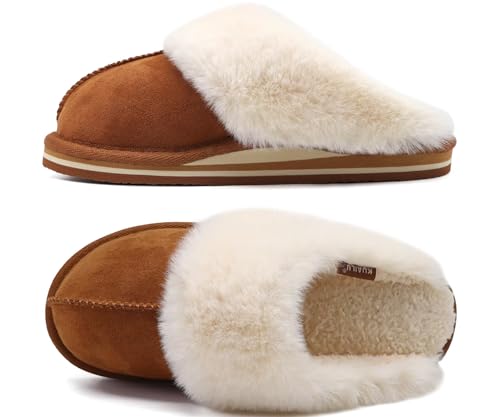
KuaiLu Fuzzy Memory Foam Slipper, Arch Support (Chestnut) — Best Budget Support Slipper
The KuaiLu closes the list as the accessible entry point. The verified listing describes a fuzzy memory foam house slipper for women with arch support, in a slip-on faux fur scuff style in chestnut. It is the lightest-duty support design here — a cushioned scuff with a stated arch-support element rather than a fully contoured footbed — and the review says so plainly, because a budget pick described honestly is worth more than a budget pick dressed as a premium one.
Strengths
- Lowest-commitment way to try a supportive slipper
- Cosy faux fur upper for winter wear
- Slip-on scuff is effortless by the bed or door
Trade-offs
- Lightest structure of the six picks
- Scuff format has no heel retention
- Foam-based support will soften with heavy daily use
| Brand | KuaiLu |
| Style | Slip-on scuff, faux fur |
| Footbed (listing) | Memory foam, arch support |
| Tier | Budget |
Think of the KuaiLu as the trial pair: if you have never worn a slipper with any arch support and want to know whether your feet prefer it before spending on the ABEO or Vionic, this is the inexpensive experiment. Wear it for the evening hours on hard floors and compare how your forefeet feel against your old flat slippers. If the answer is clearly better, the premium picks are your upgrade path with confidence; if you notice no difference, you have learned that cheaply too. Either way, it is a genuine house slipper with a stated support element — which already puts it ahead of the novelty slippers this guide excluded.
Best for: first-time buyers of supportive slippers on a budget / Not suited for: all-day wearers who need a fully contoured footbed
Check on Amazon — check the current price on Amazon before you decide, because sizes and configurations change.
Comparison Table
| Pick | Badge | Key spec | Best for |
|---|---|---|---|
| ABEO Amble Slipper, Metatarsal (Tan) | Best True Metatarsal Design | ABEO | shoppers who specifically want a metatarsal-design house slipper |
| Vionic Indulge Carlin Flannel Mule Slipper | Best Arch-Support Mule | Vionic | households wanting a proven arch-support mule for hard floors |
| Orthofeet Charlotte Slippers (Sapphire) | Best for Wide, Sensitive Feet | Orthofeet | wide or swelling-prone feet that need room plus support |
| ERGOfoot Arch Support Slippers, Closed Toe | Best Closed-Toe Support | ERGOfoot | active households wanting support that stays in place |
| COFACE Memory Foam Slippers With Arch Support, Moccasin Style | Best Warm Moccasin With Support | COFACE | cold-floor households wanting warmth with support |
| KuaiLu Fuzzy Memory Foam Slipper, Arch Support (Chestnut) | Best Budget Support Slipper | KuaiLu | first-time buyers of supportive slippers on a budget |
How to Choose the Best Support Metatarsal Slippers Without Believing the Hype
Start by separating three kinds of listing language. Strongest is a named footbed design — the ABEO’s Metatarsal version states exactly which configuration you are buying, and that specificity is information. Next is a stated construction: “arch support” in the listing, ideally with a footbed you can see is contoured rather than flat, as on the Vionic, ERGOfoot, COFACE and KuaiLu picks. Weakest is pure comfort adjectives — cloud, therapy, miracle — with no construction stated at all; slippers sold that way were excluded from this guide, and you should exclude them from your basket too.
Then fit the format to your house. Mules are effortless but let the foot travel; closed-toe and adjustable designs hold the foot on the footbed, which is where support actually happens. Match the sole to your floors: structured, non-slip soles for hard, wet-adjacent floors; softer soles only for carpeted bedrooms. And hold the medical line yourself as a buyer: a slipper can distribute pressure and feel kind, and that is a complete and sufficient promise. Any listing that promises to treat a named condition is telling you it is marketing, not footwear.
Why Flat Slippers Tire the Ball of Your Foot
Stand barefoot on a hard floor and notice where the work happens: the heel and the ball of the foot carry you, linked by an arch that is meant to act as a spring. A flat, floppy slipper removes the spring’s support and adds a thin layer of nothing — so the ball of the foot, the metatarsal area, absorbs step after step on the hardest surfaces in your home, for more hours a day than your outdoor shoes ever see. That is why people whose feet are fine in structured shoes all day can find their forefeet aching by evening in “comfortable” novelty slippers.
A supportive slipper changes the arithmetic in two ways. The contoured footbed props the arch so the midfoot shares the load, and cushioning under the forefoot softens the landing on tile, wood and stone. Neither effect is medicine; both are ordinary footwear engineering, and together they explain why the six picks here — each with support stated in its verified listing — feel different from the flat slippers they replace. If one sentence survives this guide, it should be that one: at home, on hard floors, structure beats softness alone.
Sizing and Fit: The Support Only Works Where Your Foot Actually Is
A contoured footbed is a map, and it only helps if your foot is standing on the right part of the map. The arch support must sit under your arch — not under the heel, not under the ball — which means length accuracy matters more in these slippers than in flat ones. Buy your true size, check the brand’s stated sizing on the live listing, and if you are between sizes in a contoured design, follow the brand’s guidance rather than habit, because a half-size of drift moves every contour out of position.
Width matters just as much at the forefoot. Toes that can spread load the ball of the foot more evenly, which is why the wide-toe-box Charlotte earns its place here. Wear new supportive slippers for short indoor periods at first — an hour the first evening, building over a week — because feet accustomed to flat slippers need time to adjust to being supported, and a footbed judged in the first ten minutes is a footbed judged unfairly. Judge at the end of week one, on your hardest floor, at the end of the day.
Caring for Supportive Slippers So the Support Lasts
Footbeds die by compression and moisture. Rotate two pairs if you wear slippers all day — foam and cushioning recover between wears, and a rotated pair lasts far more than twice as long as a single pair worn continuously. Air slippers out after wear rather than leaving them in a damp bathroom, and keep contoured insoles away from radiators and hot tumble cycles, which can warp the shaping you paid for.
Follow the listing’s care guidance for uppers — flannel, faux fur and cotton all wash differently — and inspect soles monthly: a sole worn smooth has lost its grip long before it loses its looks. Replace supportive slippers on evidence: when the footbed feels flat where it used to feel shaped, when the arch support has become a rumour, or when the forefoot cushioning no longer recovers overnight. That is the moment the slipper has stopped doing the job this guide chose it for, whatever its upper still looks like.
How to Break In and Test Supportive Slippers at Home
Step 1: Check the fit standing still. Stand in the slippers on a hard floor. Your heel should sit in the heel cup, the arch support should contact your arch, and your toes should not touch the front.
Step 2: Walk the hardest route in the house. Kitchen, hallway, bathroom — the hard floors. The foot should stay positioned on the footbed, not slide forward or sideways.
Step 3: Wear for one hour the first evening. Contoured footbeds feel unfamiliar at first. Short first sessions let your feet adapt without soreness confusing the verdict.
Step 4: Build up over a week. Add time daily. By the end of the week, wear them for your longest at-home stretch — cooking a full meal is a good test.
Step 5: Compare forefeet at day’s end. The honest comparison is against your old flat slippers at the same hour, on the same floor. Less forefoot tiredness is the result you bought.
Step 6: Adjust or exchange promptly. If the arch lands in the wrong place or the toes jam, the size is wrong — exchange while the return window is open rather than hoping the slipper will change shape.
Step 7: Rotate and air. Once they are keepers, rest them between wears and air them out. Support that is rested lasts; support that is never rested compresses.
Common Buying Mistakes
Buying slides or sandals for a slippers brief. Supportive slides exist, but they are not house slippers — this guide excluded them deliberately, and your feet in winter will agree.
Believing medical promises. A slipper that claims to cure a condition is marketing. Buy stated construction — footbed design, arch support, cushioning — and take medical questions to a clinician.
Choosing pure memory foam and calling it support. Foam alone is cushioning; it bottoms out. Support comes from contour and structure, ideally with foam as the comfort layer, as the better picks combine them.
Guessing the size. A contoured footbed in the wrong size puts the arch support under the wrong part of the foot. Measure, read the brand’s sizing, exchange if the map does not match.
Judging in ten minutes. Supportive footbeds feel strange to feet raised on flat slippers. The verdict belongs at the end of a week of graduated wear.
Wearing one pair into the ground. Unrotated cushioning compresses and stays compressed. Two pairs in rotation outlast the maths.
Final Recommendation
If you want the slipper this search literally describes, buy the ABEO Amble in its Metatarsal version and confirm that variant at checkout. For a proven all-round arch-support mule, the Vionic Carlin; for wide, sensitive feet, the Orthofeet Charlotte; for active days on hard floors, the closed-toe ERGOfoot; for cold houses, the COFACE moccasin; and for a first, inexpensive trial of support, the KuaiLu.
More supportive-house-shoe reading from the allocation list: Best Arch Support Slippers Mens, Best Arch Support Womens Slippers, Best Arch Support Indoor Slippers, Best Allday Comfort Slippers and Best Affordable House Slippers For Women.
Hard Floors Are the Real Reason This Category Exists
It is worth pausing on where supportive slippers actually work, because it explains both their value and their limits. Modern homes are floored in tile, stone, laminate and wood — beautiful, durable, and essentially concrete from a foot’s point of view. A person cooking dinner, doing laundry and answering the door can log thousands of steps a day on those surfaces without leaving the house, often in the flattest footwear they own. Outdoor shoes evolved structure because streets are hard; indoor footwear mostly did not, because carpets used to forgive everything. As carpets retreat, the forefoot pays the difference — which is precisely the gap the six verified picks in this guide were chosen to fill.
This also tells you how to prioritise within the list. The more of your home is hard-floored, and the more of your day is spent standing in the kitchen rather than sitting on a sofa, the more the structured end of the list — ABEO, Vionic, ERGOfoot — justifies itself. A mostly carpeted flat with an evening-only slipper habit can honestly be served by the cushioned end. Match the slipper to the floor and the hours, not to the photograph, and the category suddenly makes complete sense.
What We Excluded, and Why It Matters That We Tell You
Transparency about exclusions is part of this guide’s method, so here is the list. Recovery slides and orthotic sandals with excellent support claims were excluded because they are not slippers — they are open footwear, and a buyer searching for slippers wants an enclosed, warm house shoe. Slipper socks with grip soles were excluded because a sock has no footbed, however it is marketed. Ballet-style and novelty slippers were excluded as flat by design. And a large group of listings whose titles lead with medical treatment language was set aside even when the underlying product might have been adequate, because a guide that repeats comfort claims carefully should not reward listings that do not.
The consequence is a shorter, more honest field than a typical roundup — six picks, each of which is a real house slipper with support stated in its verified listing. If you shop beyond this guide, applying the same exclusions will protect you better than any single recommendation: house slipper first, stated construction second, adjectives last.
Gifting Supportive Slippers Without Guessing Wrong
Supportive slippers are a genuinely thoughtful gift for anyone who works from home, cooks standing up, or has mentioned tired feet — and a genuinely easy gift to get wrong. Size is the first trap: a contoured footbed in the wrong size is worse than a flat slipper in the right one, so buy the recipient’s true shoe size, keep the return route open, and do not size up “for comfort” — extra length moves the arch support out from under the arch. Style is the second trap: the person who lives in mules will not adopt a closed bootie, however supportive, so match the format they already wear and upgrade the footbed inside it.
The safest gift in this list for an unknown foot is the adjustable Charlotte, whose closure forgives sizing uncertainty, or the Vionic mule for a known size. Include the break-in advice from this guide’s how-to section in the card — an hour the first evening, a verdict at the end of the week — because the commonest fate of gifted supportive slippers is a ten-minute trial, a verdict of “weird”, and a cupboard. Given a fair week, most recipients quietly become converts, and the giver gets credited every evening thereafter.
Supportive Slippers for Standing Jobs at Home: Cooks, Carers and Workshop Hours
Some of the hardest standing in a life happens at home: the parent cooking for an hour on a tiled kitchen floor, the carer on their feet in someone else’s house, the hobbyist at a workbench in a concrete-floored garage. These are the hours flat slippers handle worst and the hours the structured picks in this guide were chosen for. If that is your pattern, weight your choice toward the closed, positioned designs — the ERGOfoot for staying in place, the ABEO for the explicit metatarsal footbed, the Charlotte if your feet also need room — and treat the slipper as part of the workstation, kept where the standing happens rather than by the bed.
Two practical additions multiply the benefit. A washable anti-fatigue mat at the sink or bench works with the slipper rather than instead of it, softening the floor while the footbed supports the foot. And a firm rule about outdoor shoes staying at the door protects both the floors and the slippers’ soles, because grit embedded in a sole turns a supportive slipper into a floor-scratching one. None of this is medical advice; it is the ergonomics of a home that asks a lot of the feet inside it, answered with the most honest tools this category offers.
How the Six Picks Feel Different on the Same Evening
Imagine the same ordinary evening — an hour of cooking, a hallway of laundry, a bathroom of tiles — walked in each pair. The ABEO feels deliberate: the shaped footbed is present from the first step, and the forefoot notices the support behind the ball of the foot most on the kitchen tiles. The Vionic feels like the all-rounder, a mule whose contour disappears into competence until you realise the evening ended without the usual forefoot tiredness. The Charlotte feels roomy and forgiving, the pair swollen evening feet vote for. The ERGOfoot feels like equipment — positioned, grippy, unglamorous, and the one still feeling right at the end of a busy day. The COFACE feels like winter itself, warm and cushioned, its support working quietly under the cosiness. The KuaiLu feels like the friendly introduction, softer and simpler, the pair that teaches you whether your feet like support at all. None of those evenings is a medical outcome; all of them are the actual product being bought, which is why this guide describes feel and fit rather than promising results no slipper can promise.
A Note on Floors You Rent and Feet You Cannot Replace
There is a hierarchy of replaceability in a home: rugs can be re-bought, slippers can be upgraded, floors can be refinished at a price — and feet are issued once. That is the quiet argument for taking indoor footwear seriously even though it looks like the least serious category in the house. A supportive slipper is not a luxury purchase or a medical one; it is routine maintenance for the two structures that carry every other activity in your life, worn during the hours when they work on the hardest surfaces you own. Choose it by construction, fit it by measurement, break it in patiently, rotate it kindly, and replace it when the support — not the appearance — gives out. Do those ordinary things well and the humble house slipper becomes what the best ones in this guide already are: the hardest-working footwear you own.
Start with the footbed, confirm the variant, and give it a week: those three steps, applied to any pick above, will land you in a better slipper than the one currently flattening itself under your forefoot — and your evening feet, on your hardest floor, will deliver the verdict that actually counts.
One Last Distinction: Slippers for Rest vs Slippers for Miles Indoors
Not every hour in slippers is the same hour. Rest hours — reading, television, a slow morning — ask for warmth, softness and easy on-and-off, and the cushioned mules here serve them beautifully. Working hours indoors — cooking, cleaning, caring, making — ask for position, grip and a footbed that shares the load, and they are the hours that decide whether your feet end the day tired. Most households need one pair that leans toward work and, ideally, the rotation partner that leans toward rest. If you can only buy one pair from this guide, buy for your working hours: a supportive slipper rests perfectly well, but a rest slipper works badly, and it is the working hours that your forefoot will remember.
Choose for the hours your feet work hardest, in the size your feet actually are, and the rest of the day takes care of itself.
That principle — honest construction, honest fit, honest claims — selected every slipper in this guide.
Your floors are waiting.
Walk kindly.
Frequently Asked Questions
What makes a slipper a “metatarsal” slipper?
A footbed designed with the ball of the foot in mind — supporting the arch and the area just behind the forefoot so pressure spreads across the foot instead of concentrating at the ball. In the current catalogue, the ABEO Amble’s Metatarsal version is the explicit example; the other picks here use stated arch-support footbeds with forefoot cushioning to pursue the same pressure-spreading goal.
Can slippers help with foot pain?
Slippers are comfort footwear. A supportive, cushioned slipper can feel much kinder than a flat one on hard floors, and many people notice their feet feel less tired. That is not a medical claim: persistent, worsening or unexplained foot pain should be assessed by a clinician, who can advise on your specific feet.
Are memory foam slippers supportive?
Memory foam is cushioning, not structure — on its own it compresses flat under load. The picks here that use memory foam pair it with a stated arch-support element. Judge any slipper by its footbed design, not by the softness of the first step.
Should supportive slippers feel strange at first?
A contoured footbed commonly feels unfamiliar for the first few sessions, especially if you are used to flat slippers. Break them in over a week with gradually longer wear. Strange is fine; painful is a fit problem — recheck the size.
How long do supportive slippers last?
It depends on hours worn and whether you rotate pairs. Judge by the footbed: when the contour feels flat and the forefoot cushioning no longer recovers between wears, the support has finished, even if the upper looks fine. Rotation roughly doubles useful life.
Can I wear these slippers outside?
Brief trips — doorstep, patio, mailbox — are fine for the picks with structured rubber soles, like the COFACE and ERGOfoot. They are house slippers, though: sustained outdoor wear will destroy the footbed and the grip that make them worth owning.


