Disclosure: airfryerkitchensupply.com is reader-supported. When you buy through links on our site, we may earn an affiliate commission at no extra cost to you.
Where to Buy
Every linked pick below was matched against a live Amazon listing before it earned a link. Prices move constantly, so this page never prints a fixed price — use the Amazon links to see the current figure for the exact size, colour and configuration you want.
- AIDEA Black Microfiber Cleaning Cloth, 12-Pack (Best Overall) — check price on Amazon
- AIDEA Microfiber Cleaning Cloth, 50-Pack Multicolor (Best Bulk Buy) — check price on Amazon
- MIRACLEAN Waffle Weave Microfiber Towel, 6-Pack (Best for Glass and Baristas) — check price on Amazon
- USANOOKS Microfiber Cleaning Cloth Grey, 12-Pack (Best Budget — Honest Near-Size) — check price on Amazon
- TEAWOO Microfiber Cleaning Cloths, 50-Pack, 5 Colors (Best Colour-Coded System) — check price on Amazon
- Udderly Clean Ultra-Cut Microfiber Towels, 25-Pack (Best Heavy-Duty) — check price on Amazon
Key Takeaways
- For the best microfiber towels 12×12, the size is the filter: true 12×12 cloths are hand-sized squares for counters, glass and dashboards — most listings that miss the size are 16-inch cloths in disguise.
- Pack count drives value more than any weave claim: the verified range here runs from 6 waffle-weave cloths to 50-packs for colour-coded systems.
- Waffle weave is the glass and barista specialist; flat plush weave is the generalist for dusting, counters and cars.
- Colour-coded packs stop cross-use — the same cloth should never move from a bathroom to a kitchen counter.
- One verified pick here is honestly 12.5 inches square, not 12: it is labelled as such below rather than rounded down.
Shopping for the best microfiber towels 12×12 sounds like the simplest purchase on the internet, and it is — right up until the parcels arrive and half the cloths are 16 inches long. The 12×12 format is a specific tool: a hand-sized square that folds into a pad for glass, sits flat under an espresso portafilter, wipes a dashboard without trailing corners, and stacks in a kitchen drawer without swallowing it. This guide only admits cloths whose verified listing actually states the 12×12 size — or, in one clearly flagged case, 12.5 inches — because a size in the search deserves a size in the parcel.
Every pick below was matched to a live Amazon listing, five of them fresh for this batch and one reused from an earlier verified cache entry. The six split into the roles this size is actually bought for: a small black everyday pack, a 50-count multicolour workhorse, a waffle-weave glass specialist, a near-size budget dozen, a 50-count colour-coded system, and a silver-embedded heavy-duty pack originally built for lab and dairy work that turns out to be the most serious cloth on the page.
What this guide will not do is print prices or star ratings — both move too fast to be honest in a static page. Use the Amazon links to check the current figure for each pack, and use the comparison table and buying guide below to decide which weave, count and colour system fits the jobs you actually clean.
In this guide
Quick Picks
AIDEA Black Microfiber Cleaning Cloth, 12-Pack — Best Overall. a true-size dozen in black that hides grime between washes and covers the everyday counter, glass and car jobs without drama. — check price on Amazon
AIDEA Microfiber Cleaning Cloth, 50-Pack Multicolor — Best Bulk Buy. fifty true-size cloths in multiple colours for households, cleaners and valeters who treat microfiber as a consumable system, not a treasured possession. — check price on Amazon
MIRACLEAN Waffle Weave Microfiber Towel, 6-Pack — Best for Glass and Baristas. a waffle-weave six-pack built for glass, mirrors and espresso machines, where the textured weave leaves a drier, cleaner finish than flat plush. — check price on Amazon
USANOOKS Microfiber Cleaning Cloth Grey, 12-Pack — Best Budget — Honest Near-Size. a keenly priced grey dozen that is honestly 12.5 inches square — half an inch over the keyword size, disclosed here rather than rounded away. — check price on Amazon
TEAWOO Microfiber Cleaning Cloths, 50-Pack, 5 Colors — Best Colour-Coded System. fifty true-size cloths in five assorted colours — the ready-made answer for households that want a colour per zone without building the system themselves. — check price on Amazon
Udderly Clean Ultra-Cut Microfiber Towels, 25-Pack — Best Heavy-Duty. a 25-pack of 12×12 cloths built for lab and dairy work, silver-embedded per its listing — the heavy-duty outlier for buyers who kill ordinary cloths. — check price on Amazon
How These Picks Were Chosen
The method started with the size, not the brand. Candidate listings were searched and any cloth whose verified title did not state 12×12 inches — or a plainly disclosed near-size — was cut, however good its reviews looked. That single rule removed most of the category, because the majority of microfiber packs are 12×16 or 16×16 inches.
Survivors were then sorted by role rather than ranked in a single line: pack count, weave type, colour system and intended surface all matter more at this size than any headline absorbency claim. Duplicate listings and size-or-colour variants of the same product were deduplicated, so each pick below is a genuinely different cloth system. Spec boxes only repeat what the verified listing states — size, count and weave — and anything the listing does not state is left unstated.
The 6 Best Microfiber Towels 12×12
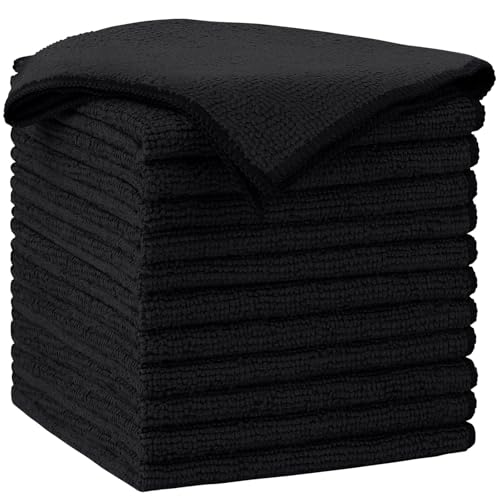
AIDEA Black Microfiber Cleaning Cloth, 12-Pack — Best Overall
The AIDEA 12-pack is the cloth most households actually need: a dozen true 12×12 squares in black, verified in the listing as microfiber towels for cars that double as kitchen towels, dusting cloths and dish rags. Black is a deliberate choice at this size — a 12-inch cloth lives a hard life of coffee rings, hob splashes and dashboard dust, and a dark cloth still looks presentable hanging by the sink long after a white one looks tired.
Strengths
- True 12×12 size stated in the verified listing
- Black colour hides staining between washes
- Dozen count suits a wash-rotation system
Trade-offs
- Single colour — no colour-coding between rooms
- Listing does not state a GSM weight
- Absorbency claims are listing language, not measured here
| Size | 12in x 12in (as listed) |
| Pack count | 12 cloths |
| Colour | Black |
| Listing-stated uses | Cars, kitchen, dusting, dishes |
In use, a 12-inch square folds twice into a palm-sized pad with eight clean faces, which is exactly the rhythm glass and counter work wants: wipe, refold, wipe again, and only then reach for a fresh cloth. Twelve cloths support the rotation that keeps microfiber honest — a few in use, a few in the wash, a few clean in the drawer — and the pack is sized so that losing one to a garage job does not break the system. It is not the cheapest cloth per piece on this page, nor the most specialised; it is the balanced default the other five picks are measured against.
See the exact configuration and check the current price on Amazon before you decide.
Best for: most households wanting one true-size pack for kitchen, glass and car / Not suited for: anyone who colour-codes cloths by room

AIDEA Microfiber Cleaning Cloth, 50-Pack Multicolor — Best Bulk Buy
Where the dozen above is a rotation, this 50-pack is a supply chain. The verified listing states 50 cloths at 12×12 inches in assorted colours, pitched at house, kitchen, window and car work. Bulk packs change behaviour in a good way: nobody hoards a cloth for one more wipe when forty-nine spares exist, and dirty cloths go straight into the wash basket instead of being rinsed and reused past their best.
Strengths
- Fifty cloths make colour-coding and rotation effortless
- True 12×12 size across the whole pack
- Multicolour assortment supports room-by-room systems
Trade-offs
- Storage — fifty cloths need a drawer or box of their own
- Per-cloth plushness is workhorse grade, not premium
- Colours are assorted by the maker, not chosen by you
| Size | 12in x 12in (as listed) |
| Pack count | 50 cloths |
| Colour | Multicolour |
| Listing-stated uses | House, kitchen, window, cars |
The honest way to judge a bulk pack is cost per working week, not cost per cloth: a 50-pack that lasts a busy household a year of heavy rotation beats a premium dozen that gets nursed, stained and demoted within months. The multicolour assortment is the quiet feature — assign colours to bathroom, kitchen, glass and garage on day one and the system polices itself. If your cleaning is light, this is overbuying and the 12-pack above is the smarter spend; if you clean for a living, run a rental, or simply hate laundry-day shortages, this is the pick.
See the exact configuration and check the current price on Amazon before you decide.
Best for: heavy users, cleaners and anyone building a colour-coded cloth system / Not suited for: light-use flats where a dozen cloths already last forever

MIRACLEAN Waffle Weave Microfiber Towel, 6-Pack — Best for Glass and Baristas
Waffle weave is the specialist texture in microfiber: the recessed grid gives water somewhere to go and gives the cloth a light scrubbing edge, which is why baristas reach for it around steam wands and why it suits glass better than a flat plush cloth. The MIRACLEAN pack is verified at exactly 12 x 12 inches in a 6-pack, and its listing names barista towels, glass towels and car detailing as its home turf.
Strengths
- Waffle weave excels on glass and polished surfaces
- True 12 x 12 size, ideal under espresso machines
- Six-pack count matches a cafe-style daily rotation
Trade-offs
- Waffle texture is less plush for dusting delicate items
- Six cloths is a small fleet for whole-house use
- Specialist weave — not the best all-rounder here
| Size | 12 x 12 inches (as listed) |
| Pack count | 6 cloths |
| Weave | Waffle weave |
| Listing-stated uses | Barista work, glass, car detailing |
The use case that sells this pack is the morning coffee routine: a 12-inch waffle cloth lives under the portafilter, catches the purge, wipes the wand, and polishes the drip tray without shedding the lint that terry-style cloths leave on chrome. The same texture that grips a steam wand also pulls water off a shower screen in fewer passes. Keep these six for glass, chrome and the coffee corner, and let cheaper flat cloths take the floor spills — specialisation is the whole point of a six-pack at this quality end of the size class.
See the exact configuration and check the current price on Amazon before you decide.
Best for: espresso owners, glass-heavy bathrooms and detailing fans / Not suited for: anyone wanting one cloth type for every job in the house
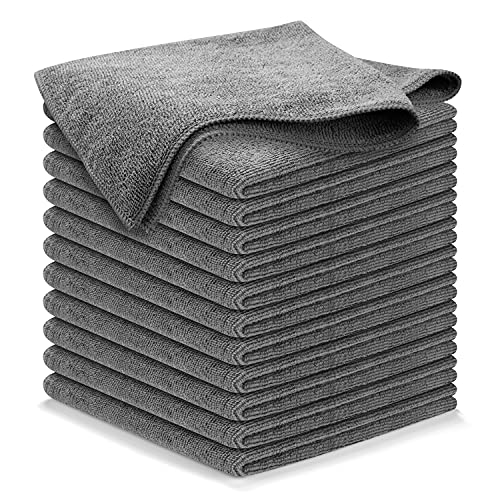
USANOOKS Microfiber Cleaning Cloth Grey, 12-Pack — Best Budget — Honest Near-Size
Honesty first: this is not a true 12×12 cloth. The verified USANOOKS listing states 12.5 x 12.5 inches, and it is included — clearly labelled — because it is one of the best-value dozens in the class and half an inch rarely changes how a cloth folds or wipes. If your drawer, caddy or machine tray is sized exactly for 12-inch cloths, treat that half inch as a real difference and choose a true-size pick instead.
Strengths
- Strong value for a 12-cloth pack
- Grey colour suits car and garage work
- Listing emphasises streak-free mirror and glass work
Trade-offs
- 12.5 inches, not the exact 12×12 of the keyword
- Listing wash-life claims are maker language, unverified here
- Single colourway limits colour-coding
| Size | 12.5in x 12.5in (as listed — not a true 12×12) |
| Pack count | 12 cloths |
| Colour | Grey |
| Listing-stated uses | Mirrors, car washing, general cleaning |
The half-inch question deserves a straight answer: in the hand, a 12.5-inch cloth folds and wipes almost identically to a 12-inch one, and the extra area is a few percent more surface per pass. Where it matters is storage systems and fitted trays built around the smaller square. Buyers who care about the number on the keyword more than the number on the parcel should stay with the AIDEA or MIRACLEAN picks; buyers who care about a dependable grey dozen for mirrors and cars will not feel the difference — and the listing was verified exactly as stated, with no rounding in either direction.
See the exact configuration and check the current price on Amazon before you decide.
Best for: value hunters who accept a disclosed half-inch over the stated size / Not suited for: anyone whose storage or kit is fitted strictly for 12×12 cloths

TEAWOO Microfiber Cleaning Cloths, 50-Pack, 5 Colors — Best Colour-Coded System
Colour-coding only works if the pack arrives pre-sorted, and that is exactly what the TEAWOO 50-pack offers: a verified 12×12-inch cloth in a 50-count with five assorted colours. Five colours map neatly onto the five zones that matter — kitchen, bathroom, glass, dusting and dirty jobs — with ten cloths per zone, enough for a full wash rotation in each.
Strengths
- Five colours make zone systems immediate
- Fifty cloths — ten per colour zone
- True 12×12 size stated in the listing
Trade-offs
- Assorted colours are maker-chosen, not customisable
- Bulk pack is overkill for occasional cleaning
- Listing does not state GSM or edge type
| Size | 12×12 inches (as listed) |
| Pack count | 50 cloths |
| Colour | 5 colours assorted |
| Listing-stated uses | Cars and home cleaning |
The system is the product here. Write the colour key on the wash-basket lid the day the pack arrives — say blue for glass, yellow for kitchen, pink for bathroom, green for dusting, grey for the garage — and cross-contamination arguments end, because the cloth itself carries the rule. Fifty cloths also absorb the reality that some will be lost, stained or demoted; the system survives losses that would break a dozen. Compared with the AIDEA bulk pack above, the TEAWOO trades a slightly more structured colour story for the same true-size bulk logic — pick by which assortment suits your zones.
See the exact configuration and check the current price on Amazon before you decide.
Best for: families and shared houses that want colour-per-room discipline / Not suited for: solo light users who will never rotate fifty cloths

Udderly Clean Ultra-Cut Microfiber Towels, 25-Pack — Best Heavy-Duty
This pick comes from a different world: the verified listing describes Ultra-Cut microfiber towels, silver-embedded, lint and scratch-free, made for home, lab and dairy industry use, at exactly 12×12 inches in a 25-pack. The silver-embedded wording is the maker’s listing language, recorded here as a listing feature, not as a health claim.
Strengths
- True 12×12 size in a mid-bulk 25-pack
- Built for lab and dairy duty — a harsher life than home cleaning
- Lint and scratch-free positioning suits sensitive surfaces
Trade-offs
- Industrial positioning — plainer hand feel than home brands
- Silver-embedded feature is listing language, not independently tested
- Verify date not recorded in the source cache
| Size | 12×12 inches (as listed) |
| Pack count | 25 cloths |
| Listing-stated feature | Silver-embedded, lint and scratch-free (listing language) |
| Listing-stated uses | Home, lab and dairy industry use |
Dairy and lab cloths are bought by people who cannot afford a cloth that sheds, scratches or gives up mid-season, and that procurement logic transfers well to hard home use: workshops, rentals, pet-heavy houses and anywhere cloths are washed hot and often. Twenty-five is also the thoughtful middle count — a real rotation without the storage commitment of fifty. If your cleaning is gentle and occasional, this is engineered beyond your needs and the AIDEA dozen is the calmer buy; if your cloths live hard lives, this is the pack built for exactly that.
See the exact configuration and check the current price on Amazon before you decide.
Best for: workshops, rentals and heavy-rotation households / Not suited for: anyone wanting the softest, plushest hand feel for delicate dusting
Comparison Table
| Pick | Badge | Key spec | Best for |
|---|---|---|---|
| AIDEA Black Microfiber Cleaning Cloth, 12-Pack | Best Overall | 12in x 12in, 12-pack, black | most households wanting one true-size pack for kitchen, glass and car |
| AIDEA Microfiber Cleaning Cloth, 50-Pack Multicolor | Best Bulk Buy | 12in x 12in, 50-pack, multicolour | heavy users, cleaners and anyone building a colour-coded cloth system |
| MIRACLEAN Waffle Weave Microfiber Towel, 6-Pack | Best for Glass and Baristas | 12 x 12 inches, waffle weave, 6-pack | espresso owners, glass-heavy bathrooms and detailing fans |
| USANOOKS Microfiber Cleaning Cloth Grey, 12-Pack | Best Budget — Honest Near-Size | 12.5in x 12.5in (not 12in), 12-pack, grey | value hunters who accept a disclosed half-inch over the stated size |
| TEAWOO Microfiber Cleaning Cloths, 50-Pack, 5 Colors | Best Colour-Coded System | 12×12 inches, 50-pack, 5 colours assorted | families and shared houses that want colour-per-room discipline |
| Udderly Clean Ultra-Cut Microfiber Towels, 25-Pack | Best Heavy-Duty | 12×12 inches, 25-pack, silver-embedded (as listed) | workshops, rentals and heavy-rotation households |
How to Choose Microfiber Towels in the 12×12 Size
Start with the job, because at 12 inches the weave matters more than the brand. Flat plush weave is the generalist: it dusts, wipes counters and buffs car paint without drama. Waffle weave is the water specialist: its grid holds more liquid per pass and leaves glass and chrome drier, which is why it dominates barista and bathroom use. Split microfiber with a cut, low-lint edge — the lab-style pick above — suits surfaces where a stray fibre is a real problem, such as screens, lenses and polished stone.
Then choose the count honestly. A dozen cloths suit a solo household with a weekly wash. Twenty-five suit a family or a coffee corner with daily cloth turnover. Fifty only make sense when the pack is a system — colour-coded zones, a rental property, a cleaning round — because unused cloths are just drawer fill. Finally, check the size claim itself: this category is full of 12×16 cloths wearing a 12×12 search term, and the verified listing title is the only size evidence worth trusting.
Reading Microfiber Specs Without the Marketing Fog
GSM — grams per square metre — is the density figure sellers love and listings often omit; none of the picks above state a GSM in their verified titles, so none is printed here. A missing GSM is not a verdict either way: judge the cloth by weave, size honesty and pack logic, and let the first wash tell you the rest. Wash-life claims in the thousands are maker language; what actually kills microfiber is heat, fabric softener and being left dirty, all covered in the care section below.
Colour deserves more respect than it gets. Dark cloths hide the staining that makes light cloths look finished months before they are. Assorted-colour packs are not decoration — they are hygiene infrastructure, letting one colour own the bathroom and another own the kitchen. And size honesty cuts both ways: the USANOOKS pick above is a good cloth at 12.5 inches, and it is labelled as exactly that, because a buyer with a fitted caddy deserves the real number.
What a 12×12 Cloth Does Better Than Bigger Towels
The case for the small square is control. Folded twice, a 12×12 becomes a padded mitt with eight fresh faces, small enough to work a hob ring, a tap base or a car mirror without dragging a wet tail across finished surfaces. Bigger cloths cover floors and bodywork faster, but around the sink, the coffee machine and the dashboard they bunch, trail and smear. Most well-run cleaning kits end up two-tier: a fleet of 12×12 squares for detail work and a few large towels for volume — and of the two fleets, the small one gets used every single day.
Room by Room: What a 12×12 Cloth Actually Does All Day
In the kitchen, the 12×12 is the hob-and-handle cloth: small enough to work around pan supports, wipe a tap base and polish a kettle without a wet tail dragging across the worktop. It is also the right size for the fridge-door seal, the microwave plate and the coffee machine’s drip tray — the three places a big towel simply cannot fold itself into. Keep two in rotation here at all times: one damp for wiping, one dry for finishing, because a single cloth asked to do both jobs does neither well.
In the bathroom it becomes the mirror and chrome cloth, where the waffle pick in this guide earns its keep — a 12-inch square covers a basin in four passes and polishes a tap without leaving the lint that terry sheds. In the car it is the dashboard and glass cloth, sized to the glovebox and to the hand that works a windscreen’s awkward lower corners. And at a desk it is the screen and keyboard cloth, where the low-lint, lab-style pick belongs. The pattern across all four rooms is identical: the small square wins wherever the work is detailed, wet-dry paired, and finished by hand rather than by area.
How Long a Microfiber Cloth Lasts — and How to Tell It Is Done
A well-kept microfiber cloth should give years of service, and the retirement signs are easy to read once you know them. The first is the water test: a healthy cloth drinks a spill on contact, while a tired one pushes it around for a pass before absorbing. The second is the glass test: a cloth that leaves streaks on a clean mirror after a proper wash is carrying build-up or fibre damage it will not recover from. The third is feel — split fibres that have melted or matted under heat go smooth and slightly stiff, and no wash restores the split ends that do the work.
Before retiring a cloth, give it one honest rescue attempt: a warm wash with white vinegar and no detergent, then a low dry. Softener build-up — the commonest cause of “dead” microfiber — often strips out completely, and the cloth returns to service for another season. If it still fails the water test after that, demote rather than bin: a retired glass cloth still serves for wheels, bins, pet paws and workshop spills, and a colour-coded fleet makes the demotion easy to track. Only when a cloth sheds grit it has picked up from rough work should it leave the house entirely, because trapped grit turns any cloth into sandpaper.
Building the Two-Weave Kit: A Complete Small-Cloth System
If this guide leaves you with one system to build, make it this: a flat-weave fleet for dry and dusty work, a waffle fleet for wet and glass work, colour-separated so the two never blur. A practical household version is a dozen flat cloths in one colour family for counters, dusting and the car, six waffle cloths in a second colour for bathrooms, mirrors and the coffee corner, and — if your life includes a workshop, pets or rentals — a heavy-duty pack in a third colour that nobody is tempted to use on a screen. Total fleet: under thirty cloths, every one of them with a named job.
The kit works because it removes decisions at the moment of cleaning. Nobody stands at the sink wondering which cloth is safe for the induction hob; the colour answers. Nobody ruins the glass cloths with a greasy oven job; the system forbids it by design rather than by memory. Wash each fleet separately on the routine in the care section, store them in two stacks, and the whole arrangement runs itself. It is also the cheapest form of quality available in this category: ordinary cloths, correctly assigned, outperform premium cloths used at random — which is, in the end, the argument of this entire guide in miniature.
Microfiber and Lint: Protecting Screens, Paint and Glass
Lint is the invisible specification in this category: two cloths can share a size and a price and differ completely in what they leave behind. The mechanism is fibre length and edge finish — a cloth whose fibres are securely split and whose edges are properly finished sheds almost nothing, while a cheaply cut cloth releases fibres onto exactly the surfaces where they show most: black glass hobs, television screens, piano-black car trim and camera lenses. This is why the guide’s lab-style pick, with its lint-free positioning in the verified listing, holds a real job in the fleet despite its industrial origins, and why the waffle pick’s tidy weave suits chrome and mirrors. The practical test at home costs nothing: wipe a clean black surface in good light with a dry cloth. What you see left behind is the cloth’s lint signature, and it should decide which drawer — glass or garage — that cloth lives in from then on.
Protecting delicate surfaces is then a matter of assignment and hygiene rather than expense. Keep a small, reserved set of your best low-lint cloths for screens and lenses only, stored folded in a closed box so they cannot pick up the grit that turns any cloth into an abrasive. Never let a cloth that has wiped a floor, a wheel or a workbench return to glass duty, however well it washes — grit embeds below the surface of the pile and survives laundry. Car owners should apply the same rule in miniature: one cloth for paint, one for glass, one for the interior’s dusty corners, and the wheels get the demoted veterans. It sounds like ceremony until the first time sunlight crosses a bonnet wiped with the wrong cloth; after that, the system runs itself.
Buying for Rentals, Cleaners and Other People’s Houses
Professional and semi-professional use rewrites this category’s priorities. A cleaner working six houses a day does not need the plushest cloth; they need counts that survive a lost cloth without a thought, colours that communicate the zone system to any helper instantly, and a size — 12×12 — that fits a caddy pocket and a back pocket alike. That is the world the two 50-packs in this guide were built for, and it is why their reviews judge them as systems rather than as individual cloths. Airbnb and rental hosts sit between the domestic and professional cases: turnover cleaning is time-boxed, laundry is industrial in rhythm if not in machinery, and a guest who finds a tired grey rag by the sink reads the whole property through it — matched, bright, colour-coded cloths are cheap signalling that the cleaning is real.
The buying discipline for this world is standardisation. Choose one cloth system — the picks above make it easy to choose two, a flat fleet and a waffle fleet — buy it in depth, and reorder the identical product when stock runs low, because a fleet of near-identical cloths from six purchases defeats the colour logic that made the fleet valuable. Track cost per month of service rather than cost per cloth: bulk microfiber at these pack sizes is among the cheapest consumables in any cleaning operation, and the expensive failure mode is not wearing cloths out — it is staff time lost to sorting, substituting and second-guessing a mixed drawer. Standardise, label the wash basket, and the humble 12×12 becomes infrastructure.
Edges, Stitching and the Details That Predict a Cloth’s Life
Two cloths can share a weave, a size and a pack count and age completely differently, and the difference usually lives at the border. A cloth’s edge is where its fibres escape, where its shape distorts in the wash, and where a cheap finish announces itself first: overlocked edges with loose thread tails fray into whiskers that themselves become lint, while tightly bound or ultrasonically cut edges — the lab-style pick’s territory — hold the square’s geometry for years. When a new pack arrives, stretch one cloth gently at its corners and look at the edge under good light; a fleet purchase deserves that thirty-second inspection, because the edge you see on day one is the edge that decides whether the cloth is still square, flat and stackable in year two, or a curled rag that will not fold into the pad that glass work needs.
Stitching colour and tag placement sound like trivia and are not. A sewn-in tag on a glass cloth is a scratch risk and a smear source — the better cloths in this class print their branding or use a tiny corner label, and owners of tag-bearing cloths should simply cut the tags off before first use, flush to the seam. Corner rounding matters at the other end of the scale: square corners fold into the crisp pad described throughout this guide, while heavily rounded corners make a sloppier pad that still works for counters and cars. None of these details appears in a headline specification, which is precisely why this section exists — the spec boxes in this guide record what listings state, and the buyer’s own hands, in the first minute of ownership, can verify the rest.
Finally, judge a cloth by its second wash, not its first. New microfiber often carries a factory finish that flatters absorbency in the first use and washes out immediately; the cloth you actually bought reveals itself once that finish is gone. Wash a new fleet before its first real duty — separately, warm, softener-free, exactly as the care section prescribes — and then run the water test and the glass test from the longevity section. A fleet that passes both is the fleet you standardise on and reorder; a fleet that fails has told you cheaply, before you built a system on it, that it belongs to a lighter duty. That two-wash honesty ritual is the professional buyer’s whole secret, and it costs one laundry cycle.
What to Do With the Cloths That Fail the Tests
Every fleet eventually produces graduates and dropouts, and a household that manages the demotion ladder deliberately gets a second life from every cloth it buys. The ladder runs in a fixed order: glass and screens at the top, counters and chrome below them, general kitchen work next, then bathrooms, then the garage and garden, and finally the truly expendable jobs — paint, oil, pet accidents — after which a cloth leaves the house without ceremony. A cloth moves down one rung when it fails the test for its current rung, never before, and the colour system makes each cloth’s rung visible at a glance, which is why demotion only works inside a colour-coded fleet: an unmarked cloth that has wiped a wheel arch looks exactly like the one reserved for the television, and that ambiguity is how screens get scratched.
The ladder also disciplines buying. When the top rung runs short, the purchase is a top-rung cloth — waffle for glass, low-lint for screens — and the rest of the fleet cascades down a place, so a single new pack refreshes three rungs at once. Households that buy this way discover their cost per year of cloth service falling steadily, because almost nothing is wasted: a cloth bought for mirrors may end its life, three years later, under a car, having worked every week of the journey. That is the complete economics of the humble 12×12 — not the price on the pack, but the length and usefulness of the ladder it gets to climb down.
The 60-Second Shopper’s Checklist
If this whole guide had to fit on the caddy it serves, it would read: confirm the size in the listing title, not the search page; choose the weave by the wettest job the cloth must do; choose the count by your wash rhythm, not your optimism; assign colours to zones on day one and write the key where the laundry happens; wash warm, softener-free, dry low; test on the second wash and standardise on whatever passes. Six lines, and every pick in this guide was chosen by them. The AIDEA dozen for the default drawer, the waffle six for glass and coffee, the bulk packs for systems, the lab-grade 25 for hard lives, and the honestly-labelled 12.5-inch dozen for value — each survives the checklist from its own direction, which is what a shortlist is for.
How to Wash and Care for 12×12 Microfiber Cloths
Microfiber rarely wears out — it gets killed, usually by heat or softener. This routine keeps a 12×12 fleet absorbent for the long haul.
- Shake and sort first. Shake each cloth outside to shed grit, then sort by zone colour so bathroom cloths never wash their way into the kitchen pile.
- Wash warm, not hot. A warm cycle with a small amount of plain detergent lifts grease without melting the split fibres that do the absorbing.
- Never use fabric softener or dryer sheets. They coat the fibres and turn an absorbent cloth into a water-pushing rag within a few washes.
- Skip the bleach. Bleach weakens the fibres and fades the colour-coding the whole system depends on.
- Dry low or air-dry. High tumble heat is the other fibre-killer; 12×12 cloths air-dry on a rail in very little time thanks to their size.
- Store folded in zone stacks. A quarter-fold stack per colour keeps the rotation visible — when a stack runs low, it is laundry day.
One rescue tip for cloths that already push water around: a warm wash with a cup of white vinegar and no detergent strips softener build-up and restores much of the absorbency. If a cloth still smears after that, demote it to garage duty and promote a fresh one — with packs at these counts, rotation beats resurrection.
Common Buying Mistakes
Buying the wrong size on purpose-by-accident. The most common failure in this category is ordering a 12×16 or 16×16 pack because the search page blurred the sizes together. Check the verified listing title for the actual dimensions before ordering — the picks above state theirs in the spec boxes.
Using one cloth for the whole house. A single heroic cloth that does the bathroom, then the kitchen, then the car is a hygiene problem wearing a productivity costume. Colour-coded packs exist precisely to end this; even two colours are better than one.
Washing with softener. Fabric softener coats split fibres and quietly destroys absorbency. It is the single most common way good microfiber dies young, and it is entirely avoidable.
Judging by pack count alone. Fifty thin cloths are not automatically better than twelve good ones. Match the count to your wash rhythm and the weave to your surfaces, not to the biggest number on the page.
Expecting one weave to do everything. Waffle weave on a dusty shelf and plush weave on a shower screen both disappoint. The two-weave kit — waffle for wet glass, plush for dry dusting — costs little and ends the compromise.
Final Recommendation
For most buyers the AIDEA 12-pack in black is the calm default: true size, sensible count, no system to learn. If your cleaning life is heavier, step up deliberately — the AIDEA or TEAWOO 50-packs for colour-coded volume, the Udderly Clean 25-pack for industrial-grade durability. For glass, chrome and the coffee corner, the MIRACLEAN waffle six-pack is the specialist worth its drawer space, and the USANOOKS dozen is the value play for anyone who accepts its honestly disclosed 12.5-inch size.
Whichever pack you choose, commit to the two habits that make 12×12 cloths work: colour zones and softener-free washing. The cloths themselves are simple; the system around them is what turns a cheap pack of squares into the hardest-working tool in the cleaning cupboard.
Keep exploring the same corner of the range here: Best Absorbent Gym Towels Best Bar Towels For Drying Glassware Best Bang For Buck Dish Towels Best Bargain Towels Best Bath Towels Quick Drying
Frequently Asked Questions
Are 12×12 microfiber towels big enough for kitchen use?
Yes — for counters, hobs, taps and dishes they are the control size most people prefer. They are too small to dry a large roasting tray in one pass, so many kitchens pair a fleet of 12×12 cloths with one or two larger towels for volume jobs.
What is the difference between waffle weave and flat microfiber?
Waffle weave has a recessed grid that holds more water per pass and leaves glass and chrome drier, which suits bathrooms and coffee stations. Flat plush weave is softer for dusting and general wiping. Most complete kits include both.
Why do my microfiber cloths stop absorbing water?
Almost always fabric softener or dryer-sheet residue coating the fibres, or repeated high-heat drying. A warm vinegar wash with no detergent often restores absorbency; after that, wash softener-free and dry low.
How many 12×12 cloths does a household actually need?
A dozen covers a light-use home with a weekly wash. Busy kitchens, coffee corners and pet households rotate through cloths faster — twenty-five is the comfortable middle, and fifty only earns its storage when used as a colour-coded system.
Is a 12.5-inch cloth close enough to 12×12?
In the hand, yes — it folds and wipes almost identically. It matters only for fitted storage, trays or caddies built to the exact size. That is why the one near-size pick in this guide is labelled with its real dimensions instead of being rounded down.
Can microfiber cloths scratch car paint or screens?
Clean microfiber in good condition is the standard gentle choice for both. Scratching comes from grit trapped in a dirty cloth, not the fibre itself — shake cloths out, wash them regularly, and retire any cloth that has picked up debris you cannot wash out.


