Disclosure: airfryerkitchensupply.com is reader-supported. When you buy through links on our site, we may earn an affiliate commission at no extra cost to you.
Where to Buy
Every linked pick below was matched against a live Amazon listing before it earned a link. Prices move constantly, so this page never prints a fixed price — use the Amazon links to see the current figure for the exact size, colour and configuration you want.
- Scandilivin Homes Jute Cotton Hand Woven Area Rug, 9×12, Natural Beige (Best Overall Soft Blend) — check price on Amazon
- GRUHUM Jute Cotton Area Rug, 6ft Round, Natural (Best Round Blend) — check price on Amazon
- Chardin Home Jute Cotton Area Rug, 6×9, Natural Jute Ivory, Reversible (Best Reversible Flatweave) — check price on Amazon
- COTTON CRAFT Jute Chindi Braid Rag Rug, 6ft Round, Multi (Best Colour and Softness Mix) — check price on Amazon
- The Knitted Co. 100% Jute Area Rug, 6ft Round, Natural White Rings (Best Pure Jute Braid) — check price on Amazon
- SAFAVIEH Natural Fiber NF447A Jute Rug, 5×8 (Best Firm Traditional Jute) — check price on Amazon
Key Takeaways
- Honesty first: pure jute is a firm, textured fibre. The soft jute rugs are the cotton-blended, braided or chindi designs — this roundup ranks by construction, not by marketing.
- Cotton content is the softness lever: jute-cotton blends and jute-and-cotton chindi weaves feel noticeably kinder underfoot than 100% jute.
- A rug pad is the second softness lever, and under a flatweave jute rug it contributes more cushion than the rug itself.
- Round braided formats suit barefoot zones — beside beds, reading corners — better than large stiff flatweaves.
The best soft jute rugs require one honest sentence up front: jute itself is not a soft fibre, and any roundup that pretends otherwise is selling you a scratchy disappointment. Jute is a coarse plant fibre valued for texture, durability and natural colour. The softness in a jute rug comes from what it is blended and built with — cotton woven through it, braiding that rounds the surface, chindi rag construction that mixes fibres — and from the pad underneath. Ranked on that truthful basis, the six verified picks below run from a large jute-cotton handwoven area rug and a reversible jute-cotton flatweave, through braided rounds and a jute-and-recycled-cotton chindi, to a 100% jute braided rug and a firm hand-knotted SAFAVIEH included deliberately as the traditional end of the scale, with its trade-off stated in plain words. If you want barefoot plush, buy the blends and add a pad; if you want jute’s look with honest texture, the firmer picks will serve you for years.
In this guide
Quick Picks
- Scandilivin Homes Jute Cotton Hand Woven Area Rug, 9×12, Natural Beige — Best Overall Soft Blend. A room-size 9×12 jute-cotton handwoven rug — the largest soft-blend format verified for this roundup. Check the current price on Amazon.
- GRUHUM Jute Cotton Area Rug, 6ft Round, Natural — Best Round Blend. A 6ft round jute-cotton braided rug whose listing itself says soft — reversible, low pile, for bedrooms and living rooms. Check the current price on Amazon.
- Chardin Home Jute Cotton Area Rug, 6×9, Natural Jute Ivory, Reversible — Best Reversible Flatweave. A 6×9 reversible jute-cotton flatweave in natural and ivory — two looks, one rug, in a versatile mid size. Check the current price on Amazon.
- COTTON CRAFT Jute Chindi Braid Rag Rug, 6ft Round, Multi — Best Colour and Softness Mix. A jute and recycled-cotton chindi braid in multi colours — the softest-feeling construction here, and the most colourful. Check the current price on Amazon.
- The Knitted Co. 100% Jute Area Rug, 6ft Round, Natural White Rings — Best Pure Jute Braid. A 100% jute braided round with a natural white rings design — pure jute, honestly textured, softened only by its braid. Check the current price on Amazon.
- SAFAVIEH Natural Fiber NF447A Jute Rug, 5×8 — Best Firm Traditional Jute. A hand-knotted jute rug with a 3/4 inch pile — the firm, durable traditional end of the scale, included as the honest reference. Check the current price on Amazon.
How These Picks Were Chosen
Only genuine jute rugs were considered — jute-print and faux-jute designs were excluded even where their listings used the word. Each pick’s listing had to state its construction (blend, braid, chindi, knotted) so softness could be judged from structure rather than adjectives. The set is ordered by likely underfoot softness based on that construction: cotton blends first, braided mid, firm knotted last as a reference point. Sizes and fibre contents are reproduced exactly as listed, including where a pick is 100% jute and therefore not soft in the plush sense — that pick is labelled as the firm, traditional option rather than oversold.
The 6 Best Soft Jute Rugs

Scandilivin Homes Jute Cotton Hand Woven Area Rug, 9×12, Natural Beige — Best Overall Soft Blend
Most jute rugs are accent-sized; this Scandilivin is a true area rug at 9×12, in the jute-cotton construction that leads this roundup’s softness ranking. The cotton woven through the jute takes the edge off the fibre, and the handwoven flatweave format keeps the natural farmhouse look that is the entire reason to choose jute.
Strengths
- Full 9×12 room coverage in a soft-leaning blend
- Handwoven construction with natural variation
- Natural beige suits farmhouse, boho and Scandinavian rooms
Trade-offs
- Flatweave — soft for jute, not cushioned; a pad is still the comfort upgrade
- Large natural-fibre rug needs two people to lay and position
- Handwoven pieces vary slightly in tone and edge — character, not defect
Key specs (from the verified listing):
- Size: 9 x 12 ft
- Fibre: Jute cotton per listing
- Construction: Hand woven per listing
- Colour: Natural beige
Set expectations precisely: this rug feels like a firm, smooth textile underfoot — pleasant in bare feet in the way linen is pleasant, not in the way a bath mat is. That is the genuine article in this category, and in a living room it delivers jute’s texture and warmth of colour without the rope-like coarseness of pure jute constructions.
At 9×12 it also does the acoustic and visual anchoring work of any large rug. Pair it with a dense pad and the combination — natural surface, cushioned step — is as close as jute honestly gets to the soft brief while staying jute.
Best for: Living rooms wanting natural texture at full size with the softest available blend / Not suited for: Anyone expecting plush, sink-in softness
See this pick on Amazon to confirm the current configuration, size and colour before ordering: Check the current price on Amazon.
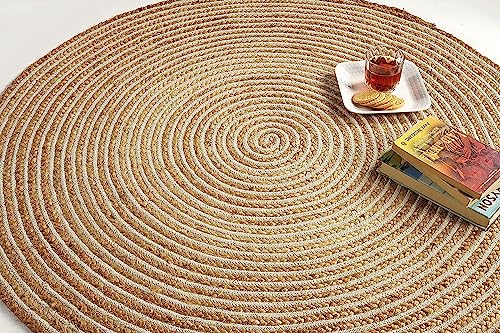
GRUHUM Jute Cotton Area Rug, 6ft Round, Natural — Best Round Blend
The GRUHUM is the pick whose listing makes the soft claim itself — ‘Boho Soft’ — on a jute-cotton braided construction, which is exactly the construction that can back the claim up. At 6 feet round it suits the barefoot zones: beside a bed, under a reading chair, in a nursery corner where the floor is sat on.
Strengths
- Cotton blend in a braided build — the softest construction class here
- Reversible doubles its service life
- Round format suits bedsides and reading corners
Trade-offs
- Round rugs do not anchor rectangular furniture groups
- Braided texture is felt through thin socks — soft for jute, still textured
- Natural beige shows soil more than darker naturals
Key specs (from the verified listing):
- Size: 6 ft round
- Fibre: Jute cotton per listing
- Construction: Handwoven braided per listing
- Features: Reversible, low pile per listing
Braiding softens jute two ways: the cotton content lowers the fibre’s coarseness, and the rounded braid profile replaces a flat scratchy plane with a cushioned rope surface. It remains a textured rug — you will feel the braid — but texture with give is precisely what soft means in natural fibre.
Reversibility is a practical feature, not a garnish: flip the rug each season and both faces wear evenly, doubling the time before traffic patterns show. In a bedroom, place it so the first steps of the morning land on it — that is the moment this rug was bought for.
Best for: Bedrooms, nurseries and reading corners wanting soft natural texture / Not suited for: Under dining tables or large sofa groups
See this pick on Amazon to confirm the current configuration, size and colour before ordering: Check the current price on Amazon.

Chardin Home Jute Cotton Area Rug, 6×9, Natural Jute Ivory, Reversible — Best Reversible Flatweave
The Chardin occupies the sensible middle: 6×9 is big enough for a sofa’s front legs or a bed’s lower two-thirds, the jute-cotton flatweave keeps the surface kinder than pure jute, and the reversible design gives a natural face and an ivory face — a lighter room or a darker one from the same purchase.
Strengths
- Reversible natural/ivory faces suit changing decor
- Blend flatweave is smoother than 100% jute
- 6×9 is the most versatile mid size in the roundup
Trade-offs
- Flatweave firmness — pair with a pad for cushion
- Ivory face will show soil faster; use it in low-traffic rooms
- Handwoven edges need a pad to sit perfectly flat at first
Key specs (from the verified listing):
- Size: 6 x 9 ft
- Fibre: Jute and cotton per listing
- Construction: Handwoven flatweave, reversible per listing
- Colours: Natural jute / ivory
Flatweaves are the easiest natural rugs to live with under furniture: chair legs glide, doors clear, and the rug does not fight a vacuum. The softness story here is surface smoothness rather than depth — cotton in the weave removes the prickle, and the pad you add supplies the step.
Use the two faces seasonally: ivory up in summer for the lighter room, natural up in winter. It is a small trick that makes one rug feel like a deliberate refresh twice a year, and it spreads wear across both surfaces.
Best for: Living rooms and bedrooms wanting a mid-size blend with options / Not suited for: Anyone wanting a thick, cushioned rug feel
See this pick on Amazon to confirm the current configuration, size and colour before ordering: Check the current price on Amazon.

COTTON CRAFT Jute Chindi Braid Rag Rug, 6ft Round, Multi — Best Colour and Softness Mix
Chindi construction braids strips of mixed fibre — here jute with natural recycled cotton, per the listing — and the result is the most forgiving surface in this roundup: the cotton rag content softens every round of the braid, and the multi-colour pattern hides household life better than any natural solid. It is the boho pick, and proudly so.
Strengths
- Recycled cotton content gives the kindest hand-feel here
- Multi-colour braid is camouflage for crumbs and pet hair
- Reversible and handwoven, with genuine rag-rug character
Trade-offs
- Multi colours commit the room’s palette
- Chindi pieces vary — your rug’s exact colour mix is unique
- Round format limits furniture anchoring, as with all rounds here
Key specs (from the verified listing):
- Size: 6 ft round
- Fibre: Jute and natural recycled cotton per listing
- Construction: Chindi braid, handwoven, reversible per listing
- Colour: Multi
Rag construction also means no two rugs are identical, which buyers should embrace or avoid honestly: if you need a precise colour match to a sofa, choose the Chardin or Scandilivin solids. If you want a rug that looks handmade because it is, chindi is the authentic article.
The recycled cotton content is the sustainability story of this roundup, stated exactly as the listing states it — natural recycled cotton blended with jute. It is also the functional story: those cotton strips are why this braided rug feels softer than its 100% jute counterpart below.
Best for: Boho rooms, play spaces and anyone wanting colour with softness / Not suited for: Precise colour matchers or formal rooms
See this pick on Amazon to confirm the current configuration, size and colour before ordering: Check the current price on Amazon.

The Knitted Co. 100% Jute Area Rug, 6ft Round, Natural White Rings — Best Pure Jute Braid
This is the control sample of the roundup: 100% jute, braided. The braid rounds the fibre’s profile and makes it the most barefoot-tolerable form of pure jute, but no softness adjectives from the blends apply — this is texture, durability and a handsome natural-and-white ring design, for buyers who want jute itself rather than a softened interpretation.
Strengths
- Pure jute authenticity with a distinctive ring design
- Braided build is the kindest format pure jute offers
- Natural fibres suit allergy-conscious, synthetic-free briefs (as a material preference, not a medical claim)
Trade-offs
- Firm and textured — not soft in the blend sense
- Pure jute sheds more than blends, especially early
- Approx sizing per the listing — measure your space generously
Key specs (from the verified listing):
- Size: Approx 6 ft round (listing wording)
- Fibre: 100% jute per listing
- Construction: Braided, hand woven per listing
- Design: Natural white rings per listing
Place pure jute where shoes and socks are the norm, or beside the bed over a pad, and its firmness becomes a virtue: it does not mat, it does not show traffic, and it outlasts softer constructions in busy spots. The white rings lift it above the plain natural rugs visually, making it the decorative choice among the honest-texture picks.
Shedding deserves a plain word: natural jute releases fibre, most in the first weeks. Vacuum without a beater bar, shake it outside monthly, and the shedding settles. A listing or review that promises a no-shed pure jute rug is not being straight with you — this roundup’s internal links include a guide to jute rugs that don’t shed, which covers the lowest-shed constructions honestly.
Best for: Purists wanting real jute texture with a design lift / Not suited for: Barefoot plush seekers — choose a blend above
See this pick on Amazon to confirm the current configuration, size and colour before ordering: Check the current price on Amazon.

SAFAVIEH Natural Fiber NF447A Jute Rug, 5×8 — Best Firm Traditional Jute
The SAFAVIEH NF447A closes the roundup as the reference point: a knotted jute rug with a substantial 3/4 inch pile, positioned by its listing for durability and easy care in entryways, living rooms and offices. It is not the soft pick — it is the tough one, included so the scale is honest and so buyers who actually want traditional jute have a verified option rather than a blend wearing jute’s name.
Strengths
- Thick knotted construction is the most durable here
- Listing positions it as kid and pet friendly and easy care
- 5×8 is a workhorse size for living rooms and offices
Trade-offs
- Firm, coarse hand-feel — the least soft pick in this roundup, stated plainly
- Jute pile sheds and is not a barefoot rug
- Natural jute dislikes standing moisture — keep it in dry rooms
Key specs (from the verified listing):
- Size: 5 x 8 ft
- Pile: 3/4 inch per listing
- Fibre: Jute fibres per listing
- Positioning: Durable, kid and pet friendly, easy care per listing
There is a real buyer for this rug: the household that wants natural texture under a coffee table, in an office, at an entry — places where shoes stay on and durability outranks delicacy. Judged on that brief it is excellent. Judged on the soft brief of this article’s title, it ranks last, and the ranking is the information.
If you love this rug’s look but need barefoot comfort, the layered solution works: this or the Knitted Co. braid over a thick pad in a bedroom delivers most of the comfort with all of the look. What will not work is expecting the knotted pile itself to soften dramatically with age — it relaxes, it does not transform.
Best for: Entryways, offices and durability-first natural texture / Not suited for: Barefoot bedrooms or softness-first buyers
See this pick on Amazon to confirm the current configuration, size and colour before ordering: Check the current price on Amazon.
Comparison Table
| Pick | Badge | Key Spec | Best For |
|---|---|---|---|
| Scandilivin Homes Jute Cotton Hand Woven Area Rug, 9×12, Natural Beige | Best Overall Soft Blend | 9 x 12 ft; jute cotton per listing; hand woven per listing | Living rooms wanting natural texture at full size with the softest available blend |
| GRUHUM Jute Cotton Area Rug, 6ft Round, Natural | Best Round Blend | 6 ft round; jute cotton per listing; braided; reversible per listing | Bedrooms, nurseries and reading corners wanting soft natural texture |
| Chardin Home Jute Cotton Area Rug, 6×9, Natural Jute Ivory, Reversible | Best Reversible Flatweave | 6 x 9 ft; jute and cotton per listing; reversible flatweave | Living rooms and bedrooms wanting a mid-size blend with options |
| COTTON CRAFT Jute Chindi Braid Rag Rug, 6ft Round, Multi | Best Colour and Softness Mix | 6 ft round; jute and recycled cotton per listing; chindi braid; reversible | Boho rooms, play spaces and anyone wanting colour with softness |
| The Knitted Co. 100% Jute Area Rug, 6ft Round, Natural White Rings | Best Pure Jute Braid | Approx 6 ft round; 100% jute per listing; braided | Purists wanting real jute texture with a design lift |
| SAFAVIEH Natural Fiber NF447A Jute Rug, 5×8 | Best Firm Traditional Jute | 5 x 8 ft; jute fibres per listing; 3/4 in pile per listing; knotted | Entryways, offices and durability-first natural texture |
How to Choose a Soft Jute Rug
The softness truth about jute
Jute fibre is coarse. Softness in a jute rug comes from cotton blended into the weave, braided or chindi construction that rounds the surface, and the pad beneath. Any product claiming plush softness from 100% jute is misdescribing itself — this roundup ranks constructions, and you should too.
Construction ladder, softest to firmest
Jute-cotton chindi and blends sit at the soft end; braided blends follow; pure jute braids are textured but tolerable; knotted or flat pure jute is firm. Use the ladder to match a rug to its room: blends where feet are bare, firm jute where shoes are on.
The pad is half the product
Under any flatweave or braided jute, a dense rug pad supplies the cushion the rug lacks, stops creep on hard floors and extends the rug’s life. Budget for the pad as part of a jute purchase, not as an accessory.
Sizes and shapes
Rounds soften corners and suit bedsides; rectangles anchor furniture. Natural rugs are often handmade with approximate dimensions — the Knitted Co. listing says ‘approx’ outright — so measure with tolerance and avoid exact-fit alcove plans.
Shedding and care reality
Jute sheds, blends shed less, and all natural rugs dislike soaking. Vacuum suction-only, blot spills immediately (never soak a jute rug), and keep jute out of bathrooms and damp basements.
Colour expectations
Natural jute varies from gold to grey-beige between batches and even within a handwoven rug. That variation is the material’s character; if you need uniformity, a synthetic jute-look rug is the honest alternative.
How to Lay, Soft-Enable and Care for a Jute Rug
A jute rug settles beautifully when its first week is handled right.
- Unroll and let the rug relax for 24-48 hours; handwoven edges settle flat with time and a pad beneath.
- Lay a dense rug pad cut slightly smaller than the rug — this is your cushion layer and your grip.
- Position barefoot-zone rugs (blends and braids) where feet land first: bedside, reading chair, nursery corner.
- Vacuum weekly with suction only; disable the beater bar, which tears natural fibres and worsens shedding.
- Rotate the rug a half-turn seasonally, and flip reversible designs to share the wear.
- Blot spills instantly with a dry cloth; never soak or steam-soak jute — spot clean sparingly and dry flat.
- Shake braided and smaller rugs outdoors monthly to clear grit from the braid.
Treated this way, a jute rug’s texture mellows slightly and its surface evens out — not into plush, but into the comfortable, lived-in natural feel that is the category’s real promise.
Common Buying Mistakes
- Believing ‘soft’ on a 100% jute listing: Check fibre content. Softness requires cotton in the construction or a pad beneath.
- Putting jute in a bathroom: Jute absorbs moisture and mildews. It is a dry-room fibre, full stop.
- Soaking a spill out: Water is jute’s enemy; blot, spot, dry. A soaked jute rug can stain and weaken permanently.
- Vacuuming with a beater bar: It shreds natural fibres and accelerates shedding. Suction only.
- Skipping the pad: On hard floors an unpadded flatweave feels like cardboard. The pad is the comfort.
- Expecting zero shedding: All natural jute sheds, blends least. Plan the first month’s vacuuming accordingly.
Final Recommendation
For softness with jute’s look, buy the blends: the Scandilivin 9×12 for full rooms, the GRUHUM round for barefoot corners, the Chardin reversible for flexibility, and the COTTON CRAFT chindi for colour and the kindest surface. Buy the Knitted Co. braid when you want pure jute with a design lift, and the SAFAVIEH knotted rug when durability matters more than softness — it is ranked last here because this article’s brief is soft, not because it is a lesser rug. Add a dense pad under any of them; in this category, the pad is half the comfort.
Shop the shortlist again here:
- Scandilivin Homes Jute Cotton Hand Woven Area Rug, 9×12, Natural Beige — check price on Amazon
- GRUHUM Jute Cotton Area Rug, 6ft Round, Natural — check price on Amazon
- Chardin Home Jute Cotton Area Rug, 6×9, Natural Jute Ivory, Reversible — check price on Amazon
- COTTON CRAFT Jute Chindi Braid Rag Rug, 6ft Round, Multi — check price on Amazon
- The Knitted Co. 100% Jute Area Rug, 6ft Round, Natural White Rings — check price on Amazon
- SAFAVIEH Natural Fiber NF447A Jute Rug, 5×8 — check price on Amazon
Related guides on this site: Best Affordable Jute Rugs; Best Natural Soft Jute Rugs; Best Jute Rugs That Don T Shed; Best Soft Area Rugs For Living Room.
Jute, In Depth: Fibre, Rooms and Years of Use
Where jute fibre comes from and why it feels as it does
Jute is a bast fibre, stripped from the stem of the jute plant, and its character — long, strong, coarse, golden — is set by that anatomy. Unlike wool, it has no natural crimp or scale to trap air, which is why jute never feels plush and why its virtues are different: dimensional stability, a firm pleasant texture under shod feet, and a colour that pairs with almost every wood tone. Cotton, the softening partner in this roundup’s leading picks, is a seed fibre with a much finer hand, and weaving the two together is a genuine material compromise — each fibre diluting the other’s weakness. Understanding this anatomy lets a buyer read any jute listing accurately: the fibre percentages and construction are the product, and adjectives are decoration.
Room by room: where each construction belongs
The entry hall wants the firmest jute — the SAFAVIEH knotted format — because grit, moisture at the door’s edge and constant traffic punish soft constructions. The living room is contested ground: blends under the seating, firmer weaves in the walkways, with the Scandilivin and Chardin sizes suiting the anchor role. Bedrooms belong to the blends and braids, placed where bare feet land. Nurseries want the GRUHUM or chindi rounds, low and soft for floor play, with the caveat that natural fibres should be vacuumed diligently where babies crawl. Dining rooms should avoid jute altogether if chairs slide daily and spills are frequent — the fibre’s dislike of soaking makes it the wrong tool under a family table, whatever its looks.
Jute and pets: the honest ledger
Pet households are drawn to jute for its camouflage colouring and low pile, and the ledger has two columns. In jute’s favour: hair does not cling as it does to synthetic pile, dried mud brushes out, and the natural tones hide what remains between cleans. Against: claws can pull braided loops, liquid accidents must be blotted instantly because soaking is forbidden, and determined scratchers will treat a textured natural rug as an invitation. The blends sit mid-ledger — softer, slightly more vulnerable. Households with puppies or incontinent older animals should be honest that a washable synthetic is the kinder tool for that season of life, and that jute’s moment can come later.
The pad question, settled properly
Under jute, the pad does four jobs: cushion, grip, floor protection and rug protection. Natural latex or felt pads suit natural rugs best, and the pad should be cut an inch or two inside the rug’s edge on every side so it never peeks out. On heated floors, verify temperature compatibility for both rug and pad. The common failure is a thin, cheap pad that migrates and bunches, creating the trip ridge the pad existed to prevent — buy the pad with the same seriousness as the rug, because under a flatweave the pad is, functionally, half the product your feet experience. Reversible rugs in this roundup gain a fifth benefit: either face down, the pad keeps the contact even and the wear shared.
Colour ageing and sunlight
Jute’s golden tone deepens and evens with light exposure in its first months, then slowly fades in strong direct sun over years. A rug half under a sofa will age in two tones unless rotated, which is why the care section’s rotation habit matters more for natural fibres than for synthetics. Cotton-blended and ivory-faced designs fade more visibly than plain natural jute, so the Chardin’s ivory face belongs in the gentler-lit room. None of this is a defect; it is the patina behaviour of a plant fibre, closer to how wood ages than how plastic does, and buyers who enjoy materials that record their lives will find it a feature.
Buying handmade without surprises
Handwoven and braided rugs carry small irregularities — a slightly wandering edge, a tone shift where one batch of fibre met another, dimensions that are approximate, as the Knitted Co. listing states plainly. These are the signatures of the construction, and the buyer’s task is to decide in advance whether they read as character or as flaws, because the rug will not change its nature after arrival. Measure with tolerance, avoid exact-fit placements, and unroll the rug fully within the return window to inspect it in your own light. The listings in this roundup that state ‘handwoven’ and ‘approx’ are being more honest, not less capable, than listings that promise machine perfection from a hand process.
Jute at the end of its life
A worn natural rug has graceful exits that synthetic rugs lack: it can move to the garden room, the workshop, under the dog’s bed, and eventually — being a plant fibre — it does not persist in the environment the way a plastic rug does. That end-of-life profile is part of the honest case for natural fibre, stated without embellishment: the rug asks more care during its life and less forgiveness after it. Households replacing rugs every few years for fashion reasons should weigh that profile seriously; households buying for a decade will find jute’s durability, especially in the firm constructions, repays the care routine many times over.
A final honesty note on naming: the market contains many ‘jute’ rugs that are jute-printed synthetics. They can be soft, but they are not jute, and they were excluded here even when their listings ranked for the keyword. Every pick above states genuine jute fibre or a jute blend in its listing.
If your household is split — one partner wants natural texture, the other wants softness — the layered compromise in this guide (blend rug plus dense pad in the bedroom, firm jute in the entry) satisfies both briefs without either person conceding the whole house.
A note for readers comparing this roundup with the soft area rugs guide on this site: the two categories answer different briefs. Choose jute for natural texture, firm support and material honesty; choose the washable synthetics for cushion, stain forgiveness and barefoot softness. Homes often need one of each, in different rooms.
If budget forces a sequence, buy the bedroom’s blend first — that is where bare feet judge a rug most strictly — and let the entry’s firm jute follow when funds allow. The reverse order leaves the most personal room served by the least personal rug.
The barefoot test, properly conducted, separates this category’s promises from its realities. Walk each candidate zone of your home in the morning, when feet are most sensitive, and note where the floor feels kind and where it feels like a message. Those kind zones are where the blends belong; the message zones, usually thresholds and work areas, can take the firm constructions without complaint. A household that maps its own feet honestly will place the GRUHUM round and the chindi where they will be loved, instead of spreading one rug’s compromise across every room.
Layering jute over existing flooring is a renter’s technique worth naming: a jute rug over a landlord’s tired carpet adds texture and a clean visual surface without any alteration, and its firmness is an asset there, lying flat and stable where a plush rug would ripple. The blends work too, but the firm picks’ stability makes them the layering specialists. When the tenancy ends, the rug leaves with you and the deposit conversation stays short.
Jute in the workspace has a specific virtue: chair castors. An office chair on a firm jute flatweave rolls predictably and the rug does not bunch, while plush rugs fight castors and lose. The SAFAVIEH’s office positioning on its listing reflects real use. Home workers whose desks sit in bedrooms face the category’s central trade in miniature — castor-friendly firmness by day, barefoot kindness by night — and the layered answer, firm rug plus pad, or a blend in the larger sizes, is the honest resolution.
Smell is a fair question with natural fibres: new jute carries a hay-like scent that most households notice for days and few notice after two weeks of airing. Blends with cotton carry less of it. A rug whose scent persists strongly after a fortnight of ventilation is an outlier worth returning, but the initial earthiness is the material announcing itself, and for many buyers it is part of the natural product’s appeal rather than a defect to be apologised for.
Stairs and hallways are jute’s durability showcase and its safety caveat in one. A firm jute runner grips a hallway floor beautifully with a proper pad and outwears softer fibres in the traffic lane, but on stairs themselves any rug requires professional fitting and full fixing — a loose rug on a stair is a hazard whatever its fibre. This roundup’s picks are room rugs; treat stair installation as a separate, specialist purchase and do not improvise it from a flatweave bought for the floor.
The price structure of jute rewards the informed: handwoven natural rugs carry labour honestly, and the spread between the roundup’s picks reflects size and construction more than brand theatre. A suspiciously cheap large jute rug is usually a blend with minimal jute, a printed imitation or a weave too loose to last — the fibre and construction statements in these listings are the antidote, which is why every pick here was required to make them.
Cohabiting with robot vacuums, jute asks for settings rather than exclusion: suction-only modes, no beater bar, and thresholds the machine can climb — braided edges are higher than flatweave edges, and a robot that mounts a flatweave happily may baulk at a braid. Test during the return window if the robot is your primary cleaner; households that hand-vacuum weekly can ignore the question entirely, and arguably get the better of the bargain, since the weekly pass is also the rug’s inspection.
And the closing synthesis of the whole soft-jute question: softness was never jute’s native gift, and the buyers who love their jute rugs longest are the ones who purchased its actual gifts — texture, stability, natural colour, durability — and then engineered the softness honestly around it with blends and pads. Buy the fibre for what it is, and it will not disappoint you; buy it for what a listing’s adjectives wish it were, and no rug in this roundup can save the purchase.
For the reader still torn between a blend and a pure jute rug, a decision shortcut: choose the room’s dominant sense. If the room is experienced barefoot and seated — bedroom, nursery, reading corner — the blend’s softness will be noticed daily and the pure rug’s authenticity rarely. If the room is experienced standing, shod and passing through — hall, office, entry — authenticity and durability dominate and softness is a rumour. Most households own both kinds of room, which is why this roundup refuses to crown a single winner and instead maps constructions to territories.
Jute’s pairing with other natural materials is its styling superpower: it sits under wool cushions, beside linen curtains and against oak without a single argument, because its colour is the average of the natural palette. A room that feels disjointed often needs exactly this — a large, quiet, natural ground that lets the deliberate pieces speak. The big blend rugs here perform that role with the softest available surface, which is why they lead the roundup despite the category’s firm reputation.
One caution completes the care picture: jute and direct, prolonged wet-mopping of surrounding floors do not mix. Mop water that laps a jute edge repeatedly will stain and weaken the border over a season. Lift or shield the rug’s edges on floor-washing day, or choose the rug’s room with the mop in mind. Small choreography, large lifespan — the recurring bargain of natural materials.
The last word belongs to expectation itself. Every disappointed jute owner bought a picture; every satisfied one bought a material. This article has tried to sell you the material — its anatomy, its territories, its care — with the pictures demoted to illustrations. If the material sounds like something your home would enjoy living with, the picks above are its best current expressions at each point of the softness scale.
A buying-timeline note on the soft jute rug: this is a category where stock rotates and colourways come and go, so the variant you want in the size you need is worth securing when it is available rather than after a season of deliberation. The reverse discipline applies to the decision itself — the analysis in this article does not expire, and a rug bought next month on the same criteria will serve exactly as well. Urgency belongs to inventory, never to judgement.
Households sharing one rug between several people should think about the compromise explicitly rather than discovering it: the person most sensitive to the product’s main trade-off — pile height, warmth, firmness, weight — should hold the casting vote, because they are the one who will quietly stop using it if the compromise lands wrong. Shared products fail socially before they fail physically, and a soft jute rug that everyone tolerates but one person avoids is a purchase half-wasted.
There is also a case for writing down what you bought and why, in a note kept with the household records: the size, the construction, the listing’s own claims and the date. When the rug is replaced in some years’ time, that note converts a fresh research project into a five-minute reorder-or-reconsider decision, and it protects the household against the slow drift of product lines, where the same name gradually comes to mean a different product.
Neighbours, guests and family will judge this rug by exactly one encounter, and that encounter is worth optimising for honestly: the first touch, the first sit, the first use. The picks in this roundup were chosen to make that first encounter land well without sacrificing the fiftieth, because a product that impresses once and tires daily is a failed purchase wearing a good introduction. Test yours the same way during the return window — once as a guest would, and once as your tired future self would.
Finally, the meta-lesson this whole roundup runs on: in mature home categories, the differences between good products are smaller than the differences between good and bad fits. Size, format, material and maintenance matched to a specific household beat specification trophies every time. If you take nothing else from these pages, take the habit of naming your household’s actual pattern of use before opening a single listing — the soft jute rug that fits that pattern is, by definition, the best one sold.
Frequently Asked Questions
Are jute rugs actually soft?
Pure jute is firm and textured. Jute-cotton blends, chindi braids and braided constructions are noticeably softer, and a pad underneath adds real cushion. This roundup ranks the six picks on exactly that basis.
Which jute rug is softest here?
By construction, the cotton-rich options: the COTTON CRAFT chindi braid and the jute-cotton GRUHUM and Scandilivin weaves. The 100% jute picks are honestly firm.
Do jute rugs shed?
Yes — all natural jute sheds, most in the first weeks, with blends shedding less than pure jute. Suction-only vacuuming and time reduce it substantially.
Can jute rugs go in high-traffic areas?
Firm knotted and flatweave jute, like the SAFAVIEH pick, are among the most durable natural rugs and suit entries and offices. Soft blends belong in lower-traffic, barefoot zones.
How do I clean a jute rug?
Vacuum with suction only, shake outdoors, blot spills immediately and never soak it. Keep jute out of damp rooms entirely.
What pad works under a jute rug?
A dense, non-slip pad cut just smaller than the rug. It supplies cushion, grip and protection for both the rug and the floor beneath.


