Disclosure: airfryerkitchensupply.com is reader-supported. When you buy through links on our site, we may earn an affiliate commission at no extra cost to you.
Where to buy
All six picks are men’s house slippers sold on Amazon, and every linked model below was confirmed against Amazon’s catalog data before earning its link — the sizes, linings and sole descriptions quoted here come from the listings themselves. Warmth claims are easy to inflate in a product title, so use the listing page to confirm the exact size run and lining description for the pair you are about to buy, and check price on Amazon there rather than trusting any number printed elsewhere. If you are buying for feet that are always cold, the listing details that matter most are the lining material, the height of the upper around the ankle, and whether the sole is a real indoor-outdoor sole or a soft indoor one.
- PROJECT CLOUD Men’s Genuine Leather Shearling Slippers — check price on Amazon
- UGG Men’s Ascot Slipper (Chestnut) — check price on Amazon
- RockDove Men’s Sherpa Lined Memory Foam Clog Slipper — check price on Amazon
- LongBay Men’s Bootie Slippers — check price on Amazon
- Zigzagger Men’s Slip-On Moccasin Slippers — check price on Amazon
- Zizor Men’s Moccasin Slippers with Warm Plush Lining — check price on Amazon
Looking for the best slippers to keep feet warm men can wear all winter usually starts with a disappointment: a pair of thin moccasins that felt fine in the shop and do almost nothing on a cold kitchen floor in January. Warmth in a house slipper is not a mystery and it is not marketing — it comes from four physical things. A lining that traps air (shearling, sherpa, plush or fleece), an upper that covers the whole foot and ideally the ankle, an insole thick enough to insulate the foot from the floor, and a sole that blocks the cold conducting up from tile, stone or hardwood. A slipper missing two of those four will feel cold no matter what the box says.
This guide applies that test to men’s house slippers only — no sandals, no slides, no open-toe summer styles, and no listings whose pitch is primarily medical. Six verified picks remain: a genuine leather and Australian shearling pair at the top, a classic premium moccasin, a sherpa-lined clog that is the value play, a bootie that wraps the ankle, a hard-sole moccasin for men who step outside in them, and a suede moccasin with a warm plush lining. Each was checked, and where a listing title does not state a material, the review says so plainly instead of borrowing the brand’s reputation to fill the gap.
After the reviews you will find a buying guide on lining materials and insulation, a section on fit — warm slippers fail more often on sizing than on materials — a practical care routine that keeps linings lofty instead of matted, and the common mistakes men make when buying for cold feet, including the sock question and the heated-slipper question, answered honestly.
Key Takeaways
- Warmth = lining + coverage + insole insulation + a real sole. Judge every pair against those four, in that order.
- Shearling is the benchmark natural lining; sherpa and plush synthetics are the value route to similar trapped-air warmth.
- Bootie and clog shapes that cover the ankle and heel beat low scuffs for genuinely cold feet.
- A hard or rubber indoor-outdoor sole blocks floor cold far better than a soft fabric sole.
- Buy for your sock: if you wear thick winter socks, size the slipper for them, because a crushed lining insulates worse than a thinner one with air in it.
- Shape follows the house: booties for cold houses and slab floors, moccasins for heated homes, clogs for in-and-out lives — no single shape wins everywhere.
In this guide
Quick Picks
Best Overall — PROJECT CLOUD Men’s Genuine Leather Shearling Slippers. The only pick whose listing states genuine leather and Australian shearling outright, with a memory foam insole and a water-resistant build — the warmest verified combination in the guide.
Best Premium Classic — UGG Men’s Ascot Slipper (Chestnut). The classic moccasin silhouette from the brand most associated with warm winter footwear, in chestnut — with an honesty note: this listing’s title states model, color and size only, so check the listing page for its current lining specification.
Best Value Warmth — RockDove Men’s Sherpa Lined Memory Foam Clog Slipper. A sherpa-lined clog with a felt upper, memory foam footbed and a machine-washable build — the most warmth per dollar in the guide, and the easiest pick to keep fresh.
Best for Coldest Floors — LongBay Men’s Bootie Slippers. A bootie that wraps the ankle, with a tough nylon upper, a non-slip rubber outsole and adaptive memory foam — the most coverage of any pick here, for the coldest floors in the house.
Best Hard Sole — Zigzagger Men’s Slip-On Moccasin Slippers. A warm, fuzzy moccasin on a hard sole, with memory foam cushioning, a roomy toe box and a machine-washable build — the pick for men who treat slippers as all-day house shoes.
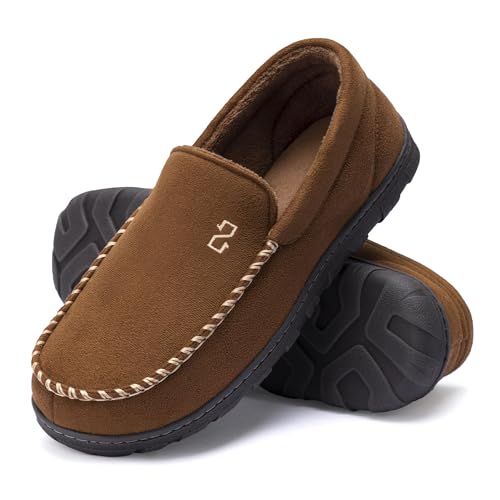
Best Plush Lining — Zizor Men’s Moccasin Slippers with Warm Plush Lining. A suede moccasin with a warm plush lining, memory foam and a non-slip rubber sole in camel — the traditional-looking pick whose lining does the warming.
How These Picks Were Chosen
The candidate pool was men’s house slippers in the verified catalog data — moccasins, clogs and booties with enclosed uppers. Open-toe styles, sandals, slides and flip-flops were excluded on sight, because an open toe defeats the purpose of the keyword no matter how plush the footbed is. Listings pitched mainly in medical language were also excluded; this guide is about comfort and warmth, and it makes no health claims for any pick. What remained was scored on the four warmth factors from the introduction: lining, coverage, insole, and sole.
Each finalist’s listing was read for what it actually states. The Project Cloud pick states its materials outright — genuine leather and Australian shearling with a memory foam insole. The RockDove states a sherpa lining. The LongBay bootie states a rubber outsole and nylon upper. The Zigzagger states a hard sole and a warm, fuzzy build. The Zizor states a suede upper and warm plush lining. The UGG Ascot’s listing title, by contrast, states only the model, color and size — so its review discusses fit, shape and brand role honestly and flags the lining as not stated in the listing title, rather than assuming the specification the brand is famous for. That distinction is the difference between a guide and a brochure, and it is applied to every pick here.
Sizing notes come from the listings too: several picks are sold in size ranges (such as 9-10 or 13-14) rather than exact sizes, and the reviews flag where that matters. No prices or fixed ratings are printed anywhere in this guide, because both change constantly; the Amazon listing carries the live numbers for the size you actually need.
The 6 Best Slippers to Keep Feet Warm Men Actually Wear

PROJECT CLOUD Men’s Genuine Leather Shearling Slippers — Best Overall
The Project Cloud takes the top spot because it is the one pick that checks all four warmth boxes with materials named in its own listing: a genuine leather upper, Australian shearling — the natural lining that winter footwear is judged against — a memory foam insole for cushion and a measure of insulation from the floor, and a water-resistant build that tolerates the trip to the mailbox or the garage. Shearling’s warmth is not a slogan; the wool fibers trap a thick layer of still air against the foot, and unlike many synthetic linings it keeps insulating without feeling clammy, because the fibers also move moisture away from the skin.
Strengths
- Genuine leather upper and Australian shearling lining, both stated in the listing
- Memory foam insole adds cushion plus insulation from cold floors
- Water-resistant build handles quick outdoor steps without drama
Trade-offs
- Natural materials put it at the premium end of this guide’s range
- Shearling needs gentle care — no machine washing marathons
- Leather upper is warmer but less stretchy than knit styles for very wide feet
| Upper (listing) | 100% genuine leather |
| Lining (listing) | Australian shearling |
| Insole (listing) | Memory foam |
| Water resistance | Water resistant (per listing) |
Who is this for? The man whose feet are cold in ordinary slippers and who wears his pair for hours every day — working from home, padding around a house with hard floors, stepping out for the dog. The leather upper earns its keep in that life: it shrugs off scuffs, sheds light moisture, and holds the slipper’s shape so the shearling stays lofted around the foot instead of collapsing into a loose bag. The honest limitation is care and commitment. Shearling and leather reward a brush-out and air-drying and punish being left damp by a radiator or tossed in a hot wash, and the price of admission for natural materials is real. If your pattern is to destroy a cheap pair every winter and replace it, the value picks below fit you better. If you want one pair that stays genuinely warm for seasons, this is the pair in the guide built that way.
Best for: Men with chronically cold feet who wear slippers for hours daily and want natural materials / Not suited for: Anyone who wants to machine-wash their slippers regularly or is shopping on a strict budget
Check on Amazon — check the current price on Amazon before you decide, and confirm the size and colorway on the listing page.

UGG Men’s Ascot Slipper (Chestnut) — Best Premium Classic
The Ascot is the moccasin that defined the category for many buyers: a low, neat silhouette that reads almost like a loafer, in chestnut, from UGG. It earns its place here as the premium classic — the pair men buy when they want warmth without the bootie look, and a slipper presentable enough for the door. One disclosure matters more than the styling: the verified listing title for this ASIN states only ‘UGG Men’s Ascot Slipper, Chestnut, 12’. It does not state the lining material, so this guide does not print one. UGG’s reputation is built on sheepskin, but reputations are not specifications — confirm the current lining on the listing page before you buy, because that detail is the entire reason this slipper is in a warmth guide.
Strengths
- Classic moccasin shape that looks tidy beyond the bedroom
- From the brand with the longest track record in warm slippers
- Low profile fits men who dislike bootie or clog bulk
Trade-offs
- Lining material not stated in the listing title — verify before buying
- Low cut leaves the ankle exposed, a real warmth cost on cold floors
- Premium brand pricing within the category
| Model (listing) | UGG Ascot |
| Color (listing) | Chestnut |
| Size (listing) | 12 (other sizes on listing page) |
| Lining | Not stated in listing title |
Treat the Ascot as a shape decision as much as a warmth decision. A low moccasin covers the foot but not the ankle, and on a cold floor the exposed ankle and the open collar are where warmth leaks. For a man whose house is moderately heated and whose feet run slightly cool, that trade is fine and the Ascot’s neatness wins. For the man whose feet are cold in bed, it is the wrong silhouette and the bootie below is the right answer. Sizing deserves attention too: moccasin styles with plush linings feel snug for the first days and relax as the lining compresses, so a fit that feels merely firm at first is usually correct, while a fit that feels comfortable immediately can become sloppy within a month. Buy your normal shoe size unless the listing’s own guidance says otherwise, and let the lining settle before judging.
Best for: Men who want a presentable, classic moccasin and will confirm the lining spec on the listing / Not suited for: Men who need maximum warmth coverage, or who will not check the lining detail before ordering
Check on Amazon — check the current price on Amazon before you decide, and confirm the size and colorway on the listing page.

RockDove Men’s Sherpa Lined Memory Foam Clog Slipper — Best Value Warmth
RockDove’s sherpa-lined clog is the value engine of this guide. The listing describes a breathable felt upper, a sherpa lining, memory foam cushioning, a non-slip sole and — the detail that changes ownership — a machine-washable build. Sherpa is the synthetic that most convincingly imitates shearling’s trick: a deep, fleecy pile that traps air against the foot. In a clog shape it wraps the top and sides of the foot, and the felt upper keeps the whole thing light. For men whose feet run cold but whose budget does not run to leather and shearling, this is the pick that respects both facts.
Strengths
- Sherpa lining delivers real trapped-air warmth at a value tier
- Machine washable — the lining can be refreshed instead of matting down for good
- Clog shape is easy on and off while still covering the foot
Trade-offs
- Open-back clog leaves the heel and ankle less covered than a bootie
- Synthetic sherpa will mat over time even with washing
- Felt upper is a house material, not a step-outside-in-the-rain material
| Upper (listing) | Felt |
| Lining (listing) | Sherpa |
| Footbed (listing) | Memory foam |
| Care (listing) | Machine washable |
The washability is not a footnote — it is the long-term warmth strategy. Every plush lining, natural or synthetic, loses loft as it absorbs moisture, skin oils and dust, and loft is insulation. A lining you can wash and fully dry recovers much of that loft, so a washable sherpa clog in its second winter can out-warm a neglected premium slipper in its second winter. Wash cool, dry thoroughly and away from direct heat, and fluff the lining with a soft brush when dry. The clog shape’s honest cost is the open heel: it is the easiest style to step into at 6 a.m., and the least enveloping on a freezing floor. Men who feel cold mainly through the soles and tops of their feet will be perfectly served; men whose ankles and heels chill should look at the bootie pick instead.
Best for: Budget-conscious men who want genuine warmth and easy care in one pair / Not suited for: Men who need full ankle and heel coverage for very cold floors
Check on Amazon — check the current price on Amazon before you decide, and confirm the size and colorway on the listing page.

LongBay Men’s Bootie Slippers — Best for Coldest Floors
When the problem is not just cold feet but a cold house — tile over a slab, a farmhouse kitchen, a basement office — the answer is coverage, and the bootie is the coverage shape. The LongBay bootie wraps the foot and ankle in a tough nylon upper, stands on a non-slip rubber outsole that insulates the foot from the floor’s chill, and cushions with adaptive memory foam. The listing calls them indoor-outdoor warm house shoes, and the rubber outsole is what makes that claim meaningful: it is a real barrier between your foot and a cold surface, not a fabric bottom pretending.
Strengths
- Bootie height covers the ankle — the warmth leak in low slippers
- Rubber outsole blocks floor cold and handles outdoor steps
- Nylon upper is tough and shrugs off scuffs and light moisture
Trade-offs
- Warmest shape can be too much in a well-heated house
- Sold in size ranges (9-10 shown) rather than exact sizes
- Sporty lounge-boot look is casual, not tidy-moccasin neat
| Upper (listing) | Nylon |
| Outsole (listing) | Non-slip rubber |
| Insole (listing) | Adaptive memory foam |
| Fit (listing) | Size ranges, e.g. 9-10 |
The physics here are worth stating plainly, because they explain why booties out-warm prettier slippers. Heat leaves a foot three ways: through the sole into a cold floor, through the upper into cold air, and out of the open collar around the ankle. A rubber outsole slows the first path, a closed upper slows the second, and the bootie’s raised collar closes the third. The LongBay addresses all three, which no low moccasin in this guide can claim. The trade is temperature range: in a house kept warm, a bootie can tip from cozy to sweaty, and sweaty linings chill later. Wear this pair where it belongs — the cold end of the house, morning floors, workshop and garage trips — and let a lighter pair handle the heated living room if you run warm by evening.
Best for: Men in cold houses, on slab or tile floors, or who step outside in their slippers / Not suited for: Men in warm, well-heated homes who run hot and want a light evening slipper
Check on Amazon — check the current price on Amazon before you decide, and confirm the size and colorway on the listing page.

Zigzagger Men’s Slip-On Moccasin Slippers — Best Hard Sole
The Zigzagger’s listing is a checklist of what all-day wearers ask for: warm and fuzzy, memory foam cushioned, a relaxed fit with a roomy toe box, machine washable, and a hard sole. That hard sole is the headline for warmth as much as for durability. On cold hard floors, the sole is the insulation layer between your foot and a surface that pulls heat away all day, and a firm, substantial sole outperforms a thin soft one at that job while also surviving the driveway, the porch and the garage.
Strengths
- Hard sole insulates against cold floors and survives outdoor steps
- Roomy toe box and relaxed fit suit thick socks and wider feet
- Machine washable, so the fuzzy lining can be kept lofty
Trade-offs
- Hard sole is less flexible and quieter-floor unfriendly than soft soles
- Listed here in a 13-14 range — check the listing for your size range
- Moccasin cut leaves the ankle open like other low styles
| Sole (listing) | Hard sole, indoor-outdoor |
| Footbed (listing) | Memory foam cushioned |
| Fit (listing) | Relaxed fit, roomy toe box |
| Care (listing) | Machine washable |
This is the slipper for the man who puts a pair on in the morning and takes them off at night. That wearing pattern punishes two things: thin soles, which transmit both cold and fatigue, and linings that cannot be cleaned, which go flat and stale by mid-winter. The Zigzagger answers both — hard sole, washable build — and adds a roomy toe box that matters more for warmth than it first appears. Toes that can spread and move generate and keep heat better than toes squeezed in a narrow toe, and a relaxed fit leaves room for the air layer that insulation needs. If your size sits between the ranges the listing offers, favor the range that leaves that room, especially if you wear proper winter socks; a crushed lining and a compressed sock insulate worse together than either does with space.
Best for: All-day wearers, men with wider feet, and anyone who steps outside in slippers / Not suited for: Men who want a soft, silent, bedroom-only slipper
Check on Amazon — check the current price on Amazon before you decide, and confirm the size and colorway on the listing page.
Zizor Men’s Moccasin Slippers with Warm Plush Lining — Best Plush Lining
The Zizor is the traditionalist’s route to warm feet: a suede upper in camel, a warm plush lining, memory foam underfoot and a non-slip rubber sole, in a classic slip-on moccasin shape. Nothing about the silhouette is novel, and that is the point — it looks like the slipper men have worn for decades, while the plush lining and rubber sole quietly fix the two reasons the old versions felt cold: thin linings and fabric soles on hard floors.
Strengths
- Suede upper with a classic moccasin look in camel
- Warm plush lining stated in the listing
- Rubber sole insulates and grips better than fabric bottoms
Trade-offs
- Suede needs protection from water and slush — not a wet-weather stepper
- Low moccasin cut leaves ankles open
- Plush lining will compress over time; rotate with a second pair if worn daily
| Upper (listing) | Suede |
| Lining (listing) | Warm plush |
| Sole (listing) | Non-slip rubber |
| Footbed (listing) | Memory foam |
Suede deserves one honest paragraph. It is a handsome, durable upper that ages into a personal patina, and it is the wrong material for wet steps to the mailbox in slush — water spots it and repeated soaking stiffens it. Keep the Zizor for indoor warmth and dry outdoor moments, and it will repay you by looking better in year two than most synthetics do. The plush lining is the warmth engine here, and its lifespan is a care story: air the pair out after long wears, let them dry fully between uses, and avoid radiator heat, which cooks linings into stiffness. Men buying a gift should note the listing’s own positioning — it names husbands and dads — because the classic shape and camel color make it the safest present in this guide for a man whose tastes you know are traditional.
Best for: Traditional tastes, gift buying, and dry indoor warmth with a classic look / Not suited for: Men who regularly step into wet weather in their slippers
Check on Amazon — check the current price on Amazon before you decide, and confirm the size and colorway on the listing page.
Comparison Table
| Pick | Badge | Key spec | Best for |
|---|---|---|---|
| PROJECT CLOUD Men’s Genuine Leather Shearling Slippers | Best Overall | Leather + Australian shearling | Men with chronically cold feet who wear slippers for hours daily and want natural materials |
| UGG Men’s Ascot Slipper (Chestnut) | Best Premium Classic | Classic moccasin, chestnut | Men who want a presentable, classic moccasin and will confirm the lining spec on the listing |
| RockDove Men’s Sherpa Lined Memory Foam Clog Slipper | Best Value Warmth | Sherpa-lined felt clog, washable | Budget-conscious men who want genuine warmth and easy care in one pair |
| LongBay Men’s Bootie Slippers | Best for Coldest Floors | Ankle bootie, rubber outsole | Men in cold houses, on slab or tile floors, or who step outside in their slippers |
| Zigzagger Men’s Slip-On Moccasin Slippers | Best Hard Sole | Hard-sole moccasin, washable | All-day wearers, men with wider feet, and anyone who steps outside in slippers |
| Zizor Men’s Moccasin Slippers with Warm Plush Lining | Best Plush Lining | Suede moccasin, plush lining | Traditional tastes, gift buying, and dry indoor warmth with a classic look |
How to Choose Warm Slippers: Linings and Insulation Explained
Linings warm you by trapping air, and the materials differ mainly in how well they trap it, how they handle moisture, and how long they keep doing both. Shearling — real sheepskin with the wool left on — is the benchmark: dense natural fibers, excellent moisture handling, and loft that survives years of wear, at a natural-material price. Sherpa and plush synthetics imitate that structure with man-made pile; they start nearly as warm, cost less, and gradually mat, though washable versions recover much of their loft with each proper wash and dry. Fleece linings are thinner and lighter — fine for cool feet, insufficient for cold ones. When a listing does not state its lining at all, treat warmth as unproven until you check the listing page, exactly as this guide does with the Ascot.
Insulation is the second half, and it lives under the foot. Floors are heat sinks: tile, stone and hardwood over a cold subfloor pull warmth downward all day. Memory foam insoles help twice — they cushion, and the foam layer slows that downward loss — but the sole underneath matters more. A rubber or hard indoor-outdoor sole is a genuine thermal break; a thin fabric sole is barely one at all. This is why two picks in this guide lead with their soles, and why the coldest-floor recommendation is a bootie standing on rubber.
- Rank linings: shearling, then sherpa/plush, then fleece, then unlined
- Check the sole before the upper if your floors are tile or stone
- Ankle coverage is a warmth feature, not a style choice
- Washable linings keep their loft — and their warmth — longer
- If the listing hides the lining material, that is your answer about its importance to the maker
Fit, Socks and the Warmth Equation
Most warm slippers that disappoint were bought the wrong size. A plush or shearling lining compresses in the first week or two of wear, molding to the foot; a pair that feels luxuriously roomy on day one often feels sloppy by day twenty, and a loose slipper pumps cold air in and out at the heel with every step. The right new fit for a lined moccasin or clog is snug-firm: toes near the front without pressing, heel held without rubbing. Several picks here are sold in size ranges rather than exact sizes — the LongBay bootie and the Zigzagger among them — and with ranges, the deciding question is your sock. If you wear thick winter socks, choose the range that fits the socked foot; insulation needs air space, and a sock crushed flat inside a tight slipper insulates worse than a thinner sock in a roomier one.
Socks themselves are the cheapest warmth upgrade in this entire guide. A wool or wool-blend sock inside a decent slipper outperforms a bare foot inside an expensive one, because the sock adds its own trapped-air layer and keeps the lining cleaner and loftier for longer. The exception is the man who hates socks at home — for him, lining quality is doing all the work, and the shearling and sherpa picks are where his money should go.
Warm Slippers for Different Cold Problems
Match the pick to the cold you actually have. Cold soles on hard floors are a sole-and-insole problem: the Zigzagger’s hard sole or the LongBay’s rubber outsole answer it. Cold ankles and a cold house are a coverage problem: the LongBay bootie is the only shape that fully answers it. Cold feet in a normally heated house are usually a lining problem: the Project Cloud’s shearling or the RockDove’s sherpa fixes it without overheating the rest of you. And the present-buying problem — a man whose tastes you half-know — is a shape problem: the Zizor’s classic suede moccasin or the Ascot’s tidy silhouette are the safe silhouettes, with the lining caveat on the Ascot checked before ordering.
One category is deliberately absent from this guide: heated and battery slippers. They exist, but none appeared in the verified catalog data used for these picks, and this guide does not recommend what it cannot verify. If your cold problem is severe enough that you are considering heated footwear, that is also a reasonable moment to mention persistently cold feet to a doctor — this guide covers comfort, and it stays in that lane on purpose.
Moccasin, Clog or Bootie: Choosing the Shape
Shape is the decision underneath every other decision in this guide, because shape decides coverage, and coverage decides how much of the foot the lining gets to protect. The moccasin — the Ascot, the Zigzagger and the Zizor here — covers the foot fully but ends below the ankle. It is the tidiest shape, the easiest to wear with trousers, and the right answer for cool-to-cold feet in a normally heated house. Its weakness is structural: the open collar is a chimney, and on genuinely cold floors the ankle becomes the coldest part of the foot while the toes stay warm.
The clog — the RockDove here — trades the closed heel for the easiest step-in in footwear. For warmth, that trade is better than it sounds if the lining is deep: the top and sides of the foot, which face the room’s cold air, stay wrapped, and only the heel sits open. Clogs suit men who kick slippers on and off constantly — cooks, gardeners between trips, anyone whose slippers live by a door. The bootie — the LongBay — is the maximalist answer: foot, heel and ankle all enclosed, standing on a real sole. It is the warmest shape by construction and the one most likely to be too warm in a heated room. Choose by your house, not by the photograph: cold house, bootie; normal house, moccasin; in-and-out life, clog.
How to Keep Warm Slippers Warm: Care and Daily Habits
A warm slipper is a lofted lining plus an insulating sole, and both degrade in predictable, preventable ways. This routine keeps the picks in this guide performing through the whole winter and beyond.
- Air them out after long wears: pull them off in a ventilated spot, not beside a radiator, and let the lining dry fully before the next wear.
- Rotate if you wear slippers all day — a rest day lets compressed foam and lining recover loft, which is warmth.
- Brush plush, sherpa and shearling linings gently with a soft brush when dry to lift matted fibers and restore trapped air.
- Wash the washable picks (RockDove, Zigzagger) cool and gentle, then air-dry completely away from direct heat; never put a lined slipper in a hot dryer cycle.
- Keep suede and leather uppers (Zizor, Project Cloud) dry; blot moisture, stuff with paper to hold shape, and dry at room temperature.
- Check soles monthly: a worn-smooth rubber sole loses grip and a little of its insulating thickness, and tells you the pair is aging out.
- Store off-season pairs clean, dry and unstuffed in a breathable place — a lining stored damp comes back smelling and matted.
The daily habit that matters most is the simplest: do not wear the same pair on wet outdoor ground and then back onto bedroom floors. Outdoor grit in a lining is nearly impossible to fully remove, and it abrades the fibers that hold your warmth. The hard-sole and rubber-sole picks tolerate the driveway; even they will live longer and stay warmer if the wettest trips go to a boot instead.
One more habit separates men whose slippers stay warm for years from men who replace them every winter: pay attention to the first sign of matting, not the last. When a lining starts to feel thinner in one spot — usually under the heel or across the toes — that is the moment a wash, a brush-out or a rest rotation can still restore it. Wait until the lining is flat everywhere and the insulation is gone for good, because compressed fibers that have been walked flat for months rarely spring back. Warmth maintenance is five minutes a month, done early. The same early-warning logic applies to soles: the week a rubber sole starts to feel slick on a wet kitchen floor is the week to start watching for its replacement, not the week it lets you down on the porch steps.
Common Buying Mistakes
Mistake 1: Buying the look instead of the lining. A handsome moccasin with a thin, unlisted lining is a cold slipper in a nice outfit. The lining, the coverage and the sole decide warmth; check all three, and treat an unstated lining as a warning, not a detail.
Mistake 2: Sizing up for comfort. Lined slippers relax as the lining compresses. A roomy day-one fit becomes a heel-pumping, cold-air-exchanging fit by week three. Snug-firm is the correct starting point for moccasins and clogs.
Mistake 3: Ignoring the sole on hard floors. On tile, stone or hardwood, the floor is the cold source and the sole is the insulation. A plush lining over a fabric sole still leaves cold feet — the heat is leaving through the bottom.
Mistake 4: Cooking linings dry. Radiators, heating vents and hot dryer cycles stiffen and crack linings and adhesives. Air-drying at room temperature is slower and is the entire reason a good pair survives multiple winters.
Mistake 5: Expecting one pair to do every job. The bootie that conquers a freezing kitchen will swamp you in a heated living room, and the neat moccasin for the door will not save cold ankles. Many men honestly need two pairs: coverage for cold zones, lighter for warm ones.
Final Recommendation
Start with the cold you have. For the warmest verified materials in the guide, the PROJECT CLOUD shearling slippers are the complete answer — real leather, real shearling, an insulating insole. For the coldest floors and ankles, the LongBay bootie wins on coverage and its rubber outsole. On a budget, the RockDove sherpa clog delivers honest warmth you can machine wash back to life. All-day wearers should take the Zigzagger hard-sole moccasin, traditionalists the Zizor suede moccasin, and men who want the classic premium silhouette the UGG Ascot — after confirming its lining on the listing page, as its review explains.
Whichever pair you choose, buy the size that fits snugly with the socks you actually wear, keep the lining dry and lofted, and let the sole do its insulating work. Warm feet at home are a solvable problem, and every pick here solves it in a verified, honestly described way.
Related guides on this site: Best Comfortable Warm Slippers Best Comfort Slippers Men Inexpensive Best Corduroy Slippers For Men Best Arch Support Slippers Mens Best Big And Tall Slippers Best Slippers To Not Track Litter
Related guides
Frequently Asked Questions
What makes a slipper genuinely warm?
Four things working together: a lofted lining that traps air (shearling, sherpa or plush), an upper that covers the whole foot, an insole that insulates against the floor, and a sole that blocks cold conducting upward. A slipper strong in all four — like the shearling Project Cloud or the rubber-soled LongBay bootie — will feel warm; one missing two of them will not, whatever its product name promises. When you read any slipper listing, translate its adjectives into those four checks and ignore everything else until all four are answered.
Are shearling slippers worth it over synthetic linings?
For men whose feet are always cold and who wear slippers daily, shearling’s durability is the argument: it keeps its loft and moisture handling for years, while synthetic piles gradually mat. Washable synthetic picks like the RockDove narrow the gap a lot, because washing restores loft. If you replace slippers yearly anyway, synthetics are the rational buy; if you want one pair for several winters, shearling earns its premium.
Should warm slippers feel tight at first?
Snug-firm, yes; painful, no. Plush and shearling linings compress and mold to your foot over the first one to two weeks, so a lined moccasin or clog that feels merely comfortable on day one often becomes loose. Toes should sit near the front without pressing hard, and the heel should be held. With size-range models, decide based on the socks you will wear.
Can I wear warm house slippers outside?
Briefly, if the sole allows it. The hard-sole Zigzagger and the rubber-outsoled LongBay and Zizor handle dry outdoor steps — mail, porch, garage — without harm. Fabric soles and suede in wet conditions do not. Keep outdoor trips dry and short, and never let a lined pair stay damp afterward.
Do I still need socks with warm slippers?
Not always, but socks are the cheapest warmth upgrade there is: a wool-blend sock adds its own insulating air layer and keeps the lining cleaner and loftier. Bare feet put the whole job on the lining, which is fine with shearling or sherpa. If you wear thick socks, size the slipper for them — crushed insulation, in sock or lining, traps less air and warms less.
Why are my feet still cold in slippers on tile floors?
Because the cold is coming from below. Tile and stone pull heat through the sole, and a thin or fabric sole barely slows it. The fix is a substantial sole — hard or rubber — plus an insulating insole, which is why the bootie and hard-sole picks lead this guide’s cold-floor recommendations. If feet stay cold in every footwear and at rest, mention it to a doctor; this guide covers comfort, not health.


