Disclosure: airfryerkitchensupply.com is reader-supported. When you buy through links on our site, we may earn an affiliate commission at no extra cost to you.
Where to buy these containers
Every container in this guide to the best container for storing microfiber towels is sold on Amazon, and every product link points to a listing we confirmed through Amazon’s own catalog data before writing a single word of this guide. We do not print fixed prices — storage prices move with pack size and season — so use the “Check on Amazon” link under any pick to see the current price for the pack you need. Capacities below are quoted exactly as the verified listings state them, in quarts, because with towel storage the honest unit is always volume, not vibes or adjectives.
- IRIS USA 13 Quart Storage Bins with Lids, Clear, 4-Pack — Check on Amazon
- Sterilite Storage Boxes, 6 Quart, Clear, 12-Pack — Check on Amazon
- YYXB Plastic Storage Latch Bins with Handles, 4 Quart, 8-Pack — Check on Amazon
- AUD Goods Towel Locker Car Detailing Organizer — Check on Amazon
- Criusia Large Storage Bins for Shelves, 4-Pack — Check on Amazon
- IRIS USA 54 Quart Storage Bins with Lids, Clear, 6-Pack — Check on Amazon
Introduction: microfiber towels have storage needs that other towels do not
A bath towel can live on a hook. A microfiber towel cannot — or rather, it can, but it will quietly stop being a microfiber towel in any sense that matters. This is the part of microfiber ownership nobody mentions at the point of sale: the towels are the cheap half of the system, and the storage is the half that decides whether they perform like the towels you paid for or like the rags they will otherwise become. Microfiber works because of its split-fiber structure, and that structure is a magnet: left open in a garage, a laundry room, or a detailing bay, microfiber collects dust, lint, and grit in its fibers, and contaminated microfiber is worse than no towel — on car paint it becomes a scratching pad, on glass it becomes a smearing pad, and in the kitchen it becomes a towel that pushes water around instead of drinking it. Storing microfiber is therefore a protection problem with four simple rules: keep it clean-side-in and covered from dust, keep it dry (never seal damp microfiber in a closed bin), keep it sorted by job so the paint-safe towels never meet the wheel towels, and keep it away from snagging surfaces and lint-shedding fabrics. The best container for storing microfiber towels is the one that enforces those rules with the least daily effort from you. Every pick below was confirmed through Amazon’s catalog data first, and the six were chosen to cover the real storage situations — the shelf system, the sorting system, the small-batch system, the detailer’s purpose-built system, the breathable open-shelf system, and the bulk archive — rather than six slightly different sizes of the same box.
In this guide
Quick Picks at a Glance
- Best Overall — IRIS USA 13 Quart Storage Bins with Lids, 4-Pack: clear, lidded, nestable bins in the size that swallows a working set of towels per category. Check on Amazon
- Best for Sorting — Sterilite Storage Boxes, 6 Quart, 12-Pack: a dozen small clear boxes with snap-on lids — one per towel grade, color, or job. Check on Amazon
- Best Small and Handled — YYXB Latch Bins, 4 Quart, 8-Pack: clear handled boxes with latching lids for grab-and-go towel kits. Check on Amazon
- Best for Detailers — AUD Goods Towel Locker: a purpose-built detailing organizer with a breathable mesh microfiber towel bag and bottle pockets. Check on Amazon
- Best Breathable Shelf Storage — Criusia Large Storage Bins for Shelves, 4-Pack: collapsible fabric bins with handles, sized for closet shelves and towels among their stated uses. Check on Amazon
- Best Bulk Storage — IRIS USA 54 Quart Storage Bins with Lids, 6-Pack: big clear bins for the full collection, seasonal rotation, and laundry-day overflow. Check on Amazon
How These Picks Were Chosen and Checked
We shopped for towel storage the way microfiber owners actually fail at it in real life. The main failure modes are dust contamination (open shelves and lidless baskets in garages), mildew (damp towels sealed in airtight boxes), cross-contamination (all grades jumbled together until the glass towels smell of tire dressing), and lint transfer (microfiber stored against cotton and terry, which shed into it). Each candidate was checked against Amazon’s catalog data — capacity, lid type, and construction as stated in the listing — and only confirmed listings received links. The picks that survived map onto the failure modes: lidded clear bins for dust and visibility, many small boxes for sorting discipline, a breathable fabric option for households that store towels in living spaces and wash them constantly, and one purpose-built detailing organizer because the car-care crowd has the strictest microfiber hygiene of all. We excluded bulk totes with no lids, decorative baskets with rough interiors that snag fibers, and anything sized for blankets rather than towels — capacity honesty runs through every spec box below.
The 6 Best Containers for Storing Microfiber Towels, Reviewed

1. IRIS USA 13 Quart Storage Bins with Lids, Clear, 4-Pack — Best Overall
The 13-quart clear bin is the Goldilocks unit of towel storage, and the verified IRIS listing states the formula plainly: storage bins with lids, clear so the transparent design makes contents easy to find, in a 4-pack, with a nestable design when empty. Thirteen quarts holds a working category of microfiber properly — a folded stack of detailing towels, the kitchen set, the bath set — without the cavernous excess that invites jumble. Clear walls enforce the first rule of microfiber storage (know what is in the box without opening it and letting the dust in), the lid enforces the second (dust stays out between uses), and IRIS’s latching-style lids in this line stay on when a bin is carried by them. Four bins map neatly onto the four categories most households actually keep: paint and glass, general purpose, kitchen, and bath — or clean, in-use, laundry-bound, and reserve.
Strengths
- Clear walls plus lids: visibility without exposure — the core microfiber storage requirement.
- 13-quart size matches one towel category per bin, which is the sorting unit that actually survives daily life.
- Nestable when empty, so the system itself stores compactly; IRIS is a storage specialist with consistent sizing across its line.
Trade-offs
- A lidded bin is a commitment to dry towels only — seal a damp towel in and you have built a mildew terrarium (see the care section).
- Four bins may be one short for detailers with many grades; the Sterilite dozen below is the sorter’s answer.
- Clear plastic shows scratches over years of garage life; cosmetic, not functional.
| Mini spec — as stated in the verified listing | |
|---|---|
| Capacity | 13 quart (per bin) |
| Pack | 4-pack |
| Construction | Clear plastic, with lids, nestable |
| Brand | IRIS USA |
If you buy one system from this guide, buy this one and label the lids. It converts microfiber storage from a pile with good intentions into an inventory — and inventory is what keeps good towels good. There is a quiet satisfaction in opening a closet and reading your whole towel collection through clear plastic, each grade in its place, that no decorative basket has ever provided anyone.
Best for: most households and most detailers — the default system. / Not suited for: anyone storing towels slightly damp (no lidded bin is) or needing very small sorting units.
Check the current price on Amazon

2. Sterilite Storage Boxes, 6 Quart, Clear, 12-Pack — Best for Sorting
Serious microfiber hygiene is a sorting discipline, and sorting needs many small boxes more than it needs few big ones. The verified Sterilite listing delivers exactly that: stackable clear plastic bins, 6 quart, in a 12-pack, with snap-on lids, described as heavy-duty organizing containers for closet, bathroom, and office. Six quarts is the size of a single grade — the plush drying towels, the glass towels, the interior towels, the dirty-job towels — and twelve boxes let a detailer or a meticulous household run a full taxonomy with spares. Snap-on lids are the honest trade here: quicker on and off than latches through a wash-day sort, slightly less secure if a box is carried by its lid, which you simply do not do. Sterilite is the other storage-specialist name in this guide, and its boxes stack with the uniformity a shelf system needs.
Strengths
- Twelve small units make true grade-by-grade sorting possible — the difference between a system and a pile.
- Clear and stackable, with snap-on lids for fast wash-day access.
- 6-quart size doubles as the dirty-towel staging box between laundry days.
Trade-offs
- Snap-on lids are not carry handles — lift these boxes from the bottom.
- Small units multiply labeling work; budget ten minutes and a marker on setup day.
- Too small for bulky bath-sheet microfiber; that is the 54-quart pick’s job.
| Mini spec — as stated in the verified listing | |
|---|---|
| Capacity | 6 quart (per box) |
| Pack | 12-pack |
| Construction | Clear plastic, stackable, snap-on lids |
| Brand | Sterilite |
Buy this pack if your towel collection has outgrown good intentions. The moment each grade has its own labeled box, cross-contamination — the silent killer of good microfiber — mostly stops happening. The dozen-box format also future-proofs the system: new grades get a box from the spares instead of a corner of someone else’s, which is how taxonomies quietly collapse.
Best for: detailers and meticulous households with many towel grades. / Not suited for: bulk towel volumes or anyone who hates labeling.
Check the current price on Amazon

3. YYXB Plastic Storage Latch Bins with Handles, 4 Quart, 8-Pack — Best Small and Handled
Some microfiber lives in kits, not shelves: the car kit, the under-sink kit, the boat kit, the kit that rides to the vacation rental. The verified YYXB listing fits that life — clear plastic handle boxes with lids and handles, latching, multi-purpose, 4 quart, in an 8-pack. The handle is the feature: a latching, handled box is the one you can grab with one hand while the other holds the spray bottle, and the latch keeps the lid honest in a trunk or a bouncing utility closet. Four quarts holds a focused kit — a handful of towels plus room for a small bottle or two — and eight boxes let a household standardize kits across cars and rooms so any family member can find “the glass kit” without a search.
Strengths
- Handles plus latching lids: the only pick designed to be carried one-handed, often.
- Clear walls keep kit contents visible; 4-quart size enforces focused, un-jumbled kits.
- 8-pack standardizes kits across vehicles and rooms.
Trade-offs
- The listing describes the bins as black plastic in its title while also calling them clear handle boxes — check the current listing photos to confirm the exact finish before ordering if that matters to you.
- Too small for bulk storage; this is the kit tier, not the archive tier.
- Latch hardware is one more part to keep clean in gritty garage environments.
| Mini spec — as stated in the verified listing | |
|---|---|
| Capacity | 4 quart (per bin) |
| Pack | 8-pack |
| Construction | Plastic latch bins with lids and handles, clear |
| Brand | YYXB |
Kits are how microfiber stays organized outside the laundry room, and this is the kit box. Standardize on it and the phrase “where are the good towels” leaves your household’s vocabulary. There is also a safety argument for kits that rarely gets made: a latched, handled box keeps towels and the small bottles that travel with them out of the reach of curious children and pets in a way an open caddy never does.
Best for: car kits, under-sink kits, and grab-and-go towel sets. / Not suited for: bulk collections or shelf-archive storage.
Check the current price on Amazon

4. AUD Goods Towel Locker Car Detailing Organizer — Best for Detailers
Every category has one product built by its obsessives, and this is microfiber storage’s: the verified AUD Goods listing describes a Towel Locker car detailing organizer — a collapsible trunk organizer with a breathable mesh microfiber towel bag, a detailing caddy with bottle pockets and a handle. Read that feature list as a detailer would. The breathable mesh towel bag solves the detailer’s specific dilemma: towels used during a session need to breathe on the way home, not stew in a sealed bin, while clean towels need protection in a trunk full of bottles and tools. Bottle pockets keep the chemicals beside the towels they serve, the handle makes the whole station portable from trunk to driveway, and collapsibility means it stores flat when the car must be a car. This is not a shelf system and does not pretend to be — it is the mobile half of a two-part system whose fixed half is the IRIS or Sterilite picks above.
Strengths
- Purpose-built for microfiber: a breathable mesh towel bag, not a generic tote with a towel in it.
- Bottle pockets and a handle make a complete mobile detailing station.
- Collapsible trunk-organizer format stores flat between details.
Trade-offs
- Mesh breathes both ways — it will not dust-proof clean towels for long-term shelf storage; pair it with lidded bins at home.
- Car-focused format is overkill for kitchen-and-bath-only households.
- Soft-sided organization depends on your packing discipline more than rigid bins do.
| Mini spec — as stated in the verified listing | |
|---|---|
| Type | Collapsible car trunk organizer / detailing caddy |
| Towel storage | Breathable mesh microfiber towel bag |
| Extras | Bottle pockets, handle |
| Brand | AUD Goods |
If your microfiber’s natural habitat is a trunk and a driveway, this is the pick that was designed by your people. Keep the archive in lidded bins at home; let the Towel Locker run the mobile operation. It is also, not incidentally, the only pick in this guide that makes a genuinely good gift for the detailer in your life, a demographic famously difficult to buy for with anything they will actually use.
Best for: car detailers, mobile kits, and trunk-based towel systems. / Not suited for: long-term dust-proof shelf storage.
Check the current price on Amazon
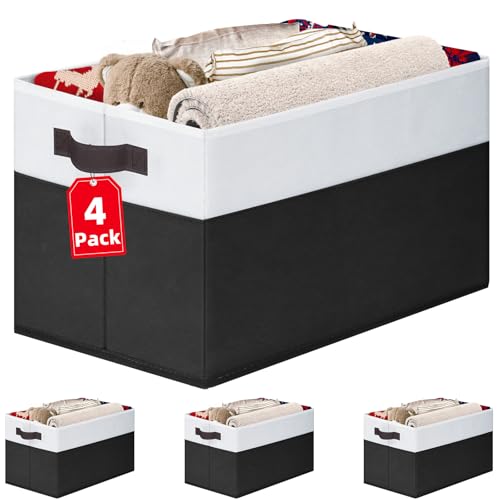
5. Criusia Large Storage Bins for Shelves, 4-Pack — Best Breathable Shelf Storage
Not every towel collection lives in a garage, and not every storage problem is dust-at-all-costs. In a linen closet or bedroom shelf system — where towels are washed constantly and the air is clean and dry — a breathable fabric bin is the kinder container: nothing seals, nothing sweats, and the towels come out smelling like the room instead of like a plastic box. The verified Criusia listing describes large storage bins for shelves in a 4-pack — collapsible fabric closet organizer bins with handles, with clothes, blankets, bedding, and towels among their stated uses. The handles make shelf retrieval civilized (pull the bin, take the towel, push it back), the collapsible build stores flat when a bin is out of rotation, and fabric sides will never snag a fiber the way a cracked rigid bin edge can. The discipline this pick requires is honesty about environment: fabric does not dust-proof, so it belongs in clean indoor closets, not garages and workshops.
Strengths
- Breathable fabric: no sealed-bin mildew risk for towels stored in clean, dry living spaces.
- Handles and shelf sizing make closet systems genuinely pleasant to use daily.
- Collapsible when empty; soft sides are gentle on fibers and on shelving.
Trade-offs
- No dust seal and no lid-first protection — wrong for garages, basements, and workshops.
- Fabric bins can absorb ambient odors over time; air them when you rotate towels.
- Less structure than rigid bins: overpacking distorts the shape and the system.
| Mini spec — as stated in the verified listing | |
|---|---|
| Type | Collapsible fabric storage bins with handles |
| Pack | 4-pack |
| Stated uses | Shelves, closet; clothes, blankets, bedding, towels |
| Brand | Criusia |
Choose this pick when your towels live where you live. It is the storage equivalent of a linen closet’s good manners — breathable, quiet, and exactly protective enough for a clean indoor environment. Households with scented-linen preferences will also notice that fabric bins let towels take on the room’s freshness in a way sealed plastic never permits.
Best for: linen closets, bedroom shelves, and bath/kitchen microfiber in living spaces. / Not suited for: garages, workshops, or any dusty environment.
Check the current price on Amazon

6. IRIS USA 54 Quart Storage Bins with Lids, Clear, 6-Pack — Best Bulk Storage
Every system needs an archive, and the verified IRIS 54-quart listing is this guide’s: storage bins with lids in a 6-pack, clear so contents are easy to find, nestable, and described for moving, blankets, clothing, and garage storage. Fifty-four quarts is the volume for the whole microfiber estate — the reserve stock, the seasonal rotation, the laundry-day surge when every towel you own is clean at once and the category bins overflow. Bulk storage has one rule the small systems do not: sort before you archive. A 54-quart bin of jumbled towels is a lint-and-grit exchange program; the same bin filled with one category, folded, is a warehouse. Used as the top of the system — categories flow from these archives into the 13-quart working bins — it is the piece that lets a serious collection breathe.
Strengths
- 54-quart capacity swallows the full collection, reserves, and laundry surges.
- Clear walls and lids keep the archive visible and dust-sealed like the rest of the IRIS system.
- Nestable empties and a 6-pack format suit garages and storage rooms.
Trade-offs
- Too big for daily grab-and-go; treat it as the archive tier, not the working tier.
- A full 54-quart bin of towels is a two-hand lift — shelve it low.
- Bulk invites jumble; the sort-before-archive rule is on you.
| Mini spec — as stated in the verified listing | |
|---|---|
| Capacity | 54 quart (per bin) |
| Pack | 6-pack |
| Construction | Clear plastic, with lids, nestable |
| Brand | IRIS USA |
Collections grow. When yours does, this is the ceiling that keeps growth from becoming chaos — buy it when the working bins start overflowing, not before, and label each archive bin with its category and the date it was packed, because an archive you cannot read at a glance is just a bigger pile with a lid on it.
Best for: large collections, reserves, and seasonal rotation. / Not suited for: daily access or small towel counts.
Check the current price on Amazon
Comparison Table of the Six Containers
| Pick | Badge | Key spec | Best for |
|---|---|---|---|
| IRIS USA 13 Quart, 4-Pack | Best Overall | Clear, lidded, nestable | One category per bin, most homes |
| Sterilite 6 Quart, 12-Pack | Best for Sorting | Small clear boxes, snap-on lids | Grade-by-grade sorting |
| YYXB 4 Quart, 8-Pack | Best Small and Handled | Latching, handled, clear | Kits for car and sink |
| AUD Goods Towel Locker | Best for Detailers | Breathable mesh towel bag, caddy | Mobile detailing |
| Criusia Fabric Bins, 4-Pack | Best Breathable Shelf | Collapsible fabric, handles | Linen closets, living spaces |
| IRIS USA 54 Quart, 6-Pack | Best Bulk | Large clear bins with lids | Archives and reserves |
Key Takeaways on Towel Storage
- Microfiber storage is contamination control: dust out, moisture out, grades separated, lint sources away.
- Clear plus lidded is the default formula — visibility without exposure — and the 13-quart bin is the category-sized unit.
- Sorting beats size: twelve small boxes protect a collection better than one big one.
- Breathability has its place — the detailer’s mesh bag and the closet’s fabric bin — but never as a license to store damp towels sealed.
- Every pick here was confirmed through Amazon’s catalog data, with capacities quoted exactly as listed.
- Storage is half of a loop whose other half is washing: separate loads, no fabric softener, complete drying, and a grade inspection at the fold.
- Keep one empty quarantine bin in the system — dropped, mystery, and new towels need somewhere to be decided about.
How to Choose a Container for Microfiber Towels
Start with where the towels actually live. Garage and workshop storage demands lidded rigid bins, full stop — airborne dust and grit are the enemy and only a lid wins. Indoor closet storage can trade the seal for breathability. Car storage wants the purpose-built caddy. Then size by category, not by collection. Count your towel grades — paint, glass, general, kitchen, bath, dirty-duty — and buy one container per grade at the working tier; a container that mixes grades is a contamination device with a lid. Then the lid question. Latching lids travel and stack best; snap-on lids open fastest on laundry day; fabric bins breathe best indoors. All three appear in this guide because all three jobs are real. Then transparency. Clear walls are a system feature: they let you audit the collection at a glance, spot the bin running low, and catch a misplaced dirty towel before it marinates. Opaque storage hides problems until they smell. Finally, plan the dirty side. Every microfiber system needs a designated dirty-towel container — ventilated, separate, and near the laundry — because dirty towels parked on top of clean ones undo the entire system in one gesture.
How to Set Up a Microfiber Storage System
Wash and fully dry every single towel before it enters the system — storage preserves condition, good or bad, so start clean. Fold towels flat and stack them by grade, plush sides protected; rolling wastes space in rigid bins, while flat folds stack into honest inventory. Label every lid or bin front with the grade and, if you are a detailer, the job it is reserved for; labels are what make the system survive other people’s help. Arrange the working bins where the work happens — detailing bins at bench height in the garage, kitchen bins under the sink, bath bins in the closet — because a system stored inconveniently becomes a pile within a month. Keep the dirty container ventilated and separate, and run the laundry loop on a schedule: dirty bin fills, wash, dry completely, restack, rotate the oldest towels to the front. Once a season, audit: demote worn towels to dirty-duty (mark an corner with a permanent marker so the demotion sticks), retire the hopeless, and wipe out the bins themselves — the inside of a towel bin accumulates the very dust the lid was keeping out, one opening at a time.
The Four Enemies of Stored Microfiber
Dust and grit arrive from the air and from neighboring storage; they embed in split fibers and turn towels into abrasives. Lids and distance from sanding, sawing, and sweeping zones are the defense. Moisture arrives as the towel put away “almost dry”; sealed in a bin it becomes mildew, and mildewed microfiber is retired microfiber. Dry fully, and when in doubt, drape it another hour. Lint arrives from cotton, terry, and paper products stored in contact; microfiber’s static-hungry surface harvests it, and linted towels smear glass and shed onto paint. Separate storage is the whole cure. Chemical cross-contact arrives via shared bins with bottles, tire dressings, and workshop solvents — and via fabric softener in the wash, which coats fibers and kills absorbency before storage even begins. Keep towels in towel-only containers, wash them without softener, and the four enemies reduce to a seasonal bin-wiping and a clear conscience.
Storage Systems by Household Type
The car detailer runs the strictest system because paint is unforgiving: grades separated in the Sterilite small boxes or the IRIS 13-quarts, a Towel Locker for the mobile session, a sealed dirty bin, and a hard rule that a dropped towel changes grade forever. The detailer’s storage budget is really a paint-protection budget, and it is the cheapest insurance in the hobby. The kitchen-and-bath household has a gentler problem: fewer grades (glass, general, bath), cleaner air, and faster wash cycles. The Criusia fabric bins in the linen closet plus one lidded IRIS bin for the reserve stock covers it, with a YYXB kit under each sink. The big-family laundry machine — sports kits, gym towels, cleaning towels in volume — needs throughput: the 54-quart archive for clean stock, working 13-quarts at point of use, and a dirty container big and ventilated enough to keep up with the week’s production. The small-apartment minimalist should resist systems entirely at first: one 13-quart lidded bin, one grade discipline (good towels, dirty-duty towels), and a kit box for the car. Storage you can see the bottom of beats storage you cannot, at every scale.
Folding, Packing, and Labeling: The Craft of the Bin
How towels enter the container decides how much fits and how it ages. Fold flat in thirds or quarters to a uniform footprint matched to the bin — uniform stacks compress evenly, waste no corners, and let you count inventory at a glance. Store plush towels with their plush face inward, protected from the bin’s edges and from the grit that settles on top of any stack; the top towel in every bin takes the dust that gets in, so rotate it to the wash first or keep a sacrificial older towel as the stack’s lid. Label with the grade, the date the batch entered service, and — for detailers — the jobs the grade is forbidden from. Marker on painter’s tape beats memory, and tape beats permanent marker when grades change. Pack to ninety percent: an overstuffed bin crushes loft and makes every retrieval a excavation, while a bin with air in it lets towels be taken and returned with one hand. Finally, keep one empty small bin in the system at all times — the quarantine box for the towel that fell in the driveway, the new purchase awaiting its first wash, the mystery towel nobody will claim. Systems fail at their exceptions; a quarantine box is where exceptions go to be decided.
Travel, Boats, and Small Spaces
Microfiber travels because it is light and dries fast, and its storage should travel the same way. The YYXB handled latch bins are the travel unit: one kit for the car (glass, interior, emergency), one for the boat or RV where towels double as everything. In RVs and small homes, vertical is the only direction — the Sterilite boxes stack into dead corners and under-bed gaps where a drawer system would never fit, and their clear walls matter doubly in dim storage bays. For gym and swim microfiber, the rule is a breathable pause between use and bin: hang the towel until dry, then kit it — the AUD Goods mesh principle applied at home. Vacation rentals and guest suites deserve a note too: a small lidded bin of microfiber in the rental’s cleaning closet protects both the property’s surfaces and your deposit, because the alternative — paper towels and mystery rags — is how glass stovetops get scratched by people who meant well.
When the Collection Outgrows the System
Microfiber collections grow by ones and twos — a sale here, a free towel with a product there — and systems fail gradually, then suddenly. The warning signs: a grade living in two places, a bin you must dig in, a towel whose grade nobody remembers, clean stock stored in the laundry basket because the bins are full. The fix is a one-hour reset, and it is cheaper than the towels it saves. Empty everything. Sort by grade with ruthless honesty — the towel with the melted edge and the one that smells faintly of tire dressing are dirty-duty now, whatever they once were. Count per grade; most households discover they own forty general towels and three glass towels, because purchasing follows enthusiasm rather than inventory. Re-bin by the counts you actually found, re-label, and set a buy rule: a new towel enters only when a resident towel is demoted or retired. Going forward, the archive bin absorbs growth in one grade at a time instead of letting it leak across the shelf. A system is not a purchase; it is this reset, repeated seasonally, with containers that make the reset easy — which is the deepest reason this guide favors clear, uniform, labeled boxes over every decorative alternative.
Container Materials and Lid Types, Decoded
Three materials do the work in this category, and each has a temperament. Rigid clear plastic — the IRIS, Sterilite, and YYXB picks — is the system material: stackable, wipeable, visible, dust-sealing, and dimensionally consistent across years of reorders, which is why two specialist brands dominate this guide. Its weaknesses are brittleness in deep cold and scratching under garage abuse, both cosmetic at towel weights. Fabric — the Criusia pick — is the furniture material: breathable, quiet, kind to shelves and fibers, and structurally humble; it organizes by presence rather than by seal. Mesh and soft organizers — the AUD Goods pick — are the transit material, trading protection for airflow and portability. Lids follow the same logic: latching lids for anything that moves or stacks high, snap-on lids for shelf boxes opened daily, no lid where breathability is the point and the environment is clean. A mixed system — rigid at the core, fabric in the closet, mesh on the road — is not indecision; it is each material doing the job its temperament suits, and it is what the six picks, taken together, describe.
The Wash-Day Loop: Where Storage Meets Laundry
Storage and washing are one system with two rooms, and the loop between them is where microfiber lives or dies. Out of the bin, a towel works; dropped or dirtied, it goes to the ventilated dirty container — never back to the clean bin, never draped over it “for later.” Wash day moves the dirty container to the machine: shake each towel outside first (the grit you shake out is grit your machine never pumps), wash microfiber separately from lint-shedders, skip fabric softener and dryer sheets, which coat the split fibers and quietly convert premium towels into ordinary rags. Dry completely — tumble low or line dry — and then the step everyone skips: let the towels cool and rest a few minutes before folding, and inspect as you fold. A towel that comes out of the dryer still holding a chemical smell changes grade; a towel with a pulled edge goes to the quarantine box; the rest return to their labeled bins, oldest stock rotated to the top. The loop takes minutes, and it is the entire difference between a collection that performs for years and a drawer of former microfiber. Storage, in other words, is not where towels wait between uses — it is where their quality is kept, and the containers in this guide are simply the loop’s most durable furniture.
What We Excluded, and Why
The also-rans deserve a paragraph, because their exclusions teach the criteria. Giant latching totes (the 30-gallon class) failed on category logic: they store everything and sort nothing, and a full one is a two-person lift of cross-contaminated towels. Open decorative baskets failed the dust test in any room with air movement, and several have rough interiors that snag loops. Vacuum storage bags failed on fiber physics: crushing microfiber flat for months mats the pile and the bags’ one virtue — compression — is a vice for a material whose loft is its function. Hanging organizers with clear pockets came closest to inclusion: they sort visibly and use door space beautifully, but their open pockets dust-expose the top rows and their pockets snag on removal; households in clean indoor spaces may still love them, and we would not argue. Cardboard, the default archive of every garage, failed on moisture and pests and deserves its disgrace. The six picks survived because each one protects the fibers’ working structure while keeping the system — sort, seal, see, retrieve — effortless enough to survive real life.
Common Buying Mistakes
- Buying one giant bin for everything. Jumbled grades cross-contaminate; sorting is the system, size is secondary.
- Storing towels damp in a sealed bin. The fastest mildew recipe in the category. Dry first, always, completely.
- Open baskets in the garage. They look organized and function as dust collectors aimed at your best towels.
- Storing microfiber against cotton and terry. Lint transfer is silent and one-directional; separate containers are the fix.
- No dirty-towel container. Without a designated dirty side, dirty towels land on clean ones and the system collapses socially before it collapses physically.
- Rough or cracked container interiors. Snags pull microfiber loops and start runs; inspect bins and retire the damaged ones to non-towel duty.
Final Recommendation for Your Towel System
Build the core system from the IRIS 13-quart 4-pack — one bin per towel category, lids labeled with grade and date. Add the Sterilite dozen when your grades multiply, the YYXB kits for cars and sinks, and the IRIS 54-quart archive when the collection outgrows the working tier. Detailers should add the AUD Goods Towel Locker as the mobile half of the system, and linen-closet households can run the Criusia fabric bins as the breathable indoor tier. For the towels themselves, see our guides to Best Microfiber Towels For Bath, Best Microfiber Drying Towels, Best Microfiber Quickdry Towels, and Best Microfiber Towels Travel Size.
Frequently Asked Questions
Practical answers about dust, damp, sorting, and the handful of storage decisions that decide whether microfiber stays microfiber.
Should microfiber towels be stored in airtight containers?
Lidded, yes; truly airtight, only when the towels are completely dry. A lid’s job is to keep dust out, and standard latching or snap-on lids do that without sealing in moisture. A damp towel in an airtight box is a mildew farm — dry towels fully first, and the lidded bins in this guide are the right home.
How many towels fit in a 13-quart bin?
It depends on towel size and plushness, but as a planning figure, a 13-quart bin comfortably holds a working category — roughly a dozen-plus standard detailing towels folded flat, or a smaller count of plush drying towels. The system’s point is one category per bin; if a category overflows a 13-quart, split it rather than stuffing it.
Can I store microfiber towels in the garage?
Yes — in lidded rigid bins, away from sanding, sawing, and chemical storage, ideally on a shelf rather than the floor. The garage is where the dust rules matter most, which is why open baskets and fabric bins are badged in this guide for indoor use only.
Should clean and dirty microfiber towels share a container?
Never. Keep a separate, ventilated dirty-towel container near the laundry. Dirty towels carry the grit and chemicals the clean system exists to exclude, and one dirty towel parked on clean stock can contaminate the whole stack’s next job.
Why do my stored microfiber towels smell musty?
Almost always moisture: towels stored before they were fully dry, or a bin kept in a humid space. Rewash, dry completely — longer than feels necessary — and air the bin itself before restocking. If a towel still smells after a proper hot wash and full dry, demote or retire it.
What is the best container for car detailing towels specifically?
At home, a lidded clear bin per grade — the IRIS 13-quart or the Sterilite small boxes — because paint towels need dust discipline above all. On the road, the AUD Goods Towel Locker, whose breathable mesh bag handles the session’s used towels while the caddy keeps bottles and clean stock organized. The two together are the complete detailer’s system.
How should I label my towel containers?
With the grade, the permitted jobs, and the date the batch entered service — marker on painter’s tape is enough. Labels are what let other people (and future you) run the system without a briefing, and they are what make a dropped or contaminated towel’s demotion permanent instead of negotiable.
Does microfiber need to be stored away from other fabrics?
Yes, particularly cotton and terry, which shed lint that microfiber’s split fibers grab and hold. Separate containers — or at minimum separate bins within the same shelf system — keep microfiber performing like microfiber instead of like a lint roller.


