Disclosure: airfryerkitchensupply.com is reader-supported. When you buy through links on our site, we may earn an affiliate commission at no extra cost to you.
Where to buy
Every rug in this guide to the best rugs for wood decks is sold on Amazon, and every product link below points to a listing we confirmed through Amazon’s own catalog data before writing. Prices on outdoor rugs swing with the season, so we do not print fixed prices here — use the “Check on Amazon” link under any pick to see the current price for the size and color you want. If a pick is out of stock in your size, the buying-guide sections further down explain exactly what to look for in a substitute, because on a wood deck the wrong rug material does more damage than no rug at all.
- MontVoo Outdoor Rug, Waterproof, 5×8 ft — Check on Amazon
- Fab Habitat Outdoor Rug, Lhasa Green, 4×6 ft — Check on Amazon
- BalajeesUSA Outdoor Rug, 5×7, Black — Check on Amazon
- GlowSol Waterproof Outdoor Rug, 8×10 ft — Check on Amazon
- KANAGAWA Reversible Outdoor Rug, 6×9 ft — Check on Amazon
- Pauwer Waterproof Outdoor Rug, 9×12 ft — Check on Amazon
Introduction: a wood deck is the hardest surface to put a rug on
If you are shopping for the best rugs for wood decks, you are solving two problems at once. The first is comfort and looks: a rug softens a hard deck, defines a seating or dining zone, and keeps bare feet off boards that bake in the afternoon sun. The second problem is the deck itself. Wood — and wood-look composite — is a breathing, moving, moisture-sensitive surface. A rug that traps water against it, leaches dye into it, or grinds grit across its finish can stain, soften, or scar decking that costs far more than any rug on this page. That is why this guide is deliberately narrow. Every pick below is a woven plastic-straw or recycled-plastic outdoor rug, the one rug family that sheds water instead of absorbing it, has no rubber or latex backing to trap moisture or react with deck finishes, and can be hosed off and stood up to dry. You will not find indoor-outdoor carpet tiles, natural-fiber jute, or foam-backed mats here, and the buying guide explains why each of those is a poor bet on wood.
We also want to be straight about one thing up front: no rug is “set and forget” on a wood deck. Even the most deck-friendly woven plastic rug slows evaporation underneath it, so the honest routine — lift it after heavy rain, let the boards dry, sweep grit out from under it — matters as much as which rug you buy. The picks below were chosen to make that routine as easy as possible: they are light for their size, they fold or roll without cracking, and none of them needs a separate rug pad, which is another moisture trap we recommend skipping on wood.
In this guide
Quick Picks
- Best Overall — MontVoo Outdoor Rug, Waterproof, 5×8 ft: the reversible plastic-straw rug that fits the most decks, light enough to lift after every storm. Check on Amazon
- Best for Pattern and Recycled Plastic — Fab Habitat Outdoor Rug, Lhasa Green, 4×6 ft: a premium recycled-plastic weave with a genuine kilim-style pattern for smaller, style-led decks. Check on Amazon
- Best Budget — BalajeesUSA Outdoor Rug, 5×7, Black: recycled plastic straw at an entry-level tier, with a bold reversible black pattern. Check on Amazon
- Best Large Coverage — GlowSol Waterproof Outdoor Rug, 8×10 ft: a big reversible plastic-straw mat that anchors a full dining set without overwhelming the lifter. Check on Amazon
- Best Portable — KANAGAWA Reversible Outdoor Rug, 6×9 ft: ships with a carry bag, folds flat, and moves between deck, campsite, and picnic duty. Check on Amazon
- Best Extra-Large — Pauwer Waterproof Outdoor Rug, 9×12 ft: the biggest footprint here, with a leaf pattern that hides the debris wood decks constantly collect. Check on Amazon
How These Picks Were Chosen
We started with one hard filter: the rug had to be a woven plastic construction — polypropylene plastic straw or recycled plastic — with no absorbent pile and no rubber, latex, or foam backing. That single rule eliminated most of the outdoor rug market, including many products marketed as “indoor/outdoor” that are really indoor rugs with a weather-resistant spray. From the survivors, we confirmed each product against Amazon’s catalog data, checking that the listing title, material description, and size matched what we intended to recommend; only confirmed listings received product links. We then balanced the six slots across the ways people actually use deck rugs: an everyday mid-size, a design-led small rug, a budget option, two large formats for dining and lounge zones, and one portable rug for renters and campers. Finally, we weighted handling — weight, foldability, how fast the weave sheds water — because on a wood deck you will move this rug often, and a rug that is a chore to lift is a rug that stays down wet, which is exactly the failure mode this guide exists to prevent.
The 6 Best Rugs for Wood Decks

1. MontVoo Outdoor Rug, Waterproof, 5×8 ft — Best Overall
The MontVoo 5×8 is the rug we would hand to most wood-deck owners first. Its woven plastic-straw construction is the deck-safe formula in its most proven form: water runs through and off the weave instead of soaking in, there is no backing layer to glue itself to a warm deck finish, and the whole rug is light enough that one person can flip it over the railing to dry after a storm. The 5×8 footprint is the sweet spot for a bistro set, a pair of lounge chairs with a side table, or the landing zone at the top of deck stairs. It is reversible, so when one face fades or gets tired you can turn it over and effectively get a second season’s look out of the same purchase.
Strengths
- Woven plastic-straw surface sheds rain instead of absorbing it, so it dries fast and never gets waterlogged and heavy.
- No rubber or latex backing — nothing to trap moisture against boards or react with deck stain and sealant.
- Reversible pattern doubles the styling life of the rug and spreads sun exposure across both faces.
Trade-offs
- Plastic straw feels firm and slightly springy underfoot, not plush — this is a functional deck surface, not a barefoot-luxury carpet.
- The woven edges can curl in the first days out of the package; they settle flat with furniture weight and sun warmth, but it is not instant.
- At 5×8 it is too small to sit under a six-person dining table with chairs pulled out — size up to the 8×10 or 9×12 picks for that job.
| Mini spec — as stated in the verified listing | |
|---|---|
| Size | 5 x 8 ft |
| Construction | Woven plastic straw, waterproof, reversible |
| Stated uses | Patio, RV, camping, picnic, beach, balcony, porch, deck |
Underfoot, the MontVoo behaves like a good deck rug should: chairs slide without catching, the weave gives just enough texture to keep wet feet from skating, and dropped crumbs and leaf litter sit on top of the weave where a broom or hose clears them in seconds instead of grinding into a pile. That last point matters more on wood than anywhere else, because grit trapped under a rug is sandpaper against your deck finish every time someone walks across it. A rug you can shake out in ten seconds is a rug whose underside stays clean, and a clean underside is what protects the boards.
Best for: most wood decks, everyday seating zones, and owners who want one proven rug and no drama. / Not suited for: anyone wanting a soft, cushioned, carpet-like feel underfoot.
Check the current price on Amazon

2. Fab Habitat Outdoor Rug, Lhasa Green, 4×6 ft — Best for Pattern and Recycled Plastic
Most plastic-straw rugs look like what they are: practical mats with striped or geometric patterns. The Fab Habitat Lhasa is the exception in this lineup — a genuine vintage-style kilim pattern woven from premium recycled plastic, in a green colorway that sits naturally against wood tones. At 4×6 ft it is sized for the jobs small rugs do best on a deck: under a two-chair coffee setup, in front of a porch swing, at the door to catch the worst of the grit before it reaches the house, or layered as the patterned centerpiece of a larger seating arrangement. The listing confirms the deck-friendly essentials — waterproof, fade resistant, crease-free, and reversible — so the style does not come at the cost of the construction rules this guide is built on.
Strengths
- Real woven pattern rather than a printed design, so it reads as a textile rug from normal viewing distance.
- Premium recycled plastic construction keeps the same water-shedding, no-backing, deck-safe profile as every pick here.
- Fade-resistant and crease-free per the listing — it unrolls flat and keeps its color in sun-exposed spots.
Trade-offs
- The 4×6 size is a accent rug, not a zone rug — measure before assuming it will anchor a seating group.
- It sits at a premium tier relative to basic plastic-straw mats of similar size; you are paying for pattern and material quality.
- The detailed pattern shows pale debris and pollen more than a plain mid-tone weave would.
| Mini spec — as stated in the verified listing | |
|---|---|
| Size | 4 x 6 ft |
| Construction | Premium recycled plastic, waterproof, reversible |
| Pattern | Vintage Boho Kilim — Lhasa, Green |
| Stated uses | Patio, deck, porch, balcony, laundry room |
Where the Fab Habitat earns its place is longevity of looks. Cheap printed outdoor rugs fade into a ghost of themselves by midsummer; a woven pattern carries its design in the strands themselves, and the listing’s fade-resistant claim plus the reversible face give this rug two presentable sides for years of deck seasons. If your deck is visible from the street or is where guests gather, this is the pick that does not make you apologize for choosing plastic.
Best for: smaller decks, entry zones, and anyone who wants the deck-safe construction without the picnic-mat look. / Not suited for: covering a large deck area on a budget.
Check the current price on Amazon
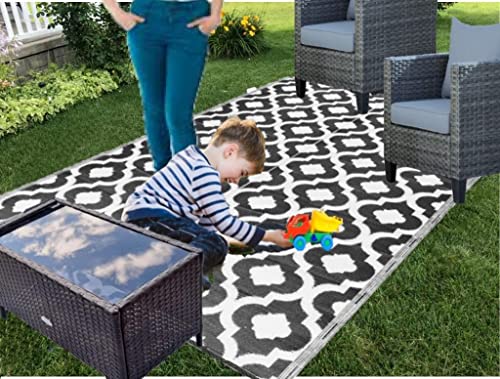
3. BalajeesUSA Outdoor Rug, 5×7, Black — Best Budget
The BalajeesUSA 5×7 covers the same deck-safe ground as the MontVoo — reversible recycled plastic straw, waterproof, made to be hosed down and hung to dry — at an entry-level tier that makes it the lowest-risk way to try a rug on a wood deck. The black colorway is a deliberate recommendation, not an accident: dark weaves hide the gray weathering dust, pollen film, and leaf stains that wood decks shed constantly, and the reversible face gives you a second pattern when the first gets tired. The 5×7 size suits a grill station, a four-chair café set, or the high-traffic lane between the door and the stairs.
Strengths
- Recycled plastic straw construction — the same moisture-safe formula as the premium picks, at a budget tier.
- Dark, reversible pattern hides deck dust and stains between cleanings better than pale rugs.
- Light and foldable; easy to pull up before a forecast storm and shake out over the railing.
Trade-offs
- Black weave gets noticeably warm in direct afternoon sun — less pleasant for bare feet at peak heat than lighter colors.
- The weave and edge finishing are a step simpler than the Fab Habitat; expect tidy and functional, not refined.
- Budget plastic-straw rugs can arrive with fold creases that need a day or two of sun and furniture weight to relax.
| Mini spec — as stated in the verified listing | |
|---|---|
| Size | 5 x 7 ft |
| Construction | Recycled plastic straw, reversible, waterproof |
| Color | Black |
| Stated uses | Patio, RV camper, large outdoor mats |
Think of this pick as the deck-rug experiment that costs little to run. If you have never kept a rug on wood and are unsure about the maintenance rhythm — lift after rain, sweep beneath weekly — the BalajeesUSA lets you learn the habit on a rug that forgives neglect better than most and costs the least to replace if your deck turns out to be a rug-hostile environment of shade and standing water.
Best for: first-time deck-rug owners, grill and traffic zones, and tight budgets. / Not suited for: sun-blasted decks where bare feet meet the rug at midday.
Check the current price on Amazon

4. GlowSol Waterproof Outdoor Rug, 8×10 ft — Best Large Coverage
An 8×10 is the size that turns a deck from a walkway into a room: a six-seat dining table with chairs that stay on the rug when pulled out, or a sofa-and-loungers conversation set with room to walk around it. The GlowSol covers that footprint in the same deck-safe woven plastic straw as the rest of this guide, reversible, waterproof, and stated UV-resistant in the listing — the quality that decides whether a big rug still looks intentional in August. The brown and coffee colorway is a wood-deck natural, echoing deck stain tones so the rug reads as part of the structure rather than a mat dropped on it.
Strengths
- True room-defining size: dining chairs stay on the rug through a whole meal, which also keeps chair feet from scuffing the same boards daily.
- UV-resistant per the listing — important at this size, because a faded 8×10 is impossible to ignore.
- Reversible faces let you alternate patterns season to season and spread wear.
Trade-offs
- Size cuts both ways: an 8×10 holds more rain against the deck than a 5×8, so the lift-and-dry routine after storms is non-negotiable.
- One person can move it, but folding and carrying it is a two-minute job, not a ten-second one.
- On a narrow deck it can crowd the edges — leave a border of bare board around it for airflow and looks.
| Mini spec — as stated in the verified listing | |
|---|---|
| Size | 8 x 10 ft |
| Construction | Reversible outdoor plastic straw, waterproof, UV-resistant |
| Color | Brown / Coffee |
| Stated uses | Patio, camping, porch, RV, deck, picnic, beach, balcony |
The hidden benefit of the big rug on wood is protection: the highest-wear square footage of any deck is exactly where dining chairs scrape and shuffle. A sacrificial woven-plastic layer takes that abrasion instead of your finish — as long as you keep the grit swept out from underneath it, which the care section below turns into a two-minute habit.
Best for: dining decks and full lounge setups on medium-to-large wood decks. / Not suited for: small decks, or owners who know they will never lift a rug after rain.
Check the current price on Amazon

5. KANAGAWA Reversible Outdoor Rug, 6×9 ft — Best Portable
The KANAGAWA is the rug for people whose deck is one of several outdoor floors in their life. It folds down small, comes with a carry bag (confirmed in the listing), and is stated UV resistant and waterproof in a woven plastic-straw build — so it can live on the deck all week, then travel to a campsite, a picnic, or a rented beach house on the weekend and come back without drama. The 6×9 size is the in-between footprint that suits a four-person dining set or a pair of loungers, and the black-and-white pattern is the crispest, most modern look in this guide.
Strengths
- Carry bag included and genuinely foldable — the only pick here designed around being moved constantly.
- Plastic-straw weave shrugs off deck rain, campsite dirt, and picnic spills with the same hose-down cleanup.
- Reversible black-and-white pattern gives a bold face and a calmer inverted face in one rug.
Trade-offs
- Frequent folding is its party trick, but fold lines can linger for a while after unpacking; lay it in sun to relax them.
- High-contrast black-and-white shows every leaf and crumb — you will sweep it more often than the mid-tone picks.
- If it never leaves your deck, you are paying a small premium for portability you do not use; the MontVoo is the stay-home value.
| Mini spec — as stated in the verified listing | |
|---|---|
| Size | 6 x 9 ft |
| Construction | Plastic straw, waterproof, UV resistant, reversible |
| Included | Carry bag |
| Color | Black & White |
| Stated uses | Patio, camping, RV, balcony, backyard |
Renters should pay special attention to this one: a rug you can fold into a bag is a rug that leaves with you, and on a rented deck the woven-plastic formula also protects you from being blamed for moisture marks — provided you still lift it after rain, because no landlord accepts “the rug was waterproof” as an explanation for a stained deck.
Best for: renters, campers, and multi-use households that move their outdoor gear around. / Not suited for: a permanent, plush lounge look that never moves.
Check the current price on Amazon

6. Pauwer Waterproof Outdoor Rug, 9×12 ft — Best Extra-Large
Some decks are genuinely big — wraparound entertaining decks, pool-adjacent wood platforms, multi-zone layouts with dining at one end and loungers at the other. The Pauwer 9×12 is built for them: the largest footprint in this guide, in the same waterproof plastic-straw weave, reversible, and stated UV resistant. Its leaf pattern in brown is more than decoration on a wood deck. Decks live under trees, and trees drop things constantly; a busy botanical pattern camouflages the leaf litter, seed pods, and pollen dust that make a plain rug look dirty a day after cleaning.
Strengths
- 9×12 coverage unifies a multi-zone deck so furniture groupings read as one designed space.
- Leaf pattern hides the exact debris wood decks collect, stretching the time between cleanings.
- Same deck-safe formula as every pick: waterproof plastic straw, no backing, hose-clean.
Trade-offs
- The largest moisture footprint here — the lift-and-dry discipline matters most with this rug, especially in shaded corners.
- Heavier and bulkier to handle; plan on two people for the seasonal deep clean and storage roll.
- On anything but a genuinely large deck it will swallow the space and leave no bare-board border.
| Mini spec — as stated in the verified listing | |
|---|---|
| Size | 9 x 12 ft |
| Construction | Plastic straw, waterproof, reversible, UV resistant |
| Pattern | Leaf, Brown |
| Stated uses | Deck, camper, porch, balcony, backyard, picnic |
If your deck hosts the neighborhood, this is the rug that keeps a dozen guests’ chairs, coolers, and foot traffic on a sacrificial surface instead of your boards. Pair it with the care routine below and it will outlast several sets of the deck furniture sitting on it.
Best for: large entertaining decks and tree-covered decks where debris is constant. / Not suited for: small or shaded, slow-drying decks where a huge rug would stay damp underneath.
Check the current price on Amazon
Comparison Table
| Pick | Badge | Key spec | Best for |
|---|---|---|---|
| MontVoo Outdoor Rug 5×8 | Best Overall | Plastic straw, waterproof, reversible | Everyday seating zones on most decks |
| Fab Habitat Lhasa 4×6 | Best Pattern / Recycled Plastic | Recycled plastic kilim weave, fade resistant | Small decks and style-led entry zones |
| BalajeesUSA 5×7 Black | Best Budget | Recycled plastic straw, reversible | Grill stations, traffic lanes, first deck rug |
| GlowSol 8×10 | Best Large Coverage | Plastic straw, UV-resistant, reversible | Dining sets and full lounge groupings |
| KANAGAWA 6×9 | Best Portable | Plastic straw, carry bag included | Renters, campers, multi-use households |
| Pauwer 9×12 | Best Extra-Large | Plastic straw, leaf pattern, UV resistant | Big entertaining decks under trees |
Key Takeaways
- On wood, material matters more than style: woven plastic straw or recycled plastic is the deck-safe family; absorbent piles and rubber backings are the risk.
- Every pick here is backing-free, waterproof, and reversible — water passes through and dries instead of sitting against your boards.
- No rug is maintenance-free on a deck. Lift after heavy rain, sweep grit from underneath weekly, and the rug protects the deck instead of harming it.
- Size to the furniture, not the deck: chairs should stay on the rug when pulled out, with a border of bare board left around the edges.
- Skip the rug pad. On wood it is one more moisture-holding layer between rug and boards.
- Buy for the wear points — dining chairs, the grill, the door lane — rather than covering every board; targeted coverage protects the finish with the smallest possible moisture footprint, and it is cheaper to buy, lighter to lift, and faster to clean at season’s end.
How to Choose a Rug for a Wood Deck
Start with the material rule. A wood deck needs a rug that behaves like a screen, not a sponge. Woven polypropylene — sold as plastic straw, plastic weave, or recycled plastic — lets rain drain through, dries in hours, and has no backing to trap a film of water against the finish. Avoid three things: natural fibers like jute and sisal, which absorb water and hold it against the boards while they slowly rot; indoor rugs with latex or rubber backing, which can trap moisture and, on some finishes and composites, leave permanent marks; and anything with a foam or felt underside, which is a moisture reservoir by design. If a listing does not clearly state an all-plastic woven construction, treat it as not deck-safe and move on.
Then size honestly. Measure the furniture grouping, not the deck. A dining rug needs roughly two extra feet on every side of the table so chairs stay on it when pulled out — that is why 8×10 and 9×12 exist. A conversation set needs the rug under at least the front feet of every seat. And always leave a visible border of deck around the rug: it looks better, it lets the perimeter boards dry at full speed, and it keeps the rug from funneling water off its edge into one soaked line of decking.
Judge the weave and the edges, not the photo. In a woven plastic rug, quality shows in how tight and even the weave is and how the perimeter is finished. A tight weave lies flatter, sheds debris instead of swallowing it, and resists the snagging that starts a run in the strands. Loose, sloppy weaves feel softer in the product photo and worse in every real month after. Edges matter because they are where these rugs fail first: look for a bound or heat-finished border rather than a raw cut edge, and expect any rug to need a day of sun and furniture weight to unlearn its packaging folds. A rug that still curls at the corners after a week of summer heat is a trip hazard at the exact place guests step — send it back rather than weighting it with planters, which just create new moisture rings on the boards.
Plan the exit before you buy. Every deck rug eventually comes up: for winter, for re-staining the deck, for the deep clean. Ask how this specific rug folds or rolls, whether one person can carry it at the size you chose, and where it will live for four months of the year. The KANAGAWA’s carry bag is the extreme version of this thinking, but the principle applies to the 9×12 too — a rug with no storage plan becomes a rug that stays down through winter by default, which is how decks get hurt. Measure your storage space with the same tape you measured the deck.
Think about color as maintenance.
Mid-tones and busy patterns hide deck dust; black weaves run hot in sun; pale weaves show pollen and leaf tannins. On a wood deck under trees, pattern is a practical feature, not just taste — the Pauwer’s leaf design and the Fab Habitat’s kilim both earn their keep this way. Finally, weigh the handling: you will lift this rug after storms and at season’s end, so a weight and fold you can manage alone is a genuine buying criterion, not an afterthought.
How to Set Up and Care for a Rug on a Wood Deck
Setup takes ten minutes and decides how the next years go. It also decides whether the rug spends its life protecting the finish or quietly working against it, so do not rush this part even though every step is simple. First, sweep and wash the deck area and let it dry completely — never lay a rug over damp or gritty boards, because you are sealing that grit against the finish. Unroll the rug and let it relax in the sun for an hour; plastic-straw weaves soften slightly with warmth and lie flatter. Position it with its border of bare board, then set furniture on it rather than dragging pieces across the weave. Do not add a rug pad, tape, or adhesive of any kind — on wood, all three hold moisture or leave residue.
The care rhythm is simple. After heavy rain, lift one long edge, prop it over a railing or chairs, and let both the rug underside and the boards dry before laying it flat again; on a sunny, breezy day this takes a couple of hours. Once a week in leaf season, fold the rug back halfway and sweep underneath — grit removal is the single highest-value habit in this guide. For cleaning, shake the rug out, hose it down on the deck or driveway, use a soft brush and mild soap on stains, rinse, and hang it over the railing until dry on both sides. At season’s end, clean it, dry it fully, roll or fold it, and store it somewhere dry; storing a damp plastic rug is how you get a musty rug and a pointless problem. Never use a pressure washer at close range on the weave, and keep the rug clear of fire pits and grill flare-ups — plastic straw is durable against weather, not against embers.
Wood vs. Composite Decks: What Actually Changes
Everything in this guide was written for real wood — cedar, redwood, pressure-treated pine, and hardwoods like ipe — because wood is the surface with the most to lose. Wood absorbs water, swells, checks, and grows mildew in damp shade, and its stains and sealers are the finishes most easily marked by a bad rug choice. If your deck is composite or PVC capped board, the rules relax in one direction and tighten in another. Composites do not rot and are far less bothered by a week of damp underneath a rug, so the lift-after-rain routine can be a lift-after-the-season-is-turning routine instead. But composite manufacturers have long warned about rubber- and latex-backed mats: plasticizers in some backings can migrate into the cap layer and leave a permanent ghost of the mat’s shape. That is a second, independent reason the backing-free woven plastic picks in this guide are the safe default — they are the one construction that is kind to both surfaces. Heat is the other composite consideration: dark boards and dark rugs together can make a surface genuinely uncomfortable at midday in southern summers, so the lighter faces of the reversible picks earn their keep there.
There is one more surface worth naming: the painted deck. Paint is the most fragile deck finish of all, and a rug that is safe on sealed wood can still lift peeling paint simply by holding moisture at a weak edge. If your deck paint is already blistering, fix the paint first and keep any rug off it until the coating has fully cured — then use the smallest pick that does the job and lift it most often of all.
Placement Patterns That Protect the Decking
Where the rug sits matters almost as much as what it is made of. The classic mistake is wall-to-wall coverage: a rug that spans nearly the whole deck leaves no fast-drying margin, channels its runoff onto one strip of boards, and hides the deck’s condition from you for months. The patterns that work keep three features. First, a perimeter border of bare board — even six inches changes how the covered area dries. Second, alignment with the sun: a rug placed where afternoon sun actually reaches it dries itself; the same rug in the permanent shade of the house side is the one to lift most often and size smallest. Third, traffic logic: put rugs where feet and chair legs actually concentrate — under dining sets, at the door, at the grill, at the stair landing — and leave the low-traffic boards bare, because every covered square foot is a square foot you have agreed to maintain.
Layering deserves a honest word, because it looks good in magazines: a small patterned rug like the Fab Habitat over a large plain weave can work on a deck, and both layers here are plastic, so neither absorbs water. But two layers dry slower than one, and the interface between them is one more place grit hides. If you layer, treat the pair as a single rug for maintenance purposes — lift both, sweep both, dry both — and do not layer over a pad or a natural-fiber base rug, which quietly reintroduces every problem this guide removed.
Finally, think about what the rug is protecting the deck from. On most decks the real finish-killers are chair feet, grill drips, planter rings, and the grit lane from the yard to the door. A modest rug placed exactly on those pressure points — the BalajeesUSA under the grill zone, the MontVoo under the dining set — delivers most of the protection of a giant rug at a fraction of the moisture footprint. Buy coverage for the wear, not for the photograph.
The Alternatives, Honestly Assessed
Plastic-straw rugs are not the only things people put on wood decks, and a fair guide should say what the alternatives do well and where they fail. Natural-fiber rugs — jute, sisal, seagrass — look beautiful against wood for about one dry month. Then they drink the first storm, hold the water against the boards, mildew in the shade, and start to break down; they belong on covered porches that never see rain, not open decks. Outdoor carpet and carpet tiles feel softer and warmer than woven plastic, and low-pile polypropylene carpet is not automatically deck-hostile — but most of it is sold with backings, adhesives, or interlocking foam layers that trap exactly the moisture and grit this guide avoids, and it dries far more slowly than an open weave. If you go that route, choose a backing-free, drain-through product and accept a heavier maintenance rhythm. Foam deck tiles and EVA mats are comfortable and modular, and they are also moisture sandwiches: water migrates under them and sits there invisibly, which is the worst configuration of all for wood. Bare deck with good deck furniture pads is the zero-risk option nobody wants to hear about: felt or plastic glides under chair feet, a grill mat that you pick up after every cookout, and a door mat you shake daily will protect the highest-wear spots with no standing moisture footprint at all. If your deck is shaded, north-facing, and slow to dry after rain, that honest answer may beat any rug — buy one of the smaller picks for the sunniest zone only, and keep the rest bare.
One more alternative is worth a sentence: deck stain and finish upgrades. A rug is partly a cosmetic device — it covers boards that have grayed or stained unevenly. If that is your real motivation, price a weekend of cleaning and re-staining against years of rug maintenance; sometimes the deck itself is the better purchase, and a small accent rug like the Fab Habitat then finishes the job instead of carrying it.
Common Buying Mistakes
- Buying an indoor rug “for outdoor use.” A spare bedroom rug on a deck absorbs rain, stays wet for days, and holds that water against the wood. If it is not all-plastic woven construction, it does not belong on decking.
- Adding a rug pad for comfort. Pads trap moisture and grit against the finish — the two things this whole guide is designed to avoid. Plastic-straw rugs are firm; accept the trade or choose a different deck surface.
- Sizing to the deck instead of the furniture. A rug that ends exactly at the table edge leaves chair legs half on, half off, rocking and scraping the same boards every meal.
- Leaving the rug down all winter. Months of trapped moisture and freeze-thaw under an unmoved rug is the fastest route to discolored, softened boards. Roll it up for the wet season.
- Choosing pale colors under trees. Leaf tannins and pollen will win. Pattern and mid-tones are the low-maintenance choice on a wood deck.
- Ignoring the underside. The damage rugs do to decks happens underneath, out of sight. If you will not lift and sweep, buy the smallest rug that does the job — or none.
Final Recommendation
For most wood decks, start with the MontVoo 5×8: it is the proven, deck-safe formula in the most useful size, at a mainstream tier. If your deck is a dining deck, step up to the GlowSol 8×10, or the Pauwer 9×12 for genuinely large, tree-covered spaces. Choose the Fab Habitat Lhasa when looks lead, the BalajeesUSA when budget leads, and the KANAGAWA when the rug needs to travel. Whichever you pick, keep the lift-and-dry habit and the rug will protect your deck instead of quietly damaging it. For more outdoor rug angles, see our guides to Best Pool Deck Rugs, Best Outdoor Rugs That Can Get Wet, Best Durable Outdoor Rugs, Best Outdoor Rugs For Rain And Mud, and Best Recycled Plastic Outdoor Rugs.
Frequently Asked Questions
Will an outdoor rug damage a wood deck?
It can, if it is the wrong kind or never moves. Absorbent rugs and rubber-backed rugs trap moisture against the boards and can cause discoloration and softening. A woven plastic rug that you lift after heavy rain and sweep under weekly is the low-risk option — the routine matters as much as the rug.
What is the safest rug material for wood decking?
Woven polypropylene — plastic straw or recycled plastic — with no backing. It drains instead of absorbing, dries quickly, and does not react with deck finishes. Avoid jute, sisal, cotton, and foam- or latex-backed rugs on wood.
Should I put a rug pad under an outdoor rug on a deck?
No. On a wood deck a pad is another layer holding moisture and grit against the finish. Woven plastic rugs stay in place under furniture without one. If the rug creeps on an empty deck, furniture placement or a different size is a better fix than a pad.
How often should I lift a rug on a wood deck?
After any heavy rain, and at least every week or two in the season, fold it back and let the boards dry and get swept. In shaded, slow-drying spots, check underneath more often — if the boards feel damp hours after the rug top is dry, lift it that day.
Can I leave a plastic-straw rug out all winter?
The rug itself will survive, but the deck underneath may not thank you: months of trapped moisture and debris are hard on wood. Clean it, dry it fully, and store it rolled in a dry place; your deck gets a season to breathe and the rug lasts longer too.
Are plastic-straw rugs slippery when wet?
Less than bare wet wood, in our assessment. The woven texture gives wet feet something to grip, and water drains through the weave instead of sheeting across the surface the way it does on sealed decking. Smooth-soled shoes on a steep, wet, shaded deck still deserve care — no rug changes physics — but a woven plastic rug is a net improvement over slick boards, which is one reason they are popular around pools and on boat decks.
How do I clean a plastic-straw deck rug?
Shake it out, hose it down, scrub stains with a soft brush and mild soap, rinse, and hang it over a railing until both sides are dry. That is the whole routine — no special cleaners, and no pressure washer at close range.


