Disclosure: airfryerkitchensupply.com is reader-supported. When you buy through links on our site, we may earn an affiliate commission at no extra cost to you.
Where to buy
The fastest way to buy any pick in this guide to the best slippers for disabled is through Amazon, where sizing, colour and stock are shown on the listing itself. Use the links below to go straight to each verified product page and check price on Amazon before you order — we do not print static prices here because they change too often to stay honest.
- Orthofeet Asheville Men’s House Slippers (Brown) — Best Overall: Check the current price on Amazon
- Orthofeet Charlotte Women’s Slippers (Taupe) — Best for Women: Check the current price on Amazon
- Ravelier Men’s Adaptive Wide Width Slipper Shoe (Black) — Best Extra-Wide Fit: Check the current price on Amazon
- Dearfoams Women’s Leslie Washable Memory Foam Terry Clog (Iceberg) — Best Washable Pick: Check the current price on Amazon
- Dearfoams Men’s Brendan Memory Foam Clog (Black Perforated) — Best Breathable Pick: Check the current price on Amazon
- Alpine Swiss Wide Men’s Moccasin Slippers (Steve) — Best Moccasin Style: Check the current price on Amazon
Finding the best slippers for disabled wearers is less about softness and more about independence: the right pair goes on without bending double, stays on without gripping with the toes, and grips the floor without catching on it. This guide was built around those three jobs. Every candidate had to be a genuine house slipper — no sandals, no slides, no novelty footwear — and every product named here was verified against Amazon’s own catalogue data before it earned a link.
The six picks below split into two camps. Hands-free slip-on designs from Orthofeet and Alpine Swiss suit wearers who cannot reach their feet easily or who use a shoe horn or long-handled aid. Adjustable and wide-width designs from Ravelier and Dearfoams suit wearers whose feet change volume during the day, who wear socks or braces, or who need a carer to help the slipper on and off. All six use closed or closable uppers rather than backless scuffs wherever possible, because a slipper that slides off mid-transfer is a fall risk, not a comfort feature.
One honesty note before the picks: slippers are comfort footwear, not medical devices. Nothing in this guide claims to treat, correct or prevent any condition. Where a manufacturer’s own product name uses clinical words, we repeat the name only so you can find the exact listing; the buying advice here is strictly about fit, closures, soles and day-to-day practicality. If a clinician has specified particular footwear features for you, match these picks against that specification first.
Who is this guide for, exactly? Three readers, mainly. First, disabled wearers shopping for themselves, who need honest notes on entries and closures rather than lifestyle photography. Second, family members and carers buying for someone else, who need to know which designs can be put on another person’s foot without a struggle — the Ravelier and the two Orthofeet models are your shortlist. Third, anyone coming home after a hospital stay or a period of reduced mobility, who needs a safe, easy pair quickly and does not want to research footwear from scratch. If you are buying for someone else, one extra step is worth it: ask the wearer to rank entry, warmth and looks before you order, because the ‘best’ pick changes with the answer — and returns are far easier when only one variable was wrong.
A final note on dignity, because it decides whether any of this gets used: the best-designed adaptive slipper fails if the wearer dislikes how it looks and quietly stops wearing it. Every pick here was chosen to look like ordinary, respectable house footwear first and adaptive equipment second. Involve the wearer in the choice whenever you can — colour, style, moccasin versus clog — because a slipper chosen is a slipper worn, and a slipper worn is the entire point.
Key Takeaways
- Hands-free slip-on designs and adjustable straps matter more than cushioning alone when bending, gripping or balancing is difficult.
- A closed heel, a wide toe box and a firm non-slip rubber sole are the three safety features to check first on any listing.
- Every pick below was cross-checked against Amazon listing data; only listing-confirmed listings carry a buying link.
- Order the size you would wear in a closed shoe, and use the strap or closure to fine-tune the fit rather than sizing down.
In this guide
Quick Picks
Best Overall — Orthofeet Asheville Men’s House Slippers (Brown). A hands-free, adjustable slip-on in faux fur with a wide toe box and arch-supporting footbed — the most complete independence package here for men. — check price on Amazon
Best for Women — Orthofeet Charlotte Women’s Slippers (Taupe). The women’s counterpart to the Asheville: hands-free entry, adjustable fit, faux fur and a wide toe box in a taupe slip-on. — check price on Amazon
Best Extra-Wide Fit — Ravelier Men’s Adaptive Wide Width Slipper Shoe (Black). An adaptive, adjustable slipper-shoe in a true wide width with memory foam, a non-slip indoor/outdoor sole and a machine-washable build. — check price on Amazon
Best Washable Pick — Dearfoams Women’s Leslie Washable Memory Foam Terry Clog (Iceberg). A wide-width terry clog with memory foam that goes in the washing machine — the practical choice when hygiene and easy care come first. — check price on Amazon
Best Breathable Pick — Dearfoams Men’s Brendan Memory Foam Clog (Black Perforated). A perforated, breathable memory-foam clog in wide widths — the cooler option for men whose feet overheat in lined slippers. — check price on Amazon
Best Moccasin Style — Alpine Swiss Wide Men’s Moccasin Slippers (Steve). A wide-fit corduroy moccasin with memory foam, terry lining and a non-slip rubber sole — traditional looks with a roomier fit. Note: the Amazon title for this listing is truncated, so we describe only what the verified portion confirms. — check price on Amazon
How These Picks Were Chosen
Each candidate was checked the same way. First, the product was searched by brand and model on this site’s own Amazon connection, and the returned title had to match the slipper we intended to describe — no match, no link. Second, the listing was screened for the features that matter to disabled wearers: a closure or hands-free entry, width options, a closed or secure heel, a rubber outsole with tread, and a low, stable profile. Backless fashion scuffs, thin fabric hotel-style slippers and anything pitched mainly with medical promises were cut.
Third, duplicates were removed: colour and size variants of the same slipper count as one pick, so the six slots go to six genuinely different designs. Fourth, we favoured slippers a wearer can manage seated — pull-on from a chair, fasten with one hand, or step into without hands — because that is how slippers are actually put on in most households. Finally, prices were deliberately left off this page: they move too often to print honestly, so each pick links to its live listing where you can check price on Amazon.
The 6 Best Slippers for Disabled Wearers, Reviewed

Orthofeet Asheville Men’s House Slippers (Brown) — Best Overall
The Asheville is built around the two problems that make ordinary slippers hard work: getting them on, and keeping them on. The hands-free slip-on entry means the wearer can step in from a seated or standing position without reaching down, and the adjustable fit lets the upper be snugged or loosened as feet change through the day. The wide toe box leaves room for socks, toe separators or simply feet that should not be squeezed.
Strengths
- Hands-free slip-on entry — no bending or pulling required
- Adjustable fit accommodates volume changes and thicker socks
- Wide toe box and faux-fur lining for a roomy, warm fit
Trade-offs
- Men’s sizing only in this listing; women should look at the Charlotte below
- Faux fur lining runs warm in summer months
- Costs sit in the premium tier for house slippers
| Entry style | Hands-free slip-on |
| Closure | Adjustable |
| Toe box | Wide |
| Lining | Faux fur |
| Listing size shown | Men’s 10, Brown |
What separates the Asheville from a generic wide slipper is the combination rather than any single feature. The supportive footbed gives the arch something to rest on during short household walks, the cushioned sole softens hard kitchen and bathroom floors, and the closed construction means the slipper travels with the foot instead of trailing behind it. For a wearer with limited reach, limited grip strength, or a carer helping from the front, that combination is the difference between footwear that helps and footwear that has to be managed. It is also a sensible choice after foot surgery recovery periods at home — with the obvious caveat that your own clinician’s footwear instructions always come first.
Day to day, the Asheville also behaves well on the surfaces that cause trouble: the sole grips laminate and tile without the squeak-and-stick of soft foam soles, and the closed toe protects against furniture legs and door frames. Care is simple — air them out overnight rather than leaving them by a radiator, which hardens linings. If the wearer splits time between two rooms, this is the pair worth duplicating rather than carrying from room to room, because a slipper that is not within reach does not get worn.
Best for: men who need step-in entry, an adjustable fit and a secure closed slipper for all-day indoor wear / Not suited for: hot sleepers, or anyone who specifically wants a backless scuff

Orthofeet Charlotte Women’s Slippers (Taupe) — Best for Women
The Charlotte applies the same independence-first formula as the Asheville in women’s sizing. The hands-free slip-on design lets the wearer step in without stooping, the adjustable upper handles days when feet are more swollen than others, and the wide toe box avoids the pinch that makes narrow women’s slippers unwearable by mid-afternoon. The taupe colour is forgiving about household dust and pairs with most loungewear.
Strengths
- Hands-free entry suits limited reach or balance
- Adjustable fit for day-to-day volume changes
- Wide toe box with soft faux-fur cushioning
Trade-offs
- One colour in the verified listing
- Warm lining is a winter-weight choice
- Premium-tier pricing for the category
| Entry style | Hands-free slip-on |
| Closure | Adjustable |
| Toe box | Wide |
| Lining | Faux fur |
| Listing size shown | Women’s 9, Taupe |
Women’s slippers are often cut narrower than the equivalent men’s last, which is exactly why the Charlotte’s wide toe box matters in practice. The supportive insole and cushioned construction make it a realistic all-day house shoe rather than a bedroom-only slipper, and the closed heel keeps it in place on stairs and during transfers from chair to standing. If the wearer uses a wheelchair footrest for part of the day, the closed back also stops the slipper slipping off onto the floor unnoticed — a small detail that saves a carer several retrievals a day.
The Charlotte’s taupe faux fur hides everyday marks better than pale colours, which matters for a slipper worn all day rather than just at bedtime. The cushioning is tuned for standing tasks — making tea, sorting post, watering plants — rather than pure lounging, so it suits wearers who are up and down frequently. Pair it with the size chart rather than a usual shoe size: Orthofeet’s women’s lasts are generous, and the adjustable fit rewards choosing the chart size and closing the upper down rather than sizing up speculatively.
Best for: women who want step-in convenience with room for socks and daily fit adjustment / Not suited for: wearers who prefer an open summer slipper

Ravelier Men’s Adaptive Wide Width Slipper Shoe (Black) — Best Extra-Wide Fit
The Ravelier is the most overtly adaptive design in this roundup: a slipper built like a shoe, in a wide width, with an adjustable opening that lets the foot be placed in rather than pushed in. That matters for wearers with very wide feet, for feet dressed with bandages or bulky socks, and for carers who put the slipper on someone else — the opening does the work instead of force.
Strengths
- True wide-width last with an adjustable, easy-entry opening
- Non-slip indoor/outdoor sole for trips to the door or bin
- Memory foam cushioning and machine-washable construction
Trade-offs
- The verified listing is a very large size (15W); check the size run on the listing
- Shoe-like looks will not suit everyone
- Breathable upper is less warm than fleece-lined rivals
| Width | Wide (adaptive fit) |
| Closure | Adjustable |
| Sole | Non-slip, indoor/outdoor |
| Care | Machine washable |
| Listing size shown | Men’s 15W, Black |
Adaptive footwear lives or dies on the entry, and the Ravelier’s is the easiest in this guide for a second person to manage: open it up, place the foot, close it down. The memory foam bed and breathable upper keep it comfortable for long seated stretches, and the sole is grippy enough for tiled floors and short outdoor errands. Because the verified listing we checked was an extra-large wide size, treat the size selector on the Amazon page as part of the purchase — the design is sold across a size run, and the right width matters more than the right length here.
Because the Ravelier opens so completely, it is also the easiest pick here to inspect before putting on — a quick shake-out for anything that has fallen inside, which is a genuine routine for households with pets or grandchildren. The breathable upper makes it the best summer option among the structured picks. One practical tip: fasten the closure to the same mark each time for the first week. Consistent tension teaches everyone involved — wearer and carer alike — what ‘right’ feels like, and drift from that mark is an early signal that feet have changed volume.
Best for: very wide feet, carer-assisted dressing, and wearers who need a slipper that opens right up / Not suited for: anyone wanting a plush, fleece-lined winter slipper

Dearfoams Women’s Leslie Washable Memory Foam Terry Clog (Iceberg) — Best Washable Pick
The Leslie is a clog-style slipper in soft terry with memory foam cushioning, offered in wide widths, and — the feature that earns its badge — it is washable. For households where slippers get heavy daily use, where continence or wound care makes frequent washing a fact of life, or where a carer manages laundry, a slipper that survives the machine beats a delicate one every time.
Strengths
- Machine-washable terry upper for easy hygiene
- Wide widths available in a simple clog entry
- Memory foam cushioning at a mid-range tier
Trade-offs
- Clog back is lower than a full closed heel — less secure for some wearers
- Terry is a warm, absorbent fabric that dries slowly
- Less structured support than the Orthofeet picks
| Style | Clog |
| Upper | Terry |
| Widths | Wide widths offered |
| Care | Washable |
| Listing size shown | Women’s Medium, Iceberg |
Think of the Leslie as the workhorse pick. The clog shape slides on quickly from a seated position, the wide fit avoids squeezing, and when the pair gets grubby it goes in with the towels. The honest limitation is security: a clog’s open back is fine for confident walkers but is not the best choice for anyone whose slippers tend to slip off, shuffle on stairs, or catch during transfers. Pair it with the closed-back options above if the wearer splits time between a favourite chair and short, supervised walks.
The Leslie’s terry upper absorbs small spills instead of letting them run onto the floor, an underrated safety feature in kitchens. Wash it on a gentle cycle and air-dry; tumble heat shortens the life of memory foam. Households running a two-pair rotation will find the Leslie washes and dries on the same rhythm as bath towels, which keeps the system effortless. If the wearer finds the clog back slipping on carpet edges, that is the cue to move this pair to single-floor, hard-floor duty and use a closed-back pick elsewhere.
Best for: easy-care households that wash slippers often and want a wide, simple clog / Not suited for: wearers who need a fully closed, stay-on heel
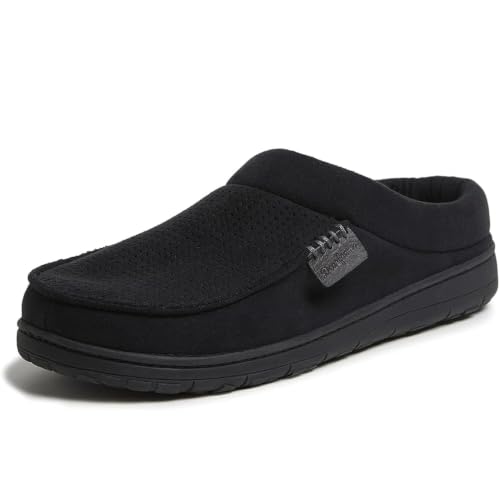
Dearfoams Men’s Brendan Memory Foam Clog (Black Perforated) — Best Breathable Pick
Not every disabled wearer wants a warm slipper. The Brendan is a clog in a perforated, breathable build with memory foam cushioning, offered in wide widths, aimed at men who find fleece-lined slippers uncomfortably hot or whose feet sweat in enclosed footwear. The clog entry keeps putting them on simple, and the perforations move air where lined models trap it.
Strengths
- Perforated breathable upper for warm feet and warm homes
- Wide widths in an easy clog entry
- Memory foam footbed for cushioned short walks
Trade-offs
- Clog back is open — not the most secure fit here
- Breathable build offers little insulation in cold houses
- Less adjustment than strap-closed rivals
| Style | Clog |
| Upper | Perforated, breathable |
| Widths | Wide widths offered |
| Footbed | Memory foam |
| Listing size shown | Men’s Large, Black Perforated |
The Brendan earns its place as the warm-weather and warm-foot option. In heated homes, feet in lined slippers can end up damp, and damp feet slide inside footwear — a subtle safety issue. A breathable clog avoids that cycle while keeping the wide, easy entry this category needs. As with the Leslie, judge the open back honestly: confident indoor walkers will be fine, while anyone unsteady should start with the closed, adjustable picks at the top of this list and treat the Brendan as a summer second pair.
Heat management is the Brendan’s whole argument, and it holds up: perforations over the top of the foot vent the warm air that lined slippers trap, so feet stay drier through a long evening. The perforated build also makes it the fastest-drying pick here after a spill. It is the one to pack for hospital or respite stays in warm wards, where a wide, easy clog in a breathable fabric is far more comfortable than the alternatives — check the sole is clean before ward floors, as with any footwear brought from home.
Best for: men with warm or sweaty feet who want a wide, breathable clog / Not suited for: cold houses, or wearers who need a closed heel

Alpine Swiss Wide Men’s Moccasin Slippers (Steve) — Best Moccasin Style
Some wearers simply want a slipper that looks like a slipper. The Alpine Swiss Steve is a classic moccasin in corduroy with a terry lining and memory foam footbed, cut in a wide fit with a non-slip rubber sole for indoor and light outdoor use. The slip-on moccasin entry has no straps to manage, which suits wearers who can use a shoe horn or a heel loop pull but struggle with fastenings.
Strengths
- Classic moccasin looks in a genuinely wide fit
- Memory foam cushioning with a terry lining
- Non-slip rubber sole for indoor/outdoor use
Trade-offs
- No adjustable closure — fit depends on choosing the right size
- Slip-on entry needs more foot mobility than hands-free rivals
- Corduroy upper is a casual, warm-leaning fabric
| Style | Moccasin slip-on |
| Upper | Corduroy |
| Lining | Terry |
| Sole | Non-slip rubber, indoor/outdoor |
| Fit | Wide |
The Steve is the style-first pick that still respects the category’s rules: wide fit, cushioned bed, grippy sole, closed toe. It asks a little more of the wearer at entry than the hands-free Orthofeet designs, so it suits someone whose limitation is width, swelling-prone feet or general comfort rather than reach. The manufacturer’s listing for this line mentions room for feet that swell; we have kept our description to the construction features the listing-verified title confirms, and the wide last is the part you can verify yourself with a tape measure against the size chart.
Moccasin styling carries one more practical benefit: the Steve looks appropriate if the doorbell rings, which sounds trivial until you realise how many wearers avoid answering the door in slippers that feel like nightwear. The corduroy upper shrugs off light marks, and the terry lining is a middle path — warmer than the Brendan’s perforations, cooler than full fleece. Keep a shoe horn at the usual chair; with that one aid, the slip-on entry becomes a two-second job and the Steve’s lack of adjustment stops mattering.
Best for: wearers who want traditional moccasin styling with a wide, cushioned fit / Not suited for: anyone who cannot manage a standard slip-on entry
Comparison Table
| Pick | Badge | Key spec | Best for |
|---|---|---|---|
| Orthofeet Asheville Men’s House Slippers (Brown) | Best Overall | Hands-free slip-on, adjustable, wide toe box | men who need step-in entry, an adjustable fit and a secure closed slipper for all-day indoor wear |
| Orthofeet Charlotte Women’s Slippers (Taupe) | Best for Women | Hands-free slip-on, adjustable, wide toe box | women who want step-in convenience with room for socks and daily fit adjustment |
| Ravelier Men’s Adaptive Wide Width Slipper Shoe (Black) | Best Extra-Wide Fit | Adaptive wide width, adjustable, machine washable | very wide feet, carer-assisted dressing, and wearers who need a slipper that opens right up |
| Dearfoams Women’s Leslie Washable Memory Foam Terry Clog (Iceberg) | Best Washable Pick | Washable terry clog, wide widths, memory foam | easy-care households that wash slippers often and want a wide, simple clog |
| Dearfoams Men’s Brendan Memory Foam Clog (Black Perforated) | Best Breathable Pick | Breathable perforated clog, wide widths | men with warm or sweaty feet who want a wide, breathable clog |
| Alpine Swiss Wide Men’s Moccasin Slippers (Steve) | Best Moccasin Style | Wide moccasin, memory foam, rubber sole | wearers who want traditional moccasin styling with a wide, cushioned fit |
What Makes a Slipper Disability-Friendly?
Strip away the marketing and four construction features do almost all of the work. The first is entry: a slipper that can be put on seated, ideally hands-free or with a wide-opening adjustable top, removes the daily bend-and-pull that excludes so many standard designs. The second is retention: a closed heel or a strap that genuinely holds, so the slipper cannot slide off during a transfer or on a stair. The third is the sole: rubber, treaded, low and stable, with no high or narrow heel profile. The fourth is volume: a wide toe box and an upper with some give, so the fit survives socks, braces and ordinary daily changes in foot size.
Notice what is not on that list: extreme softness. Very soft, unstructured slippers feel lovely for ten minutes in a shop and then collapse sideways in use, which is the opposite of what an unsteady wearer needs. A firm-ish footbed with moderate cushioning, inside a structured upper, is the safer everyday combination. When you compare listings, read the construction details in that order — entry, retention, sole, volume — and let everything else be a tiebreaker.
Closures Compared: Hands-Free, Straps and Plain Slip-Ons
Hands-free designs, like the two Orthofeet picks, use a structured heel that the foot slides past and then holds. They are the fastest option and the best for limited reach, but the fit is fixed by size, so accurate sizing matters. Adjustable closures — straps and wide-opening uppers like the Ravelier’s — trade a few seconds of fastening for a fit that can change with the foot; they are the most forgiving option for carers and for feet whose volume varies. Plain slip-ons and clogs are the simplest of all, but they rely on the wearer’s foot shape to stay in place, which is why this guide reserves them for breathable and washable roles rather than the top spots.
Grip strength is the hidden variable. A strap that needs two hands and real pinch force is not an accessible closure, whatever the listing says. If the wearer has limited hand function, prioritise hands-free entry or a single large strap that can be pressed down with a palm. Trying the closure seated, one-handed, before the returns window closes is a five-minute test that saves a great deal of frustration.
Sizing and Fit Checks That Actually Work
Measure feet at the end of the day, when they are at their largest, and measure both — the difference between feet is often bigger after illness, injury or long seated periods. Compare against the brand’s own size chart rather than your usual shoe size, because slipper lasts vary more than shoe lasts. If the wearer uses thick socks, an ankle brace or a splint, measure with those on. Between sizes in an adjustable design, take the larger size and close the strap down; between sizes in a fixed hands-free design, follow the brand’s guidance for that model rather than a general rule.
Once the pair arrives, run three checks. The heel check: walking a few steps on a hard floor, the heel should not lift out. The toe check: there should be room to wiggle toes without the upper pressing down on them. The seated check: with feet on the floor or on wheelchair footrests, the slipper should stay put when the foot is lifted and replaced. A pair that fails any of the three goes back, however comfortable it felt in the chair.
Slippers, Safety and the Home Environment
Most indoor falls involve a small cast of repeat offenders: loose backless footwear, socks on hard floors, trailing flexes and rushing. The right slipper addresses the first two directly — a closed, treaded slipper is meaningfully grippier than socks and far more secure than a scuff. Keep the pair by the bed or the chair so they are the default, not an option across the room. On stairs, a closed heel matters most; if the wearer’s slippers are clogs, consider keeping the closed pair for stair use and the clogs for single-floor living.
Also think about thresholds and rugs. Very thick, plush soles can catch on rug edges and door bars; the low, stable soles in this guide are partly chosen for that reason. If a new pair feels ‘trippy’ on a particular rug, that is useful information, not a breaking-in problem — change the rug or the slipper before it becomes an incident.
How to Put On and Adjust Slippers With Limited Mobility
A calm, seated routine makes any of these picks easier and safer. Set it up once and it becomes automatic.
- Sit in a firm chair with armrests, feet flat on the floor, and the slippers placed directly in front of the feet — not under the chair and not across the room.
- For hands-free designs, slide one foot forward into the slipper using the floor for leverage, then press the heel down gently until it seats. Repeat with the second foot before standing.
- For adjustable designs, open the closure fully before the foot goes in. Place the foot, then close the strap with a palm press rather than a pinch grip if hand strength is limited.
- For carer-assisted fitting, open the slipper completely, guide the foot in from the front, and check the heel is fully seated before fastening — most ‘tight slipper’ complaints are actually a heel that never went all the way in.
- Stand while holding the armrests, take two or three steps on the spot, and check heel lift and toe pressure before walking away.
- Re-check strap tension after the first hour of wear and again in the evening; feet change, and a thirty-second adjustment keeps the fit honest.
- Keep a long-handled shoe horn by the chair if entries feel tight — it converts most slip-ons into near-hands-free footwear.
Store the pair in the same place every night, soles down and closures open, so the morning routine needs no searching, bending or improvisation.
When to Ask for Professional Footwear Advice
Slippers solve everyday comfort and convenience; they do not solve feet that are changing. If swelling is new, one-sided or rapidly increasing, if skin breaks down, if a slipper that fitted last month no longer fits, or if falls or near-falls are happening even in good footwear, that is information for a clinician, a podiatrist or an occupational therapist — not for a bigger slipper size. The same applies after surgery or a new diagnosis that affects circulation or sensation: ask what footwear features are recommended, then use this guide’s framework — entry, retention, sole, volume — to match products to that advice.
For wearers with professional input already in place, the practical move is to take the recommended feature list to the listings above and check them off literally. Adjustable uppers, wide toe boxes, closed heels and treaded soles are all verifiable from a product page; claims beyond construction are not, and this guide has deliberately not relied on any. Good footwear support at home is mostly a logistics problem — the right pair, in the right place, in the right size — and that is a problem you can fully solve.
Care, Rotation and Knowing When to Replace
Two pairs in rotation last longer than two pairs bought in sequence, because foam needs a rest day to recover its loft and linings need time to dry fully between wears. Alternate days if the budget allows, and keep both pairs in the same spot so the rotation never depends on memory. Air slippers overnight in the open rather than in a closed cupboard, and keep them away from direct radiator heat, which stiffens soles and cracks linings faster than wear does.
Washable models like the Dearfoams Leslie can go through a gentle machine cycle; for the others, a damp cloth on the upper and a brush on the sole tread is the weekly routine that keeps grip honest — compacted dust in the tread is a common, invisible reason a good sole starts to slide on tile. Check the inside of the heel monthly for wear-through, since a collapsed heel counter quietly turns a secure slipper into a sloppy one.
Replace on condition, not on calendar. The three retirement signals are a sole that looks polished rather than patterned, cushioning that stays compressed after a night’s rest, and an upper that has stretched enough for the foot to move sideways inside it. For full-time wearers, expect to judge a pair against those signals every few months. A fresh pair that passes the heel, toe and seated checks is a small purchase compared with the confidence a secure slipper returns to every trip across the room.
What the Different Price Tiers Actually Buy
This guide does not print prices — they change too often — but the tiers in this category are consistent enough to describe. Budget-tier slippers buy softness and basic warmth, usually with fixed sizing and thinner soles. The mid tier adds the features this category actually needs: wide widths, washable builds and memory foam, which is where the Dearfoams picks sit. The premium tier, where the Orthofeet and Ravelier designs live, buys structure: hands-free or fully opening entries, adjustable fits that stay adjusted, and soles built for all-day indoor use. For a wearer who depends on slippers as their main footwear at home, the premium features are functional, not decorative — but a mid-tier second pair for rotation is money better spent than a second premium pair.
Common Buying Mistakes
Buying backless scuffs for an unsteady wearer. Scuffs and slides rely on toe-gripping to stay on. For anyone with reduced sensation, weakness or a shuffling gait, that is an accident pattern, not a style choice. Choose a closed heel or a secure strap.
Judging by softness alone. The softest slipper in the shop is usually the least supportive by week three. A structured upper and a firm-cushioned footbed outlast marshmallow foam and keep the foot centred on the sole.
Ignoring the closure test. An adjustable strap only helps if the wearer can actually work it. Test every closure one-handed, seated, before deciding — and favour palm-press straps over fiddly fastenings.
Forgetting socks, braces and swelling. A slipper fitted to a bare morning foot may be unwearable by evening. Size for the foot as it will actually be worn, with the socks or supports the wearer uses daily.
Keeping worn-smooth soles. Tread wears invisibly. Check soles monthly against a new pair’s grip; once the tread looks polished on hard floors, replace the slippers rather than waiting for a slip.
Final Recommendation
If you buy one pair from this guide, make it the Orthofeet Asheville for men or the Orthofeet Charlotte for women: hands-free entry, an adjustable fit and a wide toe box cover the widest range of needs in a single design. For very wide feet or carer-assisted dressing, the Ravelier’s opening upper is the most practical tool here. Households that wash slippers constantly should add the Dearfoams Leslie as the rotating second pair, warm-footed wearers will live in the Brendan, and anyone who simply wants a proper moccasin that respects a wide foot should look at the Alpine Swiss Steve.
Whichever you choose, buy from the verified listing, run the three fit checks on day one, and use the returns window without sentimentality if a check fails. The best slippers for disabled wearers are the ones that go on easily, stay on securely and get worn every day without a second thought.
Shortlist again: Orthofeet Asheville Men’s House Slippers (Brown), Orthofeet Charlotte Women’s Slippers (Taupe), Ravelier Men’s Adaptive Wide Width Slipper Shoe (Black), Dearfoams Women’s Leslie Washable Memory Foam Terry Clog (Iceberg), Dearfoams Men’s Brendan Memory Foam Clog (Black Perforated), Alpine Swiss Wide Men’s Moccasin Slippers (Steve).
Related guides on this site: Best Slippers For Edema · Best Arch Support Slippers Mens · Best Allday Comfort Slippers · Best Big And Tall Slippers · Best Bedroom Slippers For Grandma
Frequently Asked Questions
Can these slippers be put on without bending down?
The two Orthofeet picks use a hands-free slip-on entry designed to be stepped into, and adjustable models like the Ravelier open wide enough to place the foot in while seated. A long-handled shoe horn by the chair makes almost any other pick here manageable without bending.
Are wide-width slippers worth it if my feet are not wide?
If the wearer uses thick socks, a brace or a splint, or their feet swell during the day, the extra volume is what keeps the slipper wearable from morning to evening. If none of that applies, a standard width in the right size is fine — width is a tool, not an upgrade.
Which pick is best for a carer to put on someone else?
The Ravelier. Its upper opens right up, so the foot can be placed rather than pushed, and the closure fastens over the top. The adjustable Orthofeet models are the next easiest for assisted fitting.
How do I know if the heel is secure enough?
Walk a few steps on a hard floor: the heel should not lift out or slap. Then lift each foot as if onto a wheelchair footrest — the slipper should travel with the foot. If it hangs or drops, choose a more closed design.
Can these slippers be worn outside?
Several picks here have indoor/outdoor rubber soles suitable for short trips — taking out bins, stepping onto a patio. They are still house slippers: for longer outdoor walking, proper shoes with a structured sole are the safer tool.
How often should slippers be replaced?
Check the tread and the footbed monthly. When the sole looks polished, the cushioning feels packed flat, or the upper has stretched so the foot slides, it is replacement time — for daily wearers that is often sooner than people expect.
Should slippers be worn with socks?
That is a fit question, not a rule. If the wearer normally wears socks indoors, size and adjust the slipper with those socks on, and prefer natural-fibre socks that do not slide inside the slipper. If the wearer goes barefoot, washable or easily aired models like the Dearfoams Leslie and the breathable Brendan keep the inside of the slipper fresher for longer.
What if the wearer uses a wheelchair most of the day?
Prioritise a closed heel and a sole that will not catch on footrests — the Orthofeet models and the Ravelier are the natural shortlist. Check that the slipper stays on when feet are lifted onto the rests, and that the sole’s edge does not drag on the footrest during transfers. Warmth matters more for seated wearers, since feet move less; the faux-fur lined picks earn their keep here.

