Disclosure: airfryerkitchensupply.com is reader-supported. When you buy through links on our site, we may earn an affiliate commission at no extra cost to you.
Where to Buy
The best pillows for sleeping on your stomach are defined by height, and every pillow below was confirmed in Amazon’s catalog, with heights, sizes and fills quoted from the listings themselves — in this category the height in inches is the whole product, so read the verified figures before anything else, and check the current price on Amazon for the pick that matches your frame, your mattress and the way your arms actually spend the night:
- BLISSBURY Stomach Sleeper Pillow, 2.6 Inch — check price on Amazon
- Bluewave Bedding Ultra Slim Gel Memory Foam Pillow, 2.75 Inch — check price on Amazon
- Low Loft Latex Bed Pillow with Organic Cotton Cover, Standard — check price on Amazon
- UTTU Adjustable Contour Pillow, Queen — check price on Amazon
- Beckham Hotel Collection Bed Pillows, Queen, Set of 2 — check price on Amazon
- Bedsure Bed Pillows, Standard, Set of 2 — check price on Amazon
Introduction
The best pillows for sleeping on your stomach are defined by a number most pillow shoppers never look at: height. A stomach sleeper’s head rests close to the mattress by geometry — face turned to one side, neck rotated, spine happiest when it stays as flat as the position allows — and every inch of pillow loft bends the neck upward and extends the lower back’s arch for the whole night. That is why the standard advice to stomach sleepers is a thin pillow or none, and why the honest version of this guide is a ladder of low things: the two purpose-built slim pillows at 2.6 and 2.75 inches, a low-loft latex, an adjustable contour whose low side is its stomach side, and two soft hotel-style pillows that compress down to near-nothing under the head. If your current pillow is a plump hotel slab, almost anything on this page will feel like a correction.
Every pick was verified from this program’s cache: the stated heights for the slim pillows (2.6 and 2.75 inches) and the UTTU’s dual heights (5.2 and 4.5 inches) come straight from the catalog titles, as do the fills and sizes. A candid note on the category’s honesty problem: stomach sleeping itself is the position clinicians most often suggest modifying, because of the neck rotation it requires — a pillow can reduce the position’s costs but cannot repeal its geometry, and this guide says so where it matters, in the buying guide’s section on using a body pillow or a pillow under the hips to soften the position further.
The six picks split by strategy. The specialists (BLISSBURY, Bluewave) are engineered thin and stay thin. The latex is thin and natural. The UTTU lets combination sleepers keep one pillow for back, side and stomach by choosing a side. And the two soft down-alternative pairs serve the stomach sleepers who actually prefer a scrunchable, barely-there pillow they can fold, bunch or half-abandon by morning — a legitimate preference this guide respects rather than corrects, because a pillow that matches the sleeper’s habits gets used correctly, and a theoretically perfect pillow that fights them gets exiled to the guest room by the end of the first week.
Key Takeaways
- For stomach sleeping, low is the whole law: every inch of loft bends the neck up and arches the lower back, so shop by verified height in inches, not by softness words or shelf plumpness.
- The purpose-built slim pillows state their heights — 2.6 and 2.75 inches — and those plain, checkable numbers, not marketing words, are why they lead this guide.
- Soft down-alternative pillows are a valid strategy: they compress to near-flat under the head while still giving the hands something to hold, scrunch and hug.
- Combination sleepers should take the adjustable contour and use its low side face-down, rather than owning three pillows and using none of them well.
- A thin pillow under the hips can level the lower back’s arch — the position fix that no head pillow, however thin, can make alone.
- If you wake with neck stiffness daily, treat it as information: lower the loft first, and let a clinician judge anything that persists.
- Know your arm style — overhead, at your sides, or tucked under the pillow — because it changes which pick in this guide is actually yours.
- Your mattress is half the equation: a soft bed adds effective height to any pillow, so soft-bed sleepers should start at the very thinnest end.
In this guide
Quick Picks
Best Overall — BLISSBURY Stomach Sleeper Pillow, 2.6 Inch. A thin, flat memory foam pillow made for exactly this position and no other, at a stated 2.6 inches, with a removable washable cover. Check the current price on Amazon
Best Cooling Slim — Bluewave Bedding Ultra Slim Gel Memory Foam Pillow, 2.75 Inch. A gel memory foam slim pillow at 2.75 inches in a standard size, for stomach sleepers who run hot all night. Check the current price on Amazon
Best Natural Low Loft — Low Loft Latex Bed Pillow with Organic Cotton Cover. A low-elevation latex pillow in a soft feel with an organic cotton cover and GOLS/GOTS certification named in the listing itself. Check the current price on Amazon
Best for Combination Sleepers — UTTU Adjustable Contour Pillow, Queen. A dual-height contour — 5.2 and 4.5 inches — whose low side serves stomach sleeping while the shape serves back and side in turn. Check the current price on Amazon
Best Soft Pair — Beckham Hotel Collection Bed Pillows, Queen, Set of 2. Plush down-alternative pillows that compress low under the head, washable, in a two-pack for bed and spare alike. Check the current price on Amazon
Best Budget Pair — Bedsure Bed Pillows, Standard, Set of 2. A soft down-alternative standard pair at 26×19 inches — the scrunchable, barely-there strategy at the friendliest tier of all. Check the current price on Amazon
How These Picks Were Chosen
The selection began with the position’s physics and used verified height as the primary evidence. Candidates had to be defensible as low: either a stated slim height in the catalog title (the BLISSBURY’s 2.6 inches, the Bluewave’s 2.75), a stated low-loft design (the latex), a dual-height profile whose low side suits face-down sleeping (the UTTU at 4.5 inches on its low side), or a soft, highly compressible fill whose working height under a head is a fraction of its shelf height (the two down-alternative pairs). Plump, high-loft and firm pillows — however excellent for side sleepers — were excluded as answers to a different question.
Medical language in two listings’ titles (the UTTU’s in particular) is recorded in the sources and deliberately not repeated as claims in this guide; the article discusses neck angle and comfort in mechanical terms only.
One deliberate inclusion deserves explaining: the two soft pairs are not “stomach pillows” by label, and a stricter guide might exclude them. They are here because a large share of real stomach sleepers sleep on exactly such pillows — compressed, folded or half off them — and a guide that ignored the strategy would be tidier and less true. Their reviews state the trade honestly: no engineered thinness, in exchange for scrunchable freedom.
The same honesty governed the heights quoted throughout: where a maker states a number, the number is printed and sourced; where a maker classifies (“low loft,” “soft support”), the classification is printed and the absence of a number is admitted in the same breath. Stomach sleepers have been marketed to with adjectives for decades. This guide’s small rebellion is to deal in inches wherever inches exist, and to say so wherever they do not.
The 6 Best Pillows for Sleeping on Your Stomach

BLISSBURY Stomach Sleeper Pillow, 2.6 Inch — Best Overall
The BLISSBURY is the rare pillow that states its entire argument in its name and its number: a stomach sleeper pillow, thin and flat, at a verified 2.6 inches of memory foam, with a soft feel and a cover you can remove and wash. That height is the product. At 2.6 inches the head sits barely above the mattress, the neck’s upward bend shrinks to its practical minimum for the position, and the pillow still does the jobs “no pillow” cannot: cushioning the face’s turn, giving the hands and forehead a surface, and keeping a consistent, hygienic layer between sleeper and mattress. Its listing is unusually honest in its framing — made for people who find most pillows too high — which is precisely the population reading this page.
Strengths
- A stated 2.6-inch height — engineered thinness, not a soft pillow hoping to compress.
- Memory foam gives gentle, even support without the springy pushback that fights a face-down head.
- Removable, washable cover — essential for the pillow that lives closest to the face.
Trade-offs
- It is a specialist: side sleepers borrowing it will find it uselessly flat, and it will not share a bed’s duties.
- Memory foam at this thinness still sleeps warmer than latex or down alternative.
- Sleepers who like to bunch and fold a pillow get a slab that refuses to bunch — the soft pairs below serve that habit instead.
| Spec | Verified detail |
|---|---|
| Height | 2.6 inches |
| Fill | Memory foam, thin flat design |
| Cover | Removable, washable |
| Feel | Soft, gentle support (per listing) |
Who thrives on it: the committed, all-night stomach sleeper who has already discovered that hotel pillows leave them stiff, and who wants the position optimized rather than debated. Pair it with the under-hips tip in the buying guide and the position is as kind as it can be made. Give it the honest trial — a week, not a night — because a neck accustomed to a high pillow reads any correction as wrongness for the first few nights, and the BLISSBURY’s benefit is measured in week two’s mornings, when the body has stopped arguing with the new geometry and started reporting on it honestly instead.
Best for: dedicated stomach sleepers who want the thinnest engineered option. / Not suited for: combination sleepers, pillow-bunchers, or anyone who also side sleeps seriously.
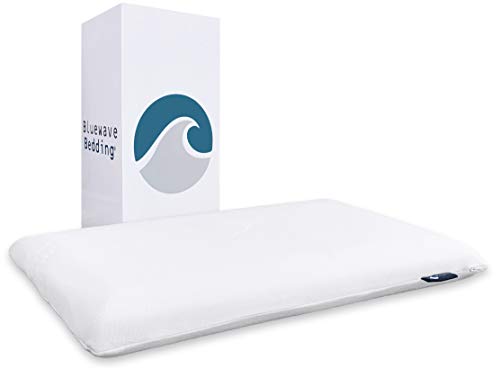
Bluewave Bedding Ultra Slim Gel Memory Foam Pillow, 2.75 Inch — Best Cooling Slim
The Bluewave is the BLISSBURY’s near-twin with one deliberate difference: gel. Its verified specification is an ultra-slim gel memory foam pillow at 2.75 inches in a standard size, designed — per its listing — for stomach and back sleepers, with a thin, flat profile aimed at keeping the neck’s angle low. The gel infusion is the hot sleeper’s argument: face-down sleeping buries the face in the pillow’s neighborhood all night, and the gel foam’s cooler hand is a genuine comfort difference in a warm room, even if no foam is truly cold by morning.
Strengths
- Stated 2.75-inch ultra-slim profile — within a whisper of the thinnest pick here.
- Gel memory foam answers the position’s heat problem better than plain foam.
- Standard size fits the pillowcases already in the house.
Trade-offs
- The cache record for this product carried no verification date; it is recorded as “not recorded” in the sources, honestly.
- Gel foam’s coolness is a first-hours effect, not an all-night refrigeration.
- Like the BLISSBURY, it is a one-position specialist that side sleepers cannot borrow.
| Spec | Verified detail |
|---|---|
| Height | 2.75 inches |
| Fill | Gel memory foam, ultra slim |
| Size | Standard |
| Positions | Stomach and back (per listing) |
Choose between the two slim specialists on temperature and touch: the BLISSBURY is the softer, simpler slab; the Bluewave is the cooler hand and the fractionally higher profile, which back-sleeping hours in a combination night will appreciate. Either way, the purchase logic is identical — buy the number. A stomach sleeper comparing these two is comparing honestly stated heights from two makers who understood the assignment, which is more than most of this category offers, and more than the plump generalist pillows at the same prices will ever offer a dedicated face-down sleeper.
Best for: hot-sleeping stomach sleepers and stomach/back combination sleepers. / Not suited for: side sleepers, or anyone wanting a natural fill.

Low Loft Latex Bed Pillow with Organic Cotton Cover, Standard — Best Natural Low Loft
Latex is the connoisseur’s answer to the thin problem: instead of a foam slab cut thin, a low-loft latex pillow keeps the material’s spring and breathability at a reduced elevation. The verified listing describes a low-loft latex bed pillow with an organic cotton cover, in a standard size and soft feel, positioned for back and stomach sleepers, and it names GOLS/GOTS certification — GOLS being the organic latex standard, GOTS the organic textile one — in its catalog record. The listing’s own logic is the position’s logic: low elevation reduces the upward neck bend that makes stomach sleepers wake stiff.
Strengths
- Natural latex at a genuinely low loft — spring and airflow without the height.
- Certifications named in the listing: GOLS for the latex, GOTS for the organic cotton cover.
- Latex outlasts foam slabs by years and never needs fluffing or reshaping.
Trade-offs
- The listing does not state an exact height in inches, so the “low loft” is the maker’s classification rather than a measured figure like the slim picks’.
- Latex’s bounce is a taste: foam lovers may find it lively under a turned head.
- The brand is not named in the catalog title — the product is sold on its specification, and the sources record it exactly as listed.
| Spec | Verified detail |
|---|---|
| Loft | Low loft (exact inches not stated) |
| Material | Latex, GOLS certified (per listing) |
| Cover | Organic cotton, GOTS certified (per listing) |
| Size / feel | Standard, soft |
This is the pick for the stomach sleeper who is also the household’s materials skeptic — the one who reads certifications and wants the natural option without surrendering the position’s low requirement. It also suits the warm sleeper who found gel foam’s coolness too brief: latex breathes by structure, all night, every night, for the many years the pillow will last. Judge it over the same honest week as the slim picks; latex’s first-night springiness settles into familiarity quickly.
Best for: natural-materials shoppers and warm sleepers who want low loft with longevity. / Not suited for: buyers who need an exact stated height, or the slow-sink feel of foam.

UTTU Adjustable Contour Pillow, Queen — Best for Combination Sleepers
Most stomach sleepers are not only stomach sleepers — they rotate, and a one-position slab punishes every rotation. The UTTU is the compromise engineered honestly: a memory foam contour pillow in a Queen size, verified at 23.6 x 13.8 inches with a dual-height profile of 5.2 and 4.5 inches, adjustable in its sandwich construction, with a cooling cover per the listing. The stomach sleeper’s side is the 4.5-inch low edge — still higher than the slim specialists, and this guide will not pretend otherwise — but for the sleeper who spends the night across two or three positions, one pillow that serves all of them adequately beats a perfect stomach pillow that fails the side hours.
Strengths
- Dual heights in one pillow: rotate to the low side for stomach, the contoured side for back and side.
- Adjustable sandwich construction lets the loft be tuned beyond the two factory profiles.
- Cooling cover addresses the foam family’s warmth.
Trade-offs
- Even its low side, at 4.5 inches, is nearly double the slim picks — committed stomach sleepers should buy those instead.
- The contour shape constrains the face-down position more than a flat slab does.
- Its listing leans on medical positioning language; this guide credits only its geometry, and the sources record the distinction.
| Spec | Verified detail |
|---|---|
| Size | Queen, 23.6 x 13.8 inches |
| Heights | 5.2 in / 4.5 in dual profile |
| Fill | Memory foam, adjustable contour |
| Cover | Cooling (per listing) |
The honest use case: the sleeper whose night is a tour — stomach to fall asleep, side by 2 a.m., back by dawn — and who is tired of a pillow wardrobe. Set the UTTU’s low side as the home position, let the contour catch the other hours, and accept the stomach compromise as the price of the tour. If the tour ever simplifies into pure stomach sleeping, the BLISSBURY will be waiting; until then, this is the one-pillow answer with its trade-offs printed on its face.
Best for: combination sleepers who rotate through positions nightly. / Not suited for: dedicated stomach sleepers — 4.5 inches is not thin.

Beckham Hotel Collection Bed Pillows, Queen, Set of 2 — Best Soft Pair
Here is the strategy half of stomach sleepers actually use: a plush down-alternative pillow that compresses to a whisper under the head. The Beckham Hotel Collection pair — Queen, set of two, down alternative fill, washable, listed for back, stomach and side sleepers — is the category’s beloved execution of it. On the shelf it looks like everything this guide warns against; under a face-down head it flattens to a soft layer with give, and its real virtues emerge: it can be scrunched for the arms, folded once for a slightly higher night, or mostly abandoned to the side while the head takes the mattress’s edge. Flexibility is its specification.
Strengths
- Down-alternative softness compresses low — the working height is a fraction of the shelf height.
- A two-pack at Queen size covers the bed and the guest or laundry rotation.
- Washable, per the listing — the whole pillow, not just a cover.
Trade-offs
- No engineered thinness: the loft depends on how you arrange it, nightly.
- Down alternative loses its plush with age and washing faster than latex or solid foam.
- Side sleepers in the same bed will find it too soft at full fluff and too flat compressed — it is the stomach sleeper’s pillow, borrowed at others’ risk.
| Spec | Verified detail |
|---|---|
| Size | Queen |
| Pack | Set of 2 |
| Fill | Down alternative |
| Care | Washable (per listing) |
The Beckham is also the diplomat’s pick for couples: where a 2.6-inch slab announces a problem being solved, a hotel pair just looks like a nicely made bed, and the stomach sleeper quietly uses theirs at a third of its fluff. Buy it if your stomach sleeping is a preference rather than a prescription, if you bunch and hug a pillow as much as you lie on it, and if the bed’s other occupant has opinions about how pillows should look. It is the comfort-first, aesthetics-safe route into this guide.
Best for: scrunchers, huggers, couples and guest-ready beds. / Not suited for: sleepers needing a guaranteed, engineered low height every night.

Bedsure Bed Pillows, Standard, Set of 2 — Best Budget Pair
The Bedsure pair runs the same soft strategy at the friendliest tier and a slightly smaller footprint: standard size at a verified 26×19 inches, down alternative fill, sold as a two-pack in the brand’s hotel collection line, listed for back, stomach and side sleepers. Standard size suits smaller beds, smaller frames and the stomach sleeper who finds a Queen pillow’s acreage mostly wasted — the head uses a corner of it either way. Soft support is the listing’s own phrase, and for this position soft is not a compromise; it is the mechanism by which the pillow gets out of the neck’s way.
Strengths
- The scrunchable soft strategy at the guide’s friendliest tier, in a two-pack.
- Standard 26×19 size fits existing cases and smaller beds and frames.
- Down alternative fill is the washable, allergy-friendly route — no down in the product, per the fill’s definition.
Trade-offs
- Like the Beckham, its working height is arranged, not engineered — discipline sold separately.
- Soft pairs flatten permanently over time; expect to re-fluff and eventually replace sooner than the latex.
- The cache record carried no verification date; recorded as “not recorded” in the sources.
| Spec | Verified detail |
|---|---|
| Size | Standard, 26 x 19 inches |
| Pack | Set of 2 |
| Fill | Down alternative |
| Feel | Soft support (per listing) |
As a first experiment in stomach-sleeping strategy, the Bedsure pair is the low-risk door: if compressing a soft pillow solves your mornings, you have learned it cheaply; if it does not, the slim specialists above are the measured next step, and the pair retires to the guest bed with honor. It is also the dorm and first-apartment pick — two pillows, every position tolerated, nothing precious — and the one most likely to be bought twice by the same household as the first pair wears soft into legend.
Best for: first experiments, dorms, small beds and budget-first buyers. / Not suited for: sleepers needing engineered thinness or maximum longevity.
Comparison Table
| Pick | Badge | Key spec | Best for |
|---|---|---|---|
| BLISSBURY Stomach Sleeper Pillow | Best Overall | 2.6 in memory foam, washable cover | Dedicated stomach sleepers |
| Bluewave Ultra Slim Gel Pillow | Best Cooling Slim | 2.75 in gel memory foam, standard | Hot sleepers |
| Low Loft Latex Pillow | Best Natural Low Loft | Latex, GOLS/GOTS per listing, soft | Natural materials, longevity |
| UTTU Adjustable Contour, Queen | Best for Combination Sleepers | Dual height 5.2 / 4.5 in | Position rotators |
| Beckham Hotel Collection, Queen 2-Pack | Best Soft Pair | Down alternative, washable | Scrunchers and couples |
| Bedsure Pillows, Standard 2-Pack | Best Budget Pair | Down alternative, 26 x 19 in | First experiments, dorms |
Read the table as a height ladder, because that is what it is. The first two rows are the engineered floor of the category — 2.6 and 2.75 inches, stated and guaranteed. The third row is the same idea in a natural material whose maker classifies rather than measures it. The fourth is the compromise row, higher than ideal and proud to serve three positions instead of one. The last two rows leave the ladder entirely and play a different game — compression instead of construction — whose height is whatever your hands arrange at lights-out. A reader who knows which row’s philosophy is theirs can stop reading here and buy correctly; the sections below exist for readers still deciding which philosophy deserves them.
How to Choose a Pillow for Stomach Sleeping
Decide first which of the two honest strategies is yours. The engineered-thin strategy — BLISSBURY, Bluewave, the low-loft latex — guarantees the same low height every night with no arrangement, and suits committed stomach sleepers whose mornings have already indicted their current pillow. The compressible-soft strategy — the Beckham and Bedsure pairs — trades the guarantee for freedom: scrunch, fold, hug, half-abandon. It suits preference-driven stomach sleepers and beds shared with people who judge pillows by how they look at noon. Combination sleepers live between the strategies, which is exactly where the UTTU’s low side sits.
Then apply the height discipline to whatever you buy: measure your current pillow’s working height by lying on it and having someone photograph your neck’s angle from behind — the picture is worth a page of advice. If the head rides visibly above the mattress line of the back, go lower than feels plausible; stomach sleepers consistently overestimate the loft they need because every pillow they have ever owned was too high. And change one variable at a time over a week: a neck adapted to a tall pillow needs nights, not minutes, to deliver its verdict on a thin one.
Making Stomach Sleeping Kinder: The Hip Pillow and the Turn
Two adjustments outside the head pillow do as much for this position as the pillow itself. The first is a thin pillow or folded blanket under the hips and lower abdomen: stomach sleeping arches the lower back because the pelvis sinks while the chest and legs rest higher, and a modest lift under the hips levels the spine’s sag in a way no head pillow can reach. Start thin — an inch or two of support — and judge by the morning. The second is the turn itself: the neck must rotate to let you breathe, but rotating to the same side at the same angle all night concentrates the cost. Alternating the face’s direction across nights, and using a slim pillow that lets the head rest closer to level while turned, spreads the load the position inevitably creates.
Honesty requires the closing note of this section: stomach sleeping is the position most often discouraged by clinicians, for the neck rotation and back arch described above, and a meaningful share of readers will ultimately feel better transitioning toward side sleeping with a body pillow as a bridge — the pillow in front gives the arms and top leg somewhere to go, which is what most stomach sleepers are seeking on their front in the first place. This guide optimizes the position for those who keep it; it does not argue with anyone’s clinician, and persistent neck pain, arm numbness or morning headaches are referrals, not shopping problems.
How to Transition to a Thinner Pillow Without a Week of Bad Nights
- Step 1: Split the difference first. If your current pillow is plump, spend two or three nights with it compressed — a soft pair folded out from under the head, or the fill of an adjustable reduced — before the slim pillow arrives, so the drop is two steps instead of a cliff.
- Step 2: Introduce the thin pillow for the first half of the night, swapping back if you wake uncomfortable. Partial nights count; adaptation is cumulative.
- Step 3: Add the under-hips support in the same week only if the lower back is part of the complaint — otherwise change one thing, so you know what worked.
- Step 4: Judge at day seven by the mornings: neck stiffness on waking, and how the first hour feels. Night three’s opinion is withdrawal talking, not data.
- Step 5: If stiffness persists at two weeks on the thinnest reasonable setup, stop shopping and get the neck looked at — the pillow has delivered its information.
The Mattress Variable: Why Your Bed Changes the Pillow Answer
The same 2.6-inch pillow is not the same height on every bed, because the mattress contributes its own geometry. On a soft, deep-sinking mattress, the stomach sleeper’s chest and hips settle into the surface, and the head — resting on the pillow at the mattress’s edge of that hollow — effectively gains height relative to the spine; the slimmest picks earn their keep most on soft beds, and some soft-bed stomach sleepers end up happiest with the compressible pairs used nearly flat. On a firm mattress, the body rides on top, the head’s relative height is closer to the pillow’s stated figure, and the full 2.6-to-2.75-inch class feels as designed. A thick pillow-top or topper behaves like softness added: subtract a little pillow, conceptually, for every inch of plush above the mattress’s support core.
This is also why one partner can thrive on a pillow that ruins the other on the same bed: body weight changes sink, shoulder width changes the turned head’s rest, and the mattress reads each sleeper separately. Judge your pillow on your bed, in your body, over the honest week — and treat any review written from a different mattress as weather reporting from another climate: interesting, and not your forecast.
Wedges, Rolls and Face-Down Gadgets: A Short, Honest Tour
Search this category long enough and stranger devices appear, and a complete guide should account for them. Cervical rolls — small cylinders meant to sit under the neck — are a back and side sleeper’s tool; under a stomach sleeper’s neck they add exactly the height and extension the position needs less of, and none is recommended here. Wedge pillows incline the whole upper body, which serves reflux and reading, not face-down sleep; a stomach sleeper on a wedge has traded a neck bend for a hip hinge. The face-down specialty pillows with breathing cutouts that appear in massage and post-surgery contexts solve a real but different problem — prone positioning for medical recovery or table work — and their listings’ contexts say so; they are not nightly sleep pillows and are excluded on intent.
What survives this tour is unfashionable and true: for nightly stomach sleeping, the entire effective technology is a low, honest height of a comfortable material, plus the hip support described above. The category’s gadgets mostly monetize the hope that the position’s geometry can be gadgeted away. It cannot — it can only be minimized, which the six picks here do at six price-and-preference points, with their heights stated and their limits admitted.
Arms Up, Arms Down: The Two Stomach-Sleeping Styles
Stomach sleepers divide by their arms, and the division changes the pillow brief. The arms-up sleeper — hands overhead, elbows bent, the classic “freefall” tangle — loads the shoulders all night and benefits most from the thinnest head pillows, because the raised arms already lift the chest’s end of the spine; adding pillow height on top of raised arms stacks extension on extension. This sleeper should also test sleeping with one arm up and one down, an asymmetric compromise many find relieves the shoulder that complains. The arms-down sleeper — arms at the sides or tucked under the hips — keeps the shoulders quiet and puts the whole question on the neck and lower back: the slim pillow plus the under-hips support is their complete prescription, and they are the sleepers most likely to report that the BLISSBURY alone fixed their mornings.
A third, smaller tribe tucks the hands under the pillow itself, using it as much for the hands as the head — and for them the soft pairs win outright, because a slab cannot be gathered around the hands the way a down-alternative pillow can. Know your tribe before you buy: the right pillow for the wrong arm position is a partial answer wearing a full answer’s confidence, and the five-minute honesty of identifying your style is worth more than any single feature in this guide.
Common Buying Mistakes
- Buying a “medium” pillow and hoping. Medium is a side sleeper’s word. For stomach sleeping, only a stated low height or a compressible fill is an answer.
- Judging the slim pillow on night one. A neck trained on a tall pillow protests any correction briefly. The week-long trial is the product’s real test.
- Stacking two thin pillows. Two slabs slide into a wedge by 2 a.m. and the neck rides higher than on one honest pillow. One pillow, right height, wins.
- Ignoring the hips. Perfecting the head while the pelvis arches untreated is half a fix; the folded blanket under the hips costs nothing to test.
- Believing cure language. Some listings in this category promise medical outcomes. A pillow changes angles and comfort — nothing in this guide claims more, and neither should your purchase.
Final Recommendation
Committed stomach sleepers should buy the BLISSBURY at 2.6 inches — or the Bluewave if heat is half the complaint — and give it the honest week. Preference-driven sleepers will be happier with the Beckham pair’s freedom, and rotators with the UTTU. Whichever row of the ladder you land on, run the transition gradually, test the folded blanket under the hips in the same fortnight, and let a full week of mornings — not one night’s novelty — deliver the verdict. Stomach sleeping will never be the position the textbooks bless, but with the height honest and the hips level, it can be a position your mornings stop arguing with. For the wider stomach-sleeper field, see Best Affordable Pillows For Stomach Sleepers and Best Soft Pillows For Stomach Sleepers; combination sleepers should compare Best Pillows For Back And Stomach Sleepers, and those building the full low setup can read Best Pillows For Stomach Sleepers And Neck Support and Best Type Of Pillows For Stomach Sleepers.
Frequently Asked Questions
How thin should a stomach sleeper’s pillow be?
Thin enough that your head rests close to the mattress with the neck near level — for most adults that means a stated height in the 2.5-to-3-inch class, which is exactly where the BLISSBURY (2.6) and Bluewave (2.75) sit, or a soft pillow compressed to a similar working height. If a listing will not state a height and the pillow is not soft-compressible, it is not a stomach pillow, whatever its title says.
Is it better to sleep with no pillow at all on your stomach?
For some sleepers, yes — the mattress alone gives the lowest possible neck angle, and if you wake comfortable pillow-free, no product here will improve on it. Most stomach sleepers, though, prefer a slim pillow’s cushioning for the turned face and a place for the hands and forehead, which is the honest case for the 2.6-inch class: nearly none, but not none.
Why do I wake with a stiff neck as a stomach sleeper?
Usually a height problem: a pillow that props the head up while the face is turned combines extension with rotation for hours, and the neck invoices you in the morning. Lower the loft first — it is the cheapest experiment in sleep — and add the under-hips support if the stiffness lives lower. Stiffness that persists through two weeks of correct, low setup, or that comes with arm symptoms, belongs to a clinician’s exam rather than another purchase.
Can one pillow work for stomach and side sleeping?
Compromisedly, yes: the UTTU’s dual-height design is the engineered version — low side down for stomach hours, contour for the rest — and an adjustable shredded pillow tuned low is the soft version. What does not exist is a pillow that is simultaneously ideal for both, because the positions want opposite heights; the honest products say which side of the compromise they serve, as this guide has tried to do for each pick.
Does a body pillow help stomach sleepers?
It helps the transition more than the position: hugging a body pillow at a three-quarter angle — chest partly on the pillow, one leg over it — keeps much of stomach sleeping’s comfort while unloading the neck’s full rotation and the back’s arch. Many lifelong stomach sleepers migrate to that hybrid with a slim head pillow and never fully return. If pure stomach sleeping keeps invoicing your neck, the hybrid is the experiment to run before any other.
Should children sleep on their stomachs with these pillows?
These are adult pillows for adult stomach sleepers, and this guide’s scope is adults. Infants are a separate and serious matter: babies should be placed on their backs to sleep, with nothing soft in the crib — no pillow of any kind belongs in an infant’s sleep space. For older children who settle onto their stomachs on their own, a thin pillow is the proportionate choice, and any persistent sleep or neck complaint in a child belongs in front of their clinician, not in a shopping guide.
What pillowcase works best on a slim pillow?
A standard case with room to spare is fine — slim pillows swim in them slightly, and the excess fabric can bunch under the face; a case sized close to the pillow, or the maker’s own cover used as sold (the BLISSBURY’s is removable and washable), keeps the surface smooth. Choose smooth, breathable fabrics: a face-down sleeper’s skin spends the night in closer contact with the case than any other position’s, so the case’s softness and washability matter more here than thread-count prestige.
How often should a slim pillow be replaced?
When it stops holding its stated height: memory foam slabs telegraph this by staying compressed where the head rests, and soft down-alternative pairs by refusing to refluff. Slim pillows have less material to lose, so their decline is easier to miss — compare against a hand’s width at the pillow’s edge, where the foam is uncompressed, and replace when the middle no longer recovers to near it. Latex, as ever, is the long-lived exception.

