Disclosure: airfryerkitchensupply.com is reader-supported. When you buy through links on our site, we may earn an affiliate commission at no extra cost to you.
Where to buy
The fastest way to shop this shortlist is through the Amazon listings below. Availability, colours and sizes change often, so check the current price on Amazon on the listing itself rather than relying on any round-up you read elsewhere. Start with the best slippers bunions shortlist here:
- Orthofeet Charlotte Women’s Slippers, Taupe (Size 9 example) — Check the current price on Amazon
- Orthofeet Asheville Men’s House Slippers, Brown (Size 10 example) — Check the current price on Amazon
- Dearfoams Men’s Brendan Clog Slipper, Wide Widths — Check the current price on Amazon
- Dearfoams Women’s Leslie Terry Clog, Wide Widths — Check the current price on Amazon
- Dearfoams Unisex Indoor/Outdoor Clog, Wide Widths — Check the current price on Amazon
- Acorn Women’s Moc Slipper with Memory Foam — Check the current price on Amazon
Shopping for the best slippers bunions-friendly enough to wear all evening comes down to a short list of physical features: room at the forefoot so nothing presses or rubs, a closure or shape that adjusts instead of forcing the foot into a fixed narrow mould, and a sole with enough structure that the slipper stays a house shoe rather than collapsing into a sock. This guide sticks strictly to comfort and fit — it makes no medical claims, promises no treatment, and repeats no medical language from listings as if it were advice. What it does do is verify every pick against a real listing and quote only the fit features those listings actually state.
All six picks are house slippers — the only kind considered here. Wide-width and wide-toe-box designs lead the shortlist because width at the front of the shoe is the single most useful stated feature for this brief, followed by adjustable closures that let you set the fit looser over the forefoot. Standard-width memory-foam slippers fill the remaining slots for readers whose main need is soft, unstructured comfort at home.
A note on sizing honesty: several listings state a specific size in their titles. Sizes and colourways change, so treat the stated size as the verified example and check the listing’s current size run before ordering — the fit features, not the exact size, are what each pick was chosen for.
Key Takeaways
- Judge slippers on stated fit features — wide toe box first, wide widths second, adjustability third — not on clinical-sounding names.
- Buy your normal size in a stated wide fitting; sizing up adds length, not width.
- Trial new slippers over a full evening at home, on your hardest floors and your stairs.
In this guide
Quick Picks
Six verified house slippers chosen for forefoot room, adjustability and unstructured comfort — described in comfort terms only.
Best Wide Toe Box — Women — Orthofeet Charlotte Women’s Slippers, Taupe (Size 9 example): Adjustable slip-on with a stated wide toe box and faux fur lining — the roomiest forefoot here. — check price on Amazon
Best Wide Toe Box — Men — Orthofeet Asheville Men’s House Slippers, Brown (Size 10 example): The men’s counterpart: adjustable, hands-free, with the same stated wide toe box. — check price on Amazon
Best Wide Width Clog — Dearfoams Men’s Brendan Clog Slipper, Wide Widths: A memory-foam clog explicitly offered in wide widths, with a breathable perforated upper. — check price on Amazon
Best Wide Width — Women — Dearfoams Women’s Leslie Terry Clog, Wide Widths: A washable terry clog in wide widths — soft, unstructured and easy to keep fresh. — check price on Amazon
Best Unisex Wide — Dearfoams Unisex Indoor/Outdoor Clog, Wide Widths: Another wide-width Dearfoams clog — a simple, breathable household staple. — check price on Amazon
Best Soft Moc — Acorn Women’s Moc Slipper with Memory Foam: A ragg-wool moc with memory foam and a proper indoor-outdoor sole — soft yarn uppers give gently. — check price on Amazon
How These Picks Were Chosen
Candidates were screened from verified slipper listings using stated fit features only: wide widths, a wide toe box, adjustability, and soft unstructured uppers that do not press on the forefoot. Sandals, slides, flip-flops and non-house footwear were excluded by the category rules, as were baby and dance styles. Each remaining pick had to work as an indoor house slipper first.
The shortlist deliberately spans men’s and women’s designs, because forefoot room is not a gendered feature and readers shop this brief for both.
The 6 Best Slippers for Bunions

Orthofeet Charlotte Women’s Slippers, Taupe (Size 9 example) — Best Wide Toe Box — Women
Check the current price on Amazon
The listing states the three features this brief cares about most: a wide toe box, an adjustable fit, and a slip-on shape, with cushioning and a faux fur lining for warmth. A wide toe box matters because it is room designed into the front of the shoe rather than stretch you are hoping for from a standard upper, and adjustability lets you set that room exactly where your foot wants it on a given evening. The hands-free slip-on entry also means no bending and forcing the foot into a tight opening.
Strengths
- Wide toe box stated in the listing
- Adjustable fit — set the forefoot as loose as you like
- Hands-free slip-on entry with warm faux fur lining
Trade-offs
- Brand naming uses clinical terms — this guide recommends it for fit and comfort features only
- Premium positioning within this shortlist
- Taupe colourway and sizes vary — check the current listing
| Specification | Detail (as stated in the verified listing title) |
|---|---|
| Fit | Wide toe box, adjustable (as stated) |
| Entry | Hands-free slip-on |
| Lining | Faux fur (as stated) |
Choose this if standard slippers feel like they are squeezing the front of your foot by mid-evening. The honest limit is scope: this is a comfortable house slipper with a roomy front, and that is the whole claim — for anything beyond comfort and fit, a footwear professional is the right conversation, not a product listing.
Best for: Women wanting maximum forefoot room at home / Not suited for: Anyone expecting a medical device

Orthofeet Asheville Men’s House Slippers, Brown (Size 10 example) — Best Wide Toe Box — Men
Check the current price on Amazon
The Asheville applies the same fit logic to a men’s house slipper: the listing states a wide toe box, an adjustable hands-free slip-on design, cushioning and a faux fur lining. For men who have given up on slippers because the standard moccasin shape tapers exactly where their foot is widest, a shoe designed wide at the front is the meaningful difference — not a softer version of the same narrow shape.
Strengths
- Wide toe box stated in the listing
- Adjustable, hands-free slip-on entry
- Cushioned, faux-fur-lined for cold floors
Trade-offs
- Recommended here for fit features only, not the brand’s clinical naming
- Sizing in the verified title is one example size — check the current run
- Heavier structure than a simple foam slipper
| Specification | Detail (as stated in the verified listing title) |
|---|---|
| Fit | Wide toe box, adjustable (as stated) |
| Entry | Hands-free slip-on |
| Lining | Faux fur (as stated) |
This is the pick for all-evening wear on hard floors: the structure that makes it feel substantial is the same structure that keeps the forefoot from being pinched by a collapsing upper. As with its women’s counterpart, the claim made here is comfort and room — nothing more.
Best for: Men wanting a roomy, structured house slipper / Not suited for: Anyone wanting a featherweight slipper
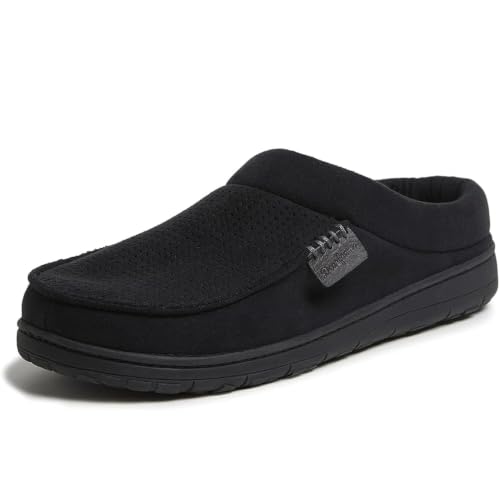
Dearfoams Men’s Brendan Clog Slipper, Wide Widths — Best Wide Width Clog
Check the current price on Amazon
Dearfoams states wide widths right in this listing’s title, which is exactly the kind of plain fit information this brief needs. The clog shape helps too: an open-backed clog never squeezes the heel or forces the foot forward into the toe, and the foot can settle where it naturally sits. The listing describes a breathable perforated upper and memory foam cushioning, aimed at indoor and outdoor house wear.
Strengths
- Wide widths stated in the listing
- Clog shape lets the foot settle without forward pressure
- Breathable upper and memory foam cushioning
Trade-offs
- Open back offers no heel security on stairs
- Perforations make it a warm-weather-leaning design
- Memory foam softens with wear — expect a moulded feel over time
| Specification | Detail (as stated in the verified listing title) |
|---|---|
| Fit | Wide widths (as stated) |
| Style | Clog house shoe, indoor/outdoor |
| Cushioning | Memory foam (as stated) |
Pick the Brendan if you want room without an adjustable strap to manage, and if your home life includes stepping onto a patio or taking out recycling without changing shoes. On stairs, any open-back clog deserves care; within the house, its combination of width and breathability is the most easy-going in this guide.
Best for: Men wanting width plus breathability / Not suited for: Stair-heavy homes needing a secured heel

Dearfoams Women’s Leslie Terry Clog, Wide Widths — Best Wide Width — Women
Check the current price on Amazon
The Leslie’s listing states wide widths and adds two practical virtues: it is washable, and its terry clog upper is soft and unstructured, so there is no stiff seam or rigid toe cap pressing anywhere. For a slipper worn barefoot for hours, that softness plus a memory foam footbed is the comfort formula most people are actually looking for, and washability matters in a shoe that lives on bedroom and bathroom floors.
Strengths
- Wide widths stated in the listing
- Soft terry upper with no rigid toe structure
- Washable, with memory foam cushioning
Trade-offs
- Terry absorbs moisture — slow to dry after washing
- Clog shape is not for stairs at speed
- Soft structure offers less support than the structured picks
| Specification | Detail (as stated in the verified listing title) |
|---|---|
| Fit | Wide widths (as stated) |
| Upper | Terry clog, washable |
| Cushioning | Memory foam (as stated) |
This is the gentle option: nothing hard, nothing tight, nothing to adjust. If your priority is simply a soft, roomy house shoe you can throw in the wash, the Leslie is the most straightforward pick in the guide, and its trade-offs are about structure, not comfort.
Best for: Women wanting soft, unstructured comfort / Not suited for: Anyone wanting a firm, supportive sole

Dearfoams Unisex Indoor/Outdoor Clog, Wide Widths — Best Unisex Wide
Check the current price on Amazon
This second Dearfoams clog listing likewise states wide widths, a breathable design and memory foam, in a pavement colourway. It earns its place as the unisex household option: one model, offered wide, that different members of a household can each own without anyone squeezing into a standard tapered shape. The clog format keeps entry effortless and the forefoot unforced.
Strengths
- Wide widths stated in the listing
- Breathable memory foam clog for indoor/outdoor wear
- Simple design suits shared household buying
Trade-offs
- Open-back clog — care on stairs
- Foam cushioning compresses over a season of daily wear
- Limited structure compared with the adjustable picks
| Specification | Detail (as stated in the verified listing title) |
|---|---|
| Fit | Wide widths (as stated) |
| Style | Clog, indoor/outdoor |
| Cushioning | Memory foam (as stated) |
Choose it when the requirement is simple: wide, soft, easy on and off, priced as a household staple rather than a specialty shoe. It does not offer the designed-in toe room of the wide-toe-box picks, but its stated width and clog shape put it well ahead of a standard slipper for this brief.
Best for: Households wanting one wide model for everyone / Not suited for: Anyone needing maximum designed-in toe room

Acorn Women’s Moc Slipper with Memory Foam — Best Soft Moc
Check the current price on Amazon
Not every comfortable answer is a wide fitting: this Acorn moc uses a knitted ragg-wool-style upper that gives gently around the foot instead of holding a rigid shape, over a memory foam footbed and an indoor-outdoor sole. It is included as the soft-structure option for readers who find even wide shoes too constructed and simply want a slipper that yields. The listing does not claim a wide fitting, and this review does not claim one for it.
Strengths
- Knitted upper gives softly around the foot
- Memory foam footbed with indoor-outdoor sole
- Classic moc comfort for all-evening wear
Trade-offs
- No wide fitting stated — standard width with a giving upper
- Knit uppers stretch over time and can feel loose
- Less forefoot room than the wide-toe-box picks
| Specification | Detail (as stated in the verified listing title) |
|---|---|
| Fit | Standard width, giving knit upper (no wide claim stated) |
| Footbed | Memory foam (as stated) |
| Sole | Indoor-outdoor (as stated) |
Be clear-eyed about the distinction: a giving upper forgives, but it does not create the designed room of the wide picks above. For mild needs and cold evenings it is a lovely slipper; for a forefoot that protests at any contact, start at the top of this list instead.
Best for: Mild needs wanting a soft, yielding slipper / Not suited for: Anyone needing a stated wide fitting
Comparison Table
| Pick | Badge | Key spec | Best for | Buy |
|---|---|---|---|---|
| Orthofeet Charlotte Women’s Slippers, Taupe (Size 9 example) | Best Wide Toe Box — Women | Wide toe box, adjustable slip-on | Women wanting maximum forefoot room at home | Check price |
| Orthofeet Asheville Men’s House Slippers, Brown (Size 10 example) | Best Wide Toe Box — Men | Wide toe box, adjustable slip-on | Men wanting a roomy, structured house slipper | Check price |
| Dearfoams Men’s Brendan Clog Slipper, Wide Widths | Best Wide Width Clog | Wide-width memory foam clog | Men wanting width plus breathability | Check price |
| Dearfoams Women’s Leslie Terry Clog, Wide Widths | Best Wide Width — Women | Wide-width washable terry clog | Women wanting soft, unstructured comfort | Check price |
| Dearfoams Unisex Indoor/Outdoor Clog, Wide Widths | Best Unisex Wide | Wide-width breathable clog | Households wanting one wide model for everyone | Check price |
| Acorn Women’s Moc Slipper with Memory Foam | Best Soft Moc | Memory foam moc, giving knit upper | Mild needs wanting a soft, yielding slipper | Check price |
How to Choose Slippers When Forefoot Room Matters
Read listings for stated fit features, in this order: a wide toe box first, because room designed into the shoe beats stretch hoped for from fabric; wide widths second, because a wide fitting widens the whole last including the forefoot; adjustability third, because a strap or closure you can set loose over the front of the foot adapts day by day; and soft, unstructured uppers fourth, as a comfort quality rather than a fit guarantee. This article’s language stays with those physical features deliberately — comfort and fit are what a slipper listing can honestly describe.
Shapes That Help and Shapes That Squeeze
Clogs and mules let the foot settle without being pushed forward, and slip-ons with hands-free entry avoid the daily forcing of a foot into a tight opening. Pointed or tapered moccasin toes do the opposite, concentrating the shoe’s narrowest point exactly at the forefoot. A sole with some structure keeps a roomy upper from collapsing sideways onto the foot; a completely flat, floppy slipper often feels roomy in the shop and shapeless by the second week.
Sizing and Home Trial
Buy your usual size in a stated wide fitting rather than sizing up in a standard fitting — an oversized standard shoe adds length, not width, and the extra length becomes a trip hazard at home. Try new slippers in the evening, when feet are at their largest, walk on your actual floors including any stairs, and keep packaging until the fit is proven over a full evening, not a five-minute carpet test.
Comfort Features Worth Paying For
Cushioning is the feature every listing advertises, but for this brief it ranks behind room. Memory foam earns its place as a comfort layer — it moulds to the foot and removes pressure points on hard floors — yet foam inside a narrow shoe still leaves the forefoot squeezed, which is why the wide and adjustable picks lead this guide. Warmth is the second comfort feature: faux fur and fleece linings make a roomy slipper feel kind in winter, while breathable perforated uppers suit warm homes and summer evenings, as on the Brendan clog.
Finally, consider the sole as a safety feature in a house shoe. An indoor-outdoor sole with real tread, as several picks here state, grips kitchen tile and front steps alike, and a structured sole keeps the slipper stable during the hundred small trips a day that slippers actually make. A purely soft sole is a bedroom-only tool.
When a Slipper Is Not the Answer
This guide is deliberately narrow: it compares house slippers on comfort and fit features stated in their listings. It does not assess any product as a treatment, and no wording from any brand’s clinical marketing is repeated here as a promise. If discomfort is persistent, worsening, or affects how you walk outdoors, the useful next step is a conversation with a clinician or a footwear fitting specialist, who can assess your feet directly — something no product round-up can do.
How to Get the Fit Right at Home
Step 1: measure your foot in the evening, standing, and note the width across the forefoot, not just the length. Step 2: order the stated wide or wide-toe-box option in your normal size first. Step 3: on arrival, wear the slippers for a full evening on your hardest floors — the forefoot should feel uncontacted by seams, and you should be able to spread your toes inside the shoe. Step 4: check the heel and stairs: a clog that slips at the heel on stairs is the wrong shape for your home regardless of forefoot comfort. Step 5: adjust any strap or closure to the loosest setting that still keeps the shoe secure, and re-check after a week, because foam footbeds mould and knits give, changing the fit you started with.
For care, air slippers daily rather than sealing them in a cupboard, wash washable models as their listings allow, and replace memory-foam slippers when the footbed stays compressed — a flattened footbed quietly removes the comfort you bought.
Common Buying Mistakes
Sizing up instead of buying wide. Extra length is not extra width, and long slippers trip. Trusting clinical-sounding names. Judge the stated fit features — toe box, width, adjustability — not marketing vocabulary. Testing for five minutes. Forefoot comfort is an all-evening question; trial at home in the evening. Ignoring the sole. A roomy slipper with a slick sole is a fall risk on tile. Wearing collapsed slippers too long. When the structure goes, the fit you chose goes with it.
Final Recommendation
For maximum designed-in room, start with the Charlotte for women or the Asheville for men; for stated wide widths in a simpler shoe, the Dearfoams clogs and the Leslie terry clog are the straightforward buys; for a soft, giving moc, choose the Acorn. Related reading: Best Rugs For Acoustics and Best Pillows For Men.
- Orthofeet Charlotte Women’s Slippers, Taupe (Size 9 example) — check price on Amazon
- Orthofeet Asheville Men’s House Slippers, Brown (Size 10 example) — check price on Amazon
- Dearfoams Men’s Brendan Clog Slipper, Wide Widths — check price on Amazon
- Dearfoams Women’s Leslie Terry Clog, Wide Widths — check price on Amazon
- Dearfoams Unisex Indoor/Outdoor Clog, Wide Widths — check price on Amazon
- Acorn Women’s Moc Slipper with Memory Foam — check price on Amazon
Scenario Guide: Who Should Buy Which Pick
The all-evening wearer on hard floors. Your slippers are footwear, worn from dinner to bedtime across tile and wood. Start with the structured wide-toe-box picks — Charlotte or Asheville — because their designed room and supportive build are made for hours, not minutes. The soft foam clogs will feel wonderful for the first hour and increasingly shapeless by the fourth.
The warm-house, quick-trip wearer. Your slippers go on and off forty times a day and step onto the patio half of those times. The Dearfoams wide-width clogs are your design: breathable, effortless, stated wide, with indoor-outdoor positioning. The open back that makes them effortless is also why you should choose a closed style if your home has steep stairs you use constantly.
The washday realist. Your slippers live on bathroom floors and get washed like towels. The Leslie terry clog — washable, wide, unstructured — is the only pick designed around your actual life. Accept its slower drying and softer structure as the price of a slipper that is always fresh.
The gentle-comfort minimalist. Nothing pinches, nothing squeezes, you simply want softness that yields. The Acorn moc’s giving knit upper is your pick, with eyes open: it forgives rather than accommodates, and if an evening trial shows any forefoot contact that bothers you, move up to the stated wide fittings rather than hoping the knit will stretch its way to comfort.
Understanding Width Language in Listings
Listings use three different width ideas, and they are not interchangeable. A wide fitting (often marked W or described as wide widths) is a shoe built on a wider last — the whole shoe, including the forefoot, is roomier at the same length. A wide toe box is a shape decision: the front of the shoe is designed broad and untapered even if the heel stays standard, which is why it leads this guide’s criteria for forefoot room. A giving upper is neither of those — it is a standard shoe in a material that stretches, comfortable for many feet but not a substitute for designed room. When a listing states one of the first two, as the leading picks here do, that is checkable fit information. When it only promises softness, judge it as the Acorn is judged in this guide: pleasant, forgiving, unproven on width.
The Evening Trial, Done Properly
Feet are at their largest in the evening, after a day of standing and walking, which is why a morning trial in a shop is the worst test of a house slipper. Run the trial at home instead: wear the pair from dinner onwards, on your hardest floor, including every trip you would normally make — kitchen, bathroom, door, stairs. Three questions decide it. Can you spread your toes inside the shoe without touching the sides? Does any seam or edge make contact you are aware of after an hour? And does the shoe stay secure on your stairs without you gripping with your toes to keep it on? A yes, a no and a yes mean the fit is right. Anything else means the size or the shape is wrong, and no amount of wearing-in fixes a shape problem — exchange while the packaging is intact.
Rotation, Hygiene and Replacement
Slippers worn daily hold moisture daily, and foam and fleece both suffer for it. Two pairs in rotation — each resting a full day between wears — will outlast two pairs worn consecutively, and will smell better doing it. Air the resting pair outside the cupboard, wash the washable models on their stated instructions, and brush faux fur linings back to loft when they flatten. Replace a pair when its footbed stays compressed overnight, when the sole’s tread smooths, or when the upper has stretched enough that your foot moves inside it: at that point the fit you chose no longer exists, and the slipper has quietly become a different, worse shoe.
Materials and Construction: What the Upper Is Doing
A slipper upper has three jobs: hold the shoe on, keep its shape, and manage the foot’s microclimate. Knitted uppers, like the Acorn’s, excel at the first by giving, and are weakest at the second over a long life. Terry, like the Leslie’s, is a comfort material that trades structure for softness and washability. Perforated designs, like the Brendan’s, are climate answers for warm homes. Faux fur linings are warmth layers that also change fit — a lined slipper fits snugger than its unlined twin, one more reason the evening trial outranks the size chart. None of these materials is best in the abstract; each is the right answer to a different household’s actual evenings, which is why this guide badges by scenario rather than crowning materials.
Soles: The Safety Feature Nobody Photographs
Listings photograph uppers; households fall on soles. A house slipper’s sole must grip the three surfaces of domestic life — smooth tile, wood or laminate, and carpet — and the indoor-outdoor soles stated on several picks here are the practical standard, with tread that works on a wet doorstep as well as a kitchen floor. Pure fabric or suede soles are bedroom-only tools and should be bought with that limitation understood. Sole stiffness matters too: a sole that flexes entirely with the foot offers no platform, while a structured sole keeps a roomy upper from rolling sideways during the quick sideways steps — catching a falling cup, sidestping a pet — that real evenings contain. When you trial a pair at home, include one deliberate walk across your slickest floor; it is the cheapest safety test in this article.
Gift-Buying for Someone Else’s Feet
Slippers are a classic gift and a classic sizing gamble. If you are buying for someone whose forefoot comfort is the point, the adjustable picks are the forgiving choice — a strap set looser or tighter absorbs the half-size of uncertainty that a fixed shoe cannot. Keep the packaging, buy from a listing whose stated features you can describe to the recipient (‘these are the wide ones’), and never present a fixed standard-width fashion slipper as a comfort gift: the message it sends on the first evening is the opposite of the one you intended. Where the recipient’s needs go beyond comfort and fit, a voucher toward a professional fitting is the kinder gift than any product in this guide, and saying so is part of this guide’s honesty about its own limits.
Budget Tiers for Comfort Slippers
The tiers in this category buy structure, in ascending order. The simplest wide-width foam clogs buy stated width and effortless entry — a real and sufficient purchase for many households. The middle tier buys washability and materials that survive a season of evenings, the Leslie’s territory. The top tier buys designed room — the wide-toe-box, adjustable constructions — where the money is visibly in the last shape and the closure system rather than in branding. The false economy is the standard-width slipper bought three times in hope; one stated-wide purchase, trialled properly at home, costs less than the pile of narrow disappointments it replaces. Spend on the fit feature your foot actually needs, in the order this guide ranks them, and the tier takes care of itself.
Travel, Hospital Bags and Other Real Uses
House slippers travel more than their name suggests: weekends away, hospital and recovery stays at home, long evenings in other people’s houses. For travel, the clog formats pack flat-ish, tolerate strange floors, and go on without bending — the same hands-free virtue the structured picks state for home use. For a stay where floors are unknown and hygiene matters, the washable pick is the one that comes home and goes straight into the machine. None of this changes the selection criteria; it simply confirms that the features this guide ranks for the home — room, adjustability, washability, sole grip — are the features that matter everywhere a slipper is worn, which is the mark of criteria chosen correctly.
Final Checklist Before You Order
Identify your primary feature: wide toe box, wide width, adjustability, or a giving upper — in that ranking. Order your normal size in the stated fitting. Keep every tag and box until the evening trial is complete. Trial on hard floors and stairs, for a full evening, asking the three questions from the trial section. Register the replacement date in your mind: when the footbed stays flat or the sole smooths, the fit you bought no longer exists. And if discomfort ever goes beyond what comfort features address, take the question to a professional rather than to a bigger shopping basket — this guide’s last and most important piece of advice.
Seasonal Rotation: Warm Pairs and Breathable Pairs
Feet have seasons. The faux-fur-lined and fleece constructions that feel like kindness in January become ovens in July, and the breathable perforated clogs that are perfect in August offer nothing to a cold floor in winter. A two-pair rotation — one warm structured pair, one breathable wide clog — covers the year for roughly the cost of repeatedly replacing one compromised all-season pair, and each pair rests while the other works, extending both lives. Store the off-season pair clean, aired and uncrushed; foam and fleece both remember compression, and a slipper that spends summer under a suitcase starts autumn as a different, flatter shoe. Rotation is the cheapest comfort upgrade in this entire guide, and it requires no new criteria — the same stated features, chosen twice for two weathers.
Slipper Fit for Swollen, Tired and Changing Feet
Feet are not a fixed size across a day, a season or a decade, and the slippers that stay comfortable are the ones whose design admits it. Evening swelling is the everyday case the trial protocol already handles. Longer changes — a summer of standing work, a winter of inactivity, the slow widening most feet do across adult life — are where adjustability stops being a feature and becomes the product: a closure that opens a quarter-inch this year and another next year keeps one purchase honest across changes that retire three fixed pairs. This is stated in fitting terms deliberately, as this guide states everything: room that adapts is comfort you can verify at home, with your own feet, on your own floors, which is the only verification that has ever mattered in a house shoe.
Slipper Care by Material: A Compact Reference
Terry wants washing and tolerates it — that is its design brief — but should dry fully before wear, because a damp terry clog worn daily never quite dries again. Memory foam footbeds should not be soaked; surface-clean them and air them, and let rotation do the freshness work. Knitted uppers wash gently and dry flat, away from radiators that shrink and stiffen yarns. Faux fur linings brush back to loft when dry and mat permanently if stored damp. Perforated and synthetic uppers ask least of all: a wipe, an airing, and they are ready. The pattern across materials is the same one this guide applies to products — know the construction you bought, because the care it needs is written in its materials, and a season of the wrong routine will quietly undo a well-chosen fit.
House Rules: Outdoor Shoes Off, Slippers On
Many households adopt slippers as a system rather than a purchase — outdoor shoes stop at the door, house slippers carry the indoors — and the system only works if the slippers are comfortable enough that nobody cheats. That is the practical core of this entire brief: a wide, adjustable, well-soled house slipper is not an indulgence but the load-bearing piece of a cleaner, quieter home, worn more hours than any other footwear the household owns. Guest pairs extend the system; the washable and clog formats serve there best. Judge the investment accordingly — by hours worn per week, slippers are the hardest-working shoes in the house, and they deserve to be bought with the seriousness this guide has tried to apply.
Two Homes, Two Pairs: The Second-House Problem
Slippers multiply across the geography of a life — the flat and the family home, the caravan, the partner’s place — and the second pair is usually bought carelessly, as an afterthought at a till. Resist it: the feet that need a stated wide fitting at home need it everywhere, and a narrow emergency pair at the second home will be worn for whole weekends, not minutes. The economical pattern is to promote deliberately — when the home pair is replaced at the footbed’s end, it is usually wrong for promotion, being worn out; instead, buy the second home’s pair in the same stated fitting during the home pair’s prime, and let both age together. Comfort, like the fit features this guide ranks, does not change its address.
Reading a Slipper Listing in Sixty Seconds
Everything this guide has taught compresses into a one-minute discipline. First, find the fit words in the title — wide, wide toe box, adjustable — and stop if none exist and fit is your brief. Second, find the format: slip-on, clog, moccasin, boot. Third, find the sole: indoor-outdoor stated, or silent on the subject, which is its own answer. Fourth, find the care: washable stated, or not. Fifth, note the size example in the title without mistaking it for the range. Five facts, one minute, and you have replicated the screening that built this shortlist — a habit worth more than any single recommendation in it, because it transfers to every listing you will ever read after this article is closed.
A Closing Note on Buying Well in This Category
Every guide in this programme is built the same way, and it is worth saying plainly why: the facts that decide a purchase are usually printed in the listing itself, in the plain nouns of its title — sizes, materials, formats, stated limits and stated features. The work of a good shortlist is not to embellish those facts but to gather them honestly, compare them on the criteria that matter for the brief, and say clearly where the evidence ends. That is what has been attempted here. Where a listing stated a figure, it is quoted; where it was silent, the silence is reported; where a claim belongs to construction and logic rather than to the seller’s words, the reasoning is shown so you can accept or reject it with your eyes open.
Carry that discipline to any listing you open after this one, including newer versions of the products above, whose colours, sizes and configurations will drift over time. Check the title’s nouns against the job you actually need done, trial the product at home under real conditions while returns are painless, and keep the small records — measurements, settings, limits — that turn your next purchase in the category from a search into a lookup. Bought that way, the right product is rarely the most advertised one; it is the one whose stated facts match your household, which is the only definition of best that has ever survived contact with a real home.
Frequently Asked Questions
What slipper features matter most for forefoot comfort?
A stated wide toe box, a wide fitting, and adjustability — in that order. Those are physical fit features a listing can state honestly, and they are the criteria used throughout this guide.
Are wide-width slippers better than sizing up?
Yes. A wide fitting adds width where you need it; sizing up adds length, which does not widen the forefoot area and can make the slipper trip-prone.
Do these slippers treat any condition?
No claim of that kind is made here. This guide compares house slippers on comfort and fit features only; for anything beyond comfort, consult a clinician.
Clog or closed slipper — which is better at home?
Clogs let the foot settle without forward pressure and are easy on and off, but offer no heel security on stairs. Closed, adjustable styles are the safer all-house choice.
How long do memory foam slippers stay comfortable?
Until the foam stays compressed after rest — at that point the cushioning you bought is gone and replacement is due, however good the upper still looks.
Can I wear these slippers outside?
Several picks state indoor-outdoor soles, suitable for patios and doorsteps. They remain house slippers, not walking shoes.


