Disclosure: airfryerkitchensupply.com is reader-supported. When you buy through links on our site, we may earn an affiliate commission at no extra cost to you.
Where to buy
All six pillows below were confirmed as real, complete bed pillows through Amazon listing held for this site — no inserts, no travel cushions and no recliner add-ons. Where a slot could not be confirmed it would be left as a written specification instead of a link, and in this roundup every slot did confirm, so each pick carries a live Amazon link.
- UTTU Cervical Pillow (Best Overall): Check the current price on Amazon
- EPABO Contour Memory Foam Pillow (Best Simple Fixed Contour): Check the current price on Amazon
- Osteo Cervical Pillow (Best for Back Sleepers): Check the current price on Amazon
- Anvo Memory Foam Pillow (Best Mid-Range Contour): Check the current price on Amazon
- Bedsure Cervical Neck Pillow (Best Familiar-Brand Contour): Check the current price on Amazon
- Bluewave Bedding Ultra Slim Gel Memory Foam Pillow (Best for Stomach Sleepers): Check the current price on Amazon
If you are shopping for the best pillows for bad back and neck comfort, the honest starting point is that a pillow is a comfort and positioning product, not a treatment. No pillow in this guide is presented as fixing a back or neck condition, and nothing here replaces advice from your own clinician if you have an ongoing problem. What a well-chosen pillow can do is hold your head and neck at a height and angle that feels neutral for your sleep position, so you are not folded, propped or sunk into an awkward posture for eight hours at a stretch.
The second honest point is that “back and neck” is really two different jobs sharing one product category. Your neck cares about the pillow directly: loft, contour and firmness decide whether your head tips forward, drops back or stays level with your spine. Your back cares mostly about sleep position — back sleepers need a pillow that fills the curve behind the neck without pushing the chin down, and side sleepers need enough loft to keep the head level over the shoulder. That is why this roundup is built around adjustable and contoured memory foam designs rather than one soft hotel-style pillow after another.
All six picks are contoured or adjustable memory foam pillows whose listings were verified. Several of the manufacturers use strong comfort language in their listing titles; we have deliberately not repeated those claims as promises in the reviews. What we can verify from the listings is shape, size, adjustability and materials as stated — and that, plus how each shape suits each sleep position, is what the rankings below are based on.
In this guide
Quick Picks
The six picks at a glance. Every model is a complete pillow, and the key spec column only repeats measurements and features stated in the verified listing title.
| Pick | Badge | Key spec | Best for |
|---|---|---|---|
| UTTU Cervical Pillow — Check price on Amazon | Best Overall | Queen 23.6×13.8 in; dual height 5.2/4.5 in; adjustable sandwich layers | back and side sleepers who want to tune the height instead of guessing it |
| EPABO Contour Memory Foam Pillow — Check price on Amazon | Best Simple Fixed Contour | Firm contour, Queen; pillowcase included as listed | side and back sleepers who want one firm, shaped pillow with nothing to adjust |
| Osteo Cervical Pillow — Check price on Amazon | Best for Back Sleepers | Hollow-centre design; cooling case; adjustable as listed | back sleepers who want their head cradled in a hollow centre rather than pushed forward |
| Anvo Memory Foam Pillow — Check price on Amazon | Best Mid-Range Contour | Firm neck-contour design; blue white colourway as listed | combination sleepers who change position and want a firm all-round contour |
| Bedsure Cervical Neck Pillow — Check price on Amazon | Best Familiar-Brand Contour | Contour design that cradles the head; for side and back sleepers as listed | shoppers who prefer a widely stocked bedding brand and sleep on their side or back |
| Bluewave Bedding Ultra Slim Gel Memory Foam Pillow — Check price on Amazon | Best for Stomach Sleepers | Ultra slim 2.75 in height; Standard size; gel memory foam as listed | stomach sleepers and back sleepers who find every contour pillow too tall |
Notice that five of the six are contour designs and one is an ultra-slim flat pillow. That split is deliberate: most people shopping this search sleep on their back or side and need the shaped support under the neck, while a minority — mostly stomach sleepers and people who use a pillow under another pillow — need almost no height at all. If you only read one section beyond this table, read the buying guide on loft, because choosing the wrong height is the single most common reason a good pillow feels like a bad one.
How These Picks Were Chosen
Each candidate had to pass four checks before it earned a slot. First, it had to be a complete bed pillow — listings for pillow inserts, standalone cases, travel neck cushions and recliner headrest add-ons were excluded, because none of those solve the bedtime positioning problem this search is about. Second, the listing had to be confirmed, with the title, size and design recorded; anything we could not confirm was left out rather than guessed at.
Third, the design had to offer something position-specific: a contour with two heights, an adjustable layer system, a hollow or cut-out centre for back sleepers, or a genuinely low profile. Generic soft pillows with no shaping were cut, however popular, because they give the reader nothing to choose by. Fourth, we spread the six slots across sleep positions and budgets of design complexity — simple fixed contours, adjustable sandwiches, cooling covers — so the roundup reads as a decision tool rather than six versions of the same pillow.
A note on language: several verified listing titles use words like “relief” and “orthopedic”. Our reviews describe shape, height, adjustability and feel in plain comfort terms, and the FAQ explains when a pillow change is not the right next step.
The 6 Best Pillows for Bad Back and Neck Comfort

1. UTTU Cervical Pillow — Best Overall
The UTTU takes the top slot because it answers the biggest unknown in this category — how high should the pillow be — with adjustability instead of a guess. The listing describes a sandwich-style memory foam pillow with a contour profile and two usable heights, listed at 5.2 inches on one edge and 4.5 inches on the other, in a Queen footprint of 23.6 by 13.8 inches. Between rotating the pillow to the lower edge and adjusting the layered build, most back and side sleepers can land on a height that keeps the head level rather than tilted.
In practice, that adjustability matters more than any single foam formula. A fixed contour pillow is a bet: if the height is wrong for your shoulder width and mattress firmness, the whole pillow is wrong. The UTTU lets you change the bet after the first few nights, which is exactly when most people discover whether a contour suits them. The cooling contour design is a secondary plus for warm sleepers, though like all foam pillows it will never feel as airy as a shredded or down fill.
Strengths
- Two listed heights (5.2 in and 4.5 in) cover most back and side sleepers
- Adjustable sandwich build lets you fine-tune instead of replacing the pillow
- Queen footprint fits standard pillowcases and double beds without crowding
Trade-offs
- Contour shape feels strange for the first few nights if you are used to a soft pillow
- Smaller than a standard Queen pillow in width, so restless sleepers may drift off the edge
- Foam warmth is managed, not eliminated, by the cooling design
| Format | Complete contour bed pillow |
| Size as listed | Queen, 23.6 × 13.8 in |
| Heights as listed | 5.2 in / 4.5 in (two edges) |
| Adjustability | Sandwich layer design, adjustable |
| Cooling | Cooling contour design as listed |
Who should start here? Back sleepers who wake with a stiff, compressed feeling at the base of the skull usually need the lower edge and the centre dip working together; side sleepers with average shoulders usually need the higher edge so the head does not drop toward the mattress. Because both options live in the same pillow, the UTTU is the safest first purchase in this roundup for a household where two people with different builds might trial it in turn.
Set expectations on timing: contour pillows have an adaptation curve of roughly a week, and the honest test is whether mornings feel gradually easier across that week, not whether night one feels miraculous. If after a fair trial both heights feel wrong, the problem is the contour concept for you, not this particular model — and the slim Bluewave pick further down is the opposite direction to try.
Best for: back and side sleepers who want to tune the height instead of guessing it / Not suited for: stomach sleepers who need a near-flat pillow, or anyone who dislikes shaped pillows on principle
Check on Amazon — check price on Amazon for the current listing, size and colour options before you decide.
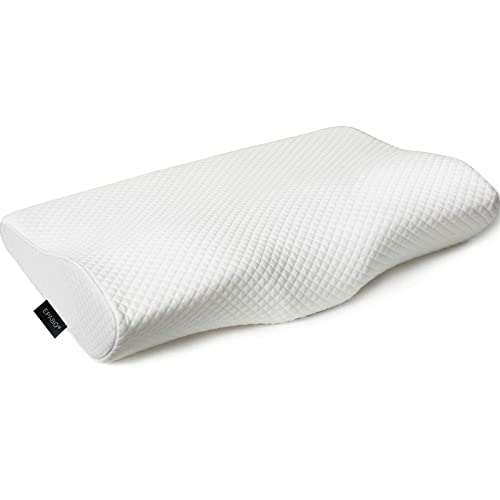
2. EPABO Contour Memory Foam Pillow — Best Simple Fixed Contour
The EPABO is the straightforward option in this roundup: a firm, Queen-size contour memory foam pillow with a pillowcase included in the listing, and no layers, inserts or settings to think about. Where the UTTU asks you to tune, the EPABO simply presents a shaped profile — raised edges for side sleeping, a dip for back sleeping — and asks whether that fixed geometry matches your body.
That simplicity is a genuine virtue for a lot of buyers. There is nothing to set up wrong, nothing to lose, and the firm feel holds its shape through the night instead of slowly collapsing the way soft fills do. Firm is the operative word, though: if your current pillow is a squishy hotel-style one, this will feel like a big change, and stomach sleepers in particular should only consider it if they use the lowest part of the contour.
Strengths
- Fixed firm contour — zero setup, nothing to adjust or misplace
- Pillowcase included in the listing, so it is usable the first night
- Holds its profile through the night better than soft filled pillows
Trade-offs
- No height adjustment if the fixed contour does not match your shoulders
- Firm feel is a sharp change from soft pillows
- One shape has to serve back, side and stomach positions, so it is a compromise for each
| Format | Complete contour bed pillow |
| Firmness as listed | Firm |
| Size as listed | Queen |
| Included as listed | Pillowcase included |
Choose the EPABO if you already know a contour works for you — perhaps from a previous pillow — and you simply want a firm, full-size replacement without a tuning project. It is also the easiest recommendation to give a partner or parent, because there is no configuration step where the gift can go wrong.
Skip it if you are contour-curious but unsure: an adjustable design is a kinder first experiment. And as with every pick here, judge it on a week of mornings, in your normal sleep position, on your own mattress — mattress firmness changes how much of the pillow’s height you actually use, because a soft mattress lets your shoulder sink and effectively lowers the pillow you need.
Best for: side and back sleepers who want one firm, shaped pillow with nothing to adjust / Not suited for: anyone who wants to change the height, or soft-pillow devotees
Check on Amazon — check price on Amazon for the current listing, size and colour options before you decide.
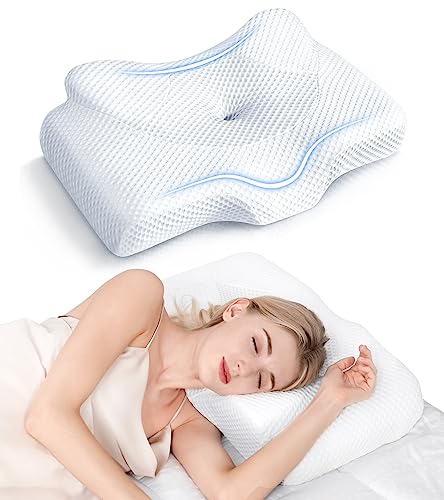
3. Osteo Cervical Pillow — Best for Back Sleepers
The Osteo’s distinguishing idea is right in its verified title: a hollow design. Instead of a simple dip, the centre of the pillow is scooped so the back of the head settles into the hollow while the shaped rim supports the neck. For back sleepers, that geometry addresses the most common contour complaint — the feeling of the chin being tipped toward the chest — by letting the head sit lower than the neck support around it.
The listing also describes the foam as odourless, which matters more than it sounds: new memory foam smell is a real reason pillows get returned in week one, and a low-odour foam shortens the airing-out period before the pillow can be judged fairly. The cooling case is the third practical touch, giving the sleeping surface a cooler hand-feel than a plain cotton cover over foam.
Strengths
- Hollow centre suits back sleeping better than a plain raised contour
- Odourless foam as listed — shorter airing period before first use
- Cooling case improves the surface feel over warm foam
Trade-offs
- The hollow is a back-sleeping feature first; side sleepers use only the rim
- Adjustable elements add a small setup step compared with fixed pillows
- Shaped pillows cannot be scrunched or folded the way soft pillows can
| Format | Complete contour bed pillow |
| Design as listed | Hollow centre design |
| Foam as listed | Odourless memory foam |
| Case as listed | Cooling case |
| Adjustability | Adjustable as listed |
If you sleep on your back for most of the night and your current pillow either pushes your head forward or lets it roll side to side, the Osteo is the most purpose-built option in this roundup. Side sleepers are listed as supported and the rim does work for position changes during the night, but a mostly-side sleeper with wide shoulders will usually be happier with the higher edges of the UTTU or the dual-height DONAMA-style designs.
One practical tip whichever contour you choose: photograph your sleep posture or have a partner check it in the first week. From above, the goal is boring — head centred, chin neither tucked nor tilted back, spine continuing the line of the mattress. If the hollow leaves your head lower than that line, a thin folded towel under the pillow for two test nights tells you whether a higher model would suit, before you buy one.
Best for: back sleepers who want their head cradled in a hollow centre rather than pushed forward / Not suited for: dedicated side sleepers with broad shoulders who need maximum edge height
Check on Amazon — check price on Amazon for the current listing, size and colour options before you decide.
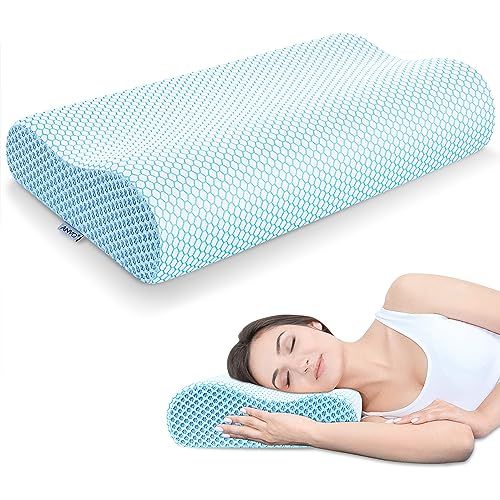
4. Anvo Memory Foam Pillow — Best Mid-Range Contour
The Anvo is the middle path of this roundup: a firm, neck-contour memory foam pillow in a blue-white colourway, listed for side, back and stomach sleepers, without the layer systems of the adjustable models. Its ergonomic contour follows the now-familiar pattern — supportive edges, lower middle — executed as a single fixed piece of foam.
Combination sleepers are the natural audience. If you start on your side, roll to your back, and occasionally end up half on your stomach, a fixed all-position contour saves you from the adjustable pillows’ one weakness: a setup tuned perfectly for one position can feel off in another. The Anvo makes no such bet; it offers the same moderate geometry in every direction.
Strengths
- One fixed contour that works across position changes through the night
- Firm foam keeps its shape for back and side sleeping alike
- Simple, complete pillow — no layers or loose parts
Trade-offs
- No way to raise or lower it if the stock height misses your build
- Firm feel will not suit committed soft-pillow sleepers
- Colourway is light, so a dark pillowcase is a sensible pairing
| Format | Complete contour bed pillow |
| Firmness as listed | Firm |
| Colour as listed | Blue White |
| Positions as listed | Side, back and stomach sleepers |
Think of the Anvo as the rental-car option of this category: not tailored to anyone, serviceable for almost everyone, and a sensible first contour if your sleep position is “all of them”. Households buying for a guest room often land here too, because a moderate fixed contour is the least surprising thing you can hand a visitor whose preferences you do not know.
Its limits show up at the extremes. Very petite back sleepers may find any firm contour assertive, and very broad-shouldered side sleepers may find the edge height modest. Both groups have better-matched picks in this same roundup — the slim Bluewave at one end and the adjustable UTTU at the other — which is exactly why the roundup is organised by fit rather than by a single score.
Best for: combination sleepers who change position and want a firm all-round contour / Not suited for: buyers who want adjustable height or a soft, sink-in feel
Check on Amazon — check price on Amazon for the current listing, size and colour options before you decide.

5. Bedsure Cervical Neck Pillow — Best Familiar-Brand Contour
Bedsure is a name many readers will already know from sheets and blankets, and its cervical neck pillow applies the same mass-market logic to the contour category: a memory foam contour that, in the listing’s words, gently cradles the head, aimed at side and back sleepers. There are no layers to configure and no unusual geometry to learn — the pillow’s shape does the positioning work by itself.
That familiarity cuts both ways. You give up the tuning range of the UTTU and the back-sleeper specialisation of the Osteo, and in exchange you get the contour category in its most approachable form, from a brand whose other bedding you may already own and whose sizing and case compatibility are easy to match with standard linens.
Strengths
- Approachable fixed contour from a widely recognised bedding brand
- Cradling shape suits the two most common sleep positions
- Easy to pair with standard cases and existing bedding
Trade-offs
- No adjustability for unusual shoulder widths or mattress pairings
- Not aimed at stomach sleepers at all
- Contour is gentler, which committed firm-pillow users may find soft
| Format | Complete contour bed pillow |
| Design as listed | Contour, cradles head |
| Positions as listed | Side and back sleepers |
| Fill as listed | Memory foam |
The Bedsure suits the reader who has decided “a contour pillow, please” and wants the decision to end there. It is also a reasonable way to test the category before spending on an adjustable flagship: if the cradling shape feels fundamentally right after a week, you have learned something real about your preferences; if it feels fundamentally wrong, no amount of layer-tuning in a rival model was likely to change that.
Pairing advice: because the contour is on the gentler side, this pillow works best on medium and firm mattresses, where your shoulder stays high and the pillow’s own shape does the supporting. On a very soft mattress, where the whole body sinks, even a well-shaped pillow can end up effectively too low — in that pairing, start with the adjustable UTTU instead.
Best for: shoppers who prefer a widely stocked bedding brand and sleep on their side or back / Not suited for: stomach sleepers, who are not the audience named in the listing
Check on Amazon — check price on Amazon for the current listing, size and colour options before you decide.
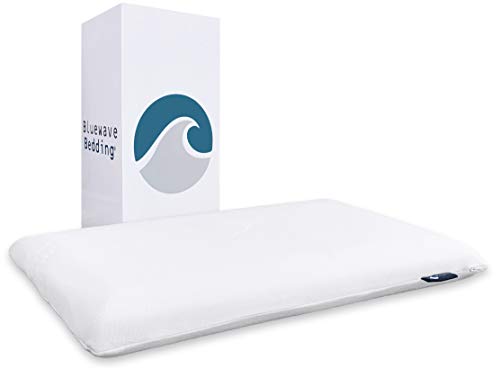
6. Bluewave Bedding Ultra Slim Gel Memory Foam Pillow — Best for Stomach Sleepers
Every roundup like this needs the opposite pick, and the Bluewave is it: an ultra-slim, flat gel memory foam pillow listed at just 2.75 inches high in Standard size, aimed at stomach and back sleepers. There is no contour, no raised edge and no adjustability — the entire design argument is that for some sleepers, the most supportive pillow is the one that barely lifts the head at all.
Stomach sleeping is where that argument is strongest. A tall pillow forces a stomach sleeper’s neck into a steep twist-and-lift combination for hours; a near-flat pillow reduces the lift so the head can rest closer to the mattress line. Some back sleepers — particularly those with a pronounced forward head posture at the desk all day — also find low pillows more comfortable than contours, and the gel foam keeps the thin profile from feeling like a folded towel.
Strengths
- 2.75 in profile solves the too-tall problem no contour can
- Flat design doubles as an under-pillow layer to fine-tune another pillow
- Gel memory foam gives a thin pillow some substance and shape retention
Trade-offs
- Far too low for side sleeping — the head will drop toward the mattress
- No contour support for sleepers who do need neck fill
- Standard size only as listed, so King-bed pairings look mismatched
| Format | Complete flat bed pillow |
| Height as listed | 2.75 in |
| Size as listed | Standard |
| Fill as listed | Gel memory foam |
| Design as listed | Thin, flat — no contour |
Buy the Bluewave if you recognise yourself in this sentence: every “supportive” pillow you have tried felt like it was pushing your head somewhere. It is also the cheapest experiment in the roundup in terms of commitment — a flat pillow that fails as your main pillow still works as a travel pillow, a knee pillow or a height-shim under another pillow, so the purchase rarely goes entirely to waste.
Do not buy it as a compromise for a side-sleeping partner. Sharing one pillow height between a stomach sleeper and a side sleeper is how both people end up uncomfortable; two different pillows on one bed is not a failure of tidiness, it is the correct answer to two different spines sharing a mattress.
Best for: stomach sleepers and back sleepers who find every contour pillow too tall / Not suited for: side sleepers, who need height this pillow deliberately does not provide
Check on Amazon — check price on Amazon for the current listing, size and colour options before you decide.
Comparison Table
Read the table by sleep position first and specifications second. Height and adjustability decide comfort in this category far more than brand or foam branding, and the table is organised so the height story of each pick is visible at a glance.
| Pick | Badge | Key spec | Best for |
|---|---|---|---|
| UTTU Cervical Pillow — Check price on Amazon | Best Overall | Queen 23.6×13.8 in; dual height 5.2/4.5 in; adjustable sandwich layers | back and side sleepers who want to tune the height instead of guessing it |
| EPABO Contour Memory Foam Pillow — Check price on Amazon | Best Simple Fixed Contour | Firm contour, Queen; pillowcase included as listed | side and back sleepers who want one firm, shaped pillow with nothing to adjust |
| Osteo Cervical Pillow — Check price on Amazon | Best for Back Sleepers | Hollow-centre design; cooling case; adjustable as listed | back sleepers who want their head cradled in a hollow centre rather than pushed forward |
| Anvo Memory Foam Pillow — Check price on Amazon | Best Mid-Range Contour | Firm neck-contour design; blue white colourway as listed | combination sleepers who change position and want a firm all-round contour |
| Bedsure Cervical Neck Pillow — Check price on Amazon | Best Familiar-Brand Contour | Contour design that cradles the head; for side and back sleepers as listed | shoppers who prefer a widely stocked bedding brand and sleep on their side or back |
| Bluewave Bedding Ultra Slim Gel Memory Foam Pillow — Check price on Amazon | Best for Stomach Sleepers | Ultra slim 2.75 in height; Standard size; gel memory foam as listed | stomach sleepers and back sleepers who find every contour pillow too tall |
Beyond the Pillow: Pairings, Second Pillows and Knowing When the Mattress Is the Problem
A main pillow does not work alone, and two pairings are worth understanding before you spend more money. The first is the second pillow: many back sleepers rest easier with a slim pillow under the knees, and many side sleepers with one between them, because those placements take twist out of the lower spine that the head pillow cannot reach. The flat Bluewave in this roundup doubles in that role honestly — it is a positioning layer, and using it as one is not a demotion but a second job it is genuinely shaped for.
The second pairing is the one nobody wants to hear: the mattress. A pillow sits on top of a system, and a sagging mattress defeats every contour in this guide by dropping the whole body into a curve no head-height can correct. The test is simple and free — sleep one night on the firmest bed or floor arrangement available to you, with your current pillow, and notice whether the morning changes more than any pillow swap ever achieved. If it does, the next purchase in the system is not in this article.
There is also a replacement rhythm to respect. Memory foam pillows lose their recovery slowly; the press test — foam that no longer pushes back fully under your palm at the thickest point — is the honest signal, and it usually arrives after a few years of nightly use rather than months. Replacing a pillow on that evidence, in the same shape family that already worked for you, is the cheapest repeatable win in this whole category: no new adaptation week, no new guessing, just the geometry you already proved, restored to full height.
A Short Word on Pillow Hygiene and Replacement
Pillows are the least-washed textile in the bedroom relative to their workload: they hold a head for a third of every day, absorb sweat and skin oils through the case, and are typically replaced years after their support has gone. The hygiene routine that matches the pillows in this roundup is simple. Use the case provided or a washable protector, wash cases with the weekly bedding, and air foam pillows in a ventilated room whenever the bedding is stripped — foam should never be soaked or machine washed unless the maker explicitly allows it, because waterlogged foam dries slowly and degrades.
Replacement is a support decision disguised as a hygiene one. The press test described earlier — foam that no longer recovers under your palm — is the signal that the geometry you bought has retired, and it usually arrives well before the pillow looks worn. A household that replaces pillows on that evidence, in the same shape family, keeps the adaptation cost at zero and the benefit continuous. The expensive pattern is the opposite: enduring a dead pillow for a year, then switching shape families in frustration and spending a month adapting to a stranger. Buy the shape once, prove it over a week, and then maintain it like the piece of sleep equipment it is.
How to Choose a Pillow for Back and Neck Comfort
Start with your dominant sleep position, honestly assessed. Most people over-report back sleeping and under-report side sleeping, because we remember how we fell asleep, not how we woke. Check where you actually wake up for three mornings, or ask a partner. Side sleepers need the tallest, firmest fill, because the pillow must bridge the full width of the shoulder. Back sleepers need a medium height with real fill behind the neck and a lower zone under the head. Stomach sleepers need the flattest pillow they can find, full stop.
Next, understand loft as a system, not a number on a box. The height you need is the gap between your head and the mattress when your spine is straight — and that gap changes with mattress firmness, because a soft mattress lets your shoulder sink and shrinks the gap, while a firm mattress holds you up and grows it. This is why adjustable pillows earn their keep in this category: the same person can need the high setting on a firm guest bed and the low setting on their own soft mattress at home.
Then weigh contour against flat. A contour pillow positions actively: raised edges and a centre dip hold the head in one intended place, which suits people who sleep relatively still in one or two positions. A flat pillow positions passively and lets you move, which suits restless sleepers and stomach sleepers. Neither is more advanced; they are different tools, and choosing by your movement pattern matters more than choosing by marketing tier.
Finally, treat firmness as a preference with a floor. A pillow that collapses to nothing by 3 a.m. is not supporting anything, whatever it felt like in the shop. Memory foam contours hold shape best; that is why this roundup is foam-led. But shape retention is not the same as comfort — give any new pillow a full week of nights before judging it, and use the return window honestly if your mornings are getting worse rather than better.
What Loft, Firmness and Shape Actually Mean at 3 A.M.
Loft is simply the pillow’s height under your head, but its effect is easiest to feel in the neck angle. Too much loft on your back tips the chin toward the chest; too little lets the head fall back and the neck arch. On your side, too little loft drops the head toward the shoulder and bends the neck sideways; too much pushes it up the other way. The neutral middle — ear roughly over shoulder, chin level — is the whole game, and every pick in this guide is a different way of landing there.
Firmness interacts with loft because a soft tall pillow and a firm low pillow can end up at the same effective height once your head’s weight settles in. This is why comparing pillows by their shelf height alone misleads. Memory foam’s slow response is useful here: it compresses to a stable working height and stays there, so the geometry you set up at bedtime is roughly the geometry you wake up with.
Shape is the third variable, and the one marketing talks about most and explains least. A dual-height contour is really two pillows in one case — rotate it and you change loft. A hollow-centre design is a back-sleeping specialisation. A sandwich or layered design is loft you can edit. When you read the reviews above, translate every design claim into one of those plain functions and the category becomes much easier to shop.
How to Set Up and Test a New Pillow Properly
Step one: air the pillow out. Even the low-odour foams in this roundup benefit from a day in a ventilated room before the first night, and judging any pillow on a night when the room smells of new foam is unfair to both of you. Step two: fit the right case — a case that is too small compresses a contour and changes its height, so use the case provided or a standard case with room to spare.
Step three: configure before you sleep, not during. With an adjustable model, set the configuration that matches your dominant position using the guide in the buying section, then leave it alone for at least three nights. Changing the setup nightly means you never adapt to anything and learn nothing. Step four: test in your real bed, with your real mattress and your usual second pillow removed — stacking a new contour on top of an old pillow defeats the entire design.
Step five: judge by mornings, across a week. Keep a two-line note each morning — how the neck feels on waking, and whether you woke in the night aware of the pillow. A good trend matters more than any single night. If the trend is flat or worsening by night seven, change one variable (rotate to the other height, or remove a layer) and give it three more nights. If it is still wrong after that, the shape is wrong for you, and the honest move is to return it and try the opposite style from this roundup.
Common Buying Mistakes
Buying by brand or by foam buzzwords instead of by height. Two pillows with identical “memory foam” branding can differ by two inches of loft, and those two inches matter more than everything else on the box combined. Shop the measurements and the adjustability first; let brand break ties, not make decisions.
Expecting a pillow to treat a medical problem. A pillow can make your sleep position more neutral and more comfortable. It cannot diagnose or treat a back or neck condition, and persistent pain, numbness, or pain travelling into an arm is a reason to see a clinician, not to buy a more expensive pillow.
Judging a contour pillow on night one. Shaped pillows feel strange before they feel right. One night tells you almost nothing; a week of mornings tells you nearly everything. Quitting on night two is the most expensive habit in this category.
Stacking pillows. A contour pillow on top of a regular pillow is just a tall, unstable pillow with an expensive bottom layer. One pillow, at the right height, beats two pillows at a wrong one — and stacking is a common hidden reason a good new pillow “doesn’t work”.
Ignoring the mattress in the equation. The same pillow is effectively taller on a firm mattress and shorter on a soft one. If you change mattresses, re-test your pillow setup before blaming either product; the pairing is the product.
Buying a side-sleeper pillow for a stomach sleeper. Shared beds tempt shared pillows, but the height needs are opposite. Two different pillows is the correct, unglamorous answer.
Final Recommendation
For most readers, the UTTU is the right first buy: its two listed heights and adjustable sandwich build give you the best chance of landing on a neutral position without a second purchase. Back sleepers who know their position and want it cradled should look first at the Osteo and its hollow centre. Side and combination sleepers who want a firm fixed contour should choose between the EPABO and the Anvo, with the Bedsure as the gentlest, most familiar-brand version of the idea.
And if every contour you have ever tried felt like too much pillow, believe that evidence: the Bluewave’s 2.75-inch flat profile exists for you, and it is a better answer than another shaped pillow bought in hope. Whichever you choose, give it a week, judge it by mornings, and remember the boundary this guide started with — comfort and positioning are what pillows do, and anything beyond comfort deserves a professional’s input, not a product page.
- UTTU Cervical Pillow (Best Overall): Check on Amazon
- EPABO Contour Memory Foam Pillow (Best Simple Fixed Contour): Check on Amazon
- Osteo Cervical Pillow (Best for Back Sleepers): Check on Amazon
- Anvo Memory Foam Pillow (Best Mid-Range Contour): Check on Amazon
- Bedsure Cervical Neck Pillow (Best Familiar-Brand Contour): Check on Amazon
- Bluewave Bedding Ultra Slim Gel Memory Foam Pillow (Best for Stomach Sleepers): Check on Amazon
Keep exploring the same corner of the catalogue with these related guides: Best Duck Feather And Down Pillows Best Eco Friendly Hypoallergenic Pillows Best Euro Square Pillows Best Extra Firm Extra Thick Gusset King Pillows
Frequently Asked Questions
Can a pillow really help my back, or is it all about the neck?
A pillow touches your back only indirectly. It positions your head and neck, and for back sleepers it also influences the curve of the upper spine as you lie down. Your lower back is mostly the mattress’s job. So shop a pillow for head and neck positioning, keep expectations there, and do not buy a pillow as a back treatment.
How high should my pillow be?
High enough that your head stays level with your spine in your main sleep position — ear over shoulder when side sleeping, chin level when back sleeping. In product terms that usually means an adjustable or dual-height contour for side and back sleepers, and the flattest pillow available for stomach sleepers. Your mattress firmness shifts the answer, which is why adjustable models are the safest buy.
How long should I trial a new pillow before returning it?
About a week of full nights, changing the configuration once halfway if it is adjustable. Judge by the trend in how your mornings feel, not by any single night. If mornings are clearly worse by the end of the week, the shape is wrong for you and returning it is the right call.
Are contour pillows safe for stomach sleepers?
Most contours are too tall and too structured for stomach sleeping, which twists the neck enough already. One pick in this roundup — the ultra-slim flat Bluewave at 2.75 inches — is designed for that position. If you are a committed stomach sleeper, start flat rather than contoured.
When should I stop shopping and see a professional?
If you have persistent pain that does not ease, numbness or tingling, pain travelling into an arm or leg, weakness, or symptoms after an injury or accident, a pillow is not the next step — a clinician is. This guide covers comfort and sleep positioning only, deliberately.
Do I need a special pillowcase for a contour pillow?
You need a case that does not fight the shape: the included case where one is provided, or a standard case with enough room that it does not compress the contour and change its height. A tight case can undo the design you paid for.

