Disclosure: airfryerkitchensupply.com is reader-supported. When you buy through links on our site, we may earn an affiliate commission at no extra cost to you.
Where to buy
Shoppers comparing thin beach towels should start from verified listings: every towel in this guide was confirmed against Amazon’s own product data before it earned a link, so the sizes and materials quoted below are the sizes and materials on the actual listings. Start with the Dock & Bay Essential Extra Large if you want the thinnest, fastest-drying option, the Cacala Turkish towel if you want thin in natural cotton, or the Wise Owl Outfitters towel if you need the biggest footprint. The full shortlist: ECCOSOPHY Microfiber Beach Towel, WETCAT Turkish Beach Towel, and the Sand Cloud Turkish Beach Towel. Check the current price on Amazon from any of these links — prices move with season and color, so we never print a fixed figure here.
Why thin beach towels are worth a separate guide
The best thin beach towels solve a problem that thick terry towels create: bulk. A plush cotton bath-style towel can take up half a beach bag, stay damp for the whole drive home, and bring a surprising amount of sand back with it. If you are comparing thin beach towels, you are probably packing for travel, walking a long way to the water, sharing one bag between several people, or simply tired of laundry loads dominated by two enormous towels. Thin does not have to mean flimsy, and this guide separates the towels that are thin by smart design — flat-weave cotton and engineered microfiber — from towels that are thin because there is barely anything there.
There are two honest families in this category. The first is microfiber: synthetic, extremely flat, quick to dry, and resistant to holding sand. The second is the Turkish flat-weave tradition — peshtemal-style cotton towels that have been thin on purpose for centuries, woven flat so they dry fast, pack small, and double as wraps, throws, and picnic blankets. Both families appear below, because the right answer depends on whether you prioritize absolute pack size or natural fiber. What you will not find here is a standard looped terry beach towel pretending to be a travel towel; every pick is genuinely slim when folded.
One expectation to set early: a thin towel absorbs differently. Microfiber pulls water across a wide area quickly but holds less total water than thick terry; flat-weave cotton absorbs well for its weight and improves after the first few washes. For drying off after a swim, all six picks are up to the job. For lying on for hours, the bigger sizes matter more than thickness, which is why this guide pays close attention to dimensions.
In this guide
Quick Picks
| Pick | Badge | Why it is here |
|---|---|---|
| Dock & Bay Beach Towel – Essential, Extra Large | Best Overall | 100% recycled microfiber, 200 x 90 cm, includes a carry bag, folds flatter than anything else here |
| Cacala Lightweight and Thin Turkish Beach Towel | Best Thin Cotton | The genuinely thin one: flat-weave 100% cotton at 37 x 70 inches that packs to almost nothing |
| ECCOSOPHY Microfiber Beach Towel | Best Value Microfiber | Oversized 71 x 35 inches, quick dry and sand free, a travel staple at a modest tier |
| Wise Owl Outfitters Microfiber Beach Towel | Best Extra Large | A huge 84 x 48 inch sheet — room for two people or one person plus all their gear |
| WETCAT Turkish Beach Towel | Best Soft Cotton | 100% Turkish cotton, made in Turkey, 38 x 71 inches, the softest hand-feel of the cotton picks |
| Sand Cloud Turkish Beach Towel | Best Organic Cotton | 100% organic cotton Turkish weave that doubles as a picnic or beach blanket |
How These Picks Were Chosen
Every product in this guide was verified through Amazon data for this site: the listing title was matched to the product named here, and the ASIN on each link comes from that API response — never from memory, never guessed. Only specifications actually stated in the verified listing data are printed in the spec boxes: dimensions, fiber content, and stated features such as an included carry bag. Where a listing does not state a specification — a weight in grams, for example — this guide says so rather than filling the gap.
Selection started from the search itself: thin. A towel had to be meaningfully slimmer than a standard terry beach towel, either by construction (microfiber sheet, flat weave) or by explicit lightweight design. From there, picks were balanced across the two material families and across sizes, from the 37 x 70 inch Cacala up to the 84 x 48 inch Wise Owl, so that solo travelers, couples, and families each have an option. Towels that were simply small — kids’ hooded ponchos and hand-towel-sized products that surfaced in the same searches — were excluded; small is not the same as thin, and a child’s poncho does not serve an adult comparing travel towels.
Two honesty rules shaped the final list. First, duplicate color variants of one product were treated as one product: the Dock & Bay range appears once, in the Essential Extra Large, even though the same towel is sold in many colors and two size lines. Second, no fixed prices and no star ratings appear anywhere in this guide, because both change constantly; each pick is positioned by tier in words instead.
The 6 Best Thin Beach Towels

1. Dock & Bay Beach Towel – Essential, Extra Large — Best Overall
This is the towel that defines the modern thin beach towel: a 100% recycled microfiber sheet measuring 200 x 90 cm (78 x 35 inches) that folds into its own included carry bag and comes out the other side of a swim dry to the touch in a fraction of the time terry needs. It suits travelers, gym-and-beach combiners, and anyone whose beach bag is shared space. It is less suited to people who want the cushioned, wrap-up warmth of cotton — microfiber feels smooth and flat rather than plush, and that texture is a genuine preference split.
Strengths
- Folds flatter than any cotton pick here, and the included bag keeps the rest of your kit sand-free
- Microfiber surface sheds sand instead of trapping it — shake it once and it is clean
- 100% recycled material, stated on the listing, for buyers who weigh that in
Trade-offs
- Smooth microfiber feel is not the soft, absorbent hug some swimmers want straight out of cold water
- Absorbs by spreading water thin rather than holding a lot of it — heavy-duty drying takes a second pass
- Synthetic fiber: buyers avoiding synthetics on principle should look at the cotton picks instead
| Spec | Verified detail |
|---|---|
| Size | Extra Large, 200 x 90 cm (78 x 35 in) |
| Material | 100% recycled (microfiber) |
| Included | Carry bag |
| Stated features | Quick dry, sand free, compact, lightweight |
The Essential line is Dock & Bay’s plain-color range, and choosing it over the striped Cabana line is mostly an aesthetic call; the construction is the same idea. In use, the size is the quiet star: 200 cm of length means tall adults can lie fully on it without feet in the sand, while the width stays narrow enough that the folded bundle remains genuinely small. For carry-on-only trips, this is the easiest towel on the list to justify packing — it takes roughly the space of a folded t-shirt. Care is simple: wash cool, skip fabric softener (it coats microfiber and dulls absorbency), and air dry, which it does quickly anyway.
Best for: travelers and minimal packers who want the thinnest fold and fastest dry. / Not suited for: swimmers who want plush cotton softness against the skin.
Check on Amazon — check price on Amazon for the current color range.

2. Cacala Lightweight and Thin Turkish Beach Towel — Best Thin Cotton
If your definition of thin is a towel that nearly disappears into a tote, the Cacala is the purest expression of it in cotton: a flat-weave 100% cotton Turkish towel, 37 x 70 inches, with no terry loops at all. It suits warm-weather beach days, travel, and anyone who uses a towel as much as a wrap, sarong, or light throw as a drying tool. It is not the pick for someone who wants to burrow into pile after a cold swim — there is deliberately almost no pile to burrow into.
Strengths
- The thinnest cotton construction here — folds or rolls to a fraction of a terry towel’s bulk
- Flat weave releases sand easily and dries fast for a natural fiber
- Doubles as a wrap, throw, or picnic cloth, which earns its place in a small bag
Trade-offs
- Absorbency per pass is modest; it dries you by wicking across area, not by soaking like terry
- Flat cotton needs a few washes to reach its softest, most absorbent state
- Offers little cushioning on hard pool decks or pebbly beaches
| Spec | Verified detail |
|---|---|
| Size | 37 x 70 in |
| Material | 100% cotton, flat (Turkish) weave |
| Stated features | Lightweight and thin, sand-free, quick-drying |
Peshtemal-style towels like this one are the original travel towel — hammams have used flat cotton for centuries precisely because it dries fast and packs small. The Cacala’s honest limitation is physics: with no loops, there is less fiber surface to hold water, so the technique is press-and-glide rather than rub. In exchange you get a towel that is dry again by the time you have had a drink, that never develops the musty smell damp terry picks up in a beach house, and that washes in a tiny fraction of a laundry load. For Mediterranean-style trips — beach club in the morning, old town in the afternoon — it also works as a shoulder wrap, which no microfiber sheet does as gracefully.
Best for: ultralight packers and warm-climate beach days where cotton is non-negotiable. / Not suited for: cold-water swimmers who want maximum post-swim warmth and absorbency.
Check on Amazon — check price on Amazon before you buy, as color pricing varies.
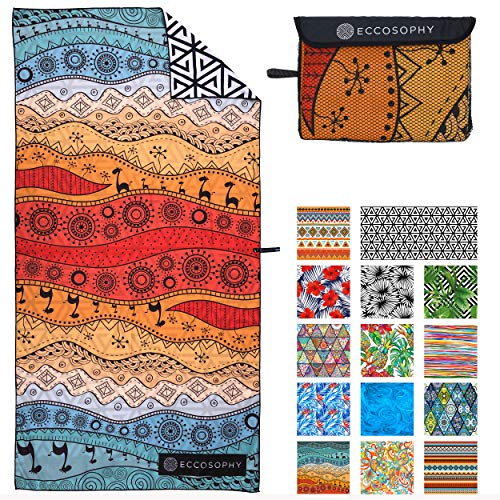
3. ECCOSOPHY Microfiber Beach Towel — Best Value Microfiber
ECCOSOPHY’s towel is the straightforward bargain of the microfiber family: an oversized 71 x 35 inch sheet that is quick drying, sand free, and sold for the whole circuit of swim, gym, pool, cruise, and camping use. It suits buyers who want the thin-towel benefits without paying a brand premium, and households buying several towels at once. It is not the pick for someone who wants a carry bag and a polished brand ecosystem included — this is a towel, plainly sold, and its value is in the sheet itself.
Strengths
- Full oversized footprint at 71 x 35 inches in a modest price tier
- Microfiber dries fast and shakes clean of sand like the premium picks
- Works across beach, pool, gym, and camping without feeling specialized
Trade-offs
- No carry bag is stated on the listing — budget a stuff sack if you travel with it
- Same smooth microfiber hand-feel as all synthetics here; not a softness pick
- Design range is print-driven; prints vary in how they age after many washes
| Spec | Verified detail |
|---|---|
| Size | 71 x 35 in (oversized) |
| Material | Microfiber |
| Stated features | Quick dry, sand free, super absorbent, lightweight, compact |
The sensible way to judge this towel is against the cost of outfitting a family or a rental property: four of these occupy less shelf and suitcase space than one terry set, dry between morning and afternoon swims, and do not demand careful laundry. The listing describes the absorbency as super absorbent; treat that as marketing framing rather than a measured claim — in practice it dries a swimmer effectively, like the other microfiber sheets here, and its real advantages are dry time and pack size. If you mostly swim at one local beach and drive there, the premium picks’ bags and finishes matter less than they do to travelers, which is exactly where this towel wins.
Best for: families and multi-towel buyers who want thin and quick-drying at a modest tier. / Not suited for: gift buyers or travelers who want the bag and finish of a premium brand.
Check on Amazon — check price on Amazon; multi-packs appear seasonally.

4. Wise Owl Outfitters Microfiber Beach Towel — Best Extra Large
Most thin towels go slim in both dimensions; the Wise Owl goes the other way, spreading to 84 x 48 inches — seven feet by four — while staying a flat microfiber sheet. It suits couples who share one towel as a base camp, parents corralling kids and gear on one surface, and tall or broad beachgoers who find standard towels comically small. It is not a solo traveler’s towel: even folded thin, that much fabric is a real bundle, and it is overkill for a single swimmer with a small bag.
Strengths
- The largest footprint in this guide by a wide margin — a genuine two-person base
- Still microfiber: quick drying and sand-shedding despite the size
- One sheet replaces a towel plus a beach blanket for many households
Trade-offs
- Folded volume is the biggest here; thin, but not tiny
- Takes longer to dry fully than the smaller microfiber picks simply due to area
- On a crowded beach, claiming 84 x 48 inches of sand is a social decision
| Spec | Verified detail |
|---|---|
| Size | 84 x 48 in (7 x 4 ft) |
| Material | Microfiber |
| Stated features | Quick dry, lightweight, sand free |
Wise Owl Outfitters comes from the camping world, and this towel reads like camping gear: a big, practical sheet that earns its space by doing two jobs. As a drying towel it is more than anyone needs; as a shared ground layer that also dries people, it is efficient. The honest framing is that this pick trades the category’s headline benefit — minimal pack size — for coverage, so it belongs in car-based beach trips, lake days, and festival-style outings rather than carry-on luggage. Hung over a line or a car door, it airs out fast for its size thanks to the thin weave.
Best for: couples, families, and big-and-tall beachgoers who want one large shared surface. / Not suited for: ultralight solo travelers counting every liter of pack space.
Check on Amazon — check price on Amazon for current colors.
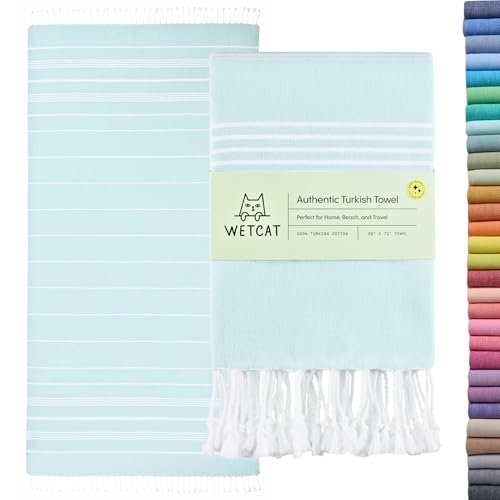
5. WETCAT Turkish Beach Towel — Best Soft Cotton
The WETCAT is the cotton pick for people who read “thin” as “not bulky” rather than “barely there”: 100% Turkish cotton, made in Turkey, in an oversized 38 x 71 inch cut that the listing describes as ultra soft and quick drying while remaining compact and lightweight for travel. It suits cotton loyalists who still want a towel that feels like a towel. It is less suited to gram-counting packers — next to the Cacala, this is the fuller-bodied cotton option, and it folds accordingly.
Strengths
- Genuine Turkish cotton with the softness that fiber is known for
- Oversized 38 x 71 inch dimensions wrap fully around most adults
- Still far flatter and faster-drying than looped terry
Trade-offs
- Thicker and slower-drying than the Cacala flat weave
- Cotton holds more sand than microfiber — shake it well before bagging
- Needs wash care (no softener) to keep absorbency at its best
| Spec | Verified detail |
|---|---|
| Size | 38 x 71 in (oversized) |
| Material | 100% Turkish cotton, made in Turkey |
| Stated features | Sand free, extra large, ultra soft, quick drying, compact and lightweight |
Within the cotton family, this guide deliberately includes two different philosophies: the Cacala is a true flat-weave peshtemal, while the WETCAT is a plusher Turkish towel engineered down to travel weight. If your beach routine involves long reads on the towel and a wrap-up on the walk home, the WETCAT’s hand-feel justifies its extra fold. The “sand free” phrasing on the listing should be read as “sand resistant in practice”: flat and short-pile cotton releases dry sand with a shake, but no cotton matches microfiber here. As a gift, this is the cotton pick that feels generous rather than austere.
Best for: cotton lovers who want softness first and thinness second. / Not suited for: minimalists who want the absolute smallest cotton fold.
Check on Amazon — check price on Amazon; the Aqua colorway is the verified listing.

6. Sand Cloud Turkish Beach Towel — Best Organic Cotton
Sand Cloud’s towel is a Turkish-weave beach towel in 100% organic cotton, sold as much as a blanket — for picnics and beach lounging — as a drying towel, in a Marine Life design. It suits buyers who put organic fiber at the top of the list and who lounge more than they swim. It is not the pick for a dedicated swimmer who needs the fastest dry time; as a blanket-first design it is the lounger’s option, and the listing does not state dimensions, so size-focused buyers should check the listing details before ordering.
Strengths
- 100% organic cotton — the only organic pick in this guide
- Turkish weave keeps it in the thin, quick-drying family despite the blanket role
- Works as picnic blanket and throw beyond the beach
Trade-offs
- Dimensions are not stated in the verified listing title — confirm on the product page
- Blanket-first design is less swim-focused than the other picks
- Organic cotton sits in a premium tier relative to conventional cotton
| Spec | Verified detail |
|---|---|
| Material | 100% organic cotton, Turkish weave |
| Stated features | Sand resistant, quick dry; blanket for picnic or beach |
| Size | Not stated in verified listing data |
A note on certification language, because this category abuses it: this guide describes the Sand Cloud as organic cotton because its verified listing says “100% Organic Cotton” — that is the claim as stated by the seller, and this guide does not add a certification (such as GOTS) that the listing data does not name. Buyers for whom third-party certification is the deciding factor should look for the certifier’s mark on the product page itself. As a towel, expect flat-weave behavior: good absorbency for its weight, fast drying, and a softer hand after the first washes. The Marine Life print also makes it the most giftable design in the cotton group.
Best for: organic-fiber buyers and loungers who want one piece that is towel and blanket. / Not suited for: size-specific buyers who need confirmed dimensions before purchase.
Check on Amazon — check price on Amazon and confirm dimensions on the listing.
A final framing before the head-to-head table: none of these six towels is a mistake. They are six different answers to the same packing problem, and the table below is organized to make the differences — material, size, and intended day — visible at a glance rather than to crown a single winner for every reader.
Comparison Table
| Pick | Badge | Key spec | Best for |
|---|---|---|---|
| Dock & Bay Essential XL | Best Overall | 200 x 90 cm, 100% recycled microfiber, bag included | Travel, minimal packing |
| Cacala Turkish Towel | Best Thin Cotton | 37 x 70 in, flat-weave 100% cotton | Ultralight cotton packing |
| ECCOSOPHY Microfiber | Best Value Microfiber | 71 x 35 in microfiber | Families, multi-buy |
| Wise Owl Outfitters | Best Extra Large | 84 x 48 in microfiber | Sharing, base-camp coverage |
| WETCAT Turkish Towel | Best Soft Cotton | 38 x 71 in, 100% Turkish cotton | Softness within thin |
| Sand Cloud Turkish Towel | Best Organic Cotton | 100% organic cotton, size not stated | Organic fiber, lounging |
How to Choose Thin Beach Towels
Start with the material decision, because it decides almost everything else. Microfiber — the Dock & Bay, ECCOSOPHY, and Wise Owl here — is the thinnest, fastest-drying, most sand-resistant choice, and the least plush. Flat-weave cotton — Cacala, WETCAT, Sand Cloud — feels natural, breathes, doubles as clothing-adjacent wraps and throws, and asks a little more patience on drying time and a few washes to reach full absorbency. Neither family is objectively better; they are better for different beach habits. Daily swimmers who rinse and repeat favor microfiber. Loungers who live on their towel all afternoon usually favor cotton.
Size is the second decision, and it is where thin towels quietly differ most. A 37 x 70 inch towel is a full adult length but a modest width — fine for drying and for lying on your back, tight for side-sleepers and gear sprawl. The 200 x 90 cm Dock & Bay is the balanced travel size. The 84 x 48 inch Wise Owl is a shared surface, not a personal towel. Measure against your own height: you want your whole body on the towel with a few inches to spare, or accept feet-on-sand as a lifestyle choice.
Weight deserves a honest footnote. Listings in this category advertise lightness constantly but rarely state a scale weight in the data this guide could verify, so no gram figures are printed here. As a rule of thumb you can apply in a store or from a parcel’s feel: a thin microfiber sheet should feel closer to a t-shirt than to a bath towel, and a flat-weave cotton should feel like a light tablecloth, not a blanket. If a “thin” towel arrives feeling like ordinary terry, it is ordinary terry wearing a travel label, and returning it is reasonable.
Third, think about the system around the towel. A carry bag (included with the Dock & Bay) keeps a damp towel from wetting everything else and keeps sand out of your car. If your pick has no bag, a dry bag or even a pillowcase does the same job. Finally, be honest about laundry: microfiber wants cool washes and no fabric softener; cotton flat-weaves want the same softener ban, because softener coats fibers and strangles absorbency in both families. A towel that “stopped working” after a month is usually a towel that has been washed in softener, not a bad towel.
Thin vs. thick: what you actually give up
There is also a hygiene angle that rarely gets mentioned. A thick terry towel that stays damp in a beach bag or a humid rental bathroom for two days is a towel developing odor, and once terry picks up that sour smell it can survive several washes. Thin towels sidestep the whole cycle: they dry on a balcony rail, a car mirror, or a hotel towel bar within hours, so they start each day actually clean-feeling. For multi-day trips without laundry access, that difference alone justifies the category.
The honest trade is cushioning and single-pass absorbency. On soft sand, you give up almost nothing — the sand is the cushion. On concrete pool decks, pebble beaches, and wooden loungers, a thin towel offers little padding, and pairing it with a cheap foam mat or choosing the plusher WETCAT narrows the gap. On absorbency, a thin towel dries a person perfectly well; it just does it with technique (press, glide, repeat) rather than one enveloping rub, and it will feel saturated sooner if three people share it in rotation. Where thin wins outright: pack volume, dry time, sand release, laundry load, and the probability that the towel is actually dry — not funky — by tomorrow morning’s swim.
How to Use and Care for Thin Beach Towels
Getting the most from a thin towel is mostly technique and wash habits:
- Dry by pressing, not rubbing. Lay the towel against the skin and press; microfiber and flat cotton both wick best with contact time. One slow pass beats three fast scrubs.
- Shake before you bag. One sharp shake per side, downwind, removes nearly all sand from microfiber and most from flat cotton. Do it at the waterline, not at the car.
- Wash new cotton towels two or three times before judging them. Flat-weave cotton ships with finishing on the fibers; absorbency climbs noticeably over the first washes.
- Never use fabric softener or dryer sheets. They coat fibers — synthetic and natural alike — and are the number one cause of “my towel repels water now.”
- Wash cool and air dry. Thin towels dry so fast that a dryer is mostly wasted energy; hanging also keeps microfiber from picking up lint from cotton loads.
- Roll, don’t fold, for packing. Rolled thin towels fill odd corners of a bag and come out with fewer hard creases.
Common Buying Mistakes
- Confusing thin with small. A kids’ poncho towel is small, not thin — and useless as an adult’s travel towel. Check dimensions, not adjectives.
- Buying microfiber and expecting terry softness. The smooth, almost suede-like feel is inherent to the material. If you know you dislike it, choose cotton now, not after a disappointed trip.
- Ignoring the size because the fold looked tiny. Thin towels unfold bigger than they look — and some unfold smaller. The Wise Owl and the Cacala are both “thin beach towels” with wildly different footprints.
- Ruining absorbency with fabric softener in the first month. The most common and most avoidable failure in this whole category.
- Paying for duplicate listings. Popular thin towels are sold in many colors under near-identical listings; one product in five colors is still one product. Compare construction, not color count.
- Expecting one thin towel to serve a whole family in rotation. Thin towels dry fast, but a saturated towel passed between four swimmers is nobody’s friend. Budget one per person, or one shared giant like the Wise Owl plus personal towels.
Final Recommendation
For most people reading this guide, the Dock & Bay Essential Extra Large is the answer: thinnest fold, fastest dry, a real adult size, and a bag to keep the system tidy. If you want cotton and mean it about thin, take the Cacala; if you want cotton that still feels plush, take the WETCAT; if organic fiber is the priority, the Sand Cloud is the verified organic option. Outfitting a family on a budget points to the ECCOSOPHY, and sharing one big base points to the Wise Owl Outfitters. Whichever you choose, check price on Amazon from the links above — we deliberately publish no fixed prices, because they change too often to print honestly.
Related guides in this series: Best Beach Towels Dock And Bay, Best Family Beach Towels, Best High Quality Beach Towels, Best Beach Towels For Boats.
Microfiber vs. flat-weave cotton, in depth
Because this guide splits evenly between two materials, it is worth understanding what is actually happening at the fiber level — it explains every strength and trade-off listed above. Microfiber beach towels are woven from split synthetic filaments, typically polyester blends, engineered so each filament has an enormous surface area relative to its weight. Water is pulled into the spaces between filaments by capillary action, which is why a microfiber sheet feels almost grabby against wet skin and why it dries you with a pressing motion better than a rubbing one. The same structure explains the sand behavior: there are no loops for grains to lodge in, so a shake clears it. And it explains the care rules — heat and softener damage or coat those fine filaments, and the towel’s wicking falls off a cliff.
Flat-weave cotton works on older principles. Long cotton fibers are woven into a dense, flat sheet with no pile. Absorption happens into the fiber itself rather than into loops, which is slower per second but perfectly adequate across a 37 x 70 inch sheet, and the towel’s capacity grows as the fibers soften and open up over the first washes. What flat cotton gives back is everything synthetic cannot: it breathes against skin on a hot day, it does not develop the static cling microfiber can, it drapes like fabric (hence the wrap, sarong, and throw uses), and it ages gracefully for years because there are no loops to snag, pull, or go threadbare. Its honest costs are dry time — fast for cotton, slow next to microfiber — and a little more sand retention when the sand is wet.
The WETCAT sits deliberately between these poles: Turkish cotton produced to feel plush while staying travel-weight. Think of the six picks as a spectrum rather than two camps — Dock & Bay and ECCOSOPHY at the engineered extreme, Cacala at the traditional extreme, WETCAT and Sand Cloud in the cotton middle, and the Wise Owl off to the side answering a size question instead of a material one. Choosing where you sit on that spectrum is the real decision in this category; the individual product choice then mostly follows.
Thin beach towels by scenario
Carry-on-only beach trips. Pack the Dock & Bay or the Cacala. Both roll to roughly t-shirt volume, dry overnight in a hotel bathroom, and survive a week of daily swims without a laundry. Between them, choose microfiber if your destination is humid (cotton dries slowly in tropical air) and cotton if you will also use the towel as an evening wrap.
Drive-to beach houses and rentals. Pack size stops mattering and hand-feel takes over: the WETCAT for the adults, ECCOSOPHY towels for the kids and spares, and the Wise Owl as the shared base by the water. This is also the scenario where owning several mid-tier towels beats owning one premium towel, because rotation matters more than refinement.
Pool decks, water parks, and gym-to-swim routines. Microfiber wins outright. It handles daily washing, dries between morning laps and an afternoon session, and does not come home smelling like a damp cave. The ECCOSOPHY’s whole design brief is this circuit.
Picnic-and-lounge beach days. The Sand Cloud and the Wise Owl are the loungers’ picks — one for its organic cotton blanket feel, the other for sheer shared area. If your beach day is 80% lying and 20% swimming, optimize for the lying.
Cold-water swimming — sea dips, northern lakes, winter lidos. Be honest with yourself here: thin towels are at their weakest straight out of cold water, because there is little insulation in a flat sheet. The WETCAT is the least-bad option in this guide, but committed cold-water swimmers should treat a thin towel as the travel layer and keep a thick robe or terry towel as the home layer. No guide should pretend a peshtemal replaces a winter robe.
What “thin” should cost: tiers in this category
Thin beach towels cluster into three honest tiers, and knowing them protects you from paying for the wrong thing. The budget tier is unbranded microfiber and simple flat cotton — the ECCOSOPHY represents it here — where the money goes into the sheet itself and nothing else: no bag, no brand story, sometimes uneven finishing at the hems. The mid tier buys refinement: Dock & Bay’s recycled material and included bag, WETCAT’s plusher Turkish cotton. The premium tier buys fiber provenance and design — Sand Cloud’s organic cotton and printed artwork. What extra money does not buy in this category is thickness; a premium thin towel is still thin on purpose. If a listing charges premium money while describing a towel that sounds like ordinary terry, it has wandered out of this category entirely.
It is also worth saying what thin towels are not priced by: thread count. That metric belongs to looped cotton bedding and terry, and any thin towel marketing itself on thread count is borrowing credibility from a different product. Judge these towels by fiber, weave, dimensions, and dry time — the four things that actually predict your beach day.
A note on recycled and organic claims
Two picks in this guide carry environmental positioning, and they are not interchangeable claims. The Dock & Bay’s “100% recycled” describes recycled synthetic input — material diverted and re-spun into microfiber. The Sand Cloud’s “100% organic cotton” describes how the cotton was grown. Neither claim, as stated in the verified listing data, names a third-party certifier, so this guide reports the claims exactly as the sellers state them and no further. That distinction matters because certification systems differ: an organic standard certifies agricultural practice, while recycled-content claims concern feedstock. Buyers who shop primarily on environmental criteria should treat the listing claims as the starting point and look for certifier marks on the product page for the specific towel they choose.
Frequently Asked Questions
Are thin beach towels actually absorbent enough?
Yes, with a technique adjustment. Thin microfiber and flat-weave cotton absorb less per square inch than thick terry but cover a large area and wick quickly. Press the towel to your skin rather than rubbing, work in sections, and a thin towel will dry you completely. Where they genuinely lose is as a shared rotation towel for several swimmers — the towel itself saturates before it can air out.
Which is better, microfiber or Turkish cotton?
Microfiber wins on pack size, drying speed, and sand release. Turkish cotton wins on natural feel, breathability, and versatility as a wrap or throw. Daily swimmers and travelers usually prefer microfiber; loungers and cotton loyalists usually prefer the Turkish weave. This guide includes three of each so the choice stays yours.
Why did my thin towel stop absorbing water?
Almost always fabric softener or dryer sheets, which coat fibers with a water-resistant film. Wash the towel a few times in warm water without softener — some owners add a cup of white vinegar to one wash — and absorbency typically returns. New cotton flat-weaves show the opposite pattern: they absorb better after the first few washes, as manufacturing finishes wash out.
What size thin beach towel should I buy?
Match length to your height first: most adults are well served by 70 inches or more. Then decide width by habit — around 35–38 inches for a personal towel, or a giant like the 84 x 48 inch Wise Owl if the towel doubles as a shared ground sheet. Remember that thin towels pack by area, so every extra inch costs a little bag space.
Do thin beach towels work as travel towels beyond the beach?
Very well — that is their home turf. The same properties (fast dry, tiny pack, sand and lint release) suit gym bags, camping, hostel travel, and cruise excursions. The cotton flat-weaves add wrap and throw duty. The only travel role they do not fill is as a warm blanket on a cold flight; they are deliberately thin.
How long do thin beach towels last?
Microfiber sheets are durable and fade-resistant but gradually lose wicking if repeatedly washed hot or with softener. Flat-weave cotton is extremely long-lived — the weave has no loops to snag or pull — and typically softens with age. In both cases, cool washing and air drying, which these towels make easy, is the whole longevity secret.
Can a thin beach towel replace a beach blanket?
At the larger sizes, largely yes. The Wise Owl at 84 x 48 inches is a blanket by any measure, and the Sand Cloud is explicitly sold as one. What a towel-blanket will not do is insulate: on cold sand or a hard deck you feel the ground through any thin layer. For warm sand and grass, one large thin sheet is a rational single purchase; for mixed use across seasons, a towel plus a separate mat covers more ground, literally and figuratively.
Why do some thin towels feel like they push water around?
That is the microfiber learning curve, plus one laundry variable. New microfiber and new flat cotton both carry light manufacturing finishes that resist water for the first wash or two, and pressing technique matters: a fast rub skims the surface, while a two-second press lets capillary action pull water in. Wash before first use, press rather than rub, and the “pushing water” phase passes. If it persists after several washes, check whether softener or dryer sheets have entered the routine — they are the usual culprit.
Are thin beach towels a good choice for kids?
For older kids, yes — they are light to carry, quick to dry between swims, and easy for small hands to shake free of sand. For toddlers, parents often prefer a hooded towel for warmth and coverage, which is a different product type (and why the hooded ponchos that surfaced in research were excluded from this adult-focused guide). For family beach days, a common pattern is one large shared sheet like the Wise Owl plus a thin personal towel per child.

