Disclosure: airfryerkitchensupply.com is reader-supported. When you buy through links on our site, we may earn an affiliate commission at no extra cost to you.
Where to buy
If you are comparing arctic weather blankets, start with the verified shortlist in this box. Every blanket below was matched to a live Amazon listing in our verification pass, so the wool percentages, dimensions and weights in the reviews are the figures the listings themselves publish. Blanket pricing moves with size and color, so each pick carries a check-price link instead of a printed number.
- Arcturus Military Wool Blanket (Twin, 64 x 88) (Best Overall): Check on Amazon — check the current price on Amazon before you buy, because sizes and colors change what you pay.
- Arcturus Backwoods Military Wool Blanket (80% Wool, 550 GSM) (Best Verified Wool Content): Check on Amazon — check the current price on Amazon before you buy, because sizes and colors change what you pay.
- Woolly Mammoth Merino Wool Blanket (66 x 90) (Best Merino Wool): Check on Amazon — check the current price on Amazon before you buy, because sizes and colors change what you pay.
- Ever Ready First Aid Wool Blanket, 2 Pack (80% Wool, 66 x 90) (Best for Emergency Kits): Check on Amazon — check the current price on Amazon before you buy, because sizes and colors change what you pay.
- JMR Wool Camping Blanket (70% Wool, 62 x 84) (Best Compact Wool): Check on Amazon — check the current price on Amazon before you buy, because sizes and colors change what you pay.
- REDCAMP Waterproof Stadium Blanket for Cold Weather (Best for Wet Cold): Check on Amazon — check the current price on Amazon before you buy, because sizes and colors change what you pay.
An arctic weather blanket is not a throw with a winter print on it. It is a serious cold-weather tool: a heavy, dense blanket — overwhelmingly wool or a wool-rich blend in every credible design — built to keep a human warm when the environment is actively trying to do the opposite, whether that environment is a tent in January, a car broken down on a rural road, a stadium seat in the fourth quarter, or a bed in a house whose heating has failed. If you are shopping for arctic weather blankets, you are shopping for insulation that works without power, and the material science of that job has barely changed in a century because wool already solved it.
This guide compares six verified blankets: three wool camping and emergency blankets from the military-blanket tradition, a merino wool camp blanket, a two-pack of military-style emergency blankets for kits and vehicles, and one waterproof-shelled stadium blanket for wet cold. Wool percentages, dimensions and weights below come from the listings themselves, and where a listing’s claim needs context — a fire-retardancy claim, a warmth claim — the review gives it, because a blanket bought for genuine cold is safety equipment and deserves to be written about that way.
A naming note, in the interest of the transparency this program runs on: two of the six picks come from a brand whose name, Arcturus, echoes the keyword. That is a coincidence of branding, not a selection criterion — those blankets earned their slots on verified wool content, weight and size, and the guide deliberately spreads the remaining slots across four other makers so the comparison stays honest. Judge every pick here on its specification, which is printed in its spec box for exactly that purpose.
In this guide
Quick Picks
Six verified cold-weather blankets, five of them wool or wool-rich. Pick by where the cold will find you: camp, car, bed or bleachers.
| Pick | Badge | Key spec | Best for | Link |
|---|---|---|---|---|
| Arcturus Military Wool Blanket (Twin, 64 x 88) | Best Overall | Wool military-style blanket, 64 x 88 in, 4.5 lbs, triple-washed (per listing) | one blanket that covers camp, car and home-emergency duty | Check on Amazon |
| Arcturus Backwoods Military Wool Blanket (80% Wool, 550 GSM) | Best Verified Wool Content | 80% wool, 550 GSM, 64 x 88 in, 4.5 lb (per listing) | buyers who want the wool percentage and fabric weight stated in numbers | Check on Amazon |
| Woolly Mammoth Merino Wool Blanket (66 x 90) | Best Merino Wool | Merino wool, 66 x 90 in, military style (per listing) | campers and cabin owners who want merino’s finer, softer wool in a full-size blanket | Check on Amazon |
| Ever Ready First Aid Wool Blanket, 2 Pack (80% Wool, 66 x 90) | Best for Emergency Kits | 80% wool, 66 x 90 in, 2 pack, military style (per listing) | vehicle kits, go-bags and households stocking more than one location | Check on Amazon |
| JMR Wool Camping Blanket (70% Wool, 62 x 84) | Best Compact Wool | 70% wool, 62 x 84 in, machine washable (per listing) | a slightly smaller, easier-care wool blanket for car and camp | Check on Amazon |
| REDCAMP Waterproof Stadium Blanket for Cold Weather | Best for Wet Cold | Waterproof shell, fleece insulation, windproof (per listing) | stadium seats, sidelines and wet-weather spectating | Check on Amazon |
How These Picks Were Chosen
The first filter was cold-weather substance. A pick had to publish its insulation story on the listing — a wool percentage, a GSM, a weight, or a shell-and-fill construction for the stadium blanket — and be a complete blanket, not a liner, a poncho or an accessory. Lightweight throws, summer blankets and decorative knits were cut regardless of how wintry their photography looked. Every figure in the spec boxes below is transcribed from the verified listing data.
The second filter was role coverage. Genuine cold finds people in different places, so the six slots cover the four real use cases: the camp and bushcraft blanket that doubles as home emergency insulation, the vehicle and go-kit blanket (where the two-pack format is the correct answer), the bed blanket for cold houses and cabins, and the wet-cold spectator blanket whose waterproof shell solves a problem wool alone does not. A list of six near-identical camp blankets would have failed the reader who needed any of the other three.
Third, claims discipline. Wool listings make warmth and fire claims freely. We report wool content and weight as facts because they are verifiable, and we treat performance language carefully: wool’s real, documented virtues — insulating when damp, resisting odor, being naturally slow to burn compared with synthetics — are stated as material properties, while any suggestion that a blanket replaces shelter, clothing systems or common sense is rejected in the text. A blanket is one layer of a cold-weather system, and this guide writes it that way.
The 6 Best Arctic Weather Blankets

1. Arcturus Military Wool Blanket (Twin, 64 x 88) — Best Overall
The Arcturus Military Wool Blanket is the archetype of this category done right: a heavy wool blanket in the military tradition, 64 x 88 inches — genuinely covering a twin bed or a wrapped human — at 4.5 pounds, triple-washed before sale per its listing, which addresses the two classic complaints about military-style wool, scratchiness and smell, before the blanket ever reaches you. The listing positions it for camping, outdoor events, cold weather, emergency kits and home use, and for once the breadth is justified: this is the blanket format that has done all five jobs for generations.
Weight is the specification to respect here. At 4.5 lbs this is not a backpacking blanket; it is a car-camping, cabin, vehicle-kit and home blanket, and its warmth comes precisely from that mass of wool. Wool’s decisive cold-weather virtue is that it keeps insulating when damp — from tent condensation, from a wet pack, from being the layer between you and a cold floor — where down collapses and cheap synthetics sulk. In genuine arctic conditions, that property is not a feature; it is the point.
Expect honest wool character: a firm hand rather than a plush one, a utilitarian finish, and warmth that feels dry rather than sweaty. The triple-washing softens the start, and the blanket softens further with use and washing. If your cold-weather plan has one blanket in it, this specification — full size, real weight, wool — is the one to beat.
One deployment tip from the emergency world that home users should steal: pair this blanket with a simple waterproof tarp or bivvy layer in the kit. Wool handles damp brilliantly, but wind-driven rain will eventually soak any blanket, and a light shell layer over wool is the classic two-part answer — shell stops the weather, wool does the insulating. The blanket is the expensive half of that system; the shell half costs almost nothing and doubles the conditions the system covers.
Strengths
- Full 64 x 88 in coverage at 4.5 lbs — real blanket mass for real cold
- Wool insulation keeps working when damp, the decisive arctic property
- Triple-washed per the listing, reducing the scratch and odor of raw military wool
Trade-offs
- Too heavy and bulky for backpacking; this is vehicle, cabin and home weight
- Wool hand feel is firm and utilitarian, not plush
- The listing does not state a precise wool percentage in the verified data — content is described as wool in the military style
| Size | 64 x 88 in (Twin) |
|---|---|
| Weight | 4.5 lbs |
| Material | Wool (military style; exact percentage not stated in verified listing data) |
| Preparation | Triple-washed (per listing) |
Best overall here means the blanket we would put in the car in November and in the tent in January without rethinking the choice. Its specification is the category’s center of gravity — size, weight and fiber all at the values that experience converged on — and its maker has sanded off the format’s traditional rough edges with the triple wash. Everything else in this guide is a variation for a specific situation; this is the standard from which the variations depart.
Check on Amazon to see the current configuration, size run and color options for the Arcturus Military Wool Blanket.
Best for: one blanket that covers camp, car and home-emergency duty / Not suited for: buyers who want a soft, finished bed blanket as their primary use

2. Arcturus Backwoods Military Wool Blanket (80% Wool, 550 GSM) — Best Verified Wool Content
The Backwoods is the specification-forward sibling of our top pick: the listing states 80% wool at 550 GSM, in the same 64 x 88 inch, 4.5 lb format, triple-washed, positioned for outdoor and emergency use. That stated percentage matters, because wool-blend blankets across this category hide behind the word “wool” with contents ranging from nearly all wool to barely any. Eighty percent is a serious cold-weather blend — the remaining fraction typically buys durability and cost control — and 550 GSM is a genuinely heavy fabric weight.
The listing also describes the blanket as warm even when wet and naturally fire-retardant. Both claims deserve their precise framing, which this review gives them: wool fibers absorb moisture without losing their insulating structure, which is the real mechanism behind “warm when wet,” and wool is naturally slow to ignite and chars rather than melts, which is the real content of the fire claim. Neither makes the blanket magic; both are legitimate reasons wool owns this category, stated here as material properties rather than miracles.
Two Arcturus picks in one guide is deliberate and disclosed: they are different models — this one publishes its blend and weight, the flagship above leads on the triple-washed generalist format — and between them they bracket the brand that specializes in exactly this product. The other four slots belong to four other makers, and the comparison stands on specifications, not on the badge count.
The 550 GSM figure also explains this blanket’s storage personality: it folds thick and rides best as the top layer of a kit or the dedicated blanket of one vehicle, rather than as one of a stack. Owners who try to treat heavyweight wool like linen-closet stock end up annoyed by it; owners who assign it a post — the truck, the tent bin, the cabin bed — find its bulk becomes reassurance. Heavy blankets want a station, not a shelf.
Strengths
- 80% wool content and 550 GSM fabric weight stated numerically on the listing
- Same full 64 x 88 in, 4.5 lb format as the flagship pick
- Triple-washed; wool’s damp-insulation and slow-burning character suit camp and emergency use
Trade-offs
- 80% wool is a blend — purists wanting 100% wool should take the Woolly Mammoth pick
- Outdoor-first finish and feel; less refined than a bed blanket
- Same vehicle-weight class as the flagship — not a backpacking choice
| Wool content | 80% wool (per listing) |
|---|---|
| Fabric weight | 550 GSM |
| Size | 64 x 88 in |
| Weight | 4.5 lb |
| Preparation | Triple-washed (per listing) |
Choose the Backwoods when you buy by the numbers. Its listing tells you the two figures — blend percentage and GSM — that let you compare it against every other wool blanket on the internet, and those figures are strong. In a category full of atmospheric photography and unspecified “wool,” a maker who prints the recipe earns a specific kind of trust, and this pick is where that trust is rewarded.
Check on Amazon to see the current configuration, size run and color options for the Arcturus Backwoods.
Best for: buyers who want the wool percentage and fabric weight stated in numbers / Not suited for: anyone needing a machine-tame bed blanket for a finished bedroom

3. Woolly Mammoth Merino Wool Blanket (66 x 90) — Best Merino Wool
The Woolly Mammoth brings merino wool to the format: a 66 x 90 inch blanket — the largest dimensions in this guide — in a military-style heavy wool construction, in the verified Moss colorway, positioned by its listing for camping, survival and sleep, bushcraft, car and camp use. Merino’s finer fibers are the comfort story: the same wool virtues of damp insulation and odor resistance, with a noticeably softer hand than standard wool, which matters on the third night of a trip when the blanket is also your pillow-side layer.
The size deserves emphasis. At 66 x 90 this blanket wraps a tall adult completely and covers a twin bed with drape to spare, and in survival terms that extra material is extra system: folded double it is a serious ground layer, wrapped it seals drafts that a smaller blanket leaves at the shoulders. Cold-weather gear rewards coverage, and this is the coverage pick.
The listing describes the blanket as thick and washable. Treat merino with a touch more respect than utility wool — gentle washing, no abuse — and it will repay it. The verified listing data does not state a precise wool percentage or product weight, and we flag that rather than filling the gap; what is verified is the merino wool construction, the dimensions and the intended uses.
Merino’s odor resistance deserves a practical translation for campers: on a five-night trip, a merino blanket still smells like a blanket on night five, while a synthetic of similar warmth smells like the trip. That is not a luxury detail on a long cold trip — it is sleep quality, and sleep quality in cold conditions is a safety variable, because exhausted people make poor decisions about stoves, driving and weather. The finest fiber in this guide earns its place on more than softness.
Strengths
- Merino wool — finer fibers, softer hand, same cold-weather wool virtues
- Largest coverage in the guide at 66 x 90 in
- Positioned and built for camp, car and bushcraft as well as sleep
Trade-offs
- Wool percentage and product weight not stated in the verified listing data
- Merino asks for gentler washing than utility wool
- Full-size and heavy — a vehicle and cabin blanket, not a trail one
| Size | 66 x 90 in |
|---|---|
| Material | Merino wool (percentage not stated in verified listing data) |
| Style | Military style, heavy wool |
| Verified colorway | Moss |
The Woolly Mammoth is the comfort maximalist of the wool tradition: the biggest blanket here, in the finest wool class here. If your cold-weather nights are long and the blanket is your primary shelter layer at a cabin, in a tent or in a truck bed, the extra coverage and the merino hand are worth more than any other refinement. It is the blanket in this guide most likely to be fought over by the household.
Check on Amazon to see the current configuration, size run and color options for the Woolly Mammoth Merino Blanket.
Best for: campers and cabin owners who want merino’s finer, softer wool in a full-size blanket / Not suited for: buyers who prioritize the lowest-maintenance, roughest-use blanket

4. Ever Ready First Aid Wool Blanket, 2 Pack (80% Wool, 66 x 90) — Best for Emergency Kits
The Ever Ready pack answers the emergency-preparedness version of the question: two military-style blankets, each 66 x 90 inches at 80% wool per the listing, in olive drab, described as warm and fire retardant in the listing’s own terms, for camping, hunting, outdoors and home emergency use. The two-pack format is the insight — cold emergencies rarely happen to one person in one place, and a blanket in the car plus a blanket in the house is a system, while one excellent blanket in the wrong location is a story about almost being prepared.
Eighty percent wool at this size is a fully credible emergency specification: the same damp-insulation logic as the premium picks, in a utilitarian finish that suits being stored folded in a trunk for two years and deployed without ceremony. The fire-retardant language on the listing reflects wool’s natural slow-burning character; as elsewhere in this guide, we report it as a material property, not as a certification, because the listing names no standard.
Judge this pick as infrastructure rather than as bedding. The finish is working-grade, the color is olive drab, and nobody will stage a cabin photograph around it. But as the blanket that is simply there — in the trunk, in the hall closet, in the kit — at a verified size and blend, it is the most rational purchase in the guide for the preparedness-minded.
A distribution plan for the two-pack, since buying it is only half the preparedness: one blanket lives in the primary vehicle, folded in a dry tote with the rest of the winter kit; the second lives where the household sleeps, because the most likely arctic scenario for most families is not a roadside at all — it is a furnace failure at 2 a.m. with the house cooling by the hour. Two locations, two scenarios, one purchase: that arithmetic is the entire case for this pick, and it is a strong one.
Strengths
- Two full-size 66 x 90 in blankets — coverage for two vehicles, two people or two locations
- 80% wool content stated on the listing
- Military-style utilitarian build suits long storage and rough deployment
Trade-offs
- Working-grade finish and olive drab only — not a decorative or luxury object
- Per-blanket refinement is below the single premium picks
- Fire-retardant wording on the listing is a material claim, not a named certification
| Pack | 2 blankets |
|---|---|
| Size (each) | 66 x 90 in |
| Wool content | 80% wool (per listing) |
| Color | Olive drab green |
Preparedness purchases should be judged on whether the gear will be present, plural and functional when the bad night comes. The Ever Ready 2-pack is the only pick designed around that exact test, and it passes it at a verified specification that many single blankets fail. Buy one pack and the cold-weather layer of two emergency kits is simply done.
Check on Amazon to see the current configuration, size run and color options for the Ever Ready wool 2-pack.
Best for: vehicle kits, go-bags and households stocking more than one location / Not suited for: a buyer who needs one premium blanket rather than two working ones

5. JMR Wool Camping Blanket (70% Wool, 62 x 84) — Best Compact Wool
The JMR is the lighter-duty wool option, stated plainly: 70% wool in a 62 x 84 inch military-style throw, in Grey, described on its listing as fire retardant and machine washable. The slightly smaller footprint and lower wool fraction make it the most manageable blanket in this guide — easier to wash, easier to store in a smaller car, easier to justify as the blanket that lives behind a seat rather than in a dedicated kit.
Seventy percent wool still delivers the category’s core behaviors — insulation that persists when damp, odor resistance, slow-burning character — at a blend point that typically buys softness and easy care with the remaining fraction. The machine-washable designation on the listing is the practical headline: several wool picks here want gentle handling, and a wool blanket you can simply wash is a wool blanket that stays in service.
The honest positioning is one tier down in extremity. For a sub-zero expedition basecamp, take the heavier, higher-wool picks above. For the realistic cold of car travel, autumn camping, power outages and cold bleachers, the JMR’s specification is sufficient and its ownership burden is the lightest of the wool five — a trade many households should make deliberately rather than by accident.
The JMR also has a quiet second career: it is the right size and weight to serve as the household’s loaner and spare-bed cold layer — the blanket handed to the guest whose room runs cold, spread over the sofa for the winter film night, kept in the guest closet rather than the kit. Multi-role gear gets maintained because it stays visible; the JMR’s manageable specification makes it the wool pick most likely to be washed, aired and ready simply because it never disappears into deep storage.
Strengths
- 70% wool with machine-washable care stated on the listing — the easiest wool here to own
- Slightly smaller 62 x 84 in format stores and handles easily
- Military-style build in a neutral Grey that suits home emergency use too
Trade-offs
- Lowest wool content of the wool picks — a tier down in extreme-cold terms
- Smaller coverage than the 66 x 90 picks for tall users
- Fire-retardant wording is, as with its peers, an unrated material claim
| Wool content | 70% wool (per listing) |
|---|---|
| Size | 62 x 84 in |
| Care | Machine washable (per listing) |
| Verified colorway | Grey |
Not every cold night is an expedition, and gear bought for expeditions often stays home because it is heavy, precious or a chore to wash. The JMR is the blanket that actually rides in the car year-round, and a present blanket beats a superior absent one every time. That is not a consolation argument; in emergency logic, it is the main argument.
Check on Amazon to see the current configuration, size run and color options for the JMR wool blanket.
Best for: a slightly smaller, easier-care wool blanket for car and camp / Not suited for: maximum-cold purists who want the highest wool content available
6. REDCAMP Waterproof Stadium Blanket for Cold Weather — Best for Wet Cold
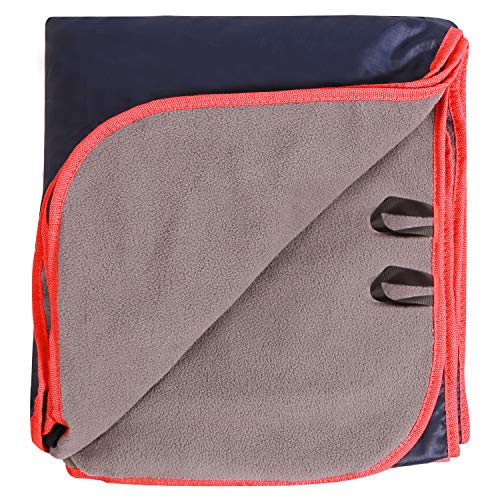
The REDCAMP solves the one cold problem wool does not: sitting still in wet weather. Its construction pairs a waterproof outer shell with a soft fleece interior, described on the listing as a large waterproof, windproof stadium and camping blanket for cold weather, in Dark Blue. Wind and rain strip heat from a seated person faster than still air at far lower temperatures, and a shell that blocks both while the fleece traps warmth is the correct engineering for bleachers, sidelines and fishing banks.
Be clear about what it is not. This is not a sleeping insulation layer for serious cold — fleeece-and-shell blankets do not match wool’s loft-for-weight or its damp performance over a night, and this guide does not pretend otherwise. It is the spectator and short-duration blanket, and within that role it outperforms every wool pick here, because wool in driving rain on a metal bench is a sponge with good PR.
The large format wraps a seated adult or shares across two laps, it wipes clean after muddy sidelines, and it stores in a car without the wool-care conversation. Households with kids in autumn sports will use this blanket more in one season than a camp blanket gets used in five — frequency of use being, as ever, a form of value.
One more scenario where the shell earns its place: youth sports in the shoulder seasons, where a parent sits motionless for two hours in wind that the players never feel. Motionless cold is its own discipline — the body produces a fraction of its active heat — and it is why spectators freeze in conditions athletes find mild. A windproof, waterproof wrap is the specific answer, and households that buy it for the bleachers tend to find it migrating to fishing trips, fireworks and every other seated outdoor hour of the year.
Strengths
- Waterproof, windproof shell — the only pick that defeats wet cold directly
- Fleece interior is soft, quiet and easy to clean after muddy use
- Large wrap format suits one adult or two laps in the stands
Trade-offs
- Not a substitute for wool insulation on a serious cold night
- Synthetic construction lacks wool’s odor resistance over long use
- Shell fabrics need seam and coating care to stay waterproof over years
| Shell | Waterproof, windproof (per listing) |
|---|---|
| Interior | Fleece |
| Use case | Stadium, outdoor sports, camping (per listing) |
| Verified colorway | Dark Blue |
Every guide needs one pick that admits the headline category is not the whole story. For arctic-grade cold at rest in dry conditions, wool wins and this guide says so five times. For the wet, windy, seated cold that most people actually endure most often, a shelled fleece blanket is the professional tool. The REDCAMP is here so the guide answers the weather you will meet, not only the weather in the search.
Check on Amazon to see the current configuration, size run and color options for the REDCAMP stadium blanket.
Best for: stadium seats, sidelines and wet-weather spectating / Not suited for: camp sleeping insulation, where the wool picks are the right tool
Comparison Table
The wool five divide by content and size — 80% wool picks for specification buyers, merino for comfort, the 2-pack for preparedness, the 70% JMR for easy ownership — while the REDCAMP stands apart as the wet-cold specialist.
| Pick | Badge | Key spec | Best for |
|---|---|---|---|
| Arcturus Military Wool Blanket (Twin, 64 x 88) | Best Overall | Wool military-style blanket, 64 x 88 in, 4.5 lbs, triple-washed (per listing) | one blanket that covers camp, car and home-emergency duty |
| Arcturus Backwoods Military Wool Blanket (80% Wool, 550 GSM) | Best Verified Wool Content | 80% wool, 550 GSM, 64 x 88 in, 4.5 lb (per listing) | buyers who want the wool percentage and fabric weight stated in numbers |
| Woolly Mammoth Merino Wool Blanket (66 x 90) | Best Merino Wool | Merino wool, 66 x 90 in, military style (per listing) | campers and cabin owners who want merino’s finer, softer wool in a full-size blanket |
| Ever Ready First Aid Wool Blanket, 2 Pack (80% Wool, 66 x 90) | Best for Emergency Kits | 80% wool, 66 x 90 in, 2 pack, military style (per listing) | vehicle kits, go-bags and households stocking more than one location |
| JMR Wool Camping Blanket (70% Wool, 62 x 84) | Best Compact Wool | 70% wool, 62 x 84 in, machine washable (per listing) | a slightly smaller, easier-care wool blanket for car and camp |
| REDCAMP Waterproof Stadium Blanket for Cold Weather | Best for Wet Cold | Waterproof shell, fleece insulation, windproof (per listing) | stadium seats, sidelines and wet-weather spectating |
How to Choose an Arctic Weather Blanket
Cold is not one problem. Choose by the scenario first, then by the specification, using the four checks below.
Match the blanket to the cold scenario
Sleeping cold (tent, cabin, power outage) wants wool mass and coverage — the 64 x 88 and 66 x 90 picks. Vehicle cold wants presence and durability — the 2-pack or the JMR, stored folded and forgotten until needed. Seated wet cold wants a shell — the REDCAMP. The most common buying error in this category is purchasing a beautiful camp blanket for a car kit, or a stadium blanket for a tent; the scenarios share a keyword and almost nothing else.
Read wool content like a specification, not a vibe
The percentage is the product. Around 80% wool is the serious cold-weather blend point; 70% trades a little extremity for softness and care; unstated content — which we flag wherever it occurs in this guide — should be treated as unknown, not assumed high. GSM, where stated, is the second number: 550 GSM is a heavy fabric by any blanket standard. Buy the numbers you can see, and let the photography go.
Size is warmth
A blanket insulates the area it actually covers, and gaps at the shoulders or feet are where cold enters. For an adult, 64 x 88 inches is a working minimum for full wrap or bed coverage, and 66 x 90 is better for tall users. Smaller throws have their place — laps, layers, children — but calling a 50 x 60 throw an arctic blanket is marketing, and this guide declined to include any.
A blanket is a layer, not a system
In genuine arctic conditions, survival guidance is consistent: shelter from wind, insulation from the ground, layered clothing, and then a blanket as one component. No blanket in this guide — or anywhere — replaces that system, and any listing implying otherwise should be distrusted on sight. Buy these blankets as the strong layer they are, store them where the scenario will find you, and respect the cold enough to build the rest of the kit too.
How to Store and Care for Wool Cold-Weather Blankets
A cold-weather blanket spends most of its life in storage and must perform on the worst night of the year. Storage and care decide whether it does.
- Store wool blankets clean. Moths and mildew both target soiled wool; a blanket put away dirty in spring is a damaged blanket in November.
- Store dry, loosely folded, in a breathable cotton bag or open shelf — never sealed in plastic while damp, and never compressed vacuum-flat for seasons at a time, which crushes the loft that insulates you.
- For vehicle kits, fold the blanket inside a dry bag or tote. Trunks leak and rear footwells flood; the blanket that must work in a breakdown must arrive at that moment dry.
- Wash wool gently and rarely: cool water, wool-safe detergent, no wringing, dry flat or on low. The machine-washable pick in this guide is the exception that proves the rule — follow each blanket’s own listing care.
- Air wool blankets in sun and breeze a few times a year. Wool releases odor naturally with airing, which is why it needs less washing than synthetics in the first place.
- Inspect before winter: seams, edges and any moth damage. Repair a small hole in October; in January it is a tear.
For the shelled stadium blanket, care is simpler and different: wipe the shell, wash the whole blanket gently when needed, and re-check the waterproof finish each season — a shell that has lost its coating is just a fleece blanket, and it should be reclassified in your kit honestly.
Common Buying Mistakes
Buying a decorative throw for an emergency role
Thin, pretty throws are the most common false purchase in this category. If the listing cannot tell you the fiber content and weight, it is not cold-weather equipment, whatever the styling suggests. Every pick here publishes its substance; hold any alternative to the same test.
Storing the only blanket in the wrong place
A superb blanket at home does nothing for a breakdown forty miles out. The two-pack pick exists because location is a specification. Audit where your cold scenarios happen — car, cabin, house — and put a blanket in each, even if the secondary ones are the simpler models.
Expecting a blanket to replace a cold-weather system
Wind shelter, ground insulation and clothing layers come first in real cold; the blanket completes the system. Listings that sell a blanket as total protection are selling a story, and believing the story is the genuinely dangerous purchase in this category.
Vacuum-sealing wool flat for a year
Compression storage crushes loft, and loft is insulation. Store wool loosely in breathable containment. The space you save is paid for in warmth you lose.
Ignoring the damp case
Cold and wet arrive together. Wool’s ability to insulate while damp is its defining advantage, and it is why five of six picks here are wool. A kit built entirely of fabrics that fail wet is a fair-weather kit with an arctic label.
Final Recommendation
For one blanket to cover the most cold honestly, take the Arcturus Military Wool Blanket: full size, real weight, triple-washed. Specification buyers should take the Backwoods for its stated 80% wool and 550 GSM; comfort and coverage point to the Woolly Mammoth merino; preparedness points to the Ever Ready 2-pack; easy ownership points to the JMR; and wet, seated cold points to the REDCAMP shell. Each pick is the right answer to a different version of the same hard question.
Whichever you choose, do the unglamorous work that makes it count: store it clean and dry, put it where the scenario will find you, and treat it as one layer of a system. Arctic weather is not impressed by purchases. It is answered by preparation, and a good wool blanket is where that preparation starts.
- Best Overall: Arcturus Military Wool Blanket (Twin, 64 x 88) — one blanket that covers camp, car and home-emergency duty.
- Best Verified Wool Content: Arcturus Backwoods Military Wool Blanket (80% Wool, 550 GSM) — buyers who want the wool percentage and fabric weight stated in numbers.
- Best Merino Wool: Woolly Mammoth Merino Wool Blanket (66 x 90) — campers and cabin owners who want merino’s finer, softer wool in a full-size blanket.
- Best for Emergency Kits: Ever Ready First Aid Wool Blanket, 2 Pack (80% Wool, 66 x 90) — vehicle kits, go-bags and households stocking more than one location.
- Best Compact Wool: JMR Wool Camping Blanket (70% Wool, 62 x 84) — a slightly smaller, easier-care wool blanket for car and camp.
- Best for Wet Cold: REDCAMP Waterproof Stadium Blanket for Cold Weather — stadium seats, sidelines and wet-weather spectating.
Building out the rest of the cold-weather kit? These guides in the same program cover the neighboring categories:
- Extreme Cold Weather Blankets
- Military Surplus Wool Blankets
- Blankets For Winter Sub-zero Temperatures
- Quality Winter Blankets
- Washable Wool Blankets
- Wool King Size Blankets
Frequently Asked Questions
Why is wool the main material for arctic weather blankets?
Wool insulates by trapping air in its crimped fiber structure, and uniquely among common blanket fibers it keeps much of that insulation when damp, resists odor over long use, and is naturally slow to burn rather than melt-prone. Those three properties — wet performance, endurance and fire character — are why military and camp blankets have been wool for a century, and why five of the six picks here are wool or wool-rich.
What wool percentage should I look for?
Around 80% wool is the serious cold-weather blend point, balancing insulation with durability and cost; 70% blends trade some extremity for softness and easier care. Treat an unstated percentage as unknown — this guide flags every pick whose listing does not publish the figure, and you should apply the same skepticism anywhere else.
Can one blanket keep me warm in arctic conditions by itself?
No — and distrust any listing that says otherwise. In genuine arctic cold, a blanket is one layer alongside wind shelter, ground insulation and proper clothing. These blankets are the strongest version of that layer, sized and weighted for real cold, but they are components of a system, not replacements for one.
How big should a cold-weather blanket be?
For an adult, treat 64 x 88 inches as a working minimum for full wrap or twin-bed coverage, and prefer 66 x 90 for tall users. Warmth leaks at gaps; a blanket that cannot cover shoulders and feet simultaneously cannot do the job its weight promises.
How do I store a wool blanket in a car kit?
Clean, fully dry, loosely folded inside a dry bag or lidded tote — trunks and footwells get wet. Air it out a few times a year, inspect it each autumn, and never vacuum-seal wool flat for long storage, because crushed loft is lost insulation.
Is a waterproof stadium blanket a substitute for a wool blanket?
For seated, wet, windy cold — games, sidelines, fishing — it is the better tool, because its shell blocks the wind and rain that defeat insulation. For sleeping insulation in serious cold, no: wool’s loft and damp performance win over a night. The two products answer different weather, and this guide includes both deliberately.


