Disclosure: airfryerkitchensupply.com is reader-supported. When you buy through links on our site, we may earn an affiliate commission at no extra cost to you.
Where to buy
Every pick below was verified against Amazon’s product data for this site before earning a link. Slipper sizing varies by brand and several picks are sold in size ranges rather than single sizes, so confirm your size and color on the listing before ordering:
- PROJECT CLOUD Men’s Genuine Leather Shearling Slippers — check price on Amazon
- LongBay Men’s Bootie Slippers — check price on Amazon
- Acorn Men’s Camden Recycled Moccasin with Berber Lining — check price on Amazon
- Zizor Men’s Moccasin Slippers with Warm Plush Lining — check price on Amazon
- RockDove Men’s Original Two-Tone Memory Foam Slipper — check price on Amazon
- UGG Men’s Ascot Slipper, Chestnut — check price on Amazon
Two ground rules for this guide. First, this is a comfort-and-warmth guide, not a medical one: several heavily marketed men’s slippers carry orthopedic and condition-specific claims, and we deliberately excluded listings whose main pitch is a medical claim — you will find no promises here about treating feet, only about keeping them warm and comfortable. Second, where a verified listing states materials — genuine shearling, berber lining, suede, plush lining — we say so; where a listing’s title is terse and states little beyond the model name, we flag that openly rather than filling the gap with assumptions. One pick below carries that flag, and it is labeled in its review.
Introduction: what makes a slipper a winter slipper
Shopping for the best mens winter slippers is really shopping for insulation that happens to be shaped like footwear. A summer house shoe and a winter slipper can share a silhouette and differ in everything that matters: the lining (bare fabric versus berber, plush, or shearling), the upper (breathable knit versus leather, suede, or a weather-shedding synthetic), the sole (a thin indoor pad versus a rubber outsole that insulates against cold floors and survives the trip to the mailbox), and the coverage (a low scuff that leaves ankles bare versus a moccasin or bootie that closes around them). Cold in a house travels upward from the floor, which is why the sole and the lining do most of the winter work — and why a genuinely warm slipper can look unremarkable while a handsome one with a thin sole and no lining leaves its owner in socks by January.
The six picks below were chosen to span the honest range of the category: genuine shearling at the premium end, a bootie for maximum coverage, a berber-lined recycled moccasin, a plush-lined suede value pick, a washable memory-foam everyday slipper, and the category’s most famous name-brand classic. All six are complete slippers — no inserts, no slipper socks standing in — and all are men’s house slippers in the kept categories: moccasins, clogs, and booties with real linings. We excluded ballet and dance styles, sandals and slides, and every listing whose headline claim is medical rather than thermal. Prices are never printed here because they move constantly; check the current price on Amazon through the links, and read the size notes carefully — winter slippers are worn with thicker socks than summer shoes, and the fit guidance in the buying section below matters more for this category than almost any other.
In this guide
Quick Picks
| Pick | Badge | Why it is here | Link |
|---|---|---|---|
| PROJECT CLOUD Genuine Leather Shearling Slippers | Best Overall | 100% genuine leather with Australian shearling and a memory foam insole, water resistant — the complete winter specification. | Check on Amazon |
| LongBay Men’s Bootie Slippers | Best for Cold Floors | Bootie coverage around the ankle, tough nylon uppers, rubber outsole, and memory foam — built for drafts and doorsteps. | Check on Amazon |
| Acorn Camden Recycled Moccasin | Best Lined Moccasin | A recycled moccasin with a berber lining — the classic winter lining in a lower-impact build. | Check on Amazon |
| Zizor Men’s Moccasin Slippers | Best Value Warmth | Suede upper, warm plush lining, memory foam, and a rubber sole at the accessible end of the category. | Check on Amazon |
| RockDove Original Two-Tone Slipper | Best Washable | Memory foam comfort that goes in the washing machine — the practical pick for mud-season households. | Check on Amazon |
| UGG Men’s Ascot | Best Premium Classic | The category’s benchmark name-brand moccasin-style slipper; the verified listing is terse, so confirm current specs on the listing. | Check on Amazon |
How These Picks Were Chosen
Warmth claims in this category are cheap, so we chose on stated construction. Each pick had to show its winter credentials in its verified listing: a named lining (shearling, berber, plush), a substantial upper (leather, suede, nylon), or bootie coverage — and preferably more than one. Soles mattered next: rubber outsoles insulate and grip better than fabric or thin foam soles, and every pick here is an indoor/outdoor style per its listing, which in practice means a sole that survives a cold porch. We then applied the category exclusions this program requires: no sandals, slides, or flip-flops; no dance or novelty footwear; no baby or kids’ styles; and no listing whose primary selling language is a medical condition claim — comfort and warmth framing only. Finally, completeness: slippers only, never inserts or liners sold separately.
All product information comes from the listings as verified connection. One transparency note: for the UGG Ascot, the listed title confirms the model, color (chestnut), and size only — it does not state materials. We include it as the premium classic because it is genuinely the category’s reference product and the ASIN/title match is certain, but we do not attribute specific materials to it anywhere in this guide, and its review tells you exactly what to confirm on the listing page. For every other pick, materials named in the review are materials named in the verified title.
The 6 Best Mens Winter Slippers

PROJECT CLOUD Men’s Genuine Leather Shearling Slippers — Best Overall
The PROJECT CLOUD slipper states the most complete winter specification of any pick here, in its verified title: 100% genuine leather, Australian shearling, a memory foam insole, and water resistance. Shearling is the benchmark winter lining for a reason that has nothing to do with luxury marketing — a natural wool fleece on its own hide insulates, breathes, and manages moisture in a way synthetic plush imitates but does not equal, which is why feet in shearling feel warm without feeling swampy through a long evening. The genuine leather upper is the other half of the winter equation: it blocks drafts that knit uppers pass through, shrugs off the wet of a doorstep trip, and ages by conforming to the foot rather than stretching out.
Strengths
- Genuine shearling lining — the reference standard for warmth without clamminess.
- 100% genuine leather upper, water resistant per the listing: the most weather-capable upper in this guide.
- Memory foam insole adds cushioning under the insulation, where many shearling slippers rely on the fleece alone.
Trade-offs
- Natural shearling and leather sit in the premium tier of the category; check the current price on Amazon in that expectation.
- Leather and shearling need gentler care than washable synthetics — this is not the pair to hose down after a muddy garden trip.
- Shearling runs warm; in a well-heated home, some men will find it more insulation than they need by mid-winter evening.
Spec snapshot (from the verified listing): Upper: 100% genuine leather · Lining: Australian shearling · Insole: memory foam · Property: water resistant
Buy this pair if winter in your house means genuinely cold floors and you want the one purchase that ends the search. It is the only pick that combines a natural premium lining, a leather upper, and water resistance in a single verified specification, and it is the slipper least likely to be replaced next winter.
Best for: cold houses, premium-lining seekers, and one-and-done buyers / Not suited for: buyers who need machine washability, or warm-climate homes

LongBay Men’s Bootie Slippers — Best for Cold Floors
The LongBay bootie attacks winter from the coverage angle: where moccasins and scuffs leave the ankle — the thinnest, draft-exposed part of the foot — open to the room, a bootie closes over it. The verified listing describes tough nylon uppers, a non-slip rubber outsole, and adaptive memory foam, positioning the style as lounge boots for indoor and outdoor wear. Nylon is the pragmatic upper for this format: light, draft-resistant, and indifferent to the wet of a porch or a garage run, where leather would need care and knit would soak through. The green configuration in size 9-10 is the one verified here; the line is sold across sizes.
Strengths
- Bootie coverage insulates the ankle — the detail that separates genuinely warm slippers from warm-enough ones in drafty houses.
- Rubber outsole insulates against cold floors and grips on porch and garage trips.
- Nylon uppers shrug off damp and dirt that would mark leather or suede.
Trade-offs
- The bootie format is warmer and bulkier — overkill for a well-heated apartment, and slower to kick off than a scuff.
- The listing does not name a specific lining material, so we do not claim one; warmth here comes from coverage, foam, and the closed build.
- The sporty lounge-boot look suits utility wear more than a classic fireside aesthetic.
Spec snapshot (from the verified listing): Style: bootie · Upper: nylon · Outsole: rubber, non-slip · Insole: adaptive memory foam · Use: indoor/outdoor
This is the pick for the man whose slippers work for a living: letting the dog out at dawn, crossing a cold garage, standing on a stone kitchen floor through a winter morning. In those houses the bootie is not a style choice; it is the correct tool, and the LongBay’s verified construction matches the job description point for point.
Best for: drafty houses, cold floors, and indoor/outdoor routines / Not suited for: buyers wanting a classic moccasin look or a kick-off scuff
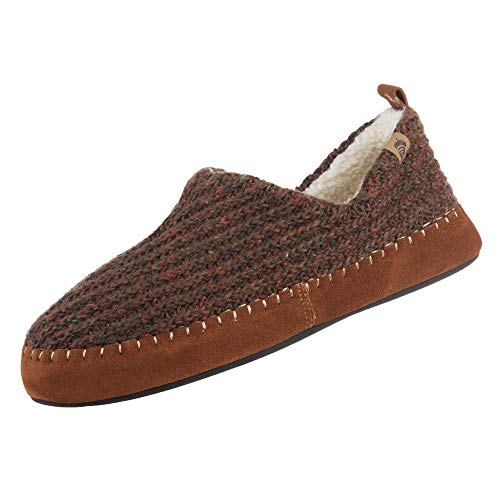
Acorn Men’s Camden Recycled Moccasin with Berber Lining — Best Lined Moccasin
Acorn has made lined moccasins its specialty for decades, and the Camden states its winter case in its name: a recycled moccasin build with a berber lining, in walnut, in the 10.5-11.5 size range for the verified listing. Berber — a nubby, fleece-style lining — is the classic synthetic answer to shearling: it traps air in its texture, feels warm on contact rather than cold, and keeps the price and the care requirements in everyday territory. The recycled construction is the distinguishing note: buyers who weigh the footprint of a purchase get a moccasin whose materials story is part of the product rather than an afterthought, without giving up the lined warmth that is the entire point of a winter moccasin.
Strengths
- Berber lining delivers immediate, contact warmth in the classic moccasin format.
- Recycled build answers the sustainability question that most winter slippers ignore.
- Acorn’s moccasin focus shows in the format: a proper closed moccasin, not a scuff with ambitions.
Trade-offs
- Berber is a synthetic lining; it does not match shearling’s moisture management over very long wear.
- The verified listing’s title does not detail the outsole, so confirm sole construction on the listing if porch trips are a priority.
- Size runs in ranges (10.5-11.5 here); men at a range boundary should read the listing’s fit guidance carefully.
Spec snapshot (from the verified listing): Style: moccasin · Build: recycled · Lining: berber · Color verified: walnut
Choose the Camden if your winter slipper ideal is the traditional one — moccasin on the couch, lining doing the work — and you would rather the materials came with a lighter footprint. It is also the natural gift pick in this guide’s middle tier: classic enough for a traditionalist, considered enough for a buyer who reads labels.
Best for: classic moccasin wearers and sustainability-minded buyers / Not suited for: buyers who want genuine shearling, or a bootie’s ankle coverage
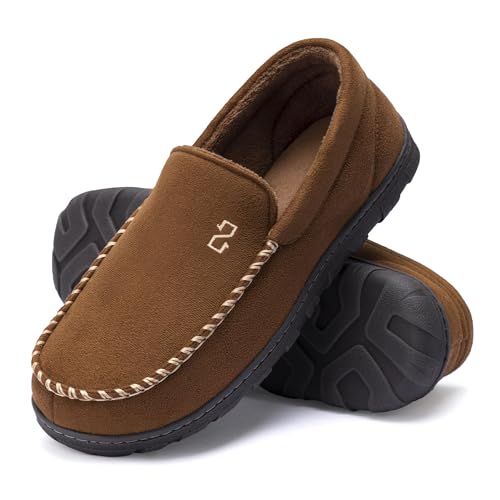
Zizor Men’s Moccasin Slippers — Best Value Warmth
The Zizor moccasin is the value pick that refuses to skip the winter specification: its verified listing states a suede upper, a warm plush lining, memory foam cushioning, and a non-slip rubber sole, in camel, size 11 for the verified configuration. Read that list again — it is the same four-part formula as the premium picks (real upper material, named lining, cushioned footbed, rubber outsole), delivered at the accessible end of the category’s pricing structure. Suede deserves its note: it is genuine leather’s brushed form, draft-resistant and handsome, though it marks with water more readily than the PROJECT CLOUD’s smooth leather and wants a protector spray in slushy households.
Strengths
- Complete winter formula — suede, plush lining, memory foam, rubber sole — at a value tier.
- Rubber outsole makes it a true indoor/outdoor slipper, not a bedroom-only shoe.
- Slip-on moccasin format suits men who will not tolerate a bootie’s fuss.
Trade-offs
- Suede needs protection from wet; it is the wrong upper for repeated snowy doorstep trips without care.
- Plush synthetic lining, like berber, warms fast but manages moisture less well than shearling over long evenings.
- Value-tier construction means the lining will pack down sooner than the premium picks under daily wear.
Spec snapshot (from the verified listing): Style: moccasin, slip-on · Upper: suede · Lining: warm plush · Footbed: memory foam · Sole: rubber, non-slip
The honest summary: if the budget is fixed, this is where it should land. The Zizor spends on the four things that make a slipper warm and skips the brand premium, and for a first winter slipper or a second pair for a cabin or office, that allocation is exactly right.
Best for: value buyers who still want the full winter specification / Not suited for: buyers wanting natural shearling, or a machine-washable pair

RockDove Men’s Original Two-Tone Memory Foam Slipper — Best Washable
RockDove’s Original Two-Tone is the pragmatic institution of this category: a knit-upper, memory-foam slip-on, non-slip and indoor/outdoor per its verified listing, whose decisive feature for winter households is that it is machine washable. Winter slippers live hard lives — they absorb the mud season at the door, the kitchen’s splashes, and the general evidence of being worn sixteen hours a day — and a slipper that can be laundered back to fresh is a slipper that stays in service. The verified configuration is dark grey/blue in the 11-12 range, with a knit upper noted in the verification record; the line spans sizes and colors.
Strengths
- Machine washable — the maintenance feature that quietly outlasts every lining claim by February.
- Memory foam cushioning with a non-slip indoor/outdoor sole covers the daily-driver brief completely.
- Knit upper breathes better than leather or suede, suiting men whose feet run hot even in winter.
Trade-offs
- No named insulating lining in the verified listing — this is the lightest-warmth pick here, better for heated homes than for drafty ones.
- Knit passes drafts and water; it is not the doorstep-in-slush choice.
- Memory foam compresses over a season of daily wear; expect a refresh cycle rather than a multi-year run.
Spec snapshot (from the verified listing): Style: slip-on · Upper: knit · Footbed: memory foam · Sole: non-slip, indoor/outdoor · Care: machine washable
Place the RockDove correctly and it is unbeatable at its job: the heated-home everyday slipper, the guest pair, the pair that lives by the door for quick trips, and the pair you buy twice so one is always clean. Ask it to be a shearling substitute in a cold farmhouse and it will disappoint — but that is a mismatch of assignment, not a failure of the slipper.
Best for: heated homes, washability-first buyers, and second-pair duty / Not suited for: unheated or drafty houses needing maximum insulation

UGG Men’s Ascot Slipper, Chestnut — Best Premium Classic
The Ascot is the name-brand reference point of men’s slippers — the pair other moccasin slippers are compared against — and it earns its place here on that standing, with one transparency flag we will state as plainly in the review as in the methodology: the listing-verified title for this listing confirms the model (Ascot), the color (chestnut), and the size (12) — and nothing else. It does not state the upper material, the lining, or the sole construction. UGG’s listings and product pages carry those details and they vary by configuration and season, so the correct move — and our actual recommendation — is to open the listing, confirm the current construction and materials for the exact configuration you are buying, and then decide. We do not fill that silence with the specifications of other UGG products, because a recommendation guide that invents specs for its most famous pick has told you what its other specs are worth.
Strengths
- The category’s benchmark brand and model, with the resale, gifting, and replacement ecosystem that follows the market leader.
- Chestnut is the classic colorway, verified here in size 12, within a wide size and color range on the listing.
- A moccasin-style silhouette that suits men who want a slipper that reads as footwear, not loungewear.
Trade-offs
- Specifications are not stated in the verified Amazon title — materials and lining must be confirmed on the listing before purchase.
- Premium brand pricing applies; you are paying partly for the name, which is a legitimate choice but should be a conscious one.
- Configuration details vary across the Ascot line; the exact listing you buy governs what arrives.
Spec snapshot (from the verified listing): Model: UGG Ascot · Color verified: chestnut · Size verified: 12 · Materials/lining: not stated in the verified title — confirm on the listing
Who should still buy it? The man who wants the known quantity and the brand’s fit and finish, and who is willing to spend ninety seconds confirming the current spec sheet. Who should not? Anyone buying on a specification they have not verified — for you, the PROJECT CLOUD pick states its leather-and-shearling construction in full, in writing, and that certainty is its own feature.
Best for: brand-loyal buyers and gift-givers who will confirm the listing’s current specs / Not suited for: buyers who want fully stated materials before they click
Comparison Table
| Pick | Badge | Key spec | Best for | Link |
|---|---|---|---|---|
| PROJECT CLOUD Shearling Slippers | Best Overall | Genuine leather, Australian shearling, memory foam, water resistant | Cold houses, premium warmth | Check on Amazon |
| LongBay Bootie Slippers | Best for Cold Floors | Bootie coverage, nylon upper, rubber outsole | Drafts and doorsteps | Check on Amazon |
| Acorn Camden Moccasin | Best Lined Moccasin | Recycled build, berber lining | Classic comfort, lighter footprint | Check on Amazon |
| Zizor Moccasin Slippers | Best Value Warmth | Suede upper, plush lining, rubber sole | Full spec on a budget | Check on Amazon |
| RockDove Original Two-Tone | Best Washable | Knit upper, memory foam, machine washable | Heated homes, easy care | Check on Amazon |
| UGG Ascot | Best Premium Classic | Model/color verified; materials not stated in Amazon title | Brand-first buyers | Check on Amazon |
How to Choose Mens Winter Slippers
Start with your floors, not the thermometer. The coldest surface in your home decides your insulation needs. Stone, tile, and uninsulated wood over a crawl space demand a rubber outsole and a real lining; carpeted, well-heated floors forgive a lighter pick like the RockDove. Men routinely overbuy lining and underbuy sole — insulate from the floor up.
Choose the lining for your wear pattern. Shearling (PROJECT CLOUD) is the long-evening champion: warm, breathable, moisture-managing. Berber (Acorn) and plush (Zizor) warm instantly on contact and suit shorter, frequent wear. Unlined-but-covered builds (LongBay’s bootie) win when drafts, not deep cold, are the enemy. There is no universal best lining; there is a best lining for how many hours a day the slippers stay on.
Match coverage to the house’s drafts. Scuffs and low moccasins leave ankles open. If your home has a cold hallway, a dog to let out, or a porch ritual, coverage is warmth: the bootie format exists for you. In a sealed modern apartment, coverage is surplus and a moccasin’s easier on-off wins.
Fit for winter socks. Slippers are sized like shoes, but winter wear adds a sock layer. If you are between sizes or at the top of a brand’s size range, the larger size is usually the winter-correct choice — a compressed lining insulates less, because insulation is trapped air and a tight fit squeezes the air out. Men with wide feet should check for wide configurations on the listing rather than sizing up twice, which trades width for sloppy length.
Plan the care before the purchase. Washable (RockDove) suits mud-season and kitchen-heavy use. Leather and suede (PROJECT CLOUD, Zizor) suit drier routines and reward a protector spray. Shearling wants airing, not washing. A slipper whose care you will not perform is a slipper with an expiration date.
Read the tiers honestly. We never print prices — they move too often to be honest in a static guide — but this category’s structure is stable enough to navigate by. The value tier (RockDove, Zizor) buys the complete comfort formula in synthetic or suede materials. The middle tier (Acorn, LongBay) buys a specialty: a considered lining, or a coverage format. The premium tier (PROJECT CLOUD, UGG) buys natural materials, brand ecosystems, or both. The step from value to middle is the largest quality jump; the step to premium is mostly about materials and longevity rather than basic warmth. A man who has never owned a dedicated winter slipper should start in the value or middle tier, learn what his house actually demands, and let next winter’s purchase be the informed premium one.
How to Break In and Care for Winter Slippers
New lined slippers should feel snug, even slightly tight: linings pack down in the first two weeks to the foot’s actual shape, and memory foam footbeds mold over the same period. Judge fit at day fourteen, not day one — but judge warmth immediately, since insulation does not improve with wear. Wear them with your usual winter socks during break-in so the lining molds to the true volume. For care: air lined slippers after long wear (overnight on a rack, not sealed in a closet), because linings that dry between wears stay fresher and warmer. Brush suede and smooth leather with a dry brush; treat suede with a protector spray before slush season. Wash only what is sold as washable — the RockDove — on a gentle cycle, and air-dry all slippers rather than applying dryer heat, which is hard on foams, glues, and linings alike. Rotate two pairs if slippers are your all-day footwear; a rested lining recovers loft, and loft is warmth.
The Anatomy of Warmth: Where a Winter Slipper Actually Insulates
Four components share the work, and a weakness in any one caps the whole slipper. The outsole is the thermal break against the floor: rubber insulates and seals; thin fabric or EVA soles pass floor cold through within minutes of standing in a kitchen. The footbed adds the second layer — memory foam’s contribution is as much insulation as cushioning, which is why foam appears in five of these six picks. The lining wraps the top and sides of the foot, trapping warmed air; its enemy is compression, which is why fit and rotation matter. The upper is the windbreak: leather, suede, and nylon stop room drafts that knit lets through, which is why the knit RockDove is honestly rated as this guide’s lightest-warmth pick despite its excellent foam. When a slipper disappoints in winter, diagnose by component — cold soles mean the outsole is thin, cold tops of feet mean the upper or lining is failing, and a slipper that starts warm and fades in an hour has a lining that has packed down. That diagnosis tells you which pick in this guide fixes your actual problem, instead of simply buying a more expensive version of the same weakness.
Matching the Slipper to the House: Five Common Situations
The old house with cold floors. Radiators that heat the air and floors that stay cold anyway — this is the bootie-and-shearling scenario. LongBay for the working hours, PROJECT CLOUD for the evening, and no knit uppers anywhere near the kitchen’s stone flags. The modern heated apartment. Insulation is the building’s job here, so buy for comfort and care instead: the RockDove’s washable foam, or the Zizor if you like a moccasin’s look, and skip the heavy linings that will spend the season making your feet sweat. The house with a dog. Your slippers are outdoor footwear several times a day whether you planned it or not: rubber outsole non-negotiable, washable or nylon strongly preferred, and a pair stationed at the dog’s door rather than the bedroom. The LongBay bootie was practically designed in this house. The cabin or second home. Intermittently heated spaces are the coldest test of all — slippers that live there should insulate from the first minute, tolerate being left in the cold, and not require delicate care: the Acorn’s berber-lined moccasin or the Zizor, in a size that accepts the thickest socks you own. The home office. Eight hours seated means circulation, not weather, sets the cold: feet chill from stillness, so the winner is the slipper you can flex and move in, with a lining that breathes through a workday — shearling’s long-wear comfort is the connoisseur’s answer, and a mid-weight moccasin the practical one. Read your house down this list before you read it down the price tiers; the match matters more than the money.
Buying Winter Slippers as a Gift, Without Guessing Wrong
Slippers are among the most-given and most-exchanged gifts in this category, and the exchanges are almost always about size and warmth level rather than taste. Three rules keep a gift pair in service. First, size from his shoe size, then choose the range that contains it with room — in ranged sizing, a man at the boundary is better served by the upper range in winter, because the gift will be worn with socks and a too-small lined slipper is unwearable rather than merely snug. Second, match the warmth to his house, not his climate: a man in a heated high-rise in a cold city needs the RockDove’s weight, while a man in a mild climate with an unheated farmhouse needs the bootie. Third, when in doubt between the famous name and the stated specification, know your recipient: brand-loyal men light up at the UGG box (and you should confirm the listing’s current construction before wrapping, as its review explains), while specification-driven men will read the PROJECT CLOUD’s leather-and-shearling brief with more pleasure than any logo. The Zizor and Acorn occupy the safe middle — complete, classic, and hard to get wrong — which is why moccasins dominate gift guides in this category every year.
One Pair or Two? The Case for a Winter Slipper Rotation
Men who wear slippers as all-day footwear — home workers, retirees, anyone whose commute is a hallway — get disproportionate value from owning two pairs, for reasons that are thermal rather than indulgent. A lining worn fourteen hours compresses and absorbs moisture; given a rest day, it dries fully and recovers loft, and loft is the insulation. Two mid-priced pairs in rotation will out-warm and out-last one premium pair worn daily, because the premium pair never gets to recover. The rotation also solves the weather split: a washable or nylon pair for door duty and wet days, a lined leather or shearling pair for evenings, each doing the job it is built for instead of one pair compromising at both. If budget forces one pair, buy for your dominant use and accept the compromise knowingly — the buying guide above is organized so the dominant-use answer is easy to find. If budget allows two, the strongest pairings in this guide are the LongBay bootie plus the PROJECT CLOUD for cold houses, and the RockDove plus the Zizor for heated ones: in each case a working pair and an evening pair, with no overlap wasted.
Storage matters to the rotation: keep slippers on an open rack or by the door they serve, never sealed in a plastic bin while still carrying the day’s moisture, and never on a heat vent, which cooks foams and dries leather. A pair put away dry in spring, loosely filled to hold its shape, starts the next winter at nearly full warmth — a small discipline that doubles the useful life of everything in this guide.
Common Buying Mistakes
- Buying the lining and ignoring the sole. Floor cold enters from below; a plush slipper on a paper-thin sole is a warm hat on cold feet.
- Sizing for bare feet in a sock season. Winter slippers are worn over winter socks; a snug summer fit becomes a compressed, colder winter fit.
- Chasing medical claims. Slippers are comfort products. Listings built on condition claims were excluded here on purpose; buy warmth and fit, not promises.
- Assuming the famous brand’s specs. Constructions change by season and configuration — the UGG review in this guide shows the honest way to handle a terse listing: verify on the page.
- Washing what is not washable. Shearling, leather, and suede have care rules; one hot wash can end a premium pair. Only the washable pick goes in the machine.
- Buying summer formats for winter. Slides, sandals, and open scuffs are different products; no lining claim redeems an open design in January.
Final Recommendation
For the most complete winter slipper, take the PROJECT CLOUD shearling slipper: genuine leather, Australian shearling, memory foam, and water resistance, all stated in its verified listing. For drafty houses and working doorsteps, the LongBay bootie is the correct tool. Classic moccasin comfort with a lighter footprint points to the Acorn Camden; the full winter formula on a budget points to the Zizor; easy care in a heated home points to the washable RockDove; and the brand-classic buyer is served by the UGG Ascot — with ninety seconds spent confirming its current specs on the listing, as its review instructs. Whichever you choose, check the current price on Amazon, confirm your size against the listing’s range, and size for the socks you will actually wear.
One last word on timing: winter slippers are best bought in autumn, while sizes are stocked and the first cold floor has not yet turned the purchase into an emergency. The man who buys in October chooses among all six of these picks in his size; the man who buys during the first cold snap chooses among what is left. If you are reading this with cold feet, forgive the advice its timing — buy the pair that matches your house today, and let it be the last January you spend in summer scuffs and thick socks, negotiating with a floor that was never going to warm up on its own.
Rounding out a winter entry setup? These companion guides from the same program cover the neighboring decisions: Best Rugged Winter Slippers, Best Winter Slippers Women, and Best Outside Rugs For Catching Dirt for the mat those slippers cross every morning.
A Note on Socks: The Other Half of the System
No slipper review is complete without the sock paragraph, because the sock is the layer that touches the skin and manages the moisture. A winter slipper over a thin cotton dress sock underperforms its specification: cotton holds moisture against the foot, and a damp foot feels cold at temperatures a dry foot would call comfortable. A wool or wool-blend sock — even a light one — wicks, insulates when damp, and lets the slipper’s lining do its work on dry warmth instead of on sweat management. This is also the resolution to the most common winter-slipper complaint, feet that are hot and cold at once: that is usually a moisture problem wearing a temperature costume. Change the sock before you blame the slipper. And for the shearling pick specifically, a sock is optional by design — shearling manages bare feet well — which is one of its quiet luxuries on the way to a midnight kitchen.
Related guides
Frequently Asked Questions
What should I do if my winter slippers feel too warm indoors?
Work down the system before replacing anything: switch to a thinner sock or none, since the sock is half the insulation stack; air the slippers between wears so the lining starts each evening dry; and reserve the heaviest pair for the coldest hours rather than the whole day. If the problem persists, your house is telling you it belongs to a lighter category — the RockDove’s unlined knit build exists precisely for men whose winter is a heated interior, and owning it alongside a lined pair is the rotation this guide recommends rather than a surrender.
Are shearling slippers really warmer than synthetic-lined ones?
Shearling’s advantage is less about peak warmth — a thick plush or berber lining is also very warm at first contact — and more about the long wear: natural fleece breathes and manages moisture, so feet stay warm without becoming clammy over hours. Synthetic linings warm faster initially and cost less, but can feel stuffy on long evenings. Choose shearling for all-day wear, synthetics for shorter, frequent use.
Should winter slippers fit tight or loose?
Snug at purchase, with a thumb’s awareness that linings pack down within two weeks. A slipper that is loose on day one becomes sloppy by February, and sloppy fit means cold air pumping in and out with every step. But do not size down into compression: a crushed lining insulates poorly. Between sizes, with winter socks in mind, take the larger.
Can I wear winter slippers outside?
Every pick here is an indoor/outdoor style with a real sole, so doorstep, porch, mailbox, and garage trips are within their design. That is not the same as wearing them as shoes: sustained wet, snow, and street grit will age any slipper quickly, leather and suede fastest. Treat outdoor use as sorties, not expeditions.
How do I keep lined slippers from smelling by mid-winter?
Moisture management, mostly: wear socks (even thin ones change the equation), air the slippers overnight on a rack rather than in a closed closet, rotate two pairs if you wear them all day, and wash the pair that is sold as washable on its maker’s schedule. Shearling benefits from airing most of all — it is a natural material managing natural moisture, and airflow is its maintenance.
What is the difference between a moccasin slipper and a bootie slipper?
Coverage. A moccasin ends below the ankle like a loafer; a bootie rises over the ankle and closes around it. The bootie is warmer in drafts and better for outdoor sorties; the moccasin is easier on and off and reads more classic indoors. The LongBay represents the bootie case in this guide; the Acorn, Zizor, and UGG picks represent the moccasin case.
Do memory foam slippers keep feet warm by themselves?
Memory foam insulates the sole of the foot — it is a genuine thermal layer against a cold floor — but it does nothing for the top of the foot or the ankle. That is why foam appears in this guide as one component among four, paired with linings and uppers in the warmer picks. A foam-only slipper with a thin knit upper, like the RockDove, is a heated-home pick; the same foam under a shearling lining and leather upper, like the PROJECT CLOUD, is a cold-house pick. Judge the system, not the foam.
What is the warmest style of men’s winter slipper overall?
By construction, a shearling-lined bootie would top the chart — maximum lining plus maximum coverage — and no single pick here is exactly that combination. Of the six, the PROJECT CLOUD brings the strongest lining and the LongBay the strongest coverage; men in genuinely cold houses who want both qualities in one purchase should weight those two reviews heaviest, and everyone else should remember that the warmest slipper is the one matched to the house it will actually live in.
When should winter slippers be replaced?
When the lining has packed flat and no longer springs back, when the footbed stays compressed, or when the outsole has worn smooth enough to slip on a kitchen floor. For daily wearers that is often one to two winters for foam-based pairs; leather-and-shearling pairs, cared for, run longer. A slipper that has stopped insulating is not broken — it is finished, and no sock upgrade fully redeems it.


