Disclosure: airfryerkitchensupply.com is reader-supported. When you buy through links on our site, we may earn an affiliate commission at no extra cost to you.
Where to buy
Parents searching for the best selling baby blankets usually want the short list of blankets that other parents actually buy, register for, and re-order — and all six blankets below are current Amazon listings we verified before writing. Start with the aden + anais muslin set for everyday swaddling, the Hudson Baby plush blanket for a warm stroller layer, and the HALO Sleepsack if what you really need is a wearable blanket for sleep.
- aden + anais Essentials Swaddle Blanket, 4-Pack — Best Overall: Check the current price on Amazon
- Copper Pearl Swaddle Blanket — Best Stretch Swaddle: Check the current price on Amazon
- Hudson Baby Plush Mink and Sherpa Blanket — Best Warm Budget Blanket: Check the current price on Amazon
- Yoofoss Muslin Swaddle Blankets, Organic — Best Organic Muslin: Check the current price on Amazon
- HALO Micro-Fleece Sleepsack Swaddle — Best Wearable Blanket: Check the current price on Amazon
- Bleu La La Organic Cotton Heritage Knit Baby Quilt Blanket — Best Heirloom Knit: Check the current price on Amazon
Introduction: what “best-selling” can and cannot tell you
Lists of the best selling baby blankets promise a shortcut: skip the research, buy what everyone else buys. There is real value in that — blankets that sell in volume get there because they survive contact with actual newborns, actual washing machines, and actual exhausted parents at 3 a.m. But one honesty point comes first. Sales rankings shift constantly, differ by store, and are not something we can verify or print as a fixed fact, so this guide makes no sales claims and prints no sales figures. Instead, we built the shortlist the way a careful friend would: the blanket types and brands that dominate registries and nursery drawers — muslin swaddles, stretch swaddles, plush stroller blankets, organic options, wearable sleep blankets, and a knit heirloom style — each represented by a specific listing we verified.
The second thing to understand is that “baby blanket” is not one job. A swaddle blanket is a tool for wrapping a newborn snugly in the first weeks. A receiving blanket is a thin all-purpose layer. A plush blanket is for the stroller, the car seat (over the harness, never under or behind the baby in a way that interferes with it), and tummy time on the floor. A wearable blanket — the HALO in this guide — replaces loose blankets in the crib. And a knit quilt blanket is the one that gets photographed, gifted, and kept. Buying one blanket and expecting it to do all five jobs is how parents end up with a drawer of almost-right blankets. The six picks below map to those jobs deliberately.
Safety framing, stated once and plainly: widely published safe-sleep guidance recommends that infants sleep on their backs, on a firm flat surface, without loose blankets in the sleep space for the first year. Loose blankets in this guide are for supervised, awake uses — swaddling in the early weeks (stopping at the first signs of rolling), stroller walks, floor time, feeding, and comfort — and the wearable blanket exists precisely for sleep. Any blanket, however soft, belongs out of the crib as a loose item. We would rather repeat that than sell you a sixth blanket.
In this guide
Quick Picks
| Pick | Badge | Why it made the list |
|---|---|---|
| aden + anais Essentials Swaddle Blanket, 4-Pack | Best Overall | The classic muslin swaddle set — breathable, generously sized, endlessly reusable |
| Copper Pearl Swaddle Blanket | Best Stretch Swaddle | Large 46 x 46 inch stretchy knit that holds a swaddle better than plain muslin |
| Hudson Baby Plush Mink and Sherpa Blanket | Best Warm Budget Blanket | Plush mink and sherpa warmth for strollers and floor time at a budget tier |
| Yoofoss Muslin Swaddle Blankets, Organic | Best Organic Muslin | Organic muslin in a large 47 x 47 inch receiving size |
| HALO Micro-Fleece Sleepsack Swaddle | Best Wearable Blanket | A 3-way adjustable swaddle blanket with TOG 3.0 warmth for cold climates |
| Bleu La La Heritage Knit Baby Quilt Blanket | Best Heirloom Knit | 100% organic cotton textured knit — the gift and keepsake pick |
How These Picks Were Chosen
Every pick was verified against a live Amazon listing on this site’s own account, and the specifications quoted — sizes, materials, pack counts, TOG — come from those verified listing titles, not from roundups. We deliberately spread the six slots across the five real blanket jobs described in the introduction, because a guide with six near-identical muslin squares would be useless. Within each job, we favored listings whose titles confirm the details a parent actually needs: dimensions for swaddles (a too-small swaddle blanket is a burp cloth), material for organic claims (the word “organic” had to be in the verified title, not assumed), and warmth rating where one exists (the HALO’s TOG 3.0). Variants of the same product — the Hudson Baby plush blanket appears in many prints — count as one pick; we list one verified print and note that others exist. Where a title is truncated in listing data or a detail is not stated, the review says so.
The 6 Best Selling Baby Blankets

aden + anais Essentials Swaddle Blanket, 4-Pack — Best Overall
If a single product explains why muslin swaddles became the default baby blanket of the last decade, it is this one. The aden + anais Essentials set gives you four muslin swaddle blankets in one pack, and muslin’s open weave does three things newborn life demands: it breathes, so a wrapped baby is less likely to overheat than in a synthetic wrap; it stretches just enough on the bias to get a snug wrap; and it washes without ceremony, getting softer with every cycle. It suits first-time parents building a registry and anyone who wants one purchase to cover swaddling, because four blankets is the realistic rotation — one in use, one in the wash, one in the diaper bag, one clean. It is not the warmest option here, and it is not meant to be.
Strengths
- Four muslin swaddle blankets per pack (per listing title) — a genuine rotation, not a single blanket
- Breathable cotton muslin that softens with washing and works across seasons
- The most versatile fabric in the guide: swaddle, stroller shade in a pinch, nursing cover, burp cloth, tummy-time mat
Trade-offs
- Muslin has no real stretch, so determined swaddle-breakers escape it sooner than the Copper Pearl knit
- Thin by design — in cold climates it is a layer, not the warmth itself
- Exact dimensions are not stated in the verified listing title; confirm the size on the listing if you need a specific swaddle size
| Spec | Detail (as verified) |
|---|---|
| Type | Muslin swaddle / receiving blankets |
| Pack count | 4 pack |
| Print as listed | Dinotime |
| Dimensions | Not stated in the verified listing title |
The real reason this set tops the guide is lifetime value per blanket. A muslin swaddle’s career does not end when swaddling does, around the first rolling attempts. It becomes the toddler’s car blanket, the preschooler’s fort roof, the household’s emergency towel. Parents re-order these because the first set is still in service years later in a different job. When you evaluate price, evaluate it against that lifespan, not against the eight weeks of swaddling.
Care is part of the appeal: machine wash, tumble dry, no special handling, and the fabric’s slight crinkle after washing is normal — it is what makes muslin grip itself in a wrap. If your nursery runs cold, pair these with the HALO for sleep warmth rather than stacking loose blankets, which brings us back to the safe-sleep framing in the introduction.
Best for: registry builders and first-time parents who want the default, do-everything swaddle set / Not suited for: parents who need serious cold-weather warmth from the blanket itself

Copper Pearl Swaddle Blanket — Best Stretch Swaddle
Some babies treat a muslin swaddle as a puzzle to solve by morning. The Copper Pearl answer is fabric with genuine stretch: a soft, stretchy knit in a large 46 x 46 inch square that wraps tighter, tucks more securely, and gives a little when the baby startles instead of working loose thread by thread. The verified title confirms the size — 46 x 46 inches — which matters, because a stretch swaddle that is too small is just a tight shirt. It suits parents of Houdini babies and anyone who found muslin wraps frustrating. It is less suited to hot climates, where a denser knit traps more warmth than open-weave muslin.
Strengths
- Large 46 x 46 inch size (per listing title) — enough fabric for a secure wrap as the baby grows
- Stretchy knit holds a swaddle better than non-stretch muslin for active newborns
- Soft, breathable knit (per listing title) that doubles as a receiving and stroller blanket
Trade-offs
- Sold as a single blanket, so a working rotation means buying multiples
- Warmer than muslin — watch layering in summer or heated rooms
- Knit fabrics can pill over time with heavy washing compared with plain-weave muslin
| Spec | Detail (as verified) |
|---|---|
| Type | Stretch knit swaddle / receiving blanket |
| Size | 46 x 46 inches |
| Print as listed | Alder |
| Pack count | Single |
Technique still matters more than fabric: hips should stay loose enough to flex and frog-leg naturally while the wrap is snug around the torso and arms. A stretch fabric makes it easier to accidentally wrap the whole baby like a parcel, legs included, which is exactly what you should not do. Snug top, roomy bottom — the stretch serves the top half.
As a gift, this is the blanket experienced parents quietly recommend over the famous one, because the failure mode of swaddling is almost always the wrap coming undone at 2 a.m., and this fabric directly addresses it. Buy two if it becomes your system; one will be in the wash on the night you need it most.
Best for: parents whose newborns escape muslin swaddles, and gift-givers who want the insider pick / Not suited for: hot climates or single-purchase minimalists
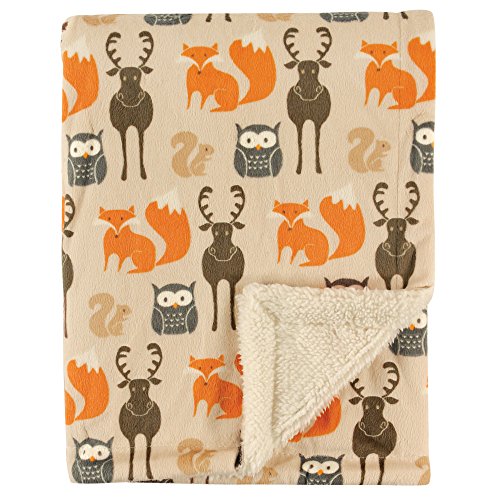
Hudson Baby Plush Mink and Sherpa Blanket — Best Warm Budget Blanket
Not every blanket job is swaddling. For the stroller on a cold morning, the car ride to grandparents, or a soft surface for floor time, what you want is plush warmth at a price that does not make you precious about spit-up. The Hudson Baby Plush Mink and Sherpa Blanket is exactly that: a mink-textured plush face with a sherpa back, sold in a wide range of prints at a budget tier. The verified listing here is the Forest print; sibling prints are the same product in different patterns, so choose by looks. It suits practical parents and gift-buyers who need something warm and presentable without registry-level spending. It is not a swaddle and not a sleep blanket — it is a supervised-use warmth layer.
Strengths
- Plush mink and sherpa construction (per listing title) — the warmest hand-feel in this guide
- Budget tier pricing (check price on Amazon) that makes multiples painless
- Many prints from the same verified product line, so matching a nursery theme is easy
Trade-offs
- Too warm and too plush for swaddling or for sleep — supervised awake use only
- Dimensions are not stated in the verified listing title for this print; check the listing for the exact size
- Plush synthetics shed a little when new — wash before first use
| Spec | Detail (as verified) |
|---|---|
| Type | Plush blanket (mink face, sherpa back) |
| Print as listed | Forest |
| Size | Not stated in the verified listing title |
| Use | Stroller, floor time, supervised warmth |
The honest way to frame this pick is cost-per-use. A plush blanket gets dragged, dropped, washed, and used as an emergency changing surface; a cheap one you like is worth more than a precious one you ration. Hudson Baby’s whole line exists in that practical register, which is precisely why it sells in the volumes that put it in a “best-selling” guide in the first place.
One usage note: in car seats, plush blankets go over the buckled harness, never under the baby or behind the straps, where the bulk can create slack in the harness fit. Over the top, tucked at the sides, it is a fine cold-weather layer for the ride.
Best for: stroller warmth, floor time, and practical gifts at a budget tier / Not suited for: swaddling, crib use, or hot climates

Yoofoss Muslin Swaddle Blankets, Organic — Best Organic Muslin
For parents who want muslin’s breathability with an organic fiber story, the Yoofoss set is the verified option in this guide: the listing title states organic baby blankets in muslin, at a generous 47 x 47 inches — a true receiving size that wraps a newborn with fabric to spare and keeps working as a toddler blanket. It suits parents prioritizing organic materials against a baby’s skin and anyone who wants the large-format muslin without the premium brand tier. It is less suited to buyers who need a certified-organic paper trail: the title says organic, and we report exactly that; it does not name a certification in the verified title, and we do not invent one.
Strengths
- Organic muslin (per listing title) in a large 47 x 47 inch format
- Muslin breathability for temperature regulation during supervised wrapping and layering
- Gender-neutral positioning that suits unknown-gender registries and hand-me-downs
Trade-offs
- No certification named in the verified listing title — buyers who require a specific certification should verify on the listing
- Muslin’s usual limits: minimal stretch, minimal warmth on its own
- Pack count is not stated in the verified listing title — confirm quantity on the listing before ordering
| Spec | Detail (as verified) |
|---|---|
| Type | Muslin swaddle / receiving blanket |
| Size | 47 x 47 inches |
| Material claim | Organic (per listing title; certification not stated) |
| Pack count | Not stated in the verified listing title |
Size deserves emphasis because it is where cheap muslin sets quietly fail. A 36-inch square wraps a six-pound newborn and nothing else; by month two it is a burp cloth. At 47 inches, the Yoofoss covers the full swaddling period and transitions to a legitimate toddler blanket, which changes the value calculation completely. If you compare muslin sets, compare inches before you compare prices.
Wash organic muslin the way you wash any muslin: warm water, no fabric softener (softener coats the fibers and reduces the absorbency and grip you bought it for), and expect the characteristic crinkle that makes the wrap hold. It will get softer for the first dozen washes, then hold steady for years.
Best for: organic-minded parents who want full-size muslin value / Not suited for: buyers who need a named organic certification confirmed in the title

HALO Micro-Fleece Sleepsack Swaddle — Best Wearable Blanket
The HALO Sleepsack Swaddle is the pick that resolves the central tension of baby blankets: babies sleep better wrapped, but loose blankets do not belong in a crib. This is a wearable blanket — a sleep sack with a 3-way adjustable swaddle wrap — so the “blanket” is worn, cannot be kicked over the face, and stays at a consistent warmth all night. The verified title states TOG 3.0, which is a genuinely warm rating aimed at cold climates and cold nurseries, in micro-fleece, sized for newborns 0–3 months. It suits parents in cold homes and winter newborns. It is emphatically not the pick for warm climates or warm nurseries, where this much insulation is too much — HALO and others make lighter TOG versions, but this verified listing is the warm one, and we describe it as such.
Strengths
- Wearable design removes loose blankets from the sleep space entirely
- 3-way adjustable swaddle (per listing title): arms in, one arm out, or arms out, easing the swaddle transition
- TOG 3.0 micro-fleece warmth (per listing title) for cold climates, with a design the title describes as hip healthy
Trade-offs
- TOG 3.0 is too warm for heated or warm-climate nurseries — overheating is a real consideration; dress and room temperature must match the rating
- Sized 0–3 months (per listing title), so it is a short-window purchase
- Swaddling of any kind stops at the first signs of rolling, wearable or not
| Spec | Detail (as verified) |
|---|---|
| Type | Wearable blanket / sleepsack swaddle |
| Warmth | TOG 3.0 (cold climates) |
| Size as listed | Newborn, 0–3 months |
| Material | Micro-fleece |
TOG is the rare baby-product number that actually deserves your attention, because it lets you match blanket warmth to room temperature instead of guessing by hand-feel. A TOG 3.0 product in a 24°C nursery is a sweaty, unhappy baby; the same product in an 18°C farmhouse bedroom is perfect. Check the room where the baby will actually sleep, then choose the rating — and if your home is warm, treat this listing as the wrong TOG and look for the same design in a lighter rating rather than forcing the fit.
The 3-way adjustability is the other genuinely useful feature, because the end of swaddling is a process, not a night. Freeing one arm, then both, over a week or two is how most babies transition without a sleep regression that sends everyone back to square one.
Best for: cold-climate and winter newborns whose parents want crib-safe wearable warmth / Not suited for: warm nurseries, or babies already showing rolling signs

Bleu La La Organic Cotton Heritage Knit Baby Quilt Blanket — Best Heirloom Knit
Every nursery drawer needs workhorses; every family also ends up with one blanket that means something. The Bleu La La Heritage Knit is that blanket in this guide: a textured knit quilt blanket in 100% organic cotton (per listing title), in a heritage style that photographs beautifully, gifts well, and is built to be kept. The verified listing is the Sky Blue colorway. It suits gift-givers who want the present that survives the purge of outgrown baby gear, and parents who prefer natural-fiber knit over plush synthetics for supervised cuddle and floor time. It is not the budget pick, and knit is not the fabric for heavy-duty daily swaddle rotation.
Strengths
- 100% organic cotton (per listing title) in a textured heritage knit with real keepsake quality
- Breathable natural fiber, warmer and more substantial than muslin without synthetic plush
- The gift pick: presentation and longevity that muslin sets and plush throws do not aim for
Trade-offs
- Premium tier in this group (check price on Amazon)
- Knit construction needs gentler washing than muslin to keep its texture and shape
- Dimensions are not stated in the verified listing title — confirm size on the listing if you need specific coverage
| Spec | Detail (as verified) |
|---|---|
| Type | Knit quilt blanket |
| Material | 100% organic cotton (per listing title) |
| Colorway as listed | Heritage — Sky Blue |
| Dimensions | Not stated in the verified listing title |
There is a practical argument for one good knit blanket alongside the workhorses: knit cotton has a weight and drape that helps some babies settle during held, supervised cuddle time in a way floaty muslin does not, and it is the blanket that works for tummy time on hard floors because the knit gives real cushion. It earns its place on use, not just sentiment.
For gift-givers: this is the blanket to send when the parents have already been given four muslin sets by everyone else. It occupies a different job, it will not be a duplicate, and it is the one most likely to be in a keepsake box in twenty years with the family able to say who gave it.
Best for: gifts, keepsakes, and natural-fiber cuddle/floor time / Not suited for: heavy-rotation daily swaddling or strict budgets
Comparison Table
| Pick | Badge | Key spec (verified) | Best for |
|---|---|---|---|
| aden + anais Essentials Swaddle, 4-Pack | Best Overall | Muslin, 4 pack | Everyday swaddling and registry builds |
| Copper Pearl Swaddle Blanket | Best Stretch Swaddle | Stretch knit, 46 x 46 in | Swaddle-escaping newborns |
| Hudson Baby Plush Mink and Sherpa | Best Warm Budget | Plush mink + sherpa | Stroller and floor-time warmth |
| Yoofoss Muslin Swaddle, Organic | Best Organic Muslin | Organic muslin, 47 x 47 in | Organic-minded, full-size value |
| HALO Sleepsack Swaddle | Best Wearable | TOG 3.0, 0–3 months, 3-way adjust | Cold-climate sleep, no loose blankets |
| Bleu La La Heritage Knit | Best Heirloom Knit | 100% organic cotton knit | Gifts and keepsakes |
How to Choose a Baby Blanket
Start with the job, not the fabric
Swaddle, receiving layer, stroller warmth, wearable sleep blanket, or keepsake — pick the job first and the fabric shortlist writes itself. Most blanket regret comes from buying a beautiful blanket for a job it cannot do: a plush throw cannot swaddle, a muslin square cannot warm a winter stroller ride, and no loose blanket of any kind is a sleep solution.
Size is the spec that decides swaddle success
For swaddling, bigger is better within reason: 44–47 inch squares (like the Copper Pearl and Yoofoss here) wrap newborns securely and keep working as the baby grows. Small “receiving” sizes are fine as layers and burp cloths but frustrate as primary swaddles within weeks. Always check dimensions on the listing — and where a title does not state them, treat the size as unknown until you confirm it, as we flag on several picks above.
Match warmth to the room, using TOG where it exists
For wearable blankets, TOG ratings turn warmth into a decision instead of a guess: higher TOG for cold rooms, lower for warm ones, and never stack extra loose blankets on top of a wearable to “make up” warmth. For loose blankets, use the hand test — plush and sherpa for cold supervised outings, muslin for everything mild.
Material claims deserve a careful read
“Organic” in a title is a claim about fiber sourcing; a named certification is a stronger, verifiable version of that claim. Both organic picks in this guide state organic in their verified titles; only some name certifications. If certification matters to you, let it be a listing-level check, and be wary of any product whose organic claim lives only in marketing images rather than its title and details.
Gift-buying: what to send at each tier
If you are buying for someone else’s baby, the logic inverts: the parents will receive muslin from three other people, so your gift should fill a gap. At a budget tier, the Hudson Baby plush is the right send — warm, pretty, and useful from the first stroller walk. In the middle, a Copper Pearl stretch swaddle is the experienced-parent gift that signals you know the 2 a.m. wrap problem is real. At the top, the Bleu La La knit is the keepsake send, the one that will not be duplicated and will not be discarded. Whichever tier you choose, include the receipt and resist monogramming until the baby’s name is certain — personalization converts a returnable duplicate into a permanent one, and duplicates are the tax every popular blanket pays.
Buy the rotation, not the blanket
Newborns produce laundry at a rate that surprises every first-time parent. Whatever becomes your primary system — muslin set, stretch swaddles, wearable — own enough of it that a 2 a.m. blowout does not leave you improvising. That is the practical reason multi-packs like the aden + anais set anchor this guide.
How to Swaddle Safely, and When to Stop
- Lay the blanket in a diamond, fold the top corner down, and place the baby on their back with shoulders just below the fold.
- Wrap snugly across the torso and arms — one side across and tucked, then the bottom corner up, then the other side across and tucked. Snug means the fabric holds the arms; it does not mean compression.
- Keep the hips and legs loose. The baby must be able to flex and frog-leg their hips inside the wrap. Never wrap legs straight and tight.
- Check warmth with a hand on the chest, not the hands or feet, which normally run cool. Adjust layers or room temperature if the chest feels hot or sweaty.
- Stop swaddling at the first signs of rolling — typically when the baby starts pushing up or rocking toward a roll. Transition with a wearable blanket’s arms-out configuration, like the HALO’s 3-way design.
- Keep loose blankets out of the sleep space for the first year, whatever the swaddle stage: back to sleep, firm flat surface, nothing soft and loose in the crib.
Baby Blanket Fabrics Compared: What Each One Actually Does
Cotton muslin is an open, plain weave that breathes exceptionally well and gets softer with washing. Its slight texture makes wraps grip themselves, which is why it dominates swaddling. Its limits are warmth and stretch: it insulates little and gives little. Stretch knit (the Copper Pearl’s category) trades some breathability for elasticity, producing the most secure wraps and a smoother, heavier drape; it is the fabric of receiving blankets meant to double as car-seat and stroller covers. Plush and sherpa synthetics (the Hudson Baby’s category) maximize warmth per dollar and wash without shrinking, but they do not breathe like natural fibers and are supervised-use layers, not sleep or swaddle fabrics. Micro-fleece, used in the HALO wearable, is plush’s disciplined cousin: consistent warmth that can be rated in TOG, light for its insulation, and quick to dry. Knit cotton (the Bleu La La’s category) sits between muslin and plush — breathable like a natural fiber should be, with more weight, drape and cushion than muslin, at the cost of slower drying and gentler washing.
Two fabric myths are worth retiring. First, “softer” is not automatically “better for skin”: what matters for a newborn is a clean, breathable fabric washed in a mild detergent, and every fabric in this guide qualifies when cared for that way. Second, natural is not automatically warmer or cooler — weave and construction decide that. Muslin and a cotton knit are both cotton, and they behave like different seasons. Buy the construction for the job; let the fiber be your second filter, for organic preference, washability, or budget.
Washing and Care: Making Blankets Last Through the Rotation
Baby blankets are washed more in their first year than most household textiles are in five, and care is where good blankets quietly die. Wash everything before first use — plush synthetics shed loose fibers when new, and all fabrics carry finishing residues from manufacture. Use a mild detergent and skip fabric softener on muslin and other absorbent fabrics: softener works by coating fibers, which reduces the absorbency you want in a burp-and-spill tool and the grip you want in a swaddle. Tumble dry muslin and plush on low to medium; knit cotton prefers lower heat or a partial air-dry to protect its texture and shape.
One more care habit pays for itself: keep a small mesh laundry bag for the stretch-knit and knit-cotton blankets, because snags and pulled threads almost always happen in the wash, where zippers and hook-and-loop closures from other garments grab at open knits. The wearable blanket’s own hook-and-loop swaddle tabs are the worst offender in any mixed load — close them before washing, both to protect the blanket and to stop it emerging wearing three socks and a washcloth. Sort by job, not just color. The wearable sleep blankets should cycle fastest — wash after a few nights or any leak, which is why owning two is the practical minimum. Stroller plush can go longer between washes but picks up outdoor grime; shake it out after outings. Keepsake knits should be washed least and gentlest: every unnecessary cycle spends a little of the texture you paid for. Finally, inspect blankets as you fold them. A swaddle with a thinning patch or a plush blanket with a loosening edge should retire to rag duty — worn fabric and loose threads have no place around a newborn, and the rotation only works if every member of it is sound.
Building a Registry That Does Not Duplicate Itself
Registries fail in a predictable way: six people buy the same famous muslin set, and nobody buys the wearable blanket. Prevent it by registering by job, with one choice per job, exactly as this guide is organized — one swaddle system, one stretch alternative if you want it, one warm plush, one wearable in the right TOG and size (plus the next size up), and one keepsake if you would like one. Add the unglamorous truth that experienced parents know: register for the second size of the wearable at the same time, because the 0–3 month window closes faster than anyone expects, and the replacement is always needed at midnight.
If you receive duplicates anyway, keep the extras in the car, at the grandparents’ house, and in the diaper bag rather than returning them. A blanket’s value is mostly about being in the right place when a spill, a chill, or a meltdown happens — distribution beats drawer-stacking every time. The same logic applies to the diaper bag: one muslin lives there permanently, swapped only when it comes home dirty, so the bag is never packed around a missing blanket.
Common Buying Mistakes
- Buying six of the same blanket type. A drawer of identical muslin squares still leaves you without stroller warmth or a sleep solution. Spread purchases across jobs.
- Ignoring dimensions. The cheapest muslin sets are often the smallest. Two inches of missing fabric is the difference between a swaddle and a scarf.
- Putting loose blankets in the crib. The most consequential mistake on this list. Wearable blankets exist to replace them; use one.
- Choosing warmth by thickness alone. A thick plush blanket in a warm room overheats; a rated TOG matched to room temperature is the disciplined way to decide.
- Paying for “organic” without checking the claim. Read whether the listing states organic fiber, and whether it names a certification, before paying the premium.
- Registering only for newborn sizes. Babies outgrow 0–3 month wearables and small receiving blankets in weeks. Include larger sizes and full-size swaddles.
Final Recommendation
Build the drawer in layers: the aden + anais Essentials 4-pack as the everyday muslin foundation, the Copper Pearl if your newborn fights wraps, the Hudson Baby plush for cold-weather outings, and the HALO Sleepsack Swaddle — in the right TOG for your nursery — for sleep. Add the Bleu La La knit as the gift or keepsake, and choose the Yoofoss organic muslin when organic fiber at full size is the priority.
Related guides in this series: Best Baby Blankets Organic, Best Hypoallergenic Blankets Cotton, Best Jersey Cotton Blankets, Best Heated Blankets Throws, and Best Gravity Blankets For Adults.
A Season-by-Season Blanket Plan
Spring and autumn babies live in the muslin layer most of the time: a muslin swaddle for the early weeks, a muslin or light knit as the stroller layer, and a mid-weight wearable for sleep. These are the easy seasons, and the aden + anais and Yoofoss sets do most of the work, with the Bleu La La knit as the in-between layer when evenings cool. Summer babies need breathability above all: muslin for everything supervised, the lightest wearable you can find for sleep (note that the HALO verified in this guide is the warm TOG 3.0 version — summer nurseries need its lighter siblings, not this one), and no plush except air-conditioned car rides. Overheating, not cold, is the summer risk, and every layer choice should be made with a hand on the baby’s chest rather than by habit.
Winter babies are where the warm picks earn their place: the Hudson Baby plush over the buckled harness and in the stroller, the TOG 3.0 HALO in a genuinely cold nursery, and the knit for supervised cuddle time. The winter mistake is stacking — plush over fleece over muslin until the baby is a sweating parcel. One warm layer, correctly matched, beats three anxious ones. Year-round, in every season, the rotation rule from earlier in this guide holds: whatever the primary system is, own enough of it that laundry never dictates the night’s sleep setup.
Finally, plan the handover. Swaddles retire at rolling; wearables size up twice in the first year; plush blankets demote to car and couch duty; the knit, if you chose well, graduates to the toddler bed as the comfort object that made it through. A blanket drawer planned this way is bought once, in the right order, instead of being rebuilt in a panic four times in the first year — which, more than any single product, is what the parents behind the best-selling lists have figured out.
Frequently Asked Questions
How many baby blankets do I actually need?
For most families: four to six everyday blankets in rotation (a 4-pack of muslin covers this), one or two warm plush blankets for outings, and two wearable blankets for sleep so one is always clean. Beyond that, extra blankets are gifts and keepsakes, not necessities.
Are muslin blankets warm enough for winter?
Not on their own in a cold climate. Muslin is a breathable layering fabric. For winter, layer it under a plush blanket for supervised outings, and use a properly rated wearable blanket — matched TOG to room temperature — for sleep.
When should I stop swaddling?
At the first signs of rolling, which can arrive as early as two months or as late as four or five. Watch for pushing up on hands during tummy time and rocking toward a roll; when you see them, transition to arms-out sleep with a wearable blanket.
What does TOG mean on a baby blanket?
TOG is a warmth rating: higher numbers mean more insulation. It lets you match the blanket to the nursery’s temperature instead of guessing. A TOG 3.0 wearable, like the HALO in this guide, is built for cold rooms; warm nurseries need a much lower rating.
Is organic cotton worth it for baby blankets?
It depends on your priorities. Organic cotton avoids certain chemical inputs in fiber production and is a reasonable preference for fabric against newborn skin. Verify what the listing actually claims — organic fiber stated in the title, and ideally a named certification — rather than paying for a vague “natural” label.
What size swaddle blanket is best for a newborn?
Aim for 44 to 47 inches square. That range wraps a newborn with enough fabric for secure tucks and keeps working as the baby grows into the blanket’s other jobs. Smaller receiving sizes are useful as layers and burp cloths but frustrate as primary swaddles within a few weeks, which is why both full-size picks in this guide — the Copper Pearl at 46 inches and the Yoofoss at 47 inches — lead with their dimensions.
How do I know if my baby is too warm under a blanket?
Feel the chest or the back of the neck, not the hands and feet, which normally run cool. A hot, sweaty, or flushed chest means remove a layer or lower the room’s warmth. This is also why rated warmth matters: a TOG figure matched to the room temperature replaces guesswork with a number, at least for wearable blankets.
Are heavier blankets better for helping babies sleep?
Weighted blankets are not recommended for infants — loose weight in a sleep space is a hazard, not a sleep aid, and no pick in this guide is a weighted product. What helps newborns sleep is the snug, consistent containment of a correctly done swaddle or a wearable blanket, stopped at the first signs of rolling. Any product marketing weight itself as the sleep mechanism for a baby under one year should be avoided.
Can I put a blanket over a baby in a car seat?
Yes, with one rule: the blanket goes over the already-buckled harness, never under the baby or behind the straps, where bulky fabric can introduce slack into the harness fit. Tuck it at the sides for the ride and remove it if the car warms up.


