Disclosure: airfryerkitchensupply.com is reader-supported. When you buy through links on our site, we may earn an affiliate commission at no extra cost to you.
Where to buy
All six products below were confirmed as live Amazon listings on 2026-11-22. Each name links to its listing so you can check the current price on Amazon and confirm the quart size and pack count before ordering — with books, the size in the title is the decision, because a tub that is two quarts too small for a textbook collection is not a bargain at any price.
- IRIS USA 32.5 Quart Clip Box with Latching Lid, 6-Pack — Check on Amazon
- Storex Large Book Bin, Pack of 6 — Check on Amazon
- IRIS USA 19 Quart Storage Bins with Gasket Lids, WeatherPro, 6-Pack — Check on Amazon
- Rubbermaid Cleverstore 17 Quart Clear Storage Bins with Lids, 6 Pack — Check on Amazon
- HOMZ Clear Plastic Storage Bins with Latching Lids, 31 Quart, 4 Pack — Check on Amazon
- Citylife 17 Quart Clear Storage Bin with Lid, 1 Pack — Check on Amazon
Introduction: books are the hardest thing you will ever put in a plastic tub
Choosing the best plastic tubs for book storage sounds like the simplest purchase in the world, and it defeats more buyers than almost any other storage decision, because books break the assumptions that ordinary storage tubs are built on. Books are dense — a tub of paperbacks weighs more than the same tub of almost anything else in your home. Books are rigid and rectangular, so a tapered tub that narrows toward the bottom wastes exactly the space books need most. Books are damaged by the two things plastic tubs are supposed to protect against and sometimes cause: moisture from outside, and trapped humidity inside. And books are usually stored to be used again — by a child growing into them, a student returning to them, a reader who rotates a collection — so a book tub is not a time capsule; it is a working container that will be opened, carried, stacked and re-shelved for years.
This guide therefore judges plastic tubs the way a librarian with a garage would. Capacity is assessed against real book formats — picture books, textbooks, paperbacks, hardcover sets — not against abstract quarts. Lids are assessed by how they close, because a latching lid and a gasket seal do different jobs. Carrying is assessed honestly: a full 32-quart tub of books is a two-hand, bend-your-knees lift, and any guide that pretends otherwise has never moved one. And the set of six picks deliberately spans the real book-storage jobs: the lidded archive tub, the open classroom-style book bin for books in daily use, the gasket-sealed tub for garages and basements, the stackable household standard, the big-capacity mover, and the single tub for one child’s current rotation.
One framing note before the picks: plastic tubs are excellent for books in motion and in rotation — moving house, storing a child’s outgrown favourites, keeping textbooks between terms, protecting a collection in a garage. For rare, valuable or antique books, plastic is not archival storage, and the buying guide below says plainly where that line sits, because an honest guide to book storage has to include the books that should never be in this guide’s products at all.
In this guide
Quick Picks
| Pick | Badge | Key detail from the listing | Check price |
|---|---|---|---|
| IRIS USA 32.5 Quart Clip Box with Latching Lid, 6-Pack | Best Overall | Dimensions stated: 18.5″L x 15.13″W x 9.38″H; clear, stackable and nestable | Check on Amazon |
| Storex Large Book Bin, Multi Color, Pack of 6 | Best Open Book Bin | Purpose-made book bin; interlocking; for home, office and classroom — open-top design | Check on Amazon |
| IRIS USA 19 Quart Bins with Gasket Lids, WeatherPro, 6-Pack | Best Sealed Protection | Gasket seal stated to protect contents from dust and moisture | Check on Amazon |
| Rubbermaid Cleverstore 17 Quart Clear Bins with Lids, 6 Pack | Best Stackable Standard | Clear bins with lids in a stackable design from a storage specialist brand | Check on Amazon |
| HOMZ Clear Storage Bins with Latching Lids, 31 Quart, 4 Pack | Best Large Capacity | 31 quart latching-lid tubs for shelves, garage and household storage | Check on Amazon |
| Citylife 17 Quart Clear Storage Bin with Lid, 1 Pack | Best Single Tub | Latching, stackable single tub; listing names colouring books among its uses | Check on Amazon |
How These Picks Were Chosen
Every tub here was verified on 2026-11-22: book-storage searches were run, listing titles were matched to the products described, and ASINs come from the listing responses. Only confirmed listings carry buying links, and every capacity, dimension and pack count in this guide is quoted from the listing itself. Where a listing does not state a fact a book buyer would want — an exact load rating, for instance — this guide says so and gives you the practical test to apply instead, because tubs are sold by volume and books punish by weight, and that gap is where this category’s disappointments live.
Selection required the product to be a rigid plastic tub or bin suited to books: fabric storage boxes were excluded even when their listings mentioned books, because fabric sides flex under book weight and cannot stack or seal; small desktop organisers were excluded as too small for real collections; and lidless novelty containers were excluded except for one deliberate exception — the Storex book bin, an open, purpose-made book container whose open top is its function, included because books in daily use are a different job from books in storage, and labelled as open in every place it appears. Within those rules the six picks spread across the jobs: archive, daily use, sealed protection, stacking, bulk capacity, and the single-tub purchase.
The 6 Best Plastic Tubs for Book Storage

1. IRIS USA 32.5 Quart Clip Box with Latching Lid, 6-Pack — Best Overall
The IRIS Clip Box leads this guide because it is the rare tub whose listing gives you the numbers a book buyer actually needs: 32.5 quarts of capacity and stated external dimensions of 18.5 by 15.13 by 9.38 inches, in a clear, latching-lid, stackable and nestable design, sold as a six-pack. Those dimensions describe a tub that takes textbooks and picture books standing in rows, fits a standard closet or garage shelf, and — at a height under ten inches — slides into the low storage spaces where book collections actually live. The latching “clip” lid matters for books specifically: a lid that clips shut stays shut when a heavy tub is tilted during carrying, which is when friction-fit lids give up.
Strengths
- Stated dimensions let you measure your books and shelves before buying — the only pick that publishes them in the title
- Latching lid stays closed under the shifting weight of a book load
- Six-pack format suits a real collection, and empties nest to save space
Trade-offs
- Filled with hardcovers, one of these is a heavy two-hand lift — pack paperbacks and hardcovers with the carry in mind
- Clear plastic shows scuffs over years of garage life; cosmetic, not structural
- No gasket seal is stated — for damp locations, the WeatherPro pick below is the better tool
Key specs (from the listing)
- Capacity: 32.5 quart per tub; pack of 6
- Dimensions: 18.5″L x 15.13″W x 9.38″H
- Lid: latching clip lid
- Design: clear, stackable, nestable
As an all-round book tub this is the purchase most households should make first: big enough for a shelf’s worth of books per tub, honest about its size, closed securely enough for attic and closet duty, and matched in a six-pack so a collection looks and stacks like a system rather than a pile of mismatched containers. Fill it thoughtfully — books upright or flat in short stacks, heaviest at the bottom, never stuffed so the lid bulges — and it will do the unglamorous work of book storage for a decade.
Best for: general book archiving, moving house, and closet or shelf storage of mixed collections. / Not suited for: damp basements without a sealed tub, or anyone who needs to carry full tubs alone over distance.
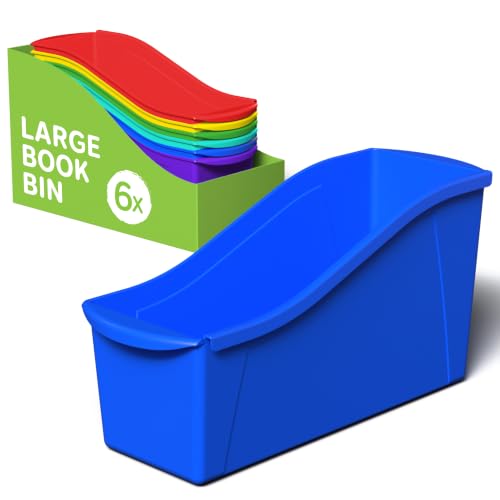
2. Storex Large Book Bin, Pack of 6 — Best Open Book Bin
The Storex is the deliberate exception in this guide, and its label says why: this is an open-top book bin, not a lidded tub. It is a large plastic book bin, sold in a multi-colour pack of six, with an interlocking design, listed for home, office and classroom — the container teachers use to hold the books children are actually reading this week. For books in daily rotation, a lid is not protection; it is friction. An open bin on a shelf or beside a reading chair lets a child pull a book out and — the harder half of the habit — put it back, and the interlocking design keeps a row of bins standing as one unit instead of skating apart.
Strengths
- Purpose-made for books in active use, not adapted from general storage
- Interlocking sides keep a shelf row of bins stable and tidy
- Multi-colour pack of six suits sorting by child, subject or reading level
Trade-offs
- Open top means no dust, moisture or stacking protection — this is not archive storage
- Not a carrying tub for moves; it is a shelf and floor container
- Exact dimensions are not stated in the title — check the listing against your largest picture books
Key specs (from the listing)
- Type: open-top large book bin
- Pack: 6, multi colour
- Design: interlocking plastic organiser
- Stated settings: home, office, classroom
Judge this bin by the job it declares and it is excellent: the daily book infrastructure of a child’s bedroom, a classroom reading corner, a home-school shelf. Books that live in Storex bins get read; books that live only in lidded archive tubs get stored. Most book-owning households need both systems — the archive for what is outgrown or out of term, the open bin for what is in hand — and confusing the two, in either direction, is how books end up either dusty and forgotten or damaged by daily chaos. This pick is the daily half of the system, honestly labelled.
Best for: children’s current books, classrooms, reading corners and home-school shelves. / Not suited for: long-term storage, garages, moving, or anywhere dust and moisture are the threat.

3. IRIS USA 19 Quart Bins with Gasket Lids, WeatherPro, 6-Pack — Best Sealed Protection
When book storage moves to the garage, the basement or the attic, the enemy changes from disorder to water — and not dramatic water, but the slow kind: humid air, condensation, the damp that creeps into cardboard and paper over a season. The IRIS WeatherPro bins are the pick built for that enemy: 19-quart clear bins with gasket lids, whose listing states the WeatherPro seal protects contents from dust and moisture. A gasket is a different thing from a latch — the latch holds the lid on, the gasket seals the gap the lid leaves — and for paper, which drinks moisture from air alone, the seal is the feature that matters.
Strengths
- Gasket seal stated to protect against dust and moisture — the correct defence for paper in garages and basements
- 19-quart size keeps each filled tub to a manageable carrying weight
- Six-pack covers a real collection with matched, stackable protection
Trade-offs
- A seal slows moisture exchange; it does not fix storing already-damp books — books must go in dry (see the how-to section)
- Smaller capacity than the big tubs means more tubs for a large library
- Gaskets age; check the seal’s condition when you reopen tubs each season
Key specs (from the listing)
- Capacity: 19 quart per bin; pack of 6
- Lid: gasket lid, WeatherPro seal
- Stated protection: dust and moisture
- Body: clear with black lid
The 19-quart size, which looks like a limitation next to the 31- and 32-quart tubs, is quietly this pick’s second virtue: books are so dense that a smaller sealed tub is the difference between storage you can carry safely and storage that injures someone every time it moves. For the collections that genuinely need sealing — the childhood favourites awaiting grandchildren, the reference library in a garage, the textbooks stored through a gap year — this is the correct container in this guide, and the others are not, however capacious.
Best for: garage, basement and attic book storage where moisture is the threat. / Not suited for: books going in damp, bulk moving of large libraries, or daily-use access.

4. Rubbermaid Cleverstore 17 Quart Clear Bins with Lids, 6 Pack — Best Stackable Standard
The Rubbermaid Cleverstore is the household-standard pick: 17-quart clear bins with lids in a stackable design, from the brand whose storage containers already live in half the closets in the country. Its virtues are system virtues. The 17-quart size is the shelf-friendly middle — tall enough for standard hardcovers and textbooks standing upright, modest enough that a full bin is a sane one-person lift — and a six-pack of identical, stackable bins turns a book collection into a wall of labelled, visible, retrievable storage instead of a archaeology project. Clear walls matter more for books than for almost anything else: you can read the spines through the plastic and find the right tub without opening three wrong ones.
Strengths
- Stackable, identical bins build a tidy, labelled book wall
- 17-quart size balances upright book capacity against carrying weight
- Clear body lets you identify contents — and read spines — without opening
Trade-offs
- The listing available at verification did not state a price in the listing response — check the current price on Amazon as part of your comparison
- No gasket seal is stated; treat as indoor storage, not damp-location protection
- Lid style is a standard fitted lid rather than a heavy-duty latch system
Key specs (from the listing)
- Capacity: 17 quart per bin; pack of 6
- Lids: included, stackable design
- Body: clear
- Brand: Rubbermaid Cleverstore line
Choose the Cleverstore when the storage location is civilised — closets, spare-room shelves, under-bed and wardrobe spaces — and the problem is order rather than weather. It is also the natural pick for households already invested in the Cleverstore ecosystem, where one more matched set extends an existing wall of storage instead of starting a rival one. Books reward systems; this is the system pick.
Best for: indoor closet and shelf archiving, labelled collections, and existing Rubbermaid households. / Not suited for: damp locations, or oversized art and coffee-table books that exceed its height.

5. HOMZ Clear Plastic Storage Bins with Latching Lids, 31 Quart, 4 Pack — Best Large Capacity
The HOMZ tubs are the bulk movers of this guide: 31-quart clear bins with latching lids, in a four-pack, listed for home, office shelves, kitchen, garage and bathroom organisation. For book storage, that capacity translates into fewer, bigger containers for the jobs where the count matters — a house move, a whole bookcase cleared for redecorating, a student’s library coming home for the summer. Latching lids keep the load closed in transit, clear walls keep the contents identifiable in a stack of moving boxes, and four matched tubs give you a system sized for a bookcase rather than a shelf.
Strengths
- 31-quart capacity swallows a bookcase section per tub
- Latching lids suit moving and transit, not just static storage
- Four matched tubs keep a bulk job uniform and stackable
Trade-offs
- A 31-quart tub filled with books is genuinely heavy — the heaviest lift in this guide; pack with the carrier in mind
- Blue-tinted lid colourway is the verified option; check the listing if colour matters
- No gasket seal stated — garage use should be dry-garage use
Key specs (from the listing)
- Capacity: 31 quart per tub; pack of 4
- Lid: latching
- Body: clear
- Stated settings: home, office shelves, kitchen, garage, bathroom
The honest counsel that comes with big tubs is about filling discipline, and it is in the how-to section because it matters: a large tub should be filled to a weight, not to a volume. Half books and half soft household goods, or books in the bottom two-thirds and the tub closed there, beats a brim-full book brick every time — for your back, for the tub’s handles and base, and for the books at the bottom of the stack. Used with that discipline, the HOMZ set is the fastest way in this guide to move or store a lot of books at once.
Best for: house moves, whole-bookcase storage, and bulk textbook archiving. / Not suited for: solo carrying over distance, damp locations, or small collections that would rattle inside it.

6. Citylife 17 Quart Clear Storage Bin with Lid, 1 Pack — Best Single Tub
Not every book problem is a library. Sometimes it is one child’s current colouring books and early readers, one term’s textbooks, one shelf that needs to come down. The Citylife bin is the single-tub answer: a 17-quart clear plastic bin with a latching, stackable lid, sold as a one-pack — and its listing names colouring books among its intended contents, a small detail that signals the size was thought about against real, awkward, larger-format children’s books rather than abstract storage. Buying one correct tub beats buying a six-pack that colonises a closet, and it beats the shoebox it usually replaces by being lidded, clear and stackable when the second tub eventually joins it.
Strengths
- Single-pack purchase matches a single, defined book job
- Latching, stackable lid — it can become the first unit of a later system
- Listing explicitly contemplates colouring books and bedroom/closet use
Trade-offs
- Per-tub value rarely matches the multi-packs; you are paying for buying exactly one
- 17 quarts fills fast with larger-format children’s books
- No gasket seal stated — indoor storage duty
Key specs (from the listing)
- Capacity: 17 quart; pack of 1
- Lid: latching, stackable
- Body: clear plastic
- Stated uses include: colouring books, closets, bedrooms, toys, garage and workshop organisation
There is a discipline worth praising in the single-tub purchase: it forces the question “which books, exactly?” before money moves, and book storage goes wrong precisely when that question is skipped and capacity is bought in the abstract. For a defined, bounded collection — this term, this child, this shelf — the Citylife is the right-sized answer, and its stackable lid means the second defined collection, when it arrives, can start a tidy stack rather than a new pile.
Best for: one child’s current books, one term’s textbooks, and defined single-shelf jobs. / Not suited for: whole collections, where the multi-packs are the sensible economics.
Comparison Table
| Pick | Badge | Key spec | Best for |
|---|---|---|---|
| IRIS USA 32.5 Qt Clip Box, 6-Pack | Best Overall | 32.5 qt; 18.5″ x 15.13″ x 9.38″; latching lid | General archiving and moving |
| Storex Large Book Bin, 6-Pack | Best Open Book Bin | Open-top; interlocking; classroom-style | Books in daily use |
| IRIS USA 19 Qt WeatherPro, 6-Pack | Best Sealed Protection | 19 qt; gasket seal against dust and moisture | Garage, basement and attic storage |
| Rubbermaid Cleverstore 17 Qt, 6 Pack | Best Stackable Standard | 17 qt; stackable; clear with lids | Indoor closet and shelf systems |
| HOMZ 31 Qt Latching Bins, 4 Pack | Best Large Capacity | 31 qt; latching lids | Moves and whole-bookcase storage |
| Citylife 17 Qt Bin, 1 Pack | Best Single Tub | 17 qt; latching; single pack | One defined, bounded book job |
How to Choose a Plastic Tub for Books: Capacity, Lids, and Weight
Measure your books before you measure tubs. Stand your largest format — usually picture books, textbooks or atlases — upright and note its height; the tub’s internal height must clear it with the lid closed, or those books will travel flat and eat the tub’s floor area instead. Then think in rows: books store best upright in rows like a shelf, or flat in short stacks; a tub whose floor fits two clean rows of your format will hold more usable books than a nominally larger tub whose tapered floor fits one row and a wedge of wasted space. Quarts are a starting filter, never the decision — the decision is whether your books’ dimensions and the tub’s dimensions agree, which is why the one pick in this guide whose listing publishes full dimensions earns its Best Overall badge.
Choose the lid for the location. A latching lid is for movement and stacking: it keeps the lid on when the tub is carried, tilted and stacked under other tubs. A gasket lid is for atmosphere: it seals against the dust and humidity of garages, basements and attics, and it is the only lid in this guide that addresses moisture. A standard fitted lid is for civilised indoor storage, where the enemies are dust bunnies and disorder rather than weather. And an open bin is for books in daily use, where access beats protection. Matching lid to location is the single highest-value decision in book storage, ahead of brand, ahead of capacity.
Respect the weight, because books rewrite the rules of tub sizing. A quart of books weighs far more than a quart of clothes, toys or decorations, so the practical capacity of a book tub is set by what a person can carry, not by what the plastic can hold. As a working rule: the 17- to 19-quart tubs in this guide make sane one-person full loads; the 31- and 32-quart tubs should be filled to a comfortable carry weight and topped with lighter items if they must be filled at all. Handles and bases also live longer under partial loads. If a collection will be carried by one person, up stairs, more than once, buy more smaller tubs — your future self, on the staircase, is the customer for that decision.
Finally, draw the archival line honestly. Plastic tubs — including the gasket-sealed pick — are for working collections: books that will be read, rotated, moved and used. Rare books, valuable first editions, family heirloom volumes and anything with genuine monetary or sentimental irreplaceability deserve archival boxes, stable indoor conditions and specialist advice, not a garage tub at any seal quality. Knowing which of your books are which, and storing the two groups differently, is the mark of a collection that will survive its owner.
How to Pack Books in a Plastic Tub So They Survive Storage
Packing well matters more than the tub. Work through it in order. One: clean and check every book first — dust it off, and never pack a book that is damp, musty or mould-spotted; one damp book in a sealed tub becomes the whole tub’s problem, and this is doubly true for the gasket-sealed pick, whose seal keeps conditions in as faithfully as it keeps them out. Two: sort by size before you pack, so rows and stacks sit evenly and weight distributes across the tub floor instead of concentrating on one corner. Three: pack upright like a shelf for books in good condition, spines down or alternating for stability, snug enough not to slump — slumped books warp — and use a wadded buffer of packing paper at the end of a partial row rather than leaving books to lean at an angle for a year. Four: heavy books at the bottom, always, whether the tub is stacked flat or upright; a tub that is top-heavy with atlases over paperbacks crushes the paperbacks and tips when carried. Five: fill to carry weight, not to the brim, and if the tub must be full for stacking strength, top the books with something light. Six: label like you mean it — author range, subject, or the child’s age the books suit — on two sides of the tub, because the clear wall helps you find a spine but the label finds you the right tub from across a garage. Seven: store the tubs off bare concrete where you can, in the driest location available, and open sealed tubs once a season to check condition and air the contents; storage that is never inspected is just delayed discovery.
Common Buying Mistakes
The first mistake is buying by quarts alone and discovering the tub’s height by trying to close the lid on a textbook. Measure the largest book first. The second is buying the biggest tubs for the heaviest contents: a brim-full 32-quart book tub is an injury with a lid. The third is using a standard lidded tub in a damp location and calling it protection — without a gasket seal, a lid is a hat, not a barrier. The fourth is the reverse error: sealing slightly damp books inside a gasket tub, which preserves the damp beautifully. Books go in dry or not at all. The fifth is lidding the daily books: children’s current reading belongs in an open bin where small hands can reach it, and a collection that is hard to access is a collection that stops being read. The sixth is storing the irreplaceable with the ordinary — heirloom volumes deserve archival treatment, and no pick in this guide, however sealed, is a substitute for it.
Final Recommendation
For most households the answer is the IRIS USA 32.5 Quart Clip Box six-pack: stated dimensions, a latching lid, and a size that suits real collections in real closets. Add the Storex open book bins for the books in daily hands, especially children’s. If the storage location is a garage, basement or attic, switch the archive to the IRIS WeatherPro gasket bins and pack the books in dry. For tidy indoor systems choose the Rubbermaid Cleverstore set; for a move or a whole bookcase, the HOMZ 31-quart tubs, filled to carry weight; and for one defined job, the single Citylife bin. Check the current price on Amazon for each, measure your largest books against the tub before ordering, and pack dry, heavy-down and labelled.
Related guides in this series: Best Plastic Tubs For Storage
Book Storage by Collection: Children, Textbooks, and the Family Library
Different collections fail in different ways, and matching the container to the collection’s behaviour is where book storage becomes a system rather than a pile. Children’s books fail by chaos and by format: picture books are oversized, board books are dense beyond their size, and the collection turns over completely every two years. The working answer is the two-tier system this guide’s picks build — open bins for the current age, lidded tubs for the outgrown ages awaiting a sibling or a decision — with the gasket-sealed tubs reserved for the keepers, the books with a future reader already named. Textbooks fail by weight and by term: they are the heaviest books in most houses and they are needed again on a date. Pack them by term in the mid-size tubs, label by course rather than by title, and store them where the student returning for them can lift them safely — a 19-quart discipline that future backs appreciate. Reference and hobby collections — cookbooks with ambitions, atlases, the craft library — fail by size: they are the books that defeat standard tub heights, and they should be measured first and packed flat in the large tubs, few per tub, with the weight rule doing the arithmetic.
The family library — the accumulated hardcovers and paperbacks of decades — fails by volume and by sentiment in equal measure. Its honest system is triage before tubs: the books that will be read again go into the labelled indoor system, the books being kept for a person go into sealed storage with that person’s name on the label, and the books being kept from guilt deserve a decision rather than a container. Tubs are wonderful servants of the first two groups and expensive enablers of the third. Whichever collection you are storing, write the label as if a stranger will move the tub — because one day a stranger, or a tired version of yourself at midnight in a new house, will be grateful that “Paperbacks A–K, living room” exists instead of a clear wall of anonymous spines.
Plastic, Cardboard, and Wood: An Honest Materials Comparison
Plastic tubs won this search, but they did not win every argument, and a good guide should say where the rivals still hold ground. Cardboard book boxes — the small, double-walled kind movers use — are genuinely excellent for a single move: cheap, right-sized for books, easy to label, and recyclable at the destination. Their failure is time: cardboard drinks ambient moisture, softens, harbours pests, and cannot be stacked for years or trusted in a garage, so it is a transport material, not a storage material. Wooden crates and shelving are the opposite profile — beautiful, breathable, permanent — and entirely wrong for damp locations, heavy to move, and open to dust and insects; they are furniture for books in use, not containers for books in waiting. Fabric bins flex, as this guide noted at selection, and belong to clothes and toys. Plastic’s claim is the middle kingdom: sealed or lidded against the environment, rigid under stacking, indifferent to damp air, light when empty and honest when full. Its weaknesses are real — it can trap moisture sealed in with damp books, it is not archival, and cheap plastic goes brittle in heat and sun — and every one of them is managed by the packing discipline in this guide: dry books, sensible loads, a dry location, seasonal checks. Choose plastic for storage and moving, cardboard for the single trip, wood for the books on display, and archival board for the treasures, and each material is doing the job it was actually good at.
Moving House with Books: The Tubs in Transit
Moving is where book tubs earn their keep most visibly, and where their rules tighten. The governing principle is that a book box should be liftable by the person who packed it, at the end of a long day, up the stairs of the new house — which is why movers have used small book boxes for a century and why this guide’s mid-size tubs, filled to carry weight, outperform the giants in transit even though the giants win on a shelf. Pack for the van, not the room: heavy tubs low and central in the load, lids latched and, for a long move, a strip of tape across the latch as insurance against the one jolt that tests it. Keep one tub unsealed until the last morning — the moving-day tub, holding the documents, chargers, kettle and the book someone will want on the first night — because a move in which everything is equally packed is a move in which the important things are equally lost. At the destination, the clear walls and two-sided labels of a good tub system pay their dividend: books can be shelved room by room without opening a single wrong container, and the tubs themselves nest away or begin their second life as the new house’s storage. Households that have moved books in matched, labelled, weight-disciplined tubs describe it as a non-event; households that have moved them in carrier bags and hope describe it as a story. The difference is entirely purchased in advance, at the price of the tubs in this guide.
Labelling and Inventory: The System That Makes Tubs Findable
A tub you cannot identify from outside is a tub you will open three times a year in vain, so the labelling system deserves the same seriousness as the containers. Label on two adjacent sides, never just the top, because tubs are viewed from the side in every real storage geometry — stacked, shelved, or lined against a garage wall. Write the label for the searcher, not the packer: the category and the range (“Children’s picture books, ages 4–7”, “Textbooks — Year 2, by course”) beats a fond inventory of every title, which will be wrong by the second reorganisation anyway. Date the label. A tub labelled with its packing date answers the question every storage system eventually asks — how long has this been here, and does its contents’ moment pass? — and dated tubs get reviewed, while undated tubs get inherited. For households with several tubs of the same family, number them and keep one phone note with the numbers and their ranges; it takes ten minutes at packing time and converts a garage of possibilities into a directory. None of this is glamorous, and all of it is the difference between storage and mere relocation: books in labelled, dated, numbered tubs are a collection in waiting, findable in a minute by whoever needs them, and books in anonymous tubs are a rumour. The tubs in this guide — clear-walled, matched, stackable — are built to carry exactly this system; the label is the part you supply.
One last practical note on stacking, since it is where tub systems quietly fail: stack by weight and by family. Heaviest tubs at the bottom of any stack, always, and never more high than you can lift the top tub down from safely — for most households that means three, not five. Keep one family of tubs to one stack where you can, because matched lids and matched footprints stack true, while mixed families lean. A stack that leans is a stack that falls, and a falling tub of books is the one storage accident this entire guide has been organised to prevent.
Frequently Asked Questions
What size plastic tub is best for books?
It depends on the carrier as much as the collection. Tubs of 17 to 19 quarts make comfortable full loads for one person and suit shelf and closet storage. Tubs of 31 to 32 quarts suit moves and bulk storage but should be filled to a carry weight rather than to the brim. In all sizes, the tub’s internal height must clear your tallest book with the lid closed — measure the book, then choose the tub.
Should books be stored upright or flat in a tub?
Both work when done properly. Upright, like a shelf, suits books in good condition packed snugly so they cannot slump and warp. Flat in short stacks suits oversized and heavy books, which should always sit at the bottom. What damages books is the in-between: leaning at angles for months, or bearing the weight of a tall stack. Pack firmly, support partial rows, and keep the heavy volumes low.
Do I need a gasket-sealed tub for book storage?
Only if the location demands it. In a dry indoor closet, a standard lidded or latching tub is entirely adequate. In a garage, basement or attic — anywhere humidity and condensation reach — a gasket seal is the correct defence for paper, and it is the feature that separates the WeatherPro pick in this guide from the rest. Remember the seal works both ways: books must go in dry.
Can plastic tubs damage books?
Used badly, yes: trapping damp books in a sealed tub, storing tubs in extreme heat, or crushing books under excessive weight will all do harm. Used well — dry books, sensible loads, a dry location, seasonal checks — plastic tubs protect working collections effectively for years. The exception is rare and valuable books, which belong in archival boxes in stable indoor conditions rather than in any plastic tub.
How do I keep stored books from smelling musty?
Start with dry, clean books in a dry tub in the driest location you have, and inspect and air sealed tubs once a season. Mustiness is moisture plus time plus no inspection; remove any leg of that tripod and books keep well. If a book already smells musty, air it separately and thoroughly before it joins a stored collection — one musty book will share its condition with a whole tub.
Are open book bins a good idea for children?
They are the best idea in this guide for books in daily use. An open, shelf-level bin lets a child choose a book and — the habit that matters — put it back without a lid standing in the way. Keep the current rotation in open bins like the Storex pick, and reserve lidded tubs for outgrown books being stored for younger siblings or for later. Access is what turns stored books into read books.


