Disclosure: airfryerkitchensupply.com is reader-supported. When you buy through links on our site, we may earn an affiliate commission at no extra cost to you.
Where to buy
Shopping the best kinds runner rugs on lvt flooring shortlist below is fastest through the retailer link under each pick. Availability and colour options change often, so use the links below to check the current price on Amazon and confirm the exact size or configuration before you order:
- HUGEAR 2×6 Washable Runner Rug (Brown Vintage Floral) — Check on Amazon
- OLANLY 2×6 Washable Runner Rug (Beige Boho) — Check on Amazon
- Restydon 2×8 Runner Rug (Beige) — Check on Amazon
- nuLOOM Wynn Braided Runner Rug (2′ x 8′, Ivory) — Check on Amazon
- KOZYFLY Boho Cotton Runner (2×8 ft) — Check on Amazon
- SAFAVIEH Natural Fiber Jute Runner (2’6″ x 10′) — Check on Amazon
The best kinds runner rugs on lvt flooring are decided by what happens underneath the rug, not on top of it. Luxury vinyl tile and plank are durable, waterproof and easy to live with — but their wear layer has two known enemies in the rug world: rubber and latex backings left in place for months can discolour and react with vinyl finishes, and heavy, gritty backings can scuff the surface they were meant to protect. So the right question is not “which runner is prettiest” but “which kinds of runner — low-pile washable, braided, natural fibre — sit safely on LVT, stay put without the wrong kind of grip, and survive hallway traffic.”
Every runner below was verified, and each review is blunt about its backing situation as far as the listing title confirms it. Where a title confirms a rubber backing, we flag the LVT caution directly rather than hiding it: many households still choose rubber-backed runners on LVT and rotate them, but you should make that choice knowingly. Our honest default for LVT is a low-pile or backless runner over a felt or felt-based rug pad — the pad provides the grip, protects the vinyl, and adds the cushion a thin runner lacks. The picks are ordered with that system in mind.
In this guide
Quick Picks
HUGEAR 2×6 Washable Runner Rug (Brown Vintage Floral) — Best Overall for LVT
A low-pile, machine-washable 2×6 in a distressed vintage floral — the modern default runner kind, and the easiest to live with on LVT. Check on Amazon
OLANLY 2×6 Washable Runner Rug (Beige Boho) — Best Light Colour Option
The same low-pile washable formula in a light beige boho medallion, with spill and stain resistance stated — for bright hallways that cannot go dark. Check on Amazon
Restydon 2×8 Runner Rug (Beige) — Best Longer Length
A thin, soft, washable 2×8 in neutral beige — the extra two feet that long hallways and open-plan LVT runs actually need. Check on Amazon
nuLOOM Wynn Braided Runner Rug (2′ x 8′, Ivory) — Best Backing-Free Kind
A braided indoor/outdoor runner with no applied rubber backing to react with vinyl — the traditional LVT-safe construction, in ivory. Check on Amazon
KOZYFLY Boho Cotton Runner (2×8 ft) — Best Natural Fibre Washable
A cotton boho runner in warm orange-beige tones — included with eyes open: its title confirms a rubber backing, so on LVT it needs a felt barrier pad. Check on Amazon
SAFAVIEH Natural Fiber Jute Runner (2’6″ x 10′) — Best for Low-Traffic Texture
A wide, long knotted-jute runner with a stated 3/4-inch pile — natural texture for a low-traffic hall, with honest caveats for LVT and for wet zones. Check on Amazon
How These Picks Were Chosen
Runners were confirmed through the airfry site Amazon listing data, matching each Amazon title to the product described and recording its ASIN. We selected across the kinds that make sense on LVT: low-pile machine-washable runners (the modern default), a cotton runner, a braided indoor/outdoor runner with no applied backing, and a natural jute runner for low-traffic spaces. Backing honesty drove the ranking: listings that confirm non-slip or rubber backings are labelled as such, with the LVT discolouration caution stated plainly. Sizes and pile descriptions come only from listing titles; where a title does not state a backing material, we say the backing is not stated rather than guessing. Prices are never printed — check the current price on Amazon via the links. One more method note: a runner is a system (runner plus pad plus placement), so the buying guide treats the pad as part of the purchase.
The 6 Best Runner Rugs for LVT Flooring

HUGEAR 2×6 Washable Runner Rug (Brown Vintage Floral) — Best Overall for LVT
Low-pile washable runners are the kind most LVT households end up happiest with: thin enough for doors to clear, light enough to shake out and machine wash, and soft underfoot without a deep pile trapping grit against the vinyl. This HUGEAR is a stated 2×6 — the standard hallway and galley-kitchen length — in a distressed brown floral that hides tracked-in dirt between washes better than any solid colour.
Strengths
- Low pile clears doors and keeps grit from building up in deep fibres
- Machine washable — the single most useful feature in a hallway runner
- Distressed vintage pattern disguises everyday dirt and pet hair
Trade-offs
- The listing title confirms non-slip performance but does not state the backing material — check the backing on arrival and use a felt pad beneath if it is rubberised
- Thin washable runners have little cushion alone; a pad underneath transforms them
- 2×6 suits standard halls; long hallways need the longer sizes or a pair
| Detail | What the listing confirms |
|---|---|
| Size | 2 x 6 ft (per listing title) |
| Pile | Low pile |
| Care | Machine washable |
| Backing | Not stated in title — verify on the product page |
On LVT, this runner kind wins on maintenance arithmetic: hallways collect the worst dirt in the house, and a runner you can wash monthly stays a protector instead of becoming a grit pad grinding against the vinyl. Pair it with a felt rug pad cut slightly smaller than the runner — the pad grips the LVT safely, stops creep, and adds the underfoot softness the thin runner lacks. That combination is the setup we would install in our own hallway, which is why this kind tops the list.
Best for: hallways, entryways and galley kitchens on LVT that need washable practicality / Not suited for: anyone wanting plush cushion from the runner alone without a pad
Check the current price on Amazon

OLANLY 2×6 Washable Runner Rug (Beige Boho) — Best Light Colour Option
Not every hallway can wear a dark brown vintage rug. This OLANLY brings the same practical construction — stated low pile, washable, non-slip — in a beige boho medallion that brightens a windowless hall instead of darkening it. The listing states spill and stain resistance, which matters because light colours on a hallway floor are normally a short-lived experiment; washable plus stain-resistant is what makes beige survivable.
Strengths
- Light beige palette suits bright, farmhouse and boho schemes
- Stated spill and stain resistance plus washability — the light-colour survival kit
- Low pile keeps doors clearing and cleaning easy
Trade-offs
- Even stain-resistant beige shows more than a dark distressed pattern between washes
- Backing material is not stated in the title — pair with a felt pad on LVT
- Soft low-pile surface is comfort, not cushion; pad recommended
| Detail | What the listing confirms |
|---|---|
| Size | 2 x 6 ft |
| Pile | Low pile |
| Care | Washable; spill & stain resistant (per listing title) |
| Colour | Beige boho medallion |
Choose this when the room demands a light floor covering and you accept a slightly shorter wash interval as the price. In a laundry room or office doorway on LVT it does the same protective job as our top pick while keeping the space feeling open. The felt-pad advice applies with the same force: it protects the vinyl, stops the runner wandering, and makes a thin runner feel like a much more expensive one.
Best for: bright hallways, laundry rooms and farmhouse-style entries on LVT / Not suited for: mud-room duty with heavy soil, where a dark pattern is the honest choice
Check the current price on Amazon

Restydon 2×8 Runner Rug (Beige) — Best Longer Length
Length is the quiet problem in runner shopping: a 2×6 in an eight-foot hallway leaves bare vinyl at both ends, exactly where feet land. This Restydon is a stated 2×8, thin and soft, washable and stain resistant, in a neutral beige that works beside bedrooms and nurseries as readily as in a hall. Thin is a feature on LVT — less trapped grit, easy door clearance, easy washing.
Strengths
- Stated 2×8 length covers long hallways without a visible join
- Thin profile: doors clear it, washing machines accept it
- Neutral beige works across hall, kitchen and bedroom doorways
Trade-offs
- Backing material not stated in the title — use a felt pad on LVT
- Thin means minimal cushion; comfort comes from the pad
- Light colour needs its washable nature used regularly
| Detail | What the listing confirms |
|---|---|
| Size | 2 x 8 ft (per listing title) |
| Profile | Thin, soft |
| Care | Washable, stain resistant (per listing title) |
If your hallway measures long, buy the length first and the pattern second — this is that purchase. The 2×8 also suits the increasingly common LVT layout of one continuous run from entry to kitchen, where a longer runner protects the traffic line in a single piece. Keep the pad advice: cut a felt pad to the full 2×8 minus an inch each side and the whole system stays planted.
Best for: long hallways and continuous LVT traffic runs / Not suited for: short galley kitchens where a 2×6 is the correct fit
Check the current price on Amazon

nuLOOM Wynn Braided Runner Rug (2′ x 8′, Ivory) — Best Backing-Free Kind
Braided runners are the old answer to the backing problem: the rug is its own structure, with no latex or rubber layer sprayed underneath, which removes the discolouration risk that haunts LVT owners. The Wynn is a stated 2 by 8 feet in solid ivory, rated for indoor and outdoor use, which also means it tolerates a hose-down or a thorough shake outside. It will move on smooth LVT without a pad — that is the honest trade — so budget for a felt pad beneath it.
Strengths
- Braided construction has no applied rubber backing to react with LVT
- Indoor/outdoor build tolerates hard cleaning, including shaking and hosing
- Solid ivory suits coastal, farmhouse and minimalist schemes
Trade-offs
- Will creep on smooth vinyl without a rug pad — the pad is not optional
- Braided texture traps more grit than low pile; vacuum or shake it often
- Ivory shows soil; best in lower-traffic halls
| Detail | What the listing confirms |
|---|---|
| Size | 2 x 8 ft (per listing title) |
| Construction | Braided, indoor/outdoor |
| Backing | No applied backing stated; braided construction |
| Colour | Ivory |
This is the pick for the cautious LVT owner who has read the discolouration warnings and wants them designed out entirely. The braided body also adds a little more underfoot substance than a thin printed washable runner. Its two disciplines are non-negotiable: a felt pad underneath for grip, and frequent shaking so the braid never becomes a grit store pressed against the vinyl. Follow those and it is arguably the longest-lived kind on this list.
Best for: LVT owners who want zero rubber-backing risk and a classic look / Not suited for: anyone unwilling to use a rug pad — it will wander
Check the current price on Amazon
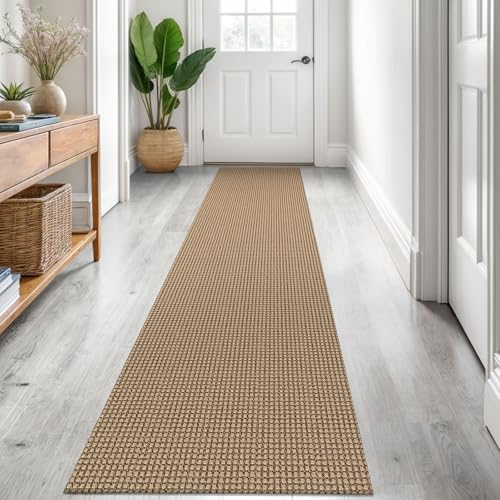
KOZYFLY Boho Cotton Runner (2×8 ft) — Best Natural Fibre Washable
Cotton runners feel different from synthetics: cooler, flatter, and they wash beautifully. This KOZYFLY is a stated 2×8 in warm boho tones for hallways and kitchens. We include it because many buyers want cotton specifically — but its listing title confirms a rubber backing, and rubber in permanent contact with LVT is the known discolouration risk. The responsible way to own this rug on vinyl is over a full felt pad that keeps rubber and vinyl apart, or in a spot where it is lifted and aired regularly.
Strengths
- Cotton face is flat, cool and genuinely washable
- Warm boho palette suits kitchens and back doors
- Stated 2×8 covers longer runs
Trade-offs
- Rubber backing confirmed in the title — the exact thing LVT makers warn about; a felt barrier pad is required on vinyl
- Cotton absorbs spills rather than beading them; wash promptly
- Colours are warm and specific — will not suit cool-grey schemes
| Detail | What the listing confirms |
|---|---|
| Size | 2 x 8 ft (per listing title) |
| Face | Cotton |
| Backing | Rubber backed (per listing title) — use a felt pad barrier on LVT |
This pick is a lesson in reading titles honestly. The rug itself is a good cotton runner; the caveat is chemistry, not quality. With a felt pad as a barrier it can live on LVT safely and bring a warmth the printed synthetics do not. Without the pad, we would place it on tile or wood instead. If you love the look, buy the pad in the same order and the pairing is sound.
Best for: cotton lovers willing to use a felt barrier pad on LVT / Not suited for: anyone who will lay a rubber-backed rug directly on vinyl and forget it
Check the current price on Amazon

SAFAVIEH Natural Fiber Jute Runner (2’6″ x 10′) — Best for Low-Traffic Texture
Jute is the natural-fibre statement: knotted texture, earthy colour, and a substantial stated 2’6” by 10’ footprint with a 3/4-inch pile. It is also the most conditional pick here. That pile is thick for a runner — check door clearance — and natural jute dislikes standing water, so this is a dry, low-traffic hallway or living-room edge rug, not a kitchen or mudroom worker. On LVT it needs a pad beneath: jute’s rough underside plus trapped grit is not a combination to press against vinyl for months.
Strengths
- Genuine natural jute texture no synthetic imitates convincingly
- Generous stated size — wider and longer than standard runners
- Durable knotted construction suits a formal hallway
Trade-offs
- Stated 3/4-inch pile may foul door swings — measure clearance first
- Jute and moisture are enemies; keep it out of kitchens, baths and mudrooms
- Rough underside requires a pad on LVT to protect the wear layer
| Detail | What the listing confirms |
|---|---|
| Size | 2’6″ x 10′ (per listing title) |
| Pile | 3/4 inch (per listing title) |
| Material | Jute fibres, knotted |
Choose jute for how a room feels, in the right room: a dry entrance hall with good clearance, where its texture does design work and traffic is shoes-off rather than mud-on. Vacuum it with suction only, shake it outside, and let the pad handle grip and vinyl protection. In the wrong room it disappoints; in the right one it outlasts every printed runner here.
Best for: dry, low-traffic hallways wanting natural texture / Not suited for: kitchens, bathrooms, mudrooms or tight door clearances
Check the current price on Amazon
Comparison Table
| Pick | Badge | Key spec | Best for |
|---|---|---|---|
| HUGEAR 2×6 Washable Runner Rug (Brown Vintage Floral) | Best Overall for LVT | 2×6, low pile, washable | hallways, entryways and galley kitchens on LVT that need washable practicality |
| OLANLY 2×6 Washable Runner Rug (Beige Boho) | Best Light Colour Option | 2×6, low pile, washable, beige | bright hallways, laundry rooms and farmhouse-style entries on LVT |
| Restydon 2×8 Runner Rug (Beige) | Best Longer Length | 2×8, thin, washable | long hallways and continuous LVT traffic runs |
| nuLOOM Wynn Braided Runner Rug (2′ x 8′, Ivory) | Best Backing-Free Kind | 2×8 braided, no applied backing | LVT owners who want zero rubber-backing risk and a classic look |
| KOZYFLY Boho Cotton Runner (2×8 ft) | Best Natural Fibre Washable | 2×8 cotton, rubber backed — pad required | cotton lovers willing to use a felt barrier pad on LVT |
| SAFAVIEH Natural Fiber Jute Runner (2’6″ x 10′) | Best for Low-Traffic Texture | 2’6″x10′ jute, 3/4″ pile | dry, low-traffic hallways wanting natural texture |
How to Choose the Best Kinds of Runner Rugs on LVT Flooring
Rule one is the backing rule. Vinyl flooring makers consistently caution against rubber and latex backings in long-term contact, because plasticiser migration can yellow or mark the wear layer. The safe kinds for LVT are therefore: backless or braided runners over a felt pad, low-pile washable runners whose backing you verify on arrival (with a felt pad as insurance), and any runner separated from the vinyl by a full felt barrier. If a listing confirms a rubber backing, as the KOZYFLY does, treat the felt pad as part of the price.
Rule two is pile height. Hallway runners live under doors and in grit zones. Low pile — the washable synthetics and the cotton flatweave — clears doors, vacuums clean and washes. Deep pile like the jute’s stated 3/4 inch is a texture choice for dry, low-traffic spaces only. Rule three is size: measure the run, then buy the length that covers the traffic line in one piece; a runner should leave a border of vinyl visible on each side and stop short of door swings at each end.
Rule four is maintenance realism. A hallway runner on LVT is a sacrificial layer: it exists to take the grit so the vinyl does not. That only works if the runner is cleaned often — shaken weekly, vacuumed regularly, washed when washable — because a dirty runner is just a grit reservoir pressed against the floor it was meant to protect. Choose the kind whose care routine you will actually keep.
The Rug Pad Question on LVT, Answered Plainly
A felt rug pad is the LVT owner’s best friend. Felt grips by friction and weight rather than by adhesive chemistry, adds cushion under thin runners, stops creep, and forms a clean barrier between any backing and the vinyl. Cut it an inch smaller than the runner on every side so it stays invisible. Avoid thick rubber mesh pads sold for hardwood unless they are explicitly rated for vinyl, and avoid any pad that sticks, glues or tapes to the floor — LVT needs none of that.
With a pad, the runner system works like this: the runner takes the dirt and the washing, the pad takes the grip and the protection, and the vinyl takes nothing but footsteps. Lift the runner monthly, vacuum the pad and the vinyl beneath, and check for any marking early — that five-minute habit is the entire long-term safety programme for rugs on LVT, whatever kind of runner you choose from this list.
Runner Kinds Compared: Washable Synthetic, Cotton, Braided, Jute
Lay the four kinds side by side and the LVT decision gets simple. Low-pile washable synthetics are the maintenance champions: they vacuum clean, wash completely, dry fast and present the least grit risk to the vinyl — their only question mark is backing composition, answered by the felt pad. Cotton flatweaves feel the most natural underfoot and wash beautifully, but drink spills and, in the KOZYFLY’s case, may arrive rubber-backed. Braided runners remove the backing question by construction and add texture and substance, at the price of creep without a pad and more trapped grit to shake out. Jute is the design statement: unmatched natural texture, the most conditions attached — dry rooms, low traffic, pad beneath, door clearance checked. Ranked purely on LVT safety and upkeep, the order is washable synthetic, braided, cotton-with-barrier, jute-with-conditions. Ranked on looks alone, reasonable people reverse it — which is why this guide gives you the conditions for each kind instead of a single commandment.
What About Anti-Fatigue Mats and Carpet Tiles on LVT?
Two neighbouring products deserve honest mention. Anti-fatigue kitchen mats are wonderful to stand on and are very often rubber or PVC-backed — the two materials vinyl makers warn about most directly. On LVT, use them only over a felt barrier, lift them weekly, and never leave one in a damp spot for months; the comfort is real and so is the chemistry. Carpet tiles with adhesive dots are the other temptation: the tiles themselves are fine, but adhesive systems and LVT are a bad marriage — residue and reaction risks outweigh the convenience in a rental or a resale-conscious home. Loose-lay runners over felt remain the reversible, floor-safe system, which is why this entire guide is built on them. If a product must be stuck down to work, it is the wrong product for a floor you intend to keep.
A Seasonal Routine for Runners on Vinyl
Runners on LVT live a harder life than area rugs because hallways are dirt highways. The routine that keeps both rug and floor healthy: shake the runner outside weekly — you will be surprised what a “clean-looking” runner holds; vacuum twice weekly in muddy seasons, with the beater bar off or on its gentlest setting over the vinyl edges; wash washable runners monthly in traffic season, less often in dry months; lift everything once a month, vacuum the pad and mop the vinyl beneath, and inspect the floor with your eyes and fingertips for any early marking, which is reversible information if caught early and a stain if ignored for a year. Rotate the runner end-for-end at each monthly lift so wear spreads. That is the whole programme — fifteen minutes a month of attention in exchange for a floor that stays unmarked under the rug for as long as you own both.
LVT, LVP and Laminate: Why the Advice Travels but the Risks Differ
Most “LVT” hallways are actually LVP — luxury vinyl plank — and the rug advice is identical, because the wear-layer chemistry is the same family: avoid permanent rubber and latex contact, keep grit from grinding, separate rug and floor with felt. Laminate is the neighbour with a different weakness: its core fears water, so the washable-runner habit of dripping a freshly washed rug back onto the floor is a laminate mistake, while its surface tolerates backings that vinyl does not. Sheet vinyl behaves like LVT for these purposes. Tile and stone forgive almost everything except grit. The reason this guide insists on naming the floor is that the runner itself is rarely the problem — the pairing is. A rubber-backed runner is a fine product on tile, a conditional one on vinyl, and a normal one on concrete. Buy the pairing, not the product, and the same runner can be the right answer in one hallway and the wrong one in the next.
Measuring and Placing: The Layout Rules for Hallway Runners
Measure the hallway’s traffic line, not its full length: the runner should start a few inches inside the entry swing and end before the last doorway, so doors never ride its edge. Width should leave a border of floor visible on both sides — a runner wall-to-wall reads as carpet and traps dirt at its edges. In a galley kitchen, the runner belongs in the work triangle’s standing line, in front of sink and hob, not centred decoratively where nobody stands. At a back door, the runner’s first job is grit capture: place it so every entering foot lands on it at least twice. Two shorter runners with a gap read as a mistake; one correct length reads as design — which is why the 2×8 options exist alongside the 2×6 standard, and why measuring before ordering is the most repeated sentence in this guide.
Pattern direction is the last layout detail: a directional vintage pattern should run its motif along the hall, and a distressed pattern should be checked in the room’s actual light, because distressing that reads as antique in daylight can read as merely dirty under warm evening bulbs. Order, unroll, live with it for a day in both lights — then commit the pad underneath.
When a Runner Is the Wrong Answer for an LVT Space
Honesty requires the exceptions. A hallway with underfloor heating running hot needs the floor maker’s own guidance before any rug: thick rugs insulate the heat and some backing materials dislike sustained warmth — thin, backless kinds over felt are the cautious end if rugs are allowed at all. A hallway that serves as a wheelchair or walker route needs no runner at all, or only a fully secured, paper-thin one: trip edges and rolling resistance outrank floor protection every time. A mudroom in a wet climate with daily standing water will destroy jute and exhaust even washable runners — there, a washable mat system designed for water, lifted and dried daily, beats any decorative runner. And a brand-new LVT floor still off-gassing its installation should breathe uncovered for the maker’s stated period before any rug lands on it. The runner is a tool with a domain; respecting the domain is what keeps it protective everywhere else.
Colour and Pattern Strategy for Hallways on Vinyl
Hallways are seen in passing and lit badly, which makes them pattern’s natural home. A distressed vintage motif — the HUGEAR and OLANLY approach — is the pragmatic champion because its deliberate irregularity swallows the irregularity of real life: tracked dust, pet hair and the odd scuff all disappear into the design between washes. Solids, like the ivory braided nuLOOM, are the calm choice and the honest one: they show everything and therefore get cleaned properly, a discipline some households prefer. Mid-tone neutrals — the Restydon’s beige — split the difference and suit the bedroom-adjacent hallway where a strong pattern would argue with every door. What to avoid on LVT specifically is the very pale, flat solid in a high-traffic line: it will look tired fastest, and a tired-looking runner tempts owners to delay washing, which is how grit wins. Choose the pattern your cleaning rhythm deserves, not the one the showroom lighting flattered.
Edges, Curling and Trip Safety: The Runner’s Mechanical Life
A runner fails mechanically before it fails aesthetically. New washable runners arrive rolled and may curl at the ends for days; reverse-roll them overnight, weight the corners with books, and let the felt pad’s friction finish the job — a curled edge is a trip edge and should never be tolerated “until it settles” in a hallway used at night. Braided and jute runners can ripple rather than curl; the pad and a day of furniture-weight at the ends usually persuades them. Fraying begins at the short ends where feet pivot; rotating the runner end-for-end at the monthly lift spreads that wear across both ends and can double the presentable life. In homes with elderly residents or toddlers, treat the runner as a safety surface: thin, flat, pad-secured, edges down — and if any edge refuses to lie flat after honest effort, the runner is retired from hallway duty regardless of its remaining beauty. Floors forgive; falls do not.
The Environmental Ledger of Runner Kinds
Buyers increasingly ask what a runner is made of and what happens when it dies, and the kinds in this guide answer differently. Natural fibres — jute, cotton, braided blends — are renewable and ultimately biodegradable, with jute the standout: a fast-growing rain-fed crop whose fibre returns to the soil, though its life in a wet hallway is short. Cotton sits in the middle: natural and washable for years, thirsty to grow. Synthetics are petroleum-derived and persist in landfill, but the washable low-pile runner’s defence is longevity-through-maintenance — a runner washed and kept for a decade beats a natural one replaced three times in damp service. The honest hierarchy is therefore situational: in a dry hallway, natural fibres win both the room and the ledger; in a wet, muddy traffic line, the long-lived washable synthetic is the defensible choice. What neither ledger excuses is the disposable runner — the flimsy, curling, single-season product whose only certain property is replacement. Every pick in this guide was chosen to be kept, washed, rotated and eventually retired with honours rather than replaced in frustration.
A Worked Example: Specifying a Runner for a Real LVT Hallway
Take the commonest case in full: a four-foot-wide, fourteen-foot-long hallway in LVP, one exterior door at the end, two bedroom doors along the side, a dog, and a household that vacuums twice a week and washes monthly. The traffic line is the full fourteen feet, so the length decision is two pieces or one long run: a single 2×8 centred leaves three feet bare at each end — exactly where the dog’s paws land — so the honest specification is the 2×8 Restydon plus a second shorter washable runner at the door end, or two matched 2×6 HUGEARs with a deliberate small gap at the midpoint doorway. Width: two feet leaves a foot of vinyl border each side, which reads right and keeps edges away from the skirting where grit collects. Backing strategy: felt pads under both pieces, cut to size on arrival. Pattern: distressed, because of the dog. Care contract: shake weekly, wash monthly, lift quarterly in this house because the traffic is heavy.
Now vary one fact and watch the specification move. Remove the dog and the pattern can lighten to the OLANLY beige. Make the hallway a rental’s and the braided nuLOOM’s zero-backing-risk construction climbs the ranking. Make it a mudroom entry in a wet climate and the whole decorative conversation yields to washable synthetics in duplicate, one in service and one in the wash. The worked example’s lesson is the guide’s thesis in miniature: on LVT, the runner is a system specified from facts — length, traffic, animals, climate — and the prettiest answer that ignores the facts is the one that marks the floor.
Quick Reference: Runner Kind by Room
Kitchen on LVT: low-pile washable, full stop — the HUGEAR or OLANLY pattern of your light, over felt, washed as often as the room demands; never jute, never a mat left damp. Hallway: the same washable family in the measured length, braided if backing anxiety rules, jute only if the hall is dry, wide and low-traffic. Entryway and mudroom: washable in duplicate, one down and one drying, because this is the grit front line. Laundry room: the OLANLY’s brief exactly — light, washable, stain-resistant, over a pad. Bedroom doorway and nursery run: the Restydon’s soft thin profile, where bare feet at night argue for the gentlest surface and the lowest edge. Bathroom on LVT: the honest answer is usually a washable bath mat system rather than a runner at all — runners belong to dry feet and dry floors. Keep this map beside the picks and the category stays simple: the room names the kind, the kind names the shortlist, and the felt pad signs off on all of it.
One Last Word on Patience: The Two-Week Test
Give any runner two weeks before its final verdict, because runners change after arrival in ways photographs cannot show. Washable synthetics relax flat and their colours settle into the room’s light; braided runners find their true length as the braid eases; cotton softens; even jute sheds its initial straw-like stiffness and its loose fibres in the first vacuums. During the fortnight, run the full routine once — shake, vacuum, lift, inspect the vinyl beneath — so the maintenance relationship is tested, not just the look. If the floor beneath is clean and unmarked, the edges lie flat, the doors clear, and the pattern has stopped arguing with the room, the runner has passed the only examination that matters. If any element fails, it fails early and honestly, inside the return window, with the felt pad ready to serve the next candidate. Patience, in rug buying as in most furnishing, is not indecision — it is the decision made with evidence.
One Sentence to Buy By
If this whole guide must shrink to a sentence, it is this: on luxury vinyl, choose a low-pile washable or braided runner, put a felt pad under it whatever its backing claims, buy the length your hallway actually measures, and lift it monthly to clean beneath — the pattern, the colour and the brand are the reward you choose after those four decisions, not before them. Every pick above satisfies that sentence with a different personality, which is exactly what a shortlist is for.
How to Lay a Runner on LVT So It Protects Instead of Damaging
Step 1: Clean the vinyl first. Sweep and damp-mop the run; grit sealed under a new runner is grit you installed. Step 2: Check the backing. On arrival, look at what will touch the floor. If it is rubber or latex and the runner will live there permanently, a felt pad goes down first — no exceptions on LVT. Step 3: Lay the pad centred on the traffic line, an inch inside the runner’s eventual footprint. Step 4: Lay the runner and walk it flat from the centre outward, checking door clearance at every door along the run. Step 5: Test the traffic line for a day — creep shows up fast; if the runner travels, the pad is too small or the runner kind is wrong for that spot. Ongoing: shake or vacuum weekly, wash washable runners as they soil, and lift everything monthly to clean beneath. That routine keeps the runner a shield for your LVT instead of a slow hazard to it.
Common Buying Mistakes
Laying a rubber-backed runner directly on LVT and forgetting it. The most common and most avoidable cause of rug-shaped discolouration on vinyl. Barrier pad, always. Choosing deep pile for a hallway. Doors foul, grit hides, cleaning fails. Low pile is the hallway kind. Skipping the pad to save money. The pad is the grip, the cushion and the protection in one inexpensive layer — skipping it makes every other choice worse. Buying the pattern before the length. A beautiful 2×6 in a ten-foot hall protects neither end. Measure the run first. Never lifting the runner. Whatever is under it after six months will tell you why the monthly lift matters. Putting jute in a wet zone. Natural fibres and standing water do not mix; keep jute dry or choose a washable synthetic.
Final Recommendation
For most LVT hallways, buy the kind first and the pattern second: a low-pile washable runner like the HUGEAR (or the OLANLY in light beige, or the Restydon when you need 2×8), over a felt pad. If you want zero backing risk by construction, the braided nuLOOM is the traditional answer. Cotton lovers can have the KOZYFLY — with the felt barrier its rubber backing demands. Jute is the texture splurge for dry, low-traffic halls only. Check the current price on Amazon, and order the felt pad in the same basket. Related reading: Best Natural Area Rugs, Best Non Skid Rugs For Wood Floor, Best Kitchen Rugs For Wood Floors and Best Rug Pads To Use For Area Rugs.
Quick links to the top three picks: HUGEAR 2×6 Washable Runner Rug (Brown Vintage Floral) · OLANLY 2×6 Washable Runner Rug (Beige Boho) · Restydon 2×8 Runner Rug (Beige)
Frequently Asked Questions
What kind of rug backing is safest on LVT flooring?
Backless, braided and felt-separated constructions are the safest. Rubber and latex backings left in permanent contact are the known discolouration risk on vinyl, so either avoid them or isolate them with a full felt pad.
Do I really need a rug pad under a hallway runner on vinyl?
Yes. The pad provides grip without adhesive chemistry, adds cushion under thin runners, and protects the wear layer. It is the cheapest insurance in the whole setup.
Are washable runners good on LVT?
They are the most practical kind for hallways: low pile, easy to shake out and wash, so grit never builds up against the vinyl. Verify the backing on arrival and use a felt pad if it is rubberised.
Can I put a jute runner on LVT?
In a dry, low-traffic area, over a pad, yes. Keep jute out of kitchens, bathrooms and mudrooms, and check door clearance — the jute pick here has a stated 3/4-inch pile.
How wide should a hallway runner be?
Leave a visible border of flooring on both sides — typically two to five inches. A standard 2-foot width suits most halls; the 2’6” jute suits wider ones. Measure before ordering.
How often should I clean under a runner on LVT?
Lift and clean beneath monthly, and shake or vacuum the runner weekly. Trapped grit under any rug is abrasive, whatever the floor.


