Disclosure: airfryerkitchensupply.com is reader-supported. When you buy through links on our site, we may earn an affiliate commission at no extra cost to you.
Where to buy
All six towels below were confirmed through the airfry site’s Amazon listing data on 2026-11-22, and every Amazon link points at a verified listing — check price on Amazon there, since this guide prints no static prices. Pool hooded towels split into two honest camps, cotton and microfiber, and the shortlist keeps both in view so you can choose by drying style rather than by whichever fabric a seller shouts loudest about.
- Bavilk Kids Poncho Beach Towel with Hood — Check the current price on Amazon
- growell Hooded Kids Beach Towel (Dinosaur Navy) — Check the current price on Amazon
- Joiedomi Kids Beach Towel with Hood (Unicorn) — Check the current price on Amazon
- Gealaek Cotton Hooded Towel for Toddlers (Little Mermaid) — Check the current price on Amazon
- MOKANI Kids Hooded Beach Towel (Pink Unicorn) — Check the current price on Amazon
- Kids Hooded Beach Towel with Snap Buttons (Butterfly Garden) — Check the current price on Amazon
Finding the best kids hooded towels for pool days is really about solving the cold, drippy ten minutes between the water and the changing room. A hooded towel that a child can wear like a poncho keeps shoulders and head covered while small hands stay free, dries the back that a flat towel never reaches without help, and turns a shivering dash into a manageable walk. The six picks below were all verified for exactly that job — pool first, with beach and bath use as the natural overlap — and they divide cleanly by fabric, size and age range, which are the three decisions that actually matter.
Cotton is the traditional answer: absorbent in the familiar, thirsty way, soft after washing, and heavier — which at the pool means warmer and more substantial, and in the swim bag means more bulk and a slower dry on the line afterwards. Microfiber is the modern answer: lighter, quicker to dry between sessions, and smoother against the skin, but with a different, glide-over-the-water feel that some children love and some reject on first touch. Neither is the correct fabric in the abstract; the right one is the one your child will actually keep on for the walk back to the car.
Size is the second decision, and the verified titles state it more honestly than most categories: several picks give exact dimensions or a clear age range, and a pool poncho should err large, because a towel a child grows into still works this summer while a towel already at its limit becomes a cape that covers nothing by August. The reviews below read each title’s stated size and fabric literally, the guide explains how to choose between cotton and microfiber for your routine, and the how-to covers the washing habits that keep both fabrics absorbent season after season.
In this guide
Quick Picks
Bavilk Kids Poncho Beach Towel with Hood — Best Overall: A large 30 × 50 inch wearable cotton poncho for bath, pool and swim, for girls and boys — the biggest stated coverage and the classic cotton feel in one pick. Check price on Amazon
growell Hooded Kids Beach Towel (Dinosaur Navy) — Best for Toddlers: A quick-dry, lightweight microfiber poncho sized 24×23 for ages 1 to 6 — the toddler pick, small enough for little shoulders and fast to dry between lessons. Check price on Amazon
Joiedomi Kids Beach Towel with Hood (Unicorn) — Best for Swim Lessons: A 30×30 inch microfiber swim robe for ages 3 to 10 that packs into its own backpack — the lesson-bag pick, in a unicorn design stated in the title. Check price on Amazon
Gealaek Cotton Hooded Towel for Toddlers (Little Mermaid) — Best Cotton for Ages 2–6: A 100% cotton hooded poncho for ages 2 to 6 with a Little Mermaid design — the traditional-fabric choice sized honestly for the toddler and preschool years. Check price on Amazon
MOKANI Kids Hooded Beach Towel (Pink Unicorn) — Best for Older Kids: A thick microfiber poncho for ages 6 to 14 with a themed storage bag — the only pick in this guide sized for older children and young teens, in a pink unicorn design. Check price on Amazon
Kids Hooded Beach Towel with Snap Buttons (Butterfly Garden) — Best Stay-On Design: A large 50 x 30 inch cotton towel for ages 3 to 10 whose two snap buttons close it into a wrap that stays on — the answer to towels that slide off small shoulders. Check price on Amazon
How These Picks Were Chosen
Every pick was searched on this site’s own account, matched by its returned title, and only then given a link from its API ASIN. The screening criteria were specific to pool use: a hood integrated into a wearable poncho or wrap form, a stated size or age range that covers real children rather than only babies, and a fabric stated plainly enough — cotton or microfiber — for a parent to choose knowingly. Baby-only hooded towels, however good, were left to the baby guides; this shortlist starts where independent pool-going children start.
Character designs appear in several titles — a unicorn here, a dinosaur there — and they are reported as the listings state them, because at the pool the design is a legitimate feature: the towel a child chooses is the towel a child wears. What this guide does not do is invent dimensions, fabric blends or age ranges a title omits; where a title states them, they are quoted as the pick’s key spec, and where it does not, the pick is judged on what is confirmed.
No prices and no ratings are printed anywhere in this guide. Swim-season products are promoted aggressively and prices swing with the weather almost literally; positioning is given by tier in words, and the Amazon link carries the live figure.
The 6 Best Kids Hooded Towels for Pool

Bavilk Kids Poncho Beach Towel with Hood — Best Overall
The Bavilk poncho leads because its title confirms the pool brief completely: a wearable hooded wrap, 100% cotton, in a stated 30 × 50 inch large size, aimed at toddler children for bath, pool and swim. That dimension is the headline — a poncho this size drapes past the waist on smaller children and still covers properly on bigger ones, which is what keeps the post-swim walk warm. The cartoon animal styling is stated in the title and matters at this age. Its cotton nature is the trade-off to accept knowingly: thirstier and warmer than microfiber, and slower to dry on the line between a morning lesson and an afternoon swim.
Strengths
- Stated 30 × 50 inch large size — the most generous coverage in this guide
- 100% cotton stated in the Amazon title, for traditional absorbency and softness
- Wearable poncho form covers head, shoulders and back hands-free
Trade-offs
- Cotton dries slowly between same-day sessions
- A large cotton poncho is the bulkiest option in a swim bag
- Character design is fixed by the listing variant you choose
Key spec: 100% cotton; 30 × 50 inches; hooded poncho wrap (as stated in Amazon title)
Size is warmth at the pool: the children who shiver are the ones whose towel ends at the waist, leaving wet swimwear and a wet back exposed to the breeze. A 50-inch length in a wearable form solves that geometry completely for the toddler-to-young-child range this title addresses, and because it is worn rather than held, it stays solved while a parent is carrying bags, holding a sibling’s hand and unlocking a car. Buy it as the house’s main pool towel, wash it without fabric softener as the how-to section explains, and it will outlast several growth spurts of lighter towels.
The Bavilk is the towel to buy when you can only buy one: the stated size covers the widest span of childhood, the cotton is the fabric nobody argues with, and the poncho form does the pool job completely. Accept its slower drying as the price of that universality, and hang it where air moves the moment you are home.
Best for: families wanting one generously sized cotton poncho for pool, swim and bath / Not suited for: families who need a towel that dries fast enough for twice-daily sessions
Check on Amazon — check price on Amazon for the current listing, options and availability.

growell Hooded Kids Beach Towel (Dinosaur Navy) — Best for Toddlers
The growell poncho is built for the youngest pool-goers in this guide: its title states ages 1 to 6, a 24×23 size, and quick-dry lightweight microfiber in a poncho form, in a dinosaur navy design. For a toddler, a towel’s weight is a real specification — a heavy cotton wrap can drag at small shoulders and end up carried by the parent, while a light poncho stays worn. The quick-dry fabric suits the rhythm of toddler swimming, which is often a short lesson, a warm wrap, and home. The stated size is deliberately small; a tall five-year-old is near the top of its range, and families wanting years of growth room should take the larger cotton picks instead.
Strengths
- Stated age range 1 to 6 and toddler-appropriate 24×23 size
- Quick-dry lightweight microfiber — easy for small children to actually wear
- Poncho cover-up form works from pool edge to car seat
Trade-offs
- Small stated size is outgrown sooner than the large picks
- Microfiber’s feel divides children; some prefer cotton’s texture
- One stated design in the verified title (Dinosaur Navy)
Key spec: Microfiber; 24×23; ages 1 to 6; quick dry, lightweight (as stated in Amazon title)
Toddler swim sessions are short and the logistics around them are long, which is why this pick optimises for the logistics: a poncho light enough to stay on a two-year-old, quick enough to be dry again for tomorrow’s lesson, and hooded so the head — where toddlers lose heat fastest and complain loudest — is covered the moment they leave the water. The dinosaur design is not decoration for its own sake; at this age, the towel being the dinosaur towel is what makes it acceptable to wear at all. Treat it as the lesson-day specialist and pair it with a bigger cotton towel at home.
The growell poncho understands toddlers better than bigger towels do: it is light enough to be worn rather than carried, and quick enough to be ready again tomorrow. Its small stated size is a feature with an expiry date — enjoy it for the lesson years it names.
Best for: toddlers aged roughly 1 to 6, swim lessons and quick changes / Not suited for: older or taller children who need the large stated sizes
Check on Amazon — check price on Amazon for the current listing, options and availability.

Joiedomi Kids Beach Towel with Hood (Unicorn) — Best for Swim Lessons
The Joiedomi towel is designed around a routine: weekly lessons, a bag packed the night before, a child who carries their own kit. Its title states the useful facts — ages 3 to 10, a 30×30 inch size, absorbent quick-dry microfiber, and a backpack the poncho packs into — which together make it the most logistics-aware pick in this guide. The unicorn design is stated and will decide the purchase for many children in the age range, which is fine: a towel that travels in its own bag and gets worn willingly beats a technically superior towel left at home. Microfiber’s quicker line-dry suits the weekly-lesson cycle perfectly, since the towel is washed, dried and repacked within a day or two as a matter of routine.
Strengths
- Packs into its own backpack, as stated in the Amazon title — a child can carry it
- Stated ages 3 to 10 and 30×30 inch size cover the core lesson years
- Quick-dry microfiber matches the wash-and-repack lesson routine
Trade-offs
- Microfiber absorbency feels different from cotton; not every child likes it
- 30×30 is a robe cut — less drape than the largest poncho here
- Design-led pick; the unicorn will not suit every child
Key spec: Microfiber; 30 x 30 inches; ages 3 to 10; packs into backpack (as stated in Amazon title)
The backpack detail sounds like a gimmick until you have watched a term of swimming lessons: the towel that has a home gets packed, and the towel that gets packed gets used. A poncho that folds into its own bag also solves the wet-towel-in-the-car problem, because the damp towel travels contained rather than against dry clothes and car seats. Within its stated age range this is the most complete lesson-day system in the guide; outside it — for beach weeks where a towel lives on sand all day — the big cotton wraps are the better tool.
The Joiedomi’s backpack is the rare accessory that changes behaviour: kit that packs itself gets packed. For the school-swimming and weekly-lesson routine, that behaviour is worth more than any fabric argument.
Best for: weekly swim lessons, school swimming and independent kit-carrying children / Not suited for: families wanting a heavy cotton towel for all-day beach use
Check on Amazon — check price on Amazon for the current listing, options and availability.
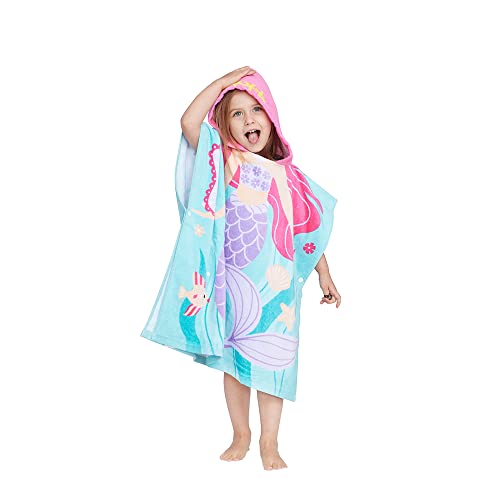
Gealaek Cotton Hooded Towel for Toddlers (Little Mermaid) — Best Cotton for Ages 2–6
Gealaek’s towel is the cotton counterpart to the toddler microfiber pick: its title states 100% cotton, ages 2 to 6, and use across bath, pool and beach in a poncho form, with a Little Mermaid design. For parents who simply prefer cotton against young skin — its softness after washing, its familiar thirsty feel — this is the pick that does not ask them to compromise on the pool brief to get it. The age range is stated and should be believed: this is a towel for the 2-to-6 window, generously useful inside it and honestly outgrown after it, at which point the larger Bavilk or snap-button cotton picks take over.
Strengths
- 100% cotton stated in the Amazon title, in a true poncho form
- Stated ages 2 to 6 — an honest, focused size range
- Design stated in the title, chosen by the child as much as the parent
Trade-offs
- Cotton’s slower drying between sessions
- Age ceiling of 6 years is real; not a buy-for-years pick
- No dimensions stated in the title beyond the age range
Key spec: 100% cotton; ages 2 to 6; hooded poncho (as stated in Amazon title; dimensions not stated)
There is a case for cotton that no microfiber specification answers: children who have grown up with cotton towels find microfiber’s glide strange, and a pool towel’s first job is to be accepted at the exact moment a cold child is least reasonable. The Gealaek pick respects that reality while still delivering the wearable hooded form that makes pool exits manageable. It is also the natural bath-to-pool crossover in this guide — the same towel works after an evening bath, which for the 2-to-6 age group is not a minor convenience but the difference between a product used daily and a product used weekly.
The Gealaek is the traditionalist’s toddler towel — cotton, honestly aged, prettily designed — and its bath-to-pool crossover means it will be used on ordinary evenings, not just swim days. In this category, frequency of use is the truest measure of value.
Best for: cotton-preferring families with children aged 2 to 6 / Not suited for: children older than the stated range, or twice-daily swim schedules
Check on Amazon — check price on Amazon for the current listing, options and availability.

MOKANI Kids Hooded Beach Towel (Pink Unicorn) — Best for Older Kids
Most hooded towels abandon children at age seven; the MOKANI pick exists for the years after. Its title states ages 6 to 14, a thick and absorbent microfiber build in a wearable poncho form, and a themed storage bag included, in a pink unicorn design. For an older child, the hood-and-poncho form stops being about warmth management by a parent and becomes about independence and modesty — a wearable towel is a changing room of one’s own at a busy pool or beach, and that is a genuinely different job that this pick is honestly specced for. The thick microfiber answers the usual microfiber criticism, that it feels thin, while keeping the quick-dry advantage for holiday and club-swimming routines.
Strengths
- Stated ages 6 to 14 — the widest older-child range in this guide
- Thick microfiber stated in the title, with a storage bag included
- Wearable form gives older children privacy while changing at busy venues
Trade-offs
- Pink unicorn design will not suit every older child
- Microfiber still dries the microfiber way — fast, but a different feel from cotton
- Too large and heavy-duty for toddlers; this is not the family one-size pick
Key spec: Microfiber, thick build; ages 6 to 14; storage bag included (as stated in Amazon title)
The 6-to-14 window is where pool kit quietly fails families: children are too big for toddler towels, too independent to be wrapped by a parent, and too self-conscious for an open change on a beach. A poncho towel sized and styled for that window, with its own storage bag for a club bag or holiday suitcase, solves a problem the rest of this guide’s picks are too small to touch. Judge it as a changing-and-drying system rather than a towel, and its place at the premium end of this shortlist makes sense.
The MOKANI serves the years the rest of the category ignores. If your child is eight, ten or twelve and still needs a wearable towel — for changing privacy as much as for drying — this is the pick specced for them, and the storage bag keeps it theirs.
Best for: children and young teens aged 6 to 14, club swimming and beach holidays / Not suited for: toddlers, or children who will reject the stated design
Check on Amazon — check price on Amazon for the current listing, options and availability.

Kids Hooded Beach Towel with Snap Buttons (Butterfly Garden) — Best Stay-On Design
This pick’s distinguishing fact is stated plainly in its title: two snap buttons. A hooded towel’s oldest failure is gravity — it slides off wet shoulders the moment a child moves — and a closure turns a draped towel into a worn one. Around that idea the title confirms the rest of the brief: 100% cotton, a large 50 x 30 inch size, ages 3 to 10, and use across pool, beach and bath, in a butterfly garden design. The age range is the widest among the cotton picks, and the length matches the largest poncho here, so this is the cotton choice for families buying once for the primary-school years. The snaps are also its only mechanism, and like all mechanisms they reward a child old enough to work them — the stated range starting at 3 is well judged.
Strengths
- Two snap buttons stated in the Amazon title — the wrap closes and stays on
- Large stated 50 x 30 inch size and wide ages 3 to 10 range
- 100% cotton with pool, beach and bath use all stated
Trade-offs
- Snaps need a child who can work them; very young toddlers are below the stated range
- Cotton drying time between sessions, as with all cotton picks
- A closure is one more thing to check after washing
Key spec: 100% cotton; 50 x 30 inches; ages 3 to 10; 2 snap buttons (as stated in Amazon title)
Think of the snap buttons as the difference between a towel a child wears and a towel a child carries. On a windy beach path or a cold pool concourse, the closed wrap keeps the fabric where the warmth is needed and frees the child’s hands entirely — for a parent carrying everything else, that is the whole game. Combined with the largest stated footprint among the cotton picks and the broadest cotton age range, this is the most considered design in the guide, and the pick to choose when the towel must serve siblings across several years of growth.
The snap-button towel is the engineer’s answer in a category of drapes and hopes. If your family’s pool exits involve wind, distance or a child who shrugs off every ordinary towel, the closure is the feature you have been missing.
Best for: ages 3 to 10, windy venues and families buying one cotton towel for years / Not suited for: toddlers under the stated range who cannot manage the snaps
Check on Amazon — check price on Amazon for the current listing, options and availability.
Comparison Table
| Pick | Badge | Key spec | Best for |
|---|---|---|---|
| Bavilk Kids Poncho Beach Towel with Hood — Check price | Best Overall | 100% cotton; 30 × 50 inches; hooded poncho wrap (as stated in Amazon title) | families wanting one generously sized cotton poncho for pool, swim and bath |
| growell Hooded Kids Beach Towel (Dinosaur Navy) — Check price | Best for Toddlers | Microfiber; 24×23; ages 1 to 6; quick dry, lightweight (as stated in Amazon title) | toddlers aged roughly 1 to 6, swim lessons and quick changes |
| Joiedomi Kids Beach Towel with Hood (Unicorn) — Check price | Best for Swim Lessons | Microfiber; 30 x 30 inches; ages 3 to 10; packs into backpack (as stated in Amazon title) | weekly swim lessons, school swimming and independent kit-carrying children |
| Gealaek Cotton Hooded Towel for Toddlers (Little Mermaid) — Check price | Best Cotton for Ages 2–6 | 100% cotton; ages 2 to 6; hooded poncho (as stated in Amazon title; dimensions not stated) | cotton-preferring families with children aged 2 to 6 |
| MOKANI Kids Hooded Beach Towel (Pink Unicorn) — Check price | Best for Older Kids | Microfiber, thick build; ages 6 to 14; storage bag included (as stated in Amazon title) | children and young teens aged 6 to 14, club swimming and beach holidays |
| Kids Hooded Beach Towel with Snap Buttons (Butterfly Garden) — Check price | Best Stay-On Design | 100% cotton; 50 x 30 inches; ages 3 to 10; 2 snap buttons (as stated in Amazon title) | ages 3 to 10, windy venues and families buying one cotton towel for years |
How to Choose the Best Kids Hooded Towels for Pool Use
Choose the fabric first, because it decides the towel’s whole rhythm. Cotton, stated on three of these picks, absorbs in the deep, familiar way and feels substantial and warm; it also holds water, dries slowly on the line and adds real weight to a swim bag. Microfiber, stated on the other three, is light, dries quickly between sessions and packs small; its absorbency works by wicking across a smooth surface, which feels different on skin and divides children sharply. Match the fabric to your routine: daily or twice-daily swimming rewards microfiber’s turnaround, while a weekly lesson followed by a proper wash-and-line-dry cycle suits cotton perfectly.
Size second, and buy for the child you will have in August, not the child you measured in May. The stated figures in this guide run from a toddler 24×23 up to full 30 × 50 and 50 x 30 inch wraps, and the stated age ranges run from 1–6 to 6–14. A poncho that reaches mid-shin on a small child still serves at the waist two years later; a poncho that starts at the waist is a cape by the second summer. When a title states both dimensions and ages, believe both; when it states only ages, as the Gealaek pick does, treat the range as the size and stay inside it.
Form third. A true poncho, worn over the head, cannot be dropped in a puddle and covers the back completely; a wrap with snap buttons, like the final pick, closes deliberately and stays closed in wind; a robe-style towel with its own bag, like the Joiedomi pick, optimises the journey rather than the drying. All three forms appear in this guide because families’ pool days differ — the walk, the venue and the child’s independence decide which form is best, and no form wins in the abstract.
Keeping Pool Towels Absorbent Season After Season
The single most common way families ruin a good pool towel is kindness: fabric softener and dryer sheets coat towel fibres with a water-repelling film, and a coated towel pushes water around instead of drinking it. Cotton towels lose their thirst gradually and microfiber loses its wicking the same way, so the rule covers every pick in this guide — wash towels without softener, and if a towel has already gone flat and smearing, a hot wash with a cup of white vinegar in the rinse helps strip the build-up and restore the fabric’s appetite.
Chlorine is the second slow enemy. Rinse or wash a pool towel promptly after heavy pool use rather than leaving it balled in a bag, where chlorine and damp conspire to fade designs and sour the fabric. Microfiber should be washed cool and dried away from high heat, which can damage its fine fibres; cotton tolerates warmer washes and needs them occasionally to stay fresh. Both fabrics dry best fully — a towel put away at ninety percent dry will smell like it by the weekend.
Finally, rotate if you swim often. Two mid-tier towels alternating sessions will outlast and outperform one premium towel used twice a day, because full drying between uses is what keeps any towel absorbent and fresh. The picks in this guide pair naturally for exactly that rotation: a cotton wrap for lesson day and a microfiber poncho for the day after, each resting while the other works.
Reading the Shortlist Side by Side
Specifications only become decisions when they are compared, so lay the six picks against the two or three facts that govern your situation before you buy: the constraint you cannot change, the feature you will use every single time, and the compromise you are genuinely willing to live with. In this category those facts are stated in the verified titles themselves, which is deliberate — every pick here earned its place from what its own listing confirms, not from adjectives gathered elsewhere.
It is also worth deciding what would make you return the purchase before it arrives: a size that turns out not to exist, a material that is not what the title led you to expect, a form that does not suit the room or routine it was bought for. Naming that test in advance turns a vague disappointment into a clear decision, and it is the habit that separates households whose purchases keep working for years from households whose cupboards fill with nearly-right versions of the same product.
One Towel, Three Jobs: Pool, Beach and Bath
Every title in this guide lists more than one setting, and that overlap is worth using deliberately. A hooded poncho that works at the pool works identically after a bath, and for younger children the bath use may outnumber the pool use ten to one across a year. That frequency changes the value calculation completely: a towel used nightly earns a better fabric and a better fit than a towel used on six pool days a summer, and it justifies keeping the child’s favourite design in daily rotation rather than saving it for outings.
The beach is the third job, and it argues slightly differently. Sand is the beach variable: it shakes out of smooth microfiber readily and clings to cotton terry until the wash, while wind is the other, and it rewards the closed forms — the poncho worn over the head and the snap-button wrap — over any towel that merely drapes. A family whose swimming is mostly beach swimming should weight those two points; a family whose swimming is a leisure-centre pool will never meet either problem and can choose on drying feel alone.
Whichever setting dominates your year, store the towel for that setting: by the bathroom door for the bath-led household, in the swim bag’s top pocket for the lesson-led one, with the beach kit for the coastal family. A hooded towel’s usefulness is decided less by its specifications than by whether it is physically present in the ninety seconds when a cold, wet child needs it — and presence is a storage decision, made once, that pays out every session.
How to Use a Hooded Towel for a Smooth Pool Exit
The hooded towel earns its price in about ninety seconds at the pool’s edge. This routine makes those seconds calm for toddlers and independent swimmers alike.
- Have the towel open and ready before the child leaves the water — a poncho found quickly is worn; a poncho dug out of a bag is refused.
- Lift the hood on first and settle it over wet hair, then arrange the body of the towel; a covered head ends most of the shivering and complaining at once.
- Close any fastenings the towel has — the snap-button pick in this guide exists for this moment — so the wrap stays on for the walk.
- Pat and press rather than rubbing, especially with microfiber, which absorbs best when it is held against the skin for a few seconds at a time.
- Let older children change under the poncho where the venue allows; the wearable form is a privacy screen as much as a towel.
- At home, shake the towel out, hang it fully open in moving air, and wash it before the next session if it has had a full pool day.
- Pack the towel dry and last, on top of the swim bag, so it is the first thing found at the next session’s exit.
Run that routine twice and it becomes the child’s own habit — hood up, wrap closed, walk — which is the real product every pick in this guide is selling: a pool exit that no longer needs managing.
Common Buying Mistakes
Buying the towel for this summer’s exact size. Children grow through a poncho’s coverage quickly. The stated age ranges and dimensions in the titles are there to be used — size up within them.
Washing with fabric softener. Softener coats fibres and kills absorbency in cotton and microfiber alike. It is the most common and most reversible mistake in towel care.
Choosing microfiber for a child who hates the feel. Fabric arguments lose to a child’s skin. If your child rejects microfiber’s glide, the cotton picks in this guide exist precisely for them.
Ignoring the older child’s needs. A 10-year-old in a toddler towel has no towel at all. The 6-to-14 pick in this guide covers the years most ranges abandon.
Leaving the wet towel in the bag. Chlorine, damp and darkness sour a towel within days. Shake it out and hang it open as soon as you are home, every time.
Final Recommendation
Buy the Bavilk cotton poncho if you want one towel that covers the most childhood generously, and the snap-button cotton wrap if your pool exits are windy or your child shrugs off every draped towel. For toddlers, choose between the growell microfiber poncho for lesson-day lightness and the Gealaek cotton poncho for traditional feel; for the lesson routine itself, the Joiedomi’s own backpack makes it the system pick. And for the child everyone else’s ranges forgot, the MOKANI covers ages 6 to 14 with the privacy a wearable towel gives.
Every one of the six was verified the same way — title matched before a link was earned — so whichever you choose, choose it by the stated fabric, the stated size and your family’s actual routine. Those three facts, all printed in the listings themselves, are what separate a towel that serves for years from a towel that serves for a month.
Keep exploring the shortlist: Best Kids Hooded Towels Best Hooded Towels For Babies Best Towels For Kids Best Organic Cotton Towels For Kids With Hood Best Infant Towels Best High Quality Beach Towels
Designs, Siblings and the Hand-Me-Down Question
It is easy to treat the character designs in these titles — the unicorn, the dinosaur, the mermaid, the butterflies — as decoration, but at the pool they function as equipment. A young child wears the towel they chose with a completeness that no parental instruction achieves, and an older child keeps ownership of a designed towel in a way that a plain family towel never survives at a busy venue, where three identical white towels on three adjacent loungers are a mix-up waiting to happen. When two siblings swim together, different designs are also the simplest labelling system ever devised: no names to write, no tags to check, just the dinosaur towel and the unicorn towel, sorted by their owners at a glance.
The hand-me-down question runs the other way. A generously sized cotton poncho, like the large picks in this guide, is one of the few children’s products that genuinely passes down: the fabric improves with washing for a long while, the size range spans siblings, and a design chosen neutrally enough survives the transfer. Microfiber towels hand down well too, provided their care rules have been kept — a microfiber towel raised on fabric softener hands down its ruined absorbency along with its size. If a second child is likely, that is one more argument for buying toward the top of a stated size range and keeping the care routine clean from the first wash.
There is also a spare-towel logic worth stating plainly. Pools are wet places and towels get dropped in them, forgotten at them and occasionally taken home by the wrong family at them. A household that swims weekly does well to own the main towel and a plainer understudy, so that a loss is an annoyance rather than the end of the routine while a replacement ships. The understudy need not match the star’s fabric or design; it needs to be present, sized and dry — the same three virtues this entire guide has been arguing for, in their humblest form.
A closing word on value in this category: a hooded pool towel is used in short, intense bursts — ninety seconds at the water’s edge, ten minutes on the walk, an hour on a lounger — and judged entirely in those bursts. The specifications that decide it are the ones this guide has kept returning to: a fabric your child accepts, a size that still covers them next summer, and a form that stays on without being held. Everything else about a towel is laundry. Choose on those three, keep softener away from it, and the towel will still be doing its ninety seconds perfectly when the child has grown two shoe sizes.
Frequently Asked Questions
Which is better for pool use, cotton or microfiber?
Neither in the abstract. Cotton absorbs deeply and feels warm and substantial but dries slowly and weighs more; microfiber is light, packs small and dries fast between sessions but feels different on skin. Daily swimmers lean microfiber; weekly-lesson families are usually happiest with cotton.
What size hooded towel should I buy?
Use the stated dimensions and age ranges in the listings: this guide’s picks run from a 24×23 toddler poncho for ages 1 to 6 up to 30 × 50 and 50 x 30 inch wraps and a 6-to-14 range. Buy toward the top of your child’s range — a poncho should drape past the waist to do its warming job.
Why does my child’s towel stop absorbing water?
Almost always fabric softener or dryer-sheet build-up coating the fibres. Wash without softener; a hot wash with white vinegar in the rinse helps strip existing build-up and restore absorbency.
Are hooded towels only for toddlers?
No — the MOKANI pick in this guide is stated for ages 6 to 14, where the wearable form doubles as a changing cover at busy pools and beaches. The toddler ranges are simply the most common, which is why older sizes take finding.
How many pool towels does a child need?
One is workable with prompt washing and full drying; two in rotation is better for frequent swimming, because a towel that dries completely between uses stays absorbent and fresh far longer.
Can these towels be used at the beach and bath too?
Yes — every title in this guide states pool alongside beach, swim or bath use. The same fabric and size logic applies; only the sand, which shakes out of microfiber more easily, argues differently at the beach.


