Disclosure: airfryerkitchensupply.com is reader-supported. When you buy through links on our site, we may earn an affiliate commission at no extra cost to you.
Where to buy
Every blanket below is sold through Amazon, where you can check the current price on Amazon and confirm the size and colorway on the listing — cotton blanket lines often share a listing across twin, queen and king, and the hypoallergenic routine described in this guide depends on buying the size that fits your bed and your washing machine.
- Bedsure PureWoven 100% GOTS Certified Organic Cotton Blanket, Queen — Check on Amazon
- Bedsure 100% Cotton Waffle Weave Blanket, Queen, White — Check on Amazon
- Utopia Bedding 100% Cotton Thermal Blanket, Queen, Smoke Gray — Check on Amazon
- Lane Linen 100% Cotton Blanket, Queen, 350 GSM — Check on Amazon
- Threadmill Luxury 100% Cotton Herringbone Blanket, Queen — Check on Amazon
- Bedsure 100% Cotton Herringbone Blanket, King — Check on Amazon
Introduction
The best hypoallergenic blankets cotton weavers make earn that description through a simple, honest mechanism, and this guide will state it plainly rather than hide behind the label. Cotton is a smooth, natural fiber that does not shed the clouds of micro-lint that synthetic fleece releases, does not build the static that attracts dust to synthetic blankets, and — the decisive point — tolerates the hot, frequent washing that is the actual foundation of allergen control in bedding. Dust mites and their debris, pet dander, and pollen are managed in a bedroom primarily by laundering them away on a schedule; a blanket that can be washed hot every week or two, and dried fully, is a hypoallergenic system. A blanket that cannot be washed is a storage unit for everything you are trying to avoid, whatever its label says.
So this guide’s picks are all 100% cotton — no blends sneaking polyester into the weave — in the constructions that serve sensitive sleepers best: waffle weaves whose texture traps warmth without weight and releases soil in the wash, herringbone weaves with a smooth, low-lint face, and thermal weaves built for layering. Several carry certifications that matter in this context: GOTS-certified organic cotton on our Best Overall pick, and OEKO-TEX certification on the Threadmill — third-party verification about what is (and is not) in the textile, which is the part of “hypoallergenic” a buyer can actually check.
One boundary, stated once and meant: no blanket treats allergies or asthma, and we claim nothing medical for any pick here. What these blankets do — verifiably — is minimize fiber shed, avoid synthetic static and lint, and survive the hot-wash routine that allergen-aware households run. Paired with washable bedding discipline, that is a real and meaningful contribution to a cleaner sleep environment, and it is exactly as much as any honest blanket guide should promise.
In this guide
Quick Picks
- Best Overall: Bedsure PureWoven Organic Cotton Blanket, Queen — GOTS-certified organic cotton, 400 GSM, waffle and herringbone texture, all-season weight. Check the current price on Amazon
- Best Waffle Weave: Bedsure 100% Cotton Waffle Weave Blanket, Queen, White — the classic breathable waffle in pure cotton, 90 x 90 inches. Check the current price on Amazon
- Best Budget Thermal: Utopia Bedding 100% Cotton Thermal Blanket, Queen, Smoke Gray — lightweight, breathable, endlessly washable layering value. Check the current price on Amazon
- Best Medium Weight: Lane Linen 100% Cotton Blanket, Queen — 350 GSM medium-weight all-season layer in a soft light blue. Check the current price on Amazon
- Best Premium: Threadmill Luxury 100% Cotton Herringbone Blanket, Queen — OEKO-TEX certified, moisture-wicking thermal weave, bright white. Check the current price on Amazon
- Best for King Beds: Bedsure 100% Cotton Herringbone Blanket, King — 108 x 90 inches of breathable pure cotton for the big bed. Check the current price on Amazon
How These Picks Were Chosen
The first gate was fiber purity, verified against Amazon listing data: 100% cotton, full stop. Blends were excluded not because polyester is wicked but because this search makes a specific promise — a smooth natural fiber, minimal lint, hot-wash tolerance — and blends dilute every part of it. The second gate was washability in practice: constructions and sizes a home machine can actually launder and dry fully, because a king blanket that only fits a commercial washer fails the hypoallergenic routine in most homes. The third gate was weave suitability: waffle, herringbone and thermal weaves that balance warmth with breathability and release soil well, over lofty constructions that trap debris in depth.
Certifications were weighed where listings state them. GOTS certification verifies organic fiber and chain-of-custody standards; OEKO-TEX certification verifies the finished textile has been tested for harmful substances. Neither certifies that a blanket will improve anyone’s symptoms — no such certification exists — but both verify the “what is in this fabric” question that sensitive buyers are really asking. Finally, we balanced the list across weights and sizes: a lightweight thermal for hot sleepers and summer layering, medium weights for all-season single-blanket use, and a true king size, because allergen routines fail quietly when the blanket does not fit the bed.
The 6 Best Hypoallergenic Cotton Blankets

Bedsure PureWoven 100% GOTS Certified Organic Cotton Blanket, Queen — Best Overall
The PureWoven leads this guide because it stacks every credential the category can honestly offer. The listing specifies 100% GOTS-certified organic cotton — the strongest mainstream verification that the fiber is what it claims to be — at 400 GSM, a genuinely substantial all-season weight, in a combined waffle and herringbone texture, queen size, in a tan beige that suits the calm bedrooms sensitive sleepers tend to keep. The texture pairing is functional, not decorative: waffle pockets hold warmth without sealing in heat, herringbone gives a smooth face that sheds less and washes clean.
At 400 GSM this is a real blanket rather than a token layer — the one-blanket answer for most of the year in most homes, supplemented by a duvet in deep winter rather than replaced by one. For the allergen-aware routine, its virtues compound: pure organic cotton tolerates the hot wash, the weave releases what it catches, and the weight dries fully in a home dryer without the damp-core problem of loftier bedding. If a household is rebuilding its bedding around washability and verified fiber, this is the cornerstone piece we would buy first.
Strengths
- GOTS-certified organic cotton — the fiber claim is third-party verified
- 400 GSM all-season substance with a breathable waffle-herringbone texture
- Pure cotton tolerates the hot, frequent washing allergen control requires
Trade-offs
- Premium tier within this list, reflecting the certified fiber
- 400 GSM is too warm as a summer-only blanket for hot sleepers
- Natural beige palette is calm rather than colorful
Best for: sensitive sleepers rebuilding bedding around verified organic cotton and washability. Not suited for: hot sleepers wanting the lightest possible summer layer. Check the current price on Amazon

Bedsure 100% Cotton Waffle Weave Blanket, Queen, White — Best Waffle Weave
The waffle weave is the classic hypoallergenic-friendly construction, and this Bedsure is its benchmark expression: 100% cotton in a waffle weave, queen size at 90 x 90 inches, in white — the color that tells the truth about cleanliness and tolerates the hottest washes without fading. The waffle’s grid of pockets is the mechanism: it traps still air for warmth while the raised threads keep most of the blanket off the skin, so the sleeper gets insulation without the sealed, sweaty microclimate that smooth heavy blankets create. For warm sleepers with sensitive skin, that breathability is often the difference between using a blanket and kicking it off by 2 a.m.
White cotton also runs the most honest laundry life: it can be washed hot, treated for stains without color anxiety, and inspected at a glance — you can see whether your routine is keeping it clean, which in an allergen-managed bedroom is information, not vanity. As a layering piece it pairs with everything; as a sole blanket it suits spring through autumn and heated winter bedrooms. It is the pick we would hand a first-time cotton-blanket buyer who asked for one recommendation and no homework.
Strengths
- Waffle weave breathes while it warms — ideal for warm, sensitive sleepers
- White pure cotton tolerates hot washes and shows its cleanliness honestly
- 90 x 90 in queen sizing drapes properly for tucking or layering
Trade-offs
- White shows every mark between washes — the routine must be real
- Waffle texture can snag on rough jewelry or pet claws
- Light for deep-winter sole use in cold bedrooms
Best for: warm sleepers, layering systems, and households that wash hot and often. Not suited for: anyone wanting a single heavy winter blanket or a color that hides a relaxed laundry schedule. Check the current price on Amazon
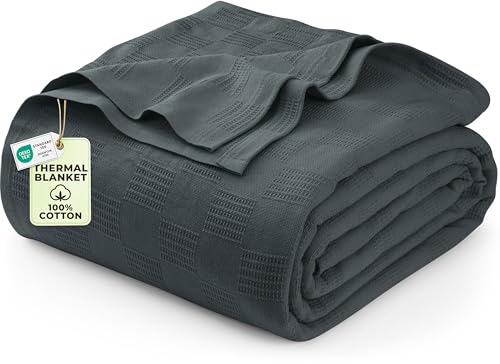
Utopia Bedding 100% Cotton Thermal Blanket, Queen, Smoke Gray — Best Budget Thermal
Utopia Bedding’s thermal blanket is the value engine of this category: 100% cotton in a thermal weave, queen at 90 x 90 inches, in smoke gray, positioned as a lightweight all-season throw for bed, couch and sofa. Thermal weave — a loose, breathable construction — is the summer and layering specialist: on its own it takes the chill off air-conditioned bedrooms and spring nights; under a duvet in winter it adds a washable cotton interface between the sleeper and the harder-to-wash layers above. That interface role is a genuine hypoallergenic strategy — the blanket becomes the frequently washed sacrificial layer that keeps the duvet cleaner longer.
The budget tier buys honesty about expectations: this is a lighter, simpler blanket than the 400 GSM PureWoven, and its drape and finish read practical rather than luxurious. Smoke gray is a considered color choice for real life — it hides the interval between washes better than white while staying calm in the bedroom. For households outfitting several beds — kids’ rooms, a guest bed, the cottage — the Utopia is how the all-cotton, wash-hot routine becomes affordable at scale, and a routine that covers every bed beats a premium blanket on one bed and synthetics on the rest.
Strengths
- Pure cotton thermal weave at a genuinely accessible tier
- Perfect sacrificial layer: washes hot and often, protects the duvet
- Smoke gray forgives real-life intervals between washes
Trade-offs
- Lightweight — a layer, not a winter blanket on its own
- Simpler finish than the premium picks
- Thermal weave’s openness catches more ambient dust between washes than smooth herringbone
Best for: multi-bed households, summer use, and layering systems on a budget. Not suited for: buyers wanting one substantial blanket for all seasons. Check the current price on Amazon

Lane Linen 100% Cotton Blanket, Queen, 350 GSM — Best Medium Weight
Lane Linen’s queen blanket occupies the middle of this guide’s weight range with intent: 100% cotton at 350 GSM, described as a medium-weight, warm and soft all-season layer, in light blue. Medium weight is the most underrated specification in bedding — heavy enough to feel like a blanket rather than a sheet’s ambition, light enough to wash and dry without drama and to sleep under in three seasons out of four. For the allergen routine, 350 GSM is a sweet spot: substantial cotton that a home dryer can still bring to fully dry, every time, which matters because a blanket stored even slightly damp undoes the point of washing it.
The all-season layering positioning in the listing is accurate to how this blanket will actually live: alone over a sheet in spring and autumn, over a duvet or under one in winter depending on your bedroom’s temperature, and across the foot of the bed in summer for the sleeper who wants weight without coverage. Its light blue colorway adds a gentle option to a list dominated by neutrals — a reminder that hypoallergenic discipline does not require a beige bedroom.
Strengths
- 350 GSM medium weight — the all-season, easy-laundry sweet spot
- Pure cotton that dries fully in a home dryer, every wash
- A soft color option in a category of neutrals
Trade-offs
- Medium weight still wants a partner layer in cold-winter bedrooms
- Light colors ask for the regular washing the routine prescribes anyway
- Less textured interest than the waffle and herringbone weaves
Best for: all-season single-blanket shoppers who wash weekly and dry at home. Not suited for: deep-winter sole use in unheated rooms. Check the current price on Amazon

Threadmill Luxury 100% Cotton Herringbone Blanket, Queen — Best Premium
The Threadmill is the connoisseur’s pick: 100% cotton in a herringbone thermal weave, queen at 90 x 92 inches, bright white, OEKO-TEX certified and described as soft, breathable and moisture-wicking. The certification is the headline for this audience — OEKO-TEX testing verifies the finished textile against harmful-substance standards, which addresses the “what is in this fabric” question with a laboratory rather than a slogan. Herringbone is the connoisseur’s weave for the same reason it appears on the PureWoven: a smooth, dense face that sheds little, drapes elegantly, and presents a clean surface to the wash.
Moisture-wicking in cotton means the weave moves perspiration away from the skin surface and releases it — relevant to sensitive sleepers because a dry sleep surface is both more comfortable and less hospitable to the warm, damp microclimate that dust mites prefer. The bright white finish completes the premium-hospitality effect and, like the Bedsure waffle, runs an honest hot-wash life. The premium here buys fiber quality, weave fineness and certification; buyers who do not value those will find the same fiber honesty in the Utopia at a friendlier tier, and this guide respects both calculations.
Strengths
- OEKO-TEX certified — harmful-substance testing on the finished textile
- Herringbone weave: smooth, low-shed, elegant drape
- Moisture-moving thermal construction for a drier sleep surface
Trade-offs
- Premium tier for refinements some buyers will not feel
- Bright white demands the washing discipline it enables
- Thermal weight is a layering weight, not deep-winter armor
Best for: buyers who value certified textiles and fine weave quality. Not suited for: budget-first multi-bed outfitting. Check the current price on Amazon

Bedsure 100% Cotton Herringbone Blanket, King — Best for King Beds
King beds break hypoallergenic routines quietly: the blanket that fits them is big, and big blankets tempt households to wash less often because the load is a production. This Bedsure herringbone in king — 108 x 90 inches, pure cotton, breathable and lightweight for its class — is the pick that keeps the routine feasible at king scale. The herringbone weave keeps the large surface smooth and low-shedding, the weight stays manageable for a home machine (check your washer’s capacity honestly; a king blanket in a small top-loader is a wadded, half-washed blanket), and the coverage drapes a king bed with proper overhang instead of the skimpy span that leaves one partner blanket-poor by morning.
It shares its family virtues with the queen waffle pick — Bedsure’s cotton blankets wash and wear predictably — translated to the size where those virtues are hardest to find in pure cotton. If your machine cannot take it, the correct move is two queen blankets used as his-and-hers layers — a legitimate European habit that also ends the midnight tug-of-war — rather than a king blanket washed rarely. Frequency beats size in this category, every time.
Strengths
- True king coverage, 108 x 90 in, in pure breathable cotton
- Herringbone face stays smooth and low-shed across a large surface
- Light enough for its size to keep home washing realistic
Trade-offs
- Needs a genuinely large-capacity washer to wash properly
- King loads dry slowly; full dryness must be verified, not assumed
- One big blanket means one big laundry commitment per cycle
Best for: king beds in homes with large-capacity laundry. Not suited for: small washers — choose two queens instead. Check the current price on Amazon
Comparison Table
| Pick | Badge | Key spec | Best for |
|---|---|---|---|
| Bedsure PureWoven Organic | Best Overall | GOTS organic cotton, 400 GSM, queen | Verified fiber, all-season |
| Bedsure Waffle Weave | Best Waffle | 100% cotton waffle, 90 x 90 in, white | Warm sleepers, layering |
| Utopia Thermal | Best Budget | 100% cotton thermal, queen, smoke gray | Multi-bed value, summer layer |
| Lane Linen | Best Medium Weight | 100% cotton, 350 GSM, queen | All-season single blanket |
| Threadmill Herringbone | Best Premium | OEKO-TEX cotton herringbone, 90 x 92 in | Certified textile quality |
| Bedsure Herringbone King | Best for King | 100% cotton herringbone, 108 x 90 in | King beds, big laundry |
How to Choose a Hypoallergenic Cotton Blanket
Verify the fiber, then ignore the adjective. “Hypoallergenic” on bedding is an unregulated comfort claim; “100% cotton” is a checkable fact. Your selection process should run: pure cotton (or certified organic cotton), a weave that breathes, a size your washer can truly handle, and a weight matched to your seasons. The adjective takes care of itself once those four are right, because the hypoallergenic effect lives in the fiber behavior plus your laundry routine — not in the word on the package.
Match the weave to your sleep temperature. Waffle for warm sleepers and summer: maximum breathability, warmth from trapped air rather than mass. Herringbone for the smooth-face, low-shed, elegant middle: all-season layering with the least lint behavior of any weave here. Thermal for the lightest layer and the sacrificial duvet-protector role. If you sleep cold, weight (GSM) matters more than weave: the 400 GSM PureWoven and 350 GSM Lane Linen are the substantial picks, and both still breathe as only cotton does.
Size for the bed and the machine, in that order — then re-check the machine. A queen blanket should span roughly 90 inches to drape and tuck; a king needs its 108. But the binding constraint in this category is laundry capacity: an allergen routine that requires a laundromat trip will quietly stop happening. If your washer is modest, choose the queen sizes, or run the two-blanket king strategy, and keep the weekly-to-fortnightly wash a home event.
Treat certifications as information, not magic. GOTS tells you the cotton is organic through a verified chain; OEKO-TEX tells you the finished cloth was tested for harmful substances. Both answer real questions sensitive buyers ask. Neither promises symptom relief, and a blanket flaunting certification while blending synthetic fiber would fail this guide’s first gate regardless — fiber first, certificates as confirmation.
How to Run the Wash Routine That Makes Cotton Blankets Work
The routine is the product, so here it is as a practice rather than a principle. Wash the blanket every one to two weeks in the hottest water the care label allows — cotton’s tolerance for hot water is its superpower in this category — with a measured dose of detergent and an extra rinse if your machine offers one, because residue left in the weave is residue in the bed. Skip fabric softener for the same reason as with towels: it coats fibers, reduces absorbency and breathability, and gives dust something to cling to. Dry completely — completely means the thickest folded seam gives up no cool dampness to your hand — because a blanket put away at 95% dry is a mildew invitation, and mildew is an allergen source no fiber choice can outrun.
Around the blanket, the routine extends: pillow protectors and sheets on the same wash rhythm, the duvet cover washed with the blanket load when sizes allow, and the mattress surface vacuumed when the bed is stripped. None of this requires special equipment — it requires a calendar. Households that put “bedding wash” on a recurring day report that the routine costs less effort than the ad-hoc alternative, because it never becomes a crisis clean. Start the rhythm the day the blanket arrives, with a first wash before first use to clear spinning residues and open the fibers — cotton blankets, like cotton towels, perform better from the second wash onward.
Common Buying Mistakes
- Trusting the word “hypoallergenic” without checking the fiber. Blends and synthetics wear the adjective too. Read the fiber content; it is the only part that behaves.
- Buying a blanket too big to wash at home. An unwashed king blanket is worse than a washed queen. Laundry capacity is a sizing specification.
- Using fabric softener. It coats the cotton, dulls breathability and gives particles a grip. Skip it on all bedding in an allergen-aware home.
- Storing the blanket slightly damp. “Mostly dry” is where mildew starts. Verify the seams, extend the dryer, or air it before folding.
- Expecting the blanket to do the whole job. Sheets, pillow protectors and the mattress surface are part of the system. The blanket is the most-washed layer, not the only one.
- Choosing loft over washability. Deep, lofty constructions trap debris in their depth and dry slowly. Smooth and waffle weaves win this category on behavior, not looks.
Final Recommendation
Build the bed around the Bedsure PureWoven if verified organic fiber leads your priorities — check the current price on Amazon — or around the Bedsure waffle in white if breathability and hot-wash honesty lead. Outfit multiple beds with the Utopia thermal, take the Lane Linen for the all-season middle weight, indulge in the Threadmill’s certified herringbone where one fine blanket is the goal, and size up to the Bedsure king only if your laundry can keep its promise. Then run the routine: hot, often, fully dry. The blanket is half the system; the calendar is the other half.
Related bedding reading: Best Jersey Cotton Blankets, Best Natural Blankets, Best Light Weight Blankets, Best Medium Weight Blankets King.
Cotton vs the Alternatives, for Sensitive Sleepers
It clarifies the choice to see why the usual alternatives were excluded. Polyester fleece and microfiber blankets are warm and cheap, but they shed micro-lint, build static that attracts airborne dust to the sleep surface, and their makers often caution against the hot washing that allergen routines require — a poor trio for this search. Wool is a genuinely fine natural fiber with its own lanolin-based dust resistance, but it cannot be hot-washed at home without felting risk, it carries its own sensitivity issues for some sleepers, and it fails the laundry test that defines this guide. Down and down-alternative fills trap debris within a lofty structure that is hard to wash and slow to dry completely; quality encasements mitigate this, but the blanket-as-washable-layer strategy works against fill construction. Cotton wins this specific brief not by being the warmest or softest fiber in bedding, but by being the one whose entire behavior — smooth surface, low shed, no static, hot-wash endurance, fast complete drying — aligns with how allergens in bedding are actually controlled. Choose it for the system it enables, and it will not disappoint you.
The Allergen-Aware Bedroom: The Blanket’s Place in the System
No single textile controls a bedroom’s allergen load, and the households that succeed treat the bed as a system with the blanket as its most-serviced component. The mattress is the reservoir: years of skin cells and mite habitat accumulate in a surface you cannot wash, which is why encasement covers exist and why vacuuming the bare mattress at each bedding change is worthwhile. Pillows are the second reservoir and the closest to the sleeper’s face; washable pillows or protector covers washed with the blanket load close that gap. Sheets are the high-frequency layer, washed with the blanket or more often. The blanket’s role in this system is to be the warm layer that never becomes a reservoir — the layer whose hot-wash tolerance resets it completely on schedule, so that at least one major surface in the bed is always recently cleaned.
Beyond the bed, two habits multiply the blanket’s contribution. Floors: hard bedroom floors with a washable rug beat wall-to-wall carpet for particle control, because every surface that can be fully cleaned is a surface that stops storing the problem. Air and humidity: dust mites thrive in warm humidity, so a bedroom kept at moderate humidity and ventilated when weather allows is working with your laundry, not against it. None of this is medical advice — it is housekeeping physics, and it is the context in which a pure cotton blanket’s virtues actually cash out. Buy the blanket as the system’s workhorse, keep the calendar, and the bedroom’s background load falls by the accumulation of unglamorous, repeatable wins.
Weights and Weaves by Season and Climate
Hot climates and summer sleepers. The Utopia thermal is your blanket: an open, breathable cotton layer that takes the edge off air conditioning without sealing heat in. Some hot sleepers run it as a sheet-topper rather than a cover, gaining the slight weight many people need to settle without any insulation penalty. Wash frequency can rise in summer — sweat is a soil load too — and the thermal’s light construction dries fast enough to keep up.
Temperate, three-season homes. The Lane Linen at 350 GSM and the Bedsure waffle define this band. Either serves alone from spring through autumn in a heated home; the waffle breathes better for warm sleepers, the Lane Linen drapes warmer for cool ones. This is also the band where a single-blanket strategy is most realistic, and where the weekly wash rhythm is easiest to sustain.
Cold winters. Cotton becomes the system’s inner layer rather than its insulation: the PureWoven at 400 GSM under a duvet, or the Threadmill herringbone between sheet and duvet, keeps a washable, smooth, low-shed surface against the sleeper while the duvet does the thermal heavy lifting. The mistake to avoid is buying an un-washable heavy blanket for winter and letting it become the bed’s one unwashed layer for five months — winter is when beds are closed up longest and the routine matters most.
Guest beds and kids’ beds. The Utopia’s tier and the Bedsure waffle’s white honesty serve these beds best: washable after every guest, durable under children’s harder laundry life, and inexpensive enough to hold in duplicate so a stripped bed is never waiting on the dryer. In allergen-aware homes, the guest bed’s blanket often decides whether a sensitive visitor sleeps well — treat it with the same routine as your own.
Troubleshooting Cotton Blankets: Lint, Shrinkage and Fading
Early lint. A new cotton blanket releases surface lint in its first washes — loose fibers from weaving working free. This is normal, temporary, and distinct from the continuous shedding of synthetic fleece: wash the blanket separately for its first two or three cycles, clean the dryer’s lint trap mid-cycle on the first dry, and judge the blanket’s true shed behavior from week three. A cotton blanket still shedding heavily after a month of weekly washing is a quality problem worth a return; one that settles is behaving exactly as cotton should.
Shrinkage. Cotton shrinks, most of it in the first hot wash and dry. Quality blankets are cut with an allowance, but the honest expectation is a few percent — noticeable on a tuck-in, irrelevant on a drape. The control lever is drying heat: tumble drying hot maximizes shrinkage, while medium heat and removing the blanket promptly gets you dryness with less contraction. For this category, we favor accepting modest shrinkage as the price of the hot-wash routine; the blanket’s job is cleanliness and coverage, and a 90-inch blanket at 87 inches still does both. If exact dimensions are critical to your bed-making, wash before you commit to the pairing, not after a season of assumptions.
Fading and graying. Colored cottons fade gradually under hot washing — smoke gray and beige forgive this longest, which is part of their popularity in this guide — while whites gray when washed with colored loads or under-dosed detergent leaves soil redeposited in the weave. Wash whites as whites, dose detergent for the soil load rather than by habit, and the occasional oxygen-based brightener (used per its own directions) restores the truth-telling brightness that makes white cotton so satisfying in an allergen-aware bedroom. None of these issues touches the blanket’s hypoallergenic behavior; they are cosmetics, and in this category cosmetics rank a respectful second to the wash routine that actually matters.
Cotton Blankets in Homes With Pets
Pet households run the strictest version of this category’s logic, because dander management is a daily reality rather than a seasonal concern. Cotton’s case strengthens here: pet hair releases from smooth cotton weaves far more readily than from fleece, where it weaves itself in; a shake outside and the wash resets the blanket completely; and cotton tolerates the increased wash frequency that a bed-sharing dog or cat imposes without wearing out at fleece speed. Two adjustments serve pet homes specifically. First, choose the smoother weaves — herringbone over waffle — if your pet sleeps on the blanket, because claws catch waffle grids and hair lodges in the pockets; the Threadmill and the king Bedsure herringbone are the pet-practical faces in this list. Second, consider the sacrificial-layer strategy at full strength: a Utopia thermal over your good blanket, washed twice as often, keeps pet load off the primary bedding and stretches every other layer’s service life. The Bedsure listings themselves note their cotton blankets are “not pet-friendly” in the sense of pet-proof — claws and chewing defeat any textile — so set the expectation correctly: cotton is not armor, it is simply the easiest fine fiber to keep genuinely clean in a house with animals, which is the quality this search is actually about.
Reading a Cotton Blanket Listing Like a Textile Buyer
Since this category’s marketing leans on adjectives, a short course in reading listings pays for itself. Fiber content first, and it should be a number: “100% cotton” is a claim you can hold a seller to, while “cotton-rich” and “natural blend” are invitations to guess. GSM second, when given: it is the blanket’s weight class, and a listing that publishes it — as the PureWoven’s 400 and the Lane Linen’s 350 do — is a listing confident in its substance. Weave third: waffle, herringbone and thermal describe real structures with real behavior; “luxury weave” describes nothing. Certifications fourth, and only the real ones — GOTS and OEKO-TEX have registries and standards behind them, while invented badges with laurel wreaths certify the designer’s clip art. Dimensions last, checked against both your bed and your washer. A listing that survives those five questions has earned your trust on the sixth, which is how the blanket will actually feel — and in this guide’s picks, each of which passed that reading against verified listing data, feel is the one thing we are content to let the blanket itself report when it arrives.
For Hot Sleepers: Sleeping Cool on Cotton
A large share of this search’s searchers are not managing a diagnosis at all — they are hot sleepers who have learned that synthetic blankets make them sweat, and that a sweaty sleep surface is its own kind of sensitivity. Cotton’s answer is breathability plus moisture handling: the fiber absorbs perspiration into itself rather than letting it pool on the skin, and open weaves — waffle and thermal above all — let air keep moving across the body through the night. The practical cool-sleep configuration from this list is the Utopia thermal or the Bedsure waffle over a cotton sheet, with the medium weights reserved for the months when the bedroom itself turns cold. If you wake hot under cotton too, the remaining levers are the room, the mattress’s own heat behavior and your sheet fiber — the blanket will have done its part. It is one more reason this guide insists on pure cotton and honest weaves: for the hot sleeper, as for the allergen-aware household, the fiber’s behavior is the feature, and everything else is styling.
Frequently Asked Questions
Does a cotton blanket really help with dust mite allergies?
A blanket cannot treat an allergy, and we make no medical claim for these picks. What pure cotton does is support the control routine allergen-aware households use: it sheds little fiber, builds no static, and survives the hot, frequent washing that removes mite debris and dander from bedding. The benefit lives in that routine — the blanket is the layer that makes the routine easy to keep.
How hot should I wash a cotton blanket?
As hot as the care label allows — cotton tolerates hot water better than any common blanket fiber, which is central to its role here. Check the label on your specific blanket, wash with a measured detergent dose, and dry the blanket completely before it returns to the bed.
Waffle or herringbone — which is better for sensitive skin?
Both are smooth, low-shed cotton weaves. Waffle breathes more and suits warm sleepers; herringbone presents the smoothest continuous face and drapes more elegantly. Sensitive skin responds more to cleanliness and full rinsing than to the difference between these two weaves, so choose by your sleep temperature.
What does GOTS or OEKO-TEX certification actually guarantee?
GOTS verifies organic fiber production and processing through a certified chain of custody. OEKO-TEX verifies the finished textile has been tested for harmful substances. Both verify what is in the blanket; neither certifies symptom relief, and any brand implying otherwise is overselling a real but narrower credential.
Can I use a cotton blanket year-round?
Yes, with weight selection and layering. A 350-400 GSM cotton blanket serves most sleepers through spring, summer in air conditioning, and autumn alone; winter adds a duvet over or under it. Lightweight thermals serve as the summer layer. Cotton’s breathability makes it more year-round-capable than synthetics of equal weight.
How often should an allergen-aware household wash its blanket?
Every one to two weeks is the working rhythm most such households sustain, with sheets at least as often and pillow protectors on the same cycle. The right interval is the shortest one you will actually keep: a weekly wash that happens beats a perfect schedule abandoned by March. Cotton’s tolerance for that frequency — without pilling apart or losing its shape — is precisely why it anchors this category.
Is organic cotton worth it for a hypoallergenic blanket?
Organic certification verifies how the fiber was grown and processed, which matters to buyers avoiding pesticide residues and preferring verified supply chains — the GOTS PureWoven is the pick for them. For allergen behavior in the bedroom, conventional pure cotton performs essentially the same once washed, since the active mechanism is the wash routine itself. Buy organic for the verified provenance; buy conventional pure cotton without guilt for the routine.
Can I dry a cotton blanket in the dryer every time?
Yes — cotton is the dryer-friendly fiber in bedding, and for this category complete machine drying is a feature, not a risk, because it guarantees the full dryness the allergen routine requires. Use medium heat to balance dryness against shrinkage and fading, clean the lint trap (cotton’s early lint is real), and check the thickest seams before folding. Line drying works too in dry weather, with the caveat that outdoor drying during high-pollen days loads the blanket with the very particles you washed out — during pollen season, the dryer is the hypoallergenic choice.
Should I keep a spare cotton blanket?
Yes — a spare is what makes the wash routine survivable on laundry’s bad weeks, because the bed never has to choose between a dirty blanket and no blanket. The spare need not match the primary’s tier: many households run a premium primary and a Utopia-class spare, rotating the spare in on wash day and travel weeks. Store the spare fully dry, loosely folded, where air can reach it; a spare stored damp is a spare in name only.
Why does my cotton blanket feel less soft than a fleece one?
Fleece’s plushness comes from raised synthetic fibers — the same structure that sheds lint and holds static. Cotton’s hand is smoother and cooler, and it improves with washing as the fibers relax. Most sensitive sleepers come to prefer cotton’s clean, dry feel; if you want more softness within cotton, the waffle weaves and the PureWoven’s texture come closest.


