Disclosure: airfryerkitchensupply.com is reader-supported. When you buy through links on our site, we may earn an affiliate commission at no extra cost to you.
Where to buy
Every slipper below is sold through Amazon, where you can check the current price on Amazon and — most importantly for this category — confirm that the specific size you are ordering is the wide-width version. Several of these models are sold in both regular and wide fits under the same listing, so check the size selector carefully before checkout; a wide slipper ordered in the regular width is just a regular slipper.
- Dearfoams Women’s Leslie Washable Memory Foam Terry Clog, Wide — Check on Amazon
- Dearfoams Women’s Darcy Microfiber Velour Clog, Wide — Check on Amazon
- Dearfoams Men’s Brendan Breathable Memory Foam Clog, Wide — Check on Amazon
- Orthofeet Asheville Orthopedic Men’s House Slippers, Wide — Check on Amazon
- FitVille Extra Wide Men Slippers — Check on Amazon
- EUROPEAN SOFTEST Men’s Wide and Extra Wide Adjustable Slippers — Check on Amazon
Introduction
The best house slippers wide width shoppers can buy solve a problem that regular slippers quietly create: a wide foot in a standard slipper does not just feel snug, it spills over the footbed’s edges, which unbalances every step, wears the upper out from the inside, and turns a comfort product into a low-grade annoyance you kick off by mid-morning. A true wide-width slipper is built on a wider last — more room across the forefoot and toe box, a footbed your whole foot actually lands on — and the difference is not subtle. Your foot sits in the slipper instead of on it.
This category has three honest tiers. The first is the mainstream wide: brands like Dearfoams cut their proven memory-foam clogs in dedicated wide widths for both women and men, and these are the right answer for most wide feet — same washable, affordable comfort, correctly proportioned. The second tier is the supportive wide, from orthopedic-leaning makers like Orthofeet and FitVille, where the wide last comes with structured cushioning, adjustable uppers and soles built for all-day standing on hard floors. The third tier is the adjustable extra-wide, designed for feet whose width changes — swelling that is worse by evening, bandages, sensitivity — where a strap-adjusted upper matters more than any fixed shape. We have picks in all three tiers, and we are careful in each review to say which kind of wide foot it fits, because “wide” on a size chart and “wide” on your foot are only cousins.
A note on language, since this category attracts medical marketing: these are comfort products. A roomy, cushioned, adjustable slipper can be far more comfortable for sensitive or swelling-prone feet, and that comfort is a legitimate reason to buy. No slipper treats a medical condition, and we make no such claim for any pick here — if you have diabetes, neuropathy or a foot condition, treat your clinician’s footwear guidance as the authority and these reviews as fit information only.
Below: six verified picks, our selection method, a comparison table, and the full buying guide — how wide sizing actually works, how to measure your feet at the right time of day, which uppers and soles suit which floors, and how to keep memory foam from going flat before its time.
In this guide
Quick Picks
- Best Overall Women’s Wide: Dearfoams Women’s Leslie Terry Clog, Wide — washable memory-foam comfort in a genuine wide fit. Check the current price on Amazon
- Best Women’s Wide for Indoor/Outdoor: Dearfoams Women’s Darcy Velour Clog, Wide — microfiber velour upper with a sole that handles the porch and the mailbox run. Check the current price on Amazon
- Best Men’s Wide: Dearfoams Men’s Brendan Breathable Clog, Wide — perforated breathable upper over memory foam, offered in wide widths. Check the current price on Amazon
- Best Supportive Men’s Wide: Orthofeet Asheville, Wide — adjustable hands-free slip-on with structured cushioning and arch support for all-day comfort. Check the current price on Amazon
- Best Extra Wide: FitVille Extra Wide Men Slippers — a genuinely roomy last with a non-slip sole, built for feet regular wides still squeeze. Check the current price on Amazon
- Best Adjustable for Swollen Feet: EUROPEAN SOFTEST Men’s Wide/Extra Wide Adjustable — strap-adjusted upper over memory foam that adapts as foot volume changes through the day. Check the current price on Amazon
How These Picks Were Chosen
Verification in this category means one thing above all: the listing itself must confirm the wide fit. Several famous slipper models are marketed with phrases like “roomy” or “relaxed” without offering a true wide last; those were excluded unless the listing explicitly offers wide widths, an extra-wide size run, or an adjustable upper that achieves the same result. Where a brand sells both regular and wide under one listing, we say so, because choosing the right option at checkout is part of the product working at all.
Beyond the width check, we weighed the things that decide whether a slipper is still loved in month three: memory foam that cushions without bottoming out, uppers that accommodate a high instep as well as a wide forefoot (the two often travel together), soles with real grip for hard floors and quick outdoor trips, and washability — house slippers absorb a household’s worth of dust and spills, and a washable pair simply lives a cleaner life. Supportive picks were judged on structure: a footbed with actual shape, an upper that holds the foot in place, and adjustability that survives daily use.
The 6 Best House Slippers in Wide Width

Dearfoams Women’s Leslie Washable Memory Foam Terry Clog, Wide — Best Overall Women’s Wide
The Leslie is the slipper we recommend first to most women with wide feet, because it gets the fundamentals right in the right order. It is a genuine wide-width version of Dearfoams’ terry clog — not a regular slipper with hopeful wording — so the memory-foam footbed is wide enough for your forefoot to land fully on it, and the soft terry upper has the give to accommodate a high instep without a pressure line across the top of the foot. The clog shape means no heel counter to dig in and no straps to adjust: step in, and the width is simply there.
Terry cloth is an underrated slipper material for wide feet. It stretches gently where a foot is widest, breathes better than faux fur, and — the Leslie’s headline virtue — the slipper is washable, so the foam-and-terry combination can be reset to fresh instead of slowly absorbing the household. Memory foam does compress over months of daily wear; washable terry at this tier is priced so that replacing the pair yearly is a reasonable ownership model rather than a failure. For wide feet that are wide in the ordinary way — E-width territory, fuller forefoot, normal swelling by evening — this is the benchmark.
Strengths
- True wide-width last with a footbed the whole forefoot lands on
- Washable terry upper — hygienic, breathable, gently stretchy over the instep
- Memory-foam cushioning in a clog that is easy on and off
Trade-offs
- Memory foam compresses with daily wear; expect a yearly replacement rhythm
- Clog style offers little heel hold for shuffling gaits — some wearers prefer a closed back
- Terry is a warmer-weather friend; it is not a deep-winter insulated slipper
Best for: women with ordinarily wide feet who want washable everyday comfort. Not suited for: feet needing adjustability for significant swelling, or anyone wanting structured arch support. Check the current price on Amazon

Dearfoams Women’s Darcy Microfiber Velour Clog, Wide — Best Women’s Wide for Indoor/Outdoor
The Darcy takes the same wide-width clog idea and dresses it for a life that crosses the threshold. The microfiber velour upper looks smoother and more finished than terry — closer to a casual shoe than a bedroom slipper — and the indoor/outdoor sole is built to handle the driveway, the porch and the school run without the wearer changing footwear at the door. For wide feet, that matters more than it might seem: people with wide feet often own exactly one comfortable pair of anything, and a slipper that can also do the mailbox trip becomes the most-worn item in the house.
Inside, it is the familiar Dearfoams memory-foam formula in the wide fit, with the velour upper offering a touch more structure than terry — it holds its shape better over the toes, at the cost of a little of terry’s stretch for very high insteps. If your width is mostly forefoot, the Darcy will feel tailored; if your width comes with a tall instep, try the Leslie’s give first. Either way, you are choosing between two honest versions of the same idea, which is a good position for a buyer to be in.
Strengths
- Wide fit with a presentable velour upper — slips on for errands without a shoe change
- Indoor/outdoor sole built for porches, driveways and hard floors alike
- Memory-foam comfort in a clog shape that stays easy to enter with wide feet
Trade-offs
- Velour upper has less stretch than terry for very high insteps
- Not the washable-terry hygiene story of the Leslie; check care directions on the listing
- Same memory-foam lifespan reality as its sibling
Best for: wide-footed women whose slippers live an indoor/outdoor life. Not suited for: very high insteps, or buyers who machine-wash their slippers weekly. Check the current price on Amazon

Dearfoams Men’s Brendan Breathable Memory Foam Clog, Wide — Best Men’s Wide
Men’s wide slippers are scarcer than women’s, which makes the Brendan’s wide-width availability genuinely valuable. It is a breathable clog — the listing describes a perforated upper over the memory-foam footbed — offered in wide widths, and breathability is not a garnish for men’s house slippers: a wide foot in a sealed faux-fur slipper overheats, sweats, and makes the slipper unpleasant by afternoon. The Brendan’s ventilated design is the pair men actually keep on from morning coffee through the evening, especially in warm houses and warm climates.
The clog format suits wide feet well because entry is unobstructed — no squeezing a wide forefoot through a narrow throat — and the perforated upper flexes across the toes rather than binding them. The trade-offs mirror the women’s Dearfoams: memory foam that will gradually thin under a heavier wearer, and an open back that some men find too loose for stairs at speed. Worn as intended — around the house, out to the yard, up and down stairs at a human pace — it is the men’s wide benchmark at this tier.
Strengths
- Genuine wide widths in a men’s model — rarer than it should be
- Breathable perforated upper keeps wide feet cool through a full day
- Clog entry welcomes wide forefeet without a fight
Trade-offs
- Open-back clog is not the most secure fit for fast stair climbing
- Memory foam compresses faster under heavier wearers
- Breathability means minimal insulation for cold floors in winter
Best for: men with wide feet in warm homes, or anyone whose feet run hot. Not suited for: deep-winter use on cold floors, or wearers needing a locked-in heel. Check the current price on Amazon

Orthofeet Asheville Orthopedic Men’s House Slippers, Wide — Best Supportive Men’s Wide
The Asheville is where this guide steps from “roomy slipper” to “structured footwear that happens to be a slipper.” Orthofeet builds the Asheville in a wide size — the verified listing is the Brown, Size 10.5 Wide — with an adjustable, hands-free slip-on design, supportive cushioning and arch support under a faux-fur-lined upper. For a wide-footed man who is on his feet at home for hours — cooking, workshop, chasing grandchildren across hard floors — the difference between flat memory foam and a shaped, supportive footbed is the difference between feet that ache at dinner and feet that do not. We frame that strictly as comfort, because comfort is what a slipper can honestly offer.
The hands-free entry deserves emphasis for this audience: the slipper is designed to step into without bending and hand-wrestling a wide foot past a heel counter, and the adjustable fit lets you set the volume once and then live in it. That combination — wide last, structured support, step-in ease — is rare, and it is why the Asheville anchors the supportive end of this list despite sitting in a higher tier than the Dearfoams picks. Buy it when your feet ask for support all day, not just softness for an hour.
Strengths
- Wide fit with structured cushioning and arch support for all-day standing
- Adjustable, hands-free slip-on — no bending or forcing a wide foot in
- Faux-fur lining adds winter warmth the breathable Brendan lacks
Trade-offs
- Higher tier than mainstream slippers — you are paying for structure
- Warmer lining can be too much in hot climates
- Supportive feel is firmer than memory-foam plush; plush-seekers should choose Dearfoams
Best for: wide-footed men on their feet at home for hours who want support with their width. Not suited for: buyers wanting the cheapest soft pair, or hot-climate wear. Check the current price on Amazon

FitVille Extra Wide Men Slippers — Best Extra Wide
Some feet are not “wide” so much as beyond wide — and for them, a standard wide last still pinches. FitVille builds its reputation on extra-wide footwear, and its men’s house slipper applies that last to a slip-on house shoe with a non-slip sole, positioned for indoor and outdoor wear and for flat-footed comfort. The verified listing describes exactly that: extra wide, slip-on, non-slip, for indoor and outdoor use. If you have tried wide slippers and still felt the upper strain across your forefoot, this is the next honest step before full adjustability.
The extra room changes the wearing experience in a specific way: your toes can splay naturally when you stand, which spreads load across the footbed instead of concentrating it at the ball of the foot. Combined with a sole that grips rather than slides, the FitVille feels planted and calm on hard floors — a good description of what extra-wide wearers actually want from a house shoe. It is a men’s pick in a category where extra-wide women’s options are thinner on the ground; women with very wide feet often size into men’s extra-wide slippers successfully, using the size conversion on the listing and the return window if the first try misses.
Strengths
- Genuinely extra-wide last for feet that standard wides still squeeze
- Non-slip sole for confident hard-floor and quick outdoor wear
- Room for natural toe splay reduces pressure at the forefoot
Trade-offs
- Fixed shape: no strap adjustment for day-to-day swelling changes
- Men’s sizing — women buyers need to convert sizes carefully
- Roomy fit can feel loose on feet that are only slightly wide
Best for: men whose feet exceed standard wide, and very-wide-footed women willing to cross-size. Not suited for: slightly wide feet, which will swim in it, or swelling that changes hourly. Check the current price on Amazon
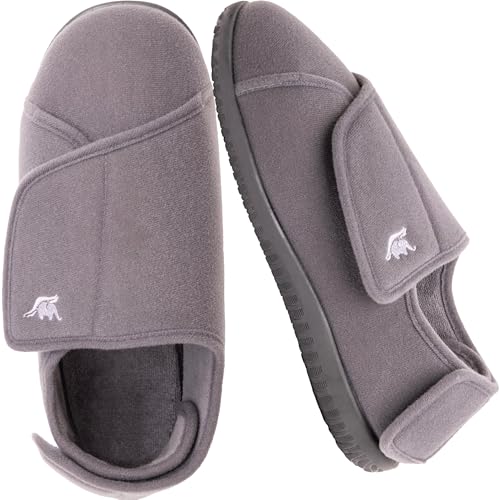
EUROPEAN SOFTEST Men’s Wide and Extra Wide Adjustable Slippers — Best Adjustable for Swollen Feet
The final tier is adjustability, and this is its representative: a men’s memory-foam slipper offered in wide and extra wide, with an adjustable upper designed for feet whose volume changes — the listing names swollen feet, edema and arthritis as its audience. We will describe it the way we describe every comfort product: the strap-adjusted upper lets you loosen the slipper in the evening when feet are fuller and snug it in the morning, the soft construction avoids pressure points on sensitive feet, and the non-slip sole serves indoor and outdoor use. That adaptability — not any medical promise — is the product.
Adjustable slippers earn their keep in households where fit is a moving target: after long days on concrete, during recovery periods when a foot is bandaged, or for older wearers whose feet simply vary. The design compromises are real — a strap upper never looks as sleek as a moccasin, and hook-and-loop closures need occasional lint removal to keep their grip — but for the wearer who has returned three fixed-shape slippers, a forgiving adjustable is not a compromise at all. It is the first pair that fits on both Tuesday morning and Friday night. As with all comfort footwear in this space: if a clinician has given you specific footwear instructions, those instructions outrank anything in this review.
Strengths
- Adjustable upper fits the foot you have at each hour of the day
- Wide and extra-wide options with soft, pressure-avoiding construction
- Memory-foam cushioning with a non-slip indoor/outdoor sole
Trade-offs
- Strap styling is functional rather than handsome
- Hook-and-loop needs periodic cleaning to keep its hold
- Soft structure gives less arch support than the Orthofeet pick
Best for: men with swelling-prone or volume-changing feet who need fit that adapts. Not suited for: wearers wanting firm arch support, or a traditional moccasin look. Check the current price on Amazon
Comparison Table
| Pick | Badge | Key spec | Best for |
|---|---|---|---|
| Dearfoams Leslie Wide (Women’s) | Best Overall Women’s Wide | Wide terry clog, memory foam, washable | Everyday wide comfort |
| Dearfoams Darcy Wide (Women’s) | Best Indoor/Outdoor Women’s | Wide velour clog, indoor/outdoor sole | Errands without changing shoes |
| Dearfoams Brendan Wide (Men’s) | Best Men’s Wide | Wide breathable clog, memory foam | Warm homes, hot feet |
| Orthofeet Asheville Wide (Men’s) | Best Supportive | Wide, adjustable, arch support, hands-free entry | All-day standing at home |
| FitVille Extra Wide (Men’s) | Best Extra Wide | Extra-wide last, non-slip sole | Feet beyond standard wide |
| EUROPEAN SOFTEST Adjustable | Best for Swollen Feet | Wide/extra wide, strap-adjustable upper | Volume-changing feet |
How to Choose Wide Width House Slippers
Measure at the right time, in the right way. Feet are longest and widest in the late afternoon, after a day of standing has done its work — measure then, in the socks you will wear with the slippers. Stand on a sheet of paper (standing, not sitting: your full weight spreads the foot to its true working width), trace both feet, and measure the widest point across the forefoot. Compare against the brand’s size chart for the wide fit specifically. If your two feet differ — most people’s do — fit the larger one and let an insole or thicker sock civilize the smaller.
Know which kind of wide you are. Forefoot-wide feet need toe-box room and a footbed that extends under the splayed toes; look for clog and moccasin shapes on wide lasts, like the Dearfoams picks. High-volume feet — wide plus a tall instep — need upper give or adjustability: terry stretch, or the strap designs of the Orthofeet and EUROPEAN SOFTEST. Feet that change through the day need adjustability above all; no fixed shape wins against a moving target. And feet that are simply big all over, beyond standard wide, belong in the FitVille’s extra-wide last.
Match the sole to your floors and your habits. On hardwood, tile and laminate, a rubber or TPR sole with real tread pattern is the difference between a slipper and a skating accident — especially for wide feet, whose owners sometimes have balance quirks from years of ill-fitting shoes. Soft fabric soles are for carpeted homes and careful walkers. If your slippers will cross the threshold — bins, porch, mailbox, garage — choose an indoor/outdoor sole and accept a little extra weight as the price of not changing shoes ten times a day.
Be honest about foam. Memory foam is the comfort headline of this category and its lifespan is finite: under daily wear it gradually compresses and stops springing back, sooner under heavier wearers. That is not a defect to be outraged by; it is a replacement cycle to plan around, and washable mainstream pairs like the Leslie are priced for it. If you want a footbed that holds its shape for years, you want the structured supportive end of this list, and you will pay accordingly.
How to Fit and Break In Wide Slippers (and Make Them Last)
Fitting is a five-minute ritual worth doing properly. Put both slippers on with your usual socks, stand, and walk the length of the house. Your heel should lift only slightly in a clog — a wide clog that slaps loudly is a size too big, and one that grips your heel is a size too small. Press your thumb across the widest part of the upper: you should feel your forefoot filling the width without the material straining white. Sit, stand, climb your stairs once. Wide feet that have spent years in narrow shoes sometimes feel “unsupported” in a correct wide fit for the first days — that is your foot relearning its natural splay, and it passes.
For adjustable models, set the strap in the morning to a comfortable snugness, then re-check at night: the right evening setting is looser, and the fact that you can change it is the entire point. Rotate two pairs if you wear slippers all day — foam recovers loft when given a rest day, and a rotation easily doubles the useful life of both pairs. Wash washable models on a gentle cycle and air-dry them; dryer heat is memory foam’s enemy. For non-washable pairs, a sprinkle of baking soda overnight, shaken out in the morning, keeps the interior civilized. Replace any slipper whose sole has worn smooth: in this category, the sole is a safety component, not a cosmetic one.
Common Buying Mistakes
- Ordering your shoe size in the regular width by habit. The wide version often hides in the size selector of the same listing. Check it before checkout — this is the single most common failure in the category.
- Sizing up instead of sizing wide. A longer slipper is not a wider slipper; you get heel slip and toe overhang’s clumsy cousin, extra length to trip on.
- Assuming “roomy” means wide. Without a wide last, an extra-wide size run or an adjustable upper, “roomy” is a mood, not a measurement.
- Ignoring the instep. Wide feet often come with high insteps. A low-cut upper that fits your width can still saw across the top of your foot; choose stretch or straps.
- Judging support by softness. The softest foam can be the least supportive thing in the house by month two. All-day standers should buy structure.
- Wearing a worn-smooth sole on hard floors. When the tread is gone, the slipper is done, however fond of it you are.
Final Recommendation
Most wide-footed shoppers should start with the Dearfoams that matches their life: the washable Leslie for women at home, the Darcy for women whose slippers go outdoors, the breathable Brendan for men. When the need is bigger — all-day support, feet beyond standard wide, or volume that changes by the hour — step up to the Orthofeet Asheville, the FitVille Extra Wide, or the adjustable EUROPEAN SOFTEST respectively. Fit the larger foot, measure in the evening, and confirm the wide option at checkout, and this category will finally feel like it was made for you.
More from this cluster: Best House Slippers For Supination, Best House Slippers Home, Best Indoor Outdoor Slippers On Ice, Best Ladies Slippers For Plantar Fasciitis.
Wide Feet and Slippers: Why the Last Matters More Than the Size
A shoe or slipper’s last is the three-dimensional form it is built around, and width lives in the last, not in the size number. When a maker cuts a true wide version, they rebuild the last: wider across the ball, roomier in the toe box, a footbed whose edges extend to meet the foot’s actual outline. When a maker instead offers only a longer size, the proportions stay narrow and the wide foot overflows a longer platform — worse balanced than before. This is why this guide insists on listings that confirm a wide fit, and why the same wearer can be a perfect 10 Wide and a miserable 11 Regular in the same brand. It is also why adjustable uppers are such an effective technology for this audience: a strap does not care about last geometry, because it wraps the volume you present to it, morning or evening, socked or bare. If you take one idea from this guide to every future footwear purchase, take this one: fit the shape, not the number.
Choosing by Wearer: Six Common Wide-Foot Scenarios
The evening-swelling office worker. You sit all day, your feet widen by the commute home, and your slippers are an evening product. Buy for the evening foot: an adjustable upper or a stretch terry clog, fitted at the larger end of your range. The Leslie and the EUROPEAN SOFTEST bracket this scenario from two directions — fixed-but-forgiving versus fully adjustable.
The all-day home stander. Remote workers, home cooks, carers and workshop hobbyists log serious standing hours on hard floors. For you, width without structure is half a solution; the Asheville’s supportive footbed in a wide fit is the pick, and the FitVille’s planted extra-wide sole is the alternative when your width exceeds even that. Rotate pairs and your feet will notice the difference by Friday.
The warm-house, hot-foot wearer. Some feet overheat in any enclosed slipper, and wide feet overheat faster because there is more foot and less air. The Brendan exists for you: perforated, breathable, wide. In genuinely hot climates it may be your year-round answer, with a lined pair kept only for the coldest weeks.
The older wearer and the balance-conscious. Priorities reorder with age: step-in ease without bending, a sole that grips, a fit that does not let the foot slide inside the slipper. Hands-free adjustable designs and non-slip extra-wides serve this best. Avoid backless clogs if shuffling is part of the gait — a heel that can catch is a household hazard, and no amount of width compensates for it.
The gift buyer. Slippers are a classic gift and wide slippers are a thoughtful one, because the recipient’s wide feet are usually a known family fact. When you do not know the exact size, choose adjustability — a strap forgives a size of error — and choose washable, because a gift that is easy to live with gets lived in. Keep the receipt path simple; even good charts miss sometimes.
The post-surgery or bandaged foot. During recovery, a foot may be wrapped, sensitive and temporarily larger. An adjustable extra-wide with a soft upper and a low step-in profile is the comfort-first choice for home wear — used within, and never against, the treating clinician’s instructions about weight-bearing and footwear.
Uppers, Foams and Soles: A Material Field Guide
Terry cloth is the forgiving all-rounder: stretchy over the instep, absorbent, breathable and usually washable — the Leslie’s formula. Its limit is structure; terry holds a foot kindly, not firmly. Microfiber velour, as on the Darcy, trades a little stretch for a smoother look and better shape retention; it reads as casual footwear rather than sleepwear, which is why it suits indoor/outdoor pairs. Faux fur and plush linings deliver winter warmth and a luxurious first step, at the cost of heat in summer and a tendency to pack down in the heel zone over a season. Perforated and mesh uppers solve the opposite problem — airflow for hot feet — and give up insulation entirely. None of these is “best”; each is a climate and lifestyle answer, and wide-footed buyers in particular should choose by their house’s temperature and their feet’s habits rather than by the softest-looking photo.
Underfoot, memory foam molds to your foot’s pressure map, which is why wide feet love it initially — the foam finally touches everywhere at once. Its weakness is compression set. Structured EVA and orthotic-style footbeds feel firmer on day one and nearly identical on day three hundred; the Asheville represents this school. Many experienced wearers end up owning one of each: plush foam for the evening couch hours, structure for the standing hours. On the ground, TPR and rubber soles with patterned tread are the safety standard for hard floors and thresholds; soft fabric soles belong to carpeted, careful households only. Read a sole the way you would read a tire: pattern, material, and visible wear all tell the truth.
Standing All Day at Home on a Wide Foot
It is worth understanding why hard floors punish wide feet more than narrow ones, because the fix follows from the mechanism. When you stand, your foot spreads under load — that is its design, distributing weight across the forefoot. A narrow footbed cuts that spread short: the outer edge of the foot lands partly off the cushion, pressure concentrates under the ball of the foot, and the muscles of the foot work overtime stabilizing a platform that does not match them. Multiply by a day of cooking, cleaning and standing at a home desk, and the ache that arrives by evening is not mysterious. A wide footbed restores the design: the whole forefoot lands on cushion, pressure spreads, and the foot can do its job instead of compensating for its footwear.
Three practical habits compound the benefit of the right slipper. First, alternate footwear zones: even the best house slipper is a compromise between softness and support, and giving genuinely tired feet a change of surface — slippers for the kitchen hours, bare feet on a rug for a while, supportive shoes for the garage project — prevents any single pressure pattern from dominating the day. Second, mind the standing surface itself: an anti-fatigue mat at the sink and stove does for your slippers what the slippers do for your feet, and the combination is greater than either alone. Third, elevate and rest on schedule rather than on collapse: wide feet that swell by evening are telling you about circulation and load, and ten minutes with your feet up at midday buys a more comfortable evening than any product can. The slippers in this guide are the equipment; these habits are the technique, and wide-footed home standers deserve both.
One more equipment note belongs here, because it is the mistake we see most in this exact scenario: wearing a beloved pair long past its footbed’s life. Memory foam does not announce its retirement — it thins gradually, and because your feet adapt gradually too, the first clear signal is often a return of the evening ache you bought the slippers to escape. When that ache returns with no other change in your routine, suspect the foam before you suspect your feet, and replace or rotate the pair. It is the cheapest diagnostic in home comfort.
A Care Calendar for Slippers That Earn Their Keep
Wide slippers work harder than regular ones — more foot, more contact, more hours — and a small care rhythm keeps them comfortable and safe. Weekly: shake them out over a bin (you will be surprised what a house deposits in a slipper), check the sole tread with a glance, and if the pair is washable and the week was sweaty, that is wash day — gentle cycle, air dry, never the dryer. Monthly: inspect the footbed by pressing a thumb deep into the heel zone; foam that stays dented rather than springing back is entering its final season, and a structured footbed should be checked for cracking at the flex point instead. Check adjustable straps monthly too — clear the hook-and-loop of lint with a dry brush so the closure keeps its authority, because a strap that lets go mid-stride is worse than no strap at all. Seasonally: reassess the rotation. Summer wants the breathable pair forward and the lined pair stored clean and dry; winter reverses it. Storage matters more than it sounds — slippers stored damp in a dark closet arrive at their season pre-spoiled, while slippers stored clean, dry and uncrushed can serve two or three seasons at the supportive end of this list. Finally, keep one honest rule above the calendar: the day the tread goes smooth on your floors, the pair retires, whatever the calendar says. Comfort can be negotiated; grip cannot.
Socks, Insoles and Other Wide-Slipper Companions
A wide slipper does not work alone, and two companions decide much of its comfort. Socks first: the right sock thickness is part of the fit you measured for, so fit-check slippers in the socks you actually wear at home — a wide slipper perfect barefoot can bind over winter socks, and one bought for winter socks swims in July. Seam placement matters for wide feet specifically, because a sock seam across a wide forefoot becomes a pressure line inside a snug upper; smooth-toe socks remove a variable many wearers blame on the slipper. Insoles second: a removable insole — as some adjustable models offer — lets you tune volume, swap in a fresher cushion when the original tires, or accommodate a thin orthotic layer a clinician has suggested. If your slipper’s insole is not removable, a slim aftermarket insole over the footbed can still rescue a pair whose foam has thinned, extending its life by a season. Treat these companions as part of the purchase and the wide fit you chose so carefully will survive contact with real life — different socks, different seasons, and feet that refuse to be the same size twice in one day.
Frequently Asked Questions
How do I know if I need wide or extra wide slippers?
If regular slippers feel snug across the forefoot but a wide fit feels secure without strain, you are wide. If wide fits still pinch, if your forefoot visibly overflows the footbed’s edge when standing, or if you routinely size up two sizes hunting for room, you are likely extra wide — start with the FitVille or an adjustable extra-wide like the EUROPEAN SOFTEST.
Should wide slippers fit loosely?
No — they should fit spaciously across the forefoot and snugly enough at the heel and midfoot that the slipper moves with your foot. Loose everywhere is a tripping hazard; roomy where your foot is wide and secure where it is not is the goal.
Can women wear the men’s extra-wide picks?
Yes, and in the extra-wide tier it is often the only route. Convert using the listing’s size chart — men’s sizes run roughly one to one-and-a-half sizes above women’s — fit the larger foot, and use the return window if the first conversion misses.
How long do memory-foam slippers last?
Under daily wear, expect the foam’s best cushioning for roughly a year, sooner under heavier wearers or all-day use; rotating two pairs extends both lives noticeably. Structured supportive slippers hold their shape longer, which is part of their higher tier.
Are adjustable slippers good for swelling feet?
They are the most practical comfort option, because the fit adapts as volume changes through the day instead of forcing one fixed shape on a changing foot. They are comfort products, not medical devices — follow your clinician’s guidance for any diagnosed condition, and let adjustability serve the comfort goal within it.
My wide slippers feel loose at the heel. Is that wrong?
A little heel movement is normal in a clog — the style trades heel hold for easy entry, which many wide feet need. What is not normal is the slipper sliding side to side or your toes gripping to keep it on; that gripping is a sign the width or size is wrong, and it will tire your feet. If the forefoot fits but the heel wanders, a heel-grip insert or a switch to a closed-back or adjustable model, like the Asheville or the EUROPEAN SOFTEST, usually resolves it without giving up the width you need.
Do wide slippers stretch over time?
Uppers relax modestly — terry and knit uppers give a little across the forefoot in the first weeks, and leather or suede moccasins give more. Footbeds, by contrast, only compress. Buy for the width you need on day one rather than counting on stretch: a slipper that must stretch to fit will spend its life straining at the seams, and a wide foot will find that seam. Adjustable models are the exception, since their “stretch” is built into the closure by design.
What sole is safest for wide feet on hardwood floors?
A rubber or TPR sole with a real tread pattern, like the non-slip soles on the FitVille and the indoor/outdoor Dearfoams picks. Fabric soles on polished wood are a fall risk for anyone; check the tread again every few months and retire the pair when it wears smooth.


