Disclosure: airfryerkitchensupply.com is reader-supported. When you buy through links on our site, we may earn an affiliate commission at no extra cost to you.
Where to buy
Every pick below was cross-checked against the Amazon catalogue for this site before it earned a link. Picks with a live link take you straight to the current listing, where you can check the current price on Amazon, confirm the size or configuration you need, and read the full specification sheet. Any slot marked as a pick slot is a product type we recommend shopping for, but one we could not match to a confirmed Amazon listing at the time of writing, so it carries no link rather than a guessed one.
- Orthofeet Asheville Orthopedic Men House Slippers — Best Overall: Check on Amazon
- Orthofeet Tuscany Orthopedic Men’s Moccasin Slippers — Best Moccasin Style: Check on Amazon
- KuaiLu Mens Slippers Orthopedic Arch Support Suede Plush Clogs — Best Clog Style: Check on Amazon
- ONCAI Mens Slippers Arch Support Bedroom House Shoes — Best Warm Memory Foam: Check on Amazon
- Men’s Orthopedic Slippers with Arch Support and Fuzzy Wool-Like Lining — Best Loafer Style: Check on Amazon
- VALSOLE Orthopedic Slippers for Women and Men — Best Heavy-Duty Support: Check on Amazon
Finding the best house slippers men for metatarsalgia starts with a truth the slipper aisle rarely prints: a slipper cannot cure ball-of-foot pain, and any listing that promises to fix, treat or heal it is overclaiming. What a well-chosen slipper genuinely does is manage the hours you spend at home — which, for most men, is most of the hours they are on their feet — by cushioning the forefoot, supporting the arch so the midfoot shares the load, and leaving the toes room to splay instead of squeezing them. Those three mechanical ideas, repeated consistently, are the difference between a house slipper that helps your evenings and one that quietly makes them worse.
The second truth is that almost no slipper is marketed for metatarsalgia by name. Manufacturers build and label for arch support and plantar fasciitis comfort, because those are the search terms shoppers use. Where a listing’s own words support a claim, we say so; where they do not, we do not invent it.
The six picks below span the main shapes a man might actually live in: two structured orthopedic models from Orthofeet, a suede clog, a warm memory-foam design, a presentable loafer and a heavy-duty unisex option rated for larger wearers. Read the badges first, then the trade-offs — for sore forefeet, the trade-off column is usually where the right decision hides.
In this guide
Quick Picks
- Best Overall: Orthofeet Asheville Orthopedic Men House Slippers — a hands-free, adjustable slip-on with genuine arch support, comfortable cushioning and a wide toe box confirmed in its Amazon listing. — Check on Amazon
- Best Moccasin Style: Orthofeet Tuscany Orthopedic Men’s Moccasin Slippers — the same orthopedic support idea in a classic moccasin silhouette, faux fur lined with confirmed arch support. — Check on Amazon
- Best Clog Style: KuaiLu Mens Slippers Orthopedic Arch Support Suede Plush Clogs — a suede slip-on clog with orthopedic arch support, plush fluff lining and an easy backless entry. — Check on Amazon
- Best Warm Memory Foam: ONCAI Mens Slippers Arch Support Bedroom House Shoes — a warm, cozy arch-support slipper that combines a supportive footbed with memory foam cushioning. — Check on Amazon
- Best Loafer Style: Men’s Orthopedic Slippers with Arch Support and Fuzzy Wool-Like Lining — a loafer-style orthopedic slipper with arch support and a warm fuzzy wool-like lining. — Check on Amazon
- Best Heavy-Duty Support: VALSOLE Orthopedic Slippers for Women and Men — a unisex orthopedic slipper with arch support whose listing specifically rates it for wearers of 220+ lbs. — Check on Amazon
How These Picks Were Chosen
Our screening started with the full men’s house slipper field and applied four filters in order. First, confirmed arch support in the verified listing — not implied, not in a review quote, in the product’s own catalog entry. Second, cushioning with structure beneath it, because foam alone compresses flat under the forefoot. Third, forefoot room: wide toe boxes, clog shapes that let the foot splay, or uppers that do not taper aggressively. Fourth, honest construction for indoor life — soles and uppers suited to hard household floors, where metatarsal discomfort is usually worst.
Products were excluded for the opposite traits: flat ballet-style slippers with no structure, novelty slippers, massage or post-surgery footwear (outside this guide’s comfort-only scope), and any model whose support claims existed only in shopper reviews rather than the verified listing. We also excluded products we could not verify through the API at all rather than guessing at their specifications — every linked pick below has its ASIN, Amazon title and verification source recorded in the article’s source file.
A note on scope: this guide discusses comfort only. Persistent, worsening or one-sided forefoot pain, pain with numbness, or pain after an injury deserves a clinician’s assessment, not a better slipper. Everything here is about making home hours kinder to feet that already have a management plan — supportive footwear at home is the part of that plan most men neglect, because the house feels like time off for feet. On hard floors, it is not.
The 6 Best House Slippers for Men for Metatarsalgia

Orthofeet Asheville Orthopedic Men House Slippers — Best Overall
Metatarsalgia is the name for pain and inflammation in the ball of the foot, and the honest starting point for this whole guide is that no house slipper treats it. What the right slipper can do — and what the Asheville is built to do — is change the comfort equation at home: cushion the forefoot instead of letting it take bare-floor impact, support the arch so load is shared more evenly across the foot, and give the toes and forefoot room instead of squeezing them into a tapered toe box. The Asheville’s confirmed listing describes exactly that formula: supportive house shoes with arch support, comfortable cushioning and a wide toe box, in an adjustable, hands-free slip-on design with a faux fur lining.
The hands-free element matters more than it sounds. Men dealing with forefoot discomfort often bend and press down on a heel counter with a finger or a shoe horn, and a slipper that takes the foot without hands — and then adjusts to hold it — removes a small daily friction that adds up. The adjustability also helps across the day: feet that feel fine at breakfast can feel fuller by evening, and a slipper that can open up slightly is more likely to stay on your feet instead of being kicked off, which is when bare-floor walking does its damage.
Inside the house, this is the pick we would hand to a man whose kitchen and hallway are tile, stone or hardwood and who stands at a counter cooking, doing dishes or working through laundry. The structure that makes it supportive also makes it feel more like a shoe than a slipper for the first few days; men coming from flat moccasins should expect an adjustment period while their feet get used to an arch actually being present. That is normal for orthopedic footwear and is a reason to build up wear time gradually rather than judging the slipper in the first hour.
Strengths
- Confirmed arch support and comfortable cushioning in the Amazon listing
- Wide toe box gives the forefoot room instead of compressing it
- Adjustable, hands-free slip-on is easy to get into without bending and pressing
Trade-offs
- Feels structured, more like a shoe than a soft slipper, at first wear
- Faux fur lining runs warm for summer use
- Supportive design is a premium-tier purchase compared with basic moccasins
| Fit | Size 10 listing; adjustable slip-on |
| Toe box | Wide, per Amazon title |
| Support | Arch support, per Amazon title |
| Lining | Faux fur, per Amazon title |
Best for: men who want structured support and forefoot room for all-evening wear on hard floors / Not suited for: men who want a barefoot, zero-structure feel or a backless scuff for quick trips outside
Check on Amazon — check price on Amazon before you decide, because sizes and colors go in and out of stock.

Orthofeet Tuscany Orthopedic Men’s Moccasin Slippers — Best Moccasin Style
Plenty of men will not wear a slipper that looks like medical footwear, no matter how sensible it is, and the Tuscany exists for them. Its Amazon listing describes a faux fur lined moccasin that is also a supportive house shoe with arch support — the support is built into a shape that reads as an ordinary, handsome moccasin in brown. For a man whose forefoot aches by the end of the day but who hosts friends, answers the door and generally lives in his slippers, that disguise is a genuine feature.
Moccasin construction brings a specific comfort profile worth understanding. The upper wraps under and around the foot rather than sitting on a stiff last, so the slipper moves with the foot during the short, shuffling steps that make up most indoor walking. Combined with the built-in arch support, that wrap helps the midfoot carry its share of each step instead of passing everything forward to the ball of the foot at push-off — the moment when metatarsal discomfort is usually sharpest.
The faux fur lining makes the Tuscany a cool-weather and air-conditioned-house slipper more than a summer one, and moccasin styling means a closed toe box: check the fit carefully if your forefoot is wide, because the listing for this model does not promise the explicitly wide toe box of the Asheville above. If your feet run wide at the forefoot, the Asheville is the safer Orthofeet choice; if your feet are a standard width and you simply want support in a slipper you will actually wear all day, the Tuscany is the one.
Strengths
- Classic moccasin looks with confirmed arch support underneath
- Faux fur lining adds warmth and a soft step-in feel
- Supportive build suited to long indoor wear on hard floors
Trade-offs
- Closed moccasin toe box is not the widest option in this roundup
- Lining runs warm in hot weather
- Fixed fit — no adjustability for day-to-day foot volume changes
| Style | Moccasin slipper, brown |
| Support | Arch support, per Amazon title |
| Lining | Faux fur, per Amazon title |
Best for: men who want orthopedic support without giving up the traditional moccasin look / Not suited for: men who need an open or adjustable fit for feet that change volume during the day
Check on Amazon — check price on Amazon before you decide, because sizes and colors go in and out of stock.

KuaiLu Mens Slippers Orthopedic Arch Support Suede Plush Clogs — Best Clog Style
The clog is the fastest slipper shape there is — step in, walk — and the KuaiLu pairs that convenience with an orthopedic arch-support footbed and a suede upper with plush fluff lining, all confirmed in its Amazon listing. For forefoot comfort, the clog shape has one underappreciated advantage: there is no heel counter pressing or rubbing, and the foot can splay naturally at the front of the shoe. Its listing frames it around plantar fasciitis comfort; we are recommending it here for the same underlying mechanics — arch support plus cushioning — applied to ball-of-foot comfort at home, not as a treatment for any condition.
Backless footwear does change how you walk, and it is worth being honest about that in a comfort guide. Without a heel, the toes do a little more gripping work to keep the clog on, and gripping toes load the forefoot. The mitigation is fit: a clog that fits closely at the midfoot stays on with far less gripping than a sloppy one, so resist sizing up. Men who mostly move between rooms, stand at a workbench or potter in a kitchen will feel the convenience far more than the compromise; men whose homes involve constant stairs should pick a closed-heel model from this list instead.
The suede upper and plush lining put the KuaiLu in the cozy camp — it is a slipper for cooler floors and evenings, and suede asks for a little care around kitchen splashes. As a second pair alongside a structured shoe-style slipper, or as the main pair for a man who prioritizes easy entry above all, it earns its place here on the strength of a genuinely supportive footbed in the most convenient shape available.
Strengths
- Orthopedic arch support in an easy step-in clog shape
- Suede upper with plush lining feels warm and finished
- No heel counter to rub, and room for the forefoot to splay
Trade-offs
- Backless fit can encourage toe gripping if sized too large
- Suede needs care around water and kitchen spills
- Less secure on stairs than closed-heel slippers
| Style | Slip-on clog / bedroom clog |
| Upper | Suede, per Amazon title |
| Support | Orthopedic arch support, per Amazon title |
| Lining | Fluff plush, per Amazon title |
Best for: men who want support in a backless clog they can step into in one motion / Not suited for: men who walk fast, use stairs constantly, or need a heel that stays locked in
Check on Amazon — check price on Amazon before you decide, because sizes and colors go in and out of stock.

ONCAI Mens Slippers Arch Support Bedroom House Shoes — Best Warm Memory Foam
Memory foam is the most misunderstood material in the slipper aisle. On its own, a flat slab of memory foam feels wonderful for ten minutes and then compresses to almost nothing under the ball of the foot — exactly where a man with metatarsalgia needs lasting cushion. The ONCAI’s listing pairs its memory foam with arch support, and that pairing is the whole point: the arch structure carries load through the midfoot while the foam layer softens the forefoot’s contact with the floor. Soft on top, structured underneath is the correct order of operations for forefoot comfort, and it is why this model makes the list while dozens of foam-only slippers do not.
The listing describes a warm, cozy slipper for indoor and outdoor use, which positions it as a winter and cool-floor pick. Warmth is a real comfort variable for sore feet — cold, stiff feet complain more — but it cuts both ways, and this is not the slipper for a man in a hot climate or one whose feet overheat. Think of it as the evening slipper: after a day on your feet, changing into a warm, cushioned, supported slipper is a genuinely restorative ritual, and the ONCAI is built precisely for that slot in the day.
Fit notes: memory foam slippers almost always feel snug for the first few wears and then mold and relax, so judge the fit after several evenings, not out of the box. If the forefoot feels compressed rather than cushioned once the foam has settled, the size is wrong — forefoot room is non-negotiable for this readership, and a half-size decision matters more than any feature on the box.
Strengths
- Memory foam cushioning layered over confirmed arch support
- Warm, cozy build suited to cold floors and evenings
- Indoor/outdoor positioning for quick trips to the door or mailbox
Trade-offs
- Warm build is wrong for hot climates and summer
- Memory foam needs a few wears to settle before fit is final
- Softer feel than the Orthofeet models if you prefer firm structure
| Support | Arch support, per Amazon title |
| Cushioning | Memory foam, per Amazon title |
| Use | Indoor and outdoor, per Amazon title |
Best for: men who want soft memory foam cushioning under the forefoot without giving up arch support / Not suited for: hot sleepers or men in warm climates who need a breathable summer slipper
Check on Amazon — check price on Amazon before you decide, because sizes and colors go in and out of stock.

Men’s Orthopedic Slippers with Arch Support and Fuzzy Wool-Like Lining — Best Loafer Style
This loafer-style entry covers the man who wants his slippers to pass as casual shoes — the pair that stays presentable when neighbors drop by or when working from home on video calls. Its Amazon listing confirms the essentials we screen for: orthopedic arch support, a warm build and a fuzzy wool-like lining, in a loafer silhouette rather than a moccasin or clog. The support-first brief is identical to the rest of this list; only the styling brief changes.
Loafer construction typically means a slightly more structured upper than a moccasin, which helps the slipper hold the foot in position over the supportive footbed instead of letting it slide and shear across it. Shear — the foot sliding forward and rubbing — is an under-discussed source of forefoot soreness in loose slippers, and a loafer that fits properly at the heel and midfoot reduces it. As with the clog above, the rule is honest sizing: snug at the midfoot, room at the toes, never the reverse.
Because this is a value-tier listing rather than a specialist orthopedic brand, set expectations accordingly: you are buying the confirmed arch-support design and loafer styling at an accessible tier, and the buying-guide checks below — forefoot room, cushion that does not bottom out, a sole with real structure — are how you confirm the individual pair delivers. If you need the most engineered support in this roundup, the Orthofeet models sit above it; if you need a presentable everyday loafer with support built in, this is the sensible spend.
Strengths
- Presentable loafer styling with confirmed orthopedic arch support
- Fuzzy wool-like lining for warmth
- Structured upper helps keep the foot positioned over the footbed
Trade-offs
- Value-tier construction versus specialist orthopedic brands
- No wide-fit promise in the listing
- Warm lining is seasonal, not year-round for everyone
| Style | Loafer slipper |
| Support | Arch support / orthotics positioning, per Amazon title |
| Lining | Fuzzy wool-like, per Amazon title |
Best for: men who want a neat loafer profile with orthopedic support for wearing around the house and at the door / Not suited for: men who need a certified wide fit or an open, adjustable upper
Check on Amazon — check price on Amazon before you decide, because sizes and colors go in and out of stock.
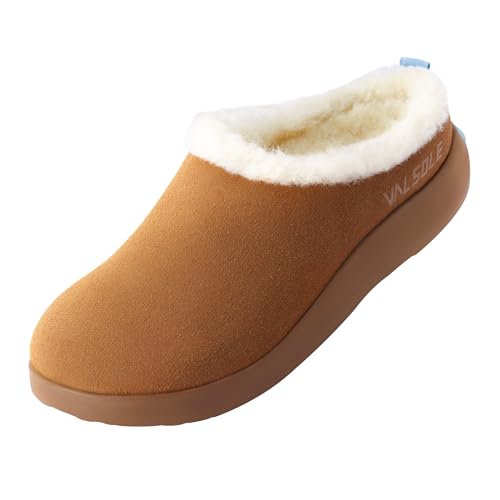
VALSOLE Orthopedic Slippers for Women and Men — Best Heavy-Duty Support
Body weight is the variable most slipper guides politely ignore, and it should not be ignored in a forefoot-comfort guide: load through the ball of the foot scales with the wearer, and a cushioning stack that feels plush under a lighter man can compress to the floor under a heavier one. The VALSOLE listing is unusual for addressing this directly, describing arch-support house shoes rated for wearers of 220+ lbs and framed around plantar fasciitis and flat-feet comfort. For a bigger man whose slippers always seem to go flat in a month, that explicit rating is the most relevant line in this entire roundup.
A heavy-duty footbed trades a little initial softness for staying power. Expect the VALSOLE to feel firmer on day one than a memory-foam slipper, and to feel almost the same on day ninety — which is the correct trade for forefoot comfort, because consistent, distributed support beats a brief plush phase followed by a collapsed one. The unisex design also makes it a practical household buy in homes where a supportive pair gets shared between partners, though for genuine all-day wear each person is still better served by their own fitted pair.
One honest caution: a listing weight rating describes the footbed’s intended load range, not a medical endorsement, and heavier wearers with persistent forefoot pain should treat slippers as one part of a bigger conversation with a clinician, alongside the supportive shoes worn outside the house. Within the slipper category itself, though, this is the pick engineered for the reader the rest of the aisle forgets.
Strengths
- Listing explicitly rates the design for wearers of 220+ lbs
- Arch support with a firmer, longer-lasting support profile
- Unisex design suits shared households
Trade-offs
- Firmer initial feel than memory-foam slippers
- Support is comfort framing only — not a treatment for any condition
- Unisex last may fit differently than a men’s-specific model
| Fit | Unisex, women and men |
| Support | Arch support, per Amazon title |
| Load rating | 220+ lbs, per Amazon title |
Best for: heavier men whose body weight bottoms out ordinary slipper cushioning / Not suited for: lighter men who may find a heavy-duty footbed firmer than they want
Check on Amazon — check price on Amazon before you decide, because sizes and colors go in and out of stock.
Comparison Table
| Pick | Badge | Key spec | Best for |
|---|---|---|---|
| Orthofeet Asheville Orthopedic Men House Slippers | Best Overall | Arch support, wide toe box, adjustable hands-free slip-on | men who want structured support and forefoot room for all-evening wear on hard floors |
| Orthofeet Tuscany Orthopedic Men’s Moccasin Slippers | Best Moccasin Style | Moccasin style, arch support, faux fur lining | men who want orthopedic support without giving up the traditional moccasin look |
| KuaiLu Mens Slippers Orthopedic Arch Support Suede Plush Clogs | Best Clog Style | Suede clog, orthopedic arch support, plush lining | men who want support in a backless clog they can step into in one motion |
| ONCAI Mens Slippers Arch Support Bedroom House Shoes | Best Warm Memory Foam | Arch support plus memory foam, warm indoor/outdoor build | men who want soft memory foam cushioning under the forefoot without giving up arch support |
| Men’s Orthopedic Slippers with Arch Support and Fuzzy Wool-Like Lining | Best Loafer Style | Loafer style, arch support, fuzzy wool-like lining | men who want a neat loafer profile with orthopedic support for wearing around the house and at the door |
| VALSOLE Orthopedic Slippers for Women and Men | Best Heavy-Duty Support | Arch support, rated in listing for 220+ lbs wearers | heavier men whose body weight bottoms out ordinary slipper cushioning |
How to Choose House Slippers When the Ball of Your Foot Hurts
Start with the arch, because it decides how much work the forefoot does. In a flat slipper, each step rolls load forward until push-off concentrates it under the metatarsal heads. A contoured footbed with genuine arch support props the midfoot, shares load across a larger area and softens that final concentration. You can test a slipper’s arch with your thumb: a real support structure pushes back and holds its shape; a foam pad with an arch-shaped bump printed on it collapses. The listings in this guide were screened for the former.
Next, forefoot room. The metatarsals need to spread slightly under load — that spreading is part of how the foot absorbs impact — and a tapered toe box blocks it, squeezing the forefoot at exactly the wrong moment. Wide toe boxes (confirmed on the Asheville above), clog shapes and roomy loafers all solve this differently. When you try a pair, stand and put your full weight through one foot: you should be able to wiggle your toes without the upper pressing down on them.
Then judge cushioning by its second month, not its first minute. Memory foam feels luxurious immediately and compresses progressively; structured foam and orthopedic footbeds feel firmer initially and change far less. For all-evening, every-day wear, durability of cushion beats initial plushness. Finally, match the sole to your floors: the more tile, stone and hardwood in your home, the more sole structure and grip matter, because a thin slipper sole on a hard floor is barely better than a sock.
Sizing and Fit Checks That Matter More Than Features
Fit is the cheapest comfort upgrade available and the one most men skip. Order your normal shoe size first — supportive slippers are lasted on shoe-like forms, unlike novelty slippers that run small and stretch. Wear them in the evening for the first fitting, when feet are at their fullest; a forefoot that fits at 9 a.m. can be compressed by 9 p.m. Walk on your hardest floor, not carpet, and pay attention to two signals: any pressing or pinching across the ball of the foot (reject the pair), and any need to grip with your toes to keep the slipper on (size down or choose a closed heel).
Men with one foot noticeably more sensitive than the other should fit to the sensitive foot and use the adjustability of models like the Asheville to fine-tune the other side. And give structured slippers a fair trial: an arch your feet are not used to can feel intrusive for several days. Build up over a week — a few hours, then evenings, then full days — before deciding. Discomfort that fades as you adapt is normal; forefoot pain that increases is a stop signal, not something to push through.
How to Break In and Rotate Supportive Slippers at Home
Treat a new pair of orthopedic slippers like new supportive shoes. Day one and two, wear them for an hour or two around the house in the evening. Days three to five, extend to most of the evening, including standing time in the kitchen. By the end of the first week most men can wear them for all home hours. This graduated approach lets the foot adapt to arch contact it may not have felt in years, and it separates genuine fit problems (which persist) from adjustment sensations (which fade).
Rotation extends both comfort and product life. If home hours are long — remote workers especially — alternating two pairs lets each footbed recover its loft between wears and gives linings a full day to dry. The natural pairing in this guide is one structured pair (Orthofeet Asheville or Tuscany) for standing-heavy hours and one easy pair (the KuaiLu clog or ONCAI) for short, low-effort movement. That combination covers a whole day of home life better than any single pair can.
Care is simple but not optional. Keep lined slippers dry — a day resting open near (not on) a heat source restores a damp lining. Brush suede rather than washing it, keep memory foam out of the washing machine unless the listing allows it, and check soles monthly: a worn-smooth sole on tile is a fall risk that no amount of arch support compensates for. Replace slippers when the forefoot cushioning feels packed down under your thumb compared with the heel area — that comparison tells you the working part of the slipper has finished its service.
A Realistic Home Routine for Forefoot Comfort
Slippers work best as part of a routine rather than as a standalone fix, and the routine is mostly about not giving the forefoot long, unprotected shifts. Keep the supportive pair where your day starts — beside the bed — so the first steps of the morning, often the stiffest, land on cushioning instead of a cold hard floor. The men who get the most from supportive slippers are the ones who treat putting them on as automatic as putting on glasses; the pair left in a closet is the pair that never helps.
During the day, think in terms of alternating loads. Long standing sessions at a counter or bench are the hardest pattern for the ball of the foot, harder than walking the same number of minutes, because walking at least cycles pressure on and off. Break standing into shorter blocks, sit for the parts of a task that allow it, and let the slipper’s job be cushioning the standing you cannot avoid rather than licensing unlimited standing. In the evening, elevating the feet for a while after dinner is a simple, old-fashioned comfort measure that pairs well with changing into the warmest, softest structured pair — the ONCAI’s slot in this guide — for the low-activity hours.
Keep perspective on what improvement looks like. A good slipper routine does not announce itself with a dramatic day; it shows up as evenings that end more comfortably than they used to, and mornings that start without the first-steps wince. Track it loosely over two or three weeks rather than judging hour by hour. If the trend is flat or worsening despite sensible footwear at home and supportive shoes outside it, that is useful information to take to a clinician — it tells them the home half of the equation has been handled, and the cause needs their tools, not a seventh pair of slippers.
Common Buying Mistakes
Mistake one: buying the softest slipper in the store. Softness is a first-impression quality; support is a third-hour quality. For ball-of-foot discomfort, the slipper that feels like a cloud in minute one and a floorboard by evening is the wrong purchase, however good the intentions. Mistake two: going barefoot ‘to rest your feet’ on hard floors. Barefoot on tile concentrates the entire step on the heel and forefoot with zero distribution — the house is precisely where supportive footwear earns its keep.
Mistake three: sizing up for comfort. Oversized slippers slide, and a sliding foot shears across the footbed and grips with the toes, loading the forefoot in exactly the pattern you are trying to avoid. Room belongs at the toes in width, not in overall length. Mistake four: expecting a slipper to do a clinician’s job. Slippers manage comfort during home hours; they do not diagnose why the ball of your foot hurts, and pain that persists, sharpens or changes character needs professional assessment rather than a more expensive slipper.
Mistake five: wearing one pair into the ground. Cushioning fatigue is invisible — the slipper looks fine while its forefoot pad has compressed to a fraction of its working thickness. If your evenings have gradually become less comfortable in a pair that used to help, suspect the slipper before you suspect your feet.
Final Recommendation
If you buy one pair from this guide, make it the Orthofeet Asheville: it is the only pick that combines confirmed arch support, comfortable cushioning, an explicitly wide toe box and an adjustable hands-free fit in one design, and that combination addresses every screening criterion at once. Men who will not wear orthopedic styling should take the Tuscany, which hides the same support philosophy inside a moccasin. Heavier men should go straight to the VALSOLE and its explicit 220+ lbs rating.
Choose the KuaiLu clog if your home life is a series of short trips between rooms and you value stepping in and out instantly, and the ONCAI if cold floors and evening comfort are your priorities. The loafer-style orthopedic pick is the presentable all-rounder for men who host, work from home and want support that reads as a shoe. Whichever you choose, apply the fit checks in the buying guide, break them in gradually, and keep a clinician in the loop for pain that does not settle.
Related guides on this site: Best House Slippers Wide Width, Best House Slippers Home, Best House Slippers For Supination, Best Isotoners Mens Slippers, Best Indoor Slippers Or Mocassins.
Hard Floors, Stairs and Standing Work: Matching the Slipper to Your House
The house itself is a variable in this purchase, and two men with identical feet can need different slippers because their homes differ. Start with floor surfaces. A home that is mostly carpet forgivingly cushions every step, and almost any supportive slipper in this guide will feel adequate there. A home of tile, stone, polished concrete or hardwood is a different mechanical environment: the floor returns nearly all of each step’s energy to the foot, standing still at a counter loads the forefoot continuously rather than in steps, and the slipper’s sole and cushioning become the only shock absorption in the system. Hard-floor households should weight structure and sole thickness heavily — the Orthofeet models and the VALSOLE — and treat thin-soled novelty slippers as socks with decoration.
Stairs deserve their own sentence in a comfort guide, because they are where backless slippers stop being a preference and start being a hazard. Climbing in a clog or scuff, the foot works to retain the shoe on every step; descending, a loose heel can catch. Households where the bedroom, laundry and living space sit on different floors should default to closed-heel, securely fitting models for the stair runs, whatever easy pair they keep by the sofa. Two pairs, each matched to its job, is not indulgence in a multi-storey home — it is the correct equipment decision.
Finally, standing work changes the brief again. A man who cooks seriously, works at a standing bench in a garage that opens off the kitchen, or does long ironing and laundry sessions is not walking in his slippers so much as standing in them, and standing loads the forefoot differently from walking: constant, unrelieved pressure rather than rolling steps. For standing hours, prioritize the pairs with the most structured support and the least compressible cushion, shift your weight and change position often, and consider a cushioned floor mat at the main standing spot as a partner purchase — the mat and the slipper share the job, and together they outperform either alone.
Shortlist again before you buy: Orthofeet Asheville, Orthofeet Tuscany, KuaiLu clog, ONCAI, loafer-style orthopedic slipper and VALSOLE — check price on Amazon for the pair that matches your floors and your feet.
Related guides
- Best Men's House Slippers For Flat Feet
- Best House Slippers For Plantar Fasciitis Men's
- Best Men's Fleece House Slippers
- Best Men's Slippers For Warmth
Frequently Asked Questions
Can house slippers actually help with metatarsalgia?
Slippers cannot treat or cure metatarsalgia, and you should be skeptical of any product that claims otherwise. What supportive, cushioned slippers can do is reduce the mechanical aggravation of home hours: cushioning the forefoot on hard floors, supporting the arch so load is shared, and giving the toes room. That is comfort management, and for many men it is the difference between comfortable and miserable evenings — but persistent pain needs a clinician’s assessment.
What should I look for in a slipper for ball-of-foot pain?
Four things, in order: genuine arch support confirmed in the product listing, forefoot cushioning with structure under it so it does not bottom out, a toe box wide enough for the forefoot to spread under load, and a fit that holds the foot in place without toe-gripping. Every pick in this guide was screened against those four criteria using its verified listing.
Are memory foam slippers good for sore forefeet?
Memory foam alone is a mixed blessing: it feels soft immediately but compresses flat under the ball of the foot over an evening. Memory foam layered over an arch-support structure — the formula in the ONCAI pick above — is a different story, because the structure carries the load while the foam softens contact. Judge any foam slipper by how it feels in hour three, not minute one.
Should I wear slippers instead of going barefoot at home?
On hard floors, yes, for this readership. Barefoot walking on tile, stone or hardwood concentrates each step on the heel and forefoot with nothing to distribute it. A supportive slipper is not a medical device, but it is plainly kinder mechanics for the hours you spend cooking, cleaning and moving around the house.
How long should supportive slippers last?
It depends on hours worn and the wearer’s weight, but the working signal is the forefoot cushion: press your thumb into the ball-of-foot area and compare it with the heel. When the forefoot feels packed and thin by comparison, the slipper’s useful comfort life is over even if the upper still looks presentable. Rotating two pairs stretches the calendar life of both.
When should I see a doctor instead of buying slippers?
See a clinician if forefoot pain is new and unexplained, keeps worsening, affects only one foot, comes with numbness, swelling or bruising, follows an injury, or simply does not improve over a few weeks of sensible footwear. Slippers are for comfort while you manage a known, mild situation — they are not a diagnostic tool.


