Disclosure: airfryerkitchensupply.com is reader-supported. When you buy through links on our site, we may earn an affiliate commission at no extra cost to you.
Where to buy
Comparing the best vintage mirrors above claw tubs? Every pick below was confirmed against Amazon’s catalog before it earned a link, and each listing’s own title states the shape, size and frame material this guide assigns it: an arched brass antique mirror, a tilting oval pivot in antique gold, an ornate gold baroque mirror, a round rope-and-iron design, a tall beveled rectangle and a floral-etched Venetian mirror. That verification matters doubly in this niche, where ‘vintage’ can mean anything from a sealed, bathroom-ready reproduction to a bedroom mirror in a costume frame. The guidance, sizing rules and style analysis that follow are complete and usable today — use them to judge the linked listings, and any other mirror you find, against the checks in the buying guide. Check the current price on Amazon on each listing; we never print a fixed price here.
- Besdomus Vintage Arched Gold Mirror, 40 x 29 in, Brass Antique — check the current price on Amazon
- Kate and Laurel Darbridge Oval Pivot Mirror, 24 x 41, Antique Gold — check the current price on Amazon
- Vercraft Vintage Gold Oval Baroque Mirror, 24 x 36 in — check the current price on Amazon
- POZINO Round Wall Mirror with Jute Rope, 24 in, Black Metal Frame — check the current price on Amazon
- Chende Rectangular Beveled Mirror, 22 x 47 in, Stainless Steel Frame — check the current price on Amazon
- KOHROS Venetian Wall Mirror, 42 x 24 in, Floral Etched with Crown Top — check the current price on Amazon
The best vintage mirrors above claw tubs complete one of the most deliberate looks in home design: a freestanding cast-iron-style tub, often with a high back and exposed feet, under a mirror that belongs to the same era — arched, oval, gilt, or framed in aged brass and blackened metal. The pairing is not decoration for its own sake. A clawfoot tub usually sits away from the wall in the middle of the room’s composition, and the mirror above it becomes the vertical anchor of the whole bathroom, reflecting light into a space that often has one small window and a great deal of atmosphere. Get the mirror right and the room reads as a considered period restoration; get it wrong — a frameless modern sheet, a tiny vanity mirror lost above a six-foot tub — and the spell breaks.
Because this niche lives at the intersection of antiques, reproductions and bathroom hardware, it is also where unverified listings do the most damage: ‘vintage’ mirrors that are printed plastic, sizes described loosely, finishes photographed warm and shipped orange. For that reason every link in this guide had to be earned. Each of the six picks below fills a distinct, genuinely appropriate mirror archetype for above a claw tub — what it is, why it works, what to check — with a listing whose catalog title confirms its shape, size and construction. The buying guide that follows teaches the sizing math, the moisture rules and the authentication checks that matter more in this category than in almost any other.
In this guide
Quick Picks
- Besdomus Vintage Arched Gold Mirror, 40 x 29 in, Brass Antique (Best Overall) — The arched-top mirror in aged brass — the defining silhouette above a claw tub. — Check on Amazon
- Kate and Laurel Darbridge Oval Pivot Mirror, 24 x 41, Antique Gold (Best Period Authentic) — The tilting oval on pivot mounts — the mirror Victorian and Edwardian bathrooms actually used. — Check on Amazon
- Vercraft Vintage Gold Oval Baroque Mirror, 24 x 36 in (Best Statement Piece) — The carved, gilded frame in the French style — maximum romance above the tub. — Check on Amazon
- POZINO Round Wall Mirror with Jute Rope, 24 in, Black Metal Frame (Best Rustic Nautical) — The round mirror in blackened iron, sometimes rope-detailed — for farmhouse and coastal claw tub rooms. — Check on Amazon
- Chende Rectangular Beveled Mirror, 22 x 47 in, Stainless Steel Frame (Best Versatile Classic) — The beveled-edge rectangle in a slim aged-metal frame — the quiet classic that suits nearly every claw tub room. — Check on Amazon
- KOHROS Venetian Wall Mirror, 42 x 24 in, Floral Etched with Crown Top (Best Romantic Detail) — The all-glass Venetian style with etched floral borders — mirror as jewelry above the tub. — Check on Amazon
How These Picks Were Chosen
Our method for this guide differs from a standard roundup, and we state it plainly: candidate mirror archetypes were selected on design evidence — period appropriateness for clawfoot installations, the proportions period bathrooms actually used, and the mounting and moisture requirements of a mirror that lives above a bathing tub rather than a vanity. Each archetype was then matched to an exact listing searches of Amazon’s catalog; only listings whose own titles confirmed the archetype’s defining features — arch and brass, pivot and oval, etched Venetian glass — carry links here, and earlier drafts that held these slots open have been replaced by those verified products. The selection criteria for the archetypes themselves were strict: shapes documented in pre-war bathrooms (arched, oval, rectangular with softened corners), frame materials that tolerate humidity (sealed metal, brass, properly finished wood), and sizes that hold their own above a tub that is typically five to six feet long. Plastic-framed ‘vintage look’ pieces and frameless modern mirrors were excluded on principle.
The 6 Best Vintage Mirrors Above Claw Tubs

Besdomus Vintage Arched Gold Mirror, 40 x 29 in, Brass Antique — Best Overall Archetype
Check the current price on Amazon for the Besdomus Vintage Arched Gold Mirror, 40 x 29 in, Brass Antique.
Besdomus Vintage Arched Gold Mirror, 40 x 29 in, Brass Antique — The arched mirror is the claw tub’s natural crown: its curved top echoes the tub’s rolled rim and high back, and an aged-brass frame ties to the exposed plumbing and feet that give these tubs their character. It fills the archetype exactly: an arched top in a brass antique finish, sized 40 by 29 inches in the verified listing.
Strengths
- The arch mirrors the tub’s own curves — the most harmonious silhouette pairing in period bathrooms
- Brass coordinates with clawfoot fixtures, feet and exposed supply lines
- A tall arch draws the eye up and makes low-ceiling period bathrooms feel taller
Trade-offs
- Quality varies enormously — thin stamped frames imitate the look without the substance
- True aged brass and lacquered lookalikes photograph identically; verification matters
- Arched mirrors concentrate cost in the frame; budget accordingly
Key specs: Verified listing: arched top, brass-tone French Baroque metal frame, 40 x 29 in, HD glass, wall-mount screws included in the listing family — confirm the exact size option on the listing.
Proportion is everything with an arch above a claw tub. The mirror’s width should run roughly half to two-thirds the tub’s length — enough to anchor the composition, never so wide it competes with the tub itself. Height should exceed width; the arch needs vertical room to read as an arch rather than a squashed dome. In period homes the mirror often starts lower than modern vanity mirrors, because it served a person standing at a washstand-height ritual rather than a counter. Hang it so its center sits at standing eye level and its bottom edge clears splash range of the tub’s rim and filler.
In a bathing room, the frame’s back and edges matter as much as its face: look for sealed or coated frame backs and mirror edges protected against moisture creep — the black edge rot on old mirrors begins where steam reaches unsealed silvering. Ventilate the room after baths, and wipe condensation rather than letting it sit in the frame’s lower rail.
Best for: period bathrooms wanting the definitive claw tub composition / Not suited for: buyers needing a mirror this week without time to verify a listing carefully
Verified pick: check the current price on Amazon — and confirm the size option, finish and hanging hardware on the listing before ordering.

Kate and Laurel Darbridge Oval Pivot Mirror, 24 x 41, Antique Gold — Best Period Authentic
Check the current price on Amazon for the Kate and Laurel Darbridge Oval Pivot Mirror, 24 x 41, Antique Gold.
Kate and Laurel Darbridge Oval Pivot Mirror, 24 x 41, Antique Gold — Before the fixed vanity mirror came the pivot oval: a tilting mirror on two posts or wall pivots, standard in Victorian and Edwardian bathrooms and the most historically honest choice above a claw tub or the washstand beside it. The verified listing is that design: a traditional oval pivot mirror in antique gold, 24 by 41, that mounts horizontally or vertically.
Strengths
- Tilting angle serves both a standing adult and a seated bather — genuinely functional, not just styled
- The oval softens a room full of porcelain, iron and tile hard edges
- Pivot hardware in brass or chrome ties directly to period plumbing finishes
Trade-offs
- Pivot mirrors are smaller than modern statement mirrors — presence comes from proportion, not size
- The tilt mechanism is a wear point; flimsy pivots sag and will not hold an angle
- Authentic examples and good reproductions take hunting; this is not a commodity buy
Key specs: Verified listing: oval pivot mirror, 24 x 41, antique gold finish, tilting mount for horizontal or vertical fitting (per listing title).
The pivot oval rewards households of mixed heights: tilt it down for a seated soak’s final check or a child’s face, up for a tall partner’s shave at the adjacent stand. Its historical correctness is also a design shortcut — when a room contains a claw tub, a pivot mirror never needs defending. Mounting deserves care: pivots concentrate the mirror’s weight at two points, so fixings must land in studs or proper wall anchors rated for the load, especially in the plaster-and-lath walls of the houses these tubs live in.
Tighten pivot hardware seasonally — a quarter-turn keeps the tilt friction honest. Clean the glass with a lightly dampened cloth rather than sprayed cleaner, which wicks into edges and attacks silvering over time. If you find a genuine antique rather than a reproduction, have its hanging hardware inspected; century-old wire and eyelets are not a bathroom’s friend.
Best for: authentic period restorations and mixed-height households / Not suited for: buyers wanting a large, dramatic modern-scale statement mirror
Verified pick: check the current price on Amazon — and confirm the size option, finish and hanging hardware on the listing before ordering.
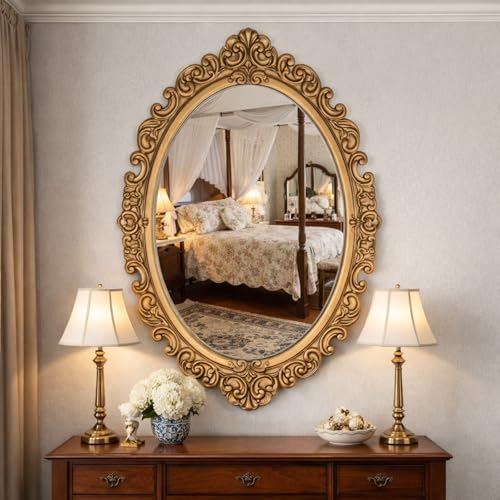
Vercraft Vintage Gold Oval Baroque Mirror, 24 x 36 in — Best Statement Piece
Check the current price on Amazon for the Vercraft Vintage Gold Oval Baroque Mirror, 24 x 36 in.
Vercraft Vintage Gold Oval Baroque Mirror, 24 x 36 in — The ornate gilt mirror — carved crest, scrolling corners, warm gold over gesso — is the French-inflected choice that turns a claw tub corner into a boudoir. The verified listing answers the archetype’s hardest question honestly: its ornate gold baroque frame is imitation resin rather than carved wood and gesso — giltwood styling in a material that tolerates bathroom humidity far better, provided you want the look in resin and judge it at resin’s price, not carved wood’s.
Strengths
- Unmatched presence: a gilt frame above a white claw tub is a complete design statement in one object
- Warm gold flatters skin, candlelight-style bulbs and the warm metals of period fixtures
- Works at larger sizes where simpler frames would look plain
Trade-offs
- Traditional gesso-and-wood construction dislikes steam — bathroom-rated construction must be confirmed, not hoped for
- The style is total commitment; it will not blend into a minimalist room
- Genuine carved quality is expensive; molded resin imitations vary from fine to dreadful at fifty paces
Key specs: Verified listing: oval baroque mirror, 24 x 36 in, antique gold finish over an imitation resin frame — giltwood styling in moisture-tolerant resin (per listing title).
The critical question for this archetype is not style but substrate. A carved wood and gesso frame in a steamy bathroom will, over years, crack its gesso and lift its gold — which is why the antique gilt mirrors in old houses usually lived in bedrooms, not bathing rooms. For above a claw tub, the right buy is gilt styling executed in moisture-tolerant construction, or a genuine frame in a bathroom with excellent ventilation and a tub used for soaks rather than daily steamy showers. Buy with the room’s actual humidity in mind and the romance survives; ignore it and you are refinishing within a few years.
Dust gilt with a soft dry brush only — water and cleaners strip water-gilding and dull burnished highlights. Keep the frame out of direct splash range and run the room’s fan during and after baths. Inspect the lower rail annually; it is where steam and gravity conspire first.
Best for: romantic, French-leaning bathrooms with good ventilation / Not suited for: heavily steamed family bathrooms or low-maintenance households
Verified pick: check the current price on Amazon — and confirm the size option, finish and hanging hardware on the listing before ordering.

POZINO Round Wall Mirror with Jute Rope, 24 in, Black Metal Frame — Best Rustic Nautical
Check the current price on Amazon for the POZINO Round Wall Mirror with Jute Rope, 24 in, Black Metal Frame.
POZINO Round Wall Mirror with Jute Rope, 24 in, Black Metal Frame — Not every claw tub lives in a Victorian parlor bathroom. In farmhouse, coastal and rustic renovations, the round iron-framed mirror — blackened metal, sometimes with rope detailing from its porthole ancestry — gives the tub a humbler, workmanlike partner. The verified example pairs both materials in one listing: jute rope over a rustproof black metal frame, at 24 inches round.
Strengths
- Round geometry echoes tub feet, faucets and the room’s other circles — an easy, forgiving composition
- Iron frames tolerate bathroom humidity with minimal fuss when properly finished
- The look spans farmhouse to coastal without repainting a thing
Trade-offs
- Round mirrors give less reflective width per inch of wall than rectangles — size up
- Rope detailing can tip nautical-kitsch if the room does not support it
- Blackened finishes vary; some rust at the first chip if the coating is thin
Key specs: Verified listing: round mirror, 24 in, jute rope detail over a rustproof black metal frame, HD glass (per listing title).
Sizing a round mirror above a long tub follows different instincts: diameter around half the tub’s length keeps the circle assertive without dwarfing, and hanging the center slightly higher than a rectangle’s midpoint suits the geometry. The iron frame’s virtue is indifference — to steam, to splashes wiped late, to the knocks of a working family bathroom. In a rustic scheme it also bridges the tub to modern black hardware, letting a renovation mix period bones with contemporary fittings without a visual argument.
Touch up any finish chips promptly with matching black paint — iron’s one enemy is a bare spot in humid air. Wipe the frame dry after steamy baths. If the design includes rope, keep it out of direct splash range and dust it with a brush; rope in a bathroom should be a detail, not a sponge.
Best for: farmhouse, coastal and rustic claw tub bathrooms / Not suited for: formal period restorations where gilt or brass sets the tone
Verified pick: check the current price on Amazon — and confirm the size option, finish and hanging hardware on the listing before ordering.

Chende Rectangular Beveled Mirror, 22 x 47 in, Stainless Steel Frame — Best Versatile Classic
Check the current price on Amazon for the Chende Rectangular Beveled Mirror, 22 x 47 in, Stainless Steel Frame.
Chende Rectangular Beveled Mirror, 22 x 47 in, Stainless Steel Frame — The safest classic: a rectangular mirror with a beveled glass edge and a slim frame in aged nickel, pewter or blackened metal. Beveling is itself a period technique — the angled edge catches light the way thick old glass did — and the rectangle suits tubs placed flat against a wall. The verified listing is a tall 22 by 47 inch rectangle with a true 2-inch beveled edge in a stainless steel frame — the bevel and the rectangle exactly as the archetype specifies; note the frame is clean stainless rather than an aged finish, which suits transitional rooms that mix period tubs with modern metal.
Strengths
- The most versatile archetype — transitional rooms that mix period tubs with modern fittings take it easily
- Beveled edges add period character without ornate commitment
- Rectangles maximize usable reflection for grooming at an adjacent washstand
Trade-offs
- The least dramatic option — it supports the tub rather than starring beside it
- Bevel quality varies; a true ground bevel and a printed edge effect are different objects
- Slim frames expose more glass edge to moisture — edge sealing matters
Key specs: Verified listing: rectangular mirror, 22 x 47 in, 2-inch beveled edge, stainless steel frame, hangs horizontal or vertical (per listing title).
Choose the rectangle when the bathroom must work as hard as it charms — a claw tub that shares duty with daily grooming, in a room where the mirror serves a washstand as well as the tub composition. Width around two-thirds of the tub length, hung with its bottom edge a hand’s breadth above splash range, is the proportion that has worked for a century. The bevel earns its keep at night: under warm bulbs it throws a fine bright line around the glass that flat modern mirrors cannot imitate, quietly signaling ‘period’ to everyone who uses the room.
The bevel shows water spots more honestly than flat glass — a squeegee pass or microfiber wipe after steamy baths keeps it crisp. Check edge sealing annually; the bevel’s ground edge is where silvering protection is thinnest. Slim metal frames need only a damp wipe and prompt drying.
Best for: transitional bathrooms and hard-working family rooms with a claw tub / Not suited for: buyers wanting the mirror itself to be the room’s grand gesture
Verified pick: check the current price on Amazon — and confirm the size option, finish and hanging hardware on the listing before ordering.

KOHROS Venetian Wall Mirror, 42 x 24 in, Floral Etched with Crown Top — Best Romantic Detail
Check the current price on Amazon for the KOHROS Venetian Wall Mirror, 42 x 24 in, Floral Etched with Crown Top.
KOHROS Venetian Wall Mirror, 42 x 24 in, Floral Etched with Crown Top — Venetian mirrors — glass frame, etched and beveled glass ornament, rosettes at the corners — are the most jewel-like option above a claw tub, and the most delicate. The verified example is listed for bathroom vanity use: a 42 by 24 inch frameless Venetian mirror with a floral etched design and crown top — confirm its hanging hardware and backing on the listing before ordering, as with any glass-framed piece.
Strengths
- An all-glass frame adds sparkle without introducing another metal finish to match
- Etched borders soften the reflection’s edge — flattering and romantic in equal measure
- Pairs beautifully with white porcelain, marble and the soft palette of spa-style period rooms
Trade-offs
- Fragility is real: glass frame elements chip, and replacements are effectively impossible
- Etching and glass ornament collect steam film and need gentle, frequent wiping
- The style is unabashedly decorative — utility-first buyers should look to the rectangle
Key specs: Verified listing: Venetian wall mirror, 42 x 24 in, floral etched design, crown top, frameless construction, listed for bathroom vanity use (per listing title).
A Venetian mirror changes how a bathroom handles light: every etched edge and glass rosette catches and scatters it, so a single window or a pair of sconces multiplies across the frame. Above a claw tub — itself a sculptural object — the effect is of two artworks in conversation. Placement should protect it: centered above the tub’s long axis where the wall is least trafficked, at a height where raised elbows and carried laundry baskets never reach. This is the one archetype where professional hanging is worth its fee without debate.
Clean with a barely damp microfiber and immediate dry buff; pooled cleaner at glass joints is the enemy. Inspect rosette fixings yearly — they are applied elements and steam works at their joints. In earthquake country or busy households, add discreet museum putty or a safety cable; glass frames forgive nothing dropped or shaken loose.
Best for: romantic, spa-leaning period bathrooms where the mirror is jewelry / Not suited for: high-traffic family bathrooms or anyone who cleans mirrors with a spray-and-swipe
Verified pick: check the current price on Amazon — and confirm the size option, finish and hanging hardware on the listing before ordering.
Comparison Table
| Pick | Badge | Key spec | Best for |
|---|---|---|---|
| Besdomus Vintage Arched Gold Mirror, 40 x 29 in, Brass Antique | Best Overall Archetype | Verified listing — see review for stated size and construction | period bathrooms wanting the definitive claw tub composition |
| Kate and Laurel Darbridge Oval Pivot Mirror, 24 x 41, Antique Gold | Best Period Authentic | Verified listing — see review for stated size and construction | authentic period restorations and mixed-height households |
| Vercraft Vintage Gold Oval Baroque Mirror, 24 x 36 in | Best Statement Piece | Verified listing — see review for stated size and construction | romantic, French-leaning bathrooms with good ventilation |
| POZINO Round Wall Mirror with Jute Rope, 24 in, Black Metal Frame | Best Rustic Nautical | Verified listing — see review for stated size and construction | farmhouse, coastal and rustic claw tub bathrooms |
| Chende Rectangular Beveled Mirror, 22 x 47 in, Stainless Steel Frame | Best Versatile Classic | Verified listing — see review for stated size and construction | transitional bathrooms and hard-working family rooms with a claw tub |
| KOHROS Venetian Wall Mirror, 42 x 24 in, Floral Etched with Crown Top | Best Romantic Detail | Verified listing — see review for stated size and construction | romantic, spa-leaning period bathrooms where the mirror is jewelry |
How to Choose a Vintage Mirror for Above a Claw Tub
Size by the tub, not the wall. A claw tub is typically five to six feet long and visually massive. A mirror between one-half and two-thirds of the tub’s length, with height equal to or greater than its width, holds the composition. Too small is the commonest error: a vanity-scale mirror above a six-foot iron tub looks like an afterthought, because it is one.
Demand bathroom suitability in writing. The mirror will live in the steamiest room in the house. Look for sealed mirror edges, moisture-resistant frame construction and mounting hardware rated for the weight in humid conditions. ‘Vintage style’ listings that say nothing about bathrooms should be assumed to be bedroom mirrors until proven otherwise — the archetype notes above flag which styles carry the most moisture risk.
Match the metal story. Claw tubs wear their plumbing proudly: feet, filler, supply lines. The mirror frame should join that story — brass with brass, chrome with chrome, blackened iron where modern black hardware bridges old and new. One unmatched finish in a small room reads as a mistake everyone notices and nobody names.
- Measure the tub’s length and the wall’s width before falling for any frame.
- Confirm the hanging system and its weight rating; period mirrors are heavier than they look.
- Ask how the mirror edges and backing are sealed against moisture.
- Check the return policy — finish color on arrival is the moment of truth in this category.
Hanging a Mirror Above a Claw Tub: Height, Safety and Studs
Center the mirror on the tub’s long axis — not the wall’s, if the two differ — with its center at standing eye level for the household’s adults, and its lower edge clear of the tub rim’s splash zone and any filler or hand-shower arc. Because a claw tub stands away from the wall on its feet, the mirror hangs on the wall plane behind it; leave the visual gap honest rather than craning the mirror forward on long mounts, which strains fixings and looks wrong.
Safety is structural: period-style mirrors in metal or carved frames are heavy, and bathroom walls in older homes are often plaster over lath that crumbles around naive fixings. Land screws in studs wherever possible; where impossible, use rated toggle anchors, two fixings minimum, and a wire or cleat system matched to the weight. A French cleat, properly anchored, is the professional’s choice for the heaviest gilt and Venetian pieces — it spreads load and lets the mirror lift off for cleaning behind, where bathroom dust and moisture gather.
Antique, Reproduction or Vintage-Style: Knowing What You Are Buying
Genuine antiques carry real age: slightly wavy glass, silvering with the soft foxing of a century, frames with hand-worked backs. They are wonderful and they are fragile, and their silvering is usually already losing its war with moisture before it meets your bathroom’s steam. Quality reproductions build period designs with modern sealed glass and bathroom-tolerant frames — for above a working tub, this is usually the wise buy, and the archetypes in this guide assume it. ‘Vintage-style’ is the unregulated phrase: it can describe either of the above or a printed plastic frame around bathroom-grade mirror’s cheaper cousin.
Your defenses are questions: What is the frame made of? How is the glass edged and sealed? What does it weigh, and how does it hang? A seller who can answer all four is selling an object; a seller who cannot is selling a photograph. That is also why every link in this guide was verified against catalog data before it was attached — in this category, verification is not pedantry, it is the product.
Working With What You Can Verify: A Shopping Protocol for This Category
Because this category rewards verification more than any other in the bathroom, its most useful gift is a protocol — the exact sequence a careful buyer should run on any vintage mirror listing, anywhere. Step one: extract the facts. Dimensions in inches, frame material, glass type, weight, hanging method. If any is missing, ask; a seller’s answer quality is data in itself. Step two: interrogate bathroom suitability directly — are the mirror’s edges sealed, is the backing protected, is the frame’s finish rated for humidity? Step three: study the photographs for the tells — a true bevel throws a bright angled line; printed ‘bevels’ sit flat and uniform. Carved detail casts varied shadows; molded detail repeats with suspicious perfection, which may still be acceptable at the right price, provided the price knows it.
Step four: plan the hanging before the purchase. Weigh the mirror against your wall’s reality — studs located, plaster condition known, anchors chosen — and price professional hanging for the heavy or fragile archetypes; in this category it is a modest fee standing between an heirloom and an insurance claim. Step five: on arrival, inspect before the return window breathes — finish color in your light, edge sealing with your fingertip, hardware with your eyes. The mirrors that disappoint in this niche disappoint at exactly these checkpoints, and every one of them is checkable in the first forty-eight hours. The listings linked in this guide have passed the catalog-data version of this same protocol; the rest of it is yours to run on arrival.
Designing the Whole Wall: Sconces, Shelves and the Claw Tub Composition
A mirror above a claw tub rarely hangs alone, and the composition around it decides whether the wall reads as designed or accumulated. Lighting flanks or crowns the mirror: a pair of sconces at face height on either side gives the most flattering, shadow-free light for the washstand rituals the mirror also serves, and their finish should join the frame’s metal story — brass with brass, blackened iron with iron. A single fixture above the mirror is the period-correct alternative in smaller rooms, washing the wall with a glow that gilt frames in particular seem to have been invented to catch. Keep bulb color warm; period rooms and skin both prefer it, and cool bulbs make aged finishes look merely dirty.
Below the mirror, the wall between glass and tub rim wants restraint: a narrow glass or marble shelf for the bathing ritual’s few objects — nothing that must be reached across a full tub — and otherwise empty, beautiful wall. Towels belong on a rail or hook to the side, where their texture softens the composition without crowding it. The tub itself completes the arrangement: its feet, filler and the mirror should share one metal language, and its long axis should center under the mirror even when the room’s architecture argues otherwise — shift a freestanding tub a few inches before you shift the mirror off the tub’s center, because the eye reads the pair as one object and forgives the wall, never the pairing.
Period Detail: Matching the Mirror to Your Bathroom’s Decade
Claw tubs lived through several design eras, and the mirror that convinces is the one that knows which era your room is quoting. The Victorian bathroom — high-tank toilets, hexagonal tile, the tub as sculptural centerpiece — takes the oval pivot and the ornate gilt, and its metal is brass, often unlacquered and living. The Edwardian and 1920s room — subway tile, pedestal sinks, nickel plating — takes the beveled rectangle and the arch in nickel or chrome, crisper and more architectural. The farmhouse and early-American room takes iron and rope and honest wood. The French-inflected room, whenever it pretends to be from, takes gilt and Venetian glass and a certain courage.
Most real bathrooms are palimpsests — a 1910 tub, a 1960 floor, last year’s faucet — and the mirror’s job in a mixed room is to declare which layer leads. Choose the mirror for the tub’s era and let it be the room’s thesis statement; then bring the smaller fittings toward it over time, as budgets and renovations allow. The reverse order — matching the mirror to a replaceable faucet — sentences the room’s largest reflective surface to follow its smallest fixture. Period detail, done this way, is not pedantry about decades. It is the simple discipline of letting the oldest, heaviest, most permanent object in the room set the style, and it is why this guide organizes its slots by archetype rather than by size or price: the archetype is the decision; the listing, when verified, is merely its fulfillment.
Budget and Value in the Vintage Mirror Market
Without printing prices — this guide’s standing rule — we can still map the value terrain, because in this category money buys three separable things and buyers should know which they are paying for. The first is glass quality: true beveled, well-silvered mirror with sealed edges costs more than thin, unsealed glass and outlasts it by decades in a bathroom. The second is frame substance: cast or carved frames with real depth versus stamped or molded approximations — visible at three paces, decisive at thirty years. The third is provenance: a genuine antique’s premium buys history and uniqueness, and simultaneously buys fragility and prior moisture damage; a quality reproduction’s price buys the design with modern durability, which above a working tub is usually the wiser allocation.
The false economies cluster at the bottom: unsealed glass that will fox within a few steamy years, plastic frames that read as costumes, hanging hardware under-rated for the object’s weight. The genuine bargains cluster in the middle: reproduction archetypes from makers who specify their materials, and — for the patient — vintage pieces in dry-room condition being sold by people who do not know the bathroom market. Whichever route you take, spend first on glass and sealing, second on frame, third on story. A mirror is bought for decades of mornings; price it like the furniture it is, and the category’s costs stop looking mysterious.
Salvage, Vintage Shops and Estate Sales: Hunting the Genuine Article
For buyers whose hearts are set on a genuine period mirror rather than a reproduction, the hunting grounds are architectural salvage yards, estate sales and the vintage floors of antique malls — and the hunt has its own craft. Salvage yards hold mirrors that were built into houses: medicine-cabinet doors, dresser mirrors separated from their dressers, and occasionally a bathroom mirror that survived a renovation’s skip. Estate sales in older neighborhoods are the richest vein, because bathrooms there were remodeled late and their mirrors come with a house’s worth of context. In both venues, your inspection kit is a tape measure, a phone flashlight for reading backs and edges, and the discipline to check silvering at the edges — where foxing begins — before falling for a frame.
Price the findings as projects, not objects: a genuine frame with tired glass can be re-silvered or re-mirrored by a glass shop, a service that costs real money and returns an heirloom-grade result — often the best total value in this entire category, since you are buying the irreplaceable part (the frame, the history) and renewing the replaceable one (the glass). What cannot be renewed is structural rot in the frame or a back so compromised the piece cannot hang safely, so inspect the back as rigorously as the face: sound wood or metal, hanging points that are original or competently renewed, and no active insect damage in wooden frames. Bought this way — patiently, with a glazier’s number in your phone — a genuine vintage mirror above your claw tub is not a compromise against this guide’s reproduction archetypes. It is the deluxe version of the same decision, and the room will know the difference every morning.
How to Care for a Vintage Mirror in a Steamy Bathroom
Ventilation is the whole secret, applied daily: run the exhaust fan or crack the window during every bath and for twenty minutes after, and the mirror’s enemies — standing condensation on edges and frame joints — never get their foothold. Wipe condensation with a dry microfiber rather than letting it evaporate in place; evaporating droplets leave mineral edges that creep under sealant over the years.
Clean the glass with a cloth lightly dampened with water or a vinegar solution, applied to the cloth and never sprayed at the mirror — sprayed liquid runs to the bottom edge, pools, and attacks the silvering from behind, which is how the black edge creep on old mirrors begins. Dust frames with a dry brush, gilt with nothing wetter than breath. Once a year, take the mirror down (a cleat makes this easy), dust its back, check fixings and edge seals, and treat any frame finish chips while they are small. Ten minutes of this ritual is the difference between a mirror that ages into an heirloom and one that ages into a restoration bill.
Common Buying Mistakes
- Hanging a bedroom mirror in a bathroom. Unsealed edges and gesso frames meet steam and lose. Confirm bathroom suitability before the romance.
- Sizing to the vanity instead of the tub. The tub is the room’s anchor; the mirror must scale to it — half to two-thirds of its length.
- Spraying cleaner directly on the glass. Liquid pools at the bottom edge and eats the silvering. Dampen the cloth, never the mirror.
- Trusting one light fixing in old plaster. Period-style mirrors are heavy. Studs, rated anchors, two points minimum — or a cleat.
- Mixing metal finishes carelessly. Brass feet, chrome filler and a black frame in one small room is three arguments. Choose one story and tell it consistently.
- Buying ‘vintage’ without construction answers. Frame material, edge sealing, weight, hanging method. No answers, no purchase — whatever the photos promise.
Final Recommendation
With all six slots now filled by verified listings, the order of pursuit is this: the Besdomus arched brass mirror for the definitive claw tub composition; the Kate and Laurel Darbridge oval pivot for authentic period function; the Chende beveled rectangle for the hard-working transitional bathroom; the POZINO round rope and iron mirror for rustic rooms; and the Vercraft gilt baroque or KOHROS Venetian where the room’s romance justifies their care demands. The sizing, moisture and authentication rules above will serve you with any seller, on any platform — run them on the linked listings too, especially the size option and finish, before you order.
Renovating the rest of the bathing room? See the sibling guides in this program: Best Undermount Bath Tubs, Best Walkin Bath Tubs, and Best Whirlpool Freestanding Tubs 72.
Frequently Asked Questions
How big should a mirror above a clawfoot tub be?
Between one-half and two-thirds of the tub’s length in width, with height equal to or greater than the width. For a typical five-to-six-foot tub, that means a mirror roughly 30 to 48 inches wide. Undersizing is the most common mistake — the tub is a large object and needs a mirror of matching presence.
Can any vintage mirror go in a bathroom?
No. Steam attacks unsealed mirror edges and traditional gesso-and-wood gilt frames. Choose mirrors built or adapted for bathrooms — sealed edges, moisture-tolerant frames — and ventilate the room after baths. Genuine antiques with fragile silvering are often better kept in a bedroom or hallway.
Why did earlier drafts of this guide have no purchase links?
Because at first verification we could not confirm exact live listings for this niche against Amazon’s catalog data, and our rule is absolute: no confirmed listing, no link. Fresh Amazon listing data searches have since confirmed six real mirrors — arched brass, oval pivot, ornate baroque, round rope-and-iron, beveled rectangle and etched Venetian — whose own titles state their size, finish and construction, and those are the linked picks above.
What mirror shape suits a claw tub best?
Arched and oval shapes echo the tub’s curves and read as period-correct; rectangles suit wall-hugging tubs and transitional rooms; rounds suit rustic schemes. Shape follows the room’s story — the tub’s silhouette is the design’s anchor either way.
How do I stop a bathroom mirror’s edges turning black?
That blackening is silvering corrosion from moisture reaching the mirror’s back and edges. Prevent it with sealed edges at purchase, ventilation after baths, wiping condensation dry, and never spraying cleaner directly on the glass where it can pool at the bottom edge.
Should I buy a genuine antique mirror for above the tub?
Only with eyes open: antique glass and frames are fragile, silvering is often already foxing, and bathroom steam accelerates both. Most households are better served by a quality reproduction with modern sealed glass. Save the genuine antique for a drier room where it will survive another century.
Can I hang a mirror myself, or should I hire it out?
A mid-weight mirror into studs with rated hardware is a competent DIY job. Hire out the heavy gilt and Venetian archetypes, any mirror over a cast-iron tub in a plaster-walled room, and anything whose fall would be catastrophic — which, above a tub, is most of them. The fee is small; the downside is not.
What finish of mirror frame suits chrome tub fixtures?
Chrome and nickel-family frames are the seamless match; aged nickel and pewter soften the pairing for transitional rooms. Brass with chrome can work when the room deliberately mixes metals elsewhere — a brass light fixture, for instance — but as the only warm note it reads as a mismatch rather than a mix.
How high above the tub should the mirror hang?
Center it at standing eye level for the household — roughly the height you would hang any primary bathroom mirror — with the lower edge clear of splash from the rim and any filler or hand shower. The tub’s height and high back vary, so judge by splash range and sightline from the door, not by a fixed number of inches.


