Disclosure: airfryerkitchensupply.com is reader-supported. When you buy through links on our site, we may earn an affiliate commission at no extra cost to you.
Where to buy
Comparing the best eco-friendly hypoallergenic pillows? Every linked pillow below was confirmed against Amazon’s catalog, with materials and sizes taken from the listing data itself — no certification or fiber claim appears in this guide unless the listing states it. Pillow feel is personal and return windows matter, so check the current price on Amazon and the seller’s trial terms before you commit.
- Beans72 Organic Buckwheat Pillow, Queen — Check on Amazon
- LOFE Buckwheat Pillow 20×26 with Organic Cotton Pillowcase — Check on Amazon
- Saatva Latex Pillow — Check on Amazon
- Zen Chi Organic Buckwheat Hull Pillow 20×26 — Check on Amazon
- MIOTO Organic Buckwheat Pillow with Extra Hulls — Check on Amazon
- Cuddledown Dreamstead 700 Fill Power Goose Down Pillow — Check on Amazon
The best eco-friendly hypoallergenic pillows sit at the intersection of two claims that marketing loves to blur, so let us define them before recommending anything. Hypoallergenic, in any honest sense, means the pillow’s materials and structure do not feed or harbor the common triggers: a fill that dust mites cannot colonize the way they colonize down’s protein-rich environment, a cover that can be washed hot or that resists allergen pass-through, and no latex protein issue for the latex-sensitive — a caveat we will handle openly, because natural latex is plant-derived and eco-friendly while still being an allergen for a small minority. Eco-friendly means the materials story survives scrutiny: plant-based fills grown without heavy processing, organic cotton covers where the listing actually says organic, and durability that keeps the pillow out of landfill for years instead of months.
Judged by evidence rather than adjectives, one fill family dominates this category: buckwheat hulls. Four of our six verified picks are buckwheat — organic hulls in organic or all-cotton covers, adjustable by adding or removing fill, naturally inhospitable to dust mites, and compostable at end of life. Alongside them stand a shredded natural latex pillow for sleepers who want contouring softness, and a certified, handcrafted goose down pillow for traditionalists — included with its trade-offs stated plainly, because down’s hypoallergenic claim rests on washing and processing standards that this particular listing documents with certifications. Every pick is listing-confirmed; every claim below traces to its listing.
In this guide
Quick Picks
- Beans72 Organic Buckwheat Pillow, Queen (Best Overall) — Organic buckwheat hulls in a queen 20×30 format — the reference design for this entire category. — Check on Amazon
- LOFE Buckwheat Pillow 20×26 with Organic Cotton Pillowcase (Best Adjustable) — Tartary buckwheat hulls with an organic cotton pillowcase and add-or-remove adjustability, in Japanese style. — Check on Amazon
- Saatva Latex Pillow (Best Soft Natural) — A hypoallergenic shredded natural latex core in a high-loft build — the soft, contouring alternative to buckwheat. — Check on Amazon
- Zen Chi Organic Buckwheat Hull Pillow 20×26 (Best Cooling) — Organic buckwheat hulls in an all-cotton cover, designed around natural cooling airflow for hot sleepers. — Check on Amazon
- MIOTO Organic Buckwheat Pillow with Extra Hulls (Best Starter Kit) — Organic buckwheat with an extra cotton pillowcase and extra Tartary hulls in the box — the complete starter package. — Check on Amazon
- Cuddledown Dreamstead 700 Fill Power Goose Down Pillow (Best Traditional Luxury) — European white goose down in a cotton sateen shell — handcrafted, with hypoallergenic processing and OEKO-TEX and RDS certifications in the listing. — Check on Amazon
How These Picks Were Chosen
We required three things. First, materials evidence in the listing data: organic or natural fills named explicitly, cotton covers, and certifications only where the listing itself asserts them — no certification appears in this guide on a manufacturer’s say-so repeated from elsewhere. Second, allergen logic: fills that do not support dust mite colonies, covers that can be cleaned, and adjustability that keeps the pillow in correct use rather than replaced. Third, eco substance over eco vocabulary: plant-based, minimally processed, long-lived and repairable or refillable designs scored above any amount of green packaging language. Synthetic ‘eco’ foams with unverifiable claims were cut, as were pillows whose organic claim applied to a pillowcase while the fill went unnamed.
The 6 Best Eco-Friendly Hypoallergenic Pillows
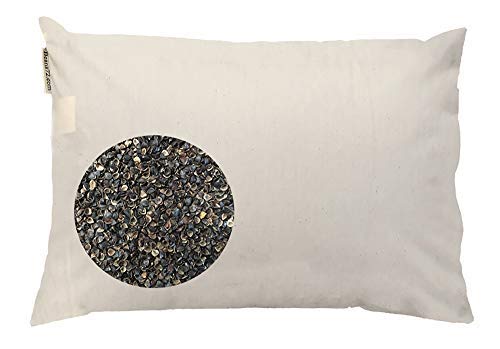
Beans72 Organic Buckwheat Pillow, Queen — Best Overall
Beans72 is one of the original names in buckwheat pillows, and its queen-size organic model is confirmed in the Amazon listing at 20 by 30 inches. If the eco-hypoallergenic brief has a reference product — plant fill, minimal processing, decades-long design — this is it.
Strengths
- Organic buckwheat hulls: a plant fill that dust mites cannot feed on or colonize like protein fills
- Queen 20×30 sizing fits standard queen cases and wider sleeping styles
- Buckwheat’s airflow makes it one of the coolest-sleeping fills made
Trade-offs
- Buckwheat is heavy and firm — a genuine adjustment for soft-pillow sleepers
- Hulls rustle softly when you move; light sleepers notice for the first nights
- Loft is set by fill volume; confirm adjustability on the current listing before ordering
Key specs: Queen 20 x 30 in (Amazon listing); organic buckwheat hull fill.
Buckwheat works by mechanics, not chemistry: thousands of hard, triangular hulls flow around your head and then lock, holding the neck at the height you set instead of slowly collapsing like foam or down. For allergy management the advantage is structural — hulls offer mites no food and no warm protein matrix, and the fill can be aired in sunlight, the oldest allergen control there is. Eco-wise the case is equally plain: hulls are the byproduct of a food crop, the pillow contains no foam chemistry, and at end of life the fill goes to the garden, not the landfill.
Expect a one-to-two-week adjustment: most converts pass through a ‘too firm’ phase into the best neck alignment they have had from a pillow. Air the fill in sun a few times a year, wash the cover on its own cycle, and top up hulls if the loft ever settles — a pillow you can refresh is a pillow you do not replace. Keep it dry; hulls and moisture are enemies.
Best for: allergy-conscious sleepers who want the definitive natural, adjustable fill / Not suited for: sleepers who want a soft, silent, cloud-like pillow from night one
Check on Amazon — check the current price on Amazon before you buy, because bundle and filter options change.

LOFE Buckwheat Pillow 20×26 with Organic Cotton Pillowcase — Best Adjustable
The LOFE pillow makes adjustability the headline: Tartary buckwheat hulls you add or remove to set your exact loft, an organic cotton pillowcase confirmed in the listing, and a Japanese-style design philosophy — the culture that has slept on buckwheat for centuries.
Strengths
- True add-or-remove loft adjustment lets side and back sleepers dial in alignment precisely
- Organic cotton pillowcase included — the organic claim covers the part touching your face
- Tartary hulls are the traditional, durable grade of buckwheat fill
Trade-offs
- Standard 20×26 size only in this configuration — queen-width sleepers should look at the Beans72
- Adjustment takes a few nights of experimentation to perfect
- Same buckwheat rustle and weight as the category generally
Key specs: 20 x 26 in (Amazon listing); Tartary buckwheat hulls; organic cotton pillowcase; adjustable fill.
Loft is the most personal variable in pillow fit — it depends on your shoulder width, mattress firmness and sleep position — and a fixed pillow guesses it for you. The LOFE’s zippered access turns that guess into a setting: side sleepers keep it full for shoulder gap support, back sleepers remove a few cups for a lower cradle. The organic cotton case matters beyond virtue: it is the washable, replaceable interface, and keeping that layer clean is most of practical allergen management for any pillow.
Adjust in small amounts and sleep two nights between changes; neck adaptation lags behind the adjustment itself. Keep the removed hulls in a sealed jar — you may want them back after a mattress change alters your ideal loft. Wash the case hot as its care label allows, and air the hull fill in sun seasonally.
Best for: sleepers who have never found a fixed pillow at the right height / Not suited for: queen-pillow loyalists or anyone unwilling to spend a few nights tuning
Check on Amazon — check the current price on Amazon before you buy, because bundle and filter options change.

Saatva Latex Pillow — Best Soft Natural
Not everyone converts to buckwheat, and the Saatva is the natural-fill answer for them: a shredded latex core, confirmed in the listing as hypoallergenic, in a high-loft build from a brand known for considered materials. Latex contours like memory foam but springs from a plant, sleeps cooler, and lasts far longer.
Strengths
- Shredded latex contours and rebounds — soft feel without foam’s heat and off-gassing concerns
- Latex is inherently resistant to dust mites and mold, the core hypoallergenic logic
- High loft suits side sleepers and broad shoulders
Trade-offs
- Natural latex is an allergen for a small minority — if you have a known latex sensitivity, choose buckwheat instead
- Premium brand tier; the listing’s loft description is the guide, so confirm dimensions at purchase
- Heavier than down or poly fills, like all latex
Key specs: Shredded latex core (Amazon listing); hypoallergenic per listing; high loft.
Shredded latex threads a needle the other fills cannot: it molds to the head and neck like a contour pillow, then recovers instantly when you move, so there is no waiting for foam to re-inflate and no bottoming-out by 3 a.m. Its allergen story is material-deep — latex foam’s structure gives dust mites little purchase and resists mold — and its eco story is a renewable plantation crop processed into one of the most durable fills in bedding, with a service life measured in many years rather than seasons. For the eco buyer who tried buckwheat and missed softness, this is the honest compromise that is barely a compromise.
Use a washable protector and wash the outer cover per label; the latex core itself should be spot-cleaned and aired, never soaked. Keep it out of prolonged direct sun, which degrades latex slowly. Expect the loft to hold for years — when a latex pillow finally tires, it does so gracefully and gradually.
Best for: side sleepers wanting natural materials with a soft, contouring feel / Not suited for: anyone with a latex sensitivity — choose a buckwheat pick instead
Check on Amazon — check the current price on Amazon before you buy, because bundle and filter options change.
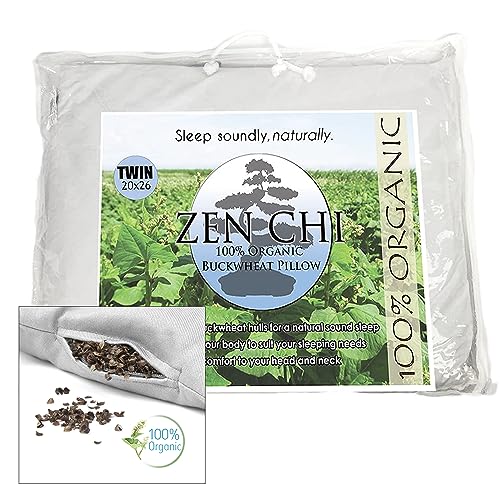
Zen Chi Organic Buckwheat Hull Pillow 20×26 — Best Cooling
The Zen Chi takes buckwheat’s natural advantage — airflow — and builds the pitch around it: organic hulls in an all-cotton cover, confirmed in the listing, in the classic 20×26 twin/standard size. For hot sleepers with allergies, it is the coolest head-rest in this guide, literally.
Strengths
- Hull airflow plus a cotton cover makes this the coolest-sleeping pick here
- All-cotton cover — no synthetic layer between you and the natural fill
- Organic hulls with the category’s standard mite-unfriendly structure
Trade-offs
- Standard size only — no queen width in this model
- Cooling is passive airflow, not refrigeration; very hot sleepers may still want a cooling case
- Firm, rustling buckwheat character, as with the whole family
Key specs: 20 x 26 in (Amazon listing); organic buckwheat hulls; all-cotton cover.
Heat is an underrated pillow complaint: foam insulates, down insulates, and a warm head is a wakeful one. Buckwheat’s hulls leave air channels throughout the fill, so heat dissipates instead of pooling — the ‘natural cooling’ in the listing is physics, not a gel gimmick with a marketing name. The Zen Chi leans fully into that with a breathable all-cotton shell. Allergy sleepers who also sleep hot are doubly served: the same structure that starves mites also vents warmth.
In humid climates, air the pillow in sun more often — hulls manage moisture well but appreciate the help. The cotton cover washes conventionally; dry it fully before refitting. If you migrate from a thick foam pillow, give the firmness two weeks before judging; necks recalibrate slowly and then, usually, gratefully.
Best for: hot sleepers who want natural materials and passive cooling / Not suited for: sleepers wanting a tall, plush loft or queen dimensions
Check on Amazon — check the current price on Amazon before you buy, because bundle and filter options change.

MIOTO Organic Buckwheat Pillow with Extra Hulls — Best Starter Kit
The MIOTO removes the two frictions of switching to buckwheat: it ships with an extra cotton pillowcase and extra Tartary hulls for loft adjustment, all confirmed in the Amazon listing. It is the pick for the buckwheat-curious who want everything in one box.
Strengths
- Extra hulls included — full loft adjustability from day one without a second purchase
- Spare cotton pillowcase keeps the wash rotation effortless
- Organic Tartary hull fill with the family’s mite-resistant, cool-sleeping structure
Trade-offs
- Newer brand than Beans72 or Zen Chi — less long-term track record to consult
- Standard sizing; confirm dimensions on the listing for your bed
- Buckwheat adjustment period applies, as with all hull pillows
Key specs: Organic buckwheat (Amazon listing); extra Tartary hulls included; extra cotton pillowcase included.
The extras are not padding — they are the ownership experience. Extra hulls mean the pillow arrives tunable across the full range, from low back-sleeper cradle to high side-sleeper support, without discovering mid-adjustment that you need to order more fill. The spare case means laundry day never forces a bare-pillow night or a skipped wash, which matters when the whole point is allergen discipline. For a first buckwheat pillow, removing those two annoyances measurably raises the odds the switch sticks.
Start at the shipped fill level, sleep three nights, then adjust by the cupful. Store spare hulls sealed and dry. Rotate the two cases weekly if allergies are active — the case is your most-washed line of defense, and this is the one pick that ships you a rotation out of the box.
Best for: first-time buckwheat buyers who want the complete, tunable kit / Not suited for: buyers who prefer the longest-established brand names
Check on Amazon — check the current price on Amazon before you buy, because bundle and filter options change.

Cuddledown Dreamstead 700 Fill Power Goose Down Pillow — Best Traditional Luxury
The traditionalist’s pick, included with open eyes: the Cuddledown Dreamstead is a European white goose down pillow in a 100% cotton sateen shell, and its listing asserts the things a down pillow must assert to belong here — hypoallergenic processing, handcrafted construction, and OEKO-TEX and RDS certifications. Down is not for every allergy sufferer; for those whose sensitivity is to mites rather than down itself, properly processed and certified down in a washable system is a legitimate, luxurious choice.
Strengths
- Certifications named in the listing itself — OEKO-TEX for substance screening, RDS for responsible down sourcing
- 700 fill power loft is genuinely luxurious and long-lived when cared for
- Cotton sateen shell is tightly woven, which is the mite-barrier half of down’s hypoallergenic case
Trade-offs
- Down is an animal product and a protein fill — true down allergy rules it out entirely, and its eco profile differs from the plant fills
- Premium tier, and it wants a protector and proper care to earn its lifespan
- Needs regular fluffing and airing; neglected down clumps and loses loft
Key specs: European white goose down, 700 fill power (Amazon listing); 100% cotton sateen shell; hypoallergenic per listing; OEKO-TEX & RDS certified per listing; handcrafted per listing.
Why include down in an eco-hypoallergenic guide at all? Because honesty cuts both ways: many ‘down allergy’ cases are dust-mite reactions to poorly cleaned fill, and down that is rigorously washed, encased in tight cotton and certified — as this listing documents — behaves very differently from bargain down. The RDS certification addresses the sourcing ethics that make eco buyers flinch, and OEKO-TEX screens the finished textile. What remains is the feel no plant fill replicates: weightless, moldable, silent luxury. Buy it if your allergist’s distinction — mites, not down — applies to you, and maintain it like the premium textile it is.
A washable protector is non-negotiable; it keeps the fill cleaner for far longer between the careful washes down requires. Fluff daily, air monthly in sun, and store uncompressed. Treated so, quality down outlasts several synthetic pillows — which is its own sustainability argument, made honestly alongside its animal origin.
Best for: traditionalists with mite-only sensitivity who want certified, luxurious down / Not suited for: vegan buyers, true down-allergy sufferers, or anyone wanting plant-based fills only
Check on Amazon — check the current price on Amazon before you buy, because bundle and filter options change.
Comparison Table
| Pick | Badge | Key spec | Best for |
|---|---|---|---|
| Beans72 Organic Buckwheat Pillow, Queen | Best Overall | Organic buckwheat; queen 20×30; naturally cool | allergy-conscious sleepers who want the definitive natural, adjustable fill |
| LOFE Buckwheat Pillow 20×26 with Organic Cotton Pillowcase | Best Adjustable | Adjustable Tartary hulls; organic cotton case | sleepers who have never found a fixed pillow at the right height |
| Saatva Latex Pillow | Best Soft Natural | Shredded natural latex; high loft; mite-resistant | side sleepers wanting natural materials with a soft, contouring feel |
| Zen Chi Organic Buckwheat Hull Pillow 20×26 | Best Cooling | Organic hulls; all-cotton cover; natural cooling | hot sleepers who want natural materials and passive cooling |
| MIOTO Organic Buckwheat Pillow with Extra Hulls | Best Starter Kit | Starter kit: extra hulls + spare case | first-time buckwheat buyers who want the complete, tunable kit |
| Cuddledown Dreamstead 700 Fill Power Goose Down Pillow | Best Traditional Luxury | 700 fill power down; OEKO-TEX & RDS per listing | traditionalists with mite-only sensitivity who want certified, luxurious down |
How to Choose an Eco-Friendly Hypoallergenic Pillow
Interrogate both claims separately. For hypoallergenic, ask: does the fill feed or shelter dust mites? Can the cover be washed, and how hot? Is the fill itself a known allergen for anyone (latex, down protein)? For eco-friendly, ask: what is the fill, where does it come from, how long will it last, and what happens at end of life? A pillow that survives eight years beats a ‘green’ pillow replaced annually on every honest accounting.
Match fill to sleep style. Buckwheat gives firm, set-and-hold support and the coolest sleep; it asks for an adjustment period. Shredded latex gives contouring softness with natural mite resistance; it asks only that you have no latex sensitivity. Certified down gives moldable luxury; it asks for mite-versus-down clarity and careful maintenance. There is no universal best — there is a best per sleeper, which is why this guide carries all three families.
Use adjustability as insurance. Pillow fit depends on shoulder width, mattress and position. Adjustable fills — the LOFE and MIOTO’s add-or-remove hulls — let you correct the guess after purchase, which is the single most practical feature in the category.
- Confirm certifications in the listing itself, not in marketing roundups.
- Buy a washable protector with any pick — it is the cheapest allergen control there is.
- Check the return or trial terms; necks need nights, not minutes, to judge.
- Note your current pillow’s loft before shopping, to anchor the comparison.
Dust Mites, Latex and Down: The Allergy Facts Behind the Labels
Most pillow allergy is dust-mite allergy: mites colonize warm, humid fills that offer food — skin cells and, in protein fills, the fill itself. Buckwheat hulls offer structure without food and can be sun-aired, which is why they anchor this guide. Latex foam’s closed structure resists colonization and mold; its caveat is different — a true latex protein allergy in a small minority, for whom latex pillows are simply out, full stop. Down sits in between: the protein is a potential allergen, but rigorous commercial washing removes the mite load and much of the reactive material, and tight cotton shells block re-colonization — the certified Cuddledown documents exactly that system.
Whatever you choose, the cover discipline matters as much as the fill: a protector washed regularly, cases changed weekly in active allergy seasons, and the pillow itself aired in sunlight. Materials set the ceiling; habits reach it.
What ‘Eco-Friendly’ Should Mean in a Pillow
Apply three tests. Origin: plant fills — buckwheat hulls are a food-crop byproduct; natural latex is tapped sap — carry a fundamentally lighter footprint than petroleum foams, and organic cotton covers reduce the chemical load where your face spends eight hours. Longevity: a refillable buckwheat pillow or a durable latex core stays in service for many years; longevity is the least glamorous and most real eco feature. End of life: hulls compost, latex biodegrades slowly, cotton rots; foams persist. A pillow passing all three tests — like the buckwheat picks here — earns the eco label without adjectives doing the work.
Beware the partial claim: an organic pillowcase over an unnamed synthetic fill is marketing, not ecology. Read the fill line first; it is most of the pillow and most of the footprint.
The Pillow System: Protectors, Cases and Rotation That Make Any Fill Work
Allergy management is a system, and the pillow is only its center. The first layer is a washable protector — ideally a tightly woven or zippered encasement — that stands between your face and the fill, catching the skin cells and moisture that feed mite colonies and intercepting whatever the fill itself might shed. Wash the protector on the hot cycle its fabric allows, on a rhythm of weeks, not months. Above it, the pillowcase changes weekly in allergy season; it is the cheapest, most-washed surface in the system and should be treated as consumable infrastructure rather than bedding décor. The picks in this guide were chosen to cooperate with that system: buckwheat’s cases and covers remove and wash, the MIOTO ships a spare case precisely to make rotation effortless, and latex and down both assume a protector as their working surface.
Rotation and airing complete the discipline. Two pillows in rotation — or one pillow aired while its protector washes — keep any single pillow from becoming a permanently warm, humid habitat, which is the condition mites actually require. Sunlight is the system’s free sanitizer: an hour of sun and moving air on the fill or the whole pillow, a few times a year for buckwheat and monthly for down, does work no spray matches. None of this is heroic housekeeping; it is ten minutes distributed across a month, and it is the difference between a hypoallergenic pillow as a label and as a lived result.
Pillow Loft and Sleep Position: The Fit Guide Behind the Fill Choice
Fill decides a pillow’s character, but loft decides its correctness. Side sleepers need the pillow to fill the distance from mattress to ear — shoulder width made solid — which is why high-loft latex and generously filled buckwheat serve them best. Back sleepers need a lower cradle that supports the neck’s curve without pushing the chin toward the chest; adjustable buckwheat, tuned down by the cupful, is the precision instrument here. Stomach sleepers need the least pillow of all — thin, soft, and forgiving — and are the one group for whom a well-worn down pillow’s compressibility is a genuine feature.
Mattress firmness quietly rewrites all of this: a soft mattress lets the shoulder sink, shrinking the gap a side sleeper’s pillow must fill; a firm mattress leaves the gap at full height. This interdependence is the practical argument for adjustability that runs through this guide — the LOFE and MIOTO’s add-or-remove hulls, the buckwheat family’s general tunability. A fixed pillow is a bet placed once; an adjustable pillow is a fit you can correct when the mattress changes, when your shoulder complains, or when a partner with different geometry inherits the pillow. In a category bought for years of service, correctability is the feature that keeps the purchase correct.
Certifications Decoded: What the Labels on These Pillows Actually Certify
Certification language is where eco-hypoallergenic marketing does its quietest inflating, so this guide’s rule — a certification is mentioned only where the listing itself asserts it — deserves its decoder. OEKO-TEX Standard 100, asserted in the Cuddledown’s listing, tests the finished textile product for a schedule of harmful substances; it speaks to chemical safety of the article you touch, not to the farm or the forest. RDS, the Responsible Down Standard, also in that listing, audits the down supply chain against animal-welfare criteria — no live-plucking, no force-feeding — and says nothing about allergens. ‘Organic’, where listings assert it for the buckwheat fills and cotton in this guide, properly refers to certified organic agriculture for that component — which is why this guide names exactly which component each claim covers: hulls, case, or cover.
The borrower’s rule for all of it: a certification is a floor, not a halo. It verifies the specific thing it tests, for the specific component it covers, and it does not bless the rest of the product by association. Sellers who specify — ‘organic hulls, conventional cotton cover’ — are telling you the truth in parts, which is how truth usually arrives. Sellers who drape one certification across an entire product in adjectives are decorating. The picks in this guide were chosen partly on this evidence discipline, and your own shopping beyond it should demand the same: component by component, claim by claim, exactly as the listings are written.
When to Replace, Refresh or Retire a Natural Pillow
Natural fills age on a different clock from synthetics, and knowing their signals saves both money and necks. Buckwheat’s signal is loft loss with a papery feel: hulls slowly polish and fracture under years of load, and the first remedy is not replacement but refreshment — a top-up of fresh hulls, sold by the pound by the same makers, restores the pillow for a fraction of a new one’s cost and keeps the old hulls for the garden. Latex’s signal is a slow, even softening with no recovery after airing and rotation; a quality core takes years to arrive there, and when it does, the pillow retires whole — latex does not refresh, it endures and then concludes. Down’s signal is clumping that fluffing and a careful wash no longer cure, or a persistent odor after airing: the fill has absorbed more life than it can release, and the honest end has come.
Build the check into an existing rhythm — the daylight-saving weekends work — and perform it the same way each time: fold the pillow, press, release, and watch the recovery; smell it aired; weigh a buckwheat pillow against its younger self if you keep the number. The eco promise of this whole category is longevity with maintenance, and maintenance includes knowing the difference between a pillow asking for ten minutes of care and one asking, fairly after long service, to be composted, recycled or retired with thanks.
Beyond the Pillow: The Low-Allergen, Low-Impact Bedroom Around It
A pillow chosen this carefully deserves a room that does not undo it, and the surrounding system is mostly habits rather than purchases. The mattress beneath wants the same treatment as the pillow above: an encasement that can be washed, bedding laundered on a real rhythm, and a bedroom vacuumed with attention to the floor beside the bed, where dust reservoirs accumulate undisturbed by foot traffic. Humidity is the room’s master variable — dust mites thrive in warm, moist air and falter in drier rooms, so a bedroom kept on the drier side of comfortable, ventilated after showers and in damp seasons, quietly suppresses the entire mite economy that hypoallergenic pillows are bought to escape. None of this requires equipment beyond what most homes own; it requires the calendar discipline this guide has prescribed for the pillow, extended to its surroundings.
The eco half of the room follows the same longevity logic as the fills themselves. Natural-fiber bedding that is washed gently and mended lasts; a bed built from a few durable pieces — the buckwheat or latex pillow, cotton or linen sheets chosen for fiber rather than thread-count theater, a wool or cotton blanket from the same philosophy as this program’s blanket guides — ages as a system, each piece’s lifespan measured in years and their combined footprint a fraction of the fast-bedding cycle. That coherence is the real destination of the eco-hypoallergenic brief: not a single virtuous product, but a sleeping environment whose materials are honest, whose allergens are managed by structure and habit, and whose replacement calendar runs in years. The pillow is where it starts, because it is where your face spends the night — but it was never only about the pillow.
How to Set Up and Adjust a Buckwheat or Latex Pillow
For buckwheat: unzip the inner case over a tray or the bathtub — hulls travel — and start with the pillow slightly overfilled. Sleep two nights before touching it; necks judge slowly. Then adjust by the half-cup: side sleepers generally need the fill to hold the head level with the spine, filling the shoulder gap; back sleepers need less, a gentle cradle with the chin neutral. Press a fist into the finished pillow: it should mold, hold the impression briefly, and feel supportive rather than packed hard. Keep removed hulls sealed and labeled — a mattress change may send you back for them.
For latex: fit the protector, fluff the shredded core evenly by hand, and give it three nights; shredded fills settle into your shape. For down: fluff vigorously on arrival and daily thereafter, and let it air in sun monthly. Across all fills: pillowcase on, protector zipped, and a note in your phone of the date — allergy discipline is a calendar habit, and the pillow rewards it for years.
Common Buying Mistakes
- Trusting ‘eco’ without reading the fill line. The fill is the pillow. An organic case over mystery foam is a costume, not a credential.
- Ignoring the latex caveat. Natural latex is an excellent hypoallergenic fill for most people and a hard no for the latex-sensitive. Know which you are before ordering.
- Judging buckwheat on night one. Hull pillows ask for a one-to-two-week neck adjustment. Deciding in a night discards the category’s best support for no reason.
- Skipping the protector. It is the washable barrier that makes any fill’s allergen story real. Every pick in this guide assumes one.
- Assuming down is automatically out — or automatically fine. Mite sensitivity and down-protein allergy are different diagnoses. Buy for yours, with certifications checked in the listing.
- Never adjusting an adjustable pillow. The feature only pays if used. Tune by the half-cup, two nights apart, until the neck wakes up neutral.
Final Recommendation
The Beans72 Organic Buckwheat is the reference buy — organic hulls, queen size, the category in its purest form. Choose the LOFE if precise loft tuning is your priority, the MIOTO for the complete starter kit with spares, or the Zen Chi if you sleep hot. The Saatva latex is the soft, contouring natural alternative — unless latex is your allergen, in which case the buckwheat family is yours. And the Cuddledown down serves traditionalists whose sensitivity is mites rather than down, with certifications documented in its listing.
Completing a lower-impact, lower-allergen bed? See the sibling guides: Best Duck Feather And Down Pillows, Best Ethical Feather Down Pillows, and Best Encasements For Mattress And Pillows.
Frequently Asked Questions
Are buckwheat pillows really hypoallergenic?
In the practical sense, yes: the hulls give dust mites no food source or protein matrix, the fill can be aired in sunlight, and the covers wash. They contain no latex and no down protein. ‘Hypoallergenic’ is not a regulated guarantee for any pillow, but buckwheat’s structure is about as inhospitable to common triggers as a fill gets.
Is natural latex safe for allergy sufferers?
For dust-mite and mold concerns, latex is one of the best fills — its structure resists both. The exception is true latex allergy, which affects a small minority and is an absolute contraindication. If you react to latex gloves or balloons, choose buckwheat; if not, latex is a sound hypoallergenic choice.
How long does it take to get used to a buckwheat pillow?
Most sleepers need one to two weeks. Start slightly overfilled, adjust by small amounts every couple of nights, and expect a ‘too firm’ first impression to resolve into unusually good neck alignment. The rustle also fades from awareness within the first week for most people.
Can I wash a buckwheat pillow?
Wash the cover and case; do not soak the hull fill. Hulls can be aired in direct sun — the traditional refresh — and if they ever do get wet, they must be dried completely and promptly. The MIOTO’s spare case exists precisely to keep the wash cycle easy.
What does OEKO-TEX or RDS certification actually tell me?
OEKO-TEX Standard 100 screens the finished textile for harmful substances. RDS — the Responsible Down Standard — certifies that down was sourced without live-plucking or force-feeding. Both are asserted in the Cuddledown’s listing itself; as with any certification, they speak to process and sourcing, not to whether down suits your personal allergy profile.
How long should an eco-friendly pillow last?
Far longer than a budget synthetic. Buckwheat fills refresh with top-up hulls and can serve for many years; quality latex cores hold loft for years as well; certified down, protected and aired, is similarly long-lived. Longevity is the core of these picks’ eco case — buy once, maintain, and skip the replacement cycle.
Are these pillows suitable for children?
Buckwheat and latex pillows in standard sizes are adult pillows — firm, heavy and high. Young children need smaller, softer, age-appropriate pillows, and infants should have none at all per safe-sleep guidance. Buy the eco-hypoallergenic logic in a child-specific product rather than handing down an adult pillow.
How do I dispose of an eco-friendly pillow at end of life?
Buckwheat hulls go to compost or garden mulch; cotton covers join textile recycling or the rag bag; latex can go to mattress-and-foam recycling streams where they exist. The long service life of these fills means the question arises rarely — which is rather the point of buying them.
Do buckwheat pillows attract bugs or pantry pests?
Properly processed, food-grade hulls — the kind reputable makers in this guide use — are cleaned and heat-treated, and the dry, hard hull environment is a poor habitat. Store the pillow dry, air it in sun periodically, and the risk stays theoretical. It is moisture, not buckwheat, that invites problems in bedding.
Do buckwheat pillows smell?
New hulls carry a faint, earthy, grain-like scent that most owners stop noticing within the first week as the fill airs. It is the smell of a plant material being itself — the same family of scent as a straw hat or a linen closet. If it bothers you at first, air the pillow in sunlight for an afternoon before its first night.
Can side sleepers and back sleepers share one pillow design?
With an adjustable fill, yes — that is the design’s point. The household compromise is a buckwheat pillow tuned to the higher, side-sleeping loft, with the back sleeper removing a portion into a labeled jar for their nights if the pillow changes beds. Fixed-loft pillows force a choice; adjustable ones negotiate it.
How firm is a buckwheat pillow, really?
Firmer than any foam or down pillow you have slept on — closer to the support of a well-made Japanese floor cushion than to a hotel pillow. The hulls mold precisely and then hold, which reads as firmness with shape rather than hardness. Sleepers who adapt — most do, within two weeks — describe it less as firm and more as ‘finally level’, particularly side sleepers whose necks were bending nightly on collapsing fills.
Are natural pillows a good choice for guest rooms?
An excellent one, with a caveat: guests get one night, not an adjustment period, so the guest bed is where the Saatva’s immediately comfortable latex or a well-kept down pillow earns its place, while buckwheat — the connoisseur’s fill — belongs on the household’s own beds, tuned to their owners. Keep a washable protector on guest pillows without exception; it is the layer that makes hospitality hygienic.

