Disclosure: airfryerkitchensupply.com is reader-supported. When you buy through links on our site, we may earn an affiliate commission at no extra cost to you.
Where to buy
Every towel in this guide was cross-checked against Amazon’s own product data, so the links below are verified, not guessed. Start with the Dock & Bay Beach Towel in Extra Large, the quick-dry all-rounder, and check the current price on Amazon. Then compare the cotton traditionalists: the Sand Cloud Turkish Beach Towel in organic cotton and the WETCAT Turkish Beach Towel in oversized Turkish cotton. For microfiber value and size, look at the ECCOSOPHY Microfiber Beach Towel and the very large Wise Owl Outfitters Beach Towel, and for the lightest packable option, the Cacala Turkish Beach Towel. The guide is organized around a real fork in this category, cotton versus microfiber, and the reviews below are honest about what each material does better, because “high quality” means different things depending on whether you prize a plush dry-off or a towel that shakes sand off and dries before the drive home.
Introduction: what “high quality” means in a beach towel
Shoppers looking for the best high quality beach towels are usually fleeing a specific disappointment: the thin, scratchy, promotional towel that absorbs nothing, fades in a month, and feels like drying off with a flag. Quality in this category is measurable, and it splits into two philosophies. The cotton philosophy says a great beach towel is a textile achievement: long-staple Turkish cotton, woven densely, heavy enough to feel substantial, absorbent enough to dry a swimmer in one pass, and soft enough to lie on for an afternoon. The microfiber philosophy says a great beach towel is an engineering achievement: it absorbs several times its weight, refuses to hold sand, dries in a fraction of cotton’s time, and packs to a quarter of the space, because the beach day it serves involves travel, swimming laps, and a bag that must also hold everything else. Neither philosophy is wrong, and this guide refuses to pretend one is. What quality means in both is execution: materials as stated, dimensions as printed, edges finished so they survive the season, and colors that endure sun and washing.
The six verified picks below cover the spectrum deliberately. Dock & Bay anchors the microfiber end with its recycled quick-dry fabric and travel bag. Sand Cloud and WETCAT carry the cotton flag at two different tiers, organic and premium on one side, classic oversized Turkish cotton on the other. ECCOSOPHY is the microfiber value play in a genuinely oversized cut. Wise Owl is the blanket-scale option for couples and families. And Cacala is the traditional thin Turkish peshtemal, the lightweight travel towel that cotton loyalists have packed for a century. Read the buying guide after the reviews for the material science, GSM, sizes, and care that let you judge any towel beyond these six, then buy the philosophy that matches your beach.
In this guide
Quick Picks
- Best Overall: Dock & Bay Beach Towel, Extra Large — quick-dry, sand-free, 100% recycled fabric with a carry bag, in a full 200 x 90 cm cut. Check the current price on Amazon.
- Best Premium Cotton: Sand Cloud Turkish Beach Towel — 100% organic cotton, sand resistant and quick dry for a cotton towel, with a blanket-worthy drape. Check the current price on Amazon.
- Best Classic Cotton: WETCAT Turkish Beach Towel, Oversized — 100% Turkish cotton at 38 x 71 inches, soft, quick drying for cotton, and compact for its size. Check the current price on Amazon.
- Best Value: ECCOSOPHY Microfiber Beach Towel — oversized 71 x 35 inches, super absorbent, quick dry and sand free at the accessible tier. Check the current price on Amazon.
- Best Oversized: Wise Owl Outfitters Microfiber Beach Towel — a 7 x 4 ft sheet of quick-dry microfiber that works as a two-person beach blanket. Check the current price on Amazon.
- Best Lightweight Travel: Cacala Turkish Beach Towel — the thin, light, 100% cotton peshtemal style at 37 x 70 inches that packs to almost nothing. Check the current price on Amazon.
How These Picks Were Chosen
Only listing-confirmed towels received purchase links, and every specification quoted below, dimensions, materials, recycled content, comes from the verified Amazon title, not from listing photography or marketing claims we could not check.
Within the verified shortlist, selection balanced the category’s two material philosophies across the roles buyers actually shop: an all-round quick-dry anchor, two cotton picks at premium and classic tiers, a microfiber value pick, a blanket-scale oversized pick, and a lightweight travel pick. We weighted stated dimensions heavily, because beach towels are chronically under-sized in marketing and over-promised in photographs; every pick here publishes real measurements in its product data. We also applied this site’s standing rules: no static prices anywhere, since towel pricing swings with color and season, and no fixed star ratings or review counts, for the same reason. Tier language, budget, mid-range, premium, does the positioning work instead.
The 6 Best High Quality Beach Towels

Dock & Bay Beach Towel, Extra Large — Best Overall
Dock & Bay essentially defined the modern travel beach towel, and this extra large version, 200 x 90 cm in Deep Sea Navy, shows why: a quick-dry, sand-free microfiber made from 100% recycled material, compact and lightweight in the bag it includes, yet genuinely full-sized on the sand. The sand-free claim is the one that converts skeptics; dry sand shakes off this fabric instead of embedding the way it does in cotton loops, which means the towel that goes home in your car is not carrying a cup of beach with it. It suits travelers, swimmers, gym-to-beach commuters, and anyone whose beach day involves a bag rather than a beach house. It does not deliver the plush, wrap-up warmth of a heavy cotton towel on a windy evening, and microfiber’s hand feel, smooth and slightly clingy on wet skin, is a texture some people simply prefer less. Those are the honest terms of the category’s best overall pick.
Strengths
- Quick-dry, sand-free performance is the best in this guide, verified as the product’s core design.
- 100% recycled fabric and an included carry bag make it the most considered travel package here.
- True extra large dimensions, 200 x 90 cm, give full-length coverage many “XL” towels only claim.
Trade-offs
- Microfiber feel is smooth rather than plush; cotton loyalists will notice the difference every time.
- Less insulating as an evening wrap than a heavy cotton towel.
- Premium-mid tier pricing for the brand and the recycled fabric story.
| Spec | Detail (from Amazon title) |
|---|---|
| Size | Extra Large, 200 x 90 cm (78 x 35 in) |
| Material | 100% recycled quick-dry fabric |
| Properties | Sand free, compact, lightweight |
| Included | Carry bag |
| Color listed | Deep Sea Navy (Essential) |
Use it as the system it is designed to be: shake it before you leave the sand, hang it for the short time it needs to dry, and let it live in its bag in your tote so a beach hour can happen on impulse. For the widest range of real beach days, travel, pool, lake, and the spontaneous kind, this is the towel this guide would hand a friend first.
Best for: travelers, swimmers, and anyone who hates sandy cars and slow-drying towels. / Not suited for: plush-cotton devotees or windy-evening wrapping.

Sand Cloud Turkish Beach Towel — Best Premium Cotton
Sand Cloud takes the cotton philosophy seriously: a Turkish beach towel in 100% organic cotton, sand resistant and quick dry by cotton’s standards, with the drape and weight to double as a picnic or beach blanket, in the Marine Life design in this listing. Organic cotton is the premium claim here, and it is stated plainly in the Amazon title rather than implied, which is how premium claims should behave. The towel suits buyers who want the natural-fiber experience, real cotton softness against skin, a substantial lie-on surface, and a product whose materials story they can verify, and who accept cotton’s physics: it absorbs beautifully, dries slower than microfiber, and carries sand more willingly, though this weave is designed to shed it better than standard terry. It is the guide’s premium cotton pick because it is the cotton pick that tries hardest to answer microfiber’s arguments while remaining honestly cotton.
Strengths
- 100% organic cotton, stated in the verified Amazon title, for buyers who shop materials first.
- Sand resistant and quick dry for a cotton towel, narrowing microfiber’s practical lead.
- Substantial enough to serve as a beach or picnic blanket, not merely a dry-off towel.
Trade-offs
- Premium tier; organic cotton and the brand’s positioning cost more than every other pick here.
- Still cotton: slower drying and heavier when wet than any microfiber in this guide.
- Design-led colorways mean your preferred pattern may not always be the one in stock.
| Spec | Detail (from Amazon title) |
|---|---|
| Material | 100% organic cotton, Turkish |
| Properties | Sand resistant, quick dry |
| Design listed | Marine Life (Swirl Turtle) |
| Dual use | Beach towel / picnic blanket |
Buy this towel when the beach day is the destination rather than a stop: long afternoons, a towel that is also the blanket, and a dry-off that feels like an amenity. It is the premium expression of the cotton philosophy and earns the tier by materials honesty.
Best for: cotton loyalists, long beach days, and materials-first buyers. / Not suited for: ultralight packing or anyone who needs a towel dry within the hour.
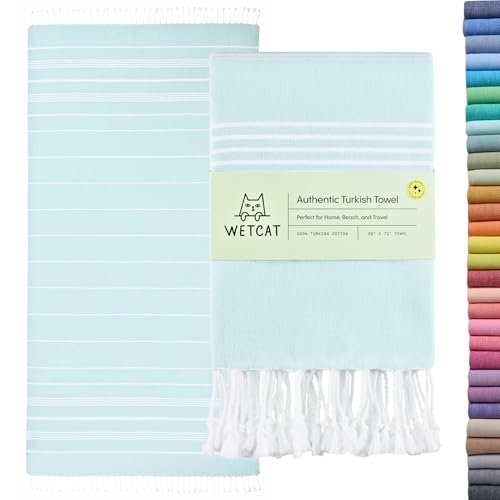
WETCAT Turkish Beach Towel, Oversized — Best Classic Cotton
The WETCAT is the classic Turkish cotton beach towel executed at generous scale: 100% Turkish cotton, made in Turkey per its Amazon title, oversized at 38 x 71 inches, and described as sand free, ultra soft, quick drying, and compact and lightweight for travel relative to its size. That combination, real cotton with real dimensions at a mid-range tier, is rarer than it should be, because the budget end of cotton beach towels is where undersizing and thin weaving hide. WETCAT’s proposition is the traditional one done properly: a towel big enough to lie on without your feet in the sand, soft from the first wash, and light enough, for cotton, to earn its place in a suitcase. It suits households stocking up for family beach weeks and anyone whose reference towel is a good hotel pool towel. It will not out-dry microfiber and does not pretend to; its quick-dry claim is within cotton’s honest limits, helped by a weave that is not over-piled.
Strengths
- Genuine oversized dimensions, 38 x 71 inches, in 100% Turkish cotton.
- Soft, absorbent classic terry experience at a mid-range tier.
- Packs more compactly than its size suggests, making it the cotton pick for travel.
Trade-offs
- Cotton drying time and wet weight remain cotton’s, whatever the weave.
- Sand releases less completely than from microfiber; shake it well and often.
- Light colors in this style show beach-day staining more honestly than dark microfiber.
| Spec | Detail (from Amazon title) |
|---|---|
| Size | Oversized, 38 x 71 in |
| Material | 100% Turkish cotton, made in Turkey |
| Properties | Sand free positioning, ultra soft, quick drying, compact |
| Color listed | Aqua |
If your mental image of a beach towel is cotton, this is the one to buy in multiples: consistent, generous, and honestly made. It is the classic pick because it respects the classic form instead of discounting it.
Best for: families, cotton traditionalists, and beach-week stocking up. / Not suited for: fast-dry devotees or minimal packers.
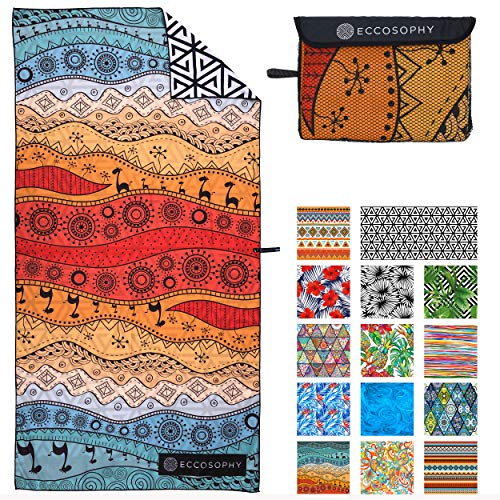
ECCOSOPHY Microfiber Beach Towel — Best Value
ECCOSOPHY’s towel is the microfiber formula at full size and a value tier: oversized at 71 x 35 inches, quick dry, sand free, super absorbent and lightweight, in the Marrakesh design in this listing, positioned by its maker for swimming, pool, cruise, camping, and travel. The value here is real because microfiber’s performance does not scale with price the way cotton’s does; a well-made budget microfiber towel dries nearly as fast and packs nearly as small as a premium one, and the differences show up in edge finishing and long-term softness rather than in the core function. For buyers outfitting several people, or a cruise bag, or a gym locker, that math wins. The trade-offs are the category’s: smooth microfiber hand feel, less wrap warmth, and a fabric that asks for simple care, no fabric softener, to keep its absorbency. As the guide’s budget pick it is verified, genuinely oversized, and honestly specified, which is the entire requirement.
Strengths
- Full microfiber performance, quick dry, sand free, absorbent, at the value tier.
- Truly oversized at 71 x 35 inches; no shrink-to-fit games.
- Lightweight and compact for cruises, camping, and multi-towel packing.
Trade-offs
- Edge finishing and long-term hand feel trail the premium microfiber pick.
- Microfiber texture is not for cotton devotees.
- Fabric softener and high heat degrade microfiber absorbency; care discipline required.
| Spec | Detail (from Amazon title) |
|---|---|
| Size | Oversized, 71 x 35 in |
| Material | Microfiber |
| Properties | Quick dry, sand free, super absorbent, lightweight, compact |
| Design listed | Marrakesh |
Buy it in the quantity your life needs and spend the savings on the beach itself. In a category where the budget tier often means quietly smaller and thinner, a verified full-size performer is the smart shopper’s pick.
Best for: value shoppers, cruises, camping, and outfitting several people. / Not suited for: buyers who want premium finishing or cotton feel.

Wise Owl Outfitters Microfiber Beach Towel — Best Oversized
Some beach products stop being towels and become territory, and the Wise Owl, at 7 x 4 ft, is that product: an extra large microfiber sheet, quick dry, lightweight and sand free, sized by its Amazon title at 84 x 48 inches for adults at the beach, pool, gym, or for travel and outdoor use. Two people can lie on it. A family can stage a base camp on it. A tall person can stretch out entirely on it, a sentence almost no other towel in this guide can claim. Wise Owl comes from the camping world, and the towel behaves accordingly: it packs far smaller than its deployed size suggests and dries with microfiber speed. The honest trade-off is that as a personal dry-off towel it is unwieldy, all that fabric is a lot to wrap and wring, and its thin microfiber build offers no plushness. It is not competing with the cotton picks on comfort; it is competing with beach blankets, and against blankets it wins on weight, sand behavior, and drying time.
Strengths
- The largest deployed size in this guide, a genuine two-person surface.
- Microfiber sand release and fast drying at blanket scale.
- Packs to a fraction of an equivalent cotton blanket’s bulk.
Trade-offs
- Too much fabric for a quick personal dry-off; pair it with a smaller towel for that job.
- Thin microfiber offers coverage, not cushion or plushness.
- Its size makes home laundering a full-load event.
| Spec | Detail (from Amazon title) |
|---|---|
| Size | Extra large, 7 x 4 ft (84 x 48 in) |
| Material | Microfiber |
| Properties | Quick dry, lightweight, sand free |
The smart setup this pick enables is a two-piece system: the Wise Owl as the ground layer and base, a personal towel from elsewhere in this guide for drying off. Bought for that system, it is the most useful square footage in the article.
Best for: couples, families, and tall beachgoers wanting a real base layer. / Not suited for: solo minimalists or plush-seekers.

Cacala Turkish Beach Towel — Best Lightweight Travel
The Cacala is the peshtemal, the traditional flat-woven Turkish towel: 100% cotton, lightweight and thin, sand-free and quick-drying by design, extra large at 37 x 70 inches in this listing, and positioned as a travel towel and beach accessory. Flat-weave cotton dries fast because there is barely anything to dry, packs to the size of a paperback, and has served Mediterranean beachgoers for generations before microfiber existed. Its absorbency works differently from terry: it wipes and sheets water rather than soaking it into loops, which feels less luxurious and works better than first impressions suggest, improving with washing as the cotton softens. It suits travelers above all, one-bag packers, and anyone who wants a towel that is also a wrap, a sarong, a picnic cloth, and a light blanket. It will not cushion you on hard sand or warm you like a heavy towel, and buyers expecting terry plush should choose WETCAT instead. As the lightest verified full-size option here, it owns the travel slot honestly.
Strengths
- The lightest, most packable full-size towel in this guide, in real cotton.
- Flat weave sheds sand and dries quickly without any synthetic fiber.
- Multi-use: towel, wrap, throw, and picnic layer in one piece.
Trade-offs
- Thin means thin: no cushioning and little warmth as an evening wrap.
- Absorbency style is wiping, not terry’s soak; expect an adjustment period.
- Flat-weave cotton softens with washing but starts comparatively crisp.
| Spec | Detail (from Amazon title) |
|---|---|
| Size | 37 x 70 in |
| Material | 100% cotton, Turkish peshtemal style |
| Properties | Lightweight, thin, sand-free, quick-drying |
Pack two and they still take less room than one terry towel, which is the peshtemal’s centuries-old argument and still its best one. For the traveler, this is the quality pick that respects the suitcase.
Best for: one-bag travelers and multi-use minimalists. / Not suited for: buyers wanting plush terry comfort or sand cushioning.
Comparison Table
| Pick | Badge | Key spec | Best for |
|---|---|---|---|
| Dock & Bay Beach Towel XL | Best Overall | 200 x 90 cm, 100% recycled quick-dry fabric, sand free, carry bag | Travel and everyday beach |
| Sand Cloud Turkish Beach Towel | Best Premium Cotton | 100% organic cotton, sand resistant, blanket-capable | Long beach days, materials-first buyers |
| WETCAT Turkish Beach Towel | Best Classic Cotton | 38 x 71 in, 100% Turkish cotton, oversized | Families and traditionalists |
| ECCOSOPHY Microfiber Beach Towel | Best Value | 71 x 35 in microfiber, quick dry, sand free | Value, cruises, groups |
| Wise Owl Outfitters Beach Towel | Best Oversized | 7 x 4 ft microfiber, two-person surface | Couples and family base camps |
| Cacala Turkish Beach Towel | Best Lightweight Travel | 37 x 70 in flat-weave cotton peshtemal | One-bag travel |
How to Choose a High Quality Beach Towel
Choose the material first, because it decides the towel’s whole personality. Cotton, especially Turkish cotton, wins on feel: soft, absorbent in the familiar terry way, substantial to lie on, and improving with washing. Its costs are drying time, wet weight, and sand retention. Microfiber wins on logistics: it dries in a fraction of the time, shakes sand off instead of storing it, absorbs impressively for its weight, and packs small enough to change what bag you carry. Its costs are hand feel, a smooth, sometimes clingy texture on wet skin, and care rules, no softener, moderate heat, that protect its absorbency. Flat-weave cotton, the peshtemal, splits the difference for travelers: natural fiber, minimal pack size, fast drying, modest absorbency. There is no material that wins all three columns, and any guide claiming otherwise is selling something.
Size second, and insist on numbers. A beach towel should be longer than you are tall in your lying-down ambitions: standard towels around 60 inches serve children and chair-draping, while the 70-inch-plus class in this guide serves adults lying flat. Width matters for the same reason; a towel narrower than your shoulders is a strip, not a surface. Every pick here publishes dimensions in its verified product data, and that is the habit to demand of any towel you consider: if the listing will not state inches or centimeters, assume the towel is smaller than its photographs.
Then read construction. In cotton, density and weave decide absorbency and lifespan more than any single number; a towel that feels substantial in hand and whose edges are properly hemmed will outlast a fluffy lightweight that sheds its loops by August. In microfiber, edge finishing is the tell of the tier, and a carry bag or strap signals a maker thinking about the towel’s real life in transit. Finally, buy for your actual beach: the daily local swimmer wants drying speed and sand behavior, the week-long renter wants cotton multiples, the traveler wants the peshtemal or the Dock & Bay, and the family wants one oversized base plus personal towels. Quality is fitness for your use, verified in the product data, and nothing else.
How to Care for Beach Towels So They Stay Absorbent
More towels are ruined by laundry than by beaches. Rule one applies to both materials: skip the fabric softener. Softener coats fibers with a waxy film that feels silky and absorbs terribly, and on microfiber it is close to a death sentence for absorbency; a towel that stops drying you has usually been softened, not worn out, and a hot wash with a cup of white vinegar in the rinse can often strip the buildup and restore it. Rule two: wash before first use, especially cotton, to remove factory finishes and set the fibers, and expect cotton towels to reach peak softness after several washes rather than out of the packet. Rule three: dry completely, in sun when you can, because a towel stored damp mildews and the smell survives washing. Rule four: shake sand out before the wash, not into the machine, and wash beach towels as their own load so grit and sunscreen do not migrate. Rule five, for microfiber: moderate heat only, since high dryer heat damages the split fibers that do the absorbing. Follow those five and the towels in this guide will serve for seasons; ignore the first and you can ruin the best towel here in a single laundry day.
Reading Towel Specifications Like a Buyer: GSM, Staple, and Weave
Cotton towels are graded by GSM, grams per square meter, and while none of the verified picks in this guide prints a GSM in its Amazon title, which is why none is quoted as a product specification here, the scale is worth knowing for your own shopping beyond this list. Lightweight towels live at the low end, dry fast, pack small, and feel thin because they are. The middle band is where most good beach towels sit, substantial enough to absorb and to lie on, still capable of drying in a day’s sun. The heavy end belongs to bath luxury: magnificent after a shower, slow and sodden at a beach house, and usually the wrong purchase for sand and travel. GSM is a density measure, not a quality verdict; a mid-weight towel woven from long-staple cotton will out-absorb and out-last a heavier one woven from short fibers, which is why the second specification matters as much as the first.
Staple length is the fiber story behind Turkish cotton’s reputation. Longer cotton fibers spin into smoother, stronger, less lint-prone yarn, and towels woven from them stay soft and intact through seasons of washing where short-staple towels pill, shed, and thin. It is also why two towels of identical GSM can age completely differently, and why “100% Turkish cotton,” stated in the verified data as it is for the WETCAT, Sand Cloud, and Cacala picks here, carries information that a bare weight number does not. Weave is the third leg: terry loops maximize absorbency and plushness, flat weaves like the peshtemal minimize weight and drying time, and microfiber sidesteps the whole taxonomy with split synthetic fibers whose absorbency comes from surface area rather than loops. A buyer who can read those three specifications, weight, staple, weave, in a listing’s data can predict a towel’s behavior before it ever touches sand, which is the actual skill this category rewards.
Building a Beach Towel Kit: One Towel Is Not a System
Households that beach well rarely own one kind of towel, because the jobs are genuinely different and the guide’s six picks map onto them neatly. The base layer job, defining territory, insulating from hot or rough sand, hosting the bag and the book and the sleeping toddler, belongs to the largest surface you own, the Wise Owl’s role, or to a substantial cotton like the Sand Cloud when the base must also feel like a blanket. The dry-off job belongs to personal towels, one per swimmer, chosen by material philosophy: microfiber for the swimmer who is in and out of the water all day and needs the towel dry again by the next plunge, cotton for the swimmer who takes one long swim and wants the wrap afterward to feel like an event. The travel job belongs to the Cacala and the Dock & Bay, the two picks that disappear into luggage. And the spare job, the towel that lives in the car for the unplanned lake, the rained-on dog, the spilled cooler, is where the ECCOSOPHY’s value tier stops being a compromise and becomes the strategy: a good towel bought cheaply enough to be deployed without ceremony.
Sizing the kit is arithmetic, not shopping: regular beachgoers times beach days between laundry opportunities, plus one base, plus one spare. A couple beaching three days straight on a rental week needs six personal towels or a midweek wash, and discovering that on day two is the classic vacation friction this arithmetic exists to prevent. Buy the kit in distinguishable colors or designs per person, a small decision that ends the daily negotiation over whose towel is whose and, not incidentally, makes the beach photographs better. None of this requires six premium towels; it requires the right towel in each role, which is the entire architecture of this guide’s picks, and a household that builds the kit once will not think about beach towels again for years.
Sand, Salt, and Sun: How Beach Conditions Age a Towel
A beach towel’s enemies are specific, and knowing them explains several care rules that otherwise sound fussy. Sand is an abrasive: worked into terry loops and then ground by feet and bodies, it saws at fibers all afternoon, which is one more reason the shake-out ritual matters and why microfiber and flat weaves, which release sand instead of storing it, age more gracefully in heavy beach use. Salt water leaves mineral residue that stiffens cotton as it dries, so the crunchy towel on day three of a beach week is not dirty so much as salted, and a rinse in fresh water restores more softness than an extra wash cycle. Chlorine is the quiet bleacher of pool towels, fading dyes and weakening fibers across a season; darker, saturated colorways and synthetic microfiber both resist it better than pale cotton, a practical argument for assigning the ECCOSOPHY or Dock & Bay to pool duty and keeping the premium cottons for the beach they were bought for. Sunlight itself is the final agent, ultraviolet breaking down dyes and, slowly, the fibers themselves, which is why towels stored draped over sunny railings for entire summers fade in stripes that map the railing exactly. None of this demands anxiety; it demands rotation, a rinse when convenient, shade for storage, and the understanding that a towel’s second season appearance is decided by these small physics more than by its price tag. The picks in this guide were chosen with materials stated in verifiable data precisely so you can match each one to the conditions it will actually meet.
Color, Pattern, and the Practical Aesthetics of the Beach Kit
It sounds like the least serious section in the guide and quietly prevents the most daily friction. Assign colors by person and by job, and hold the assignment: when every swimmer owns a distinguishable towel, the whose-is-whose negotiation that opens every beach day simply stops happening, and a missing towel announces its owner by its absence. Choose those colors with the conditions in mind rather than the catalog photograph. Dark and saturated tones hide the honest staining of beach life, sunscreen, sand minerals, and the occasional berry, and they resist chlorine fade better at the pool; pale and white towels look magnificent for exactly one holiday and then testify about all of them. Stripes and strong patterns earn their classic status functionally as well as aesthetically: they disguise the uneven fading that sun and washing guarantee, and they make your patch of sand findable from the water, a navigational feature every swimmer has used without ever crediting the towel. Finally, photograph your kit once, laid out, before the first trip: when a towel is left at a rental, a pool, or a friend’s beach house, that photograph settles identification faster than any description. Small systems, like the kits in this guide generally, are what separate households that beach effortlessly from households that re-buy towels every June.
Kids, Dogs, and Other Honest Stress Tests
Households with children and dogs evaluate towels by standards no showroom simulates, and the picks sort themselves differently under that audit. For children, the virtues reorder toward the indestructible and the identifiable: microfiber’s quick drying matters because a child’s towel is somehow always wet, its sand release matters because children import sand professionally, and a personal color or design per child ends disputes that adults find funnier in retrospect than at 8 a.m. on a beach rental’s checkout day. The ECCOSOPHY’s value tier is a strategic asset here, because towels assigned to children should be priced for the losses that will occur. Dogs add abrasion and enthusiasm: a towel drafted for dog duty, drying a wet dog, lining a car seat, should be the kit’s designated workhorse, and the Wise Owl’s size makes it the natural assignee, big enough to matter and hard-wearing enough to be honored with the job. None of this is a demotion of the premium cottons; it is the kit logic of the earlier section applied honestly, with the Sand Cloud reserved for the adults’ long afternoons and the whole system surviving contact with the household as it actually is.
Pool Days Are Not Beach Days: Assigning Towels by Venue
One last kit refinement, because the two venues punish towels differently. Pool water carries chlorine, which fades dyes and tires cotton fibers across a season, while pool decks are clean, flat, and sand-free, so the pool kit can be lighter, brighter, and more numerous without consequence. The beach adds sand abrasion, salt stiffening, and wind, which argues for the sand-shedding microfibers and the flat-weave peshtemal on the sand itself. Households that swim in both places do well to designate rather than rotate blindly: microfiber and darker cottons to the pool bag, the full kit logic to the beach bag, and the premium organic cotton reserved for the long beach afternoons it was bought for. It is a small administration, performed once, that doubles the graceful life of every towel in this guide.
The Hotel Test: What Good Beach Towels Share With Good Hotel Towels
There is a reason several makers in this category borrow hotel language, and it is not only flattery. Hotels replace towels on evidence: a towel that survives industrial laundering, keeps its hand, and dries a guest completely is a towel whose construction was honest, because no hotelier reorders on adjectives. The qualities that pass that test, dense and even weaving, fibers long enough to stay soft after a hundred washes, edges that do not unravel, and colors that hold through commercial cycles, are the same qualities this guide selected on in verified product data. You cannot run a hundred-wash trial before buying, but you can buy the construction traits that predict one, and you can treat any towel that fails early at home as data about its maker rather than about your laundry. That is the hotel test, and the six picks here were chosen to pass it.
Common Buying Mistakes
The first mistake is buying by photograph instead of by dimensions, then meeting a towel six inches shorter than expected on the first beach day. The second is expecting one material to do everything, then blaming cotton for drying slowly or microfiber for feeling smooth, when both were honest about their physics. The third is judging quality by initial fluffiness, which in cotton often means loose loops that shed, rather than by density and finishing. The fourth is laundry sabotage: fabric softener on every wash, wondering by July why nothing absorbs. The fifth is buying a single standard-size towel for a family and discovering that beach real estate is a zero-sum negotiation. And the sixth is paying premium prices for premium adjectives, “luxury,” “resort,” “spa,” without a single verified specification, material, dimension, or construction detail, behind them. The product data is the towel; read it.
Final Recommendation
For most people, the answer is the Dock & Bay Extra Large: verified recycled quick-dry fabric, real dimensions, sand that shakes off, and a bag that makes the whole thing a system, so check the current price on Amazon and make it your default. Cotton loyalists should choose between the Sand Cloud at the premium, organic end and the WETCAT as the classic oversized workhorse, and families should add the Wise Owl as the shared base layer. Value shoppers get genuinely full-size microfiber performance from the ECCOSOPHY, and travelers should pack the Cacala peshtemal and use the saved suitcase space for something better than terry. Every pick is listing-verified with its material and dimensions stated as its maker declares them, which, in a category sold on adjectives, is the quality signal that counts.
More towel and summer guides from this program: Best Large Beach Towels · Best Thin Beach Towels · Best High Quality Towels · Best Selling Pool Towels
Related guides
Frequently Asked Questions
Is cotton or microfiber better for a beach towel?
They win different contests. Cotton feels softer and more luxurious, absorbs in the familiar terry way, and makes the better lie-on surface. Microfiber dries far faster, refuses sand, and packs far smaller. Choose by your beach day: long, local, and leisurely favors cotton; travel, swimming, and spontaneity favor microfiber. This guide’s Best Overall is microfiber because most modern beach days are the second kind.
What size should a high quality beach towel be?
Long enough to lie on fully. For most adults that means the 70-inch class and above, which is where every pick in this guide sits, up to the Wise Owl’s full 7 feet. Standard 60-inch towels are chair towels and children’s towels whatever their marketing says. Always buy from stated dimensions, never from size adjectives.
Why did my beach towel stop absorbing water?
Almost always fabric softener or dryer-sheet buildup coating the fibers, or, for microfiber, heat damage from hot drying. Try a hot wash with white vinegar in the rinse to strip the coating before replacing the towel. Going forward, skip softener on towels entirely; absorbency is the quality you bought, and softener trades it away.
What makes Turkish cotton towels special?
Long-staple cotton fibers, which spin into smoother, stronger yarns that weave into towels that are soft, absorbent, and durable at once, plus a weaving tradition built around exactly this product. The verified Turkish picks here, Sand Cloud, WETCAT, and the Cacala peshtemal, show the tradition in three forms: premium organic terry, classic oversized terry, and flat-weave travel weight.
How many beach towels should a household own?
One per person per day is the comfort standard for a beach week, because cotton needs a full day to dry between uses; microfiber’s speed stretches that to one per person with a midweek wash. A practical household kit is two per regular beachgoer, plus one oversized shared base like the Wise Owl for the group.
Are sand-free towels really sand free?
Microfiber’s smooth, split-fiber surface genuinely releases dry sand with a shake in a way looped cotton cannot, and flat-weave cotton sheds sand nearly as well. Wet sand clings to everything, and no towel repeals that. The honest claim, which this guide’s microfiber picks support, is that you bring home dramatically less beach than a terry towel carries.


