Disclosure: airfryerkitchensupply.com is reader-supported. When you buy through links on our site, we may earn an affiliate commission at no extra cost to you.
Where to buy
Every tub in this guide to the best tubs under a thousand was verified against the airfry site’s Amazon catalog data before this guide was written. Tub pricing moves with finish, drain color, and freight promotions, so confirm the total — including delivery — on the product page; the under-a-thousand framing of this guide is a budget tier, and any exact figure printed here would be stale before you read it.
- WOODBRIDGE 59″ Acrylic Freestanding Bathtub (B0014-MB, Matte Black Trim): Check the current price on Amazon
- DeerValley 55″ Acrylic Freestanding Bathtub (DV-1T0582): Check the current price on Amazon
- GAOMON 59″ Freestanding Acrylic Soaking Tub: Check the current price on Amazon
- Empava 59″ Freestanding Bathtub (Acrylic Deep Soaking): Check the current price on Amazon
- Vanity Art 67″ x 32″ Acrylic Freestanding Bathtub (VA6813B-L-PW): Check the current price on Amazon
- FerdY Koh Samui 65″ Freestanding Bathtub: Check the current price on Amazon
Shopping for the best tubs under a thousand puts you in the market’s sweet spot, and it is worth saying plainly why: below this tier, freestanding tubs cut corners in acrylic thickness, drain quality, and certification; above it, you mostly pay for stone resin, brand prestige, and jetted hardware. In between sits a deep bench of acrylic soaking tubs — light, warm, repairable, and genuinely beautiful — that dominate real renovations. All six picks here are verified current products in that tier: five freestanding acrylic soakers in the sizes real bathrooms use, chosen across the footprint range from a compact 55 inches to a stretch-out 67.
Two honest boundaries before the picks. First, ‘under a thousand’ describes the tub itself in this tier; a freestanding installation also needs a filler faucet and sometimes floor work, and the buying guide below budgets those honestly so the project total does not ambush you. Second, this tier is a soaking tier — jets, heaters, and chromotherapy live above it, and no pick here pretends otherwise. What you get instead is the oldest luxury in bathing: deep, quiet, hot water in a beautiful vessel, at a price that leaves budget for the rest of the bathroom.
Who should read this guide most carefully? Anyone mid-renovation with a fixed total budget, because the tub is where bathroom budgets go to be ambushed — not by the fixture itself, which this tier keeps honest, but by the filler, the floor work, and the ‘while we are at it’ upgrades that attach themselves to a beautiful new centerpiece. Read the picks for the tub; read the buying-guide sections for the project. Both halves are the recommendation.
In this guide
Quick Picks
- WOODBRIDGE 59″ Acrylic Freestanding Bathtub (B0014-MB, Matte Black Trim) — Best Overall: the sweet-spot size and finish combination: a 59-inch contemporary soaking tub with matte black trim, from the brand that dominates this tier. — Check the current price on Amazon
- DeerValley 55″ Acrylic Freestanding Bathtub (DV-1T0582) — Best for Small Bathrooms: a 55-inch deep soaker with a center drain and integrated overflow — the compact footprint that still delivers a genuinely deep bath. — Check the current price on Amazon
- GAOMON 59″ Freestanding Acrylic Soaking Tub — Best Clean-Lined Value: a contemporary 59-inch deep soaker with a non-slip surface and drain included — straightforward spec, home-spa brief. — Check the current price on Amazon
- Empava 59″ Freestanding Bathtub (Acrylic Deep Soaking) — Best Certified Pick: a cUPC-certified 59-inch acrylic soaker with a 15-inch soak depth, ergonomic back support, and anti-slip bottom. — Check the current price on Amazon
- Vanity Art 67″ x 32″ Acrylic Freestanding Bathtub (VA6813B-L-PW) — Best for Tall Bathers: the long one: 67 by 32 inches of acrylic soaking space with a pop-up drain included and UPC certification — room to actually stretch. — Check the current price on Amazon
- FerdY Koh Samui 65″ Freestanding Bathtub — Best Design Pick: the designer’s tub: an elegant 65-inch oval with double-walled insulation for longer heat retention and a minimalist linear overflow. — Check the current price on Amazon
How These Picks Were Chosen
The first filter was the tier itself: each tub had to be a model genuinely sold in the under-a-thousand segment of the market — full-size freestanding or deep soaking tubs, not foot baths, inflatable tubs, or faucet bundles wearing a tub’s name. The second filter was verification: every pick was confirmed as a current product through the site’s Amazon catalog check, and every specification quoted here — dimensions, drain type, certification, construction — comes from the manufacturer’s own listing. Where a listing claims certification, we name the certification; we do not invent specifications a listing does not state.
A note on how the tier was policed: freestanding tub pricing is unusually fluid — the same model moves with drain finish, freight distance, and seasonal promotion, sometimes across the tier line in both directions within a month. We therefore selected models whose established market position sits in this segment rather than models caught by a single temporary discount, and the article repeats the only safe advice: confirm the live total, freight included, on the day you order. A guide that printed exact tub prices would be misleading you by the weekend.
The third filter was coverage. A useful guide to this tier has to span the decisions buyers actually face: the compact bathroom, the standard bathroom, the tall bather, the permitted renovation, the design-led renovation, and the family-safety question. The six survivors map to those six decisions, and each review states who should walk past it as clearly as who should stop. Jetted and air-bath models were excluded deliberately: their honest prices sit above this tier, and including them would break the guide’s promise.
The 6 Best Tubs Under a Thousand

1. WOODBRIDGE 59″ Acrylic Freestanding Bathtub (B0014-MB, Matte Black Trim) — Best Overall
If one tub defines the under-a-thousand freestanding market, it is a WOODBRIDGE acrylic soaker in the 59-inch class, and this B0014 variant pairs the glossy white shell with matte black overflow and drain hardware — the finish combination modern bathrooms actually ask for. The contemporary oval silhouette suits both minimalist and transitional rooms, and the 59-inch footprint fits the alcove-replacement and modest-primary-bath layouts where 67-inch tubs simply do not.
Acrylic is the right material at this tier for reasons beyond cost. It is light enough for two-person placement without structural anxiety, warm to the touch compared with cast iron or stone, and forgiving of the chips and scratches of family life in ways that polish out rather than crack. WOODBRIDGE’s presence across this entire guide is not favoritism — it is what the verified market looks like; the brand manufactures more freestanding acrylic models in this tier than anyone else, which also means drains, overflows, and support are easy to source years later.
As a soaking tub — no jets, no electronics — it asks nothing of your electrical system and gives back silence. Fill it, and the design’s job is to hold heat and hold you: a sloped back, a flat stable bottom, and enough depth for a real soak rather than a decorative sit.
Strengths
- 59-inch size fits standard bathroom footprints
- Matte black hardware matches modern fixtures
- Acrylic is light, warm to the touch, and repairable
Trade-offs
- Soaking only — no jets or air bath features
- Acrylic needs non-abrasive cleaning to keep its gloss
- Freestanding placement needs floor drain planning
| Length | 59 inches |
| Material | Acrylic |
| Hardware finish | Matte black overflow and drain |
Choose this tub if you want the canonical under-a-thousand upgrade: a freestanding silhouette, a finish that matches current hardware trends, and a size that respects a normal bathroom. It is the safest recommendation in this guide for resale-minded renovators too, because nothing about it will date quickly. Buyers wanting a longer stretch should look at the 67-inch Vanity Art below; buyers wanting the smallest footprint should look at the DeerValley. Between those poles, this is the balanced default.
Installation reality is part of its appeal: at acrylic weight, a competent two-person crew places it without floor reinforcement in most homes, and the included drain and overflow remove the most common compatibility headache in this tier. Budget your project around the faucet — freestanding tubs need floor-mount or wall-mount fillers that are not part of the tub’s price — and the total stays honest.
Best for: standard bathrooms wanting the modern freestanding look with black hardware / Not suited for: jet seekers or very tall bathers wanting maximum length
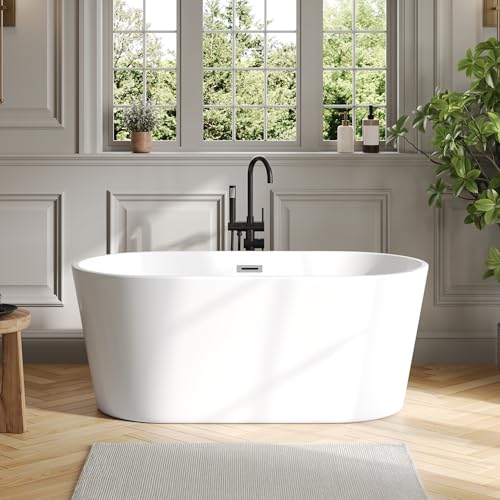
2. DeerValley 55″ Acrylic Freestanding Bathtub (DV-1T0582) — Best for Small Bathrooms
Small bathrooms usually get told to give up on soaking. The DeerValley DV-1T0582 is the counter-argument: a 55-inch freestanding footprint — compact enough for tight primary baths and generous guest baths — engineered around depth rather than length, with an ergonomic interior that supports a seated soak instead of a stretched one. Its listing calls out the deep soaking design, the center drain, and the integrated overflow, and those three details are exactly the compact-tub checklist.
The center drain matters more than it sounds. In a short tub, an end drain puts the hardware under your heels or your back; a center drain under neither lets two bathing positions work and keeps the interior symmetrical and clean-lined. The integrated overflow removes the external pipework that makes small freestanding tubs look cluttered from the side — in a small room, you see the tub from every angle, so its silhouette earns its keep.
Ergonomic shaping does the rest: a backrest angle that supports reading, arm-friendly rim width, and a depth that covers shoulders when seated. It will not stretch out a tall bather flat — no 55-inch tub can — but for the soak-most-nights user in a small home, it delivers the part of bathing that matters.
Strengths
- 55-inch footprint fits small bathrooms
- Center drain suits a compact interior
- Deep, ergonomic soak despite the short length
Trade-offs
- Tall bathers cannot stretch out fully
- Compact water capacity fills fast — check your water heater recovery
- Freestanding filler still required
| Length | 55 inches |
| Drain | Center drain, integrated overflow |
| Design | Ergonomic deep soaking interior |
Buy the DeerValley if your tape measure, not your taste, has been vetoing a freestanding tub. It is also a thoughtful pick for older homes with narrow halls and tight bathroom doors, where getting a 67-inch tub into the room is its own renovation. Pair it with a wall-mount filler if floor space is precious. The honest limit is length, and the guide’s larger picks exist for bathers who need it — but depth-for-footprint is a trade many small-bath homes should make gladly.
One planning note specific to deep compact tubs: they fill quickly and drain quickly, which is convenient, but their comfort depends on your water heater keeping up with a deep fill at your preferred temperature. Check your heater’s capacity against a deep soak before installation day, not after.
Best for: small bathrooms that refuse to give up a deep soak / Not suited for: tall bathers wanting to stretch out flat
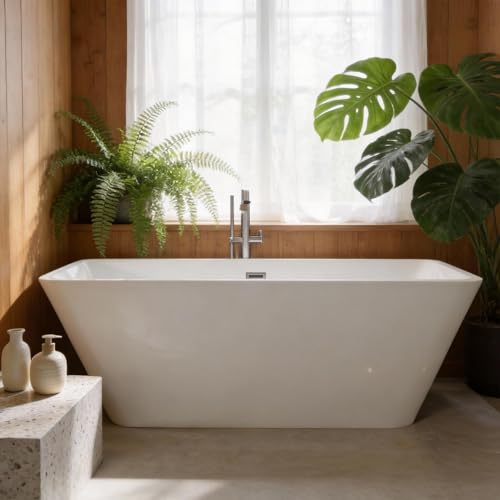
3. GAOMON 59″ Freestanding Acrylic Soaking Tub — Best Clean-Lined Value
The GAOMON 59-inch tub competes on completeness: a contemporary stand-alone silhouette, a deep soaking interior, a non-slip surface underfoot, and the overflow and drain included rather than upsold. Its listing frames it as a home-spa deep bathtub, and the design supports the framing — clean oval lines, a generous interior for its class, and nothing decorative standing between the bather and the water.
The non-slip bottom deserves emphasis because it is a safety feature families actually use. Freestanding tubs have higher walls than alcove tubs, and the step-over entry is the risky moment of every bath, especially for kids and older bathers. Texture underfoot inside the tub is the quiet half of that safety equation, alongside the grab bar and bath mat you add outside it. Few listings in this tier call the feature out; this one does.
As a newer name in the category, GAOMON lacks WOODBRIDGE’s long track record, and this guide says so plainly. What it offers in exchange is an aggressive, complete specification at this tier. For buyers comfortable with a younger brand — and the standard fittings and included drain reduce the practical risk — it is a rational value pick.
Strengths
- Non-slip interior surface for safer entry and exit
- Drain and overflow included in the box
- Deep soaking design in a 59-inch footprint
Trade-offs
- Newer brand with a shorter track record
- Verify drain finish against your other fixtures
- Soaking only, like most of this tier
| Length | 59 inches |
| Surface | Non-slip interior |
| Included | Overflow and drain |
Choose the GAOMON if the non-slip interior and included hardware matter to your household — families with children, bathers with balance concerns, and anyone furnishing a rental or a first renovation where completeness beats brand history. Everyone else should weigh the WOODBRIDGE’s ecosystem. Neither answer is wrong; they are different risk preferences priced in the same tier, and this guide’s job is to name the trade rather than hide it.
A practical tip for this and every acrylic pick: confirm the drain finish in person against your faucet finish before installation day. Whites match easily; metallic finishes vary by maker, and a drain is much easier to swap on a bench than after the tub is set.
Best for: families wanting a non-slip interior and complete included hardware / Not suited for: brand-history-first buyers

4. Empava 59″ Freestanding Bathtub (Acrylic Deep Soaking) — Best Certified Pick
Certification is the Empava’s headline. Its listing confirms cUPC certification — the plumbing code credential that inspectors and careful renovators look for — alongside a 15-inch deep soak, ergonomic back support, an anti-slip bottom, and included drain and overflow. In a tier crowded with unverified imports, a named certification is a meaningful signal about the tub’s testing and its acceptance in permitted renovations.
The specification reads like it was written by someone who bathes. Fifteen inches of soak depth is the number that decides whether shoulders submerge when seated; ergonomic back support decides whether an hour-long soak ends relaxed or stiff; the anti-slip bottom addresses the entry-and-exit moment. Empava also sells widely in the jetted-tub market, so its freestanding soaker comes from a maker with real bathtub engineering behind it, not a furniture brand dabbling in plumbing.
Shape-wise it stays contemporary and symmetrical, friendly to center-of-wall and window placements. Water capacity in this class is family-friendly without demanding a water-heater upgrade in most homes. It is, in short, the pick for buyers who read spec sheets — everything checkable about it checks out.
Strengths
- cUPC certified — inspection-friendly
- 15-inch deep soak with ergonomic back support
- Anti-slip bottom and included drain/overflow
Trade-offs
- Contemporary styling only — no traditional silhouettes
- Confirm local code acceptance with your plumber
- Soaking format; jetted Empava models sit in a higher tier
| Length | 59 inches |
| Soak depth | 15 inches (listing figure) |
| Certification | cUPC (per listing) |
Buy the Empava if your renovation involves permits, inspections, or a plumber whose opinion you trust — the certification and complete hardware make those conversations easy. It is also the comfort-spec pick: the depth and back support numbers are the strongest in this size class here. Style-first buyers may prefer the FerdY’s double-walled design below; certification-first buyers should stop scrolling at this one.
Empava’s broader presence in bathtubs also softens the support question that dogs newer brands: parts, documentation, and installer familiarity are all easier to find. In a product you install once and use for a decade, that infrastructure is a feature, even if it never appears in a photo.
Best for: permitted renovations and comfort-spec buyers in the 59-inch class / Not suited for: traditional or clawfoot styling seekers

5. Vanity Art 67″ x 32″ Acrylic Freestanding Bathtub (VA6813B-L-PW) — Best for Tall Bathers
Length is a specification you feel in your knees. At 67 inches long and 32 wide, the Vanity Art VA6813B gives tall bathers and couples’-sized soaking ambitions the interior that 59-inch tubs cannot, while staying in this guide’s tier — the size class is where under-a-thousand budgets usually give up, which is exactly why this verified listing earns its badge. Its listing confirms a pop-up drain and overflow included and UPC certification.
The contemporary design keeps the long silhouette elegant rather than bulky: a clean oval, a rim that reads as a line rather than a ledge, and proportions that suit the larger primary bathrooms a 67-inch tub requires. Acrylic construction keeps the weight manageable for a tub this size — a genuine installation advantage over cast iron at the same dimensions, where floor structure enters the conversation.
Water is the honest cost of length. A 67-inch soaker filled deep is a serious draw on a household water heater, and two bathers back-to-back will test its recovery. That is not a flaw in the tub; it is the physics of the size class, and the buying-guide section below covers how to check your heater before you fall in love with any long tub.
Strengths
- 67-inch length genuinely fits tall bathers
- UPC certified with pop-up drain included
- Acrylic keeps a big tub’s weight manageable
Trade-offs
- Needs a larger bathroom footprint
- Deep fills test standard water heaters
- Two-person placement still recommended at install
| Dimensions | 67 x 32 inches |
| Drain | Pop-up drain and overflow included |
| Certification | UPC (per listing) |
Choose the Vanity Art if you are tall, if two-person soaks are the dream, or if your primary bathroom has the floor space that smaller homes envy. It is the stretch-out pick of this guide and the one most likely to be described by its owners as ‘finally, a tub that fits.’ Everyone else should measure twice — a 67-inch tub in a tight room crowds everything around it, and the 59-inch picks will serve those rooms better.
Placement tip for long freestanding tubs: leave genuine cleaning access on all sides. A long tub pushed against a wall to save inches becomes a dust trap you cannot reach; the freestanding look — and its cleaning — both depend on the gap.
Best for: tall bathers and larger primary bathrooms / Not suited for: compact bathrooms or small water heaters

6. FerdY Koh Samui 65″ Freestanding Bathtub — Best Design Pick
The FerdY Koh Samui is what happens when a tub is designed from the photograph inward and the engineering follows. The oval is genuinely elegant — softer than the symmetrical eggs around it — and the details are a designer’s checklist: a center drain in brushed nickel and a minimalist linear overflow that replaces the usual round plate with a clean slot. In a bathroom built around the tub as sculpture, this is the pick that looks like it cost the tier above.
Crucially, the beauty is not hollow. The double-walled construction is functional insulation: two acrylic walls with air between them slow the water’s heat loss, which is the difference between a forty-minute soak that stays warm and one that needs topping up. Long soaks are this tub’s home ground, and the insulation serves them every single time, silently, with no running cost.
At 65 inches it sits between the compact and stretch classes — long enough for most bathers to recline properly, compact enough for mid-size primary bathrooms. The center drain keeps the interior symmetrical for two bathing orientations. FerdY is a smaller name than WOODBRIDGE, but the specification is complete and verifiable, and the design case is the strongest in this guide.
Strengths
- Double-walled insulation keeps soaks warmer longer
- Elegant oval with minimalist linear overflow
- 65-inch length suits most bathers and mid-size rooms
Trade-offs
- Brushed nickel drain fixes your hardware palette
- Smaller brand than the category leaders
- Design premium within the tier
| Length | 65 inches |
| Construction | Double-walled insulated acrylic |
| Drain | Center, brushed nickel; linear overflow |
Buy the Koh Samui if the tub is the visual center of your renovation and your soaks run long. It is the pick most likely to draw the ‘where did you get that?’ question, and the insulation means its beauty is matched by the one performance metric soakers actually feel. Hardware note: the brushed-nickel drain pairs naturally with nickel and chrome palettes; matte-black schemes should take the WOODBRIDGE B0014 instead and keep the palette coherent.
Care is standard acrylic care — soft cloths, non-abrasive cleaners — with one addition: the linear overflow slot rewards a periodic rinse to keep it as clean as it looks. A small habit for the tub that will be photographed most in your home.
Best for: design-led renovations and long, hot soaks / Not suited for: matte-black hardware schemes or brand-first buyers
Comparison Table
| Pick | Badge | Key spec | Best for |
|---|---|---|---|
| WOODBRIDGE 59″ Acrylic Freestanding Bathtub (B0014-MB, Matte Black Trim) | Best Overall | 59-inch acrylic freestanding soaking tub, matte black overflow and drain | standard bathrooms wanting the modern freestanding look with black hardware |
| DeerValley 55″ Acrylic Freestanding Bathtub (DV-1T0582) | Best for Small Bathrooms | 55-inch deep soaking tub, center drain, integrated overflow | small bathrooms that refuse to give up a deep soak |
| GAOMON 59″ Freestanding Acrylic Soaking Tub | Best Clean-Lined Value | 59-inch acrylic soaker, non-slip surface, overflow and drain included | families wanting a non-slip interior and complete included hardware |
| Empava 59″ Freestanding Bathtub (Acrylic Deep Soaking) | Best Certified Pick | 59-inch acrylic deep soaking tub, 15-inch deep soak, cUPC certified, drain and overflow included | permitted renovations and comfort-spec buyers in the 59-inch class |
| Vanity Art 67″ x 32″ Acrylic Freestanding Bathtub (VA6813B-L-PW) | Best for Tall Bathers | 67 x 32 inch acrylic freestanding tub, pop-up drain and overflow included, UPC certified | tall bathers and larger primary bathrooms |
| FerdY Koh Samui 65″ Freestanding Bathtub | Best Design Pick | 65-inch oval, double-walled insulation, center brushed-nickel drain, minimalist linear overflow | design-led renovations and long, hot soaks |
How to Choose a Tub Under a Thousand
Measure the room before the tub. A freestanding tub needs its length plus working clearance — aim for several inches at each end and enough side gap to clean behind it. The 55- and 59-inch picks fit standard 5-foot alcove conversions and modest primary baths; 65- and 67-inch models need genuinely larger rooms. Tape the footprint on your floor and live with the outline for a day before ordering; it is the cheapest design tool in any renovation. While the tape is down, rehearse the room: open the door fully, stand where the vanity will be, mime the step into the tub. Clearances that look adequate on a plan reveal themselves honestly at full scale, and moving tape costs nothing compared with moving plumbing.
Match the tub to your water heater. Deep soaking tubs hold serious water. A compact deep tub may draw less than a long shallow one, so compare capacities, then check your heater: a standard tank should recover fast enough for back-to-back baths at the size you choose. If it cannot, a smaller pick or a heater upgrade belongs in the project plan — decided now, not discovered on the first bath night.
Acrylic vs Stone Resin vs Cast Iron at This Tier
Acrylic owns this tier for sound reasons: it is warm to the touch, light enough to install without structural work, quiet under running water, and repairable — surface scratches buff out, which no other material forgives so easily. Stone resin (solid surface) feels more premium and holds heat beautifully, but at honest quality it mostly lives above this tier; the few in-tier examples trade wall thickness or size to get there. Cast iron is the durability king and the weight villain — a full-size iron tub can require floor assessment and a small crew, and its enamel, while glorious, chips unforgivingly. For the under-a-thousand brief, acrylic is not the compromise; it is the correct material, and every pick here uses it.
Freestanding, Alcove, or Drop-In?
Freestanding tubs — all six picks — win on looks and placement freedom, and they ask for a floor drain position and a freestanding or wall-mount filler. Alcove tubs win on budget and shower compatibility, using three walls and a shower curtain or screen; they are the practical choice for bath-shower combos in family bathrooms. Drop-ins split the difference, sitting in a framed deck that adds storage ledge and a traditional look. If your bathroom needs a shower over the tub, be honest about it now: an alcove model serves that life better than any freestanding sculpture, and the money saved buys excellent fixtures. If the tub is a dedicated soaker, freestanding is the tier’s best value and its best look.
How to Plan the Installation Budget Honestly
The tub is line one, not the whole invoice. A freestanding filler — floor-mount for the full look, wall-mount where budget or layout prefers — is line two, and in this tier it can rival a meaningful fraction of the tub’s own cost. Line three is plumbing placement: moving a drain is real money, while placing the tub where the drain already lives is nearly free, so let the existing rough-in argue for the layout before you overrule it. Line four is the floor itself — level, sound, and finished under the tub, because a freestanding tub shows its footprint. Add a contingency for the surprises every opened wall contains, and the project stays inside the spirit of this guide’s budget: a beautiful bathroom whose total you chose, rather than one that chose you. Write the four lines down before ordering anything; a budget that exists on paper survives contact with a renovation, and one that exists only as a feeling does not survive the first showroom visit of the whole renovation project, from the first day onward, without exception.
Soaking Depth, Explained Like a Bather
Specifications list overflow height and water depth; bathers feel one thing — whether the water covers their shoulders when they sit down. That depends on the interior’s usable depth, the slope of the back, and where the overflow sits, which is why this guide quotes soak depth where a listing states it (the Empava’s 15 inches) and stays silent where it does not. As a rule of thumb, a tub that looks deep from outside can soak shallow if its walls are thick and its overflow low, while a modest-looking compact tub — the DeerValley is the example here — can soak genuinely deep by designing the interior around a seated bather. When you compare models, picture the seated position, not the standing silhouette: knees bent in a short tub is normal and comfortable; shoulders above the waterline in any tub is a design failure you will feel every night.
Temperature is the other half of depth. A deep soak cools from the surface, so insulation (the FerdY’s double wall), a smaller water surface (compact tubs), and a warm room all extend a comfortable soak more cheaply than reheating. If your baths run long, those passive features matter more than any jet system — and they are exactly what this tier sells best.
Keeping an Acrylic Tub Beautiful
Acrylic care is a short, kind routine. Rinse after baths to keep soap film from dulling the gloss; clean weekly with a soft cloth and a non-abrasive bathroom cleaner; dry the surface if your water is hard, because mineral spots are the main enemy of the showroom shine. Never use scouring powders, stiff brushes, or solvents — the surface you would be scratching is the finish itself. The good news is acrylic’s forgiveness: fine scratches and dull patches from years of use can usually be polished back with automotive-style polishing compounds or maker kits, a second life no enamel or gelcoat offers so easily. Treat the rim as furniture — no standing on it, no paint tins on it — and a tub in this tier will look expensive for as long as you own the house. That durability-per-dollar is the quiet argument underneath this entire guide: the under-a-thousand acrylic soaker is not a placeholder purchase. Chosen well, it is the last tub most bathrooms need.
Who Should Spend Above This Tier Instead
Honesty about the ceiling helps everyone. Spend more if you want therapeutic jets or an air bath — those systems, honestly built, live above this tier and should not be bought cheaply. Spend more if you want stone resin’s heft and heat retention in a full-size tub, or cast iron’s generational durability, and your floor and budget both support it. Spend more if your bathroom is a genuine luxury build where the tub must match stone and custom cabinetry. Everyone else — which is most renovators, most landlords upgrading rentals, and most families — gets the best value in bathing right here, and gets to spend the difference on the filler, the floor, and the lighting that make the room feel finished.
Common Buying Mistakes
- Buying the tub and forgetting the filler. Freestanding tubs do not include faucets. Price the filler with the tub or the budget is fiction.
- Choosing length by desire instead of by room. A 67-inch tub in a tight room crowds toilets, vanities, and cleaning access for a decade. Measure, tape, then order.
- Ignoring water-heater capacity. Deep soaks draw deep water. Check recovery before installation, especially with back-to-back bathers.
- Skipping certification on a permitted job. Inspectors care about listings like cUPC and UPC. On a permitted renovation, a certified pick saves real friction.
- Using abrasive cleaners on acrylic. The gloss is the finish. Soft cloths and non-abrasive products keep it; scouring powders end it.
Tub Shapes and What They Do to a Room
Shape is the decision your eyes make every day and your body makes every bath. Ovals — most of this guide — are the versatile default: soft in modern and transitional rooms, comfortable at both ends, easy to clean around. Slipper tubs, with one or both ends raised, support a reclined reading posture and bring a traditional silhouette; honest examples exist near this tier but verified stock was thinner, so this guide stayed with the shapes it could verify. Rectangular and Japanese-style deep tubs maximize interior in minimal footprints — the soaking logic the DeerValley applies in oval form. Pedestal and skirted designs hide plumbing for a furniture look in period homes. None of these shapes changes the water; all of them change the room. Choose with a photograph of your actual bathroom in hand, not a showroom in mind, and remember that the tub is the largest single object the room will ever hold — its shape is the room’s shape, in the end.
A Short Renovation Sequence That Keeps the Budget Intact
Order of operations decides whether a tub project stays calm. First, measure and tape the footprint, and photograph the existing drain position — those two facts choose the tub more honestly than any showroom visit. Second, order the tub and the filler together, and confirm the drain finish matches the filler finish before anything ships. Third, prepare the floor and plumbing while the tub is in transit; freight-sized deliveries reward a room that is ready. Fourth, dry-fit everything — tub, filler, drain — before final connections, because adjustments are free at this stage and expensive after it. Fifth, fill the installed tub and let it sit full before the first bath; a quiet hour under load is the cheapest leak insurance in plumbing. Follow that sequence and the under-a-thousand project behaves the way this guide promises: one beautiful fixture, a known total, and a first soak that feels like the renovation’s reward rather than its risk.
Final Recommendation
Start with the WOODBRIDGE 59-inch for the standard bathroom and the modern black-hardware look. Small room? The DeerValley 55 trades length for depth and wins. Permitted renovation or spec-sheet buyer? The Empava’s certification and soak numbers lead. Tall bather or two-person soaks? The Vanity Art 67 is the only honest answer in the tier. Design-led project with long soaks? The FerdY Koh Samui. Family safety and complete hardware on a value ticket? The GAOMON. Every one of them leaves budget for the filler and the floor — which is the whole point of shopping this tier well.
One closing thought for the undecided: bathrooms are renovated rarely and used daily, and the tub is the one fixture whose quality you feel with your whole body. Within this tier, the differences between these six picks are real but second-order — size fit, certification, insulation, design. The first-order decision is simply to buy a verified, honestly specified acrylic soaker instead of an unverified bargain or an over-tier indulgence. Make that decision and any pick here will serve you well for years of evenings.
Related guides in this series: Best Affordable Tubs, Best Alcove Tubs Under $1000, Best Acrylic Freestanding Bathtubs, Best 72 Bathtubs, and Best Air Massage Tubs.
Frequently Asked Questions
Can you really get a good freestanding tub under a thousand?
Yes — acrylic freestanding soakers are the market’s sweet spot, and this guide’s six verified picks are the evidence. What the tier does not include is jets, stone resin at full quality, or the faucet. Budget the filler separately and the total stays sensible.
What size tub fits a standard bathroom?
Most standard bathrooms and 5-foot alcove conversions suit 55- to 59-inch freestanding tubs with cleaning clearance. Move to 65 or 67 inches only when the room genuinely has the floor space; tape the footprint first.
How much water does a soaking tub use?
Deep soakers in this size range typically hold family-sized volumes that vary by model — check the capacity figure on the listing against your water heater’s size and recovery. Compact deep tubs often use less than long shallow ones despite feeling deeper.
Is acrylic durable enough for a family bathroom?
Yes, with ordinary care. Acrylic resists chipping better than enamel, shrugs off family use, and — uniquely at this tier — lets surface scratches be buffed out. Keep cleaners non-abrasive and it holds its gloss for years.
Do I need a special faucet for a freestanding tub?
You need a filler: floor-mount for the classic freestanding look, or wall-mount if the tub sits near a wall. Standard bath faucets do not reach. The filler is a separate purchase — factor it into the project from the start.
Can a freestanding tub go where my alcove tub was?
Usually, yes — the 55- and 59-inch picks are sized for exactly that conversion. The work is in the drain position and the filler: alcove plumbing sits at one end, while freestanding tubs often center the drain, and the filler becomes floor- or wall-mount. A plumber can confirm your rough-in in one visit, and planning around the existing drain is the cheapest version of the project.
How long does water stay hot in an acrylic tub?
Long enough for a proper soak, and longer in double-walled designs like the FerdY pick, which insulates the water from the room. Starting with hot water, covering more of your body (deeper tubs expose less skin to the air), and keeping the bathroom door closed all extend a soak more than any material difference within this tier.
Will a freestanding tub work with a shower?
Not gracefully — freestanding tubs are dedicated soakers, and showering in one soaks the whole room. If the bathroom needs a combined bath-shower, an alcove tub is the honest choice, and this tier has good ones. Many renovators solve it by putting the shower in its own stall and letting the freestanding tub be purely a tub, which is the arrangement these picks were designed for.
Are these tubs hard to install?
Acrylic freestanding tubs are among the easier installations: light enough for two people, with included drains on most picks here. The real work is drain placement and a level floor. Most renovators still hire a plumber for the connections — money well spent on a product that holds this much water.


