Disclosure: airfryerkitchensupply.com is reader-supported. When you buy through links on our site, we may earn an affiliate commission at no extra cost to you.
Where to buy
The fastest way to buy any of the best tubs for baby below is Amazon, where stock, colour and size options are widest and returns are straightforward if a pick does not suit your space. Linked picks go straight to the verified product page — check price on Amazon on the listing itself, because options and availability change often.
- The First Years Sure Comfort Newborn to Toddler Tub, 3-in-1 with Sling (Best Overall): check price on Amazon
- Stokke Flexi Bath Bundle with Newborn Support (Best Premium Foldable): check price on Amazon
- OXO Tot Splash & Store Bathtub (Best for Small Bathrooms): check price on Amazon
- Boon Soak 3-Stage Baby Bathtub with Colour-Changing Drain Plug (Best for Temperature Peace of Mind): check price on Amazon
- Ingenuity Tuckaway Toddler Folding Tub (Best for Toddlers in a Shower): check price on Amazon
- Munchkin Inflatable Baby Bathtub, Toddler Travel Tub (Best for Travel): check price on Amazon
Safety comes before shopping in this guide, so it comes first in the text: whichever of the best tubs for baby you choose, a baby in water is never left alone or with a sibling in charge — an adult stays within arm’s reach for the entire bath, every time. Check the water temperature with your own wrist or elbow before the baby goes in (it should feel warm, not hot), keep baths shallow, and empty the tub immediately afterwards, every time. Those three habits matter more than any feature below; the features exist to make the habits easier to keep.
With that fixed, the choice is genuinely simple. Newborns need support — a sling, an insert or a cradled shape — because they cannot hold their heads or sit. Older babies need room to sit and splash safely. Toddlers in shower-only homes need a tub that creates a bath where none exists. The six picks map to those stages: two long-service staged tubs, two folding space-savers, a temperature-helping design, a shower converter for toddlers and a travel inflatable, each verified against Amazon’s catalogue data for this site.
Prices are not printed, because they vary with bundles and colours; check price on Amazon and weigh cost against years of stated service, which each review states plainly. A tub used daily for two years is among the hardest-working purchases of the baby era — buy the stage coverage right and it is bought once.
In this guide
Quick Picks
- The First Years Sure Comfort Newborn to Toddler Tub, 3-in-1 with Sling — Best Overall. The classic 3-in-1: a mesh sling for newborns, then two toddler stages to 24 months — the tub most families can buy once. — Check on Amazon
- Stokke Flexi Bath Bundle with Newborn Support — Best Premium Foldable. A spacious fold-flat tub with a newborn insert and the longest stated service in the guide — birth to around four years. — Check on Amazon
- OXO Tot Splash & Store Bathtub — Best for Small Bathrooms. Folds flat, hangs to store, and cradles newborns at its narrow end — the small-bathroom specialist. — Check on Amazon
- Boon Soak 3-Stage Baby Bathtub with Colour-Changing Drain Plug — Best for Temperature Peace of Mind. Three support positions plus a drain plug that changes colour with water temperature — a small feature that answers a big new-parent worry. — Check on Amazon
- Ingenuity Tuckaway Toddler Folding Tub — Best for Toddlers in a Shower. Converts a shower stall into a toddler tub and folds away after — for homes without a family bath, ages 12 months to 5 years. — Check on Amazon
- Munchkin Inflatable Baby Bathtub, Toddler Travel Tub — Best for Travel. Deflates into a suitcase corner: the inflatable tub for holidays, grandparents and small-space backup, 6 to 24 months. — Check on Amazon
How These Picks Were Chosen
Picks were chosen stage-first: every pick had to state its age or weight span plainly and genuinely serve it — a newborn solution must support a baby who cannot sit, and a toddler solution must contain a child who definitely can. Tubs vague about their stage were cut, because guessing about baby equipment is not a service this guide offers.
Support design was the second filter: slings, inserts, contoured positions and cradled ends were judged on whether they leave the adult’s hands free to wash while the baby stays securely positioned — in shallow water, with the adult right there, always. Storage and drying formed the third filter, because a tub that lives damp in a corner is a hygiene problem; folding, hanging and easy-clean designs earned their places partly on how they spend the 23 hours a day they are not in use.
One category rule deserves stating: bath seats and rings that promise to hold a baby so an adult can step away were excluded from consideration entirely. No product makes unsupervised bathing safe, and this guide will not list equipment whose marketing leans that way.
The 6 Best Tubs for Baby

The First Years Sure Comfort Newborn to Toddler Tub, 3-in-1 with Sling — Best Overall
Check the current price on Amazon
This is the default recommendation for a first baby tub: a convertible design that starts with a removable mesh sling cradling a newborn, then reconfigures as the baby gains head control, and again for a sitting toddler, across a stated 0 to 24 months. It suits first-time parents who want one purchase to cover the whole baby-tub era, and its simplicity — no folding mechanisms, no assembly — means any caregiver can use it correctly at 2 a.m. Safety framing that applies to every pick here: a baby in water needs an adult within arm’s reach at all times, the water temperature checked before the baby goes in, and the tub emptied straight after the bath.
Strengths
- Three stages from newborn sling to toddler tub in one purchase
- Removable sling supports newborns who cannot sit or hold their head
- Simple, rigid design any caregiver can use correctly
Trade-offs
- Full-size rigid tub needs storage space between baths
- Sling must be washed and dried carefully to stay fresh
- Babies who outgrow stages fast may use the sling briefly
| Detail | What to know |
|---|---|
| Stages | 3-in-1 convertible with removable sling per Amazon listing |
| Age range | 0 to 24 months per Amazon listing |
| Line | Sure Comfort per Amazon listing |
The sling is the feature that decides the newborn weeks. A brand-new baby in a bare plastic tub slides, startles and cries; the same baby hammock-supported in warm shallow water usually settles, which makes the parent’s hands free to actually wash. First Years has refined this format for years, and the stage progression — sling, reclined, upright — matches how babies actually develop rather than how marketing stages them.
Longevity is the value case: a tub that serves to 24 months replaces the newborn tub, the infant tub and the toddler seat that separate purchases would involve. Store it inside the family bath or hung from a hook and its one footprint is the only cost of that coverage.
Best for: first-time parents wanting one tub from newborn to toddler / Not suited for: very small bathrooms with no storage for a rigid tub

Stokke Flexi Bath Bundle with Newborn Support — Best Premium Foldable
Check the current price on Amazon
The Flexi Bath bundle is for households that will pay for design that solves real problems: it folds flat for small bathrooms and travel, yet opens into one of the most spacious baby tubs here, with a stated span from birth to four years using the included newborn support for the earliest stage. It suits small homes, frequent travellers between family houses, and parents of tall babies who outgrow standard tubs early. The same safety rules apply as everywhere in this guide: constant arm’s-reach supervision, temperature checked first, tub drained immediately after use.
Strengths
- Folds flat yet opens spacious — rare combination
- Newborn support included for the earliest stage
- Longest stated service: birth to 4 years per Amazon listing
Trade-offs
- Premium tier — the highest budget commitment here
- Fold mechanisms need a rinse and dry to stay sweet
- Newborn insert is one more piece to store later
| Detail | What to know |
|---|---|
| Format | Foldable bathtub with newborn support bundle per Amazon listing |
| Age range | Birth to 4 years per Amazon listing |
| Colour verified | White Grey per Amazon listing |
Folding tubs usually compromise on size — small tub, small baby window. The Flexi Bath’s trick is folding flat without shrinking the bathing space, so it serves a newborn with its support and still fits a long three-year-old who wants to splash. For a flat or a house where the baby tub must live behind a door, that combination is worth real money.
The four-year span also changes the cost conversation: priced per year of service, the premium tub competes with buying a newborn tub and then a toddler tub, while taking less total storage across those years. Stokke’s spare-parts and resale culture adds a second life most plastic tubs never get.
Best for: small homes and long babies needing years of service / Not suited for: buyers wanting the simplest rigid tub at a budget tier

OXO Tot Splash & Store Bathtub — Best for Small Bathrooms
Check the current price on Amazon
OXO designed this tub around storage: it folds flat and hangs, so it can live on the back of a bathroom door or a hook in a shower — the places small bathrooms actually have. The narrow end cradles a newborn while the wider end serves the older baby, across a stated infant-to-18-months span. It suits flat-dwellers, shared family bathrooms and grandparents who need a tub that disappears between visits. As with every tub here: an adult stays within arm’s reach for the whole bath, water temperature is checked before the baby, and the tub is emptied as soon as bath time ends.
Strengths
- Folds flat and hangs — the best storage story here
- Narrow end shaped to cradle newborns
- Thoughtful OXO detailing and easy-clean surfaces
Trade-offs
- Stated span ends at 18 months — shorter than the Stokke
- Folding seams need drying to stay fresh
- Less spacious for very long babies at the top of the range
| Detail | What to know |
|---|---|
| Format | Fold flat to store per Amazon listing |
| Age range | Infant to 18 months per Amazon listing |
| Design | Narrow end cradles newborns per Amazon listing |
Storage is the unglamorous feature that decides whether a baby tub is loved or resented, because it is encountered twice a day for over a year. A tub that hangs flat behind a door never becomes the thing tripped over in the night or the mould suspect in the corner — and a tub that is easy to put away is a tub that gets put away, dry, which is also the hygiene answer.
The newborn cradle end shows the same thoughtfulness at the bathing end of the experience: a shaped narrow section supports a small baby along its length, giving a new parent one less thing to improvise with rolled towels. OXO’s kitchen-grade understanding of grips, drainage and cleaning shows throughout.
Best for: small bathrooms, flats and grandparents’ houses / Not suited for: families wanting one tub past 18 months
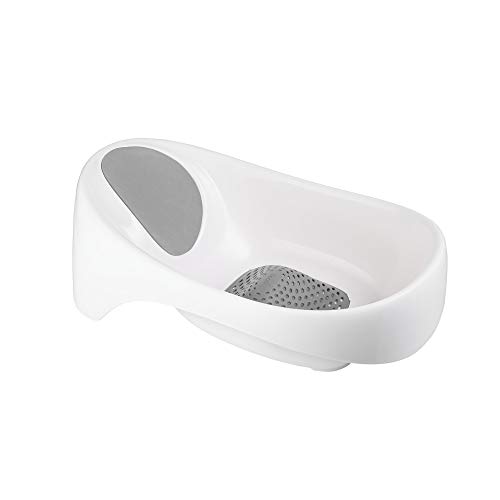
Boon Soak 3-Stage Baby Bathtub with Colour-Changing Drain Plug — Best for Temperature Peace of Mind
Check the current price on Amazon
The Boon Soak is built around the two anxieties of early bath time: holding the baby securely, and getting the water temperature right. Its contoured support adjusts through three positions from newborn to toddler, and the drain plug changes colour to signal water that is too hot — a backup check alongside the adult’s own wrist or elbow test, never a replacement for it. It suits first-time parents who want the tub itself to help them learn, across a stated 0 to 18 months and up. Supervision rules are unchanged and absolute: baby within arm’s reach always, temperature verified by the adult, tub drained immediately after the bath.
Strengths
- Colour-changing plug gives a visual temperature warning
- Three support positions grow with the baby
- Contoured design supports babies securely at each stage
Trade-offs
- Plug is an aid, not a thermometer — adult checks remain essential
- Stated range tops out earlier than the longest-serving picks
- Contoured shape is less roomy for very large toddlers
| Detail | What to know |
|---|---|
| Stages | 3 support positions per Amazon listing |
| Feature | Colour-changing drain plug for temperature per Amazon listing |
| Age range | 0 to 18 months and up per Amazon listing |
Temperature is the safety detail new parents most want help with, and Boon’s colour-changing plug is the honest version of that help: a clear, passive signal that the water is too hot, visible at a glance while your hands are full of baby. It does not replace checking with your own skin — the guide’s how-to section is explicit about that — but as a second pair of eyes on the one variable that matters most, it is genuinely well aimed.
The three-position support keeps the baby at the right recline as control develops, which makes washing easier and bath time calmer. Calm matters: a baby who enjoys baths and a parent who feels equipped are the foundation of the whole routine.
Best for: first-time parents who want temperature reassurance built in / Not suited for: parents wanting a tub that serves to age four

Ingenuity Tuckaway Toddler Folding Tub — Best for Toddlers in a Shower
Check the current price on Amazon
This pick solves a housing problem: homes and flats with only a shower, where a toddler still needs a proper soak and play bath. The Tuckaway sits in the shower base to create a tub, folds to store, needs no assembly, and serves a stated 12 months to 5 years — the toddler and preschool span the newborn tubs have exited. It suits shower-only homes, travel to relatives, and as a second-stage tub after a newborn model. The supervision rule is identical at this age: an adult within arm’s reach throughout, water temperature checked first, and the tub emptied and stored dry straight after use.
Strengths
- Creates a tub inside a shower-only bathroom
- Folds flat, no assembly, easy to clean
- Long toddler span: 12 months to 5 years per Amazon listing
Trade-offs
- Starts at 12 months — not a newborn solution
- Shower bases vary; check your stall’s dimensions
- A folding tub is less rigid than a fixed one
| Detail | What to know |
|---|---|
| Format | Folding tub converting shower to tub per Amazon listing |
| Age range | 12 months to 5 years per Amazon listing |
| Setup | No assembly required per Amazon listing |
Shower-only bathrooms are increasingly common in new flats, and toddlers are the age group worst served by them — too big for sink baths, too splash-happy for a held shower. A tub that creates a contained, seated water space inside the shower tray answers the problem directly, and folding flat afterwards respects the same small bathroom that caused it.
As a second tub it also extends the bathing years cheaply: newborn tub to 18 or 24 months, then this for the long toddler stretch, with each tub sized to its stage instead of one compromise stretched across both. For travel to shower-only holiday rentals, it packs the routine with you.
Best for: shower-only homes and the toddler years / Not suited for: newborns — choose a sling or support tub above

Munchkin Inflatable Baby Bathtub, Toddler Travel Tub — Best for Travel
Check the current price on Amazon
The Munchkin inflatable is the travel answer: it packs nearly flat, inflates inside a hotel bath or shower tray to give a 6-to-24-month-old a familiar, contained bath anywhere, and doubles at home as a spare for grandparents’ houses. Padded inflatable walls are forgiving for a sitting baby who topples occasionally. It suits travelling families and anyone who needs a tub only occasionally rather than daily. Travel changes nothing about safety: constant arm’s-reach supervision, adult-checked water temperature, and the tub emptied and dried after every use — inflatables especially must dry fully before being packed away.
Strengths
- Packs almost flat for travel and storage
- Padded walls are forgiving for sitters who topple
- Inexpensive enough to keep as a spare at grandparents’
Trade-offs
- Needs inflating and fully drying each trip
- Not for newborns — stated from 6 months
- Less durable than rigid tubs over years of daily use
| Detail | What to know |
|---|---|
| Format | Inflatable travel tub per Amazon listing |
| Age range | 6 to 24 months per Amazon listing |
| Use | Travel and occasional use per Amazon listing |
Familiarity is an underrated travel tool with babies: a tub that smells and feels like the home routine can turn a strange hotel bathroom into a calm bath, which is worth more than its tiny packed size suggests. The inflatable format also earns its place as the grandparent spare — stored in a drawer, ready in two minutes, and not occupying a bathroom for the other 350 days of the year.
The honest limits are durability and drying discipline. Inflatable seams live shorter lives than rigid plastic, and a tub packed away damp will smell of it. Treat it as the occasional-use specialist it is, dry it properly, and it will cover years of trips.
Best for: travel, holidays and grandparents’ spare / Not suited for: daily bathing from birth — choose a staged tub above
Comparison Table
| Pick | Badge | Key spec | Best for |
|---|---|---|---|
| The First Years Sure Comfort Newborn to Toddler Tub, 3-in-1 with Sling | Best Overall | 3-in-1 with newborn sling, 0–24 months | first-time parents wanting one tub from newborn to toddler |
| Stokke Flexi Bath Bundle with Newborn Support | Best Premium Foldable | Fold-flat, spacious, birth–4 yrs bundle | small homes and long babies needing years of service |
| OXO Tot Splash & Store Bathtub | Best for Small Bathrooms | Fold-flat hanging storage, newborn cradle | small bathrooms, flats and grandparents’ houses |
| Boon Soak 3-Stage Baby Bathtub with Colour-Changing Drain Plug | Best for Temperature Peace of Mind | 3-stage, colour-change temperature plug | first-time parents who want temperature reassurance built in |
| Ingenuity Tuckaway Toddler Folding Tub | Best for Toddlers in a Shower | Shower-converting folding tub, 12M–5Y | shower-only homes and the toddler years |
| Munchkin Inflatable Baby Bathtub, Toddler Travel Tub | Best for Travel | Inflatable, packs flat, 6–24 months | travel, holidays and grandparents’ spare |
Short on time? Start with the Best Overall pick, then use the table to check whether a specialist badge matches your actual room, routine or household better before you check price on Amazon.
How to Choose the Best Tubs for Baby
Match the tub to the stage you are in, and the next one. A newborn needs reclined support — sling, insert or cradle. A sitting baby (roughly from six months, when your baby actually sits, not by the calendar) needs a contained space with room to splash and toys. A toddler needs depth and stability, or a shower-converting design if the home has no bath. Staged tubs that convert across these phases are the value choice for a first baby; single-stage tubs make sense as travel or second-location purchases.
Then choose by bathroom, not by brochure. Measure where the tub will live and where it will be stored: a rigid tub needs a home inside the family bath or a large cupboard; folding and hanging designs exist precisely for bathrooms without that space. If the tub will be used inside a sink or on a counter in the earliest weeks, check the base dimensions against your sink before ordering.
Finally, prefer simple to clever. Every mechanism — folds, inflatables, inserts — adds a cleaning and drying task. That trade is worth it when the mechanism solves your actual problem (storage, travel, temperature confidence) and not worth it when it solves a problem you do not have.
Water Temperature and Bath Safety, Without the Myths
Warm, not hot: bath water for a baby should feel comfortably warm on the inside of your wrist or elbow — the skin there is sensitive enough to judge for a baby. A colour-changing plug like the Boon pick’s is a useful second signal, but the adult’s skin check is the standard, performed every bath, before the baby is undressed. Fill the tub first, swish to even out hot spots from the tap, then check.
Shallow is safe: a few inches of water is plenty for a baby bath — enough to keep the baby warm with your hand scooping water over them, never deep. Babies can drown silently in very shallow water, which is why the arm’s-reach rule has no exceptions for doorbells, phones or towels forgotten in the next room: take the baby with you or lift them out, every time.
After the bath, empty the tub immediately and store it dry. Standing water is a risk to curious toddlers and a hygiene problem in any tub; folding and inflatable tubs need to dry fully before storage or they develop the mildew smell that ruins them. Two minutes of draining and airing is the whole maintenance religion of this category.
Newborn Support: Slings, Inserts and Cradles Compared
Mesh slings (the First Years approach) hammock the baby above the tub base and are kind to true newborns, including the first baths before the cord stump has healed, when many parents prefer sponge baths and brief shallow dips — follow your midwife or paediatrician’s guidance for your baby. Slings need thorough drying after use and are outgrown fastest, which is fine: their job is the first months, done well.
Moulded inserts and contoured positions (Stokke’s support, Boon’s stages, OXO’s cradled end) integrate the support into the tub itself — nothing separate to store or dry, and a firmer recline some babies prefer. The choice between sling and moulded support is mostly parental preference; the non-negotiable is that a newborn is supported along the whole body, head included, rather than propped or held in place by water depth.
Making One Tub Last: Stages, Siblings and Storage
A staged tub bought for a first baby commonly serves siblings later, which argues for the longer stated spans and for storing the tub clean, dry and out of sunlight between children. Check plastic for cracks and slings for worn mesh before reusing with a new baby, and replace anything doubtful — a tub is cheap compared to its job.
Between baths, the storage that works is the storage that happens: hung flat behind a door, nested inside the family bath, or folded in the airing cupboard. If your current tub lives on the bathroom floor gathering dust and worse, that is a storage-design failure, and the folding picks in this guide exist to fix it.
How to Bath a Baby Safely, Step by Step
The routine below is the standard one midwives teach, matched to any tub in this guide. Read it fully before the first bath.
- Gather everything first — towel, clothes, nappy, washcloth, mild baby wash if you use it — because once the bath starts, you do not leave to fetch anything.
- Fill the tub with a few inches of water, swish to mix hot spots, and check the temperature with your inner wrist or elbow: warm, not hot. Check again if you add water.
- Undress the baby, wrap them in the towel, and wash face and head first if you are doing a full wash, before placing them in the water.
- Lower the baby in feet-first, slowly, supporting head and shoulders, into the sling, insert or cradle. Keep one hand on the baby at all times; stay within arm’s reach for the whole bath.
- Wash gently with your free hand or a cloth, scooping water over the baby to keep them warm. Keep newborn baths short — a few minutes is plenty.
- Lift the baby straight into the towel, wrap and dry thoroughly — especially skin folds — then dress. Only then empty the tub, rinse it, and store it dry.
If bath time currently ends in tears, check the three usual causes in order: water slightly too cool by the end (keep baths short and the room warm), hunger (bath before a feed, not after), and a startled entry (feet-first, slow, talking to the baby throughout). Most babies come to love baths once those are fixed.
Bathing Twins, Siblings and the Second-Time Parent’s Shortcuts
Twins do not need two tubs; they need a system. Bath one baby while the other waits somewhere safe and within sight — a bouncer on the bathroom floor is the classic — then swap, reusing the same water only if it is still warm and clean, and topping up with fresh checked water between babies. Two staged tubs in a small home is storage madness; one good tub and a calm order of operations is the answer every twin parent arrives at.
An older sibling changes bath time’s shape: many families move to bathing toddler and baby together in the family bath once the baby sits securely — with the adult present and within arm’s reach exactly as always, the baby in the adult’s hands or supported seat area, and the toddler briefed that baths are sitting games. The baby tub then retires to travel and grandparents, which is another argument for buying a tub with a second life in it.
Second-time parents consistently report the same shortcut list: everything laid out the night before for morning baths, the towel warmed on a radiator in winter, bath toys kept to three that dry fully, and the tub stored where it is used rather than where it looks tidy. None of it is purchasable — which is why it belongs in a guide that sells you nothing for this section.
Tub Materials, Cleaning and the Hygiene Questions Parents Actually Ask
Rigid plastic tubs should be washed with warm soapy water, rinsed and dried after use — daily effort of about a minute that prevents the biofilm that makes any bath slippery and suspect. Avoid abrasive scourers, which scratch plastic into grooves that hold grime; a soft cloth and, weekly, a thorough dry in moving air keeps a tub honest for years and across siblings.
Mesh slings and fabric supports are the parts that need real attention: rinse out soap after every bath, hang to dry fully, and wash according to the maker’s instructions regularly. A sling stored damp inside a folded tub is the number-one source of the musty smell parents blame on ‘the plastic’ — it is almost never the plastic.
Inflatable tubs need their valves and seams checked as they age, and must be bone dry before being packed away; folding tubs need their hinges and folds wiped and aired for the same reason. The pattern across all formats is identical and worth memorising: babies’ equipment stays hygienic in proportion to how dry it is stored, far more than to any cleaning product used on it.
Buying Scenarios: First Baby, Small Flat, Grandparents and Travel-Heavy Families
The first baby in an average home is the staged tub’s scenario: the First Years 3-in-1 covers newborn to toddler with one footprint and no decisions left to make at 3 a.m. Add nothing else until the baby arrives and your actual bathroom routine reveals what, if anything, is missing — most families discover nothing is.
The small flat is a storage problem before it is a bathing problem, and it splits by budget: the OXO’s hang-flat design at the sensible tier, the Stokke bundle at the premium tier with its longer span. Either way, the winning tub is the one that disappears — behind a door, in the shower, on a hook — because a tub that cannot be stored will be stored in the bath, damp, which fails the hygiene rule this guide keeps repeating.
Grandparents and travel-heavy families should not duplicate the main tub: the Munchkin inflatable lives in a drawer at the grandparents’ house and in a suitcase for trips, giving the baby a familiar bath everywhere for very little money. The scenario logic is the same throughout this guide — one primary tub matched to stage and bathroom, specialists only where a real second location or housing constraint exists.
What to Check on the Listing Before You Buy a Baby Tub
The stated stage — age and, where given, weight range — matched to your baby now and the months ahead, not to the photograph’s baby. Second, the support method for a newborn: sling, insert or moulded cradle, named explicitly. A tub vague about how a newborn is supported is a tub for an older baby wearing a younger baby’s listing.
Third, where it stores: rigid dimensions against your cupboard or bath, or a fold/hang design whose stored size is stated. Fourth, drainage and drying — a drain plug speeds emptying, smooth mouldings dry faster than crevices, and slings should remove for separate drying. Fifth, the cleaning instructions: anything that cannot be simply washed, rinsed and dried will not stay hygienic in real family life.
And the check that is not on any listing: your own routine. The safest tub is the one whose use you can picture, step by step, with everything within reach and the baby never unattended — if a design complicates that picture, choose the simpler one, whatever its features promise.
Bath Time Across the First Two Years: How the Tub’s Job Changes
The first month is about confidence — mostly the parent’s. Baths are short, the water shallow, the baby supported completely by sling or insert, and the adult’s free hand doing more reassuring than washing. The tub’s job in this phase is to be one less thing to think about: stable, simple, quick to fill and empty, so the adult’s whole attention can stay where the safety rules put it, on the baby. This is why the guide’s newborn picks are its simplest designs.
Months three to six change the emotional weather: head control arrives, baths lengthen, and many babies discover splashing, at which point the tub’s job becomes containment and calm in equal measure. The support reclines less, the parent’s hand stays on the baby but the mood shifts from procedure to play. Parents who dreaded the first baths find themselves running them for pleasure — a small, warm daily ritual that reliably precedes sleep, which no parent undervalues.
From sitting to standing, the tub becomes a safety perimeter for a baby who can suddenly pull up, lunge for taps and attempt to stand in slippery water. The adult’s arm’s-reach rule matters most in exactly this confident phase, baths happen in the staged tub’s upright position or the family bath with the adult present, and toys enter — few, quick-drying, and stored out of the tub. The toddler tubs in this guide exist because this phase outlasts the newborn equipment by a year or more.
By the second birthday the baby tub is usually a travel and grandparents’ tool, and its final lesson is about buying once: the families who chose stage-spanning tubs at the start are still using the same purchase, while the families who bought a prettier newborn-only tub have bought twice. Every phase above was predictable at the moment of purchase — which is the whole argument for reading a guide like this one before the baby arrives, and for choosing the tub by its stated span rather than its first photograph.
Value, Longevity and the Cost of the Bathing Years
Price a baby tub across the months it will actually serve and the category’s value order is plain: a staged tub spanning birth to toddlerhood, used daily, costs pennies per bath, while a beautiful newborn-only tub replaced at six months costs several times more per use. The stated span on the listing is therefore the most financial line in this guide — read it before the colour options, and let it arbitrate between otherwise similar tubs.
Longevity across siblings multiplies that value again, which is why storage discipline — emptied, dried, kept out of sunlight — is treated in this guide as part of the purchase rather than housekeeping. A tub stored dry is a tub ready for the next baby; a tub stored damp is a replacement waiting to be bought, and the difference is two minutes after every bath, repeated.
Spend the savings where they matter: the staged tub frees budget for the things babies genuinely consume — and the calm of a bath routine that never changes equipment mid-stream is worth more than either. Buy the span, keep the routine, store it dry, and the baby tub becomes what it should be: bought once, used daily, and remembered fondly rather than researched twice.
Common Buying Mistakes
Leaving the room ‘for one second’
There is no safe version of this. Drowning is silent and fast, and every warning in this category exists because of it. If you must answer the door, the baby comes with you, wrapped in the towel.
Trusting a gadget over your own temperature check
Colour-changing plugs and thermometer toys are backups. The standard is your wrist or elbow, every bath, after swishing out hot spots — because taps and boilers do not deliver the same temperature twice.
Filling the tub deep to keep the baby warm
Depth is risk, not warmth. Shallow water plus your hand scooping warm water over the baby keeps them comfortable; deep water adds danger and makes a slippery baby harder to hold securely.
Storing the tub wet
A tub put away damp grows mildew — worst in folds, slings and inflatables. Empty, rinse and air-dry after every bath; it takes two minutes and it is the difference between a tub that lasts years and one that smells by month two.
Buying a tub for the wrong stage
A toddler tub will not support a newborn and a newborn sling is outgrown in months. Buy by stated stage and your baby’s actual development — sitting means your baby sits unaided, not a date on a box.
Final Recommendation
For most families the First Years 3-in-1 is the right single purchase: sling for the newborn weeks, stages through toddlerhood, nothing to assemble and nothing to fold. Small bathrooms should take the OXO for its hang-flat storage or the Stokke Flexi Bath if the budget allows its longer span; anxious first-timers will appreciate the Boon’s temperature plug; shower-only homes need the Ingenuity Tuckaway for the toddler years; and the Munchkin inflatable covers travel and grandparents.
Whichever tub comes home, the routine is the product: everything gathered first, temperature checked by your skin, a hand on the baby throughout, and the tub emptied and dried the moment the bath ends. Do that every time and bath time becomes what it should be — a calm, warm few minutes that both of you look forward to.
Best Baby Bath Products Best Newborn Essentials Best Baby Shower Gifts Best Baby Towels Best Baby Wash Best Gifts For New Parents
Frequently Asked Questions
At what age can a baby use a tub without a sling or insert?
When your baby can sit unaided and has full head control — commonly around six months, but the baby decides, not the calendar. Until then, use the sling, insert or cradled position every bath, with your hand on the baby throughout.
How warm should baby bath water be?
Comfortably warm on the inside of your wrist or elbow — it should feel warm, never hot. Fill first, swish away hot spots, and check before undressing the baby. Temperature gadgets are a backup signal, not the check itself.
How often should I bath my baby?
Newborns need only a few baths a week — more can dry young skin — with a daily top-and-tail wash of face, neck folds and nappy area. Older babies who enjoy baths can have them more often; keep them short and moisturise if skin runs dry.
Can I use a baby tub in a shower-only home?
Yes — that is exactly what the Ingenuity Tuckaway pick is for: it sits in the shower base and creates a contained tub for toddlers. For newborns in shower-only homes, a countertop or in-sink supported bath, or a folding tub placed securely, covers the early months.
How do I stop a baby tub going mouldy?
Empty it immediately after every bath, rinse, and store it fully dry — hung, folded open to air, or nested dry in the family bath. Slings should be removed and dried separately. Mildew is a storage habit, not a product flaw.
When should I replace a baby tub?
When it cracks, when a sling’s mesh wears or tears, when an inflatable’s seams weaken — or when your child outgrows its stated stage. Check second-hand and sibling-hand-me-down tubs against the same list before the first bath.
Can my baby share the family bath instead of a baby tub?
Once a baby sits securely, many families bath together in the big bath with the adult in it too — the adult’s presence and arm’s-reach rule still apply in full, the water stays shallow and warm-checked, and a non-slip mat helps everyone. Before sitting stage, a supported baby tub is the manageable option.
What do I do if my baby hates the bath?
Work the checklist: warmer room, water checked and comfortably warm, a warm wet cloth draped over the baby’s tummy in the water, shorter baths, and a feed not immediately before. Most bath-hating is temperature or timing, and most babies convert within a couple of weeks of calm repetition.
Do I need special baby soap for bath time?
Plain warm water is enough for newborns in most baths; a small amount of mild, baby-formulated wash is fine for dirty areas as babies grow. Whatever you use, keep baths short and rinse well — young skin dries out from long soaks and excess product far more readily than from water alone.
How do I bath a baby with a healing cord stump?
Follow your midwife or paediatrician’s guidance for your baby — commonly, sponge baths and keeping the stump dry until it separates, with brief shallow tub baths using the sling once you are advised they are fine. The tub choice does not change the medical guidance; the support designs here simply make whichever routine you are advised easier to perform.
When do babies move from a baby tub to the family bath?
Typically once they sit securely and outgrow the staged tub’s space — often somewhere in the second year, though the long-span picks here extend tub bathing well beyond that. The move is about size and confidence, not a birthday, and the arm’s-reach supervision rule travels with the baby into the big bath unchanged.


