Disclosure: airfryerkitchensupply.com is reader-supported. When you buy through links on our site, we may earn an affiliate commission at no extra cost to you.
Where to Buy
All six picks below were confirmed against the airfry the Amazon catalogue and carry Amazon links. Use the links to check the current price on Amazon and — for the custom-cut KOECKRITZ picks — to price your exact dimensions, because a rug made to your measurements is quoted by size, and the honest comparison is cost per season of service, not the headline figure.
- KOECKRITZ Indoor/Outdoor Carpet Rug, Custom Cut to Order — check price on Amazon
- KOECKRITZ Heavy Duty Indoor/Outdoor Rug With Rubber Backing, Custom-Cut — check price on Amazon
- KOECKRITZ Vitality Indoor/Outdoor Economy Area Rug, Customized — check price on Amazon
- nuLOOM Wynn Solid Braided Indoor/Outdoor Area Rug (3×5, Ivory) — check price on Amazon
- nuLOOM Wynn Solid Braided Indoor/Outdoor Runner Rug (2×8) — check price on Amazon
- BalajeesUSA Outdoor Rug, 5×7 Black, Reversible Recycled Plastic Straw — check price on Amazon
The best durable outdoor rugs are not the prettiest rugs in the catalogue; they are the ones still lying flat, unfaded and unrotted in their third summer, after winters of rain, springs of pollen, barbecues, chair legs, dog claws and a pressure washer or two. Shoppers searching for the best durable outdoor rugs have usually already buried one cheap rug — curled at the corners, green at the edges, backing flaking into the deck boards — and are now shopping for construction instead of pattern. This guide is written for that second purchase: materials and weaves first, looks second, with every pick judged on how it ages outdoors rather than how it photographs indoors.
The durable end of the market divides into three constructions. Custom-cut indoor/outdoor carpet, like the KOECKRITZ picks that anchor this list, is the commercial answer: loop-pile polypropylene carpet cut to your exact space, optionally with a rubber backing, of the kind that survives porches, patios and pool decks for years. Braided synthetic rugs, represented by the nuLOOM Wynn, trade a softer, more textile feel for the same weatherproof fibre logic. And woven recycled-plastic straw rugs, represented by the BalajeesUSA pick, are the featherweight champions of wet climates — they cannot rot at all, because there is nothing in them to rot. Each school is genuinely durable; they differ in feel, weight and how they meet your floor.
In this guide
Quick Picks
- KOECKRITZ Indoor/Outdoor Carpet Rug, Custom Cut to Order — Best Overall — Made to Fit: Commercial-grade loop carpet cut to your exact dimensions: the rug that ends the cycle of standard sizes that almost fit. Check on Amazon
- KOECKRITZ Heavy Duty Indoor/Outdoor Rug With Rubber Backing, Custom-Cut — Best for Grip and Deck Protection: The same custom-cut idea with a rubber non-slip backing: for pool decks, steps, ramps and anywhere a rug must not travel. Check on Amazon
- KOECKRITZ Vitality Indoor/Outdoor Economy Area Rug, Customized — Best Budget Custom Option: The economy line of the custom-cut family: the same made-to-measure logic at the friendliest tier, for big areas and rental properties. Check on Amazon
- nuLOOM Wynn Solid Braided Indoor/Outdoor Area Rug (3×5, Ivory) — Best Braided Texture: A braided synthetic rug with a soft, textile hand: the durable pick that feels like a rug rather than a carpet tile, for porches and seating corners. Check on Amazon
- nuLOOM Wynn Solid Braided Indoor/Outdoor Runner Rug (2×8) — Best Runner for Paths and Balconies: The Wynn braid in a 2×8 runner: for the long narrow outdoor spaces standard rugs ignore — side paths, balconies, galley decks and door runs. Check on Amazon
- BalajeesUSA Outdoor Rug, 5×7 Black, Reversible Recycled Plastic Straw — Best for Wet Climates: A woven recycled-plastic straw rug that cannot rot, dries in minutes and weighs almost nothing — the wet-climate and camping answer, in a 5×7 black reversible format. Check on Amazon
How These Picks Were Chosen
We chose for survival, in this order: fibre (solution-dyed or inherently UV-stable synthetics that shrug off sun and rain), construction (loop pile and tight braids that resist chair legs and claw traffic), backing (rubber where grip and deck protection matter, unbacked where drainage matters more), and edges, because rugs die at their borders first. Every linked pick was confirmed through the site Amazon listing data, and where a rug is custom-cut, the review treats the made-to-order process itself as part of the product.
We excluded indoor rugs with outdoor styling, jute and other natural fibres marketed hopefully for covered porches (they mildew in real weather), and thin printed mats whose pattern is a surface film. We also read ‘durable’ as a whole-life claim: a rug that survives but cannot be cleaned will be discarded for looking filthy, so every pick here can be hosed, scrubbed or pressure-washed back to presentable. A durable rug you cannot clean is a slow-motion bin purchase.
The 6 Best Durable Outdoor Rugs

KOECKRITZ Indoor/Outdoor Carpet Rug, Custom Cut to Order — Best Overall — Made to Fit
The KOECKRITZ custom-cut rug reframes the whole purchase: instead of choosing the least-wrong standard size, you order the carpet cut to the space — the porch’s true rectangle, the deck’s awkward L, the balcony’s narrow run. Its verified listing confirms a multilevel loop Berber construction in a made-to-order indoor/outdoor carpet, described by its maker as durable and soft-textured. Loop pile is the durability connoisseur’s weave: loops resist crushing under furniture far better than cut pile, the low profile lets doors swing and chairs slide, and the Berber-style fleck hides the outdoor dirt that shows cruelly on flat colours.
Strengths
- Cut to your exact measurements: no compromise sizing
- Loop pile resists crushing and hides outdoor dirt
- Commercial carpet logic: built for years of weather
Trade-offs
- Made to order: measure twice, it is cut once
- Heavier and less ‘soft textile’ than a braided rug
- Custom sizes price by dimension — budget accordingly
| Detail | What to know |
|---|---|
| Construction | Multilevel loop Berber |
| Sizing | Custom cut to order |
| Use | Indoor/outdoor carpet rug |
The ownership story is the strongest in this guide. A fitted outdoor carpet turns a slab into a room, stays put underfoot, and cleans with a hose and a stiff brush or a careful pressure wash. Its enemies are the usual ones — standing water against a wall, grit ground in unvacuumed — and the care section below addresses both. If your outdoor space is a defined rectangle you will keep for years, this is the pick that treats it that way, and its cost should be judged per season: spread over a realistic service life, the custom carpet is frequently the cheapest rug in this guide.
Best for: Defined patios, porches and decks kept for years / Not suited for: Renters and anyone whose space changes often
Check on Amazon — check the current price on Amazon before ordering, and confirm size, colour and configuration on the listing.

KOECKRITZ Heavy Duty Indoor/Outdoor Rug With Rubber Backing, Custom-Cut — Best for Grip and Deck Protection
Add a rubber backing to custom-cut outdoor carpet and the rug’s character changes from floor covering to floor equipment. The verified listing confirms the formula: heavy-duty indoor/outdoor rug, rubber non-slip backing, custom-cut and made to order. The backing does three jobs — it grips so the rug does not creep under chair traffic, it cushions the deck surface beneath from grit abrasion, and it gives the carpet a reassuring, planted feel on smooth concrete, tile and pool surrounds where an unbacked rug can skate when wet. For households with older relatives, toddlers or a poolside brief, that grip is the product.
Strengths
- Rubber backing grips wet smooth surfaces
- Protects decking and tile from grit abrasion
- Custom-cut to steps, ramps and landings as well as rooms
Trade-offs
- Backing holds moisture against the floor: lift and dry periodically
- Heaviest option here when wet
- Rubber can mark very light stone: test a corner first
| Detail | What to know |
|---|---|
| Backing | Rubber, non-slip |
| Sizing | Custom-cut, made to order |
| Use | Heavy-duty indoor/outdoor |
Choose it where movement is the risk: pool decks, entrance steps, the strip in front of an outdoor kitchen, a ramp used daily. Then respect its one demand — a backed rug traps a film of moisture against the floor, so lift it after the wettest spells and let both sides dry, a five-minute chore that prevents the musty floor film owners blame on the rug. With that rhythm, the rubber-backed KOECKRITZ is the most safety-minded pick in this guide and the one most likely to be specified twice: buyers who fit one area with it tend to return for the steps and the landing.
Best for: Pool decks, steps, entrances and homes wanting maximum grip / Not suited for: Floors that must dry fast and completely after rain
Check on Amazon — check the current price on Amazon before ordering, and confirm size, colour and configuration on the listing.

KOECKRITZ Vitality Indoor/Outdoor Economy Area Rug, Customized — Best Budget Custom Option
The Vitality is the custom-cut idea with the frills priced out, and its verified listing says so in its name: an economy indoor/outdoor area rug carpet, customised and made to order. The economy shows in pile plushness and finish rather than in the concept — you still measure, order and receive a rug that actually fits the space, which is the single largest quality-of-life upgrade in this category. For a large patio where a premium carpet’s per-metre price multiplies painfully, or a rental property whose outdoor room needs to look intentional without a capital project, the Vitality’s tier is the rational one.
Strengths
- Custom fit at the economy tier
- Covers large areas without premium pricing
- Same low-maintenance loop-carpet lifestyle
Trade-offs
- Thinner, less plush feel than the flagship carpet
- Economy finish at edges and backing
- Made to order still means measure carefully
| Detail | What to know |
|---|---|
| Tier | Economy |
| Sizing | Customized, made to order |
| Use | Indoor/outdoor area rug carpet |
Judge it as the landlords and large-deck owners do: cost per square metre per season, with a broom-and-hose care routine. It will not feel like the flagship KOECKRITZ under bare feet and does not pretend to; it will lie flat, stay put, hide dirt in its fleck, and survive tenants. In a guide about durability, there is an honourable place for the rug that is 80 percent as luxurious at a fraction of the fitted cost, especially when the area is measured in tens of square metres.
Best for: Large patios, rentals and budget-fitted outdoor rooms / Not suited for: Small, precious spaces where feel is the priority
Check on Amazon — check the current price on Amazon before ordering, and confirm size, colour and configuration on the listing.

nuLOOM Wynn Solid Braided Indoor/Outdoor Area Rug (3×5, Ivory) — Best Braided Texture
The Wynn brings the other texture story: braiding. Its verified listing confirms a solid braided indoor/outdoor construction in ivory, in the handy 3×5 format that fits a porch seating pair, a balcony or a front-door landing. Braided synthetic rugs earn their durability differently from loop carpet — the braid’s interlocked structure resists unraveling, the synthetic fibre ignores rain and sun, and the whole rug can be hosed down and hung over a rail to dry in an afternoon. Underfoot it is the softest, most fabric-like feel in this guide, which is why it suits the corner where bare feet actually land.
Strengths
- Braided structure resists unraveling and wear
- Softest, most textile feel in this guide
- Light enough to hose, hang and reposition easily
Trade-offs
- Ivory shows outdoor dirt fastest — clean little and often
- Unbacked: can shift on smooth decks without a pad
- Braid texture traps grit: shake and hose regularly
| Detail | What to know |
|---|---|
| Construction | Solid braided |
| Size | 3 x 5 ft |
| Colour | Ivory |
Style-wise the ivory Wynn is the brightener: it lifts a shaded porch, photographs beautifully, and pairs with any furniture colour, at the cost of showing the season’s dirt sooner than the flecked carpets do. Owners who hose it monthly keep it ivory; owners who wait for it to look dirty before acting have a bigger job. That is a fair trade for the right household — one that wants its outdoor room to feel like a room, with a rug that behaves like fabric and survives like plastic. In covered porches and seating nooks, it is the pick most likely to be loved rather than merely respected.
Best for: Covered porches, balconies and barefoot seating corners / Not suited for: High-traffic, muddy or dog-heavy zones in ivory
Check on Amazon — check the current price on Amazon before ordering, and confirm size, colour and configuration on the listing.

nuLOOM Wynn Solid Braided Indoor/Outdoor Runner Rug (2×8) — Best Runner for Paths and Balconies
Runners are the unsung format of outdoor durability, because the places they serve — the side path to the gate, the long balcony, the strip between pool and door — are exactly the highest-traffic, wettest-footed routes in the garden. The verified listing confirms the Wynn braid in a 2×8 runner, bringing the same synthetic, hoseable construction to that strip. A runner takes the grit and the wet footprints that would otherwise track across the whole patio rug, and when it tires years from now, it is the cheapest piece in the garden to replace.
Strengths
- Purpose-built for long, narrow, high-traffic routes
- Same braided, hoseable construction as the area rug
- Sacrificial layer that protects larger rugs and floors
Trade-offs
- Unbacked runner can creep on smooth surfaces
- Narrow format shows a wear line honestly
- Ivory tone in a traffic lane needs regular hosing
| Detail | What to know |
|---|---|
| Construction | Solid braided |
| Size | 2 x 8 ft runner |
| Colour | Ivory |
Fit it with the path’s reality in mind: on smooth decking, add a non-slip underlay or choose the rubber-backed KOECKRITZ cut to the same strip; on rougher surfaces the braid’s own weight and texture hold it well. Overlap its ends thoughtfully with door swings and gate arcs. As a system — runner on the route, area rug in the room — outdoor flooring stops being a single point of failure and becomes maintainable in pieces, which is how commercial spaces have always done it and how a home garden that sees real use should too.
Best for: Long balconies, side paths, pool-to-door routes / Not suited for: Open seating areas needing a full rug
Check on Amazon — check the current price on Amazon before ordering, and confirm size, colour and configuration on the listing.
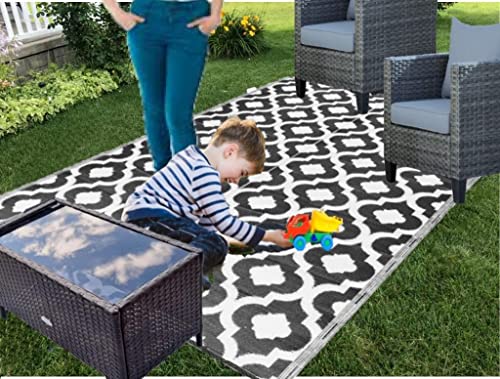
BalajeesUSA Outdoor Rug, 5×7 Black, Reversible Recycled Plastic Straw — Best for Wet Climates
The BalajeesUSA rug is the durability extremist of this category. Its verified listing confirms the construction in its own title: a reversible outdoor rug woven from recycled plastic straw, in a 5×7 black format, sold for patios, RV and camper use. Woven plastic straw contains nothing that can rot, mildew or absorb water: rain passes through or sits on the surface to be shaken off, and the rug dries in the time it takes to make tea. It is reversible, feather-light to roll and carry, and sits in the budget-to-mid-range tier despite a service life in wet climates that embarrasses dearer rugs.
Strengths
- Cannot rot or mildew: nothing organic in it
- Dries almost immediately; water does not soak in
- Very light, rollable and reversible — two looks in one
Trade-offs
- Straw texture is firm and plasticky under bare feet
- Light weight means wind can lift corners without furniture or stakes
- Pattern is woven-in geometry, not fine detail
Judge any listing by weave tightness and edge finishing, the two places cheap versions fail: a tight weave lies flat and resists snagging chair legs, and bound or heat-sealed edges outlast folded ones. In a dry climate it is merely a good rug; in a wet one — the patio that never quite dries, the coastal deck, the campsite circuit — it is often the only rug still presentable in year three. Pair it with furniture weight on its corners and it will quietly outlive rugs costing several times more, which is the definition this guide has used from the start.
Best for: Wet climates, coastal decks, camping and RV life / Not suited for: Barefoot luxury seekers wanting a soft textile feel
Check on Amazon — check the current price on Amazon before ordering, and confirm size, colour and configuration on the listing.
Comparison Table
| Pick | Badge | Key spec | Best for |
|---|---|---|---|
| KOECKRITZ Indoor/Outdoor Carpet Rug, Custom Cut to Order | Best Overall — Made to Fit | Custom-cut loop Berber carpet | Defined patios, porches and decks kept for years |
| KOECKRITZ Heavy Duty Indoor/Outdoor Rug With Rubber Backing, Custom-Cut | Best for Grip and Deck Protection | Custom-cut; rubber non-slip backing | Pool decks, steps, entrances and homes wanting maximum grip |
| KOECKRITZ Vitality Indoor/Outdoor Economy Area Rug, Customized | Best Budget Custom Option | Customized economy carpet rug | Large patios, rentals and budget-fitted outdoor rooms |
| nuLOOM Wynn Solid Braided Indoor/Outdoor Area Rug (3×5, Ivory) | Best Braided Texture | Braided indoor/outdoor; 3×5 ivory | Covered porches, balconies and barefoot seating corners |
| nuLOOM Wynn Solid Braided Indoor/Outdoor Runner Rug (2×8) | Best Runner for Paths and Balconies | Braided runner; 2×8 | Long balconies, side paths, pool-to-door routes |
| BalajeesUSA Outdoor Rug, 5×7 Black, Reversible Recycled Plastic Straw | Best for Wet Climates | Woven recycled plastic straw; reversible; 5×7 | Wet climates, coastal decks, camping and RV life |
Read the table as a shortlist, not a ranking: the right row is the one whose key spec matches the problem you described at the start, and the full reviews above explain where each pick gives ground as well as where it wins.
How to Choose a Durable Outdoor Rug: Fibre, Weave and Backing
Fibre decides the ceiling on a rug’s life. Polypropylene is the category’s champion because it is inherently indifferent to water, resists fading better than most synthetics, and does not feed mildew; solution-dyed versions carry their colour through the fibre rather than on its surface, so sun and scrubbing cannot strip what is not a coating. Polyester looks richer and feels softer but generally fades and tires sooner outdoors; nylon is tough but thirsty and slow to dry. Natural fibres — jute, sisal, seagrass — are for covered, dry porches only, whatever the listing implies: in real rain they wick, stain and mildew, and their presence in an ‘outdoor’ search result is a category error you pay for.
Weave decides how the rug meets traffic. Loop pile, as in the KOECKRITZ carpets, is the workhorse: loops spring back under furniture, the low profile sheds dirt to a broom, and there are no cut ends to fray. Braids, as in the Wynn, trade a softer hand for a structure that must be kept free of ground-in grit, which acts as sandpaper inside the braid. Flat woven straw, in the recycled-plastic pick, has no pile to crush at all and therefore nothing to look tired — its wear shows at the edges instead. Match weave to traffic: loops for dining sets and chair legs, braids for barefoot corners, straw for wet routes and camping.
Backing decides the rug’s relationship with the floor beneath. Rubber backing grips, protects decking from grit abrasion and feels planted, at the cost of trapping a moisture film that needs occasional lifting and drying. Unbacked rugs drain and dry fast and can be hosed through, at the cost of creeping on smooth surfaces unless weighted or underlaid. Neither is superior; the error is mismatch — a backed rug left sodden against a wooden deck all winter, or an unbacked rug skating on wet tile at a pool door. Choose the backing your floor and your habits can live with, because the rug will live with it for years.
Sizing and Placing Outdoor Rugs So They Last
Durability is partly placement. A rug whose edge sits in a drip line from the roof, or in the puddle that forms at the patio’s low corner, ages years faster than its twin a metre away, so map your space’s water before you measure for size: after rain, note where water stands and where it runs, and keep rug edges out of both where you can. Under a dining set, size the rug so chair legs stay on it when chairs are pulled out — a chair half-on, half-off rocks the edge, curls it, and grinds grit into the same border every meal. That edge abuse, repeated, is how good rugs die young.
Front legs only is the stylist’s rule for seating areas and it doubles as a durability rule: a rug anchored by the furniture’s front legs is held flat by weight exactly where foot traffic crosses its border. In open traffic lanes, prefer the runner system in this guide — a replaceable strip taking the wear — over one heroic rug spanning everything. And leave a border of bare floor around any outdoor rug: it frames the room visually, keeps edges out of the mop-water and leaf-drift lines at walls, and makes the weekly shake-and-sweep a two-minute job instead of a furniture move. Placement is free durability; spend it before you spend money.
Cleaning and Winter Care That Double a Rug’s Life
Outdoor rugs die of neglect in a specific sequence: grit settles into the pile or braid, foot traffic grinds it like sandpaper, fibres fray, and then water finds the damage. Interrupt the sequence at its first step and the rest never happens. The routine is short: shake or beat the rug monthly (weekly for runners and door zones), sweep or vacuum the grit that shaking loosens, and hose the rug down with a brush and mild detergent whenever the season turns or the colour dulls. Pressure washers are legitimate on the loop carpets and the straw rug at a respectful distance and fan setting; they are a braid’s enemy at close range, where the jet can lift and fray the weave. Match the violence to the construction.
Winter asks a decision by climate. In mild, wet winters, the kindest storage is often in place but lifted: roll the rug, stand it in a dry corner of the garage or under cover, and let the floor beneath dry and be swept. In harsh freeze-thaw country, in-place rugs suffer ice working into backings and fibres, so rolling and storing is worth the effort for every construction except the plastic straw, which tolerates being left out better than any pick here. Whatever the climate, never store a rug dirty or damp: the season in the dark is when mildew and odours set permanently. A rug put away clean in autumn comes back in spring needing nothing but unrolling, and that annual rhythm — clean, dry, rest — is the real secret behind every ‘ten-year rug’ story in this category.
Decks, Balconies and HOA Realities
Where the rug lives changes what ‘durable’ must include. On wooden decking, the rug’s underside matters as much as its face: grit trapped beneath any rug sands the boards with every footstep, so lift and sweep beneath monthly, and favour the rubber-backed pick if the boards are precious, since the backing interposes a soft layer between grit and wood. On balconies, weight and wind join the brief — a featherweight straw rug on an exposed high balcony needs its corners held by furniture or it will visit the neighbours — and drainage rules in many buildings forbid rugs that hold water against the slab, which quietly favours unbacked, fast-drying constructions.
Shared and regulated spaces add one more filter: appearance from outside. A rug that fades unevenly or curls at the visible edge reads as neglect from the street, however sound its centre; solution-dyed fibres and loop constructions fade the most gracefully and lie the flattest, which is another reason the commercial-style carpets top this guide. Renters should note the reversible straw rug’s quiet advantage — two faces mean a mid-season flip restores the show side — and everyone should photograph their rug new, because the comparison a season later tells you your real fading rate and whether next time’s budget belongs in a better fibre.
Rug Pads, Tape and the Grip Question, Settled
Owners of unbacked rugs on smooth floors face the grip question immediately, and the options deserve a straight ranking. A purpose-made outdoor rug pad — a waffle or felted synthetic grid — is the best answer: it cushions, grips both ways, lifts the rug a few millimetres so air and water move beneath, and comes up with the rug for cleaning. Double-sided carpet tape works in small, covered areas but leaves residue arguments on decking and fails when wet, which is when grip matters most. Silicone caulk dots and spray adhesives belong to desperation, not to a guide that values the floor. If grip is a daily, wet, safety-critical need — pool edges, steps, an elderly relative’s route — skip the accessories entirely and buy the rubber-backed rug in the first place; retrofitting grip is always second best to building it in.
For braided and straw rugs on rougher surfaces — brushed concrete, stone, older decking — the surface itself usually supplies enough friction once the rug is weighted by furniture at its working edges, and a pad is then only a cushion decision. Test with a week of real traffic before buying accessories: many rugs that skate on day one settle as their fibres relax and their undersides pick up the floor’s texture. The runner on a route is the exception — it takes directional traffic all day and earns its pad or its backing from the start.
When to Repair, Demote or Replace an Outdoor Rug
A durable rug should be managed like any long-life equipment, with a ladder of responses before replacement. Fading that is even is cosmetic and often reversible in effect by flipping a reversible rug or rotating it 180 degrees so the sun’s work balances; treat it as patina, not failure. Edge fray on a woven or braided rug can be arrested early with a fabric sealant or a stitched binding, and an hour with a needle at the first loose thread saves the border. Curl that survives the placement fixes in this guide usually means the backing has tired; a pad beneath often buys the rug two more presentable seasons.
Demotion is the honourable middle path: the patio rug that no longer photographs well moves to the side path, the garage door, the potting bench — places where its remaining durability serves without its appearance being judged — and the runner’s slot in this guide exists partly to receive such retirees. Replacement is truly due when the backing powders or cracks, when the pile or weave has worn to the foundation in the traffic lane, or when cleaning no longer restores it: at that point the rug has delivered its seasons, and the cost-per-season arithmetic in this guide will usually show it earned its price. Buy its successor by the same construction logic and the cycle improves each time.
Colour and Pattern Choices That Age Gracefully
Since this guide assumes you will live with the rug for years, choose the face for its third summer, not its first afternoon. Flecked and heathered surfaces — the Berber-style mix in the KOECKRITZ carpets is the textbook example — hide the pollen film, leaf tannins and dust that settle on every outdoor floor, and they fade evenly because there is no single dye to bleach. Busy woven geometry, the straw rug’s natural idiom, hides wear patterns in its design. Flat, pale solids — the ivory Wynn is the beautiful offender — show everything and demand the monthly hose discipline its review describes; buy them with that commitment made, in the spaces where the brightening effect is worth it, and they will reward you. Dark solids sit in between for dirt but lead the league for visible fading, especially in full sun.
Pattern scale should match viewing distance: a patio read from a kitchen window wants a bold, simple design or none; a balcony read from two feet away can carry detail. And remember the furniture’s claim on the composition — most of a seating rug is covered by the set it serves, so its visible border does the design work, which argues for strong edges and quiet centres outdoors. Choose with those rules and the rug will still look intentional when its construction has long since proved itself, which is the complete definition of a durable purchase.
How to Install and Settle a New Outdoor Rug
An hour of methodical placement on day one prevents the curls, creep and edge wear that owners later blame on the rug.
- Sweep and hose the floor first and let it dry: grit sealed under a new rug starts sanding the floor and the rug’s underside from the first footstep.
- Unroll the rug and let it relax in the sun for an hour where possible; shipping curl is normal, and warmth plus time removes most of it without weights or tape.
- Position with the furniture rule: front legs of seating on the rug, dining chairs fully on it when pulled out, and a border of bare floor to walls and drip lines.
- Flatten stubborn corners by reverse-rolling them briefly or weighting them overnight with furniture — never with adhesive tape on decking you care about.
- Add grip where the construction needs it: underlay or the rug’s own rubber backing on smooth surfaces, furniture weight on light straw corners.
- Walk the routes: from door to seating, seating to gate. If a rug edge crosses a route at an angle, square it — diagonal edges catch toes and chair legs and curl first.
- After the first rain, check where water sits on and under the rug and adjust position once, permanently, out of standing water and runoff lines.
Photograph the settled layout. When the rug comes up for its first deep clean, the photograph restores the arrangement in minutes, and comparing photographs season to season is the easiest durability log you will ever keep.
Common Buying Mistakes
- Buying an indoor rug for an outdoor life. Indoor fibres and backings mildew, fade and disintegrate outdoors at a pace no care routine can prevent. Construction for the climate is the whole game.
- Choosing natural fibre for real weather. Jute and sisal are covered-porch materials. In open rain they wick, stain and rot, however beautiful the listing photograph.
- Leaving rug edges in drip lines and puddles. Water geography ages rugs unevenly and fast. Map where rain stands and runs, and keep borders out of both.
- Never lifting a backed rug. A rubber backing traps a moisture film against the floor. Lift and dry both sides after wet spells or the floor beneath suffers in silence.
- Pressure-washing any rug at point blank. Close jets fray braids and blast pile. Distance and a fan pattern clean every construction in this guide without wounding it.
- Storing the rug dirty and damp for winter. A stored season in the dark sets mildew and odour permanently. Clean, fully dry, then roll — in that order, every year.
Final Recommendation
If your outdoor space is a keeper, the KOECKRITZ custom-cut carpet is the guide’s centre of gravity: fitted, loop-piled and commercial in spirit, with its rubber-backed sibling specified wherever grip and deck protection lead, and the Vitality carrying the same fitted logic to large areas at an economy tier. The nuLOOM Wynn pair — area rug and runner — bring the soft, braided, barefoot feel to porches and paths, and the BalajeesUSA recycled-plastic straw rug is the wet-climate and camping extremist that cannot rot at all. Each pick survives by a different mechanism, and the guide has told you which mechanism your floor, climate and traffic actually need.
Buy the construction, place it out of the water’s way, shake the grit out before it grinds, and put it away clean. Those four habits, more than any brand, are what a ten-year outdoor rug is made of.
Measure your space’s water as carefully as its dimensions, photograph the rug the day it settles, and let those two records guide every later decision. Durability, in the end, is mostly attention paid early.
Related guides on this site: Best Outdoor Rugs For Patios Best Washable Outdoor Rugs Best Rugs For Decks Best Outdoor Runners Best Patio Furniture
Frequently Asked Questions
What is the most durable material for an outdoor rug?
Polypropylene, in loop-pile, braided or woven-straw constructions, is the category’s durability benchmark: it ignores water, resists fading — especially solution-dyed — and does not feed mildew. The picks in this guide are built on it or its close synthetic family for exactly that reason.
Can I leave an outdoor rug out all winter?
The recycled-plastic straw rug tolerates it best. Others survive mild winters in place if they are clean and the floor drains, but freeze-thaw cycles and months of trapped moisture shorten every rug’s life; rolling and storing clean and dry is the kindest option wherever winters are harsh.
How do I stop an outdoor rug curling at the corners?
Let it relax in warmth when new, reverse-roll stubborn corners, weight them with furniture, and keep edges out of drip lines and chair-leg battlegrounds. Persistent curl usually traces to an edge being repeatedly kicked, dragged or soaked — fix the cause and the corner behaves.
Will an outdoor rug damage my deck?
Only by neglect: grit trapped underneath sands the boards, and a backed rug left sodden holds moisture against them. Lift, sweep beneath and dry both sides periodically, and a rug protects the deck’s finish far more than it threatens it.
How often should I clean an outdoor rug?
Shake or beat monthly — weekly for runners — sweep grit as you see it, and hose with a brush and mild detergent each season or whenever the colour dulls. The expensive mistake is waiting until the rug looks dirty, because by then grit has been grinding the fibres for weeks.
Is a rubber backing a good idea outdoors?
Where grip and floor protection matter — pool decks, steps, smooth tile — yes, with the discipline of lifting it to dry after wet spells. Where fast drainage matters more, an unbacked rug is the better tool. The backing question is about your floor, not about the rug’s quality.
What size outdoor rug do I need under a dining set?
Big enough that every chair stays fully on the rug when pulled out for sitting — in practice, at least two feet of rug beyond the table’s edge on all sides. A chair straddling the border rocks the edge, grinds grit into it and curls it, which is the fastest route to a tired-looking rug.
Can I use an outdoor rug on grass?
For an event, yes; as a season-long installation, it smothers the lawn beneath and holds moisture against it. The straw rug is the least harmful for short stays because water passes through it. For a permanent garden seating area, build the hard surface first and rug it properly.
Are custom-cut rugs worth it over standard sizes?
Where the space is a keeper, yes: the fitted rug eliminates the compromise border where wear, curl and dirt concentrate, and its cost per season over a long life routinely beats two cycles of almost-fitting standard rugs. For temporary spaces, standard sizes and the runner system are the sensible spend.
Do outdoor rugs attract mould underneath?
They can hold a moisture film that encourages it, especially backed rugs on shaded, slow-drying floors. The prevention is the routine in this guide: lift periodically, sweep beneath, dry both sides after wet spells. A rug in a moving-air, sun-touched spot with that rhythm stays clean and sound underneath for many long years of faithful service outdoors.
One rug or several smaller ones?
Several, zoned by traffic, usually win on lifetime cost: a runner takes the route’s wear, the area rug takes the room’s, and each is cheaper to clean, dry and eventually replace than one giant rug doing both jobs badly.


