Disclosure: airfryerkitchensupply.com is reader-supported. When you buy through links on our site, we may earn an affiliate commission at no extra cost to you.
Where to buy
Every tub below is sold on Amazon, and the listing page is where you confirm the three numbers that decide whether a freestanding tub delights or disappoints: the exact outside dimensions, the drain finish, and the delivery arrangement for a fixture that may weigh more than the person delivering it. Solid surface tubs are heavy, rigid and unforgiving of a mis-measured doorway, so read the dimension drawing on the listing, not just the headline length, and check price on Amazon at the time you order.
- WOODBRIDGE 61″ Stone Resin Freestanding Soaking Tub — check price on Amazon
- WOODBRIDGE 67″ Stone Resin Freestanding Soaking Tub — check price on Amazon
- WOODBRIDGE 55″ Stone Resin Freestanding Soaking Tub — check price on Amazon
- BCANHOME 51″ Stone Resin Freestanding Bathtub — check price on Amazon
- MUIRYN 63″ Stone Resin Freestanding Bathtub — check price on Amazon
- Kingston Brass Aqua Eden 72″ Solid Surface Resin Freestanding Tub — check price on Amazon
Introduction: What “Solid Surface” Actually Buys You
The best solid surface freestanding tubs solve a specific problem with acrylic, which is that acrylic is a compromise most buyers only discover after the first winter. A thin acrylic shell flexes underfoot, loses heat quickly, and once its gelcoat is scratched the repair shows. Solid surface — sold as stone resin, mineral composite or engineered stone depending on the brand — is a cast material that is the same substance all the way through. It feels like cool stone, holds bath heat far longer, does not flex, and can be gently sanded and re-polished years later because there is no coating to break through. That is the whole case for the category, and it is a strong one.
The honest costs are weight, money and care. A stone resin tub can weigh two to three times its acrylic equivalent before water, which turns delivery and floor loading into real project steps rather than footnotes. The material sits in the mid-range to premium tier as a class. And the matte finishes that make these tubs look like sculpture also ask for a rinse-and-wipe habit after oily baths. None of that should scare off the right buyer — the six tubs below are the verified listings we would shortlist — but a solid surface tub bought casually, without measuring the room, the route and the floor, is the most common expensive mistake in bathroom remodelling.
Every pick in this guide was confirmed against a live Amazon listing before it earned a link, and the six split cleanly by the only decision that really matters: length. Choose the length that fits your body and your wall, and the rest of this guide — drains, fillers, floors, installation, cleaning — is about not spoiling a good choice with a sloppy install.
In this guide
Quick Picks
Six verified solid surface freestanding tubs, from a 51-inch compact to a 72-inch statement piece. Badges are used consistently in the full reviews below.
- WOODBRIDGE 61″ Stone Resin Freestanding Soaking Tub — Best Overall — check price on Amazon
- WOODBRIDGE 67″ Stone Resin Freestanding Soaking Tub — Best for Tall Soakers — check price on Amazon
- WOODBRIDGE 55″ Stone Resin Freestanding Soaking Tub — Best for Compact Bathrooms — check price on Amazon
- BCANHOME 51″ Stone Resin Freestanding Bathtub — Best for Tiny Bathrooms — check price on Amazon
- MUIRYN 63″ Stone Resin Freestanding Bathtub — Best Mid-Size Alternative — check price on Amazon
- Kingston Brass Aqua Eden 72″ Solid Surface Resin Freestanding Tub — Best Statement Tub — check price on Amazon
How These Picks Were Chosen
We started from the material, not the marketing. Listings that called themselves “stone” while describing an acrylic shell were excluded; every pick here is a cast solid surface or stone resin tub per its verified listing title. We then checked the practical inclusions that separate a complete purchase from a partial one: whether the drain is in the box, whether the overflow is integrated, and whether the published dimensions are complete enough to plan a room around. Tubs that failed any of those checks, or whose listings could not be confirmed, did not make the six.
The shortlist was then spread deliberately across the size range — 51, 55, 61, 63, 67 and 72 inches — because in this category the “best” tub is meaningless without a length attached. A perfect 67-inch tub is a terrible purchase for a 55-inch wall. Within each size we favoured established bathroom brands and listings with clear dimension data, and we have flagged the smaller brands honestly in their reviews rather than pretending all six carry identical aftercare. Finally, we applied this site’s standing rules: no static prices anywhere (check price on Amazon on the listing), and no fixed star ratings or review counts, because both change too fast to print responsibly.
The 6 Best Solid Surface Freestanding Tubs

WOODBRIDGE 61″ Stone Resin Freestanding Soaking Tub — Best Overall
If you read one review in this guide and stop, make it this one. The WOODBRIDGE 61-inch is the size most primary bathrooms can actually accept, in the material this search is really about: a stone resin solid surface with a matte white finish that reads more like carved stone than like fibreglass. The oval shape is not a styling gimmick — the sloped ends give you a backrest at either end, and the integrated slotted overflow means the rim line stays unbroken, which is most of what people are paying for in this category.
Strengths
- The 61-inch length is the honest sweet spot: long enough for a genuine soak, short enough to fit a standard alcove-length footprint once the old tub is out
- Stone resin holds bath heat noticeably longer than thin acrylic shells, so top-ups with hot water are less frequent
- Integrated slotted overflow keeps the silhouette clean and removes a separate overflow plate from the parts list
Trade-offs
- At 61 inches, bathers much over six feet will soak with knees bent — the 67-inch sibling exists for a reason
- Matte solid surface shows bath-oil residue more readily than gloss finishes and wants a wipe-down routine
- Like every stone resin tub here, it is heavy before a drop of water goes in; plan the carry route before delivery day
Key specs: 61″ L oval; stone resin solid surface; matte white; integrated slotted overflow; drain included (per Amazon listing title).
In daily use the difference between solid surface and the acrylic tubs that dominate freestanding listings is thermal. A thick stone resin wall starts at room temperature, warms through in the first minutes of the fill, and then gives that heat back slowly. A 40-minute soak stays a 40-minute soak instead of becoming a negotiation with the hot tap. The trade-off is discipline: matte finishes reward a quick rinse-and-wipe after draining and punish bath oils left to dry on the surface, so treat the care section later in this guide as part of the purchase.
Installation is the standard freestanding pattern — floor-mounted filler or a wall spout, a flexible tailpiece connection to the floor drain, and a bead of silicone at the base once the tub is levelled. The drain is included in the box per the listing, which removes the classic freestanding mistake of ordering a tub and discovering the drain kit is a separate, finish-matched purchase. Confirm the drain finish against your filler finish before the plumber arrives, not during.
Best for: Most primary bathrooms and average-height soakers / Not suited for: Very tall bathers who need a 67-inch-plus interior
Check on Amazon — check the current price on Amazon and confirm the drain finish and delivery options for your bathroom.
WOODBRIDGE 67″ Stone Resin Freestanding Soaking Tub — Best for Tall Soakers
Everything said about the 61-inch applies here, scaled for the people the 61-inch leaves folded up. If you are tall, or you share the bath with a tall partner, the extra six inches are not a luxury — they are the difference between a soaking tub and an expensive sitz bath. The WOODBRIDGE 67 keeps the same oval profile, the same matte white stone resin, and the same integrated slotted overflow, so you are choosing purely on fit rather than on a different feature set.
Strengths
- A true 67-inch interior lets tall bathers submerge shoulders and knees at the same time, which no amount of clever contouring achieves at 59 inches
- Same stone resin construction and matte finish as the 61-inch, so heat retention and the care routine carry over unchanged
- The longer footprint still fits many primary bathrooms planned around a 72-inch alcove
Trade-offs
- Filled weight climbs fast at this size — verify joist capacity on any upstairs install before ordering
- Needs a filler with enough reach; short-spout floor fillers that suit a 55-inch tub can look and perform awkwardly here
- Two-person delivery and placement is not optional; this is not a one-person carry up a staircase
Key specs: 67″ L oval; stone resin solid surface; matte white; integrated slotted overflow; drain included (per Amazon listing title).
Fit is a three-part question at this size. First, the room: measure the wall the tub will sit against and leave honest clearance at both ends for cleaning access, because a 67-inch tub wedged wall-to-wall collects dust exactly where you cannot reach. Second, the route: door widths, stair turns and landing depth decide whether the tub reaches the bathroom at all, and stone resin does not flex around a tight corner the way an acrylic shell sometimes can. Third, the floor: a tub of this size, filled, with a bather in it, is a serious point load, and upstairs bathrooms in older homes deserve a joist check before the order, not after the delivery truck leaves.
Assuming all three answers are good, this is the most satisfying soak on the list. The long interior pairs well with a floor-mounted filler placed at the centre of one long side, and the matte surface photographs — and, more importantly, ages — better than gloss gelcoat, which shows every micro-scratch under window light within a couple of years.
Best for: Tall bathers and spacious primary suites / Not suited for: Small bathrooms or weak floors that cannot take the filled weight
Check on Amazon — check the current price on Amazon and confirm the drain finish and delivery options for your bathroom.
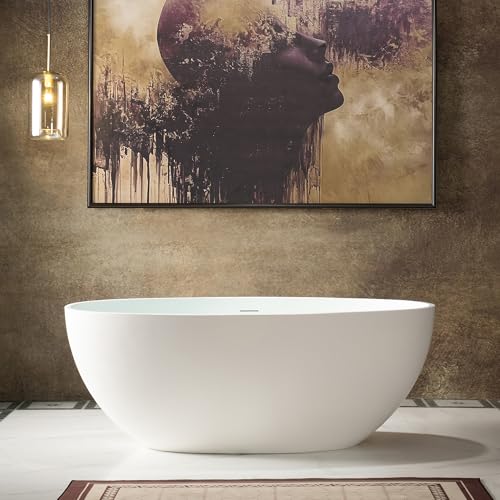
WOODBRIDGE 55″ Stone Resin Freestanding Soaking Tub — Best for Compact Bathrooms
The 55-inch WOODBRIDGE (model B0043 in the listing) answers the most common freestanding question we hear: can I have the solid surface look in a bathroom that currently holds a compact alcove tub? Usually, yes. Fifty-five inches fits inside the footprint of many standard alcoves once the surround is stripped, and because a freestanding tub reads visually lighter than a boxed-in apron tub, the room often feels larger after the swap, not smaller.
Strengths
- A genuine solid surface tub that fits bathrooms where freestanding is usually ruled out entirely
- Shorter length means a faster, cheaper fill and less hot water per soak — a real running-cost advantage
- Same integrated overflow and matte stone resin finish as its larger siblings
Trade-offs
- The soak is upright and deep rather than stretched out; tall bathers will not submerge fully
- Resale and guest impressions aside, a 55-inch tub suits one person only — there is no couples configuration
- Filler placement is tighter: wall-mounted spouts often suit this size better than floor fillers
Key specs: 55″ L oval; stone resin solid surface; matte white; model B0043; integrated slotted overflow; drain included (per Amazon listing title).
The honest compromise is posture. At 55 inches you soak sitting up, knees raised, water deep rather than long. Plenty of people prefer exactly that — it is the Japanese soaking posture, and for evening wind-down soaks of twenty minutes it is arguably better than a lukewarm sprawl. But go in knowing which bather you are. If your ritual is a full-length Sunday soak with a book, buy the length your ritual needs and solve the room problem differently.
Practical notes: the smaller volume fills quickly from a standard water heater without exhausting it, which matters in households where someone showers after your bath. The drain and integrated overflow are included as with the rest of the WOODBRIDGE stone resin line. Because the tub is shorter, check filler reach twice — a floor filler positioned for a longer tub can overshoot the rim here.
Best for: Smaller bathrooms that still want a real soaking tub / Not suited for: Couples soaking together or bathers over about six feet tall
Check on Amazon — check the current price on Amazon and confirm the drain finish and delivery options for your bathroom.

BCANHOME 51″ Stone Resin Freestanding Bathtub — Best for Tiny Bathrooms
The BCANHOME 51-inch exists for the bathrooms the rest of this list cannot enter. Fifty-one inches is genuinely small for a freestanding tub, and the listing says plainly that it is an oval solid surface stone resin tub for small bathrooms. That honesty is the point: rather than a scaled-down acrylic compromise, you get the same material family — matte stone resin, with the heat retention and repairable surface that justify choosing solid surface in the first place.
Strengths
- At 51 inches this is one of the smallest true solid surface freestanding tubs with a verified listing — most rivals at this size are acrylic
- Compact footprint opens up en-suite additions, converted closets and small rental remodels
- Matte white finish and oval profile keep the small-bathroom result looking deliberate rather than compromised
Trade-offs
- This is a deep, upright single soak; nobody stretches out in a 51-inch tub
- Smaller brand, so confirm drain parts and support terms in the listing before purchase
- The small interior volume means bath additives go further — and stain faster if left unrinsed
Key specs: 51″ L oval; solid surface stone resin; matte white; designed for small bathrooms (per Amazon listing title).
Where does a tub this size earn its place? In the en-suite carved out of a spare-room corner, in the rental renovation where the bathroom is long and narrow, in the primary bath of a small urban flat where the alternative is no tub at all. The soaking posture is upright and deep, closer to an ofuro than to a hotel sprawl, and for short evening soaks that is a perfectly good trade — especially since the small volume fills fast and drains fast.
Two cautions. First, measure your doorway and the final approach turn; small bathrooms often sit at the end of small hallways. Second, because the interior is compact, waterline marks and bath-oil residue concentrate on a smaller wall area — the wipe-down habit matters even more here. Neither is a reason to skip the tub; both are reasons to buy it with open eyes.
Best for: Powder-room conversions, studio flats and tight remodels / Not suited for: Anyone expecting to stretch out fully or soak two people
Check on Amazon — check the current price on Amazon and confirm the drain finish and delivery options for your bathroom.

MUIRYN 63″ Stone Resin Freestanding Bathtub — Best Mid-Size Alternative
MUIRYN’s 63-inch tub is the argument for measuring yourself, not your bathroom, first. If a 61-inch interior leaves your shoulders out of the water and a 67-inch tub will not fit the wall, the market’s honest answer used to be ‘compromise’. A 63-inch solid surface oval is the compromise removed: long enough for most adults to get shoulders under, short enough to sit where a 67 will not.
Strengths
- 63 inches splits the difference between the 61 and the 67 — a real option for bathers who found 61 tight but lack the room for 67
- Drain and integrated overflow are included, keeping the install parts list to the tub plus a filler
- Contemporary oval profile with the same matte finish language as the category leaders
Trade-offs
- A smaller brand name than WOODBRIDGE or Kingston Brass, so aftercare depends on the seller — keep the listing documentation
- Fewer published dimensions beyond length, so verify width and soaking depth in the listing before ordering
- As with all stone resin, weight demands a planned carry and a checked floor
Key specs: 63″ L oval; solid surface; matte white; drain and integrated overflow included (per Amazon listing title).
The listing confirms the essentials — contemporary oval solid surface construction, matte white finish, drain and integrated overflow included. Beyond that, apply the standard checks with a little extra care because this is a younger brand: download the dimension drawing from the listing, confirm the drain thread standard matches your plumber’s expectations, and keep the order paperwork somewhere safer than an email inbox you will clean out.
In the room, expect the same solid surface behaviour as the bigger names: slow heat loss, a surface that can be gently re-polished if it ever dulls, and a rim that feels cool and stone-like rather than hollow. If the numbers fit your body and your wall, this is a rational buy rather than a risky one.
Best for: Buyers who want a step up in length without jumping to 67 inches / Not suited for: Shoppers who need a long-established dealer network for parts
Check on Amazon — check the current price on Amazon and confirm the drain finish and delivery options for your bathroom.

Kingston Brass Aqua Eden 72″ Solid Surface Resin Freestanding Tub — Best Statement Tub
Kingston Brass built its name on faucets and fittings, and the Aqua Eden 72-inch brings that traditional-plumbing sensibility to solid surface: a long, matte white resin tub with the drain kit in the box and proportions meant for a bathroom that is being designed around the bath, not squeezed by it. Seventy-two inches is the length at which essentially every adult soaks fully extended, and the interior volume makes this the slowest-cooling, most hotel-like soak on the list.
Strengths
- At 72 inches with a drain kit included, this is the full-length, no-apologies soak — and from a plumbing brand with a long retail history
- The Aqua Eden line is built around traditional bathroom design, so it pairs with bridge faucets and classic fillers better than the minimalist ovals
- Solid surface resin at this size delivers the longest heat retention of any tub on this list simply through wall mass
Trade-offs
- The footprint (just under 72 by 32-5/16 inches) and filled weight demand a big room and a verified floor
- The traditional profile will fight a starkly minimalist bathroom scheme rather than blend into it
- Delivery logistics are the project: confirm the carry route, including stair turns, before you commit
Key specs: 71-7/16″ L x 32-5/16″ W x 22-13/16″ D; solid surface resin; matte white; drain kit included (per Amazon listing title).
It is also the most demanding purchase here. The footprint needs a genuinely large room to keep cleaning clearance at both ends; the filled weight needs a floor you have verified rather than assumed; and the delivery needs a route — through the front door, up the stairs, around the landing — that a long, rigid, heavy tub can actually travel. None of this is hidden cost; it is the standard physics of big tubs, and the listing’s published dimensions let you check all of it before money moves.
Choose this tub when the bathroom is the project: a primary suite renovation, a design scheme with traditional fittings, a household where the bath is a daily ritual for someone tall. In that setting it will be the best-used fixture in the house. In a modest family bathroom it will dominate, crowd and annoy — buy the 61-inch instead and spend the difference on a better filler.
Best for: Large bathrooms, long soaks and design-led renovations / Not suited for: Upstairs bathrooms with unverified floor loading or narrow doorways
Check on Amazon — check the current price on Amazon and confirm the drain finish and delivery options for your bathroom.
Comparison Table
| Pick | Badge | Key spec | Best for |
|---|---|---|---|
| WOODBRIDGE 61″ Stone Resin Freestanding Soaking Tub — check price on Amazon | {p[“badge”]} | {p[“keyspec”]} | {p[“bestfor”]} |
| WOODBRIDGE 67″ Stone Resin Freestanding Soaking Tub — check price on Amazon | {p[“badge”]} | {p[“keyspec”]} | {p[“bestfor”]} |
| WOODBRIDGE 55″ Stone Resin Freestanding Soaking Tub — check price on Amazon | {p[“badge”]} | {p[“keyspec”]} | {p[“bestfor”]} |
| BCANHOME 51″ Stone Resin Freestanding Bathtub — check price on Amazon | {p[“badge”]} | {p[“keyspec”]} | {p[“bestfor”]} |
| MUIRYN 63″ Stone Resin Freestanding Bathtub — check price on Amazon | {p[“badge”]} | {p[“keyspec”]} | {p[“bestfor”]} |
| Kingston Brass Aqua Eden 72″ Solid Surface Resin Freestanding Tub — check price on Amazon | {p[“badge”]} | {p[“keyspec”]} | {p[“bestfor”]} |
How to Choose a Solid Surface Freestanding Tub
Start with the tape measure, in this order: body, room, route, floor. Measure the bather first — sit in your current tub, note where the waterline falls, and be honest about whether you soak stretched out or sit up. That answer sets your minimum interior length, and interior length is always several inches less than the headline figure once rim and wall slope are accounted for. Then measure the wall the tub will stand against and the clearance at both ends; you need room to clean behind and beside a freestanding tub for its entire life, and a tub you cannot clean around becomes a grime trap with a luxury price tag.
The route is the step everyone skips. Walk from the kerb to the bathroom with the tub’s dimensions in hand: front door width, hallway turns, stair width and the landing turn are the four usual failure points. Stone resin does not bend, compress or forgive. If the route fails for a 67-inch tub, it fails — buy the size that travels. Finally, the floor. A filled solid surface tub with a bather can concentrate several hundred pounds on four small feet or a plinth. Ground-floor installs on slab are simple; upstairs installs in timber-framed homes deserve a joist assessment, particularly at 63 inches and above.
Solid Surface vs Acrylic vs Cast Iron: An Honest Comparison
Acrylic wins on price, weight and forgiveness — it is the right answer for rental remodels, tight budgets and difficult staircases, and modern acrylic is better than its reputation. What it cannot do is feel like stone, hold heat like stone, or be resurfaced invisibly once scratched. Cast iron with enamel is the heritage option: enormously durable, superb heat retention, and heavier than everything else in this guide combined, with a price and a delivery problem to match. Solid surface sits deliberately between them — stone-like feel and repairability, heat retention close to iron in practice because the wall mass is substantial, at a weight a two-person crew can manage and a tier below iron’s typical cost. If you are reading a guide with this search, you have probably already decided the middle path is yours; the comparison matters only to confirm that the acrylic tub your contractor keeps suggesting is a different product, not a cheaper version of the same one.
Drains, Overflows and Fillers: The Parts That Decide the Install
All six picks include the drain, and five integrate the overflow into the tub wall as a slot rather than a separate plate — that is the clean modern detail in the photographs. What is never included is the filler, and filler choice is where freestanding projects most often stumble. A floor-mounted filler needs its rough-in positioned before the finished floor goes down, which means the tub’s position must be final at first-fix plumbing stage. A wall-mounted spout avoids floor work but demands the tub sit close to the wall and the spout reach the interior without splashing the rim. Deck-mounting is not an option on these rim profiles. Decide the filler at the same time as the tub, match the drain finish to it (the WOODBRIDGE and Kingston Brass listings offer the drain in the box — confirm its finish against your filler before the plumber’s visit), and budget for a flexible tailpiece or island drain kit if your floor drain position and the tub’s drain position do not align exactly, which in real remodels they rarely do.
How to Install a Freestanding Solid Surface Tub
Freestanding installation is simpler than alcove work — no surround, no tiling-in — but it is unforgiving of sequence errors. Work in this order. First, confirm the finished floor is level across the tub footprint and that the drain rough-in sits where the tub’s drain will land; mark the tub outline on the floor with tape and live with it for a day, walking the room, before anything is fixed. Second, dry-fit the tub with a helper: set it in place, check it does not rock, and confirm the drain alignment from below or through the access the design allows. Third, fit the drain body to the tub per the manufacturer’s instructions, connect the tailpiece to the floor drain (a flexible connector forgives small misalignments), and water-test the drain connection by filling the tub partway and watching every joint before the tub is finally positioned.
Fourth, level the tub on its adjustable feet or plinth — solid surface tubs are cast accurately, but floors are not, and a rim that is visibly off-level will annoy you daily. Fifth, once level, plumbed and tested, run a neat bead of sanitary silicone around the base contact line to stop the tub creeping and to keep mop water out from underneath. Sixth, fit and test the filler, fill the tub fully, and check the overflow slot actually discharges into the drain before the first real bath discovers otherwise. Keep the delivery packaging until the first fill is done: a tub that leaks at the drain is a warranty conversation, and the box is your evidence it arrived as it left. None of this requires exotic tools, but steps two and three genuinely require two people — schedule the helper, do not improvise with towels and optimism.
How to Clean and Maintain a Matte Solid Surface Finish
The maintenance bargain of solid surface is: five minutes of routine care, in exchange for a surface that can be restored rather than replaced. Daily, rinse the interior after draining and wipe with a soft cloth — this is about bath oils and soap film, which dry into visible marks on matte finishes if left. Weekly, wash with a mild detergent solution and a non-scratch sponge. Never use abrasive scouring powders, steel wool or strong solvents; the material does not need them and they dull the finish unevenly. Limescale in hard-water areas lifts with a diluted citric-acid solution left to sit briefly, then rinsed. If the surface ever dulls or picks up a stubborn stain, the solid surface party trick applies: a fine abrasive pad or very fine wet sandpaper, worked evenly over the area and then the whole panel, restores a uniform matte — because the material is the same all the way through, you are refinishing, not stripping. Test any restoration on the least visible area first, and keep strong dyes (hair colour, bath bombs with heavy pigment) rinsed promptly, as matte surfaces hold pigment longer than gloss.
Matching Tub Length to the Bather: A Practical Table in Words
Because interior dimensions vary by model, treat these as planning bands and confirm the soaking length and depth on the listing’s dimension drawing. Bathers up to about five foot six generally soak happily in the 55–61 inch band, with the 61 giving a stretched posture and the 55 an upright, deep one. Bathers between five foot six and six feet should start at 61 inches and prefer 63 if the wall allows it — this is the band where the MUIRYN earns its place. Bathers over six feet should not compromise below 67 inches; the physics of shoulder submersion do not negotiate, and a too-short premium tub is a worse purchase than a right-sized mid-range one. Two-person soaking is realistic only at 67 inches and above, and even then it is one stretched bather plus one tucked, whatever the marketing photographs imply. Depth matters alongside length: a deep 55-inch tub can submerge a seated bather’s shoulders more completely than a shallow 61-inch one, which is why the compact picks in this guide are deep-soak designs rather than scaled-down sprawlers.
The True Cost of the Project Beyond the Tub
The tub is the headline purchase, not the whole budget, and planning the rest qualitatively now prevents the classic mid-project stall. Expect the project to include: the filler (floor-mounted models are a significant purchase in their own right, and their rough-in valve work belongs to the plumbing budget), a drain connection kit if your floor drain position needs a flexible or island-style solution, the plumber’s time for rough-in and final connection if you are not doing the work yourself, possible floor reinforcement on upstairs installs, and delivery — heavy freight for stone resin is sometimes threshold delivery only, which means the tub arrives at the kerb or garage and the last fifty feet are yours to plan. None of these items is optional decoration; each one skipped becomes a delay with a half-finished bathroom behind it. Set the total project expectation at the start, in tiers rather than false precision, and the tub tier you choose — mid-range WOODBRIDGE or BCANHOME, premium Kingston Brass — will sit comfortably inside it.
Converting From an Alcove Tub: What Actually Changes
Most solid surface freestanding tubs replace an alcove tub, and the conversion has a predictable shape. The old tub and its surround come out, and the wall and floor finishes behind them — usually unfinished or damaged — must be made good across the whole footprint the freestanding tub will reveal, because a freestanding tub hides nothing: floor and wall that were covered for decades become visible from every angle. The drain position usually survives the conversion, since alcove and freestanding drains land in similar places, but the filler supply almost never does — alcove mixers live on the wall at tub height, while a freestanding tub wants a floor filler or a properly reaching wall spout, so expect new supply runs. The shower question decides the rest. If the alcove tub was also the shower, a freestanding replacement means either a separate shower enclosure (the better answer where space allows), a ceiling- or wall-mounted shower over the tub with a curtain ring (workable, but it changes the clean look you are paying for), or accepting a bath-only room. Decide that before ordering, because it drives both the plumbing plan and whether a 55-inch compact — which frees floor area for a separate shower — beats a 61-inch tub that fills the room. Conversions done in this order — finishes, drain check, filler plan, shower decision, then tub — go smoothly; conversions that start with the tub delivery tend to store a very heavy object in a hallway for a month.
Water Capacity and Your Water Heater
One planning check remains, and it is the one that decides whether the first bath is a triumph or a tepid disappointment: can your hot water supply fill the tub you are buying? Large solid surface tubs hold a lot of water, and a standard tank water heater delivers only a portion of its nominal capacity as usable hot water before the temperature falls away. As a rule of planning, match the tub’s capacity — published on the listing — against roughly two-thirds of your tank’s size if the tub will be filled mostly with hot water in a cold climate, and remember that someone showering at the same time spends from the same account. The compact picks in this guide are the forgiving option here: a 51- or 55-inch tub fills quickly and comfortably from a modest tank, which is one more reason small bathrooms and smaller tubs belong together. Tankless systems sidestep the capacity question but introduce a flow question at the filler instead. Either way, five minutes with the listing’s capacity figure and your heater’s rating plate, before ordering, is the cheapest insurance in the whole project.
Common Buying Mistakes
Buying the photograph’s length for your body. Headline length is the outside of the tub. Tall bathers who order by headline alone end up soaking with knees up in a tub they paid a premium for. Skipping the route check. Every season, solid surface tubs are returned — at the buyer’s expense — because they could not make the stair turn. Measure the route before the order. Forgetting the floor. Weight is not a detail on a 67-inch stone resin tub; verify upstairs floors. Choosing the filler last. Floor fillers need first-fix rough-in; deciding after the floor is finished converts a simple job into demolition. Mixing drain and filler finishes. The included drain has a finish; if it clashes with your filler, you discover it on install day. Treating matte like gloss. Bath oil left to dry, abrasive cleaners, and pigment-heavy bath bombs are the three enemies of the matte finish — all avoidable with the routine above. Chasing the cheapest “stone” listing. If the description quietly says acrylic, it is acrylic, whatever the headline claims.
Final Recommendation
For most primary bathrooms, the WOODBRIDGE 61-inch is the purchase we would make: the right material, the right inclusions, and a size that fits both the room and the average bather. Tall soakers should step straight to the 67-inch WOODBRIDGE or the 72-inch Kingston Brass Aqua Eden and spend their effort on floor and route checks instead of feature comparisons. Small bathrooms are genuinely served here for once — the WOODBRIDGE 55-inch and the BCANHOME 51-inch bring real solid surface into rooms that acrylic usually monopolises — and the MUIRYN 63-inch is the sensible answer for the in-between body and the in-between wall. Whichever length you choose, choose it by measurement, confirm the drain finish and delivery route on the listing, and check price on Amazon when you order.
Related guides on this site: Best Freestanding Bathtubs Best Soaking Tubs Best Bathtub Fillers Best Bathroom Faucets Best Bath Towels
Frequently Asked Questions
Is solid surface better than acrylic for a freestanding tub?
For feel, heat retention and long-term repairability, yes — solid surface is the same material through its whole thickness, holds bath heat longer, and can be re-polished if it dulls. Acrylic wins on purchase tier, weight and ease of delivery. Most buyers choosing this search value the stone-like feel enough to accept the weight and the wipe-down routine.
How much does a solid surface freestanding tub weigh, and can my floor take it?
Weights vary by size and wall thickness, and the listing for each model is the authority — check it there before ordering. As a planning rule, expect a stone resin tub to weigh substantially more than acrylic, and assess the total as tub plus water plus bather concentrated on a small footprint. Ground floors on slab are rarely a concern; upstairs timber floors at 63 inches and above deserve a professional joist check.
What is the best length for a soaking tub?
Match interior length to the bather. Average-height adults soak comfortably from about 61 inches overall; tall bathers should look at 67 inches and above. Compact 51–55 inch tubs give a deep, upright soak rather than a stretched-out one — a legitimate style of bathing, but buy it knowingly.
Do these tubs include the drain and faucet?
The six picks here include the drain (the Kingston Brass includes a drain kit), and overflows are integrated on most. Faucets and fillers are never included with freestanding tubs — you will choose a floor-mounted filler or wall spout separately, and its rough-in position should be planned before the finished floor is laid.
How do I clean a matte stone resin tub without damaging it?
Rinse and wipe after use, wash weekly with mild detergent and a non-scratch sponge, and avoid abrasive powders, steel wool and strong solvents. Limescale responds to a diluted citric-acid solution. Because the material is solid throughout, a dulled area can be evened out with a fine abrasive pad — test in a hidden spot first.
Can a solid surface tub be installed upstairs?
Often yes, but verify rather than assume: confirm the floor’s load capacity for the filled weight, and measure the stair and landing route, since a rigid stone resin tub cannot flex around a tight turn. If either check fails, a shorter tub from this list — or an acrylic alternative — is the honest answer.


