Disclosure: airfryerkitchensupply.com is reader-supported. When you buy through links on our site, we may earn an affiliate commission at no extra cost to you.
Where to buy
Every blanket in this guide was confirmed in the Amazon catalog through the site’s product verification before publishing; each pick links to its Amazon listing so you can check the current price on Amazon and confirm the current size, colour and pack count. One request before you shop: read the safety section below first. It decides how these blankets get used, and it matters more than any fabric comparison.
Quick links to the six picks: Burt’s Bees Baby Organic Cotton Reversible Blanket · Bleu La La Organic Cotton Heritage Knit Baby Quilt Blanket · aden + anais Essentials Muslin Swaddle Blankets, 4 Pack · Gerber Cotton Flannel Receiving Blankets, 5 Pack · CLoucl 100% Cotton Muslin Crib Comforter / Quilt, 41 x 48 · Luvable Friends Cotton Flannel Receiving Blankets, 7 Pack.
Introduction: cotton is the right fibre — and safety decides how every blanket here is used
The best cotton baby blankets earn the title on three honest strengths: cotton breathes, so a baby wrapped or covered in it is less prone to overheating than in synthetic fleece; cotton washes hot and often without falling apart, which is the actual life of a baby blanket; and cotton puts no synthetic fibres against newborn skin. This guide compares the six cotton blankets we could verify properly — a quilted organic everyday blanket, a 100% organic knit, classic muslin swaddles, two flannel workhorse packs and a toddler-sized muslin quilt — so you can match the fabric to the job instead of buying one blanket and asking it to do everything.
Now the part that outranks every recommendation: no blanket of any material belongs loose in a crib with a sleeping baby. Safe-sleep guidance is consistent on this — babies sleep safest on their backs, on a firm flat mattress, in a bare crib with nothing soft or loose in it. Every blanket in this guide is therefore a supervised-time product: for tummy time, stroller rides with an awake or watched baby, cuddles, nursing, floor play, and — for the toddler-sized pick — bedding only once your child is old enough under current guidance. We repeat this in the safety section and the FAQ because it is the single most important thing on this page.
In this guide
Quick Picks
Burt’s Bees Baby Organic Cotton Reversible Blanket — Best Overall. A quilted organic-cotton blanket sized 30 x 40 inches for tummy time, stroller rides and supervised floor play — the versatile everyday pick, with an honest note that the quilting fill is polyester.
Bleu La La Organic Cotton Heritage Knit Baby Quilt Blanket — Best Knit Heirloom Pick. A 100% organic cotton heritage knit with real texture and weight — the keepsake-grade blanket for supervised cuddles, photos and the stroller, in a classic Sky Blue.
aden + anais Essentials Muslin Swaddle Blankets, 4 Pack — Best Muslin Swaddles. The classic cotton muslin swaddle set from the brand that popularised it — four large, breathable squares that swaddle, shade, mop and cover, getting softer with every wash.
Gerber Cotton Flannel Receiving Blankets, 5 Pack — Best Budget Workhorse. Five 100% cotton flannel receiving blankets in a Clouds Grey set — the inexpensive, endlessly washable staple for swaddling practice, burp duty and everyday mess management.
CLoucl 100% Cotton Muslin Crib Comforter / Quilt, 41 x 48 — Best Toddler-Size Cotton Quilt. A larger 41 x 48 inch 100% cotton muslin quilt — sized for toddlers, floor play and the sofa rather than the newborn stage, and fully machine washable.
Luvable Friends Cotton Flannel Receiving Blankets, 7 Pack — Best Value Multi-Pack. Seven cotton flannel receiving blankets in one pack — the maximum-quantity route to a stocked nursery, changing bag, car and grandparents’ house in a single purchase.
How These Picks Were Chosen
We verified each candidate against the Amazon catalog connection, and the material claims in this guide come from those listings — including the uncomfortable ones, like the polyester quilting fill inside our Best Overall pick, which we disclose rather than hide. Selection then ran on four criteria. First, fibre honesty: the blanket had to be genuinely cotton where it touches the baby, with any synthetic component named. Second, job fit: swaddling, everyday supervised covering, floor play and toddler use are different jobs, and the six picks deliberately cover different ones instead of competing for the same one. Third, washability: a baby blanket that cannot survive constant machine washing is a ornament, so every pick here is machine washable. Fourth, size truthfulness: dimensions from the verified listings are printed in each review, because ‘baby blanket’ spans everything from a 30-inch receiving square to a 48-inch toddler quilt.
Excluded along the way: blankets with synthetic faces marketed as cotton, weighted baby blankets (not appropriate for infants), and any product whose listing encouraged unsafe sleep practices. What remains is a small, honest set that covers the first two years between them.
A word on how to use the badges below. ‘Best Overall’ here means the blanket we would hand a new parent first for supervised everyday use — not the prettiest (that is the knit), not the cheapest per blanket (that is the Luvable Friends pack), and not the one that lasts longest into childhood (that is the toddler quilt). Read each badge as a job description, match it to the job you actually have — a newborn coming home, a gift to give, a toddler to cover, a laundry pile to survive — and the right pick usually selects itself. And across all six jobs, the safety rules in the next sections apply without exception: these are awake-time, watched-time blankets, and the crib stays bare.
The 6 Best Cotton Baby Blankets

Burt’s Bees Baby Organic Cotton Reversible Blanket — Best Overall
This is the blanket most families will reach for daily: organic cotton on both faces, light quilting for a little structure, and a 30 x 40 inch size that works on a play mat, over a car-seat lap on a supervised ride, or draped for tummy time. It suits parents who want one well-made cotton blanket rather than a drawer of thin ones. It is not a sleep blanket — like every blanket in this guide it stays out of the crib during sleep — and buyers wanting a fill that is also cotton should look at the knit and muslin picks below.
Strengths
- Organic cotton faces — soft, breathable and free of synthetic surface fibres against baby’s skin
- Quilted structure holds its shape through repeated washing better than single-layer blankets
- 30 x 40 inch size is the sweet spot for tummy time, strollers and floor play
Trade-offs
- The quilting fill is polyester, not cotton — disclosed in the listing and worth knowing
- Warmer than a muslin layer, so less ideal as a summer swaddle
- One blanket per purchase — flannel multi-packs below are cheaper per blanket
| Detail | What to know |
|---|---|
| Size | 30 x 40 inches (per Amazon listing) |
| Material | Organic cotton, quilted, with polyester fill (per Amazon listing) |
| Design | Reversible |
The honest detail in this listing is the one most roundups skip: the faces are organic cotton but the quilting fill is polyester. For most families that is a reasonable engineering compromise — the fill is what gives the blanket its loft and wash-durability, and it never touches the baby’s skin — but parents shopping for an all-cotton construction on principle should know before they buy, which is why the Bleu La La knit and the muslin picks follow. What the Burt’s Bees blanket does better than any other pick here is behave like a small quilt: it lies flat for tummy time instead of bunching, it folds into a stroller layer that stays put, and the quilting keeps the fill evenly distributed wash after wash.
Used correctly, this is a supervised-time blanket: on the floor for play, over legs in the stroller, as a nursing cover-up layer, and later as a toddler’s sofa blanket. Used incorrectly — in a sleeping baby’s crib — no blanket is safe, and this guide’s safety section explains the bare-crib rule in full. Within its proper role, it is the most versatile cotton blanket we verified, and the one we would buy first.
Best for: everyday supervised use — tummy time, stroller and floor play / Not suited for: anyone wanting a 100%-cotton fill, or a blanket for crib sleep (no blanket is)
Check the current price on Amazon.

Bleu La La Organic Cotton Heritage Knit Baby Quilt Blanket — Best Knit Heirloom Pick
The Bleu La La suits parents and gift-givers who want the blanket that gets photographed, kept, and handed down. It is 100% organic cotton in a textured heritage knit — no synthetic fill, no synthetic face — with the gentle weight that makes a knit blanket drape rather than float. That weight is also its boundary: it is a supervised-use blanket for cuddles, stroller walks and floor time, far too substantial to be a swaddle, and it should never be in a crib with a sleeping baby. Warm-climate families may find it a three-season piece.
Strengths
- 100% organic cotton throughout — knit construction, no synthetic fill
- Heritage knit texture drapes softly and photographs beautifully for gifts
- Breathable knit structure suits supervised use across most of the year
Trade-offs
- Premium tier positioning for a single blanket
- Knit weight is too much for swaddling or hot summer days
- Knit fabrics need gentler washing than flannel workhorses
| Detail | What to know |
|---|---|
| Material | 100% organic cotton heritage knit (per Amazon listing) |
| Colour verified | Sky Blue (Heritage) |
Knitted cotton occupies a different niche from woven muslin and flannel: the loop structure traps a little air for warmth, breathes better than a quilted layer, and gives the blanket a hand-made character that flat weaves cannot imitate. Bleu La La’s Heritage knit leans into that character — this is the blanket grandparents buy, the one that appears in the newborn photos and then lives on the nursery chair for supervised snuggles. Because it is cotton all the way through, it also answers the purist objection to the Burt’s Bees pick: no polyester anywhere in the construction.
Care is the trade-off to accept. Knits reward a gentle cycle and flat or low-heat drying; treated like a flannel workhorse they can stretch and snag. In return you get a blanket that softens with washing while keeping its texture, in a fibre that stays breathable against newborn skin. Keep it for supervised time — cuddles, stroller, tummy time on the floor — and it will be the rare baby product that is still in the house, and still used as a toddler throw, years later.
Best for: gift-givers and parents who want a keepsake-quality cotton knit / Not suited for: swaddling, hot climates, or anyone wanting low-maintenance laundry
Check the current price on Amazon.

aden + anais Essentials Muslin Swaddle Blankets, 4 Pack — Best Muslin Swaddles
Muslin is the lightest form of cotton blanket, and aden + anais built its name on it. These Essentials swaddles are large woven cotton squares: breathable enough for summer swaddling in the early weeks (following safe swaddling practice and stopping at the first sign of rolling), airy as a stroller shade that does not cook the passenger, and endlessly useful as burp cloths, changing-table covers and emergency clean-up layers. They suit newborn-stage families most; once swaddling ends they become general-purpose cloths rather than ‘blankets’ in the cosy sense, and they offer no warmth to speak of in winter.
Strengths
- True cotton muslin — the most breathable blanket fabric in this guide
- Oversized swaddle format covers swaddling, stroller shade and nursing cover duties
- Four-pack rotation survives the newborn laundry cycle; muslin softens with washing
Trade-offs
- Very light — not a warmth layer on its own in cold weather
- Swaddling has a short, safety-bounded window (stop when baby starts to roll)
- Thin weave snags more easily than flannel or knit
| Detail | What to know |
|---|---|
| Format | 4-pack swaddle blankets (per Amazon listing) |
| Material | Cotton muslin (Essentials line) |
| Design verified | Dinotime print set |
There is a reason muslin dominates the newborn months: the open weave breathes, so a wrapped baby is far less likely to overheat than in a fleece or quilted wrap, and the fabric grips itself well enough to hold a swaddle. The aden + anais Essentials line is the accessible version of the brand’s classic muslins — the same fundamental cloth in a four-pack sized for real life, where two swaddles are always in the wash and one is always in the nappy bag. Follow safe-swaddle rules strictly: arms and hips positioned correctly, baby always placed on the back to sleep, and the whole practice retired the moment rolling begins.
After the swaddle stage, these squares keep working — stroller shade (with airflow, never sealed over the seat), tummy-time layer on hard floors, lightweight summer blanket for supervised naps in arms, and eventually the household’s favourite soft cloths. That long second life is the real value case for muslin, and why a cotton guide that skipped it would be incomplete. Just do not ask it to be a winter blanket; layer it over the Burt’s Bees quilt on cold stroller walks instead.
Best for: newborn-stage families who want breathable swaddles with a long second life / Not suited for: winter warmth, or toddlers who have outgrown the swaddle stage
Check the current price on Amazon.

Gerber Cotton Flannel Receiving Blankets, 5 Pack — Best Budget Workhorse
Gerber’s flannel receiving blankets are the nursery equivalent of kitchen towels: inexpensive, flat, absorbent, and always within reach. The 100% cotton flannel is brushed for softness, thin enough to fold small in a nappy bag, and tough enough for daily hot washing — exactly what receiving blankets actually endure. They suit first-time parents building the basics and anyone stocking a grandparents’ house or childcare bag. They are not heirloom pieces: the flannel is thin, purely functional, and sized for the newborn stage rather than as a toddler blanket.
Strengths
- 100% cotton flannel — absorbent, breathable and very easy to wash
- Five-pack value means one is always clean; ideal nappy-bag and spare-set blanket
- Thin, flat weave folds small and layers easily under or over other blankets
Trade-offs
- Thin and utilitarian — no loft, texture or keepsake quality
- Newborn-stage sizing; babies outgrow them as blankets (they retire to burp duty)
- Flannel pills over time with heavy washing
| Detail | What to know |
|---|---|
| Material | 100% cotton flannel (per Amazon listing) |
| Pack | 5-pack, Clouds Grey (per Amazon listing) |
| Type | Receiving / swaddle blankets |
Every nursery runs on a category of blanket nobody photographs: the one that catches the spit-up, lines the changing mat, and goes into the wash without a thought. Gerber has made that blanket for generations, and the formula has not changed because it works — cotton flannel is absorbent in a way muslin is not, soft in a way plain weave is not, and cheap enough in a five-pack that losing one to a catastrophic nappy incident is an annoyance, not a loss. The Clouds Grey colourway keeps the set neutral for any nursery.
Buy these alongside one ‘nice’ blanket rather than instead of it. The Burt’s Bees or Bleu La La covers the photographed, cosy, supervised-cuddle role; the Gerber pack covers the hundred unglamorous jobs in between, and doubles as practice swaddles while you learn the technique on a blanket that costs very little. As with every pick here, their place is supervised time and carrying — never loose in a sleeping baby’s crib.
Best for: building the everyday basics cheaply and in quantity / Not suited for: gift-giving or anyone wanting one beautiful blanket
Check the current price on Amazon.
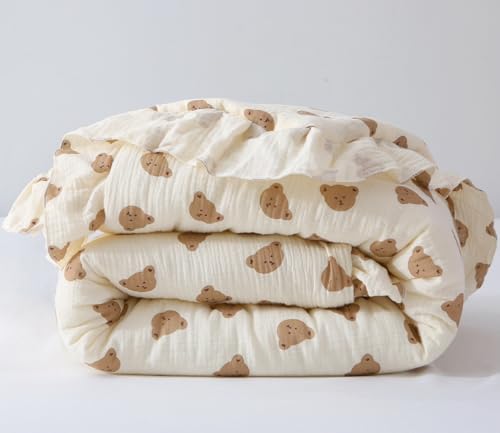
CLoucl 100% Cotton Muslin Crib Comforter / Quilt, 41 x 48 — Best Toddler-Size Cotton Quilt
The CLoucl quilt answers the question parents ask at about twelve months: what cotton blanket do we use now? At 41 x 48 inches it is genuinely toddler-sized — big enough for a small child to be covered on the sofa, spread on the floor for play, or used as a cot blanket once a child is old enough for bedding under current safe-sleep guidance. The 100% cotton muslin construction keeps it breathable and fully washable. It is too large and too lofty for newborn swaddling or for an infant’s crib, and families still in the newborn stage should start with the picks above.
Strengths
- 100% cotton muslin — breathable, natural fibre inside and out
- 41 x 48 inch size actually fits toddlers, unlike newborn receiving blankets
- Machine washable and reversible — built for daily toddler life
Trade-offs
- Too big for newborn use; this is a stage-two purchase
- Muslin loft is light — a mid-weight layer, not a deep-winter duvet
- Parents must judge the right age for cot bedding against safe-sleep guidance
| Detail | What to know |
|---|---|
| Size | 41 x 48 inches (per Amazon listing) |
| Material | 100% cotton muslin (per Amazon listing) |
| Care | Machine washable (per Amazon listing) |
Most baby blankets are secretly newborn products: charming at three months, useless at eighteen. The CLoucl’s dimensions reverse that — it comes into its own exactly when the receiving blankets retire. As a floor quilt it gives a crawling or toddling child a defined, washable play surface; as a sofa blanket it covers a small child properly; and when your paediatric guidance says bedding is appropriate, its breathable cotton muslin is a saner first cot layer than synthetic fleece, which traps heat.
The muslin construction deserves a note: multiple layers of cotton muslin quilted together produce a blanket that is warm without being stifling, and that washes without the fill shifting or clumping — the failure mode of cheap quilts. Keep the safety framing straight, though: ‘crib comforter’ is the manufacturer’s name for the product, and this guide’s position is the standard one — no loose blanket in a crib with a sleeping infant, whatever the packaging says. Bought for the toddler stage and supervised use, it is the longest-serving cotton blanket in this roundup.
Best for: toddlers who have outgrown receiving blankets / Not suited for: newborns, swaddling, or infant crib sleep
Check the current price on Amazon.

Luvable Friends Cotton Flannel Receiving Blankets, 7 Pack — Best Value Multi-Pack
If the Gerber five-pack is the sensible staple, the Luvable Friends seven-pack is the logistics play: enough cotton flannel receiving blankets to station them everywhere a baby actually goes — nursery, nappy bag, car, grandparents’ house, pram — and still have clean ones in the drawer. The flannel is the same honest category as Gerber’s: absorbent, soft, thin, made to be washed constantly. It suits parents of multiples, childcare setups, and anyone who knows laundry will not happen daily. It does not suit gift-givers looking for a presentation piece.
Strengths
- Seven blankets in one pack — the lowest effort route to full coverage
- Cotton flannel handles constant washing and everyday mess without fuss
- Spares everywhere means the ‘good’ blankets can be saved for supervised cosy time
Trade-offs
- Purely functional — thin flannel with no loft or texture
- Newborn sizing; they become cloths, not blankets, as baby grows
- Print and colour options are basic compared with boutique brands
| Detail | What to know |
|---|---|
| Material | Cotton flannel (per Amazon listing) |
| Pack | 7-pack, Basic Elephant (per Amazon listing) |
| Type | Receiving blankets |
There is a quiet arithmetic to the newborn months: a baby can work through three or four receiving blankets on a bad day, and laundry in a house with a newborn happens when it happens. A seven-pack collapses that arithmetic. Luvable Friends is a long-standing budget nursery brand, and these flannels are unpretentious — the value is in the count and in cotton flannel’s genuine usefulness as a swaddle-practice blanket, a burp cloth, a pram layer on a supervised walk and a changing-mat cover.
Set expectations correctly and this pack is hard to fault: the flannel will pill eventually, the prints are simple, and nobody will keep one in a memory box. But per-blanket usefulness in the first six months is arguably the highest in this guide, and pairing this pack with one beautiful knit — the Bleu La La — is the combination we recommend to friends: beauty for the moments that matter, quantity for the moments that don’t.
Best for: multiples, childcare bags and laundry-realists who want spares everywhere / Not suited for: gift presentation or long-term toddler use
Check the current price on Amazon.
Comparison Table
| Pick | Badge | Key spec | Best for |
|---|---|---|---|
| Burt’s Bees Baby Organic Cotton Reversible Blanket | Best Overall | Organic cotton quilted blanket, 30 x 40 in, reversible | everyday supervised use — tummy time, stroller and floor play |
| Bleu La La Organic Cotton Heritage Knit Baby Quilt Blanket | Best Knit Heirloom Pick | 100% organic cotton heritage knit, no synthetic fill | gift-givers and parents who want a keepsake-quality cotton knit |
| aden + anais Essentials Muslin Swaddle Blankets, 4 Pack | Best Muslin Swaddles | Cotton muslin swaddles, 4-pack, oversized format | newborn-stage families who want breathable swaddles with a long second life |
| Gerber Cotton Flannel Receiving Blankets, 5 Pack | Best Budget Workhorse | 100% cotton flannel receiving blankets, 5-pack | building the everyday basics cheaply and in quantity |
| CLoucl 100% Cotton Muslin Crib Comforter / Quilt, 41 x 48 | Best Toddler-Size Cotton Quilt | 100% cotton muslin quilt, 41 x 48 in, machine washable | toddlers who have outgrown receiving blankets |
| Luvable Friends Cotton Flannel Receiving Blankets, 7 Pack | Best Value Multi-Pack | Cotton flannel receiving blankets, 7-pack | multiples, childcare bags and laundry-realists who want spares everywhere |
Baby Blanket Safety: the Rules That Outrank Every Pick in This Guide
Bare crib for sleep. For every sleep — night and naps — a baby belongs on their back, on a firm, flat mattress with a fitted sheet and nothing else in the crib: no loose blanket, no quilt, no knit, however breathable the marketing claims. Breathability is a property that matters for supervised use; it does not make a loose blanket safe for an unsupervised sleeping infant, whose face can end up against or under fabric they cannot move away from.
Where blankets belong. Supervised, awake time: tummy time on the floor, play on a mat, cuddles in arms, a layer over legs in a stroller or car seat while an adult is present and the baby’s face is clear and visible. If a baby falls asleep in the stroller or during a cuddle, move them to their bare crib or watch them continuously — and never leave a blanket draped over a stroller canopy in sun, which traps heat.
Swaddling, done right and stopped on time. If you swaddle, use a light muslin, keep the wrap snug at the chest but loose at the hips so legs can bend, always place the baby on their back, and stop swaddling entirely at the first sign of rolling — after that point a swaddle becomes a hazard, not a comfort. Wearable blankets (sleep sacks) are the standard alternative for keeping a sleeping baby warm without loose fabric, and they pair with everything in this guide: the blankets are for awake life, the sleep sack is for sleep.
Toddlers are a different stage. Once a child is a toddler — generally past twelve months, and always per your paediatrician’s guidance — a light blanket in the cot becomes acceptable for most families. That is the stage the CLoucl quilt in this guide is sized and built for. When in doubt about timing, ask your paediatrician rather than a product listing.
How to Choose a Cotton Baby Blanket: Muslin, Flannel, Knit or Quilt?
Muslin is the lightest cotton weave — open, airy, increasingly soft with washing. It is the swaddle fabric, the summer layer, the stroller shade with airflow. It gives almost no insulation and asks almost nothing in care. Flannel is cotton brushed for softness: more absorbent than muslin, slightly warmer, and the natural receiving-blanket fabric — the one that catches everything and washes without complaint. Knit cotton has loop-built stretch and drape, gentle warmth without a fill, and the keepsake character that makes it the gift fabric; it asks for gentler washing. Quilted cotton layers fabric around a fill for structure and loft — the best floor and tummy-time surface — but check what the fill is, because ‘cotton blanket’ on the front sometimes means polyester in the middle, as with our Best Overall pick.
Size is the second decision. Receiving blankets (roughly 30 inches square) are newborn tools. Swaddle squares run larger so there is fabric to wrap. A 30 x 40 inch blanket is the versatile middle — floor, stroller, lap. Toddler blankets start around 40 x 48 inches; anything smaller becomes a doll blanket by the second birthday. Buy for the stage you are in and the stage you can see coming, and expect to own two categories: a workhorse pack for the mess, and one good blanket for everything else.
Certifications and claims. ‘Organic’ should mean certified organic cotton if you are paying for it — both organic picks here are from brands built on that claim. Beyond that, prefer listings that state the full construction plainly; a brand that discloses its fill material, as Burt’s Bees does, is telling you it expects to be read carefully, which is the kind of brand to buy baby textiles from.
How to Wash and Care for Cotton Baby Blankets
Step 1 — Wash before first use. Every blanket here should be washed before it touches the baby: it removes factory finishes and loose fibres, and muslin and flannel both soften noticeably in the first wash.
Step 2 — Sort by fabric, not by colour alone. Flannel and muslin can go together on a warm, gentle cycle with a mild detergent; knits get the gentlest cycle you have, ideally in a wash bag, to protect the loops from stretching and snagging.
Step 3 — Skip the fabric softener. Softener coats cotton fibres and steadily reduces the absorbency that makes flannel and muslin useful; cotton softens naturally with washing. Fragrance-heavy products are also an unnecessary extra against newborn skin.
Step 4 — Dry low, and fully. Tumble on low or line-dry; knits do best dried flat. Make sure quilts are fully dry through the fill before folding away, and store blankets somewhere airy rather than sealed in plastic.
Step 5 — Inspect like it matters. Before each use, check for loose threads, unraveling knit edges or thinning patches — damaged blankets retire to household cloth duty. A blanket with a hole is a blanket a small finger or toe can get caught in.
Cotton vs Fleece and Synthetic Baby Blankets: an Honest Comparison
Walk into any baby department and the synthetic blankets outnumber the cotton ones, so the comparison deserves a straight answer rather than a fibre sermon. Polyester fleece and minky blankets are soft in a plush, surface way, they are inexpensive, and they shrug off stains. Their weaknesses are physical: they breathe poorly, so a wrapped baby heats up faster; they build static; and their softness is a surface finish that flattens with washing. For supervised cosy time in a cold room, a fleece blanket is a legitimate tool — it is simply not the tool this guide recommends first, and it should never be the fabric a baby is swaddled in or left under.
Cotton’s case is breathability and behaviour over time. Muslin, flannel and knit cotton all let heat and moisture escape, which matters for a newborn who cannot regulate temperature or push a too-warm blanket away. Cotton also improves with washing — muslin famously so — while synthetic plush declines. And when a cotton blanket finally wears out, it retires as a household cloth without shedding synthetic fibres through years of laundry. Bamboo-derived rayon sits between the camps: soft and breathable, but it is a processed fibre rather than the natural one this search asks about, so it belongs to a different guide. Our verdict: cotton first for anything that wraps or covers a baby for more than a few minutes, synthetics reserved for brief, supervised, cold-weather layering — and nothing loose, of any fibre, in a sleeping baby’s crib.
A Blanket Wardrobe by Stage: What You Need from Birth to Two Years
Months 0–3: the swaddle and the cloth. The working set is muslin swaddles for wrapping (with the rolling rule in mind), flannel receiving blankets as the all-purpose cloth, and one soft quilted or knit blanket for supervised cuddles and tummy time. Sleep happens in a bare crib with a sleep sack — no blanket from this guide participates.
Months 3–6: the floor stage. Swaddling ends; tummy time expands. The quilted blanket becomes the play surface, the muslins become stroller shades and light covers, and the flannels continue their unglamorous reign. This is when a second ‘good’ blanket earns its place, because the first is always in the wash.
Months 6–12: the mobile stage. Blankets become drag-around comfort objects and pram layers. Durability and washability outrank everything; the knit heirloom should be supervised into gentler duty before a determined crawler tests its loops. Sleep remains blanket-free in the crib.
Months 12–24: the toddler stage. With paediatric guidance, a light blanket joins the cot, and size finally matters: this is the CLoucl quilt’s moment, and the moment the receiving blankets retire to the rag bag with honour. The wardrobe that got you here — one good blanket, one knit, muslins, flannels, one toddler quilt — is genuinely all a family needs; everything beyond it is gifts and enthusiasm.
Reading a Baby Blanket Listing Like a Sceptic: Four Checks Before You Buy
Check the full material line, not the headline. Listings lead with the nicest fibre in the product. The honest information is in the complete composition — faces, fill and backing — which is how you discover that a ‘cotton quilt’ is cotton over polyester. Brands in this guide disclose it; brands that hide composition behind adjectives like ‘cloud-soft natural feel’ are telling you something too.
Check the dimensions in numbers. ‘Large baby blanket’ has no meaning; 30 x 40 inches does. Match the number to the stage: receiving size for newborns, 40-plus inches for a toddler. If a listing will not state dimensions, it does not get the benefit of the doubt.
Check the care instructions. A baby blanket that is dry-clean only, or that cannot be tumble dried, will quietly stop being used by the third month. Every pick in this guide is machine washable because that is the entry ticket to real nursery life, not a bonus feature.
Check the safety language. Trust brands whose listings describe supervised use and bare-crib sleep accurately, and be wary of any product photography showing a loose blanket arranged in a crib around a sleeping baby. How a brand talks about safety tells you how it thinks about everything else — and on baby products, that thinking is the product.
Common Buying Mistakes
Putting a blanket in the crib ‘because it is breathable’. Breathable marketing does not change safe-sleep guidance. Loose blankets stay out of the sleeping crib, full stop — use a sleep sack for warmth instead.
Buying one blanket for every job. A muslin swaddle cannot warm a winter stroller ride and a quilted blanket cannot swaddle. The workhorse-plus-one-good-blanket combination costs less than three compromises.
Ignoring the fill. ‘Cotton blanket’ may describe only the faces. If an all-cotton construction matters to you, check the fill line of the listing — we flag it wherever it appears in this guide.
Keeping swaddling past rolling. The first roll attempt ends swaddling, that day. Set the muslins aside for their second life as cloths and move to wearable blankets for sleep.
Washing knits like flannel. A heritage knit treated as a workhorse will stretch and snag within a season. Gentle cycle, wash bag, flat dry — five extra minutes of care per wash.
Buying newborn sizes for a toddler. A 30-inch receiving blanket on an eighteen-month-old covers approximately one leg. If you are shopping past the first birthday, shop by dimension — 40 inches and up — not by the word ‘baby’ on the listing.
Draping a blanket over the stroller canopy in the sun. It feels like shade; it behaves like a greenhouse. Use the muslin as a light, airy cover with airflow at the sides, keep the baby’s face visible, and check on them often in warm weather.
Final Recommendation
If you buy one blanket, buy the Burt’s Bees Baby Organic Cotton Reversible Blanket for supervised everyday use, and pair it with the Gerber Cotton Flannel Receiving Blankets for the hundred messy jobs in between — that combination covers most of the first year. Gift-givers should go straight to the Bleu La La Organic Cotton Heritage Knit, newborn-stage families should start with the aden + anais muslins, and anyone shopping for a toddler should skip to the CLoucl quilt. And whichever you choose: blankets are for awake, supervised time — the crib stays bare, and a sleep sack does the night shift. Buy the fabric for the job, wash it before the first cuddle, and let every blanket in the house be an awake-time pleasure rather than a sleep-time risk, every single night, without exception or shortcut.
Related guides in this series: Best Baby Blankets Organic · Best Baby Washcloths And Hooded Towels · Best Baby Sleep Pillows · Best Bath Towels For Infants.
Frequently Asked Questions
Are cotton blankets safe for a newborn to sleep with?
No loose blanket of any material is considered safe in a crib with a sleeping infant. Safe-sleep guidance recommends a bare crib: baby on their back, firm flat mattress, fitted sheet, nothing soft or loose. Use cotton blankets for supervised awake time — tummy time, cuddles, stroller rides with an adult present — and use a wearable sleep sack when a sleeping baby needs warmth.
Which is better for swaddling, muslin or flannel?
Muslin, for most babies and most rooms: its open weave breathes, so overheating risk is lower, and the fabric grips itself to hold a wrap. Flannel works in cool rooms and many parents learn on it, but it is warmer and less breathable. Either way, keep hips loose, always place the baby on their back, and stop swaddling at the first sign of rolling.
Is the Burt’s Bees blanket 100% cotton?
The faces are organic cotton; the quilting fill is polyester, as the listing itself discloses. The fill never touches the baby’s skin, and it gives the blanket its structure and wash-durability — but if you want cotton throughout, choose the Bleu La La knit or the CLoucl muslin quilt instead.
How many baby blankets do I actually need?
A practical minimum is one good blanket for supervised cosy time plus a multi-pack of receiving blankets for daily mess — five to seven flannels is a comfortable rotation. Add muslin swaddles for the newborn stage if you plan to swaddle. Most families end up using two categories heavily rather than many blankets lightly.
When can my child use a blanket in their cot?
Generally once they are a toddler — past twelve months is the commonly cited threshold — and ideally confirmed with your paediatrician, since guidance is individual. At that stage a light, breathable cotton blanket like the CLoucl muslin quilt is the sensible first bedding. Until then, the crib stays bare and a sleep sack provides warmth.
How do I keep cotton blankets soft without fabric softener?
Wash warm with a mild detergent and dry on low; cotton — especially muslin — softens naturally over the first several washes. Fabric softener actually works against you on baby textiles: it coats the fibres, reduces absorbency, and adds fragrance residue against newborn skin. A thorough rinse and full drying keep cotton at its softest.


