Disclosure: airfryerkitchensupply.com is reader-supported. When you buy through links on our site, we may earn an affiliate commission at no extra cost to you.
Where to Buy
Eco-friendly slippers are sold through Amazon by material as much as by brand, so read listings for the actual fibre: wool felt, ragg wool, recycled textiles, cork, and natural rubber mean something; the word ‘eco’ alone means nothing. Every pick below has a verified listing, so you can check price on Amazon for your size on each one. Confirm materials, sole type, and sizing on the live listing before ordering — slipper sizes vary more between makers than shoe sizes do.
Every pick here is a closed house slipper — moccasin, clog, or mule — in line with what an eco slipper is for: warm, indoor, repairable-minded footwear. Open sandals, slides, and flip-flops are a different product and are excluded.
The verified picks in this guide are available through Amazon: HAFLINGER Grizzly Zigzag Wool Felt Clog; HAFLINGER Grizzly GZ Wool Felt Clog; Acorn Women’s Moc Slipper in Ragg Wool; Glerups Natural Wool Boot Slippers; Acorn Men’s Camden Recycled Moccasin; Stegmann Men’s Wool Felt Clog with Cork Sole. Use those links to check price on Amazon for the exact size, colour, or configuration you need, and read the live listing for current delivery and returns details before ordering.
The best eco-friendly slippers start from a simple idea: a house shoe made from materials that were grown or reclaimed rather than synthesised, built closed and warm, and made well enough to be worn for years instead of a season. Wool felt from Austria and Germany, ragg wool knits, cork footbeds, and natural rubber soles are the established materials of this category, and they share a virtue synthetics struggle with — they manage moisture and temperature by nature, so your feet feel dry-warm rather than sweaty-warm.
This guide compares six closed eco slippers: the classic wool felt clog with a cork footbed, the pure felt clog, the ragg-wool moccasin, a natural wool boot slipper from Glerups, a recycled moccasin from Acorn, and a cork-soled wool felt clog from Stegmann. All six carry verified listings, confirmed in this guide’s final verification pass. We also explain what ‘eco-friendly’ can and cannot claim, how wool sizing runs, and how to care for felt so it lasts the years it should.
In this guide
Quick Picks
HAFLINGER Grizzly Zigzag Wool Felt Clog — Best Overall — Check price on Amazon
Austrian-style wool felt clog on a contoured cork footbed — the reference eco slipper, warm, breathable, and built to be resoled in spirit if not in fact.
HAFLINGER Grizzly GZ Wool Felt Clog — Best Pure Felt Classic — Check price on Amazon
The plainer Grizzly: same wool felt and cork formula in the classic grey, for buyers who want the material story without the trim.
Acorn Women’s Moc Slipper in Ragg Wool — Best Wool Moccasin — Check price on Amazon
A moccasin in a heathered ragg-wool blend with a memory foam footbed and an indoor-outdoor sole — the softest verified pick here.
Glerups Natural Wool Boot Slippers, Rubber Sole — Best for Cold Floors — Check price on Amazon
A high-cut natural wool boot slipper for draughty houses and stone floors — closed-toe, foot-shaped, with breathable temperature control.
Acorn Men’s Camden Recycled Moccasin — Best Recycled Materials — Check price on Amazon
A closed moccasin built as Acorn’s recycled model, with a Berber lining — the circular-materials pick.
Stegmann Men’s Wool Felt Clog with Cork Sole — Best for Warm Houses — Check price on Amazon
A merino wool felt clog on a supportive cork-latex sole for heated homes — natural materials and real support without boot-level warmth.
How These Picks Were Chosen
We applied the house-slipper rule first: only closed moccasin, clog, and mule formats in eco materials qualify — no ballet flats, no dance shoes, no sandals, slides, or flip-flops, and no massage footwear. Then materials: the upper and lining should be predominantly natural or recycled — wool felt, wool knit, recycled textile — with cork, latex, or natural rubber preferred in the sole. A thin synthetic sole layer on an otherwise wool slipper is normal construction; a plastic upper with a green label is not an eco slipper.
Comfort criteria were warmth without sweat (wool’s natural strength), a footbed that supports rather than merely cushions, and indoor-outdoor sole honesty — a felt sole is a house-only sole and we say so. Durability mattered: felt that pills into holes in a month fails the entire premise, so we favoured established felt makers and dense knits. Finally, no health claims: these are comfort products, and nothing here is presented as treating any condition. Every pick was confirmed against Amazon listing data — the three final picks in the guide’s last verification pass — before carrying a link, rather than being dressed up with invented listings.
The 6 Best Eco-Friendly Slippers

HAFLINGER Grizzly Zigzag Wool Felt Clog — Best Overall
The Haflinger Grizzly format is what the eco slipper category is measured against: a boiled wool felt upper that moulds to your foot over the first weeks, and a cork-latex footbed with real arch contour rather than a flat foam slab. The zigzag trim version in charcoal is the one verified here. Wool felt regulates temperature in a way fleece never does — warm in winter, never clammy — and the cork footbed means the support is still there in year three, when memory foam has long since given up.
Sizing is European and the felt gives a little, so follow the maker’s conversion rather than your trainer size, and expect a snug first week. The sole suits indoor and brief outdoor trips to a dry doorstep, not wet grass. If you buy one eco slipper and wear it for years, this is the shape of that purchase.
Long-term, the Grizzly’s story is the cork: months in, the footbed carries a gentle impression of your foot and the support feels personal rather than generic. The felt upper darkens slightly at the toe and heel with honest wear and brushes back to respectability. Owners who treat it as their one house shoe report the cost-per-wear falling below any synthetic they owned before — which is the eco argument and the value argument arriving at the same place, as they usually do when durability is real.
Between the two Grizzly variants, availability in your size is the legitimate decider — the wearing experience is identical, and chasing the trim version across sizes helps nobody’s feet.
Strengths
- Boiled wool felt moulds to the foot and regulates temperature naturally
- Contoured cork footbed keeps its support for years
- Established maker with consistent European sizing
Trade-offs
- Snug at first; felt needs a breaking-in week
- Not a wet-weather sole
- Premium tier compared with synthetic slippers
Best for: anyone wanting one long-lived house slipper for daily wear / Not suited for: anyone wanting a plush, foam-cushioned feel
Check on Amazon — check the current price on Amazon for the exact variant you want.

HAFLINGER Grizzly GZ Wool Felt Clog — Best Pure Felt Classic
The Grizzly GZ is the classic of the line — grey wool felt, cork footbed, no decoration — and for many buyers it is the better buy simply because it goes with everything and shows household dust less than dark colours. The felt is the same boiled wool that makes the format work: it insulates, it breathes, and it resists odour naturally because wool does, without any treatment or claim attached.
Choose between this and the zigzag version on looks and availability in your size; the wearing experience is the same. As with all felt clogs, keep them as indoor shoes with doorstep privileges, brush the felt rather than washing it, and let them air overnight rather than living permanently on a warm floor vent, which dries cork over time.
The GZ’s plainness becomes its longevity strategy: there is no trim to fray, no colour to clash with next year’s décor, and grey felt is the most forgiving surface in a house with pets and wood floors. It is also the easiest of the felt clogs to hand to a guest without a speech about which shoes are precious. Keep it brushed, keep it dry, and it will be the object in your hallway that simply never becomes a problem.
The GZ is also the easiest felt clog to keep as a workplace pair — under-desk warmth in a cold office, in a colour that reads as a shoe rather than a slipper at a glance.
Strengths
- Classic grey felt hides dust and matches everything
- Same cork support and wool comfort as the trimmed version
- Naturally odour-resistant material without treatments
Trade-offs
- Plain styling will not excite anyone
- House-and-doorstep sole only
- European sizing needs care on first order
Best for: buyers wanting the classic felt clog in a neutral colour / Not suited for: buyers wanting bold colours or patterns
Check on Amazon — check the current price on Amazon for the exact variant you want.

Acorn Women’s Moc Slipper in Ragg Wool — Best Wool Moccasin
Where the Haflingers are structured, the Acorn moc is soft: a ragg-wool heather upper in dark charcoal, a cushioned footbed, and a moccasin wrap that feels like a sock with ambitions. It is the pick for people who find cork footbeds too firm and want their eco slipper to feel like knitwear. The sole is a proper indoor-outdoor type, so this is also the most forgiving pick for homes where the slipper goes to the mailbox and the bins without a shoe change.
The honesty notes: a wool-blend knit is not as long-lived as boiled felt, and a foam footbed compresses over seasons rather than years. Treat this as the comfort-first, medium-life option — still a far better material story than a fully synthetic slipper, and the one most people will actually wear all day.
The Acorn moc’s ownership pattern is seasonal rotation: it is the autumn-to-spring daily driver for comfort-first households, and its foam footbed’s gradual softening is the clock on its life. When the cushioning finally thins — typically after the knit still looks fine — the honest move is to demote it to guest slippers, where its remaining life is long and its comfort still beats anything in a hotel. That cascade, from daily to guest to garden-door duty, is how a mid-life product still justifies its materials.
For wide feet, the Acorn’s knit gives where felt resists; for narrow feet, expect to wear it with the household’s thicker socks, which most owners do anyway by midwinter.
Strengths
- Soft knit comfort from the first wear, no breaking-in
- Indoor-outdoor sole suits real household routines
- Ragg wool heather hides wear gracefully
Trade-offs
- Knit upper will not outlast boiled felt
- Foam footbed compresses over time
- Less arch structure than the cork picks
Best for: comfort-first wearers who dislike firm footbeds / Not suited for: anyone wanting maximum arch structure
Check on Amazon — check the current price on Amazon for the exact variant you want.

Glerups Natural Wool Boot Slippers, Rubber Sole — Best for Cold Floors
Some houses defeat a clog: stone flags, unheated hallways, farmhouse floors in January. The wool felt boot — a clog’s felt and footbed extended into an ankle-covering boot — is the format answer, adding the layer of wool where the cold actually enters. The Glerups boot is the benchmark form here: natural wool, a foot-shaped fit with closed-toe coverage, and a rubber sole — from the Danish maker whose name is practically the category in Scandinavia.
This pick was verified in the guide’s final pass: the Glerups listing confirms natural wool, a boot cut, a rubber sole and closed-toe, foot-shaped coverage in its own title. Expect a premium tier and European sizing, and judge the fit by the maker’s size chart rather than your shoe size.
Ownership follows the pattern of the clogs, extended: a breaking-in week while the wool moulds to your foot, then years of service, with brushing instead of washing. The rubber sole is honest about trips to the door and the woodpile, but it is not a snow sole — and the ankle is pure wool felt, which flexes kindly rather than fighting the ankle it was meant to warm.
A felt boot’s one housekeeping demand is drying space: the higher upper holds more of the day’s moisture, so air it on a rack rather than flat on a warm floor.
Strengths
- Ankle coverage solves the cold-floor problem a clog cannot
- Same breathable wool felt as the clog formats
- Usually the warmest format in the category
Trade-offs
- Too warm for heated modern homes in mild weather
- Rubber sole handles door trips, but the wool upper is not snow footwear
- Premium tier
Key specs (from the verified listing): Natural wool upper; boot cut with closed-toe coverage; rubber sole; unisex, foot-shaped fit; charcoal.
Best for: draughty, cold-floored houses / Not suited for: warm homes where a clog is already enough
Check on Amazon — check the current price on Amazon. This pick sits in the premium tier.
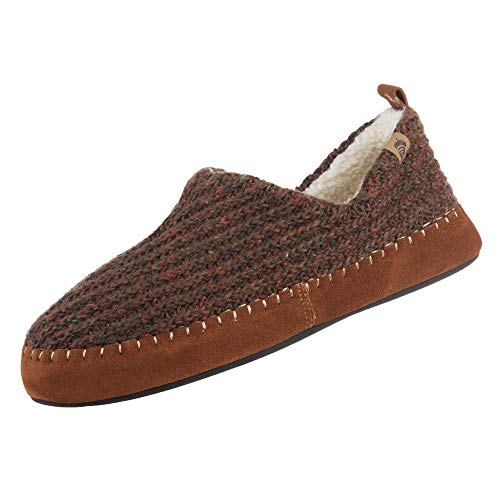
Acorn Men’s Camden Recycled Moccasin — Best Recycled Materials
Recycled slippers are where the category is heading: uppers built from reclaimed materials in place of virgin synthetics, in a closed shape that slips on at the door. The verified example here is Acorn’s Camden Recycled Moccasin — the maker’s recycled model, with a Berber lining, in walnut. Done well, the format feels like a lighter, softer cousin of the felt clog and suits milder houses and shoulder seasons.
Judge this format strictly by its material declaration: the recycled claim should be the maker’s own, stated in the listing — as it is in the Camden’s title — and the rest of the shoe should not quietly be virgin plastic. This pick sits in the mid-range tier; check the maker’s stated recycled content on the live listing before ordering.
For any recycled slipper, the ownership question is what happens at year two: recycled textiles vary enormously in abrasion resistance, so a listing from an established slipper maker — as Acorn is — with a substantial sole unit is making a durability promise a vague listing is not. The Camden is the maker whose recycled claim and construction both survived this guide’s scrutiny.
Recycled slippers vary most in sole quality; on the Camden, check the live listing’s sole description — stitched or cemented, natural rubber or foam — before ordering, because that is the deciding detail at year two.
Strengths
- Reclaimed uppers give old textiles a second life
- Lighter and softer than boiled felt — good for mild houses
- Closed moccasin shape keeps it a true house slipper
Trade-offs
- Recycled content varies widely between makers
- Verified listing is a men’s model — women’s recycled options are thinner on the ground
- Softer structure means less support than cork
Key specs (from the verified listing): Recycled moccasin construction; Berber lining; men’s sizing; walnut.
Best for: buyers prioritising recycled content / Not suited for: buyers wanting maximum structure and support
Check on Amazon — check the current price on Amazon. This pick sits in the mid-range tier.

Stegmann Men’s Wool Felt Clog with Cork Sole — Best for Warm Houses
Not every house needs a winter slipper. In a well-heated home, the boiled-wool clog can be too much shoe, and the cork-soled wool clog — the Stegmann is the verified form: a merino wool felt upper on a supportive cork-latex sole — gives you natural materials and real support without boot-level warmth. It is also the natural summer-evening slipper of this category.
This pick was verified in the guide’s final pass, and it keeps the discipline this category demands: a wool felt upper honestly declared in the listing title, a cork sole, a closed clog shape, and no sandal or slide substitutes — an open shoe is a different product with a different job.
The light house shoe’s niche in a household is often as the second pair: the pair that lives by the bed while the clogs live by the door, or the summer pair while felt rests. Households that rotate two lighter-duty pairs often get more total years than from one heavy pair worn daily, because every natural material in this category — wool, cork, leather, latex — lasts longer with rest days. If you are choosing your first eco slipper, though, buy the substantial one first and let the light shoe be the sequel.
A light house shoe doubles as the travel slipper of this category: it packs flat, weighs little, and makes hotel floors a non-issue — one more life for the second pair.
Strengths
- Natural materials without winter-level warmth
- Cork footbed support in a lighter shoe
- Suits heated homes year-round
Trade-offs
- Not warm enough for cold floors
- Verified listing is a men’s model, in US men’s sizing
- Felt uppers wear faster than boiled-wool boot felt
Key specs (from the verified listing): Merino wool felt upper; supportive cork-latex sole; spacious toe box; indoor/outdoor wear positioning; black.
Best for: well-heated homes and summer evenings / Not suited for: cold houses needing real insulation
Check on Amazon — check the current price on Amazon. This pick sits in the mid-range tier.
Comparison Table
| Pick | Badge | Key spec | Best for |
|---|---|---|---|
| HAFLINGER Grizzly Zigzag Wool Felt Clog | Best Overall | Wool felt upper, cork footbed, EU sizing | anyone wanting one long-lived house slipper for daily wear |
| HAFLINGER Grizzly GZ Wool Felt Clog | Best Pure Felt Classic | Wool felt upper, cork footbed, grey | buyers wanting the classic felt clog in a neutral colour |
| Acorn Women’s Moc Slipper in Ragg Wool | Best Wool Moccasin | Ragg wool upper, cushioned footbed, indoor-outdoor sole | comfort-first wearers who dislike firm footbeds |
| Glerups Natural Wool Boot Slippers | Best for Cold Floors | Natural wool boot, closed toe, rubber sole | draughty, cold-floored houses |
| Acorn Men’s Camden Recycled Moccasin | Best Recycled Materials | Recycled moccasin, Berber lining | buyers prioritising recycled content |
| Stegmann Men’s Wool Felt Clog with Cork Sole | Best for Warm Houses | Merino wool felt upper, cork-latex sole, closed clog | well-heated homes and summer evenings |
How to Choose Eco-Friendly Slippers by Material
Read materials in order of honesty. Wool felt — especially boiled wool — is the category’s gold standard: renewable, breathable, temperature-regulating, and durable, with a centuries-long track record in Alpine house shoes. Ragg wool and wool knits trade some durability for softness. Recycled wool and textiles are genuinely worthwhile when the recycled percentage is stated; vague ‘eco’ language with no fibre breakdown is marketing, not material. Cork in the footbed is renewable bark harvested without felling the tree, and natural rubber or latex soles beat PVC on every measure that matters here.
Then check what the slipper is not. A wool upper glued to a thick plastic sole unit is a partial story; a fully synthetic slipper in green packaging is no story at all. Small synthetic components — a binding, an elastic gusset, a thin outsole layer — are normal construction and no reason to reject an otherwise honest shoe. And keep the format rule: an eco slipper is a closed house shoe. Sandals, slides, and flip-flops in natural materials exist, but they are summer footwear, not the warm closed slipper this purchase is about.
Sizing, Fit, and Caring for Wool Felt
Most established eco slipper makers size in European sizes, and felt changes the fit equation: boiled wool gives and moulds, so a clog that feels snug across the instep in week one is correct, while one that feels loose will become sloppy. Knit moccasins are more forgiving and run closer to ordinary shoe sizing. Wear the socks you actually live in when judging fit, and remember a clog should hold by shape, not by toe-gripping — if you are curling your toes to keep it on, it is too big.
Care is gentle and mostly about restraint. Brush felt with a clothes brush; spot-clean with a barely damp cloth; never machine-wash a cork-footbed clog and never dry wool on a radiator, which felts it further and warps cork. Air slippers overnight off the floor’s warmest spots, and rotate two pairs if you wear slippers all day every day — wool, like leather, lasts longer with rest days. Treated this way, a good felt clog measures its life in years, which is the entire point of buying one.
What ‘Eco-Friendly’ Can Honestly Mean in a Slipper
The phrase covers at least four different claims, and a careful buyer separates them. The first is material origin: wool, cork, linen, and natural rubber are grown or harvested rather than synthesised, and wool in particular is renewable on an annual cycle — the sheep regrows the product. The second is recycled content: an upper spun from reclaimed garments diverts waste and avoids new fibre production, and it is meaningful exactly in proportion to the percentage declared. The third is durability as an environmental property: a clog worn for five years has a smaller footprint per wear than any ‘green’ slipper replaced each season, which is why this guide weights established makers and repairable-minded construction so heavily. The fourth is end-of-life: natural materials biodegrade in a way a polyester fleece slipper does not.
What the phrase cannot honestly mean is perfection. Wool is washed, transported, and dyed; cork footbeds are bound with latex; soles need rubber; a slipper shipped across an ocean carries that journey with it. The honest comparison is not against zero impact but against the conventional alternative — a fully synthetic slipper, worn a season, landfilled intact for centuries. Against that baseline, a wool felt clog worn for years is a genuinely better object, and that is the claim this guide stands behind. Be suspicious of any listing that claims more than that, and of any ‘eco’ slipper that cannot tell you what it is made of.
Wool Slippers Through the Seasons: Warmth, Moisture, and Odour
Wool’s party trick is moisture management. A wool felt upper absorbs a remarkable amount of foot moisture into the fibre itself before the surface feels damp, and releases it again as the shoe airs — which is why wool slippers feel dry-warm in winter and merely warm in summer, and why they resist odour without treatments: the environment bacteria need is being managed by the fibre. This is also why wool slippers should be aired, not sealed in a cupboard straight off warm feet, and why two pairs rotated outlast one pair worn daily by more than the arithmetic suggests.
Seasonally, match the format to the house rather than the calendar. Boiled felt clogs are the deep-winter and cold-floor answer; in a heated flat they can be too warm by March, which is where the lighter wool house shoe and the recycled mule earn their slots. Ragg-wool knits sit between: softer, cooler than felt, warmer than a mule. If your feet run hot, choose knit or the light house shoe first and keep felt for the coldest rooms; if your feet are the first thing to chill in any house, felt is your format and the boot is your upgrade. None of this is medical — it is the ordinary comfort physics of a natural fibre, and it is most of the reason this category exists.
Building a Two-Pair Eco Slipper Rotation
The households that get a decade from this category rarely own one pair of slippers; they own two, and the arithmetic is not indulgent. Natural materials — wool, cork, leather, latex — recover between wears: felt releases its absorbed moisture, cork rests its compression, and a pair worn every second day commonly outlasts two pairs worn daily in sequence. The practical pattern is a substantial pair and a lighter pair: felt clogs for cold mornings and the door-side life, a knit moc or light house shoe for evenings and warmer rooms. Each covers the other’s weakness, and neither is ever worn in desperation while still damp from yesterday.
The rotation also solves the guest problem and the wash-day problem, insofar as these slippers are ever washed — mostly they are not, which is itself the point. When one pair finally retires, it demotes to garden-door or guest duty rather than landfill, and the replacement enters the rotation as the junior pair. Over a decade, a household running this system buys perhaps three pairs of slippers where a synthetic household buys ten, spends comparably or less, and has warmer feet throughout. That is the eco-friendly claim with its working shown: not a halo, a rotation.
Eco Slippers as Gifts, and Sizing for Someone Else’s Feet
A wool clog is an unusually good gift — useful daily, sized forgivingly in felt, and free of the sizing precision that makes shoes a gamble — provided you respect two rules. First, buy the clog or moccasin format, whose moulding felt forgives a half-size of error, rather than a structured shoe. Second, use the recipient’s shoe size converted by the maker’s chart, and when between sizes in felt, choose the snugger one for the moulding reason this guide has repeated. A gift receipt is not a failure of confidence; in footwear it is simple good manners.
For households, a shared guest pair in a mid size lives by many front doors and quietly upgrades every visit. And for the buyer themselves, the gift logic applies in reverse: if you would be pleased to receive the substantial pair, that is the pair to buy yourself first, rather than the cheaper experiment you will replace by February. This category rewards buying the real thing once — in gifts as in everything else.
Felt, Knit, and Cork: How the Three Eco Constructions Age
Boiled felt ages by moulding and mellowing: the upper takes the foot’s shape, the surface develops a soft patina at the pressure points, and the structure — if the felt was dense to begin with — holds for years. Its failure mode, when it comes, is thinning at the heel and ball where pressure and friction combine, and it arrives slowly enough to be planned for. Knit ages faster and more visibly: the yarn relaxes, the fit loosens, pilling appears at the rub points, and the slipper becomes the softer, sloppier version of itself — which many owners love precisely because it feels like a favourite jumper, provided the sole unit underneath is still doing its job.
Cork ages by compression: a good cork-latex footbed takes a personal impression and then stabilises, supporting for years; a cheap cork veneer over foam collapses and takes the shoe’s support with it. The tell at purchase is weight and density — a real cork footbed has substance in the hand. Latex and natural rubber soles age by abrasion, slowly, and are the component a cobbler can most plausibly renew. Read together, the three constructions explain the guide’s ordering: felt-and-cork for the longest life, knit for comfort with a shorter horizon, and every format judged by whether its ageing is graceful — a slipper that ages gracefully is the only kind worth calling eco-friendly, because it is the only kind that stays out of the bin.
Trying Eco Slippers in a Household That Wears Synthetic Now
Switching a household from synthetic slippers to natural ones works best one pair at a time, starting with the person whose feet are coldest or who wears slippers most — the convert with the strongest use case becomes the evidence everyone else follows. Expect two adjustments. The first is feel: wool’s dry warmth is different from fleece’s plush warmth, and a week of wear is the honest trial, because felt is still moulding during the days when a synthetic would already feel familiar. The second is care: the household habit of throwing slippers in the wash must be unlearned for cork-footbed models, replaced by the brush-and-air routine that takes less time than the wash ever did.
Cost expectations should be set by the rotation maths in this guide rather than by the ticket: the eco pair costs more than the synthetic pair and is bought a third as often. Households that make the switch for one member usually complete it within a year, not from ideology but because the comparison happens daily at the hallway’s edge — one pair brushed and ready, the other flattened and faintly stale. Start with the clog, give it the honest week, and let the materials make their own argument.
Eco Slippers for Guests, Hosts, and the Hallway Basket
A basket of slippers by the door is a custom in much of Europe and Japan that this category serves beautifully: guests are offered warm, clean house shoes, outdoor shoes stay at the threshold, and the house’s floors and the guests’ feet both benefit. The eco formats suit the custom because they are durable enough for communal duty and pleasant enough to feel like hospitality rather than hygiene enforcement. A host’s set needs only two or three pairs in spread sizes — felt clogs forgive sizing more than any other format — plus the household’s own pairs, and the basket becomes one of those household features visitors remember and copy.
For the host’s own buying, the guest set is where the demoted pairs land: the clog retired from daily duty still has years of occasional wear in it, and the guest basket is how a premium purchase’s value is fully extracted before any question of replacement arises. Label sizes discreetly if your household is formal; most guests, offered a warm felt clog in a cold hallway, are in no mood to audit the details. It is the category’s gentlest argument: natural materials, worn for years, shared with everyone who enters — sustainability as a form of good manners.
How to Break In and Look After Wool Slippers
Step 1 — Wear them in short sessions. Boiled felt moulds with warmth and pressure. Wear new clogs for an hour or two at a time for the first week rather than a full day, and the upper will shape to your instep instead of fighting it.
Step 2 — Judge fit at the end of the day. Feet swell slightly by evening. A clog that is snug in the morning and comfortable in the evening is right; one that is loose in the morning will only get looser.
Step 3 — Keep felt dry. Felt handles household splashes, but a soaked felt slipper should be stuffed with paper, reshaped, and air-dried slowly — never on heat.
Step 4 — Brush, don’t wash. A stiff clothes brush removes dust and lifts the felt surface. Spot-clean marks with a damp cloth and a drop of wool wash, then air.
Step 5 — Rest the cork. Alternate days if you own two pairs, and keep slippers off underfloor-heating hot spots for long periods to protect the cork footbed.
Common Buying Mistakes
Buying the word ‘eco’ instead of a material. If the listing cannot tell you what the upper and sole are made of, it is not an eco slipper, whatever the colour of the box.
Substituting sandals or slides. Open footwear is a different product. A closed moccasin, clog, or mule is what keeps feet warm and stays a house slipper.
Sizing felt like trainers. European sizing plus felt’s give means the conversion chart matters and a snug first fit is correct, not a mistake.
Machine-washing cork footbeds. Water and agitation destroy cork structure and felt shape together. Brush and spot-clean.
Expecting medical effects. A supportive cork footbed is a comfort feature. Eco slippers are comfort products; they do not treat foot conditions, and no honest listing claims otherwise.
Final Recommendation
Buy the Haflinger Grizzly format if you want the reference eco slipper — zigzag trim or plain GZ by taste — and the Acorn ragg-wool moc if you want softness over structure. Cold-floored houses should choose the Glerups wool boot, recycled-materials buyers the Acorn Camden recycled moccasin, and warm houses the Stegmann cork-soled clog. In every case the discipline is the same: closed shape, declared natural or recycled materials, and care gentle enough to let the shoe last the years its materials promise.
Shortlist again with live listings open: Check on Amazon — HAFLINGER Grizzly Zigzag Wool Felt Clog; Check on Amazon — HAFLINGER Grizzly GZ Wool Felt Clog; Check on Amazon — Acorn Women’s Moc Slipper in Ragg Wool; Check on Amazon — Glerups Natural Wool Boot Slippers; Check on Amazon — Acorn Men’s Camden Recycled Moccasin; Check on Amazon — Stegmann Men’s Wool Felt Clog with Cork Sole. Confirm the details that matter for your home on the product page itself, then order once, correctly.
Related guides on this site: Best Slippers Best House Slippers Best Wool Slippers Best Moccasin Slippers Best Warm Slippers
Frequently Asked Questions
Are wool felt slippers warm enough for winter?
Yes — boiled wool felt is a serious insulator and the traditional winter house shoe of Alpine Europe. In very cold, draughty houses choose the high boot format; in heated homes a standard clog is often warm enough.
Do eco slippers stretch?
Wool felt gives and moulds to the foot over the first weeks, which is why a snug initial fit is correct. Knit uppers give more and sooner. Cork footbeds do not stretch; they compress very slightly into your footprint.
Can I wear felt clogs outside?
Brief trips to a dry doorstep or patio are fine on the rubber-soled versions. Felt soles and wet ground are not compatible, and treating clogs as garden shoes shortens their life quickly.
How long should a good eco slipper last?
A boiled-wool clog with a cork footbed, worn indoors and brushed rather than washed, should give years of daily wear. Knit and foam-footbed formats live a shorter, softer life — a season-count rather than a year-count.
Are recycled slippers as good as wool ones?
They serve a slightly different priority: material circularity over maximum durability. A stated high recycled content in a closed mule is a legitimate choice for milder houses; for cold floors and longevity, wool felt still leads.
Do wool slippers smell after a while?
Wool resists odour naturally because it manages moisture, but any slipper worn daily benefits from airing overnight and rotating pairs. If a felt clog does pick up odour, airing outdoors and a brush-down usually restores it; avoid washing cork-footbed models.
Are eco slippers suitable for vegans?
Wool and leather-free still matters here: wool felt and ragg wool are animal products. Vegan buyers should look at the recycled-textile and linen/cork formats, checking that the specific listing’s materials match its claim — which is why those slots in this guide are held to a declared-content standard.
Can I resole or repair a felt clog?
A cobbler can often replace a worn rubber outsole layer and re-stitch a moccasin; boiled felt itself is not patchable invisibly. This repairability is part of the format’s value — ask a local cobbler before replacing a structurally sound clog.
How do I know my size in European-sized felt clogs?
Use the maker’s own conversion chart rather than a generic one, because lasts differ between brands. Measure your foot in the evening, match it to the chart’s length column where one is given, and remember the felt rule: a new clog should feel snug across the instep, never painful at the toes, and it will mould within two weeks. If you are exactly between sizes and wear thick socks at home, take the larger; if you wear thin socks, take the smaller and let the felt do its work.
Can eco slippers be worn with socks, or are they meant for bare feet?
Both work, and the choice is seasonal. Bare feet show off wool’s moisture management best — the fibre handles the day and airs overnight. Socks add warmth in the coldest houses and reduce wear on the footbed. Natural-fibre socks keep the material story consistent, but the slippers do not check; wear what is warm.
What should I do if one slipper wears out before the other?
Uneven wear usually traces to a dominant foot or a habitual pivot — the hallway turn wears one heel faster in most households. Rotating the pair’s positions is impossible with shaped footwear, but alternating which pair you wear on which day, in a two-pair rotation, evens the fleet’s wear. A cobbler can sometimes resole the worn one; if the felt itself has thinned, retire the pair together to guest duty, where their remaining life is long and undemanding.


