Disclosure: airfryerkitchensupply.com is reader-supported. When you buy through links on our site, we may earn an affiliate commission at no extra cost to you.
Where to Buy
Cotton rugs are sold through Amazon by size, weave, and colour, and the listing details that matter are the fibre content percentage, whether a rug pad is needed, and the washing instructions — a cotton rug you cannot wash is a cotton rug you will throw away. Every pick in this guide was verified against Amazon’s catalog data — each listing states its cotton content in its own title — and carries a link, with its quality tier also stated in words. Shortlist by weave and room first, then confirm fibre content, backing, and care instructions on the live listing before you order.
Use the Quick Picks to find your format, read the full review, and then work through the buying guide — cotton behaves very differently from wool and from synthetics, and most disappointment with cotton rugs comes from expecting the wrong thing of the fibre.
The best cotton rugs earn their place for reasons no synthetic can copy: they are soft under bare feet without any plastic feel, they go in the washing machine (in the smaller sizes) instead of needing professional cleaning, they breathe in summer, and they suit households avoiding synthetic fibres. A flatweave cotton rug in a kitchen, a washable cotton runner by the bed, a chunky braided cotton rug in a nursery — these are honest, hardworking textiles.
Honesty also requires the other half: cotton is not the most durable fibre, it absorbs spills instead of resisting them, it can fade in strong sun, and a cotton rug without a pad slides on hard floors. This guide compares the six cotton formats worth buying — flatweave dhurrie style, washable low-pile, braided, chunky woven, cotton chenille bath-adjacent rugs, and cotton runners — and explains which rooms each belongs in, what a good weave looks like, and how to keep a cotton rug looking like itself after fifty washes.
In this guide
Quick Picks
Handmade Cotton Flatweave Dhurrie Rug (Jaipur), 3×5 ft — Best Overall
The classic cotton format: a tight flat weave, no pile, graphic patterns, and a rug that drapes, folds, and washes like the textile it is.
IOHOUZE Washable Woven Cotton Rug, 2×6 ft — Best for Kitchens and Hallways
A short, dense cotton pile on a flexible backing, built to be vacuumed daily and machine-washed whole — the working rug for working rooms.
Super Area Rugs Farmhouse Braided Cotton Rug, 4×6 Oval — Best for Farmhouse and Country Rooms
Rounds, ovals, and runners braided from cotton tube or strip — soft, reversible, and the most forgiving cotton format for uneven wear.
Dash & Albert Denim Rag Handwoven Cotton Rug, 4×6 ft — Best Texture
Thick cotton yarns woven into a nubby, substantial rug — the cotton rug for people who want to feel the weave underfoot.
Jean Pierre New York 100% Chenille Cotton Bath Mat, 20×32 in — Best Softness for Bathrooms and Bedsides
Tufted cotton chenille yarn gives a soft, absorbent, almost towelling surface — the barefoot-comfort pick.
KOZYFLY Boho Cotton Runner Rug, 2×8 ft — Best for Hallways and Galley Kitchens
The long format done in cotton: flatweave or low-pile runners that protect the traffic lane and wash when the lane gets dirty.
How These Picks Were Chosen
We chose these formats against the criteria that decide whether a cotton rug delights or disappoints. Fibre honesty first: a rug sold as cotton should be predominantly cotton, with any synthetic content declared and explained — a small percentage in the backing or warp is normal in some weaves, a mostly-polyester rug wearing a cotton label is not a cotton rug. Weave density second: in flatweaves, tightness of weave decides both durability and how the pattern holds; in braided and chunky weaves, stitch security decides whether the rug survives vacuuming.
Third, washability as actually practised: machine-washable at household sizes, or honestly labelled spot-clean for the large area sizes nobody can lift wet. Fourth, the pad question: every cotton format here states whether it needs a separate rug pad for grip and cushioning, because the pad is part of the real cost. Fifth, colour behaviour: cotton takes dye beautifully and fades honestly, so we favoured formats and colourways that age gracefully rather than patchily. No fixed prices or ratings appear anywhere; tiers are stated in words.
The 6 Best Cotton Rugs

Handmade Cotton Flatweave Dhurrie Rug (Jaipur), 3×5 ft — Best Overall
The verified example is this Jaipur handwoven dhurrie: handmade cotton flatweave with a geometric tribal diamond pattern in brown tones, 3×5 feet — the classic format in its genuine hand-made form, with the woven-in pattern this section describes.
The dhurrie-style flatweave is what most people picture when they picture a cotton rug, and it remains the best all-round answer. Woven flat with no pile, it sits low enough for doors to clear and chairs to slide, it folds for storage and shaking out, and in room sizes up to about 5×7 ft it washes in a large domestic machine or a laundromat drum. The patterns — stripes, blocks, simple geometrics — are woven in, not printed on, so they do not wear off the surface.
Know its character before you buy. A flatweave has no cushion: on a hard floor you feel the floor, which is why we treat a felt rug pad as part of this purchase, adding both grip and the underfoot softness the weave itself lacks. Cotton flatweaves also move — they are light — and the pad fixes that too. Choose the tightest weave you can find at your tier, with edges bound straight; a loose flatweave stretches into waves at the edges within a season. In return you get the most washable, most storable, most honestly cotton rug of the six.
After a year in a real house, the flatweave’s report card reads: pattern unfaded where it matters, edges still straight if the pad did its job, and a softness that synthetics never develop. It is the rug most likely to be moved between rooms over its life — living room to bedroom to study — because its weight and foldability make redecorating a one-person job. That portability is a hidden part of its value: a rug that can follow the household’s changes gets used for all of its life, not just the life of one room’s scheme.
One more practical note: flatweaves are the easiest rug to store — rolled, they take a shelf — which makes them the seasonal rug of choice for households that swap a summer cotton for a winter wool. That rotation extends both rugs’ lives and refreshes a room twice a year for the cost of storage space.
Strengths
- Woven-in pattern cannot wear off like a printed design
- Low profile clears doors and slides under furniture easily
- Washes and folds away — the easiest rug to actually maintain
Trade-offs
- No cushion of its own; a rug pad is effectively mandatory
- Light weight means it will travel without a pad
- Cotton absorbs spills, so kitchen use demands quick blotting
Best for: living rooms, bedrooms, and dining areas wanting a washable classic / Not suited for: anyone wanting plush cushioning from the rug itself
This pick sits in the mid-range tier. Check on Amazon — check the current price on Amazon.

IOHOUZE Washable Woven Cotton Rug, 2×6 ft — Best for Kitchens and Hallways
The verified example is the IOHOUZE washable runner: a woven cotton floor carpet, 2×6 feet in cream and beige, with a non-slip design for hallways and kitchens — the low, washable cotton format this section is about, sized for the rooms that destroy rugs fastest.
Kitchens and hallways destroy rugs in a specific way: constant foot traffic, grit carried in from outside, and spills that are tomato-based with suspicious regularity. The washable low-pile cotton rug is engineered for exactly that life. The pile is short and dense enough that crumbs sit on top for the vacuum rather than burying themselves, the backing is flexible enough that the whole rug goes through a wash cycle, and the cotton surface releases ordinary kitchen soil in the wash instead of holding it the way synthetics can hold grease.
The discipline this format demands is washing it before it looks desperate — a cotton rug washed monthly stays bright; one washed yearly has set its stains. Check the stated size against your machine honestly: a hallway runner washes anywhere, a large kitchen rug needs a large drum. Without a pad these can creep on tile, and many include or recommend a non-slip underlay. If your kitchen is a high-spill, high-traffic workspace rather than a showpiece, this is your format.
The washable low-pile rug’s true test is the fiftieth wash, and the format passes it when the backing stays flexible and the pile stays even. Owners should expect the colours to settle slightly from their showroom brightness into something more lived-in — plan colour choices with that honesty in mind and buy the slightly deeper shade. In rental homes this format has a particular virtue: it leaves with you, washes back to presentable, and never becomes a conversation with a landlord about the floor underneath.
For allergy-conscious households the washable format has a specific virtue: a rug that can be hot-washed regularly is a rug whose dust load is under your control in a way a vacuum-only rug’s never is. That, more than any fibre claim, is why this format anchors so many family kitchens.
Strengths
- Short dense pile vacuums clean instead of trapping crumbs
- Whole rug machine-washes — the real kitchen advantage
- Cotton releases greasy kitchen soil well in a hot wash
Trade-offs
- Needs regular washing to stay bright; neglect shows
- Large sizes need a large-capacity machine
- Can creep on smooth tile without an underlay
Best for: busy kitchens, hallways, and entryways with daily traffic / Not suited for: low-traffic formal rooms where a finer weave belongs
This pick sits in the mid-range tier. Check on Amazon — check the current price on Amazon.

Super Area Rugs Farmhouse Braided Cotton Rug, 4×6 Oval — Best for Farmhouse and Country Rooms
The verified example is the Super Area Rugs farmhouse braided rug: cotton, reversible, in gray and white, a 4×6 foot oval — the braided format with the flip-it reversibility this section promises.
Braided cotton rugs bring something flatweaves cannot: genuine softness and a hand-made character that suits farmhouse, country, and relaxed traditional rooms. The braids give the rug body and a little cushion, the round and oval shapes soften rooms full of right angles, and a braided rug is typically reversible — when one side fades or soils, flip it and the rug looks fresh again, which effectively doubles its presentable life.
Judge a braided rug by its stitching. The braids are sewn together, and cheap sewing is the failure point: look for tight, even stitching with no gaps you can push a fingertip through, and expect to vacuum with suction only or a hard-floor head, because a beater bar worries the stitches. Braided cotton is a poor choice under dining chairs, whose feet catch and drag, and a good choice beside beds, in front of sofas, and in nurseries where the softness gets used. Spot-clean small spills; full washing suits only the smallest sizes.
A braided rug ages like a favourite jumper: a little softer, a little more relaxed in shape, entirely itself. The stitching check becomes a yearly ritual — run a hand over the seams when you flip it, and catch a loose stitch with a needle and thread in two minutes rather than discovering a separated braid in two years. Households with cats should know that braids attract kneading paws; if that is your life, place the braided rug where the cat is supervised or choose the flatweave for the cat’s favourite room.
Braided rugs also make the best play surfaces in this guide: the slight cushion and the absence of pile to trap crumbs suit a playroom corner, and the flip-it reversibility survives the years when one side is always the ‘good’ side for visitors.
Strengths
- Reversible — flipping it doubles its presentable life
- Real softness and body compared with flatweave
- Round and oval shapes suit rooms flat rectangles fight
Trade-offs
- Stitching is the weak point; aggressive vacuuming loosens it
- Chair feet catch on braids — keep it out from under dining sets
- Only small sizes are realistically washable
Best for: farmhouse living rooms, nurseries, and bedside placement / Not suited for: dining areas and heavy chair traffic
This pick sits in the mid-range tier. Check on Amazon — check the current price on Amazon.

Dash & Albert Denim Rag Handwoven Cotton Rug, 4×6 ft — Best Texture
The verified example is the Dash & Albert Denim Rag rug: handwoven cotton in a blue striped rag weave, 4×6 feet. Rag weaving — strips of cotton worked into a thick, nubby surface — is the chunky handwoven format in its most established form, and this is its recognized name.
Chunky handwoven cotton rugs are the texture-lover’s format: thick woven material — in the Dash & Albert pick, cotton rag strips worked into a nubby striped surface — a visible hand-made irregularity, and a surface your feet register as genuinely textile. In neutral, undyed, or softly varied yarns, this is the rug that makes a minimalist room feel warm instead of empty, and it layers beautifully over hard floors and even over plain carpet. The weight of a chunky weave also solves the travelling-rug problem — these stay where you put them better than any other cotton format, though a thin pad still helps.
The compromises are care and precision. A chunky weave traps more dust than a flatweave and wants a thorough suction vacuum and regular shaking outdoors; it is not machine-washable at any useful size, so it belongs in low-spill rooms — bedrooms, reading corners, calm living rooms — not under a toddler’s highchair. Handwoven pieces vary: slight size variation and edge irregularity are the nature of the format, not defects, and if you need two identical rugs side by side, this is not your weave.
The chunky weave’s ownership pleasure is textural: it is the rug people describe when they describe the room. Its dust behaviour is the thing to manage — a weekly suction pass and a seasonal shake outdoors keep the deep yarns clean, and a rug beater, if you have access to a garden line, does in five minutes what vacuuming does in twenty. Because it cannot be machine-washed, a washable thin underlay beneath it in a household with small children is cheap insurance that does not compromise the feel.
If you fall for a chunky rug in a colour, choose the colour from the yarn’s nature — cotton takes dye softly, so chunky cotton colours read heathered and calm rather than saturated. Buyers expecting a synthetic’s punch of colour should look at the rug in daylight photos before committing.
Strengths
- Substantial texture warms minimalist rooms like nothing else
- Heaviest cotton format — stays put best without help
- Undyed and neutral yarns age gracefully and hide dust between cleans
Trade-offs
- Not machine-washable; spot-clean and shake out only
- Traps more dust than flat weaves
- Handwoven variation means no two are perfectly identical
Best for: bedrooms, reading corners, and calm, low-spill living rooms / Not suited for: kitchens, dining areas, and anywhere spills are routine
This pick sits in the mid-range tier. Check on Amazon — check the current price on Amazon.

Jean Pierre New York 100% Chenille Cotton Bath Mat, 20×32 in — Best Softness for Bathrooms and Bedsides
The verified example is the Jean Pierre New York bath mat: 100% chenille cotton, plush and skid resistant, 20 by 32 inches in light blue — a true cotton chenille, which matters, because most chenille bath rugs are synthetic microfiber wearing the same name.
Chenille cotton is woven or tufted from soft, fuzzy yarn, and the result is the closest a rug comes to the feel of a favourite towel or bathrobe. That makes it the natural choice where bare feet land first thing: beside the bed, in front of the bathroom sink, in a dressing area. It is absorbent as well as soft, which suits bathroom-adjacent use, and smaller chenille rugs wash easily and dry reasonably fast for a cotton product.
Softness is bought with delicacy. Chenille yarns can shed, especially early, and the surface shows footprints and vacuum tracks the way velvet does — some people love that living texture, others find it permanently untidy. It flattens in traffic lanes faster than a flatweave, so keep it in barefoot zones rather than hallways. Wash gently and dry flat or on a low tumble to protect the yarn. Chosen for the right square metre of floor, nothing else in this guide feels as kind at 6 a.m.
Chenille’s life is a tale of two zones: in its barefoot kingdom it stays plush for years, while a chenille rug mistakenly placed in a doorway flattens in a season and gets misjudged as poor quality. Rotate it within its zone — the spot directly in front of the sink wears faster than the edges — and lift it to dry fully after any soaking, because its absorbency means it holds a bath’s worth of drips happily and must be allowed to give them up to the air.
Chenille beside a bath deserves a non-slip underlay even more than most, because it will be stepped on with wet feet at the exact moment its absorbency is doing its job. A thin washable grip mat beneath it completes the format.
Strengths
- Softest barefoot feel of any cotton format
- Absorbent — genuinely useful in bathroom-adjacent spots
- Small sizes wash and dry easily
Trade-offs
- Sheds early and shows footprints like velvet
- Flattens in traffic lanes; barefoot zones only
- Needs gentle washing to protect the yarn
Best for: bedsides, dressing areas, and in front of bathroom sinks / Not suited for: hallways and other shoe-traffic lanes
This pick sits in the mid-range tier. Check on Amazon — check the current price on Amazon.
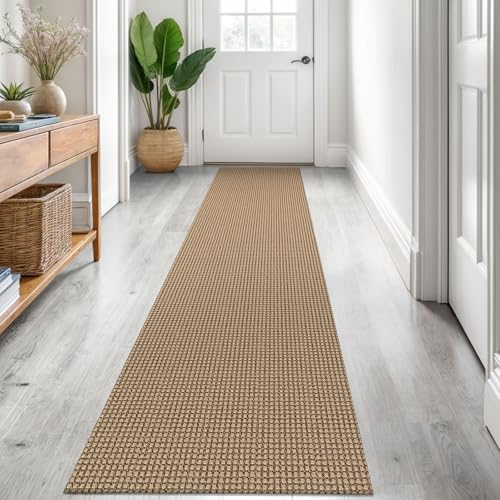
KOZYFLY Boho Cotton Runner Rug, 2×8 ft — Best for Hallways and Galley Kitchens
The verified example is the KOZYFLY boho runner: a washable cotton entryway runner, 2×8 feet, non-slip rubber backed, in orange, beige, tan, and brown — the long cotton format with the washability and the grip backing this section insists on.
Every home has a lane — hall, galley kitchen, the path from door to stairs — and a cotton runner is the washable way to protect it. Cotton suits the runner format particularly well because runners get dirty faster than any other rug in the house and cotton is the fibre you can actually wash at home. Choose flatweave or low-pile here: the runner must sit low for doors, trip-free for the half-asleep, and dense enough that grit does not grind through to the floor beneath.
Length is the decision people get wrong: a runner should cover the walking lane with a margin of bare floor at each end, not run wall-to-wall like a carpet offcut. On hard floors a runner without a pad is a slip hazard wearing a rug costume — budget the pad in from the start, cut it slightly smaller than the runner, and the combination stays put. Buy two if your lane is critical and your washing is weekly; rotation doubles the life of both.
A runner’s life is measured in wash cycles, and the cotton runner’s advantage compounds: every wash resets it to near-new in a way a synthetic runner, holding its traffic lane in grey, never quite manages. Buy the pad once and it serves successive runners for years, which improves the maths further. In a galley kitchen, two runners end to end beat one over-long piece: they wash in a domestic machine, rotate independently, and the join sits where nobody stands still.
Measure a runner by the doors it must clear, not just the lane: a runner that a door sweeps over will be dragged by that door daily. Low flatweave under a door’s arc, or a runner that stops short of the arc, are the two working answers.
Strengths
- Washable protection for the dirtiest floor in the house
- Flat, low formats stay trip-free and door-friendly
- Rotation with a second runner doubles service life
Trade-offs
- A pad is a safety requirement on hard floors, not an option
- Shows soil fast — that is its job, but it means frequent washing
- Too-long runners look like carpet offcuts; measure the lane
Best for: hallways, galley kitchens, and entry lanes / Not suited for: rooms wanting a large soft area rug
This pick sits in the mid-range tier. Check on Amazon — check the current price on Amazon.
Comparison Table
| Pick | Badge | Key spec | Best for |
|---|---|---|---|
| Handmade Cotton Flatweave Dhurrie Rug (Jaipur), 3×5 ft | Best Overall | Flatweave, woven pattern, pad required | living rooms, bedrooms, and dining areas wanting a washable classic |
| IOHOUZE Washable Woven Cotton Rug, 2×6 ft | Best for Kitchens and Hallways | Low pile, flexible backing, machine washable | busy kitchens, hallways, and entryways with daily traffic |
| Super Area Rugs Farmhouse Braided Cotton Rug, 4×6 Oval | Best for Farmhouse and Country Rooms | Braided construction, reversible, suction-only vacuuming | farmhouse living rooms, nurseries, and bedside placement |
| Dash & Albert Denim Rag Handwoven Cotton Rug, 4×6 ft | Best Texture | Chunky handwoven yarn, spot-clean only | bedrooms, reading corners, and calm, low-spill living rooms |
| Jean Pierre New York 100% Chenille Cotton Bath Mat, 20×32 in | Best Softness for Bathrooms and Bedsides | Chenille yarn, absorbent, gentle wash | bedsides, dressing areas, and in front of bathroom sinks |
| KOZYFLY Boho Cotton Runner Rug, 2×8 ft | Best for Hallways and Galley Kitchens | Runner format, flatweave or low pile, pad required | hallways, galley kitchens, and entry lanes |
How to Choose a Cotton Rug: Weave, Weight, and Fibre Content
Start with the label, because ‘cotton rug’ covers everything from a pure handwoven dhurrie to a rug with a cotton face on a synthetic skeleton. For most buyers the sweet spot is a rug that is predominantly cotton in the pile and weave, with any other fibre declared and doing a specific job — a jute warp for strength in some flatweaves, for instance. If the cotton content is vague, treat the rug as a blend and judge it as one.
Weave density is the quality signal you can check from photos and descriptions: in flatweaves, look for a tight, even weave with no visible gaps and straight, firmly bound edges; in braided rugs, tight stitching; in chunky weaves, consistent yarn thickness. Heavier for its size generally means more fibre and a longer life in cotton, the opposite of the suspicion you might bring from synthetic rugs. Finally, match pile to room honestly: flat and low for traffic and chairs, braided and chunky for softness zones, chenille for bare feet. A cotton rug fails when it is asked to do another format’s job.
Sizing, Pads, and Placing a Cotton Rug
Size a cotton rug to the furniture, not to the room’s ambition. In a living room, the front legs of seating on the rug is the minimum that looks intentional; in a dining room, the rug must extend beyond the table enough that pulled-out chairs stay on it — though for cotton specifically, we steer dining rooms to flatweave only, and to colours that forgive. Bedrooms want softness where feet land: a runner each side or one rug under the lower two-thirds of the bed.
The pad is part of the rug. Cotton has no grip of its own on hard floors and little cushion in flat weaves, so a felt or felt-and-rubber pad underneath provides safety, softness, floor protection, and years of extra life by absorbing the grinding action between rug and floor. Cut the pad a few centimetres smaller than the rug on every side so it stays invisible. On carpet, cotton rugs creep and bunch; a rug-on-carpet pad exists, but honestly, cotton earns its keep on hard floors.
Washing and Caring for Cotton Rugs Without Ruining Them
Cotton’s great promise is washability, and the promise holds if you wash like a textile person rather than a optimist. Shake and vacuum first — grit in the wash is grit ground into the weave. Wash cool to warm with a mild detergent, never bleach a coloured cotton rug, and expect some dye release from deep colours in early washes: wash alone or with like colours. Small rugs suit a domestic machine; anything you cannot lift comfortably when wet belongs in a laundromat drum or a bath soak, because wet cotton is startlingly heavy and a overloaded machine washes nothing well.
Dry flat or line-dry out of harsh sun. Tumble drying shrinks cotton and worries braided stitching; strong sun fades one side into a two-tone rug. Between washes, blot spills immediately — cotton absorbs fast, which is the same property that makes it wash clean — and rotate the rug a half-turn every few months so traffic and light fall evenly. A cotton rug cared for this way softens and settles into the house; a neglected one greys, and the difference is entirely routine.
Cotton vs Wool vs Synthetic Rugs: An Honest Comparison
Cotton’s case rests on washability, feel, and price tier. A cotton rug can be laundered at home in most formats and sizes that matter, it feels like a textile rather than a product, it contains no plastic pile to shed microfibres in the wash, and it costs less for the same coverage than wool. For households with children, pets, and a realistic attitude to spills, that combination is not a compromise — it is the correct engineering.
Wool’s case rests on resilience and lifespan. Wool fibres spring back from furniture dents and traffic, shed soil more readily at the surface, and a good wool rug outlives several cotton ones. If the room is formal, the traffic is shoes rather than bare feet, and the budget reaches, wool is the better long-term textile. Synthetics make their case on stain resistance and price: a polypropylene rug shrugs off what would mark cotton permanently and costs the least of all, at the price of a plastic feel underfoot, static, and a surface that holds grease and odour in a way cotton releases in the wash.
The mistake is ranking them absolutely. The question is which failure mode your household can live with: cotton fades and absorbs but washes; wool endures but asks for professional care at size; synthetics resist stains but feel like what they are. Most homes end up mixed — washable cotton where life is messy, wool where life is formal — and that mixture is not indecision, it is correct specification room by room.
Cotton Rugs Room by Room: Where Each Format Earns Its Place
In the kitchen, the washable low-pile or a flatweave runner along the work triangle earns its place daily: it catches the drips between sink, hob, and fridge, softens standing at the counter, and goes in the wash when the week has been tomato-heavy. Keep it out of the splash zone directly in front of the hob if your cooking is theatrical, and always over a pad — a sliding kitchen rug is a hazard wearing an apron. In the bedroom, cotton’s softness is the point: chenille or braided beside the bed, or a chunky weave under the lower bed, gives bare feet a warm landing that hard floors in winter do not.
In the nursery and children’s rooms, cotton is the default recommendation of this guide: low-pile washable formats survive the full curriculum of childhood fluids, contain no plastic pile against crawling skin, and can be replaced at a sane tier when the décor changes with age — which it will, faster than a wool rug would wear out. In the bathroom itself, cotton chenille belongs in front of the sink and beside the bath as a mat-rug hybrid, with the discipline that it must dry between uses; a permanently damp cotton rug in an unventilated bathroom will smell, because cotton is honest about moisture too.
In hallways and entries, the cotton runner takes the grit that would otherwise be walked through the house, and its washability is the entire argument. In living rooms, choose by traffic: flatweave for the busy family room, braided or chunky for the calm one. The pattern across all rooms is the same — cotton goes where washing is part of the plan, and stays out of the rooms where nobody will ever wash it.
Reading a Cotton Rug Listing Like a Weaver
Product listings for cotton rugs reward a translator’s eye. ‘Handwoven’ spans everything from a true artisan dhurrie to a loom-assisted production rug; both can be good, but they should be priced as what they are, and reviews mentioning slight irregularity are describing the genuine article rather than a defect. Fibre percentages deserve arithmetic: a rug described as ‘cotton’ in the headline and ‘cotton blend’ in the specifications is telling you, in the small print, that the pile may be cotton while the foundation is not — acceptable when declared, a warning when buried. Backing language matters too: a cotton rug with a latex or synthetic backing gains stability and loses some washability, and the listing should say which you are getting.
Photographs tell you about weave density if you know to zoom: in a flatweave, look for the warp and weft sitting tight with no gaps of light between them; in a braided rug, look at the stitching between braids at the edge, where corners reveal the maker’s care or haste; in chunky weaves, look for consistent yarn rather than alternating thick and starved rows. Size honesty is the final check — handwoven cotton is often sold in approximate sizes, so a rug that must fit a precise alcove should be ordered with tolerance or from a listing that states exact dimensions. None of this requires expertise; it requires reading the listing as a specification rather than as an advertisement, which is the habit this entire guide is trying to teach.
Cotton Rugs and Allergies, Pets, and the Washable Advantage
Households managing dust sensitivity often arrive at cotton rugs by a practical route rather than a medical one: a rug that can be removed and genuinely washed, at household scale, is a rug whose accumulated dust and dander load can be reset to near zero on a schedule the household controls. A vacuum-only rug, however good the vacuum, is managed rather than cleaned, and large rugs of any fibre eventually need professional extraction to achieve the same reset. This guide makes no health claims for any rug — but the logistics are the logistics, and for a bedroom or a child’s room, a washable cotton rug over a pad is the format whose cleanliness the household can actually verify. That verifiability, renewed monthly, is the advantage.
Pets test the same property from the other direction. Accidents on a washable low-pile cotton rug are an inconvenience; on an unwashable rug they are a permanent feature with a smell that returns every humid day. Choose cotton formats for pet rooms by washability first and looks second, keep a spare rug in rotation for the wash days, and the system works. What cotton cannot do for pets is resist claw damage in its looser weaves — braided and chunky formats in a cat’s scratching territory will be redecorated. Flat and low-pile weaves, again, are the working answer, and the household that matches weave to animal lives with its rugs for years instead of seasons.
Cotton Rug Colours and Patterns: Choosing for Real Light and Real Soil
Colour choice in cotton is a negotiation between the room’s light and the household’s soil, and the fibre’s honesty should be planned for rather than discovered. Cotton’s dyed colours soften gradually and evenly when the rug is rotated, which means a mid-tone pattern bought today becomes a slightly calmer version of itself — a quality that suits relaxed rooms and defeats anyone hoping for a permanent showroom punch. Patterns earn their keep functionally: a woven stripe or block pattern disguises the traffic lane’s daily evidence between washes in a way no plain colour can, which is why the classic dhurrie patterns are patterns at all. In kitchens and entries, pattern is not decoration; it is camouflage with a laundry schedule.
Pale cotton — the creams and whites of magazine rooms — is a legitimate choice under two conditions: the format is genuinely washable at that size, and the household’s traffic is adult and shoeless. Otherwise the honest pale is a pale pattern, which keeps the light feeling and surrenders the impossible standard. At the other end, deep indigo and madder-style tones are cotton’s traditional glory, fade into beauty rather than failure, and suit the braided and flatweave formats particularly. Choose the colour for the room the rug will live in at year three, not the room in the photograph, and cotton’s fading becomes a feature you planned rather than a decline you resent.
How to Stop a Cotton Rug Slipping and Curling
Step 1 — Fit the right pad. Choose a felt or felt-and-rubber pad cut slightly smaller than the rug. Lay the pad first, smooth it by hand from the centre out, then lay the rug over it and smooth again. Most slipping ends here.
Step 2 — Settle a new rug. New cotton rugs arrive folded or rolled with a memory of the journey. Reverse-roll it, or lay books along a curling edge overnight. Give a flatweave a few days of walking before judging its flatness.
Step 3 — Fix a stubborn corner. A corner that keeps lifting usually has a pad that is too small, a floor that is dusty under that corner, or a weave that dried curled after washing. Clean the floor, re-seat the pad, and weight the corner for a day.
Step 4 — Wash without curl. Dry flat, reshaping the rug by hand while damp, and never hang a heavy wet cotton rug by one edge — the weight stretches the weave into the wave you then fight for weeks.
Step 5 — Rotate. Turn the rug 180 degrees every few months. Cotton wears and fades where life happens; rotation shares the work across the whole rug.
Common Buying Mistakes
Skipping the pad. A cotton rug on hard floor without a pad slides, bunches, wears from beneath, and feels thin. The pad is not an accessory; it is half the product.
Expecting synthetic stain resistance. Cotton absorbs. If your household produces daily red-wine or pet accidents, choose washable formats and forgiving patterns rather than pretending a pale chunky weave will cope.
Overloading the washing machine. A rug that fills the drum cannot move, cannot rinse, and comes out dirtier in patches. Use a laundromat drum for anything large.
Tumble-drying on hot. Heat shrinks cotton and distorts braided and backed rugs. Dry flat or on the line, out of strong sun.
Putting a plush cotton rug in a traffic lane. Chenille and chunky weaves flatten and soil in hallways. Match the format to the room’s traffic, not to the photo you liked.
Final Recommendation
Most buyers should start with the flatweave dhurrie style for living spaces and the washable low-pile for kitchens and halls — between them they cover the majority of homes honestly. Choose braided cotton for farmhouse softness and reversibility, chunky handwoven for calm textured bedrooms, chenille where bare feet land, and a cotton runner wherever a traffic lane needs washable protection. In every case, budget the pad with the rug and commit to the washing routine; a cotton rug rewards households that launder and forgives almost nothing in households that do not.
Related guides on this site: Best Washable Rugs Best Kitchen Rugs Best Hallway Runners Best Bath Mats Best Area Rugs
Related guides
Frequently Asked Questions
Are cotton rugs durable enough for a living room?
A tightly woven cotton flatweave handles living-room traffic well, especially over a pad, though it will not outlast a good wool rug. Cotton’s advantage is washability and price tier rather than maximum lifespan.
Can I put a cotton rug on carpet?
It tends to creep and bunch because cotton grips carpet unevenly. Cotton rugs earn their keep on hard floors over a pad; if you must layer on carpet, use a rug-on-carpet pad and expect some movement.
Do cotton rugs fade?
Cotton fades gradually in strong direct sun and deep colours release some dye in early washes. Rotate the rug regularly and dry it out of harsh sun to keep fading even and slow.
How do I get a spill out of a cotton rug?
Blot immediately — cotton absorbs fast — then wash the rug if it is a washable format, or spot-clean with mild detergent and cool water. Avoid bleach on coloured cotton and avoid scrubbing braided stitching.
Why does my cotton rug feel thin?
Flatweave cotton has no pile by design. If the floor feels hard through it, the missing piece is almost always a felt rug pad underneath, which adds the cushion the weave does not pretend to have.
Are cotton rugs a good choice with pets?
Washable low-pile cotton is one of the better pet choices because accidents can go in the wash. Avoid braided and chunky weaves where claws can catch, and expect hair to show on pale colours.
Do cotton rugs need a pad on carpet too?
On carpet the issue is creep rather than slipping. A rug-on-carpet pad helps, but cotton performs best on hard floors; if a room is carpeted, a low-pile cotton rug in a low-traffic spot is the realistic use.
How do I stop my cotton rug smelling musty?
It is staying damp. Wash it, dry it completely — flat or on a line with airflow — and improve the room’s ventilation or move it out of a permanently steamy spot. A rug dried fully after every wash does not develop the smell.
Can I vacuum a cotton rug with a rotating brush?
Flatweaves tolerate a brush head on a low setting; braided and chunky weaves should be suction-only, because the beater bar worries stitching and pulls at thick yarns. When in doubt, suction only and shake outdoors weekly.


