Disclosure: airfryerkitchensupply.com is reader-supported. When you buy through links on our site, we may earn an affiliate commission at no extra cost to you.
Where to buy
All six picks in this guide are sold through Amazon, where you can compare exact dimensions, pile heights, and backing types on one page. Most households should start with the Hazo Haus Runner Rug 2×6, our Best Overall, because it is a washable, non-slip, low-pile runner made for exactly the hallway, mudroom, and corridor duty this guide is about. If your corridor is long, look at the SAFAVIEH Natural Fiber Runner 2’6″ x 10′ next. For a corridor that opens to the outdoors, shortlist the nuLOOM Wynn Braided Runner. Every linked product was confirmed against Amazon’s catalog data before publication; check price on Amazon on the listing page, and read the measuring section below before you buy, because a corridor rug is a made-to-measure purchase disguised as a decorative one — two centimetres of error is the difference between a runner and a trip hazard.
Introduction: the corridor is the hardest-working floor in the house
Shopping for the best corridor rugs is really shopping for the floor covering that will be walked on more than any other in your home. Every trip to the kitchen, the bathroom, the door, and the stairs crosses it — with shoes, with paws, with shopping bags, with the grit that enters on all of them. A corridor rug therefore has a job description unlike any other rug’s: it must lie flat enough that doors swing over it and feet never catch its edge, grip hard enough that it does not migrate down the hall over a week of traffic, survive a washing rhythm no living-room rug would tolerate, and still manage to be the thing that makes a bare hallway feel furnished rather than passed through. Most rugs fail this brief on at least one count, which is why this guide exists separately from general rug roundups.
The six picks divide by material and mission. Two are washable low-pile runners with rubber backing (the Hazo Haus and the BEQHAUSE) — the modern corridor default, built for mudrooms and family traffic. One is a long natural jute runner (SAFAVIEH) for hallways that want texture and length. One is a braided indoor/outdoor runner (nuLOOM Wynn) for corridors that begin at a door to the weather. One is a roll-up bamboo runner (Nuanchu) — a hard, waterproof surface for corridors over hard floors where soft pile is the wrong answer. And one is a three-piece farmhouse set (Ileading) whose runner anchors a matched kitchen-corridor scheme. Sizes in this category are stated in feet and inches and they matter to the centimetre; the reviews translate each pick’s dimensions into the corridor lengths it actually fits.
A corridor rug also does quieter work that rarely appears in listings. It warms a hard floor in the rooms you cross barefoot at night. It absorbs the footstep noise that makes a house feel flimsy, especially on stairs-adjacent landings and in flats where the corridor runs above a neighbour’s ceiling. It protects the floor finish beneath it at exactly the point of maximum wear — the traffic lane — so that when the runner is lifted after two years, the floor beneath looks newer than the floor around it. And it is frequently the only textile in the circulation spaces of a home, which makes it the cheapest way to change how the whole house feels between rooms. None of that requires an expensive rug; all of it requires the right one, correctly sized and firmly laid.
One expectation to set honestly: a corridor rug is a consumable in a way a living-room rug is not. Even the best runner in this guide lives a harder life — more passes, more grit, more washing — and its realistic ambition is years of looking good, not decades. The picks were chosen for how gracefully they handle that life: washable where possible, low-pile so dirt releases, backed so they stay put, and priced so that replacing one in several years is a shrug rather than a grief.
In this guide
Quick Picks
- Best Overall — Hazo Haus Runner Rug 2×6: a navy washable runner with non-slip rubber backing and low pile, made for kitchens, hallways, mudrooms, and laundry rooms.
- Best Long and Natural — SAFAVIEH Natural Fiber Runner 2’6″ x 10′: a knotted jute runner with a 3/4″ pile, durable and kid-and-pet friendly, in a true long-corridor length.
- Best Indoor/Outdoor — nuLOOM Wynn Braided Runner 2′ x 8′: a solid braided ivory runner that works from the entry corridor to the patio door and beyond.
- Best Washable Budget — BEQHAUSE Runner Rug 24″ x 60″: a non-slip washable runner, extra absorbent and stain resistant, sized for standard hallways and galley spaces.
- Best Hard Surface — Nuanchu Bamboo Floor Mat Runner 28″ x 79″: a waterproof, non-slip, roll-up bamboo runner for hard floors and wet zones.
- Best Matched Set — Ileading Kitchen Rugs Set, 3 Piece: a farmhouse runner rug set, non-slip and washable, for a coordinated kitchen-corridor scheme.
How These Picks Were Chosen
Corridor duty wrote the checklist. Backing came first: a runner that creeps is a runner that fails, so rubber-backed and grip-designed picks were favoured, with the bamboo and braided entries judged on their own non-slip constructions. Pile height came second — low pile for door clearance and dirt release in the washable picks, with the jute’s deeper natural pile accepted deliberately for long, door-free runs where texture is the point. Washability was scored as a corridor essential, not a bonus: every soft pick here can be machine washed or easily cleaned, because a hallway runner that cannot be washed is on a countdown from its first muddy week. Dimensions were checked against real corridors — the 2×6 and 24″x60″ formats for standard halls, 8 and 10 feet for long ones — and each review states the fit plainly.
Every product named here was verified on this site’s own Amazon integration: searched by brand and model, the returned catalog title matched to the intended product, and only then was its ASIN used for links. All six picks confirmed cleanly, so none needed a link-free write-up. Prices and ratings are deliberately absent throughout — both change constantly — so each pick tells you to check price on Amazon instead. Finally, we deliberately included materials beyond the default washable synthetic — jute, braid, and bamboo — because corridors differ: the best runner for a mudroom door is not the best runner for a quiet upstairs hall, and the guide’s job is to make that mapping obvious.
The 6 Best Corridor Rugs
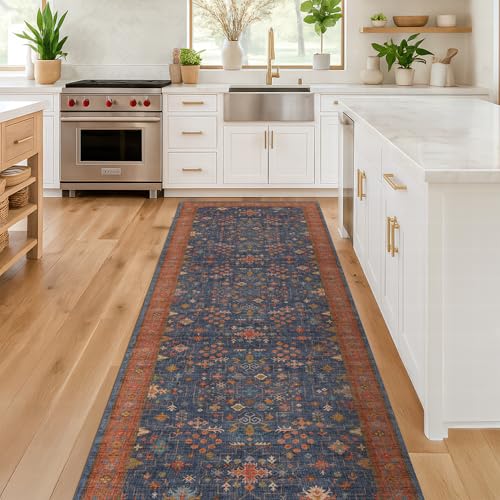
Hazo Haus Runner Rug 2×6 — Best Overall
The Hazo Haus is the modern corridor default done right: a 2×6 ft runner in navy, low-pile, machine washable, with a non-skid rubber backing that keeps it where you put it. Its listing names its habitats without embarrassment — kitchen, hallway, mudroom, laundry room, bathroom — and that honesty is the point: this is a working runner for the traffic lanes of a house, designed to be walked on in shoes, washed when the week shows, and laid back down flat. The low pile clears doors and releases dirt in the wash instead of warehousing it. It suits family hallways, rental corridors, pet households, and every mudroom in a wet climate. Hallways longer than six feet should look at the SAFAVIEH or buy the pattern in multiples; design-led upstairs corridors may prefer the jute’s texture. For the standard corridor problem, this is the answer.
Strengths
- Washable, low-pile, rubber-backed — the full corridor checklist in one runner
- 2×6 format fits the standard hallway and mudroom run
- Stain-resistant temperament suits pets, children, and shoe traffic
Trade-offs
- Six feet is the limit; long corridors need the longer picks or multiples
- Low pile is practical, not plush — barefoot luxury lives elsewhere
- Navy-forward colour range suits some halls better than others
Key specs (verified listing): Hazo Haus Navy Blue Runner Rug 2×6 for Kitchen, Hallway, Mudroom, Laundry Room, Bathroom; washable; non slip non skid rubber backing; low pile; stain resistant.
The ownership rhythm that makes this runner a success is wash-and-relay: shake it outside weekly, wash it when the traffic shows, and lay it back while slightly hungry for flatness — it settles within the hour. Owners who treat washable runners as wash-often runners get years of tidy corridor; owners who wash yearly get a runner that ages like any other. On hard floors the rubber backing does the staying-put alone; on the rare corridor with underlay-grade carpet, add rug tape at the ends, as the buying guide advises for any runner on carpet.
Best for: family hallways, mudrooms, pet households, and rentals / Not suited for: long corridors or plush-barefoot briefs.
Check the current price on Amazon

SAFAVIEH Natural Fiber Runner 2’6″ x 10′ — Best Long and Natural
Ten feet of knotted jute changes what a corridor can be. The SAFAVIEH Natural Fiber runner is the long-hallway pick: a 2’6″ x 10′ runner in natural jute with a substantial 3/4″ pile, durable enough for kids and pets, that brings texture and warmth to the kind of corridor — long, straight, door-lined — that swallows shorter runners whole. Jute is a different material bargain from the washable synthetics: it hides dirt in its texture between cleans, feels wonderful underfoot, and asks for vacuuming and spot care rather than machine washing. It suits upstairs halls, period houses, and any corridor whose doors do not swing across the rug’s path. Mudroom and wet-duty corridors should take the washable picks instead; this is the runner for the corridor as a room, not as a mop.
Strengths
- True 10 ft length covers long corridors in one piece
- Natural knotted jute brings texture no synthetic imitates
- Durable, kid-and-pet friendly construction with a substantial pile
Trade-offs
- Not machine washable — vacuum and spot-clean care
- 3/4″ pile needs door-clearance checking where doors cross it
- Jute and standing water are enemies; keep it in dry corridors
Key specs (verified listing): SAFAVIEH Natural Fiber Runner Rug 2’6″ x 10′; jute knotted natural NF447A; 3/4″ pile; indoor rug; durable; kid and pet friendly; jute fibres; easy care.
SAFAVIEH’s natural fibre line has been the reference for jute runners for years because the construction is honest: thick, tightly knotted, and heavy enough to lie flat by its own weight — a meaningful advantage in a corridor, where a runner that stays put without drama earns its place daily. Pair it with a thin rug pad on hard floors to protect both the floor and the jute’s backing, and vacuum with suction only, no beater bar, to keep the fibres handsome. In the right hallway — long, dry, and walked in socks as much as shoes — nothing else in this guide looks or feels as good.
Best for: long upstairs halls and natural-material interiors / Not suited for: wet mudrooms or machine-wash devotees.
Check the current price on Amazon

nuLOOM Wynn Braided Runner 2′ x 8′ — Best Indoor/Outdoor
The Wynn’s braid is its resume: a solid ivory braided runner, 2 by 8 feet, built for indoor and outdoor duty, which in corridor terms means it belongs where the hallway meets the weather — entry corridors, patio-door runs, conservatory links, and porches that behave like rooms. Braided construction has no pile to crush and no direction to wear unevenly; it vacuums clean, shakes out honestly, and tolerates the damp boot traffic that would shame a delicate rug. The ivory colour is braver than the mudroom default and brighter for it — in a dim entry corridor it lifts the light noticeably. It suits coastal and country houses, dog-door corridors, and anyone whose hallway is half indoors by courtesy only. Deep-clean devotees should note braids want a hose or a thorough shake rather than a machine cycle.
Strengths
- Indoor/outdoor braided build tolerates damp, grit, and heavy traffic
- 8 ft length suits entry corridors and long runs
- No pile to crush; even wear and easy shaking-out
Trade-offs
- Ivory shows mud honestly between cleans in the wettest entries
- Braided texture is firm underfoot rather than cushioned
- Not machine washable in the way the synthetic picks are
Key specs (verified listing): nuLOOM Wynn Ivory Solid Braided Indoor/Outdoor Runner Rug, 2′ x 8′.
Place the Wynn where a corridor changes state — inside the front door, along a boot room, between house and garden room — and it does the diplomatic work of a rug that belongs to both sides. On hard floors a slim rug pad underneath adds grip and a touch of give; outdoors-adjacent, let it lie on its own braid. Its eight feet also make it the natural second choice for the long dry corridor if jute’s care rules do not suit you, trading natural fibre for a tougher, more washable-by-hose constitution.
Best for: entry corridors, boot rooms, and indoor-outdoor transitions / Not suited for: plush briefs or machine-wash-only households.
Check the current price on Amazon

BEQHAUSE Runner Rug 24″ x 60″ — Best Washable Budget
The BEQHAUSE is the corridor problem solved at the simplest tier: a 24 by 60 inch runner — the five-foot format that fits the standard hallway, galley, and between-door run — non-slip, machine washable, extra absorbent, and stain resistant, in a woven design with a rubber backing. Absorbency is its distinguishing virtue: where the Hazo Haus is a generalist, the BEQHAUSE is built to drink — kitchen-adjacent corridors, bathroom approaches, and the stretch of hall outside a utility room where drips and splashes land. It suits renters, first flats, and any household that wants a second washable runner in rotation so one is always down while the other is in the wash. Five feet will not cover a grand hallway; at its tier, it is not trying to.
Strengths
- Extra absorbent and stain resistant — built for wet-adjacent corridors
- Washable with a non-slip rubber backing at a budget tier
- 24″ x 60″ fits standard halls, galleys, and bathroom approaches
Trade-offs
- Five-foot length limits it to standard runs
- Budget construction rewards gentle washing to protect the backing
- Kitchen-mat heritage shows in the styling options
Key specs (verified listing): BEQHAUSE Kitchen Runner Rug 24″ x 60″, Non Slip Kitchen Mat Washable, Blue; kitchen mats for floor; extra absorbent and stain resistant.
The two-runner rotation is this pick’s natural habitat: buy it as the working half of a pair — or frankly, buy two — and the corridor never waits for laundry day. Wash it cool and let it dry flat or draped, and the rubber backing will outlast the corridor’s tenancy; wash it hot and tumble it hard, and you are testing the backing’s patience. Treated with that much sense, the BEQHAUSE is the cheapest route in this guide to a corridor that always looks kept.
Best for: wet-adjacent halls, renters, and two-runner rotations / Not suited for: long corridors or heirloom ambitions.
Check the current price on Amazon

Nuanchu Bamboo Floor Mat Runner 28″ x 79″ — Best Hard Surface
Sometimes the right corridor rug is not soft. The Nuanchu is a bamboo runner — slatted natural bamboo with a brown border, 28 by 79 inches, non-slip, waterproof, and roll-up for storage — that treats the corridor as a hard-wearing surface rather than a textile one. Water rolls off it, grit sweeps off it, muddy paws wipe across it without consequence, and it never needs a wash cycle, a dry time, or a backing replaced. It suits corridors over hard floors in wet climates, beach and lake houses, bathroom and laundry approaches, and households with dogs whose paws bring the outdoors in daily. The feel underfoot is firm and cool — a feature in summer, a preference to check in winter. Roll it up and it stores in a cupboard corner, which no other pick here can claim.
Strengths
- Waterproof bamboo surface — mud, water, and grit simply wipe or sweep away
- Rolls up for storage; nothing to wash, ever
- Non-slip design sized generously at 28″ x 79″
Trade-offs
- Firm underfoot; no cushion for bare feet or dropped objects
- Bamboo suits hard floors and wet zones, not cosy upstairs halls
- Slatted surface asks for a sweep rather than a vacuum pass
Key specs (verified listing): Nuanchu 28 x 79 Inch Extra Large Bamboo Floor Mat; non-slip bath mat format; indoor mat rug; brown border; waterproof roll-up floor rug for bathroom and living areas.
Bamboo runners have a long history in wet-climate houses precisely because they refuse every failure mode of fabric: no mildew, no soggy backing, no laundry. The Nuanchu’s extra-large runner format brings that tradition to the corridor. Place it where the traffic is wettest — the door-to-utility run, the bathroom corridor — and let the soft runners in this guide serve the dry halls. In a house with both zones, that division of labour is the most practical arrangement this guide can recommend.
Best for: wet zones, hard floors, beach houses, and dog-heavy entries / Not suited for: cosy carpeted halls or cushion-seekers.
Check the current price on Amazon

Ileading Kitchen Rugs Set, 3 Piece — Best Matched Set
Some corridors do not end at a door; they flow into a kitchen, and the floor story wants telling in one voice. The Ileading set — three farmhouse-style pieces including a runner, non-slip and washable, stain resistant with a boho farmhouse design — exists for that open-plan reality: the runner takes the corridor or the galley’s long axis, the companion mats take the sink and stove stations, and the whole scheme matches. It suits kitchen-corridor layouts, farmhouse and boho interiors, and anyone equipping a new flat who would rather buy one coordinated decision than three separate ones. Purists furnishing a formal hallway should take the SAFAVIEH; households whose corridor is really a kitchen with ambitions have found their pick.
Strengths
- Three coordinated pieces solve corridor-plus-kitchen in one purchase
- Non-slip and washable, with stain-resistant farmhouse styling
- Runner anchors the long axis while mats cover the work stations
Trade-offs
- A set is a commitment to one design across the scheme
- Pieces are kitchen-scaled; grand hallways need the longer singles
- If one piece wears first, matching a replacement later is luck
Key specs (verified listing): Ileading Kitchen Rugs Set 3 Piece; non slip washable kitchen mats for floor; farmhouse blue runner rug set; stain resistant boho floor carpets.
The set logic rewards a moment’s planning: lay the runner where feet travel, the larger mat where someone stands longest (usually the sink), and the third at the cooker or the door, and the kitchen-corridor becomes a single designed surface rather than a rug and two apologies. Wash the pieces together so they age together — the set’s coherence is its value, and even fading is better shared. For open-plan households this is the tidiest purchase in the guide.
Best for: kitchen-corridor open plans and coordinated farmhouse schemes / Not suited for: formal hallways or single-runner minimalists.
Check the current price on Amazon
Comparison Table
| Pick | Badge | Key spec | Best for |
|---|---|---|---|
| Hazo Haus Runner 2×6 | Best Overall | Washable; rubber backing; low pile | Standard family hallways and mudrooms |
| SAFAVIEH Natural Fiber Runner | Best Long and Natural | Jute; 2’6″ x 10′; 3/4″ pile | Long dry corridors, natural interiors |
| nuLOOM Wynn Braided Runner | Best Indoor/Outdoor | Braided; 2′ x 8′; indoor/outdoor | Entry corridors and boot rooms |
| BEQHAUSE Runner 24″ x 60″ | Best Washable Budget | Absorbent; washable; rubber backing | Wet-adjacent halls and rotations |
| Nuanchu Bamboo Runner | Best Hard Surface | Bamboo; 28″ x 79″; waterproof; roll-up | Wet zones over hard floors |
| Ileading Rug Set 3 Piece | Best Matched Set | Runner plus mats; washable; farmhouse | Kitchen-corridor open plans |
How to Choose a Corridor Rug
Measure like a tailor. Three numbers decide everything: the corridor’s length, its width, and the clearance under every door that swings across the rug’s path. The runner should end 10–20 cm short of the corridor’s ends — a runner that touches both walls’ skirting looks stuffed, and one that stops well short looks lost — and leave a border of floor visible on both sides, typically 8–15 cm per side in an ordinary hall. Widths in this guide run from 24 inches to 2’6″; measure yours before falling for a pattern. Door clearance is the silent killer: measure the gap under the lowest door, and if it is under a centimetre, only the low-pile washable picks belong on your list.
Choose backing by floor type. On hard floors, a rubber backing (Hazo Haus, BEQHAUSE, Ileading) grips alone and needs nothing else. A rug pad under a backed runner can actually reduce grip — skip it. On carpeted corridors, no backing grips pile well; use rug tape or corner anchors at both ends and accept a weekly straightening as the price. Natural and braided runners (SAFAVIEH, nuLOOM) sit between: their weight does much of the work on hard floors, and a thin non-slip pad underneath finishes it without the grip conflict.
Match the material to the corridor’s weather. Dry upstairs hall: anything in this guide, chosen by eye — jute’s texture and the braided runner’s calm both shine. Family traffic lane: washable low-pile synthetic, no debate. Wet-adjacent — mudroom, bathroom approach, dog door: absorbency and washability (BEQHAUSE, Hazo Haus) or outright waterproofing (Nuanchu bamboo). Kitchen-flow corridor: the Ileading set’s scheme or the Hazo Haus’s work ethic. A corridor rug chosen against its weather is a rug on a countdown.
Think in washing rhythms. A corridor runner’s life is shake weekly, wash when the traffic shows — for a family mudroom that may be fortnightly. If that rhythm sounds like your household, washable picks only, and consider the two-runner rotation from the start: one down, one clean in reserve. Machine size matters too: a 2×6 low-pile runner fits a standard domestic machine; the 10 ft jute is vacuum-and-spot care by design, which suits households whose rhythm is gentler.
Consider the stairs conversation. Many corridors end at a staircase, and the runner’s relationship with the stair carpet — matching, echoing, or deliberately contrasting — decides whether the two read as one design or an argument. You do not need a matched set; you need a shared colour or a shared material family. The natural picks (jute, braid, bamboo) converse well with most stair carpets because texture agrees even when colour merely harmonises, while a bold patterned runner beside a bold patterned stair carpet is a fight nobody wins.
Let the corridor’s light choose the colour. Corridors are the dimmest rooms in most houses. A light runner — the Wynn’s ivory, the jute’s natural tone — borrows brightness and shows a small hall larger; a deep runner — the Hazo Haus’s navy — hides a busy family’s week and grounds a pale scheme. Pattern hides dirt better than any solid, which is why the farmhouse set’s design is practical as well as pretty. Choose with the hallway’s actual light at its actual worst hour, not at noon with the door open.
How to Lay and Care for a Corridor Runner
- Clean the floor first. A runner laid over grit becomes sandpaper with ambition — the grit wears the floor finish and the rug’s backing simultaneously. Sweep or vacuum the corridor, let it dry, then lay the rug.
- Unroll and let it settle. New runners arrive with a memory of the roll. Reverse-roll it briefly, lay it flat, and weight the ends with books for the first evening. A runner whose ends curl is a trip hazard wearing a rug costume; do not accept it as “newness” beyond the first day.
- Align to the corridor, not the wall. Walls in older houses wander. Centre the runner on the corridor’s visual axis — equal floor borders by eye from the doorway you enter by — and it will look intentional even where the architecture is not.
- Secure the ends if the floor demands it. Rubber-backed runners on hard floors need nothing. Everything else — and anything on carpet — gets rug tape or anchors at both ends. Test with a deliberate scuff of a shoe: a corridor runner should not move, full stop.
- Check every door’s swing. Open and close each door across the rug slowly. Any contact means the pile is too high for that door — move the runner’s line, or change to a lower-pile pick, before the door planes the rug’s edge into a curl.
- Keep the rhythm: shake, vacuum, wash. A weekly shake outside removes the grit that washing would only redistribute. Vacuum the traffic lane with suction appropriate to the material — no beater bar on jute or braids. Wash washable runners cool, and dry them flat or draped to protect their backings.
- Deal with spills the corridor way. Blot, never rub, and get a washable runner into the wash the same day rather than letting a spill set through a week of traffic. For jute and braid, blot, lift the runner, and dry both sides fully before relaying — natural fibres forgive spills they are allowed to dry from, and punish the ones sealed against a floor.
- Rotate and rest. Flip the runner end-for-end every few months so the door-end wear shares with the quiet end. In a two-runner household, rotate the pair through the wash so both age together and the corridor never goes bare.
Corridor Rugs by Corridor Type
The front-door corridor. The wettest, grittiest run in the house, and the one guests judge you by. It wants grip, absorbency, and washability in that order: the Hazo Haus as the default, the BEQHAUSE where the door opens to weather, the nuLOOM braid where the corridor is half porch. A boot tray and a door mat outside halve the runner’s workload before it starts — layering defence at a doorway is always cheaper than upgrading the rug.
The upstairs landing and bedroom corridor. The quiet corridor: bare feet, low light, doors that open in the night. Here the texture picks earn their place — the SAFAVIEH jute for warmth and silence underfoot, the braided Wynn for a softer landing feel — and pile can rise a little where no door swings across it. This is also the corridor where a runner’s acoustic gift matters: a good runner halves the household’s nighttime footstep noise, which light sleepers value beyond any pattern.
The kitchen corridor and galley. A work lane disguised as a passage: spills, steam, standing cooks, and constant short trips. Absorbency and washability rule — the BEQHAUSE’s drinking temperament, the Ileading set’s coordinated scheme, the Hazo Haus’s general competence. Length should cover the work triangle’s path, not the room’s full axis, so the runner lives where the drips actually fall.
The basement and utility corridor. Concrete, cool air, and honest dirt. This is bamboo country — the Nuanchu wipes clean, ignores damp air that would worry textiles, and rolls away when the space needs to be a workshop again. If the basement corridor is finished and dry, a washable synthetic serves; if it is a working utility space, hard surface wins.
The long gallery corridor. The corridor as a room in its own right, found in older and larger houses. It deserves the full-length treatment — the SAFAVIEH’s ten feet or the Wynn’s eight — laid as a single statement rather than a patchwork of shorts, with the floor border even on both sides. Long corridors also reward a runner with visual direction: braids, borders, and woven patterns that lead the eye down the length make the space feel designed rather than merely covered.
Pattern, Colour, and Light in Narrow Spaces
A corridor is the narrowest gallery in the house, and a runner is usually its only artwork. Three principles govern the choice. First, direction: patterns with a long axis — borders, stripes, braided lines — pull the eye along the corridor and make it feel purposeful; busy all-over patterns hide dirt best but can make a narrow hall feel restless, which is why the farmhouse set’s design works hardest in kitchens, where restlessness reads as charm. Second, value: in a dim corridor, a mid-tone runner is the diplomat — light enough to lift the gloom, dark enough to hide the week; the extremes (pure ivory, near-black) each show one kind of dirt mercilessly, and the Wynn’s ivory earns its place only where its indoor-outdoor toughness lets it be cleaned as often as it asks. Third, repetition: a corridor runner that echoes one colour from the rooms it connects — a door colour, a stair carpet, the kitchen’s scheme in the Ileading set — makes the whole floor feel planned. Buy the runner last, with the connecting rooms’ colours in your phone’s camera roll, and the corridor will look designed rather than decorated.
Common Buying Mistakes
- Guessing the size. The corridor rug bought by eye is too long, too wide, or under a door it cannot clear. Measure length, width, and door gaps — all three — before ordering.
- Choosing pile for the living room’s brief. Plush pile in a corridor traps grit, blocks doors, and shows traffic lanes within a month. Low pile is not a compromise here; it is the specification.
- Ignoring the backing. An unbacked runner on hard floors migrates, bunches, and eventually trips someone. Backing or a pad is not an accessory in a corridor; it is the product.
- Buying a dry-clean temperament for a wet corridor. Jute in a mudroom and ivory pile by a dog door are romances that end in a month. Match material to the corridor’s weather honestly.
- Washing a rubber backing hot. Heat and harsh tumble cycles age rubber backings fast. Wash cool, dry flat, and the backing outlasts the pile.
- One runner, no rotation. A corridor cannot go bare on laundry day without everyone noticing. The two-runner rotation is the cheapest upgrade in this entire guide.
- Letting the ends curl “for now.” A curled end is the corridor’s classic trip hazard, and it never improves with traffic. Reverse-roll, weight, tape, or replace — but do not leave a curl in the house’s busiest walkway hoping it will flatten itself.
Final Recommendation
Measure first, match the material to the corridor’s weather, and secure the ends — those three decisions are the whole craft of this category. For most corridors, buy the Hazo Haus Runner 2×6: washable, grippy, low-pile, and honestly made for hallway duty — it is the corridor default for a reason. Long, dry halls should take the SAFAVIEH jute runner and enjoy the texture nothing synthetic matches; entry corridors that meet the weather should take the nuLOOM Wynn braid. On a budget or beside wet rooms, the BEQHAUSE — ideally as a rotating pair — keeps a corridor perpetually presentable, while the Nuanchu bamboo runner solves the wettest hard-floor runs without a single wash cycle. Open-plan households should consider the Ileading set and design the kitchen-corridor as one scheme. Whichever you choose, measure first and secure the ends — in a corridor, fit and grip are the whole game.
Related guides in this series: Best Hallway Runner Rugs · Best Washable Rugs · Best Kitchen Runner Rugs · Best Jute Rugs · Best Rugs For Entryways
Frequently Asked Questions
What size runner rug do I need for my corridor?
Measure the corridor’s length and leave roughly 10–20 cm of bare floor at each end; measure the width and leave 8–15 cm of floor visible on each side. Standard hallways land on the 2×6 ft format (the Hazo Haus) or the 24″ x 60″ five-footer (the BEQHAUSE); long corridors need the 8 ft nuLOOM or the 10 ft SAFAVIEH. Also measure the clearance under every door that swings over the rug’s path — under a centimetre of gap means low pile only.
How do I stop a corridor runner from slipping?
Start with the right backing for your floor: rubber-backed runners grip hard floors unaided, and adding a pad beneath them can reduce that grip, so let them work alone. Natural and braided runners do best with a thin non-slip pad underneath. On carpeted corridors, no backing grips well — use rug tape or corner anchors at both ends. Whatever the setup, test with a deliberate shoe scuff before declaring it done; a corridor runner should not move at all.
Can I machine wash a corridor runner?
The washable picks in this guide — Hazo Haus, BEQHAUSE, and the Ileading set — are made for it: wash cool on a gentle cycle and dry flat or draped to protect the rubber backing, which heat ages quickly. The jute SAFAVIEH and the braided nuLOOM are vacuum, shake, and spot-clean care instead, and the bamboo Nuanchu needs nothing but a sweep and a wipe. Always follow the specific care label; backing preservation is the difference between a runner that lasts years and one that sheds its grip in a season.
Is a low-pile or high-pile rug better for a hallway?
Low pile, decisively, for most corridors: it clears doors, releases dirt in the wash instead of storing it, does not show traffic lanes, and dries fast. The exception is the long, dry, door-free hallway where a deeper natural pile — the SAFAVIEH jute at 3/4″ — is a deliberate luxury that its setting protects. Choose pile by the doors and the dirt your corridor actually has, not by the barefoot test in a showroom.
Are bamboo runners a good idea in a hallway?
In the right hallway, yes — specifically the wet, hard-floored, high-grit ones where fabric runners spend their lives damp or in the wash. A bamboo runner like the Nuanchu wipes and sweeps clean, never mildews, and rolls away for storage, which makes it the practical champion of entry corridors, utility runs, and dog households in wet climates. In a dry, carpeted, barefoot corridor it is the wrong tool: firm where you want soft, cool where you want warm. Match it to the wet zones and it is not a compromise at all — it is the specialist.
How often should a corridor rug be replaced?
When it stops lying flat, loses its grip despite correct backing, or stays tired-looking after a proper wash — for a hard-working family corridor, think in years rather than decades, with the washable synthetics at the shorter end and jute, braid, and bamboo at the longer. The picks here were chosen to age gracefully within that honest horizon, and the two-runner rotation stretches it further by halving each rug’s duty.
What is the best corridor rug for a house with dogs?
Prioritise the trio of grip, washability, and dirt-hiding texture. The Hazo Haus is the default answer — rubber-backed, low-pile, machine washable, and dark enough to stay presentable between washes. For the door-adjacent stretch where paws arrive wet, the Nuanchu bamboo is the specialist: everything wipes off it, and nothing soaks in. Vacuum or shake a dog corridor twice as often as feels necessary; grit under paws is what wears both the rug and the floor beneath it, and the runner’s job is to be the replaceable layer that takes that wear.
Do corridor runners need a rug pad?
Only some. Rubber-backed runners on hard floors should work alone — a pad beneath can reduce their grip. Unbacked natural and braided runners benefit from a thin non-slip pad, which also adds a whisper of cushion and protects the floor finish. On carpet, a pad is useless; use tape or anchors instead. The rule is to fix the runner’s actual weakness — sliding, curling, or floor protection — rather than adding a pad by reflex.
Can I put a runner rug on top of carpet?
Yes, with the right expectations and fixings. A runner over carpet adds a washable, replaceable traffic lane that protects the carpet beneath — a genuinely good rental strategy. It will never grip as it does on hard floors, so anchor both ends with rug tape or corners, choose a low, firm runner (the washable synthetics here), and straighten it as part of the weekly rhythm. Thick pile over thick carpet is the combination to avoid; firm over flat is the one that works.


