Disclosure: airfryerkitchensupply.com is reader-supported. When you buy through links on our site, we may earn an affiliate commission at no extra cost to you.
Where to buy
Tub plungers are inexpensive, widely stocked tools, and Amazon carries every type described below. Every pick in this guide was verified against Amazon’s catalog data and carries a link — and note what the verification confirmed: each pick below is a flat-cup or bellows drain design, because toilet flange and beehive plungers, however well made, do not seal on a flat tub drain. If you buy one thing, buy the Best Overall pick: a flat-bottom force cup plunger is the correct first tool for almost every tub clog.
Introduction: a tub is not a toilet, and its plunger should not be either
The most common reason a plunger fails on a bathtub is that it is the wrong plunger, borrowed from beside the toilet. The best plunger for tubs is a flat-bottom cup plunger — the classic red rubber cup on a handle — because a tub drain is a flat surface, and a flat cup seals against it. Toilet plungers are built differently: flange and beehive designs carry a protruding bell shaped to seal inside a toilet bowl’s curved outlet, and that protrusion prevents a clean seal on a flat drain. Press a toilet plunger onto a tub drain and most of your force escapes around the edges as splash rather than traveling down the pipe as pressure. Same household, same word “plunger,” two different tools — and the tub one costs less than the pizza you will order while standing in ankle-deep shower water if you get this wrong. This guide covers the six forms the right tool takes, the technique that makes any of them work, the prevention that makes them unnecessary for months at a time, and the symptoms that mean the problem has outgrown plungers altogether.
It also helps to know what a tub clog actually is. Unlike kitchen sinks (grease and food) or toilets (paper and worse), tub drains clog overwhelmingly with hair bound in soap residue, gathering at the drain crossbars just below the stopper and along the first bend of pipe. That location is good news: the clog is usually shallow, which is why plunging works well on tubs — the pressure wave has only a short distance to travel — and why this guide also teaches the overflow-plate seal that makes tub plunging effective, plus the honest limits of the method. Deep or recurring clogs, and drains that gurgle in other fixtures, are telling you the problem lives further down the line, where a plunger is not the tool and a drain snake or a plumber is.
In this guide
Quick Picks
- Best Overall: Supply Giant SU3249 Force Cup Rubber Plunger — the correct seal for flat tub drains and the first tool for most tub clogs.
- Best for Small / Tight Drains: Rocky Mountain Goods Small Drain Plunger — sized for small drain openings, pedal tubs, and cramped shower stalls.
- Best Power Option: Master Plunger MPS4 Sink & Drain Plunger — the high-volume bellows design moves more water per stroke for stubborn shallow clogs.
- Best for Frequent Use: Edward Tools Classic Force Cup Plunger, 23 1/4 Inch — leverage and distance for landlords, parents, and anyone whose tub clogs monthly.
- Best Compact / Under-Sink: Mini Sink & Drain Plunger with Short Handle — stores in the bathroom itself, so it is there the moment the water starts rising.
- Best Complete Kit: Mini Sink Plunger & 2 Drain Snake Combo — because half of tub clogs surrender to hair removal before plunging is even needed.
How These Picks Were Chosen
The filter for this guide was mechanical honesty. First, shape: only flat-bottom cup and drain bellows designs qualify for tubs; toilet flange and beehive plungers were excluded no matter how highly they are marketed, because their seals are designed for a different fixture. Second, cup material: natural rubber cups flex and seal better than stiff plastic ones, especially on slightly textured drain covers, so rubber is the recommended default in every slot. Third, proportion: cup diameter and handle length were matched to tub realities — flat drain covers, overflow plates a few inches above, and users kneeling beside a tub rather than standing over a bowl.
On verification, plainly: this site prints purchase links only for products confirmed against Amazon’s catalog, and all six picks below passed that check against their own listing data — flat or bellows drain designs, each listed for sinks, tubs, or showers by its maker. No prices are printed — these are budget-tier tools in any case — and no ratings are quoted. The technique sections were written from standard plumbing practice for residential drains, with safety limits stated where they belong: no chemical drain openers mixed with plunging, no excessive force on old plumbing, and clear criteria for when to stop and call a professional.
The 6 Best Plungers for Tubs

Supply Giant SU3249 Force Cup Rubber Plunger — Best Overall
The verified example is the Supply Giant SU3249: a force cup rubber plunger on an 18-inch wooden handle, listed by its maker for clogged sinks, basins, and tubs — the flat-cup geometry this slot calls for, in a full-size household format.
This is the tool the category is named for: a simple rubber cup with a flat rim, on a handle, sized to cover a standard tub drain with margin. The flat rim is the entire secret — it sits flush on the tub floor around the drain, traps a pocket of water, and converts your push-pull into pressure pulses in the pipe. Everything else in this guide is a variation for a special case; this slot is the default that clears most tub clogs in a few minutes, and it belongs in every home with a bathtub.
Strengths
- Correct seal geometry for flat drains — the force goes down the pipe, not around the cup.
- Simple, repairable-free design: no parts, no mechanism, nothing to fail in storage.
- Doubles as the household’s sink plunger, since sinks share the same flat-drain geometry.
Trade-offs
- Requires the overflow-sealing technique (taught below) to reach full effectiveness in a tub.
- Standard cup can be oversized for very small or recessed drain openings — that is the mini pick’s job.
- Rubber ages: a cup stored for a decade may crack or stiffen, and a stiff cup seals poorly.
Buy it in rubber, keep it in or near the bathroom rather than the garage, and learn the two-minute technique in the how-to section before you need it at 7 a.m. with the shower running. In tier terms this is one of the cheapest tools in home maintenance, and cost-per-use across a decade of ownership approaches zero — the rare purchase where the basic version is also the correct version.
Best for: nearly every household tub clog. / Not suited for: very small drains or deep-line clogs (no plunger is).
Rocky Mountain Goods Small Drain Plunger — Best for Small / Tight Drains
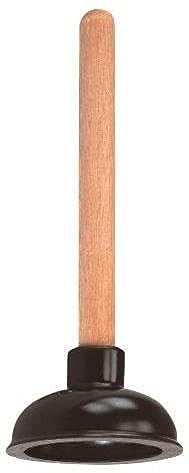
The verified example is the Rocky Mountain Goods Small Drain Plunger: a 4-inch rubber head on a 9-inch solid wood handle, sized by its maker for slow sinks, drains, tubs, and showers — the mini format in honest rubber-and-wood form.
Some drains defeat a standard cup by geometry: small shower drains, older tub drains with raised covers, and tight stalls where a full-size handle has no room to work. The mini cup plunger scales the same flat-seal principle down — a smaller rubber cup that fits inside recesses and centers exactly over small openings, with a short handle made for close quarters. It is also the right size for bathroom sinks, which makes it a tidy two-fixture tool for small bathrooms.
Strengths
- Fits small, recessed, and raised drain openings that a standard cup bridges over and leaks past.
- Short handle works in shower stalls and tight tub alcoves where a long handle hits walls.
- Stores in a vanity or small caddy — the plunger most likely to actually live in the bathroom.
Trade-offs
- Moves less water per stroke; deep or dense clogs take more repetitions.
- Short handle means your hands work closer to the water — gloves are a fair idea.
- On a standard tub drain it is the backup, not the starter; size up when the drain allows.
Choose this pick when your drain is genuinely small or your bathroom is genuinely tight, and think of it as the precision version of the Best Overall pick rather than a weaker one. In households with both a tub and a pedestal sink, it often becomes the most-used plunger in the home simply because it is the one within reach.
Best for: small drains, shower stalls, and compact bathrooms. / Not suited for: large standard drains as the primary tool.

Master Plunger MPS4 Sink & Drain Plunger — Best Power Option
The verified example is the Master Plunger MPS4: a sink and drain plunger with a large bellows chamber, listed for kitchen sinks, bathroom sinks, showers, and bathtubs in commercial and residential use — the accordion design in its established form.
The bellows plunger replaces the simple cup with an accordion chamber that holds a larger volume of water and air, delivering a stronger push per stroke. On a flat drain with a good seal — and with the overflow blocked, as the how-to teaches — that extra volume translates into extra authority against dense, shallow clogs that shrug at a standard cup: the packed hair-and-soap plug a household of long-haired bathers can build in a season.
Strengths
- Highest force per stroke of any manual design here — the step up when a cup plunger almost works.
- The chamber’s volume suits the water-filled environment of a tub drain particularly well.
- One tool covers the stubborn end of both tub and sink duty.
Trade-offs
- Accordion folds trap dirty water and are harder to rinse clean than a simple cup.
- More force demands more judgment: on old or fragile plumbing, power must be applied in pulses, not enthusiasm.
- Bulky to store, and the least graceful object in this guide to leave beside a guest tub.
The bellows earns its slot as the escalation step in a sensible sequence: technique first, cup second, bellows third, snake or plumber after that. Most households will use it rarely; the households that need it — long hair, old pipes, enthusiastic bathers — will consider it the best money in the bathroom. Respect its strength and it repays the respect in cleared drains.
Best for: stubborn shallow clogs that resist a standard cup. / Not suited for: first attempts, fragile old plumbing at full force, or tidy storage.

Edward Tools Classic Force Cup Plunger, 23 1/4 Inch — Best for Frequent Use
The verified example is the Edward Tools Classic: a 6-inch rubber force cup head on a solid wood handle, 23 1/4 inches long overall — a flat force cup (the geometry tubs need) on the longest handle in this guide.
If tub clogs are a recurring event in your home — rental properties, big families, long hair everywhere — the long-handle cup plunger turns a kneeling chore into a standing task. The same flat rubber cup does the sealing; the extra handle length adds leverage, keeps your face and hands away from the splash zone, and lets you work the push-pull rhythm longer without fatigue, which matters because persistence, correctly applied, is what clears most clogs.
Strengths
- Leverage and working distance: better rhythm, less fatigue, less splash on the operator.
- The practical choice for landlords and parents who plunge other people’s tubs regularly.
- Full-size cup seals standard drains as well as the Best Overall pick — no performance traded away.
Trade-offs
- Length needs storage space; it will not hide in a vanity.
- In very small bathrooms the long handle can be awkward against walls and glass doors.
- More leverage tempts more force; the technique is pulses, not pile-drivers, at any handle length.
This pick is the professional’s pattern at household scale. Pair it with a pair of rubber gloves kept in the same closet and the whole unpleasant job becomes a two-minute routine with a beginning, a middle, and clean hands at the end.
Best for: frequent clogs, rental properties, and anyone who values working distance. / Not suited for: the smallest bathrooms or one-clog-per-decade homes.
Mini Sink & Drain Plunger with Short Handle — Best Compact / Under-Sink
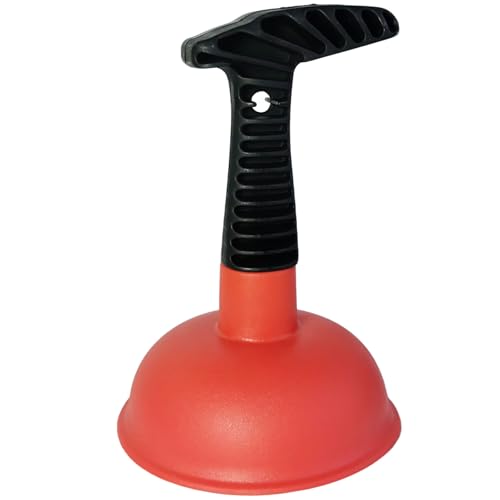
The verified example is this mini sink and drain plunger with a short handle: a heavy-duty rubber cup with an ergonomic grip in a compact, space-saving design, listed for sinks, tubs, showers, bathrooms, and kitchens.
The compact cup plunger is the “be there” tool: short enough to live in the bathroom cabinet, the side of the vanity, or a caddy behind the tub, so that when the water starts rising around your ankles the remedy is three steps away instead of in the garage behind the paint cans. Its cup is standard in principle and slightly smaller in practice; its handle trades leverage for presence, and in clog work, presence wins more often than specifications do.
Strengths
- Stores in the room where it is used — the single strongest predictor of a clog handled early and easily.
- Perfectly adequate force for the fresh, shallow clogs that make up most tub events.
- Keeps the household’s main plunger free for toilet duty, which is also a hygiene separation worth having.
Trade-offs
- Short handle, close work — the splash zone includes you; technique and gloves compensate.
- Not the tool for a dense, aged clog; it is the first responder, and first responders sometimes call for backup.
- Compact cups vary in rubber quality; choose flexible natural rubber over stiff plastic.
Every bathroom with a tub deserves its own plunger, kept in that bathroom, and this slot is how small bathrooms manage it. Buy it when you stock a new home or renovate, and future-you — standing in rising water at an inconvenient hour — will be grateful with unusual sincerity.
Best for: keeping a dedicated plunger in every tub bathroom. / Not suited for: the home’s only plunger, or for stubborn clogs.
Mini Sink Plunger & 2 Drain Snake Combo — Best Complete Kit
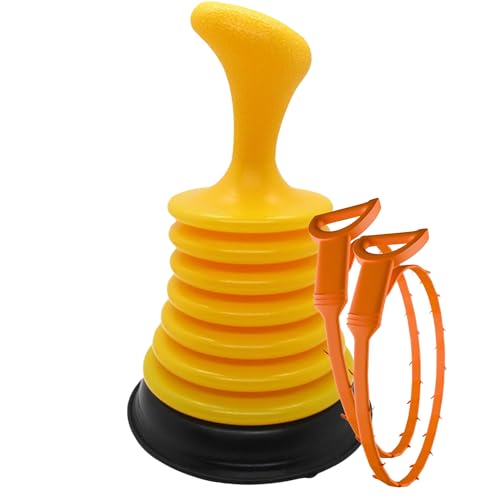
The verified example is this combo set: a mini sink plunger paired with two reusable drain snake augers with a multi-tooth design, listed for clearing clogs in sinks, tubs, and showers — the plunger-plus-hair-tool pairing in a single purchase.
The most honest slot in this guide pairs the plunger with the tool that makes plunging unnecessary half the time: a flexible plastic hair snare — a thin barbed strip that slides past the stopper, hooks the hair mat at the drain crossbars, and pulls the clog out in one deeply satisfying, deeply disgusting motion. Since tub clogs are mostly hair, the kit that attacks hair directly and plunges what remains is the complete answer in a way no plunger alone can be.
Strengths
- Attacks the actual cause: most tub clogs are hair mats at the crossbars, removable in one pull.
- The plunger then finishes what the snare loosens — the two tools cover each other’s limits.
- Prevents recurrence better than plunging alone, because the mat is gone, not just breached.
Trade-offs
- The snare is a single-or-few-use consumable; barbs that have hauled a hair mat should be retired.
- Not glamorous work. Gloves, a bag for the evidence, and a strong stomach are part of the kit.
- Snares reach the shallow zone only; deeper clogs still escalate to a snake or a plumber.
If you maintain a home for the long term, this is the kit to own even if you also own the Best Overall pick: the snare handles the common case, the plunger handles the rest, and the pair together will clear the overwhelming majority of tub clogs you will ever meet, in minutes, for the price of a sandwich.
Best for: hair-driven clogs (most tubs), and complete home kits. / Not suited for: anyone unwilling to see what lives in their drain — in which case, hire it out with our blessing.
Comparison Table
| Pick | Badge | Key spec | Best for |
|---|---|---|---|
| Supply Giant SU3249 Force Cup Plunger | Best Overall | Flat rubber cup, standard size | Most tub clogs |
| Rocky Mountain Goods Small Drain Plunger | Best for Small Drains | Small-diameter cup, short handle | Small drains, tight stalls |
| Master Plunger MPS4 Bellows Plunger | Best Power Option | Accordion chamber, high volume | Stubborn shallow clogs |
| Edward Tools Classic Force Cup Plunger | Best for Frequent Use | 18–24″ handle, full-size cup | Rentals, families, leverage |
| Mini Sink & Drain Plunger, Short Handle | Best Compact | Short handle, in-bathroom storage | Every-bathroom readiness |
| Mini Plunger & Drain Snake Combo | Best Complete Kit | Cup plunger plus barbed hair tool | Hair clogs, complete kits |
How to Plunge a Tub Correctly: The Overflow Secret
Technique decides more than tool choice in this category, and one step separates the people who clear tubs from the people who splash: sealing the overflow. A tub’s overflow plate — the round cover with screws, on the tub wall below the faucet — connects to the same drain path. Plunge without sealing it and your pressure escapes up the overflow instead of down to the clog. Here is the full method.
- Remove the stopper and visible hair first. Lift or unscrew the stopper per its type, and pull out whatever hair is within reach (this is the hair snare’s moment — see the Best Complete Kit pick). Many “clogs” end at this step.
- Seal the overflow. Press a wet rag firmly over the overflow plate and hold it there with one hand — or tape it thoroughly with duct tape if you are working alone. A helper’s hand is the classic solution.
- Add water to cover the cup. The tub needs enough water to submerge the plunger cup fully; plunging works through water, and an air-filled cup wastes the stroke. A few inches is plenty.
- Seat the cup flat and square. Center the cup over the drain, press down to expel air and establish the seal, keeping the handle vertical so force travels straight.
- Work in vigorous push-pull pulses. Ten to twenty strokes, keeping the seal — the pull matters as much as the push, because the clog breaks up under alternating pressure. Splash means a broken seal; reset and continue.
- Test, then repeat once if needed. Pull the cup away sharply and watch the drain. If water swirls down, run hot water for a minute to flush loosened residue. If progress is partial, repeat the cycle once before escalating.
- Clean up like a professional. Rinse the plunger in the now-clear tub water with a little bathroom cleaner, shake dry, and store it where it lives. Wash hands and any splashed surfaces.
Safety limits that are not fine print
Never plunge a drain that contains chemical drain opener — the pressure can splash caustic liquid onto skin and eyes. If chemicals were poured, wait and flush per the product’s directions, or call a plumber and say exactly what was used. Use controlled pulses on older plumbing rather than maximum force. And stop escalating when the evidence says the clog is deep: multiple fixtures draining slowly, gurgling from other drains, or water backing up elsewhere are main-line symptoms, and they belong to a professional with a real snake.
How to Choose a Plunger for Your Tub
Cup shape is the decision
Flat rim for flat drains — tubs, showers, sinks. Flange and beehive shapes are toilet tools. If a product shows a protruding bell or step in its profile, it is not your tub plunger regardless of what the packaging claims about versatility; some flange plungers fold their flange in for flat use, and those are acceptable exceptions if the rim seats truly flat.
Rubber quality over handle glamour
A flexible natural-rubber cup seals on imperfect surfaces — textured drain covers, slight curves at the tub floor’s edge — where stiff plastic leaks. Handles should be sturdy and smooth (wood and solid plastic both serve), long enough for your space, and attached without wobble. In this category, the boring specifications are the performance specifications.
Match the size to the drain and the room
Cup diameter should exceed the drain opening with margin, but not so far that the cup’s rim lands on a curved part of the tub floor and breaks the seal. Measure your drain cover, check your storage space, and choose between the standard, mini, and compact slots by those two numbers rather than by habit.
Own the pair, not just the plunger
Because hair causes most tub clogs, the complete purchase is a plunger plus hair removal — the Best Complete Kit logic — plus a mesh drain cover afterward to catch hair at the surface, which converts future clogs from plumbing events into a five-second cleanup. Prevention, removal, and pressure, in that order, is the whole philosophy of tub drain care in one sentence.
Common Buying Mistakes
- Using the toilet plunger on the tub. The flange that seals a toilet prevents the seal on a flat drain. Two fixtures, two tools.
- Plunging without sealing the overflow. The pressure escapes up the overflow pipe and the clog never feels it. This one step is most failed tub plungings explained.
- Reaching for chemicals first. Chemical openers rarely clear hair mats, complicate later plunging with a splash hazard, and are hard on pipes and the people who use them.
- Plunging a dry drain. The cup needs water over it to transmit pressure. Air strokes are exercise, not plumbing.
- Giving up after four strokes. Correct plunging is ten to twenty pulses, possibly twice. Most “the plunger didn’t work” stories are short stories.
- Ignoring a recurring clog. A tub that clogs monthly is reporting something — a hair mat rebuilding at the crossbars, a venting quirk, a deeper partial blockage. Clear it, prevent it with a drain cover, and if it persists, have the line inspected.
Final Recommendation
Buy the Supply Giant SU3249 force cup plunger and learn the overflow seal; that combination clears most tub clogs in minutes and costs almost nothing. Add the plunger and drain snake combo’s hair tools to attack the cause, and a mesh drain cover to prevent the sequel, and your tub drain system is complete for years. Reach for the Rocky Mountain Goods mini when your drain is small, the short-handle mini when your bathroom is, the Edward Tools long-handle when clogs are your recurring chore, and the Master Plunger bellows when a stubborn shallow clog survives correct cup technique. Beyond that sequence, escalate honestly: a hand snake for deeper hair, a plumber for main-line symptoms. The best plunger for tubs is, in the end, the flat one, used correctly, kept in the room — a humble tool whose whole reputation rests on a seal and a technique, both of which you now have.
Related reading in this series: Best Plungers, Best Toilet Plungers, Best Drain Snakes, Best Shower Drain Hair Catchers, Best Bathroom Cleaning Tools.
Anatomy of a Tub Drain: Why Clogs Live Where They Live
A residential tub drain is a short, knowable system. At the surface sits the drain opening with its crossbars — the metal grid that stops jewelry and bottle caps, and incidentally provides the anchor every hair mat needs. Just below, the pipe bends through the trap, a U-shaped section that holds water as a seal against sewer gas. The overflow pipe joins this path from the plate on the tub wall, which is why sealing it matters. Beyond the trap, the tub’s branch line runs to the home’s larger drainage, shared eventually with sinks and the toilet.
Clogs form at the system’s narrow, slow, or snagged points, in that order of likelihood: the crossbars first, where hair catches and soap binds it into a felt; the trap second, where anything heavy or greasy settles; and the branch line last and rarest, where a partial obstruction narrows the passage over years. This geography explains the guide’s escalation ladder — snare for the crossbars, plunger for crossbars and trap, snake for the branch, plumber for the main — and it explains why plunging works so well on tubs specifically: the usual suspects live within a short pressure-wave’s reach of the drain you are standing over. When a tub drains slowly but the sink and toilet beside it run free, the problem is almost certainly in that first short stretch, and it is yours to fix with the tools above. Conversely, when the tub, the sink, and the toilet all misbehave together, the geography has already told you the clog is not in the tub’s stretch at all — skip the plunger entirely and start the professional conversation, because no amount of correct technique at one fixture clears a shared line.
Plunger Care, Storage, and the Two-Plunger Household
A plunger asks little: rinse it after use (the cleared drain gives you clean running water for exactly this), shake it dry, and store it upright where air reaches it — a small tray or bucket corner in a closet beats a sealed plastic bag, which grows the very things you plunged to avoid thinking about. Inspect the cup yearly: rubber that has cracked, torn at the rim, or stiffened into a permanent shape will not seal, and a plunger that cannot seal is a stick. Replacement is cheap and should be unemotional.
Households do well to keep two plungers with two jobs: the cup plunger in the bathroom for tubs and sinks, and the toilet plunger (flange type) in its own spot for the toilet. The separation is partly performance — each shape fits its fixture — and partly simple hygiene, since the tools visit different places. Labeling is unnecessary; shape is the label. One more storage note with real consequences: keep the tub plunger out of the toilet plunger’s splash radius and vice versa, ideally in different spots entirely, so the tool you press against the surface your family bathes in has never visited the other fixture. It costs nothing but a second hook, and it is the kind of unglamorous correctness that keeps a home’s systems quietly sanitary for years. Guests, babysitters, and new roommates all benefit from a system they can read at a glance in an urgent moment, and a dedicated tub plunger stored in the bathroom (the compact pick’s entire argument) is what makes that moment short.
Renters, Owners, and Knowing Where Your Responsibility Ends
Renters can and should handle the surface sequence in this guide — stopper, snare, correctly sealed plunging — because those steps are non-invasive and reversible. What renters should not do is disassemble drain assemblies, force snakes through traps, or pour aggressive chemicals into plumbing they do not own; a clog that survives the surface sequence is a maintenance request, and documenting that you tried the basics (and what happened) makes that request faster and more credible. Owners inherit the deeper ladder — trap removal, hand snakes, cleanout access — and also the judgment calls about old pipes: galvanized and aging systems reward gentler plunging and earlier professional help, because the cost of enthusiasm can be a leak inside a wall.
Both groups share the same stop-signs, repeated here because they matter: sewage odor with slow drains throughout the home, multiple fixtures backing up, water appearing at a floor drain, or a clog that returns within days of thorough clearing. Those are system symptoms. The plunger has told you everything it knows, and what it knows is: call a plumber.
Slow Drain or Full Clog? Reading the Symptoms
Not every tub problem arrives as a standing pool of water, and the early symptoms are worth more than the late ones. A tub that drains, but leaves a ring of water around your ankles by the end of a shower, is reporting a partial obstruction — most often a young hair mat at the crossbars — at the exact stage when a snare pass takes ninety seconds and a plunger may not be needed at all. A drain that gurgles as it empties is pulling air past a narrowing, the same report in a different dialect. The time to act on either symptom is the week you notice it, because hair mats only grow in one direction, and the difference between the ninety-second version of this job and the Saturday-afternoon version is nothing but delay.
A full clog, by contrast, is a diagnosis of exclusion: water stands, plunging with correct technique moves nothing, and the snare comes up clean or cannot pass. Work the ladder in order and keep notes on what each step produced — a plumber who hears “two sealed plunging cycles, snare clean at the crossbars, still standing” starts work several diagnostic steps ahead, and you pay for fewer of their minutes. Symptom literacy, in plumbing as elsewhere, is mostly the art of acting while the problem is still small and describing it precisely when it is not.
Seasonal and Household Patterns: When Tubs Clog
Tub clogs have a calendar. Guest seasons — holidays, family visits — multiply showers per day and hair per drain, and a marginal drain that served two people fails under six; a preventive snare pass before guests arrive is the mark of a host who has learned this once. Shedding is seasonal for many people in the same way it is for pets, and late summer often shows up in the drain. New bath products matter too: heavy conditioners, bath oils, and butter-rich products coat the hair mat’s soap binder and can accelerate a clog noticeably in the weeks after a routine change — if a drain slows right after a product switch, believe the timeline. Finally, homes with children accumulate a special category: small toys and caps that lodge at the crossbars and collect hair around themselves like a reef. The snare usually retrieves the evidence; the lesson, delivered to the household’s toy policy, prevents the sequel.
The Alternatives, Honestly Assessed
Enzyme drain maintainers
Enzyme and bacterial drain treatments are the gentle end of chemical help: they digest organic buildup slowly, work best as monthly maintenance in a drain that already flows, and do almost nothing for an established clog. Used on schedule in a hair-prone tub, they can stretch the interval between snare passes. Used as an emergency cure, they disappoint — and they share the standing rule that a drain containing any treatment should not be plunged until flushed as directed.
Hand-crank and drill drain snakes
A small hand snake reaches past the trap into the branch line, into territory no plunger touches, and for owners it is the legitimate next step after the surface sequence fails. It is also a tool with a learning curve: feed slowly, never force a corner, and withdraw the cable with the debris rather than pushing debris deeper. Renters, as noted, should stop before this rung and call the landlord — the line between clearing a drain and owning a plumbing repair is located precisely here.
Air-pressure and CO2 drain blasters
Pressurized-air drain tools promise plunger results without the plunging, and they can work on shallow clogs — with real caveats. A burst of compressed air is an uncontrolled pulse compared with a plunger’s rhythm, it still requires the overflow to be sealed, and on weak or aging joints it can do harm a hand tool would not. This guide’s slots cover the manual methods because they give the operator feedback through the handle: you can feel a seal, a shift, a give. When a tool removes the feedback, it should have to argue harder for its place, and in residential tubs it rarely wins that argument.
The wet vacuum trick
A wet/dry vacuum set to wet pickup, its hose sealed over the drain with a wet rag (overflow sealed as always), can pull a shallow clog upward and out — sometimes succeeding where pushing failed, because hair mats often release more easily in the direction they grew. It is a legitimate improvisation for owners with the equipment, with two cautions: only a vacuum rated for wet pickup, and empty and clean it immediately, because what comes out of a tub drain should not take up residence anywhere.
A Five-Minute Monthly Routine That Prevents Most Clogs
Prevention in this category is not a product but a rhythm, and it fits inside five minutes a month. Week one of each month — or any fixed date you will actually remember — lift the drain cover’s catchings: remove the surface hair from the drain cover and the mesh catcher, and wipe the stopper, which grows a surprising share of the mat on its underside where nobody looks. Run the shower hot for a full minute to move softened soap residue through the trap while it is still mobile. Every third month, give the drain a hair-snare pass even if it flows freely; the mat you remove at that stage is next season’s clog, collected early and cheaply. Twice a year, look at the overflow plate screws and the drain cover’s finish — corrosion there roughens surfaces and gives hair more to hold, and catching it early is a five-dollar part instead of a plumber’s hour. That is the whole program. Households that keep it rarely meet the emergency version of anything in this guide, and their plungers age gracefully in the closet, which is the destiny every plunger deserves. Pair the routine with the drain cover habit from the prevention notes — surface hair removed after showers, before it ever reaches the crossbars — and the monthly snare pass becomes a formality that mostly confirms what the cover already caught. Prevention compounds: each layer catches what the layer above it missed, and the plunger returns to being what it should be in a well-kept home, a tool you own rather than a tool you use.
Finally, teach the technique to the household once, on a day when nothing is clogged. A calm two-minute demonstration — overflow sealed, cup submerged, pulses not plunges of panic — is what turns a midnight clog from a group emergency into one person’s short, competent errand.
Frequently Asked Questions
Can I use a toilet plunger on a bathtub?
Not effectively. Toilet plungers have a flange or beehive shape designed to seal inside a toilet’s curved outlet; on a flat tub drain that protrusion breaks the seal and your force escapes as splash. A flat-bottom cup plunger is the correct, inexpensive tool for tubs and sinks.
Why do I need to cover the overflow drain?
The overflow connects to the same pipe as the drain. Left open, it vents your plunging pressure harmlessly into the air. Sealing it with a wet rag or tape forces the pressure pulses to travel to the clog, which is the entire mechanism of plunging.
How long should I plunge before giving up?
With the overflow sealed and the cup submerged, work ten to twenty vigorous push-pull pulses, test, and repeat the cycle once. If two correct cycles make no progress, the clog is likely deep or dense — escalate to a hair snare or snake for shallow causes, or a plumber for deeper ones.
Should I use chemical drain cleaner instead?
For hair-based tub clogs, chemicals are the weaker tool: they work slowly on hair, add a splash hazard if you plunge afterward, and stress pipes with repeated use. Mechanical removal — snare, then plunger — is faster, cheaper per use, and reusable. Never plunge a drain containing chemical opener.
What if plunging makes water come up in another fixture?
Stop. Backup into other fixtures or gurgling from other drains indicates a blockage deeper in the shared line, beyond plunger territory. That is a job for a drain snake through a cleanout or a professional — continued plunging only moves the mess around.
How do I plunge a shower stall instead of a tub?
The same flat cup and the same principles apply, with two adjustments: most stalls have no overflow to seal, which simplifies the job, and the drain covers are often smaller or textured, which makes the mini cup pick the better seal for many stalls. Work with water covering the cup, keep the handle vertical, and expect the same ten-to-twenty-pulse rhythm to do the work.
Is it safe to plunge if I used drain cleaner yesterday?
Only after the product has been fully flushed from the drain according to its label directions — residual caustic liquid under plunging pressure can splash. If you are unsure what remains in the pipe, flush generously with water first, wear gloves and eye protection, or defer to a plumber and disclose what was used. When in doubt, do not plunge.
How do I keep the tub from clogging again?
Catch hair at the surface with a mesh drain cover, empty it after showers, run hot water briefly after baths to move soap residue along, and give the drain a hair-snare pass every few months in long-hair households. Prevention is a five-second habit that retires most of this guide from your life.


