Disclosure: airfryerkitchensupply.com is reader-supported. When you buy through links on our site, we may earn an affiliate commission at no extra cost to you.
Where to buy
Every blanket below is sold on Amazon, and every one is a woven natural-fiber blanket — cotton or wool — because weave structure, not branding, is what keeps a blanket from shedding onto your sheets. Open the listings to confirm size and color before ordering; the same blanket is typically listed in twin, queen, and king sizes under one product page, and the size you select changes the price, never the weave. If you take one idea from this page, take the mechanism: plush pile sheds, woven cloth does not.
- Bedsure 100% Cotton Blanket, Waffle Weave, Queen (White, 90″x90″) — Best Overall: Check the current price on Amazon
- Bedsure 100% Cotton Blanket, Herringbone Weave, Queen (Linen Beige) — Best Looking Weave: Check the current price on Amazon
- Utopia Bedding 100% Cotton Thermal Blanket, Queen (Smoke Gray, 90×90) — Best Budget: Check the current price on Amazon
- Lane Linen 100% Cotton Blanket, Queen (350 GSM Medium Weight) — Best Medium Weight: Check the current price on Amazon
- Arcturus Tahoe Wool Bed Blanket, Queen (90″x96″) — Best for Real Warmth: Check the current price on Amazon
- Bedsure 100% Cotton Muslin Blanket, King (4-Layer Gauze) — Best for Hot Sleepers: Check the current price on Amazon
The best blankets that don’t shed on sheets solve the problem at its source, and the source is construction, not quality. The blankets that coat your sheets in fuzz — the plush fleece, the sherpa, the faux-fur throw — shed because their softness comes from a cut pile: thousands of short fiber ends standing up from a base cloth, working loose with friction every night. Your sheets are the friction surface, so your sheets collect the evidence. A woven blanket has no pile to lose. Its fibers are locked into yarns, and its yarns are locked into a weave, so there is simply nothing available to shed.
That is why every pick in this guide is woven cotton or wool. Cotton waffle weaves, herringbone weaves, thermal weaves, and gauze muslins, plus a washable wool — these are the constructions that sleep clean against sheets. They feel different from plush: crisper, more breathable, more like cloth and less like a stuffed animal. Buyers who want the plush feel and zero shedding are asking for a contradiction, and this guide will not pretend a product resolves it; what it offers instead is the honest set of blankets that will never fuzz your sheets, with their real textures described so you can choose the one you will actually enjoy.
Two honest qualifications belong up front. First, new cotton blankets release some loose lint in their first few washes — surface fibers left from manufacturing, not ongoing shedding. Wash a new woven blanket separately once or twice before it meets your good sheets, and the lint story ends. Second, ‘doesn’t shed’ describes behavior against sheets in normal use; dragging any blanket across Velcro, rough wood, or a pet’s favorite scratching post is outside the warranty of physics.
There is also a household dimension worth naming: shedding does not stop at the sheets. Pile blankets dust the bedroom air, coat the laundry, and felt onto pajamas and the clothes washed with the bedding. Households tired of defuzzing everything the bed touches feel the difference of a woven bed well beyond the fitted sheet. The picks below were chosen for the keyword as asked, but their benefits generalize across the whole laundry basket.
The picks below cover the realistic briefs: the all-season cotton layer for most beds, a medium-weight cotton for cooler sleepers, a budget thermal weave, a washable wool for genuine warmth, and a feather-light muslin for hot sleepers and summer. All were verified against Amazon’s catalog data for this site, with fiber content and weave taken from the verified listings.
In this guide
Quick Picks
Bedsure 100% Cotton Blanket, Waffle Weave, Queen (White, 90″x90″) — Best Overall. The default answer: a 100% cotton waffle-weave blanket in a true queen size — breathable, layerable in every season, machine washable, and structurally incapable of fuzzing your sheets. Check the current price on Amazon.
Bedsure 100% Cotton Blanket, Herringbone Weave, Queen (Linen Beige) — Best Looking Weave. The same non-shedding logic in a herringbone weave: a flatter, more tailored cotton blanket with a classic zigzag pattern woven in — texture from structure, not from pile. Check the current price on Amazon.
Utopia Bedding 100% Cotton Thermal Blanket, Queen (Smoke Gray, 90×90) — Best Budget. The value classic: a 100% cotton thermal-weave blanket in a full queen size, from a bedding basics brand — the non-shedding answer at the lowest tier that still respects the fiber rule. Check the current price on Amazon.
Lane Linen 100% Cotton Blanket, Queen (350 GSM Medium Weight) — Best Medium Weight. The substance pick: a medium-weight 100% cotton queen blanket at 350 GSM per the listing — noticeably more blanket than the light weaves, for sleepers who find waffle and thermal too thin. Check the current price on Amazon.
Arcturus Tahoe Wool Bed Blanket, Queen (90″x96″) — Best for Real Warmth. The winter answer: a woven wool bed blanket in a generous queen size that the listing describes as washable — natural-fiber warmth with temperature regulation no synthetic matches, and a woven structure that does not fuzz sheets. Check the current price on Amazon.
Bedsure 100% Cotton Muslin Blanket, King (4-Layer Gauze) — Best for Hot Sleepers. The summer end of the spectrum: four layers of 100% cotton muslin gauze in a king size — a blanket that is mostly air, for sleepers who overheat under everything else. Check the current price on Amazon.
How These Picks Were Chosen
Each pick was verified against this site’the Amazon catalogue data during this session, and fiber content was the first verification target: a blanket had to be genuinely woven cotton or wool per its listing — not a polyester plush wearing natural language in its marketing. Several popular ‘cotton-feel’ blankets were excluded at exactly this step, because microfiber plush sheds by the same pile mechanism as fleece, whatever the product name implies.
The criteria after fiber: weave integrity (tight, even weaving sheds nothing and snags little); weight matched to purpose (a summer layer and a winter blanket are different tools, and both appear here labeled); size honesty (a queen blanket should drape a queen bed, per the listing dimensions); washability, because a blanket you cannot wash easily will not be washed, and unwashed blankets get retired; and hand feel as the makers describe it — crisp waffle, soft herringbone, airy muslin — so the texture you expect is the texture that arrives.
Excluded by design: all fleece, sherpa, microfiber plush, and faux-fur blankets, regardless of popularity, because their construction contradicts the keyword. Also excluded: loosely woven decorative throws whose open weave snags and pulls — a different failure, but a failure of the same ‘stays intact against bedding’ promise.
The 6 Best Blankets That Don’t Shed on Sheets

Bedsure 100% Cotton Blanket, Waffle Weave, Queen (White, 90″x90″) — Best Overall
Buy this if you want one blanket that lives on the bed all year. The waffle weave is the classic non-shedding construction: deep woven pockets that trap a little air for warmth, in a 100% cotton cloth that breathes in summer and layers under a duvet in winter. The verified listing gives a full 90×90-inch queen, so it drapes rather than perches. It suits most sleepers in most climates, which is what ‘best overall’ means here.
Strengths
- 100% cotton waffle weave — no pile, nothing to shed onto sheets
- True queen dimensions (90×90 in per the listing) with real drape
- Breathable enough for summer, layerable for winter — one blanket, four seasons
Trade-offs
- Waffle texture is crisp, not plush — buyers wanting a cuddly pile feel should read the intro again
- White shows everything; other colors in the same listing hide life better
- Cotton’s warmth has a ceiling — cold sleepers in winter will layer it, not rely on it alone
| Fiber (listing) | 100% cotton |
| Weave (listing) | Waffle weave |
| Size (listing) | Queen, 90 x 90 in |
| Character (listing) | Breathable, soft, cozy |
The waffle weave earns its best-overall place through structure. The woven grid creates hundreds of small air pockets, and trapped air is insulation — so the blanket warms above its weight class while staying breathable, because cotton passes moisture instead of sealing it in the way synthetics do. Hot sleepers who kick off fleece at 2 a.m. often find a cotton waffle is the first blanket they sleep under all night, and that — not any shedding property — is why it becomes the bed’s permanent layer.
Against sheets, its behavior is exactly the search’s promise. There are no cut fibers to migrate; the surface that touches your sheets is woven yarn. After the first wash or two clears manufacturing lint (wash it separately first, as the how-to section advises), the blanket and the sheets stop exchanging anything at all. Owners coming from fleece typically notice within the first week that the sheet-changing ritual no longer includes peeling a felted layer of fuzz off the fitted sheet.
Care is unremarkable, which is praise: machine wash, dry, remake the bed. Cotton waffle softens gradually over its first months and then holds steady for years. The honest limitation is the one stated above — this is a layer, with a layer’s warmth. In a cold bedroom in January it wants a duvet over it; in July it wants nothing but a sheet under it. Within that role it is the most useful blanket in this guide.
Best for: Most beds and most sleepers — the year-round non-shedding layer / Not suited for: Buyers who want plush pile softness or a standalone deep-winter blanket
Check on Amazon — check price on Amazon before you decide, because configurations and included accessories change between listings.

Bedsure 100% Cotton Blanket, Herringbone Weave, Queen (Linen Beige) — Best Looking Weave
Choose the herringbone if the waffle’s grid texture is not your taste, or if the blanket will be visible as the bed’s top layer and you want it to look tailored rather than textural. Herringbone weaves lie flatter and smoother than waffle, which also makes this the pick for sleepers who dislike any texture against the skin. It is the same 100% cotton, same queen class, in a more formal hand.
Strengths
- Herringbone weave lies flat and smooth — the least textural feel here
- Pattern is woven into the cloth, so it cannot fade, peel, or shed
- Presents beautifully as a visible top-of-bed layer or folded throw
Trade-offs
- Flatter weave traps less air than waffle, so it sleeps a touch cooler at the same weight
- The tailored look shows wrinkles more than a textured weave does
- Still a layer-weight blanket, not a winter standalone
| Fiber (listing) | 100% cotton |
| Weave (listing) | Herringbone weave |
| Size (listing) | Queen size |
| Character (listing) | Breathable, soft, cozy |
Herringbone is one of the oldest weave patterns in bedding for a reason: the broken zigzag interlacing makes a cloth that is stable, smooth, and handsome, with a subtle pattern that reads as texture from across the room and as flat comfort against the skin. For the non-shedding brief it is ideal — the pattern is the weave itself, so there is nothing applied, printed, or piled that could ever come off on your sheets.
The flatness cuts both ways and this review will say so plainly. Waffle’s pockets are functional insulation; herringbone’s flat cloth insulates only by its weight, so at equal weights the herringbone sleeps slightly cooler. For warm sleepers and summer use that is an advantage; for cold sleepers it means reaching for the Lane Linen’s heavier cotton or the wool below. Know which sleeper you are and the choice makes itself.
As a visible layer it is the strongest pick here. Made beds look intentional with a herringbone folded at the foot or spread as the top layer, and the linen-beige tone in this listing sits comfortably in most bedrooms. It also travels well between roles — bed layer in winter, sofa throw in summer — because its finish looks like a textile, not like bedding that escaped.
Best for: Sleepers who want a smooth, tailored, visible non-shedding blanket / Not suited for: Cold sleepers wanting maximum warmth from a single cotton layer
Check on Amazon — check price on Amazon before you decide, because configurations and included accessories change between listings.
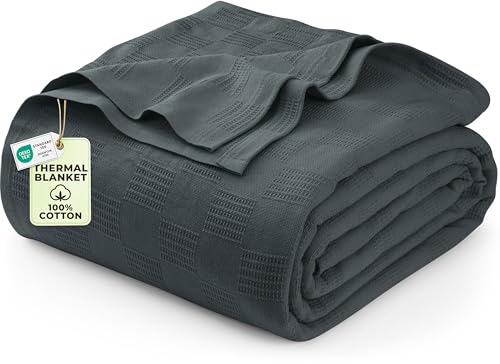
Utopia Bedding 100% Cotton Thermal Blanket, Queen (Smoke Gray, 90×90) — Best Budget
Buy the Utopia if the brief is simple: stop the shedding, spend as little as possible doing it, and cover a queen bed properly. Thermal weave — the open, breathable cotton weave hospitals and hotels have used for generations — is light, washable, and entirely pile-free. It suits guest beds, dorms, rentals, and anyone replacing a fleece on a budget.
Strengths
- 100% cotton thermal weave at the guide’s most accessible tier
- Full 90×90-inch queen sizing per the listing
- Lightweight and quick to wash and dry — practical for guest and rental use
Trade-offs
- Thermal weave is the lightest warmth here — a layer, emphatically
- The open weave can snag on sharp edges and jewelry more than tight weaves
- Utilitarian finish; it is a workhorse, not a showpiece
| Fiber (listing) | 100% cotton |
| Weave (listing) | Thermal weave |
| Size (listing) | Queen, 90 x 90 in |
| Character (listing) | Lightweight, breathable, soft |
Thermal blankets are the unglamorous backbone of institutional bedding, and institutions choose them for the reasons this guide cares about: they do not pill or shed, they survive industrial laundering, and they cost little to replace. The home version of that logic is a guest bed that always looks clean, a rental that turns over fast, and a main bed layer that asks nothing of you.
The open thermal weave breathes more than any other pick here — it is the blanket for the sleeper who wants the psychological comfort of a layer with almost no thermal opinion. In winter it disappears between sheet and duvet as a soft interface; in summer it is the whole covering for people who cannot sleep under nothing. Its shedding behavior is, like all woven cotton, a non-event after the first wash.
Respect its two limits and it will not disappoint: it is light, so it cannot be your winter plan by itself, and its open weave deserves care around snags — a caught ring or a rough bed frame edge can pull a loop. Neither matters in its intended roles, which is why it has been the budget standard for decades.
Best for: Guest beds, rentals, dorms, and budget main-bed layers / Not suited for: Anyone needing substantial warmth or a decorative finish
Check on Amazon — check price on Amazon before you decide, because configurations and included accessories change between listings.

Lane Linen 100% Cotton Blanket, Queen (350 GSM Medium Weight) — Best Medium Weight
Choose the Lane Linen if you have tried cotton blankets and found them insubstantial. GSM is the honest weight language of textiles — grams per square meter — and 350 GSM in cotton is a medium blanket with real drape and presence: it settles on the bed, stays where it is put, and warms like a winter layer in mild climates or a three-season blanket elsewhere. Still fully woven, still nothing to shed.
Strengths
- 350 GSM medium weight gives real drape, presence, and warmth for cotton
- 100% cotton woven construction — the non-shedding rule holds at this weight too
- Queen sizing aimed at the bed, not the sofa
Trade-offs
- Heavier cotton takes longer to dry after washing — plan the laundry day
- Too much blanket for hot sleepers in summer
- Medium weight costs more than the light weaves, fairly
| Fiber (listing) | 100% cotton |
| Weight (listing) | 350 GSM, medium weight |
| Size (listing) | Queen size |
| Character (listing) | Warm and soft |
Weight is the variable the other cotton picks compromise on, and this is the pick that does not. A 350 GSM cotton blanket has the hand feel people mean when they say ‘a real blanket’: it folds with substance, drapes over the bed’s edge instead of floating, and provides the gentle settled pressure many sleepers sleep better under — all while remaining a breathable natural-fiber weave that leaves sheets clean.
Its season is the long middle. In spring and autumn it can be the bed’s only blanket; in winter it is the warm layer under a duvet; in summer it retires to the foot of the bed for the hour before dawn. Cold-climate sleepers who want one cotton blanket to do the most work should start here rather than with the waffle, and warm-climate sleepers should skip it entirely — the muslin below exists for them.
The practical cost is laundry physics: more cotton holds more water, dries slower, and fills more of the machine. Households doing a weekly full-bedding wash will not notice; households washing blankets rarely should know that this one rewards being washed on a day when it can dry completely before bedtime.
Best for: Sleepers who want one substantial cotton blanket for three seasons / Not suited for: Hot sleepers, or anyone whose laundry routine cannot dry a heavy blanket fully
Check on Amazon — check price on Amazon before you decide, because configurations and included accessories change between listings.

Arcturus Tahoe Wool Bed Blanket, Queen (90″x96″) — Best for Real Warmth
Buy the Arcturus if your problem is cold, not just shedding. Wool is the original performance fiber: it insulates while breathing, manages moisture, and regulates temperature across the night so you warm up without overheating. The listing’s queen runs a generous 90×96 inches, and washable wool removes the traditional objection to owning it. It suits cold bedrooms, cold sleepers, and anyone done with synthetic winter blankets.
Strengths
- Wool warmth with natural temperature regulation — warm without the synthetic sweat
- Woven construction: no pile to shed onto sheets
- Washable per the listing, and an oversized 90×96-inch queen cut
Trade-offs
- Wool has a hand feel — some sleepers find it slightly rustic against bare skin and prefer it over a sheet or under a duvet cover
- Costs the most in this guide, as real wool does
- Washable still means wash as directed; wool rewards following its care label
| Fiber (listing) | Wool |
| Size (listing) | Queen, 90 x 96 in |
| Character (listing) | Soft, breathable, washable, warm |
| Use (listing) | Year-round comfort positioning |
Wool’s case is thermodynamic. Its fibers absorb and release moisture as humidity changes, which buffers temperature swings through the night — the reason wool bedding feels warm at bedtime and never clammy at 3 a.m. A woven wool blanket over cotton sheets is the traditional cold-climate bed, and it remains unbeaten by synthetics at the specific job of sleeping warm and dry. For the shedding brief, wool weave behaves like cotton weave: fibers locked in yarn, yarn locked in cloth, nothing migrates to your sheets.
The washable specification in the listing matters more than it might appear. Traditional wool blankets carried a dry-clean-or-fear-it reputation that pushed buyers toward fleece; a wool blanket you can wash at home, as directed, removes the practical barrier and leaves only the honest one — wool’s texture. Many sleepers love it; some find any wool slightly scratchy against the face and solve it by using the blanket as the middle layer, above the top sheet and below nothing at all. Either way it performs.
Size deserves a note: at 90×96 the cut is more generous than the standard queen blankets here, giving real overhang on both sides and the foot — valuable in a winter blanket, where a short blanket is a cold draft with good intentions. For cold sleepers, this is the guide’s winter terminus.
Best for: Cold sleepers and cold bedrooms wanting natural, washable warmth / Not suited for: Sleepers who dislike any wool texture against skin, or strict budgets
Check on Amazon — check price on Amazon before you decide, because configurations and included accessories change between listings.

Bedsure 100% Cotton Muslin Blanket, King (4-Layer Gauze) — Best for Hot Sleepers
Choose the muslin if every other blanket in your life ends up on the floor by morning. Muslin’s open gauze weave, layered four deep in this listing, gives the sensation and light pressure of a blanket with minimal insulation — the covering hot sleepers, warm climates, and summer nights actually call for. In king size it serves the largest beds, and its woven gauze construction sheds nothing onto sheets.
Strengths
- 4-layer cotton gauze is the most breathable construction in this guide
- Gives blanket feel and light weight without trapping heat
- King size covers the biggest beds with drape to spare
Trade-offs
- Warmth is minimal by design — this is not a cool-night blanket
- Gauze is delicate relative to tight weaves; treat it gently in the wash
- The crinkled muslin texture is a look you either enjoy or do not
| Fiber (listing) | 100% cotton muslin |
| Construction (listing) | 4-layer gauze |
| Size (listing) | King |
| Character (listing) | Lightweight, breathable, soft thin quilt-style bedspread |
Muslin solves the hot sleeper’s paradox: many people cannot sleep uncovered — the light pressure and enclosure are part of their sleep signal — yet cannot tolerate insulation. Gauze answers with structure instead of substance. Four layers of open-weave cotton hold tiny air gaps that read to the skin as ‘blanket’ while passing heat and moisture almost freely, so the sleeper gets the ritual without the radiator.
It also earns its place in this guide on the shedding question with room to spare: gauze is the plainest woven construction there is, yarn over and under, with no pile, no brushed surface, and nothing to transfer. After the initial wash, a muslin and a cotton sheet coexist without exchanging a single visible fiber — the cleanest sheet relationship in the guide, in the lightest package.
Handle it as the delicate textile it is: wash gentle, avoid snagging hardware, and do not ask it to be a winter blanket with a sweater over it. In its season it has no substitute in this list, and hot sleepers who discover muslin tend to buy a second for the sofa — where, for the record, it also refuses to shed on upholstery.
Best for: Hot sleepers, warm climates, and summer nights on any bed up to king / Not suited for: Cool or cold nights, or buyers wanting a durable all-purpose workhorse
Check on Amazon — check price on Amazon before you decide, because configurations and included accessories change between listings.
Comparison Table
| Pick | Badge | Key spec | Best for |
|---|---|---|---|
| Bedsure 100% Cotton Blanket, Waffle Weave, Queen (White, 90″x90″) | Best Overall | 100% cotton waffle weave, queen 90×90 | Most beds and most sleepers — the year-round non-shedding layer |
| Bedsure 100% Cotton Blanket, Herringbone Weave, Queen (Linen Beige) | Best Looking Weave | 100% cotton herringbone weave, queen | Sleepers who want a smooth, tailored, visible non-shedding blanket |
| Utopia Bedding 100% Cotton Thermal Blanket, Queen (Smoke Gray, 90×90) | Best Budget | 100% cotton thermal weave, queen 90×90 | Guest beds, rentals, dorms, and budget main-bed layers |
| Lane Linen 100% Cotton Blanket, Queen (350 GSM Medium Weight) | Best Medium Weight | 100% cotton, 350 GSM medium weight, queen | Sleepers who want one substantial cotton blanket for three seasons |
| Arcturus Tahoe Wool Bed Blanket, Queen (90″x96″) | Best for Real Warmth | Woven wool, washable, queen 90×96 | Cold sleepers and cold bedrooms wanting natural, washable warmth |
| Bedsure 100% Cotton Muslin Blanket, King (4-Layer Gauze) | Best for Hot Sleepers | 100% cotton muslin, 4-layer gauze, king | Hot sleepers, warm climates, and summer nights on any bed up to king |
How to Choose a Blanket That Won’t Shed on Your Sheets
The decision procedure is refreshingly short. Step one: eliminate pile. Any blanket whose softness comes from fibers standing up — fleece, sherpa, plush, faux fur, brushed microfiber — will shed onto sheets by design, whatever its quality. Step two: choose your woven fiber by climate. Cotton for the temperate middle and for breathability; wool for genuine cold; muslin gauze for heat. Step three: choose the weave and weight for your season from the picks above. Everything else — color, pattern, brand — is taste, and taste cannot make a fleece stop shedding or a waffle start.
Weaves compared, honestly
Waffle traps air in woven pockets: the warmest light cotton, with texture. Herringbone lies flat: smooth against skin, tailored on the bed, slightly cooler at equal weight. Thermal is the open institutional weave: maximum breathability per dollar, minimum warmth, proven durability. Plain medium-weight cotton at 350 GSM wins on substance and drape. Muslin gauze is the extreme of breathability — a blanket-shaped airflow. None of these sheds; they differ in warmth, feel, and looks, which is exactly the set of things a buyer should be choosing between once construction has settled the shedding question.
Sizing and the sheet relationship
Buy the size of your bed, and prefer listings that state dimensions — every pick here does. A blanket that barely reaches the mattress edges migrates during the night, bunches, and gets kicked onto the floor, and none of its virtues matter from down there. Queen sleepers should see 90 inches of width in the listing, as most of these provide. And one relationship note: woven blankets behave best against natural-fiber sheets. Cotton sheets and cotton or wool blankets slide and settle predictably together; the static-prone pairing is synthetics, which is one more reason the fleece-and-microfiber-sheet combination was always shedding’s worst stage.
Care That Keeps a Woven Blanket Shedding Nothing
Wash a new woven blanket separately, before its first night, and ideally twice: manufacturing leaves loose surface lint on cotton, and the first washes remove it in the machine instead of on your sheets. Thereafter, wash with similar fabrics, avoid overloading — a cramped blanket abrades, and abrasion is the one way even a woven blanket generates lint over years — and dry fully. Skip fabric softeners on cotton if you want its absorbency and hand feel to stay true, and follow the wool’s label exactly: washable wool is washed as directed, not as guessed. Treated this way, a woven blanket’s surface stays stable for years, which is the entire point of buying structure over pile.
Layering a Non-Shedding Bed Through the Seasons
A woven-blanket bed is a system, and once the shedding source is gone the system is simple. Summer: sheet plus muslin, or sheet plus the thermal weave for sleepers who want a whisper more substance. Spring and autumn: sheet plus waffle or herringbone, with the 350 GSM cotton taking over as nights cool. Winter: sheet, a cotton layer for the interface, and the wool or a duvet above — the cotton layer matters even here, because it is the washable, breathable surface against the sheets, and it keeps the whole stack’s behavior clean. Notice what the system never includes at the sheet interface: anything with a pile. Decorative throws live on top of the made bed and come off, or fold at the foot, before sleep.
This layering is also the economical way to own the category. One mid-weight woven cotton covers three seasons of the year in most homes; the seasonal extremes — muslin for heat, wool for cold — are the only additions most households ever need, and both store flat and last for years. Compare that with the plush cycle of buying, shedding, and replacing fleece, and the woven bed is not merely the cleaner choice but the cheaper one over any honest time horizon.
How to Swap a Shedding Blanket Off Your Bed, Step by Step
Changing blanket type only fixes the problem if the old blanket’s legacy fuzz leaves with it. This short routine resets the bed completely, so your new woven blanket starts on clean sheets and stays provably shed-free.
Step 1: Strip and de-fuzz the bed
Remove all bedding. Run a lint roller or a damp rubber glove over the bare fitted sheet’s replacement — that is, wash the sheets themselves first: the fuzz embedded in your current sheets came from the old blanket, and a hot wash plus a dryer cycle with a clean lint trap removes most of it. Check the mattress surface too and vacuum it with an upholstery tool.
Step 2: Wash the new blanket separately, twice
Before its first night, wash your woven blanket alone (or with like colors), then run a second short wash or rinse. This clears manufacturing lint in the machine. Dry it fully and shake it out outdoors — what little remains leaves now, not on your sheets.
Step 3: Remake the bed in the right order
Fitted sheet, top sheet, then the woven blanket, then a duvet if your season uses one. If you chose the wool and prefer no texture on skin, the blanket goes above the top sheet — which is its traditional place in any case.
Step 4: Run the one-week check
After seven nights, inspect the top sheet in daylight before washing. A woven blanket should leave it essentially clean; any trace in week one is residual lint from the old setup finishing its exit, not new shedding. By week two the inspection becomes boring, permanently.
Step 5: Set the laundry rhythm
Wash the blanket with the sheets’ cycle or on its own regular rhythm, always fully dry before remaking. Consistency here is what keeps a woven blanket’s surface stable for years.
If fuzz persists beyond two weeks, the source is not your new blanket — audit the bed for the old throw still in service, a plush decorative cushion, or synthetic sheets themselves shedding. The woven blanket is the one suspect with an alibi.
Common Buying Mistakes
Buying ‘cotton-feel’ microfiber and expecting no shedding
Microfiber plush is a pile fabric whatever the marketing calls it, and pile sheds. The fiber-content line in the listing is the truth serum: if it does not say 100% cotton or wool, woven, it is not the product this search wants. Every pick here passed that check against its verified listing.
Judging a woven blanket in its first unwashed week
New cotton carries manufacturing lint, and buyers who skip the pre-wash sometimes conclude the blanket ‘sheds too’ and return the one product that would have solved their problem. Wash first, judge second — the guide’s routine exists because this mistake is so common.
Expecting plush softness from a woven blanket
Woven cotton is soft the way a good shirt is soft — smooth, breathable, increasingly supple with washing — not the way a fleece is soft. Buyers who need the plush sensation should layer: woven blanket against the sheets, plush throw above it or folded at the foot, where its shedding lands on the blanket instead of the sheets.
Buying a size down to save money
A twin blanket on a queen bed migrates, bunches, and ends up on one sleeper or the floor. Blankets are sized textiles; the dimensions are in the listings above for a reason. Buy your bed’s size.
Overloading the wash
A woven blanket crammed into a full machine abrades against everything else, and chronic abrasion is how even good weaves eventually lint. Wash blankets with room to move, and they will outlast the sheets they protect.
Final Recommendation
For most beds, start with the Bedsure waffle weave: 100% cotton, true queen size, four-season layering, and a woven structure with nothing to shed. If you prefer a smooth, tailored surface, the herringbone is the same promise in a flatter hand; if the budget leads, the Utopia thermal delivers the essential construction for the least.
Then tune by sleeper: the Lane Linen’s 350 GSM cotton for those who want substance, the Arcturus wool for real cold, and the Bedsure muslin for hot sleepers and summer. Every one of them shares the only property that matters for this search — a woven structure whose fibers are locked into cloth — and differs only in the honest variables of warmth, weight, and feel.
Do the swap properly: de-fuzz the bed, pre-wash the new blanket twice, and give it the one-week daylight check. After that, sheet-changing day loses its least pleasant step, permanently.
If you are replacing a whole household’s worth of plush — the bed, the sofa throw, the guest room — do the bed first and live with it for a fortnight. The woven bed converts most households on contact, and the remaining swaps then happen with conviction rather than on a guide’s say-so.
Check the finalists on Amazon: Bedsure 100% Cotton Blanket, Waffle Weave, Queen (White, 90″x90″) · Bedsure 100% Cotton Blanket, Herringbone Weave, Queen (Linen Beige) · Utopia Bedding 100% Cotton Thermal Blanket, Queen (Smoke Gray, 90×90) · Lane Linen 100% Cotton Blanket, Queen (350 GSM Medium Weight) · Arcturus Tahoe Wool Bed Blanket, Queen (90″x96″) · Bedsure 100% Cotton Muslin Blanket, King (4-Layer Gauze).
Frequently Asked Questions
Why does my fleece blanket shed onto my sheets but a cotton one doesn’t?
Construction. Fleece softness comes from cut pile — short fiber ends standing free of the base cloth — and friction against sheets works those ends loose nightly. A woven cotton or wool blanket’s fibers are spun into yarns and interlaced into cloth; there are no free fiber ends available to migrate. It is not that woven blankets are higher quality — it is that shedding is a property of pile, and woven blankets have none.
Will a woven cotton blanket shed at all when it’s new?
A small amount of loose manufacturing lint can appear in the first wash or two — surface fibers left from production, which is why this guide tells you to wash a new blanket separately before its first night. That is a finite residue, not ongoing shedding: once cleared, a woven blanket’s surface is stable for years, unlike pile fabrics, which shed for their entire lives.
What about pilling — is that the same as shedding?
Related but different. Pilling is fibers tangling into balls on the blanket’s own surface; shedding is fibers leaving the blanket and landing on your sheets. Woven natural-fiber blankets do little of either in normal use. Synthetics pill more readily because their fibers are stronger and anchor the pills instead of releasing them — which is why an old fleece both sheds on your sheets and pills on itself.
Can I keep a plush throw if I love the feel?
Yes — layer it intelligently. Put the woven blanket directly over your sheets and the plush throw above the blanket or folded at the foot of the bed. The throw’s shedding then lands on the blanket, which shakes out and washes clean, instead of felted into your sheets. You keep the feel and lose the problem, which is the correct outcome for most bedrooms.
Do wool blankets shed like fleece?
No. A woven wool blanket’s fibers are locked into its weave like cotton’s, and wool’s natural fiber scales actually help yarns grip each other. Wool throws with very loose, brushed surfaces can release some surface fiber early on, which is why the pick here is a woven bed blanket, pre-washed like the cottons. In service against sheets, it behaves as the guide promises.
How do I stop an old blanket’s fuzz that’s already in my sheets?
Wash the sheets hot (as their care labels allow), then tumble dry — the dryer’s lint trap collects most embedded fuzz across a cycle or two. A lint roller handles the remainder. Once the shedding source is off the bed and replaced with a woven blanket, the problem does not recur, because the new blanket contributes nothing to replace what you removed. Two full wash-and-dry cycles clear most beds completely.
Keep exploring: Best Blankets That Don’t Shed On Sheets Best Cotton Blankets Best Waffle Weave Blankets Best Wool Blankets Best Blankets For Hot Sleepers Best Lightweight Blankets


