Disclosure: airfryerkitchensupply.com is reader-supported. When you buy through links on our site, we may earn an affiliate commission at no extra cost to you.
Where to buy
The fastest way to buy any pick in this guide to the best daily wear slippers is Amazon, where stock, size and colour options are shown on the product page itself. Use the links below to check the current price on Amazon for each model:
- RockDove Men’s Original Two-Tone Memory Foam Slipper (Best Overall (Men)): Check on Amazon
- RockDove Women’s Original Two-Tone Memory Foam Slipper (Best Overall (Women)): Check on Amazon
- Dearfoams Men’s Brendan Memory Foam Clog (Best Clog): Check on Amazon
- UGG Men’s Ascot Slipper (Best Premium): Check on Amazon
- Acorn Women’s Moc Slipper (Best Moccasin (Women)): Check on Amazon
- HomeTop Men’s Knit Moccasin Slippers (Best Budget): Check on Amazon
The best daily wear slippers are not the novelty pair you receive at Christmas and wear twice. They are house shoes in the full sense: closed, supportive slippers you pull on in the morning and forget about until bed — moccasins, clogs and mules with real soles, proper cushioning and uppers that survive being worn for twelve hours a day, every day. That is the standard applied in this guide. Ballet flats, dance shoes, sandals, slides, flip-flops and massage shoes were excluded by definition: none of them is a closed daily-wear house slipper, however comfortable they may be at the beach or the barre.
Every pick below is a closed slipper with a hard or rubber outsole suitable for hard floors and quick trips to the door or the bin, a cushioned footbed (memory foam in most cases), and a track record as an everyday product rather than a gift novelty. All six were verified against Amazon record. This guide talks about comfort, fit and durability only — slippers are footwear, not medical devices, and no pair here is presented as treating anything. If a pair earns a place in your daily routine, it will be because the sole, the cushioning and the upper suit your floors and your feet, day after ordinary day.
In this guide
Quick Picks
RockDove Men’s Original Two-Tone Memory Foam Slipper — Best Overall (Men). The benchmark daily-wear slipper: memory foam footbed, rubber sole, washable knit upper, at a price tier that makes annual replacement painless. Check on Amazon
RockDove Women’s Original Two-Tone Memory Foam Slipper — Best Overall (Women). The women’s version of the benchmark: same memory foam and rubber sole formula in a wide range of colours and dual sizes. Check on Amazon
Dearfoams Men’s Brendan Memory Foam Clog — Best Clog. A breathable perforated clog with memory foam and wide widths — the easiest on-and-off daily slipper for warm feet and wide fits. Check on Amazon
UGG Men’s Ascot Slipper — Best Premium. A leather moccasin with a wool-blend lining and a proper shoe-like sole — the daily slipper that doubles as a smart house shoe. Check on Amazon
Acorn Women’s Moc Slipper — Best Moccasin (Women). A ragg-wool moccasin with memory foam and an indoor/outdoor sole — the cosiest traditional daily slipper in the guide. Check on Amazon
HomeTop Men’s Knit Moccasin Slippers — Best Budget. A fleece-lined knit moccasin that is breathable, washable and light — the budget daily slipper that does not feel like a compromise. Check on Amazon
How These Picks Were Chosen
Candidates were verified first — brand and model searched, listing title matched, ASIN taken only from the listing response. We then filtered hard on the daily-wear definition: the slipper must be closed (full upper covering the toes, in moccasin, clog or mule form), must have a structured outsole rather than a soft fabric bottom, and must have a cushioned footbed designed for all-day standing and walking on hard floors. Open sandals, slides and flip-flops were cut, as were thin hotel-style slippers and novelty designs. Remaining candidates were ranked on sole durability, footbed quality, whether the upper and lining survive machine washing or at least regular wear without collapsing, sizing honesty (slipper sizing is notoriously vague, so we favoured brands with half-size or wide options), and value within their tier — a daily-wear slipper is replaced on a cycle, so cost per year matters as much as first comfort.
The 6 Best Daily Wear Slippers

RockDove Men’s Original Two-Tone Memory Foam Slipper — Best Overall (Men)
The RockDove Original is the slipper by which daily-wear value is judged, because it gets the unglamorous essentials right in one package. The memory foam footbed is thick enough to matter on kitchen tile and wood floors, the rubber outsole grips like a shoe rather than skating like a sock, and the whole thing goes in the washing machine — the feature that quietly decides whether a daily slipper stays pleasant in month six. The waffle-knit two-tone upper breathes better than fleece-lined winter slippers, which makes this the rare pair that works across seasons.
Fit runs in dual sizes, so if you are between sizes, the common advice from long-term wearers is to consider how thick your socks are in winter. The foam compresses over months of daily use — that is the honest life cycle of every foam slipper — but at this tier, replacing annually is a reasonable rhythm rather than a failure. For men who want to stop thinking about house footwear entirely, this is the pair to buy first.
In long-term daily service, the RockDove’s washability becomes its defining advantage: a pair that goes through the machine monthly stays fresher than a premium pair that can only be aired, and most owners settle into a rhythm of wearing, washing and rotating that keeps the foam’s decline almost unnoticeable until the day a fresh pair reveals how far the old one had faded. That is not a flaw in the product; it is the economics of the tier working exactly as designed, and it is why this slipper, more than any other here, gets bought the second and third time without a fresh round of research.
Strengths
- Complete package: foam, rubber sole, washable
- Breathable knit suits year-round daily wear
- Value tier makes the replacement cycle cheap
Trade-offs
- Foam compresses with heavy daily use over time
- Dual sizing can leave in-between feet choosing
- Knit upper is casual in appearance
| Footbed | Memory foam |
| Outsole | Rubber, indoor/outdoor |
| Upper | Two-tone knit, machine washable |
| Style | Slip-on closed moccasin-style |
Best for: Men wanting one dependable pair for all-day house wear / Not suited for: Anyone needing a leather or formal-looking slipper
Check on Amazon — check the current price on Amazon before you decide.

RockDove Women’s Original Two-Tone Memory Foam Slipper — Best Overall (Women)
RockDove’s women’s Original applies the same daily-wear formula — memory foam footbed, real rubber outsole, machine-washable knit upper — in women’s sizing and a broad colour range. It matters that this is not a scaled-down afterthought: the last, the sizing run and the colour options are designed for women from the start, and the slipper has become a default recommendation in its class for exactly that reason.
In daily use the virtues are the same practical ones: it stays on the foot without gripping, cushions hard floors through a full day of cooking, cleaning and desk work, and survives the wash when the week has been muddy. The foam will gradually take your foot’s impression and lose some spring across a long season of heavy use — normal for the category — and the knit upper favours breathability over winter warmth, so cold-floor households may pair it with the fleece-lined options below for January. As the one-pair answer for most women, it stands.
The women’s Original earns the same loyalty for a subtly different reason: colour. Because it is offered in a wide range of colourways, owners treat a replacement pair as a small refresh rather than a chore, and households often end up with a summer pair and a winter pair in different shades. Functionally it is identical in philosophy to the men’s version — foam, rubber, wash, repeat — and that consistency across the range is what makes RockDove the default answer for couples outfitting both feet at once.
Strengths
- Purpose-designed women’s fit and sizing
- Washable, breathable and genuinely all-day
- Huge colour range for a functional product
Trade-offs
- Knit upper is not the warmest for cold floors
- Foam flattens gradually under daily load
- Dual sizes may need a try-on decision between sizes
| Footbed | Memory foam |
| Outsole | Rubber, indoor/outdoor |
| Upper | Two-tone knit, machine washable |
| Style | Slip-on closed slipper |
Best for: Women wanting a washable, cushioned everyday house slipper / Not suited for: Anyone wanting a sheepskin-lined luxury feel
Check on Amazon — check the current price on Amazon before you decide.
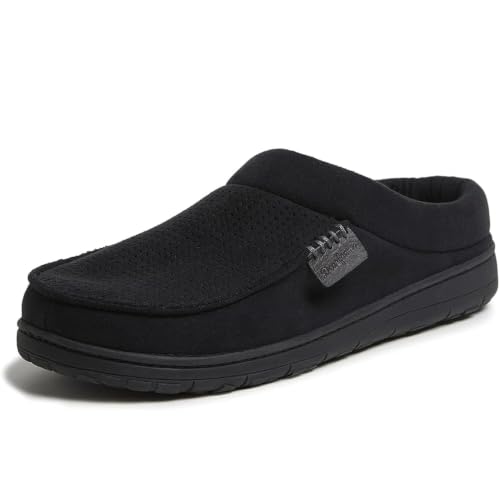
Dearfoams Men’s Brendan Memory Foam Clog — Best Clog
The clog is the daily-wear shape for people who are in and out of their slippers fifty times a day, and the Brendan is Dearfoams’ well-judged version: closed toe for protection and warmth, open back for instant on-and-off, a perforated breathable upper for feet that overheat in fleece, and memory foam underfoot. The availability of wide widths is its quiet headline — wide feet are badly served by most slipper brands, and a daily slipper that pinches is a daily irritation.
Because it is a clog, the fit is relaxed by design; it will not hug the heel on stairs the way a full moccasin does, and that is the trade every clog makes for convenience. The sole handles hard floors and doorstep trips properly. If your daily pattern is home-based work, kitchen time and constant small errands around the house, and especially if standard slippers feel narrow or hot, the Brendan is the shape — and the fit range — to start with.
Brendan owners tend to be people who tried moccasins and found them either too warm or too narrow, and the clog’s forgiveness on both counts is why the model persists in Dearfoams’ line. The perforated upper makes it the pair that lives by the back door in summer and by the desk in winter, and the wide fit means it is frequently the first slipper a wide-footed man has owned that did not need a breaking-in negotiation. Expect the relaxed heel to remind you it is a clog on stairs — a small tax on an otherwise effortless day.
Strengths
- Wide widths genuinely available
- Breathable upper suits warm feet and summer
- Clog convenience for constant on-and-off days
Trade-offs
- Open back is less secure on stairs
- Relaxed fit will not suit narrow feet seeking a hug
- Perforations mean less warmth in winter
| Style | Clog (open back, closed toe) |
| Footbed | Memory foam |
| Upper | Breathable perforated |
| Fit | Wide widths offered |
Best for: Men with wide feet or warm feet who live in their slippers / Not suited for: Anyone wanting a snug, enclosed heel fit
Check on Amazon — check the current price on Amazon before you decide.

UGG Men’s Ascot Slipper — Best Premium
The Ascot is what daily wear looks like at the premium tier: a real leather moccasin upper that shrugs off scuffs and ages gracefully, a wool-blend lining that regulates temperature better than synthetic fleece — warm in winter, not stifling in spring — and an outsole with the build of a casual shoe, so the line between slipper and house shoe effectively disappears. It is the pair you can answer the door, host friends and work from home in without ever feeling underdressed at floor level.
The ownership terms match the tier: it wants a brush and occasional leather care rather than a washing machine, and the lining packs down over the first weeks before settling into its long-term feel, so judge the fit after a fortnight, not on day one. Sized right, Ascot owners measure replacement in years. If you wear slippers more hours than shoes — as many home workers now do — the cost-per-hour arithmetic of the premium tier is surprisingly defensible, and this is its standard-bearer.
Ascot ownership is measured in years and in compliments from people who notice footwear. The leather develops the kind of patina that makes the second year look better than the first, and the sole’s shoe-like build means it is the one pair here that never feels out of place when the doorbell rings unexpectedly. Owners commonly report that buying the Ascot ended their slipper shopping entirely — the strongest verdict any daily-wear product can earn, and the reason it anchors the premium end of this guide.
Strengths
- Leather upper and shoe-grade sole last for years
- Wool-blend lining regulates temperature across seasons
- Smart enough for guests and video-call life
Trade-offs
- Premium tier pricing
- Not machine washable — needs simple leather care
- Lining compresses during the first weeks
| Upper | Leather moccasin |
| Lining | Wool blend (UGGplush-style) |
| Outsole | Durable rubber, shoe-like |
| Style | Closed moccasin |
Best for: Men wanting one premium pair that looks as good as it feels / Not suited for: Budget buyers or anyone who machine-washes slippers
Check on Amazon — check the current price on Amazon before you decide.

Acorn Women’s Moc Slipper — Best Moccasin (Women)
Acorn has made moccasin slippers for decades, and the Women’s Moc shows it: a ragg-wool upper with the hand of a good sweater, a memory foam footbed, and a sole rated for the garden path as well as the kitchen floor. It is the most traditionally cosy pick in this guide — the one for cold floors, draughty houses and people whose feet are cold from October to April — while still meeting the daily-wear standard of a closed upper and a real outsole.
Wool-blend uppers breathe better than synthetic plush, so the warmth rarely tips into sweatiness, and the moccasin construction wraps the whole foot, making it secure on stairs where clogs feel loose. Sizing follows the slipper tradition of dual sizes; expect a snug first fit that relaxes as the wool and foam settle. For daily wear in a cool home, this is the pair that feels like it was made for the job — because it was, by a company that makes little else.
The Acorn Moc’s owners are disproportionately people in old, cold houses, and their loyalty is thermal before it is anything else: this is the slipper that makes a stone-flagged kitchen at 7 a.m. a non-event. The ragg wool also ages gracefully, mellowing rather than pilling into tiredness, and the moccasin’s wrap fit means it is the pick that stays on during the stair runs and garden trips that shake looser slippers off. It is a specialist in the best sense — built for a climate and a routine, and superb within them.
Strengths
- Ragg wool warmth without heavy sweating
- Secure full-moccasin fit, good on stairs
- Indoor/outdoor sole for doorstep life
Trade-offs
- Warmest pick — less suited to hot climates
- Dual sizing needs the usual judgement call
- Wool blend wants gentler washing care
| Upper | Ragg wool blend moccasin |
| Footbed | Memory foam |
| Outsole | Indoor/outdoor |
| Style | Closed moccasin |
Best for: Women who want a traditional warm moccasin for daily wear / Not suited for: Hot sleepers or warm-climate homes without cold floors
Check on Amazon — check the current price on Amazon before you decide.

HomeTop Men’s Knit Moccasin Slippers — Best Budget
HomeTop’s knit moccasin is the budget pick that refuses to behave like one. The knit upper breathes, the fleece lining adds the warmth the RockDove knit leaves out, the whole slipper is machine washable, and it is light enough that you genuinely forget it on long days. As a combination for daily wear at a budget tier, that list is difficult to beat, and it is why this model keeps surfacing in round-ups of its class.
The compromises live where you would expect: the sole is a flexible everyday sole rather than a stiff shoe-like unit, so it suits house and doorstep rather than long gravel-drive walks, and the fit range is standard widths only. Foam cushioning is comfortable rather than luxurious. None of that matters much against its purpose — a warm, washable, forgettable daily slipper that costs little enough to keep a spare pair for guests or the wash cycle. For renters, students and anyone outfitting a whole household, start here.
HomeTop’s moccasin wins its owners on the first laundry day: in the wash, out of the wash, back on the feet, with the fleece lining surviving the cycle that kills cheaper slippers’ shape. Students, renters and anyone furnishing a first home gravitate to it because the whole proposition — warm, washable, light, inexpensive — respects a budget without apologising. It is also the most common second pair in this guide: bought as the spare, promoted to the rotation, and quietly reordered when the rotation needs refreshing.
Strengths
- Warm fleece lining plus breathable knit
- Machine washable and very lightweight
- Budget tier without the usual flimsiness
Trade-offs
- Flexible sole is house-first, not a walking shoe
- Standard widths only
- Cushioning is good, not plush
| Upper | Breathable knit moccasin |
| Lining | Fleece |
| Care | Machine washable |
| Style | Closed moccasin, lightweight |
Best for: Budget-conscious men wanting a warm, washable daily pair / Not suited for: Anyone needing wide widths or maximum sole stiffness
Check on Amazon — check the current price on Amazon before you decide.
Comparison Table
| Pick | Badge | Key spec | Best for |
|---|---|---|---|
| RockDove Men’s Original Two-Tone Memory Foam Slipper | Best Overall (Men) | Memory foam footbed, rubber outsole, machine washable | Men wanting one dependable pair for all-day house wear |
| RockDove Women’s Original Two-Tone Memory Foam Slipper | Best Overall (Women) | Memory foam footbed, rubber outsole, machine washable | Women wanting a washable, cushioned everyday house slipper |
| Dearfoams Men’s Brendan Memory Foam Clog | Best Clog | Clog style, breathable perforated upper, wide widths available | Men with wide feet or warm feet who live in their slippers |
| UGG Men’s Ascot Slipper | Best Premium | Leather upper, wool-blend lining, durable outsole | Men wanting one premium pair that looks as good as it feels |
| Acorn Women’s Moc Slipper | Best Moccasin (Women) | Ragg wool upper, memory foam, indoor/outdoor sole | Women who want a traditional warm moccasin for daily wear |
| HomeTop Men’s Knit Moccasin Slippers | Best Budget | Knit moccasin, fleece lining, machine washable, lightweight | Budget-conscious men wanting a warm, washable daily pair |
How to Choose Daily Wear Slippers
Choose the shape by your routine. Moccasins wrap the whole foot and suit stairs, cold floors and people who want a shoe-like security. Clogs and mules trade that security for instant on-and-off and better airflow — ideal for warm feet, frequent errands and mostly single-level living. Then judge the sole, because the sole is what makes a slipper a daily product rather than a bedroom accessory: look for a rubber or hard structured outsole with tread, not a fabric or thin foam bottom that will skate on wood and wear through in a season.
Footbeds come next. Memory foam gives the plushest first month and gradually compresses; denser foam and contoured footbeds feel firmer at first and last longer. If you stand for long stretches — cooking, workshop, retail-from-home days — prioritise a footbed with some structure over pure softness. Finally, be honest about care: a daily slipper absorbs daily life, so machine-washable models have a real hygiene advantage, while leather and wool models repay simple care with years of service. Buy the pair whose care routine you will actually perform.
Sizing Slippers Without the Guesswork
Slipper sizing is the category’s oldest frustration: many brands sell dual sizes (such as 9-10 or 11-12) and expect your foot to negotiate. Three rules make it manageable. First, size for your sock: if you wear thick socks all winter, judge fit with them on. Second, expect foam and wool to settle — a new memory foam slipper that feels perfectly roomy will feel loose in a month, so a snug-but-not-tight first fit is usually correct, while a leather moccasin should never pinch because leather gives far less. Third, check the return policy before you commit, and walk on carpet for the trial so the soles stay returnable. Wide feet should start with brands that actually offer wide widths, like the Dearfoams clog pick, rather than sizing up in a standard last and swimming in length.
How to Make Daily Slippers Last: A Simple Care Routine
Rotation is the single biggest life-extender: foam needs a day off to recover its loft, so two pairs worn on alternate days outlast two pairs worn sequentially — and feel better every single day. Wash washable slippers on a gentle cycle when they start to hold odour, and air-dry them; tumble heat ages foam and adhesives. Leather and wool uppers want the opposite regime: brush off, air by an open window, and keep them away from radiators, which crack leather and felt wool.
Watch the sole and the heel counter — when the tread smooths at the heel or the footbed stays compressed after a rest day, the pair has given its service and replacement time has come; worn-out slippers on hard floors are a false economy for your feet and your posture at the sink. Keep one pair by the door if your household has a shoes-off rule for guests, and store daily pairs somewhere ventilated rather than in a closed box. That is the whole routine: rotate, wash or brush appropriately, retire on time.
Hard Floors Changed What a Slipper Needs to Be
The daily slipper’s job description changed when homes changed. Carpeted houses forgave thin soles; the modern mix of wood, laminate, tile and stone does not. Hours on hard floors transmit straight through a novelty slipper, which is why every pick in this guide has a structured outsole and a real footbed. The outsole also decides safety: treaded rubber grips kitchen spills and bathroom tile, while smooth fabric soles are a genuine hazard on polished floors. If your home is mostly hard flooring, treat the slipper purchase with the same seriousness as a shoe purchase — because functionally, that is what it is.
One Pair or a Rotation? The Economics of Daily Wear
A daily-wear slipper accumulates hours faster than any shoe you own — a home worker can log more annual hours in slippers than in all other footwear combined. That reframes the tiers. A budget pair replaced twice a year, a mid-tier pair replaced annually and a premium leather pair kept for several years can land within sight of each other on cost per year, which is why this guide ranks by fit-for-purpose rather than by price. The rotation strategy — two pairs alternating — usually wins on both comfort and cost, because rested foam recovers loft and each pair dries fully between wears. Whichever tier you choose, buy for the floors and the hours you actually have, and the slippers will repay you daily.
Slippers for Different Floors: Tile, Wood, Carpet and Concrete
Your flooring quietly specifies your slipper. Tile and stone — kitchens, bathrooms, Mediterranean and modern homes — are the coldest and hardest underfoot and the most slippery when wet; they demand the thickest tread and a footbed with real substance, and they punish fabric soles fastest. Wood and laminate are kinder on warmth but slick for smooth soles and unforgiving of grit trapped under a sole, so a clean, treaded rubber outsole is the specification. Carpet forgives almost everything except heat — carpeted homes are where fleece and wool uppers earn their keep, because the floor is no longer stealing warmth. Concrete and garage-adjacent living, increasingly common in converted and workshop homes, is shoe territory that slippers visit: choose the stiffest sole you can find in this guide and treat anything thinner as indoor-only. Read your floors before your shortlist and at least one pick will eliminate itself honestly.
When Slippers Are the Wrong Answer
A guide that only sells is a poor guide, so: there are days and tasks where the correct footwear is a shoe. Ladders, heavy lifting, power tools, wet grass and any load carried against your body all want the structure, protection and grip of real shoes, and no slipper in this guide pretends otherwise. Likewise, anyone whose clinician has specified particular footwear should treat that specification as outranking a buying guide entirely — comfort advice in these pages is general, not personal. The daily slipper’s kingdom is the ordinary house day: floors, stairs taken carefully, the garden path, the doorstep. Rule that kingdom well, change into shoes for expeditions, and both will last longer.
The Daily Slipper Wardrobe: Matching Pairs to the Shape of a Day
Work-from-home days
The home worker’s slipper is on for ten hours and must disappear: breathable uppers for desk hours, a sole that handles the kitchen at lunch and the doorbell at three, and a look that survives the video call’s downward glance. The RockDove pair and the Dearfoams clog split this constituency by temperature — knit breathability for warm homes, perforated clog airflow for warm feet — and both survive the washing rhythm that desk-day wear demands.
Evenings and weekends
Evening wear is where warmth and ceremony live: the Acorn Moc by the fire, the UGG Ascot when friends come for dinner, the pair that signals the working day is over by the act of changing into it. Many households keep this as the second slot in the rotation, which is why the two-pair strategy in this guide keeps recurring — one pair for the day’s labour, one for its reward, each lasting longer because the other exists.
Guests, gifts and the spare pair
A washable spare pair by the door converts a shoes-off household from a negotiation into a hospitality: guests get real slippers, floors stay clean, and the spare returns to the wash afterwards. The HomeTop’s tier makes it the natural spare — inexpensive enough to buy for other people’s feet, good enough that guests ask about it. Gifting follows the same logic in reverse: give the pair whose sizing is most forgiving (dual-size knits and clogs), include the receipt without embarrassment, and never gift a leather moccasin to a foot you have not measured. Slippers are intimate apparel; the forgiving shapes are the kind ones.
Slipper Materials Decoded: Knit, Wool, Leather and Fleece
Knit uppers are the athlete’s choice of the slipper world: they stretch to the foot’s shape, breathe through warm rooms, and wash without complaint, which is why both RockDove picks and the HomeTop use them. Their limit is structure — a knit will not hold a sloppy fit accountable — and cold draughts pass through them in winter. Wool and ragg blends, as in the Acorn, trade some of that stretch for insulation with breathability, the rare combination that keeps feet warm without stewing them. Leather is the structural material: it holds shape for years, resists scuffs and weather at the doorstep, and asks for occasional care instead of washing. Fleece linings are pure comfort engineering — instant warmth on contact — with the shortest visual lifespan, since fleece pills and mats where heels turn. Most good daily slippers are a deliberate stack of two of these: structure outside, comfort inside. Read any listing as that stack and the price differences across this guide explain themselves.
The Heel Question: Counters, Cups and Why Slippers Fall Off
More daily slippers are abandoned for heel behaviour than for any other flaw. A slipper whose heel slips at every step taxes the toes, which grip unconsciously to keep it on, and turns a relaxing object into low-grade exercise. The fixes live in the design: a raised heel cup or counter, as moccasins naturally have, keeps the foot seated; a clog’s open back accepts the trade openly and suits short, flat routes around the house; and correct sizing does more than any feature, because a heel that fits cannot wander. When you try a new pair, walk twenty brisk steps and climb stairs if you have them. A daily slipper should be forgettable at step twenty, not merely acceptable at step two in the shop’s carpeted aisle.
Slippers and Standing Work: Cooking, Workshops and Retail Days
Standing is the daily slipper’s hardest shift. The home cook’s two-hour session, the hobbyist’s workshop afternoon and the market trader’s home-office day all load the feet statically, which is a different demand from walking: cushioning must resist bottoming out under a stationary heel, and the sole must not let the foot roll on a hard floor. Denser foam and leather-soled structure outperform plush softness here — the first hour flatters soft slippers, the third hour exposes them. If your day is mostly standing, weight this guide’s firmer picks, rotate pairs at midday if the day is very long, and treat the kitchen anti-fatigue mat as the slipper’s natural partner rather than its rival. Feet notice systems, not products.
Travel Slippers and the Second Home
A daily slipper habit eventually wants to travel, and the requirements shuffle: weight and packability rise, sole demands fall to hotel and apartment floors, and washability becomes precious because travel laundry is improvised. Knit moccasins and the lighter clog styles pack flattest and forgive being crushed in a case; leather is the wrong traveller unless the trip is by car. Second homes and caravans invert the logic — there, durability and warmth rule, and the pair can be the heaviest in your collection because it never moves. Many owners solve both with the cast-offs of the main rotation: last year’s home pair, demoted while still serviceable, becomes the travel or caravan pair, and the system’s economics improve again.
A Short History of Staying In: Why House Shoes Had a Revival
The daily slipper’s recent rise is a housing story as much as a fashion one. Open-plan hard floors replaced carpeted rooms, home working moved millions of people from office shoes to house shoes for the majority of their waking hours, and heating costs made warm feet a household economy rather than a luxury. The products in this guide are the market’s answer to that shift: slippers engineered like light shoes, washable like sportswear, and priced for replacement cycles rather than heirloom status — except at the leather end, where the old slipper virtues survive intact. Understanding the revival helps the purchase: you are not buying a novelty or a treat, you are buying the footwear of your actual life, and it deserves the same fit discipline as anything you would wear out of the house.
Slippers for Plantar Comfort Seekers — Without the Medical Pitch
Many daily slipper buyers arrive with a simple, legitimate brief: hard floors make their feet tired, and they want more between foot and floor. This guide’s answer stays inside comfort language deliberately — cushioning depth, sole structure, a footbed that does not bottom out — because those are the properties a buyer can test in a week and judge honestly. What we will not do is promise outcomes for anyone’s feet beyond comfort, and you should be suspicious of any slipper listing that does. Within those honest bounds, the practical advice is real: choose the densest footbed you find comfortable, keep the sole structured, rotate pairs so the foam recovers, and replace on schedule, because a compressed slipper worn another year serves nobody. Comfort maintained daily is a legitimate goal, and it is achievable with the picks above and no miracles claimed.
The Household Slipper Audit: A Ten-Minute Exercise
Once a year, line up every slipper in the house and audit them like equipment. Compress each footbed with a thumb: if it stays dented, that pair is done. Check soles against the light for smooth patches at heel and ball — grip is a safety feature, not a luxury. Smell is data too: a pair that no longer comes back from the wash fresh has absorbed all it can. The audit usually reveals the household’s real pattern — one pair worn to death while others idle — which is the argument for the rotation made concrete. Retire ruthlessly, promote the spares, and buy the replacement while choice is a pleasure rather than an emergency. Ten minutes, once a year, and the most-worn footwear in the home stays worthy of the title.
Slipper Storage That Isn’t a Heap by the Door
Daily slippers deserve a home that is not a pile, because piles breed the moisture and odour this guide keeps fighting. A simple open rack or a ventilated basket near the door gives each pair air and a territory; a boot tray underneath catches the winter’s grit before it migrates across the floors the slippers exist to protect. Keep the rotation pairs together and the guest pair visibly separate, and store off-season pairs washed, fully dry and uncompressed — foam stored under a stack of boxes all summer emerges pre-flattened. None of this is elaborate. It is the same lesson as the whole guide in miniature: daily objects reward small, consistent systems, and punish neglect in exact proportion to how daily they are.
Common Buying Mistakes
Buying novelty instead of footwear. If it looks like a cartoon, it will perform like one by February. Choosing fabric soles for hard floors. Skating on laminate is not a personality trait; buy treaded rubber. Sizing up for comfort. Foam settles and uppers relax — oversized becomes sloppy and trips you on stairs. Never washing them. A daily slipper is a textile worn against skin for twelve hours; washable models or a care routine are non-negotiable. Wearing a dead pair for another year. Compressed foam and smooth soles help nobody; retire on schedule. Expecting medical effects. Slippers provide comfort and grip; anything beyond that is a conversation for a clinician.
Final Recommendation
For most men, the RockDove Men’s Original is the default answer, and for most women its counterpart, the RockDove Women’s Original, holds the same position — washable, cushioned, sensibly priced. Wide or warm feet should start with the Dearfoams Brendan clog; cold floors and traditional taste point to the Acorn Women’s Moc; the UGG Ascot is the premium, years-long investment; and the HomeTop moccasin proves the budget tier can still deliver warmth and washability. Match the shape to your routine, size for the settle, rotate if you can — and your daily slippers will quietly become the most-used footwear you own.
Best Slippers For Men Best Slippers For Women Best Memory Foam Slippers Best House Slippers Best Moccasin Slippers
Related guides
Frequently Asked Questions
What makes a slipper a ‘daily wear’ slipper rather than a bedroom slipper?
A closed upper, a structured rubber or hard outsole with tread, and a cushioned footbed built for hours of standing and walking on hard floors. Bedroom slippers are softer, thinner and designed for a few carpeted steps; daily wear slippers are effectively house shoes.
How long should daily wear slippers last?
With daily use, foam slippers typically give their best service for six to twelve months before the footbed stays compressed; leather moccasins like the UGG Ascot last years with basic care. Rotating two pairs extends the life of both.
Are memory foam slippers good for all-day wear?
They are comfortable for all-day wear on hard floors, with the caveat that the foam gradually compresses and needs rest days to recover loft. If you stand for very long periods, a denser or more structured footbed may suit you better than the plushest foam.
Can I wear these slippers outside?
Briefly, yes — every pick has an indoor/outdoor sole suited to doorsteps, patios and taking the bin out. They are not walking shoes; for dog walks and errands, change into shoes and your slippers will last far longer.
How do I stop slippers from smelling?
Wash washable models regularly, rotate pairs so each dries fully, wear socks or liner socks if you run warm, and air non-washable pairs by a window. Odour lives in trapped moisture; dryness is the cure.
Should slippers feel tight at first?
Snug, not tight. Foam and wool uppers settle within a couple of weeks, so a firm first fit usually becomes correct. Leather gives least of all — if a leather moccasin pinches on day one, exchange the size rather than hoping.


