Disclosure: airfryerkitchensupply.com is reader-supported. When you buy through links on our site, we may earn an affiliate commission at no extra cost to you.
Where to buy
The fastest way to buy any pick in this guide to the best carpet shampooer for rugs is Amazon, where stock, size and colour options are shown on the product page itself. Use the links below to check the current price on Amazon for each model:
- BISSELL ProHeat 2X Revolution Pet Pro Plus (3588F) (Best Overall): Check on Amazon
- Hoover PowerScrub Deluxe Carpet Cleaner Machine (Best Value): Check on Amazon
- BISSELL Big Green Professional Carpet Cleaner (Best Heavy Duty): Check on Amazon
- Hoover SmartWash+ Automatic Carpet Cleaner (Best Easy to Use): Check on Amazon
- BISSELL TurboClean Upright Carpet Cleaner (3952) (Best Compact and Budget): Check on Amazon
- Rug Doctor Mighty Pro X3 Commercial Carpet Cleaner (Best Commercial Grade): Check on Amazon
Shopping for the best carpet shampooer for rugs comes with a twist that wall-to-wall carpet guides ignore: rugs are not fixed flooring. Area rugs sit on top of wood, tile or laminate, they have backings that can be damaged by soaking, dyes that can bleed, and fibres — wool, jute, shag, low-pile synthetic — that react very differently to hot water and aggressive brushes. The right machine for rugs is therefore not simply the most powerful carpet cleaner; it is the one whose suction, water control and brush action clean the pile without drowning the backing or dragging a lightweight rug across the floor.
The six machines below were all verified on 2026-11-22, and they span the realistic range: a heated full-size upright for homes where rugs cover most of the floor, a lighter SpinScrub machine that is kind to older rugs, a genuinely automatic model for people who hate technique, a compact budget upright for a couple of rugs, and two commercial-grade machines for very large or heavily used rugs. Each review calls out rug-specific behaviour — water recovery, weight, and how the machine treats rug edges and fringe — because that is what decides success on rugs rather than on fitted carpet.
In this guide
Quick Picks
BISSELL ProHeat 2X Revolution Pet Pro Plus (3588F) — Best Overall. A heated full-size upright with dual rotating brushes and an express mode for faster drying — the strongest all-round rug shampooer here. Check on Amazon
Hoover PowerScrub Deluxe Carpet Cleaner Machine — Best Value. A lighter shampooer whose SpinScrub brushes scrub from multiple angles without a belt to snap — kind to rugs, easy to live with. Check on Amazon
BISSELL Big Green Professional Carpet Cleaner — Best Heavy Duty. The rental-class machine you can own: XL brush, big tanks and two-motor extraction for the largest, hardest-worked rugs. Check on Amazon
Hoover SmartWash+ Automatic Carpet Cleaner — Best Easy to Use. Push forward to wash, pull back to dry — the SmartWash+ removes the technique from shampooing, with auto-mixed solution. Check on Amazon
BISSELL TurboClean Upright Carpet Cleaner (3952) — Best Compact and Budget. A light, compact upright for households with one or two rugs — easy to store, quick to deploy, honest about its limits. Check on Amazon
Rug Doctor Mighty Pro X3 Commercial Carpet Cleaner — Best Commercial Grade. The commercial vibrating-brush machine, bundled with pet cleaning solution — built for landlords, big homes and brutal workloads. Check on Amazon
How These Picks Were Chosen
Candidates were verified brand-and-model against Amazon listing data before anything else; only listing-confirmed machines carry purchase links. Selection then weighted rug suitability over raw carpet power. The criteria: extraction strength, because a rug left damp against a wood floor is a problem, so recovery matters more than spray volume; water and heat control, including whether the machine keeps solution hot and whether you can moderate it for delicate fibres; brush design, since rotating brushes deep-clean synthetics beautifully but must be used thoughtfully on wool and loops; weight and manoeuvrability, because cleaning a rug means constantly repositioning around furniture and holding lightweight rugs in place; and tank size matched to rug area, so you are not refilling every few minutes on a big living-room rug. Machines that only made sense as spot cleaners were excluded — this guide is about full-rug shampooing.
The 6 Best Carpet Shampooers for Rugs

BISSELL ProHeat 2X Revolution Pet Pro Plus (3588F) — Best Overall
The ProHeat 2X Revolution Pet Pro Plus earns the top spot because it balances the three things rug cleaning demands: it scrubs properly with dual rotating DirtLifter brushes, it keeps the cleaning solution hot so the shampoo works at full strength from the first pass to the last, and it extracts hard enough that rugs are left damp rather than wet. The express clean mode uses less water for maintenance cleans and noticeably shortens drying time — the mode you will use most on rugs over hard floors, where limiting moisture underneath matters.
On rugs specifically, the machine’s weight is an asset: it stays planted on medium and large rugs instead of pushing them ahead of it, and the edge cleaning is good enough that the perimeter does not need a second tool. The included hose and tool handle the rug’s problem zones — the traffic lane by the door, the spot under the dining table — and the pet-focused design means the whole system assumes hair, tracked-in dirt and the occasional accident as normal life. For a household whose floors are mostly rugs, this is the machine to buy once.
ProHeat ownership settles into a rhythm of express cleans: a twenty-minute pass when the rug starts to look tired, rather than a dreaded annual event, because the machine is quick to set up and the express mode dries fast enough for same-day living. The hose tool becomes the household’s stain first-responder. It is the machine owners lend to relatives with a warning and a demonstration — the mark of a tool that has become the household standard.
Strengths
- Heated solution and strong extraction suit large rugs
- Express mode limits moisture for rugs over wood floors
- Hose and tool cover edges and spot work
Trade-offs
- Full-size weight makes storage and stairs a consideration
- Rotating brushes need care on wool and loop pile
- Uses Bissell formula ecosystem for best results
| Brush | Dual DirtLifter PowerBrush (rotating) |
| Heat | ProHeat 2X — maintains solution temperature |
| Modes | Deep clean and express (faster dry) |
| Extras | Hose and tool for edges, stairs, upholstery |
Best for: Homes with several large rugs and pet traffic / Not suited for: Delicate antique or loose-weave rugs needing the gentlest touch
Check on Amazon — check the current price on Amazon before you decide.

Hoover PowerScrub Deluxe Carpet Cleaner Machine — Best Value
The PowerScrub Deluxe has been a default recommendation in its class for years because its SpinScrub system takes a different approach to agitation: multiple round brushes rotate and scrub the pile from several angles at once, cleaning thoroughly without the single aggressive brush roll — and without a drive belt, which removes the most common mid-clean failure of older shampooers. On rugs that gentler, multi-directional action is a real advantage, particularly on older synthetics and mid-pile rugs that do not need to be attacked.
It is also one of the lightest full-size machines here, which matters more on rugs than on carpet: you are constantly lifting the machine onto and off the rug, working around furniture legs and repositioning on landings. Separate clean and dirty tanks are easy to fill and empty at a sink, and forced-air drying assist helps pull moisture from the pile as you make your extraction passes. The honest limits are tank size and deep-stain muscle — very large rugs mean a refill trip, and ground-in, years-old staining is the Bissell ProHeat’s or Big Green’s fight. For routine rug revival at a value tier, this is the sweet spot.
PowerScrub owners are often second-time buyers who previously owned a heavier machine and traded down in weight on purpose. The SpinScrub’s gentleness shows on older rugs that a brush roll would bully, and the machine’s sink-friendly tanks make the clean-up after the clean-up mercifully quick. It is the shampooer most likely to be used on a whim — a free hour, a rug that needs it — and frequency, as this guide keeps arguing, is where rug care is won.
Strengths
- SpinScrub action is thorough yet comparatively gentle
- Lightweight and easy to manoeuvre on and off rugs
- Beltless brushes remove a classic failure point
Trade-offs
- Smaller tanks need refilling on big rugs
- Less extraction force than the heaviest machines
- Not the choice for neglected, heavily soiled rugs
| Brush | SpinScrub multi-angle rotating brushes (beltless) |
| Design | Lightweight upright |
| Tanks | Separate clean and dirty water tanks |
| Extras | Pet and upholstery tools included |
Best for: Mixed rug households wanting an easy, lighter machine / Not suited for: Huge rugs where its smaller tanks mean refills
Check on Amazon — check the current price on Amazon before you decide.
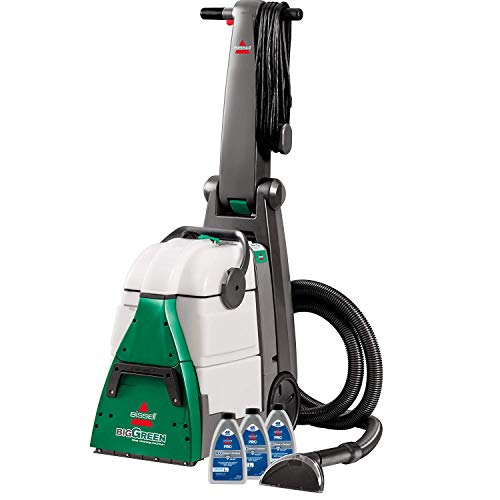
BISSELL Big Green Professional Carpet Cleaner — Best Heavy Duty
The Big Green is the machine rental counters built their reputation on, sold for ownership. Everything about it is scaled for area: an extra-large rotating brush, tanks big enough to shampoo a whole suite of large rugs without a refill parade, and extraction strong enough to pull solution back out of dense pile so drying stays reasonable even after a deep clean. Unusually, it cleans on both the forward and backward pass, which halves the time on big rugs compared with machines that only work in one direction.
For rugs, that power needs judgement. On a sturdy, colourfast synthetic or a big low-pile rug, the Big Green is unmatched in this guide — it revives traffic lanes and lifts the grey out of pale rugs in a way lighter machines cannot. On a delicate, old or loosely woven rug, use the hose tool and restraint, or choose the Hoover. It is also genuinely large to store and heavy to carry upstairs. Buy it when rugs are a major feature of your home, when you clean up after tenants or animals at scale, or when you have used rentals twice and done the maths.
Big Green ownership is an event calendar: the spring deep clean, the post-party rescue, the end-of-tenancy marathon. Between events it waits in the garage like a fire appliance, and owners justify it in single sentences that usually involve the word ‘tenants’ or ‘dogs’. Its both-directions cleaning changes the feel of big jobs from labour to process. If your rug estate is measured in rooms rather than pieces, this is your machine, and you already know it.
Strengths
- Rental-grade cleaning power with big tanks
- Cleans in both directions — fastest on large rugs
- Extraction leaves even deep cleans reasonably dry
Trade-offs
- Big and heavy; needs real storage space
- Overkill — and potentially too much — for delicate rugs
- Highest tier in this guide
| Brush | XL DirtLifter PowerBrush |
| Tanks | Large capacity, removable |
| Cleaning path | Cleans on forward and backward passes |
| Extras | Long-reach hose and tough stain tool |
Best for: Very large rugs, rental properties and end-of-tenancy rescues / Not suited for: Small flats with one rug and no storage space
Check on Amazon — check the current price on Amazon before you decide.

Hoover SmartWash+ Automatic Carpet Cleaner — Best Easy to Use
Every other machine in this guide asks you to manage a trigger: spray on the push, extract on the pull, and woe betide the beginner who sprays on both and soaks the rug. The SmartWash+ deletes that learning curve. Push forward and it washes; pull back and it switches to extraction and drying automatically, and it mixes solution and water to the right ratio itself. For rug owners who shampoo twice a year and forget the technique between sessions, that automation is not a luxury — it is the difference between a clean rug and a soggy one.
The drying assist deserves specific mention for rugs over hard floors, because it shortens the window in which any residual moisture sits between rug and floorboards. The machine is also comfortable to use: no trigger finger fatigue across a big rug. What you give up is control — you cannot easily run a water-only rinse pass at custom dilution or vary solution strength for a delicate rug, and purists will prefer the Bissell’s explicit modes. For everyone else, this is the machine most likely to be used correctly every time.
SmartWash ownership is defined by a negative: nobody in the house is afraid of it. The machine that requires no technique gets used by everyone, correctly, including whoever gets tasked with the hallway rug — a demographic no other pick can claim. The auto-mix also ends the half-bottle-of-solution guessing that wastes product and leaves residue. It is the appliance-ification of rug cleaning, and for busy households that is precisely the point.
Strengths
- Automatic wash/dry removes the main beginner error
- Auto-mix ends measuring and guesswork
- Drying assist suits rugs over hard flooring
Trade-offs
- Less manual control over solution and rinsing
- Automation hardware means more to maintain long-term
- Mid-size tanks on the largest rugs
| Operation | Push forward to wash, pull back to dry |
| Solution | Auto-mix — no manual measuring |
| Drying | HeatForce-style heated drying assist |
| Design | Triggerless — no trigger to hold |
Best for: Anyone who wants results without learning a technique / Not suited for: Users who want full manual control of solution strength
Check on Amazon — check the current price on Amazon before you decide.

BISSELL TurboClean Upright Carpet Cleaner (3952) — Best Compact and Budget
Not every rug household needs a full-size machine standing in a cupboard. If your cleaning reality is one living-room rug and a runner, the TurboClean is sized to your life: light enough to carry with one hand, compact enough for a flat’s storage, and quick enough to deploy that you will actually shampoo the rug when it needs it rather than staging a twice-yearly event. The rotating brush and Bissell’s OXY formula combination handle the everyday soil of a lived-on rug — shoe-borne grit, snack crumbs ground into the pile, pet hair worked deep.
The limits are physical and should be respected: smaller tanks mean refills if you stretch it across several large rugs, and its extraction, while fine for maintenance cleaning, will not match the ProHeat or Big Green on a saturated deep clean. Think of it as the rug equivalent of a stick vacuum — the machine you use often, lightly, so the heavy rescue is rarely needed. At its budget tier, that is a genuinely sensible strategy rather than a compromise.
TurboClean ownership is about frequency over force: it lives in a real cupboard, comes out in one hand, and turns ‘the rug needs doing’ from a project into a task. Owners of one or two rugs report the quiet satisfaction of a machine sized to their actual life rather than to a showroom’s ambitions. It will not rescue a decade of neglect, and it does not pretend to — it prevents the decade from accumulating.
Strengths
- Light and compact — gets used instead of stored
- Budget tier with real rotating-brush cleaning
- Ideal scale for one or two rugs
Trade-offs
- Small tanks limit session size
- Extraction is maintenance-grade, not rescue-grade
- No hose reach of the bigger models for edges and stairs
| Design | Compact, lightweight upright |
| Brush | Rotating DirtLifter-style brush |
| Positioning | Small-area and maintenance cleaning |
| Included | OXY cleaning formula (maker bundle) |
Best for: One or two medium rugs in a smaller home / Not suited for: Whole-house rug cleaning in one session
Check on Amazon — check the current price on Amazon before you decide.

Rug Doctor Mighty Pro X3 Commercial Carpet Cleaner — Best Commercial Grade
Rug Doctor’s Mighty Pro X3 is the commercial benchmark: the same basic machine that has cleaned carpets and rugs in rental fleets for years, using a vibrating brush bar that scrubs across the pile thousands of times a minute rather than rotating through it. That cross-scrubbing action is exceptionally good at working shampoo through dense rug pile and lifting the compacted dirt that builds in hall runners and entrance rugs, and the machine’s extraction is matched to commercial expectations — rugs are left ready to dry, not to drip.
This listing’s pet cleaner pack makes it the landlord and multi-pet household pick: the included pet stain and odour solution is formulated for the machine, and the whole package assumes hard, frequent use rather than careful occasional handling. The costs of that are size, weight and noise — this is equipment, not an appliance, and it stores like it. If your rug estate is large, your tenants rotate, or your dogs treat the hallway rug as a doormat with benefits, the X3 earns its floor space. If you clean one rug twice a year, it absolutely does not, and the Hoover PowerScrub will make you happier.
Mighty Pro ownership is unapologetically professional. It lives where the work is — garages, rental portfolios, big dog households — and its sessions are measured in properties, not rugs. The vibrating brush’s cross-scrubbing earns its reputation on entrance rugs that other machines merely improve. Owners do not describe it as convenient and do not care; they describe it as final. When a rug absolutely must come back, this is the machine that signs for it.
Strengths
- Commercial build and vibrating brush excel on dense, dirty rugs
- Large tanks suit whole-property sessions
- Pet solution bundle matches the machine
Trade-offs
- Heaviest, loudest ownership experience here
- Commercial size needs garage-style storage
- Far more machine than occasional users need
| Brush | Vibrating brush bar (commercial design) |
| Class | Commercial / rental-grade |
| Bundle | Pet stain and odour solution included |
| Tanks | Large capacity |
Best for: Landlords, large homes and very heavy rug workloads / Not suited for: Occasional cleaners who will resent its size and weight
Check on Amazon — check the current price on Amazon before you decide.
Comparison Table
| Pick | Badge | Key spec | Best for |
|---|---|---|---|
| BISSELL ProHeat 2X Revolution Pet Pro Plus (3588F) | Best Overall | Heated cleaning, Dual DirtLifter PowerBrush, hose and tool included | Homes with several large rugs and pet traffic |
| Hoover PowerScrub Deluxe Carpet Cleaner Machine | Best Value | SpinScrub brush system, lightweight body, heated air drying assist | Mixed rug households wanting an easy, lighter machine |
| BISSELL Big Green Professional Carpet Cleaner | Best Heavy Duty | XL DirtLifter PowerBrush, large-capacity tanks, cleans forward and back | Very large rugs, rental properties and end-of-tenancy rescues |
| Hoover SmartWash+ Automatic Carpet Cleaner | Best Easy to Use | Automatic wash/dry by push-pull, auto-mix solution, drying power | Anyone who wants results without learning a technique |
| BISSELL TurboClean Upright Carpet Cleaner (3952) | Best Compact and Budget | Compact lightweight upright, rotating brush, OXY formula included | One or two medium rugs in a smaller home |
| Rug Doctor Mighty Pro X3 Commercial Carpet Cleaner | Best Commercial Grade | Commercial vibrating brush bar, large tanks, pet solution bundle | Landlords, large homes and very heavy rug workloads |
How to Choose a Carpet Shampooer for Rugs
Begin with your rug inventory, honestly measured. Total rug area decides tank size and machine class: one medium rug points to the TurboClean or PowerScrub; a house of large rugs justifies the ProHeat or Big Green. Next, fibre. Synthetic rugs (polypropylene, nylon, polyester) tolerate heat, strong extraction and rotating brushes — the full menu. Wool rugs want cooler water, milder solution and gentler agitation; test any machine and formula on an inconspicuous corner first, and favour machines with good water control. Flatweaves, jute and viscose are the divas: minimal moisture, immediate extraction, and in viscose’s case, professional cleaning is often the honest answer.
Then weigh extraction above spray. Marketing shouts about brushes and heat; rugs live or die by how much water the machine takes back out. Strong extraction protects the hard floor underneath, prevents the backing staying damp, and halves drying time. Finally, consider the rug’s weight: lightweight rugs creep and ruck under a heavy machine, so either work with a helper’s foot anchoring the far edge, choose a lighter machine, or clean the rug outdoors on a clean hard surface where you can walk around it — an underrated method for small rugs in summer.
Rug Fibres and Water: What Each Type Tolerates
Polypropylene and nylon rugs are the forgiving majority: they shrug off hot solution and firm brushing, and they release dirt well. Polyester is nearly as tolerant but can hold oily soil more stubbornly, which is where heated cleaning earns its keep. Wool is the noble fibre — naturally soil-hiding and resilient — but it absorbs a great deal of water, dislikes high heat and harsh alkaline solutions, and must be extracted thoroughly and dried promptly to avoid that wet-wool smell lingering. Cotton rugs wash well but dry slowly. Jute and sisal should barely get damp; surface-clean them and never soak. Shag and high-pile rugs of any fibre need pre-vacuuming patience and slower passes, because the shampooer must reach the base of the pile where the grit lives, and they take the longest to dry. When a rug’s label or origin is unknown, treat it as wool until a hidden-corner test proves otherwise.
How to Shampoo an Area Rug Step by Step
Step 1 — prepare. Vacuum the rug thoroughly, twice, in both directions; a shampooer is not a vacuum and grit left in the pile turns to mud. Move furniture off, and decide where the rug dries — ideally you clean it in place over a protected floor, or outdoors on clean paving in warm weather. Step 2 — test. Apply solution with the machine’s tool or a cloth to a hidden corner, wait ten minutes, and blot with a white cloth: colour transfer means stop and choose a gentler method. Step 3 — pre-treat stains and traffic lanes with your chosen solution and give it a few minutes to work.
Step 4 — shampoo in sections. Work in overlapping lanes about a metre at a time: a slow washing pass, then one or two slow extraction-only passes until the returning water runs much clearer and the pile feels merely damp to a hard hand-press. Keep the machine moving; never park a running brush on one spot. Step 5 — rinse if your machine allows a water-only pass, especially on wool, to lift solution residue that would otherwise attract new soil. Step 6 — dry properly. Maximise airflow with fans and open windows, lift the rug’s edges or drape it so air reaches the back, and do not replace furniture or walk stocking feet on it until the backing is dry to the touch — hours for synthetics, longer for wool. That drying discipline, more than any machine feature, is what keeps a shampooed rug fresh instead of musty.
Drying: The Half of Rug Cleaning Everyone Rushes
More rugs are ruined after shampooing than during it. A rug’s face can feel dry while its backing still holds moisture against your floor, and trapped damp is what produces musty odours, backing deterioration and, on wood floors, finish damage. The fixes are unglamorous and effective: extract until a hard palm-press on the pile brings up no visible moisture; run a fan across the rug’s surface for several hours; prop the rug’s edges on small blocks or roll it loosely over a banister so air circulates beneath; and in humid weather, treat a dehumidifier in the room as part of the cleaning kit. If a cleaned rug smells sour two days later, it dried too slowly — the remedy is another extraction and rinse pass followed by aggressive airflow, not perfume sprays.
How Often Should Rugs Be Shampooed?
Frequency follows traffic, not the calendar. Entrance and hallway rugs in a shoe-wearing, dog-owning household earn a shampoo every few months and a vacuum weekly; the grit they collect is abrasive and shortens the rug’s life if left to grind in the pile. Living-room rugs in average use do well with a deep clean once or twice a year, plus immediate spot treatment of spills. Bedroom rugs, walked on in socks and bare feet, can go a year or more. Over-shampooing has its own costs — solution residue left behind actually attracts soil faster, and repeated soaking ages backings — so the rhythm to aim for is: vacuum often, spot-clean immediately, shampoo when the traffic lanes visibly grey, and rinse thoroughly when you do.
Rugs in Rental Homes and Deposits: Cleaning as Insurance
For renters, a carpet shampooer is less an appliance than a financial instrument. Landlords and agents inspect rugs and carpets at checkout with a professional’s eye and a contractor’s invoice book, and the difference between ‘professionally cleaned at tenant’s expense’ and ‘returned in good condition’ is very often one thorough shampoo with a competent machine a week before the move. The Hoover PowerScrub class covers most rental needs; households leaving a large property or a pet-heavy tenancy behind may find that owning the Big Green or Rug Doctor for the final clean costs less than the professional call-out it replaces — and the machine remains yours at the next address.
Two disciplines make the rental clean count. First, photograph rugs in daylight before and after cleaning; evidence ends arguments. Second, clean early enough for complete drying before the inspection — a rug that is still faintly damp reads as a problem even when it is merely slow, and the musty smell of a rushed dry can trigger exactly the professional-cleaning charge you were avoiding. Keep the machine’s receipt and your solution bottles with your tenancy paperwork. It is an unglamorous use of a shampooer, and for many owners it is the one that pays for the machine outright.
Solution Chemistry in Plain Language
Carpet shampoo is not magic soap, and understanding its three jobs helps you use any machine in this guide better. Surfactants do the lifting: they loosen the bond between soil and fibre so water and brushes can carry dirt away — this is why dwell time matters, and why pre-treating traffic lanes for a few minutes outperforms a second hurried pass. Oxidising boosters (the ‘OXY’ in several formulas) attack coloured organic stains — food, drink, pet accidents — by breaking the pigment molecules, which is why they excel on spots and do little on grey traffic soil, which is mineral grit, not pigment. Encapsulating and anti-resoil additives are the quiet heroes: they leave the pile less sticky, so the rug stays clean longer after you finish.
The practical rules follow from the chemistry. More solution is not better — excess surfactant left in the pile becomes the sticky residue that re-soils the rug, which is why the rinse pass exists. Hot water accelerates surfactant work on synthetics, which is the ProHeat’s whole argument, while wool prefers cooler water and gentler, wool-labelled chemistry regardless of machine. And never mix products experimentally in the tank: formulas are balanced systems, and the cocktail can underperform both parents while foaming like a bubble bath. One good solution, correct dilution, dwell time, thorough extraction — that sequence, not any brand, is what ‘deep cleaning’ actually means.
Rug Pads, Backings and the Machines: Protecting What’s Underneath
A rug is a sandwich — pile, backing, pad, floor — and shampooing soaks the whole stack if you let it. Latex and rubber backings tolerate water but degrade if left damp repeatedly; natural jute backings absorb water eagerly and dry slowly, which is why jute-backed rugs demand the lightest moisture hand in the house. The pad matters too: a felt-and-rubber pad can take a shampooing’s incidental moisture and recover, while a cheap foam pad holds water like a sponge against your floorboards. The professional habit worth stealing is to slip a waterproof barrier or even heavy plastic sheeting under small and medium rugs before a deep clean on a hard floor — ten minutes of setup that converts the riskiest part of the job into a non-event — and to lift the rug onto blocks or a drying rack afterwards so the backing dries from both sides.
Spot and Stain Playbook for Rug Owners
Between deep cleans, rugs live and die by the first five minutes after a spill. Blot — never rub — with a clean white cotton towel, working from the edge of the spill inward so the stain cannot spread; rubbing frays pile and drives pigment deeper. Cold water handles most fresh food and drink; a small amount of your machine’s spot solution, applied to the towel rather than poured on the rug, handles the rest. The three stains with their own rules are red wine (blot, then salt or a dedicated oxy spot treatment, then extract when the machine comes out), pet accidents (an enzyme cleaner first, given its full dwell time, because shampoo over an untreated enzyme stain seals the odour in beautifully), and mud, which breaks every instinct — let it dry completely, vacuum the solids out, and only then treat what remains. Every one of these protocols ends the same way: rinse the spot with a little clean water and blot dry, because solution residue in one patch becomes the grey patch that ‘appears’ a month later.
Storage and Maintenance of the Machine Itself
A carpet shampooer spends most of its life in storage, and storage is where they quietly die. The rules are few and absolute. Empty both tanks after every session — dirty water left in a machine becomes a smell with a permanent address. Rinse the dirty tank and leave caps open so the machine dries fully before the cupboard door closes. Run a tank of clean water through the system after heavy work, and clean the brush roll of its hair-and-thread harvest while it is still wet and easy; a brush roll wound with hair cleans nothing and strains the motor that turns it. Store the machine upright, cord loosely coiled, solution bottles separate and upright in a crate. Twice a year, whether it needs it or not, run the machine on a utility area to keep seals wet and moving parts honest. Ten minutes of this discipline is the difference between a machine that serves a decade of rugs and one that is mysteriously ‘never the same’ after its second winter in the garage.
Professional Cleaning vs Owning a Machine: The Honest Ledger
The professional-versus-own question deserves arithmetic rather than vibes. A professional rug clean costs a meaningful fee per rug and brings truck-mounted extraction and chemistry knowledge no home machine matches; for heirloom, wool and problem rugs it remains the right purchase, full stop. Owning a machine inverts the economics across time: the purchase equals roughly a few professional visits, after which every clean is solution and electricity — but the machine’s results, while very good, sit a step below the truck-mounted best, and the labour is yours. The deciding variables are rug count, pet count and spill frequency. One good rug, no pets: hire professionals annually and skip this guide’s heavier picks. Multiple rugs, animals, children, rentals: the machine pays for itself and then keeps paying, which is why this guide exists in the form it does — matched to households, not to showrooms.
There is also a hybrid worth naming, because many experienced owners land on it: own a mid-range machine for the routine and the emergencies, and still send the best rug out professionally every few years for the deep restoration home equipment cannot replicate. That division of labour — frequency at home, intensity by professionals — is how rugs actually live longest, and it reframes the purchase from a replacement for the professionals into the thing that makes their visits rare and effective.
A Note on Machines, Warranties and Hard Water
Two ownership details deserve a paragraph each. Warranties on shampooers reward the boring virtues: register the machine, keep the receipt with the tenancy or household file, and follow the manual’s cleaning routine, because most early failures trace back to a machine stored wet and dirty — the one sin this guide’s maintenance section exists to prevent. Hard water is the quieter variable: in hard-water areas, solution performs slightly less eagerly and mineral residue can build in tanks and lines, so an occasional clean-water flush and a wiped-dry tank matter more, and using the manufacturer’s recommended solution dosage — not a hopeful extra glug — keeps both the chemistry and the machine honest.
One Last Pass: Extraction, Always
If this guide could leave a single instruction carved above every machine it recommends, it would be this: when you think you have extracted enough, make one more slow pass. Water left in a rug is weight, odour, backing damage and floor risk; water removed is none of those things, and the extra pass costs ninety seconds. It is the cheapest performance upgrade in the entire category, it requires no purchase, and it separates the owners whose rugs smell wonderful on day three from those whose rugs smell like a cave. Extract, then extract once more.
Common Buying Mistakes
Soaking the rug. More solution is not more clean; extraction passes matter more than spray passes. Skipping the colour test. Ten minutes on a hidden corner prevents a ruined heirloom. Using fitted-carpet technique on a rug. Rugs creep, ruck and trap moisture underneath — anchor edges, limit water, dry the backing. Ignoring fibre. Wool, jute and viscose each punish the wrong machine settings; read the rug before the machine manual. Putting furniture back too soon. Damp pile plus furniture feet equals dents and rust or dye marks. Never rinsing. Residue left in the pile re-soils the rug faster than before you cleaned it.
Final Recommendation
For most rug households, the BISSELL ProHeat 2X Revolution Pet Pro Plus is the complete answer — heat, brushes, extraction and an express mode that respects the floor under the rug. Value and gentleness point to the Hoover PowerScrub Deluxe, while anyone who dreads technique should let the Hoover SmartWash+ automate the job. One or two rugs in a small home need nothing more than the BISSELL TurboClean. And when the workload turns serious — very large rugs, tenants, multiple dogs — the Big Green and the Rug Doctor Mighty Pro X3 are the commercial-grade tools built for exactly that. Match the machine to your rug inventory, extract more than feels necessary, and dry like you mean it.
Best Carpet Cleaners For Pet Stains Best Portable Carpet Cleaners Best Carpet Shampooer Machines Best Steam Cleaners For Carpets Best Rug Cleaners For Area Rugs
Related guides
Frequently Asked Questions
Can I use a carpet shampooer on a rug over hardwood floors?
Yes, with moisture discipline: use an express or low-water mode if the machine has one, make extra extraction passes, and dry the rug with airflow, lifting the edges so the backing dries. If the rug is small enough, cleaning it outdoors on clean paving removes the worry entirely.
Is shampooing safe for wool rugs?
Generally yes with care: cool to warm (not hot) water, a wool-safe mild solution, gentle passes and thorough extraction, after a colour test on a hidden corner. Antique, hand-knotted or bleeding-dye wool rugs belong with a professional cleaner.
Why does my rug look dirty again a week after shampooing?
Usually residue: shampoo left in the pile attracts new soil quickly. A water-only rinse pass and better extraction fix it. The other cause is wicking — deep soil drawn up as the rug dries — which a second, lighter clean resolves.
How long should a shampooed rug take to dry?
A well-extracted synthetic rug feels dry in a few hours and is fully dry within about half a day with airflow. Wool and thick shag take longer. The backing, not the face, is the test — do not replace furniture until the back is dry to the touch.
Can these machines clean rug fringe and edges?
The upright path cleans to the rug’s edge on most models, but fringe should not be run over with a rotating brush. Use the hose and upholstery tool for edges and spot work, and comb fringe straight by hand afterwards.
Spot cleaner or full-size shampooer — which do I need?
Spot cleaners handle accidents between deep cleans; they cannot shampoo a whole rug evenly. If the whole rug has greyed, you need a full-size machine from this guide. Many rug homes own both: the upright for the seasonal deep clean, a portable for the weekly reality of pets and children.


