Disclosure: airfryerkitchensupply.com is reader-supported. When you buy through links on our site, we may earn an affiliate commission at no extra cost to you.
The best alarm clocks use natural light to wake you up by simulating a sunrise at your bedside: light that builds gradually through warm tones to full brightness over twenty to forty minutes, so your body begins surfacing before any sound plays. Done well, it replaces the phone alarm’s ambush with something closer to morning itself. Every pick in this guide was confirmed through this site’s Amazon product listings, and they span the category honestly — the Philips flagships that defined it, a light specialist’s tunable dawn, an app-driven sleep system, and value clocks that put a sunrise on smaller nightstands and budgets.
Judge these clocks on three things: the quality and controllability of the light ramp, the grace of the sound that backs it up, and the evening side — because most also simulate sunset, and the routine at both ends is what changes sleep. Raw brightness alone is not the metric; a harsh lamp on a timer is not a sunrise. The reviews below therefore dwell on gradients, ramp lengths and real bedside behaviour, and the guide sections give you a week-one protocol for tuning whichever clock you choose to your own nervous system.
Where to buy
The confirmed picks in this guide are sold through Amazon, where you can check the current price on Amazon for each model, confirm the exact model code and included features on the listing, and arrange delivery. Start with these confirmed options:
- Philips SmartSleep Sleep and Wake-Up Light (HF3650/60) — Best Overall: Check the current price on Amazon
- Philips SmartSleep Wake-Up Light (HF3520/60) — Best Classic Philips: Check the current price on Amazon
- Hatch Restore 3 — Best for Sleep Routines: Check the current price on Amazon
- Lumie Bodyclock Shine 300 — Best Light Quality: Check the current price on Amazon
- JALL Sunrise Alarm Clock — Best Value with Sound Machine: Check the current price on Amazon
- REACHER Wood Grain Sunrise Alarm Clock and Sound Machine — Best Compact Design: Check the current price on Amazon
Always re-check the listing for the model code you intend to order. Wake-up light families share names across generations with different features — the code in the listing title, matched in this guide’s sources, is the clock you are actually buying.
In this guide
Quick Picks
- Best Overall: Philips SmartSleep Sleep and Wake-Up Light (HF3650/60) — Philips’ fullest wake-up light: coloured sunrise and sunset simulation, multiple sounds and a guided wind-down breathing feature. — Check the current price on Amazon
- Best Classic Philips: Philips SmartSleep Wake-Up Light (HF3520/60) — The long-running coloured sunrise model with natural sounds, FM radio, a reading-lamp role and tap snooze — the proven middle of the Philips range. — Check the current price on Amazon
- Best for Sleep Routines: Hatch Restore 3 — A design-led sleep clock built around app-crafted routines: a large library of sleep audio, circadian lighting and a screen-free bedside presence. — Check the current price on Amazon
- Best Light Quality: Lumie Bodyclock Shine 300 — The British light-therapy specialist’s clock: customisable sunrise duration, warm LED light quality and a proper reading and night light in one lamp. — Check the current price on Amazon
- Best Value with Sound Machine: JALL Sunrise Alarm Clock — A feature-stacked value clock: sunrise simulation aimed at heavy sleepers, 25 sounds, white noise, FM radio, Bluetooth speaker and dual alarms. — Check the current price on Amazon
- Best Compact Design: REACHER Wood Grain Sunrise Alarm Clock and Sound Machine — A wood-grain finished sunrise clock and sound machine with a dimmable display — the nightstand-friendly design pick for adults and children alike. — Check the current price on Amazon
How These Picks Were Chosen
Every product named with a purchase link in this guide was checked through this site’s own Amazon product listings, using cache-confirmed listings from this programme’s verified searches, matching brand and model code in the listing title to the clock being recommended. If a clock could not be matched with confidence, it was not given a link.
Picks were judged on sunrise gradient quality, ramp customisation, final brightness, sound design, sunset and wind-down features, display behaviour at night, and bedside design. No fixed prices are printed; check the current price on Amazon for the exact model. No medical claims are made for any pick — these are better alarms, not sleep treatments.
The 6 Best Options for Best Alarm Clocks Use Natural Light to Wake You Up
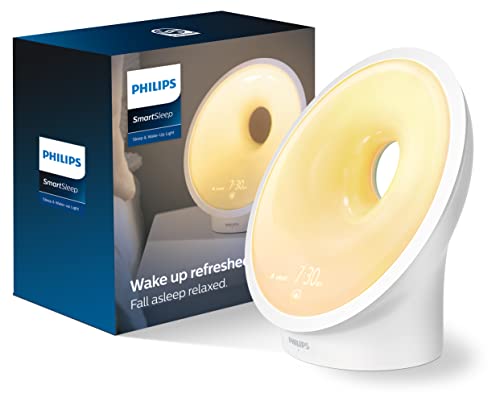
Philips SmartSleep Sleep and Wake-Up Light (HF3650/60) — Best Overall
Philips essentially created this category, and the HF3650 is its most complete expression. The sunrise simulation builds through colours rather than simply brightening a white lamp, the sunset side fades light and sound together for the evening, and the RelaxBreathe feature uses rhythmic light to pace breathing as you fall asleep. Multiple light and sound options let the routine be tuned rather than endured. For the search’s core promise — alarm clocks that use natural light to wake you up — this is the benchmark the others are measured against.
Strengths
- Full colour sunrise progression feels like morning arriving, not a lamp switching on
- Sunset simulation plus guided breathing makes it a sleep tool, not just a wake tool
- Multiple sounds and intensities allow genuine personalisation of the routine
Trade-offs
- Premium positioning in the category — it is the reference product, priced like one
- Feature depth means a real setup session; give it an evening, not a rushed minute
- App-free control is a virtue for many, a limitation for phone-first households
Key specs: Coloured sunrise and sunset simulation; multiple lights and sounds; RelaxBreathe wind-down (details from the confirmed listing title).
The wake experience is the product, so judge it precisely. Light begins at a deep, dim red-orange well before the alarm time and builds through warm tones to bright daylight white at the set hour, with sound joining only at the end if you want it. Many users find they surface during the light phase itself, somewhere in the last third of the ramp, which is the entire physiological idea: the body begins waking before consciousness is asked to. Heavy sleepers can set the sound as a firm backstop rather than the main event.
The evening side earns its keep more than expected. A fading sunset with diminishing sound gives the nervous system a down-ramp to mirror the morning’s up-ramp, and the breathing feature — light pulsing at a calming rhythm to breathe along with — is genuinely used by owners who expected to ignore it. Sleep is a routine at both ends; this is the only pick that engineers both ends with equal seriousness.
Placement is simple: bedside, at pillow height roughly, close enough that the light reaches your face across the pillow. Set the ramp length generously at first — the longer simulations feel luxurious rather than slow once you trust them — and give the routine a full week before judging, because circadian habits shift over days, not in a single morning.
Best for: anyone wanting the most complete natural-light wake and sleep routine / Not suited for: buyers who want the simplest possible clock with no setup depth
Check the current price on Amazon

Philips SmartSleep Wake-Up Light (HF3520/60) — Best Classic Philips
The HF3520 is the model that carried the wake-up light idea into the mainstream: coloured sunrise and sunset simulation, five natural sounds, an FM radio for those who wake to voices, a reading lamp bright enough to be useful, and a tap-snooze top that answers a sleepy hand without a button hunt. It lacks the flagship’s breathing coaching, and in exchange it is simpler, proven over years of production, and frequently the value point of the Philips line during promotions.
Strengths
- Coloured sunrise and sunset, not a single-tone dimmer with ambitions
- Tap snooze is the control you actually use at 6 a.m. — the whole top of the clock
- Reading lamp brightness makes it a genuine bedside lamp replacement
Trade-offs
- No guided breathing feature; the wind-down is light and sound only
- FM radio is a virtue for some, dead weight for streaming households
- Design is the classic dome — loved or merely tolerated, rarely neutral
Key specs: Coloured sunrise/sunset simulation; 5 natural sounds; FM radio; reading lamp; tap snooze (details from the confirmed listing title).
In daily use the HF3520’s charm is its lack of friction. The sunrise builds through colour to a proper room-brightening finish, the sounds are natural recordings rather than electronic beeps, and the tap snooze forgives the half-awake. Owners upgrading from a phone alarm consistently report the same surprise: the last ten minutes before the sound, surfacing gradually through light, stop feeling like an interruption and start feeling like a decision.
As a reading lamp it replaces a second device on the nightstand, which matters in small bedrooms. The light quality at full brightness is warm and even, and the sunset function dims it away if you fall asleep reading — a small mercy that becomes a nightly habit. Set the reading brightness and the wake brightness independently in your mind: they are different jobs, and this clock does both without compromise worth mentioning.
Choose it over the flagship when the breathing coaching does not call to you, or when its price during a promotion makes the decision easy. The core sunrise — the thing this search exists for — is fully present here, in colour, with the sounds and radio to finish the job.
Best for: buyers wanting proven Philips sunrise quality without flagship depth / Not suited for: users who specifically want guided breathing wind-down
Check the current price on Amazon

Hatch Restore 3 — Best for Sleep Routines
The Hatch Restore 3 approaches the nightstand from the routine side. Its circadian lighting provides the sunrise wake, while its real depth is the library of sleep audio — sounds, stories and meditations managed through the Hatch Sleep app — arranged into a screen-free bedtime routine you trigger from the device itself. The phone builds the routine; the bedroom stays free of it. For households whose problem is the whole night — falling asleep, staying asleep, then waking — that breadth is the argument.
Strengths
- Deep audio library turns the clock into a complete sleep environment, not just an alarm
- App-built routines run screen-free at the bedside, keeping phones out of the bedroom
- Sunrise lighting handles the morning end of the same routine
Trade-offs
- Full value depends on the app ecosystem; content and features should be checked on the current listing
- Less of a standalone clock for buyers who want zero phone involvement anywhere in setup
- Audio-first design means the light, while effective, is not the Philips-style colour showpiece
Key specs: Circadian sunrise lighting; extensive sleep-audio library; app-managed routines; screen-free bedside controls (details from the confirmed listing title).
The routine logic is the insight. A Hatch evening might run: warm dim light and a story at bedtime, a sound mask through the night that smooths over household and street noise, then a sunrise that lifts the room before a gentle wake sound. Each phase is ordinary alone; sequenced automatically, they remove the nightly negotiation with willpower that ruins most sleep intentions. Parents building children’s routines and adults rebuilding their own use the same machinery.
Sound masking deserves its paragraph, because for many buyers it matters more than the sunrise. A consistent audio bed hides the irregular noises — plumbing, partners, dawn traffic — that fragment light sleep, and the library’s depth means the mask can be one you genuinely like rather than tolerate. Pair that with a morning light ramp and the Restore addresses the two ends of the night that determine how the day feels.
Go in with clear eyes about the app: setup, library browsing and routine building live there, and some content models in this category involve subscriptions — check the current listing for exactly what is included before buying. Buyers comfortable with that model get the most complete sleep system here; buyers allergic to it should choose the Philips or Lumie and lose nothing at the sunrise end.
Best for: households wanting one device for falling asleep, staying asleep and waking / Not suited for: buyers who refuse any app involvement in a bedside clock
Check the current price on Amazon

Lumie Bodyclock Shine 300 — Best Light Quality
Lumie is the light specialist in this roundup — a company whose whole business is light therapy — and the Bodyclock Shine 300 shows it. Its signature control is custom light duration: the sunrise and sunset ramps can be set to the length your body actually responds to, rather than accepting a fixed programme. The warm LED output doubles as a reading light and a low night light, making it the most lamp-like of the picks, in the best sense.
Strengths
- Customisable ramp duration is the finest-grained light control in this guide
- Warm, high-quality light output serves reading and night duties genuinely well
- Specialist maker: light is the company’s entire expertise, and it shows in the gradients
Trade-offs
- Fewer audio frills than the sound-library competitors
- Physical controls reward a proper setup session rather than app convenience
- Availability and pricing vary more by region than the global brands’
Key specs: Custom sunrise/sunset duration; warm LED bedside lamp; reading and night light modes (details from the confirmed listing title).
Ramp duration is a more personal variable than the industry admits. Some sleepers surface happily through a short brightening; others need a long, slow dawn to arrive awake rather than ambushed. The Shine 300’s custom duration lets you experiment honestly — start long, shorten across a fortnight, and keep the length at which you reliably wake during the light rather than at the sound. That experiment is the difference between owning a wake-up light and benefiting from one.
The light itself has the specialist’s smoothness: gradients without visible steps, warmth that flatters a bedroom at reading time, and a night-light level low enough for a partner’s sake. As a lamp it displaces the bedside light entirely, which declutters the nightstand and means the sunrise source is already positioned where a lamp belongs — at the right height, aimed at the room and the pillow’s edge.
Choose the Lumie when light quality and control are your priorities and audio libraries are not. It is the connoisseur’s pick in this category: fewer features on the box, more of the right ones in the glass.
Best for: light-sensitive sleepers who want to tune their dawn precisely / Not suited for: buyers wanting a large built-in sound library
Check the current price on Amazon

JALL Sunrise Alarm Clock — Best Value with Sound Machine
The JALL competes on completeness per pound. Its sunrise simulation is positioned for heavy sleepers, and around that core it stacks a white-noise sound machine with a wide sound count, FM radio, a Bluetooth speaker, a multi-colour night light and dual alarms for couples or weekday-weekend schedules. No single element claims flagship refinement; the proposition is that everything a bedroom clock could reasonably do is present, in one unit, at the accessible end of the category.
Strengths
- Dual alarms suit couples and split schedules — a genuinely used feature
- Sound machine plus Bluetooth speaker covers sleep audio and daytime use
- Night light with many colours doubles as a child’s room comfort light
Trade-offs
- Sunrise gradient and light quality are good rather than specialist-grade
- Feature stacking means menus; expect a setup read-through
- Brand support and longevity trail the Philips and Lumie institutions
Key specs: Sunrise simulation; 25 sounds with white noise; FM radio; Bluetooth speaker; 17-colour night light; dual alarm (details from the confirmed listing title).
Heavy sleepers should read its positioning carefully. The light ramp does the gradual work, and the sound library plus radio give the backstop real volume and variety — the combination, rather than any single element, is what reaches through deep sleep. Set the ramp as long as the clock allows and place it unobstructed; a value clock asked to wake a heavy sleeper from behind a stack of books is being set up to fail.
Dual alarms quietly solve a common household friction: partners an hour apart, or one person with weekday and weekend selves, no longer need phone alarms as the second system. The night light’s colour range makes the same unit plausible in a teenager’s room, where it can graduate from comfort light to first own alarm clock — a second life that stretches the value argument further.
As with all value electronics, buy it for the features you will use this month rather than the full menu. If sunrise, sounds and dual alarms are your list, the JALL covers it at a position the specialists do not attempt.
Best for: heavy sleepers, couples and value buyers wanting every feature in one unit / Not suited for: buyers prioritising light gradient quality above features
Check the current price on Amazon
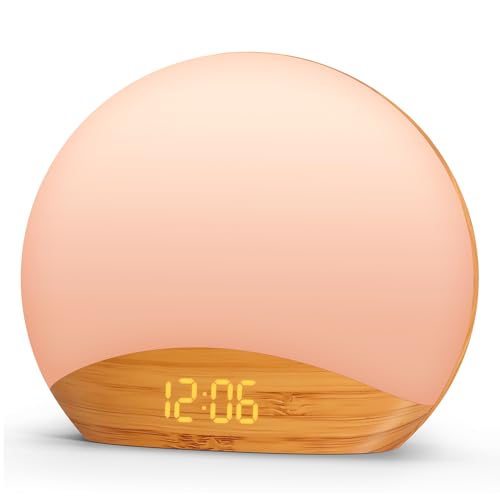
REACHER Wood Grain Sunrise Alarm Clock and Sound Machine — Best Compact Design
The REACHER wins its place on design and discretion. The wood-grain finish looks like bedroom furniture rather than electronics, the digital display dims properly for sleep, and the sunrise wake is paired with a sound machine carrying a broad library for the night side. It is explicitly comfortable across generations — listed for babies’ rooms, adults and kids — which reflects its gentle positioning: soft light, soft sounds, nothing that startles a household awake at the wrong hour.
Strengths
- Wood-grain finish blends into bedrooms where white electronics glare
- Properly dimmable display respects light-sensitive sleepers
- Sound library covers the night, sunrise covers the morning, in one compact unit
Trade-offs
- Light output is room-gentle rather than room-flooding; very deep sleepers may want a brighter flagship
- Compact size means smaller display digits for sight across a large room
- Design-led value positioning, not a light-therapy instrument
Key specs: Sunrise wake light; 26 sleep sounds; white noise machine; dimmable display; wood-grain finish (details from the confirmed listing title).
Bedrooms are visual environments, and a clock that looks like an alarm clock fights the room it sits in. The REACHER’s furniture finish and dimmed face let it disappear until it is needed, which is a real quality-of-life feature across years of nights. Its sunrise is accordingly gentle — a civilised brightening rather than a dawn raid — making it the right strength for average sleepers, children transitioning to their own wake routine, and anyone whose partner sleeps on a different schedule and needs the light kept polite.
The sound machine side is family infrastructure. White noise for a baby’s room, nature sounds for an adult’s wind-down, and a consistent audio bed that masks the household’s irregular noises — one compact unit covers the nursery’s first years and the guest room’s next decade. Dimmability ties it together: the display that informs at 9 p.m. should not glow at 3 a.m., and here it does not have to.
Choose it when the bedroom’s calm is the priority and the wake need is ordinary. Deep sleepers and light-therapy seekers have their picks above; the REACHER is for everyone whose morning simply deserves to start more gently than a phone alarm allows.
Best for: design-conscious bedrooms, children and average sleepers wanting a gentle dawn / Not suited for: very heavy sleepers needing maximum light output
Check the current price on Amazon
Comparison Table
| Pick | Badge | Key spec | Best for |
|---|---|---|---|
| Philips SmartSleep Sleep and Wake-Up Light (HF3650/60) (Check price on Amazon) | Best Overall | Coloured sunrise and sunset simulation | anyone wanting the most complete natural-light wake and sleep routine |
| Philips SmartSleep Wake-Up Light (HF3520/60) (Check price on Amazon) | Best Classic Philips | Coloured sunrise/sunset simulation | buyers wanting proven Philips sunrise quality without flagship depth |
| Hatch Restore 3 (Check price on Amazon) | Best for Sleep Routines | Circadian sunrise lighting | households wanting one device for falling asleep, staying asleep and waking |
| Lumie Bodyclock Shine 300 (Check price on Amazon) | Best Light Quality | Custom sunrise/sunset duration | light-sensitive sleepers who want to tune their dawn precisely |
| JALL Sunrise Alarm Clock (Check price on Amazon) | Best Value with Sound Machine | Sunrise simulation | heavy sleepers, couples and value buyers wanting every feature in one unit |
| REACHER Wood Grain Sunrise Alarm Clock and Sound Machine (Check price on Amazon) | Best Compact Design | Sunrise wake light | design-conscious bedrooms, children and average sleepers wanting a gentle dawn |
How to Choose a Wake-Up Light Alarm Clock
Begin with the ramp. A genuine sunrise simulation changes colour and intensity gradually; the best picks let you set the ramp’s duration and final brightness, because the right dawn is personal — deep sleepers need longer and brighter, light sleepers need less of both. Fixed, short, single-tone brightenings are the category’s weak end, and none of the picks here sits there, but the flagship and specialist models offer the finest control.
Then weigh the sound’s role in your life. If you expect to wake during the light most mornings, sound is a backstop and its library matters little. If you are a heavy sleeper, sound variety and volume become primary, and the value picks’ stacking of sounds, radio and dual alarms earns its place. Finally, decide whether you want an ecosystem — the Hatch’s app-built routines — or a self-contained clock, because that preference predicts satisfaction better than any specification.
Brightness, colour and what ‘natural’ means
Natural in this category means a progression: deep warm tones at the start, brightening through amber to a daylight white at the end, at an intensity that genuinely lights the bedside zone. Single-white-LED clocks that merely dim up are a compromise some budgets accept knowingly. The colour progression is not decoration — warm-to-white is how dawn reads to the visual system, and the picks that simulate it in colour are the ones owners describe as waking ‘with the morning’ rather than ‘to a lamp’.
The display problem nobody mentions
A wake-up light’s own clock display can undermine it: a bright, undimmable face leaks light into the room all night, working against the darkness the sunset side created. Dimmable or auto-dimming displays — a stated feature on the REACHER and handled thoughtfully across the Philips range — are therefore a real selection criterion for light-sensitive sleepers and their partners, not a footnote.
How to Set Up a Sunrise Alarm Routine That Actually Works
Give the clock its best chance with a deliberate first week rather than a factory-default first night. The sequence below assumes any pick in this guide and a consistent wake time — consistency is the routine’s active ingredient, so choose a wake time you can hold on weekdays and near it on weekends.
- Place the clock on your nightstand at roughly pillow height, unobstructed, angled toward your pillow.
- Set the longest sunrise duration offered, with the wake sound as a backstop at your must-rise time.
- Set a sunset or wind-down routine for the evening at a consistent time, and dim or switch off the display for the night.
- Hold the same wake time for seven days, noting each morning whether you woke during the light, at the sound or after it.
- Adjust one variable at a time — ramp length, then final brightness, then sound — until you reliably surface during the light.
- Keep a conventional alarm as insurance for unmissable mornings until the routine has proved itself for a month.
After the tuning week, the routine should disappear into the background: light builds, you surface, the day starts without negotiation. Revisit the settings at the season change, when natural dawn shifts and your artificial one may need to move earlier or grow brighter to stay ahead of it.
How Sunrise Waking Actually Works, Without the Hype
The mechanism is circadian, not magical. Light reaching the eyes — even through closed lids, at sufficient brightness — signals the body’s clock that morning has begun, easing the shift out of deep sleep and supporting the natural rise in alertness hormones that follows. A wake-up light stretches that signal across twenty to forty minutes, so the final sound, if it is needed at all, lands on a brain that has already begun surfacing. The felt result owners describe is consistent: less of the drugged, dragged sensation that follows a sound alarm fired into deep sleep.
Honesty requires the limits too. A wake-up light will not fix a five-hour night, a chaotic schedule or a sleep disorder, and this guide claims nothing medical for any pick here. What it can do — reliably, for most users who give it a week — is make a sufficient night’s sleep end more gracefully, and make dark winter mornings feel less like an ambush. Buy it as a better alarm, use it consistently, and judge it on mornings, plural.
Setting Ramp Length, Brightness and Sound: A Week-One Protocol
Start with the longest ramp the clock offers and the sound set as a backstop at your true must-rise time. For the first three mornings, note — honestly, in the notes app you will actually check — whether you woke during the light, at the sound, or after it. Waking during the light with time to spare means the ramp can shorten slightly; waking only at the sound means lengthen the ramp or raise the final brightness before blaming the concept.
Then tune the sound itself. Natural sounds and radio voices wake most people more kindly than tones at the same volume, and the volume should be the minimum that reliably works, because the light is supposed to be doing the heavy lifting by then. Change one variable at a time across the week; by the second weekend the clock should be configured to your nervous system rather than to its factory defaults, and that configuration is the product you actually bought.
Placement: The Unglamorous Detail That Decides Everything
A sunrise clock wakes the person it can reach. Place it on the nightstand on your side, roughly at pillow height, unobstructed by books, bottles or the partner-side clutter that accumulates by Friday. Light blocked is light wasted: a flagship behind a water carafe performs like a budget clock in the open. In shared rooms, angle it toward your pillow rather than the ceiling centre, and let the dimmable-display picks earn their keep for the partner’s sake.
Distance matters less than obstruction, but extremes fail both ways — across the room, the light becomes ambience rather than signal; inches from the face, the early ramp can feel abrupt. Nightstand distance is the design assumption for every pick here, so honour it before experimenting. Blackout-curtained rooms, incidentally, are where wake-up lights shine brightest, because the artificial dawn is the only dawn the room receives.
Sunset Routines: The Half of the Clock Most Owners Discover Late
Nearly every pick here dims as well as brightens, and owners routinely report the sunset side becoming the more valued half. A programmed fade gives the evening a shape: light and sound diminishing together tell the body the day is closing, in the same language the morning uses to open it. Pair the fade with the household’s real wind-down — last screens, book, breathing feature if your pick has one — and the clock becomes the metronome of the whole night rather than a morning gadget.
Children respond to the sunset side with particular clarity, because a light that visibly goes to sleep is an instruction a tired parent does not have to repeat. The REACHER and JALL picks, with their night-light roles, extend naturally into that family use. However it is used, the principle is the same: regularity is the active ingredient, and the clock’s job is to make regularity effortless.
Wake-Up Lights for Shift Workers and Dark Climates
For shift workers, a wake-up light’s value inverts with the schedule: waking at 3 p.m. in a blacked-out room, the artificial dawn may be the only morning signal the body gets, and a consistent ramp becomes an anchor for a drifting circadian rhythm. Set the routine relative to your wake time, not to the sun, keep the room genuinely dark for the sleep phase, and let the clock be the fixed point around which meals and light exposure are arranged.
Dark-climate households are the category’s heartland for a reason. Months of waking before sunrise turn every morning into a negotiation with darkness, and a simulated dawn restores the cue evolution assumed. In those conditions the brighter flagship picks and the longest ramps earn their keep most clearly, and owners consistently describe the purchase less as an alarm upgrade than as getting mornings back.
When a Phone Alarm Is Still the Right Backstop
This guide sells no purism. Pilots, surgeons, exam candidates and anyone whose morning has a hard external consequence should run a conventional alarm as insurance behind the sunrise — set a few minutes after the light’s peak — until the routine has proved itself across a month of mornings. The backstop costs nothing, disturbs nothing when the light works, and removes the anxiety that itself lightens sleep.
Over time most owners find the backstop firing rarely enough to retire or keep as ceremony. Either outcome is success. The goal was never to win an argument against phone alarms; it was to make waking feel like morning rather than interruption, and every pick here, at its own level of light and sound, does exactly that when placed well and given its week.
Common Buying Mistakes
Judging after one morning. Circadian habits move over days. A fair trial is a week at a consistent wake time, with one adjustment at a time — anything less measures novelty, not the clock.
Hiding the clock behind nightstand clutter. Blocked light is wasted light. The sunrise must reach your face across the pillow, unobstructed, from nightstand distance.
Setting the sound as the main event. If the beep does the waking, the light is decoration. Set sound as a backstop, tune the ramp until the light does the work, and let the sound retire to insurance duty.
Ignoring the display’s night glow. An undimmed clock face can lighten the whole room’s night. Choose dimmable models or position the display away from the bed’s sightline.
Buying brightness without gradient. A harsh, instant, single-tone light is a lamp on a timer. The category’s value lives in the gradual, colour-changing ramp — verify that is what the listing describes.
Final Recommendation
Most buyers should start with the Philips HF3650: the most complete sunrise and sunset system here, and the category’s reference for a reason. The HF3520 delivers the same coloured-dawn core with proven simplicity, the Lumie Shine 300 serves light purists who want to tune their dawn’s duration precisely, and the Hatch Restore 3 serves households whose whole night — audio, routines, waking — needs one system. The JALL and REACHER bring the sunrise to value budgets, couples’ dual alarms and design-conscious or children’s rooms.
Whichever you choose, give it the week-one protocol and an unobstructed nightstand. A sunrise clock is a habit machine; set it up as one, and mornings change character within the fortnight.
For anyone wanting the most complete natural-light wake and sleep routine, start with the Philips SmartSleep Sleep and Wake-Up Light (HF3650/60): Check the current price on Amazon
For buyers wanting proven philips sunrise quality without flagship depth, start with the Philips SmartSleep Wake-Up Light (HF3520/60): Check the current price on Amazon
For households wanting one device for falling asleep, staying asleep and waking, start with the Hatch Restore 3: Check the current price on Amazon
For light-sensitive sleepers who want to tune their dawn precisely, start with the Lumie Bodyclock Shine 300: Check the current price on Amazon
For heavy sleepers, couples and value buyers wanting every feature in one unit, start with the JALL Sunrise Alarm Clock: Check the current price on Amazon
For design-conscious bedrooms, children and average sleepers wanting a gentle dawn, start with the REACHER Wood Grain Sunrise Alarm Clock and Sound Machine: Check the current price on Amazon
Best Sunrise Alarm Clocks Best Wake Up Lights Best Alarm Clocks For Heavy Sleepers Best Sleep Sound Machines Best Bedside Lamps
Frequently Asked Questions
Do wake-up lights really work?
For most users, yes — as a gentler, more gradual way to wake. The fairest test is comparative: run your phone alarm for a week and honestly score the first ten minutes of each day, then run the sunrise routine for a week at the same wake time and score again. Most people do not need instruments to tell the difference — the drugged, startled quality of a sound alarm fired into deep sleep is unmistakable once you have mornings that begin with light instead, and the comparison, once felt, is rarely un-felt. The brightening light begins the body’s morning transition before any sound, so waking feels less abrupt. They are not medical devices and cannot compensate for too little sleep, but as alarms they are consistently preferred by owners who give them a consistent week to work.
How long should the sunrise simulation last?
Longer is usually kinder. Most clocks offer ramps in the twenty-to-forty-minute region, and customisable models like the Lumie let you set the duration precisely. Start long, and shorten only if you find yourself waking well before the end with time to spare.
I am a heavy sleeper. Will light alone wake me?
Possibly not at first — and the picks here anticipate that with sound backstops, radios and, in the JALL’s case, positioning for heavy sleepers. Heavy sleep is often partly a schedule problem wearing a disguise: a late, variable bedtime guarantees that any fixed wake time lands in deep sleep some mornings. The clock helps most when it is allowed to stabilise both ends — sunset routine at a consistent hour, sunrise at a consistent hour — because a body that falls asleep predictably also surfaces predictably, and the light’s job becomes easier week by week. Use the longest, brightest ramp, place the clock unobstructed, and keep the sound set firmly while you learn your response across a week. Many heavy sleepers find the light progressively does more of the work.
What is the sunset feature for?
The reverse of the sunrise: light and sound fade gradually in the evening, cueing the body that the day is closing. It also solves a practical household problem — the open-ended evening. Without a closing cue, screens and tasks expand until sleep is whatever time remains; a programmed fade draws a visible line, and households that adopt one often find bedtime drifting earlier without any resolution being made, simply because the room itself began saying goodnight. Owners often end up valuing it as much as the wake side, especially paired with a consistent bedtime. Several picks add wind-down help such as guided breathing or sleep audio.
Can a wake-up light help in winter?
Winter is its home territory. When your wake time falls hours before natural dawn, the simulated sunrise is the only morning light cue available, and owners in dark climates are the category’s most loyal users. It also restores a piece of information winter steals: a sense of time at waking. In a blacked-out bedroom in January, a phone alarm tells you the hour but your body believes it is midnight; a room that has brightened around you persuades the body, not just the mind, that morning is a real place and you are in it. The brighter, longer-ramp picks earn their keep most clearly in those months.
Should I still keep my phone alarm?
Keep it as a backstop for unmissable mornings until the routine has proved itself — set a few minutes after the light’s peak. Most owners find it fires less and less often. There is no prize for purism; the goal is a better morning, insured — and an insured routine is one you will still be running, relaxed and unbroken, when the clocks change and the dark months arrive.

