Disclosure: airfryerkitchensupply.com is reader-supported. When you buy through links on our site, we may earn an affiliate commission at no extra cost to you.
Where to buy
The fastest way to buy any pick in this guide to the best cold towels is Amazon, where every verified pick below is sold with its full size, colour and configuration options on one listing page. Use the links in this box to jump straight to the current listings, then check price on Amazon on the listing itself, because configurations and availability change often.
- Sukeen Cooling Towels 4 Pack (40″ x 12″) — Check on Amazon
- MISSION Max Plus Cooling Towel — Check on Amazon
- FROGG TOGGS Chilly Pad Cooling Towel — Check on Amazon
- Ergodyne Chill-Its 6602 Evaporative Cooling Towel — Check on Amazon
- MISSION Original Cooling Towel — Check on Amazon
- Ergodyne Chill-Its 6602MF Microfiber Cooling Towel — Check on Amazon
If a pick shows as unavailable in your size or finish, start from the closest alternative in the Quick Picks table rather than buying an unverified substitute with a similar name — several picks in this category are sold under look-alike listings that are not the products reviewed here.
The best cold towels — cooling towels, in the language most listings use — all work on one honest principle: evaporation. Wet the towel, wring it, snap it to activate the airflow through its fibres, and the evaporating water pulls heat from the fabric until it sits noticeably below air temperature against your neck, face or shoulders. No batteries, no chemicals doing anything mysterious, no refrigeration: just physics, a tap, and thirty seconds. Every pick in this guide was verified fresh against Amazon’s catalogue through the site’s Amazon product listings for this batch, because cooling towels are a category where look-alike listings multiply fast.
The real differences between models are material and size. PVA towels — the Frogg Toggs Chilly Pad is the classic — hold a lot of water, feel almost spongy, and stay cool for long stretches, but stiffen when dry and need storing damp. Microfiber towels — Sukeen, Mission, Ergodyne’s microfiber line — feel like ordinary soft towels, pack anywhere, and reactivate in seconds, but hold less water and need re-wetting sooner in serious heat. Mesh and performance fabrics split the difference. Size matters just as much: a 40-inch towel wraps a neck and shoulders properly; a 30-inch towel is a face-and-neck tool for a gym bag.
Set expectations the way this guide does throughout: a cooling towel cools the skin it touches, in conditions where evaporation works. In humid, still air it works less dramatically than in dry heat or moving air, and no towel replaces water, shade and rest in dangerous heat. Used honestly — at the gym, on the job site, on the sideline, in the garden — these six are the difference between enduring the heat and managing it.
In this guide
Quick Picks
Six picks survived our checks. Each one earned a different badge, because the best cold towels for one buyer is rarely the right answer for the next room, budget or body.
- Sukeen Cooling Towels 4 Pack (40″ x 12″) — Best Overall: Four full-size 40 x 12 inch cooling towels in one pack — one for the gym bag, one for the car, one for the garden, one in the wash. Check on Amazon
- MISSION Max Plus Cooling Towel — Best Long-Lasting Cool: Mission’s premium towel, rated by the maker to cool for up to three hours per activation, with UPF 50 sun protection in the fabric. Check on Amazon
- FROGG TOGGS Chilly Pad Cooling Towel — Best PVA Towel: The original PVA cooling towel: a 33 x 13 inch pad that holds water like a sponge, stays cool for hours, and is stored damp in its tube. Check on Amazon
- Ergodyne Chill-Its 6602 Evaporative Cooling Towel — Best for Work Sites: A workwear-grade evaporative towel from a safety brand, 29.5 x 13 inches — the jobsite standard, built to be issued, used and abused. Check on Amazon
- MISSION Original Cooling Towel — Best Classic: The original Mission towel — the design that popularised the category, still the balanced default for sport and spectating. Check on Amazon
- Ergodyne Chill-Its 6602MF Microfiber Cooling Towel — Best Long Microfiber for Work: Ergodyne’s microfiber version: a long 41 x 9.8 inch towel with UPF 50+, combining worksite credibility with a soft fabric feel. Check on Amazon
How These Picks Were Chosen
Every pick in this guide was verified fresh through the airfry site’s Amazon listing data on 2026-11-22: we searched the major cooling towel brands by name, matched the returned listings to the intended models, and took the ASINs from the listing responses. In a category flooded with generic copies, that verification is the difference between reviewing a known product and reviewing a photograph.
Selection then ran on use case. We required a genuine evaporative design from an established maker, a size suited to its job, and construction that survives a season of wet-dry cycles and machine washing. Multipacks scored for teams, families and gym bags that eat towels; single premium towels scored for workers who wear one all shift.
The six picks divide cleanly: a value multipack for most buyers, a premium long-duration towel, the original PVA pad, a workwear-grade towel from a safety brand, the classic original cooling towel, and a long microfiber work towel for all-day wear.
The 6 Best Cold Towels

Sukeen Cooling Towels 4 Pack (40″ x 12″) — Best Overall
The Sukeen 4-pack is the cooling towel purchase most people should make, because cooling towels live in several places at once and disappear like socks. The towels themselves are the proven format: 40 by 12 inches of soft microfiber that wraps the neck fully, cools on the standard wet-wring-snap activation, and packs into any bag corner when dry. Four of them ends the ‘where is my towel’ problem for a season.
Strengths
- Four full-size towels — every bag and car covered
- Long 40-inch wrap suits neck and shoulders properly
- Soft microfiber feels like a towel, not a sponge
Trade-offs
- Microfiber needs re-wetting sooner than PVA in extreme heat
- Multipack colours vary — check the listing options
- Like all microfiber, keep away from fabric softener
| Size | 40 x 12 in |
| Pack | 4 towels |
| Material | Microfiber |
| Activation | Wet, wring, snap |
The pack format is the feature. Athletes rotate towels between sessions while one dries; families hand them out at the gate of a hot theme park; workers keep one at the bench and one in the truck. Single-towel purchases assume a tidiness that real summer life does not support.
Performance is the honest microfiber standard: a strong initial cool on activation, a steady working cool while the fabric holds moisture, and a ten-second refresh at any tap. In dry heat and moving air — cycling, running, roofing — that cycle repeats happily all day.
Wash them before first use and never with fabric softener, which coats the fibres and strangles the evaporation the whole product depends on. Air dry, and they stay soft and effective.
Best for: Most buyers — gyms, families, outdoor workers wanting spares / Not suited for: Workers needing the longest possible single activation — look at the Mission Max Plus
Check on Amazon — check the current price on Amazon before you decide, and confirm the exact configuration on the listing page.

MISSION Max Plus Cooling Towel — Best Long-Lasting Cool
The Mission Max Plus is the single-towel upgrade: a larger, more durable microfiber built to hold its cool longer between activations — the maker rates it at up to three hours — and to block sun while it does it, with UPF 50 protection woven in. For a full shift outdoors or a long tournament day, fewer trips to the tap is a genuine quality-of-life feature.
Strengths
- Longest activation window in this guide
- UPF 50 sun protection built into the fabric
- Durable construction for daily work use
Trade-offs
- Single towel at a multipack price point
- Longer cool depends on humidity and airflow, as always
- Larger size is more towel than a gym session needs
| Brand | MISSION |
| Rating | Cools up to 3 hours per maker |
| Protection | UPF 50 |
| Material | Microfiber |
Treat the three-hour figure the way you should treat all such figures: as the maker’s best case, in conditions friendly to evaporation. What is true in every condition is the ranking — the Max Plus holds more water in a denser weave than standard towels, so it outlasts them between activations, and on a roof or a sideline that margin is measured in comfort, not minutes.
The UPF 50 rating matters more than it looks: a wet towel around the neck is exactly where sunburn lands on workers and spectators, and a towel that blocks the sun while it cools removes the classic trade-off between covering up and cooling down.
Verified fresh through the API for this guide, the Max Plus listing is the genuine Mission article — in this category, buying the verified listing rather than a look-alike is half the product.
Best for: Outdoor workers, coaches and tournament parents facing full days in heat / Not suited for: Casual gym users — the Sukeen pack is better value
Check on Amazon — check the current price on Amazon before you decide, and confirm the exact configuration on the listing page.
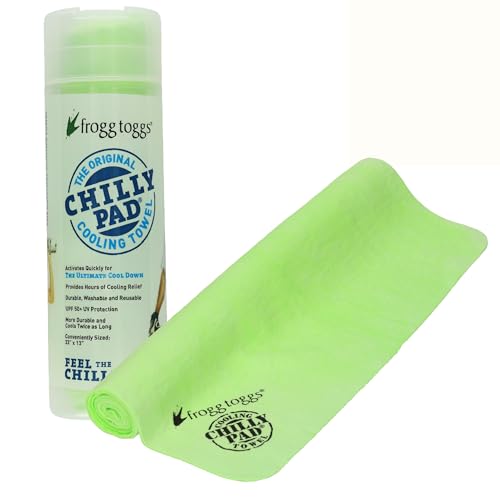
FROGG TOGGS Chilly Pad Cooling Towel — Best PVA Towel
The Chilly Pad is the towel that started the category, and its PVA material still does one thing better than microfiber: it holds a great deal of water and releases it slowly, so a single soaking can carry a long stretch of yard work, fishing or spectating. It feels different — smooth, dense, almost like a chamois — and it asks one discipline in return: store it damp, in its tube, because dried-out PVA goes stiff until re-soaked.
Strengths
- Holds the most water of any pick — long cool per soak
- The original, proven PVA design
- Storage tube included for damp keeping
Trade-offs
- Stiffens when dry; must be stored damp
- PVA feel is not for everyone — it is not fabric-soft
- Can tear if pulled hard when bone dry
| Size | 33 x 13 in |
| Material | PVA |
| Storage | Tube, keep damp |
| Feel | Smooth, chamois-like |
PVA’s water capacity is a genuine engineering advantage where taps are scarce: at a lake, a building site or a festival, the towel you soak once at breakfast and use until lunch is the towel that gets used. Anglers and gardeners — people whose hands are busy and whose shade is occasional — are the Chilly Pad’s natural constituency.
The stiffness quirk is real but manageable: thirty seconds under a tap returns a dry pad to full flexibility, and stored damp in its tube it is always ready. Buyers who want a towel that lives forgotten in a gym bag should choose microfiber; buyers who can keep a routine get the longest cool in the guide.
Never fold a bone-dry Chilly Pad sharply, and never leave it baking on a dashboard — PVA rewards minimal care and punishes only neglect.
Best for: Anglers, gardeners and anyone far from a tap for hours / Not suited for: Forgetful gym-bag owners — choose a microfiber pick
Check on Amazon — check the current price on Amazon before you decide, and confirm the exact configuration on the listing page.

Ergodyne Chill-Its 6602 Evaporative Cooling Towel — Best for Work Sites
Ergodyne makes gear for people who work in heat professionally, and the Chill-Its 6602 is the cooling towel as safety equipment: an evaporative PVA-style towel sized for a neck under a collar, sold in the safety channel where foremen buy them by the case. If your heat problem has a shift length and a hard hat, this is your pick.
Strengths
- From a professional safety brand — built for worksites
- Compact size fits under collars and PPE
- Proven evaporative design, easy activation
Trade-offs
- Smaller than the leisure picks — a neck tool, not a wrap
- Utilitarian looks and colours
- Shares PVA-family care: keep it ready, re-wet to refresh
| Size | 29.5 x 13 in |
| Brand | Ergodyne Chill-Its |
| Use | Worksite / PPE compatible |
| Activation | Soak, wring, snap |
The 6602’s size is a feature in context: on a site, a long trailing towel is a snag hazard and a nuisance under a hi-vis vest. This one covers the neck — where cooling does the most good — and stays out of the machinery’s way. Safety managers buy it because workers actually keep it on.
Like the other picks here it was verified fresh through the API for this guide, and its listing history in the safety channel is the real credential: this is the towel that gets reordered by people whose job is keeping crews working safely through August.
Pair it with the site’s water discipline: a cooling towel is the last line of heat management, after water, shade and rest breaks — a point Ergodyne’s own safety materials make and this guide endorses.
Best for: Construction, warehouse and outdoor crews; anyone in PPE / Not suited for: Leisure users wanting a big wrap — choose the Sukeen or Mission
Check on Amazon — check the current price on Amazon before you decide, and confirm the exact configuration on the listing page.

MISSION Original Cooling Towel — Best Classic
Before cooling towels were a category, there was the Mission Original: the towel athletes were seen wearing on a thousand sidelines. It remains a balanced, proven microfiber design — quick to activate, soft in use, sized for sport — and for buyers who want the established article rather than the newest variant, it is still the right answer.
Strengths
- The proven original design of the category
- Balanced size and feel for sport
- UPF sun protection in the fabric line
Trade-offs
- Standard activation life — the Max Plus lasts longer
- Single towel; spares cost extra
- Microfiber care rules apply — no fabric softener
| Brand | MISSION |
| Design | Original cooling towel |
| Material | Performance microfiber |
| Use | Sport and spectating |
Longevity in a fad-prone category is evidence: the Original has survived a decade of imitators because its balance is right — enough towel to matter, little enough to carry, and an activation ritual a child can do at a water fountain. For youth sports, it remains the towel coaches hand out.
Choose it over the Max Plus when your heat exposure comes in games and sessions rather than shifts: the shorter activation window never gets a chance to matter, and the money saved buys the spare towel that a kit bag always needs.
Snap it properly — a sharp snap is what pulls air through the weave and starts the evaporative cycle at full strength. A limp wave gives a limp cool.
Best for: Athletes, youth sports and spectators wanting the proven article / Not suited for: All-day workers needing maximum activation length
Check on Amazon — check the current price on Amazon before you decide, and confirm the exact configuration on the listing page.
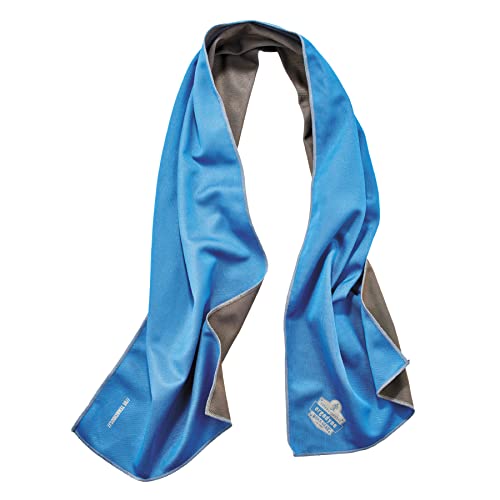
Ergodyne Chill-Its 6602MF Microfiber Cooling Towel — Best Long Microfiber for Work
The 6602MF takes Ergodyne’s worksite brief and answers it in microfiber instead of PVA: 41 inches of soft fabric that wraps the neck fully, stays where a collar leaves off, and carries a UPF 50+ rating for the uncovered skin a shift leaves exposed. It is the pick for workers who disliked the PVA feel but need the work-grade intent.
Strengths
- Extra-long 41-inch wrap in soft microfiber
- UPF 50+ sun protection
- Worksite brand, leisure-friendly material
Trade-offs
- Narrower cut — a neck wrap more than a shoulder drape
- Microfiber activation life is shorter than PVA
- Professional colours only
| Size | 41 x 9.8 in |
| Material | Microfiber |
| Protection | UPF 50+ |
| Brand | Ergodyne Chill-Its |
Length is this towel’s argument: at 41 inches it tucks into a shirt front and back, so it stays put through a shift of bending and lifting where shorter towels migrate and fall. Combined with the sun rating, it covers the two things an outdoor neck actually needs — cool and cover.
Verified fresh for this guide alongside its PVA sibling, the 6602MF shows where the category is heading: work-grade function in fabrics people describe as comfortable rather than effective. If you wear a cooling towel for eight hours, that difference in feel is the product.
It washes like other microfiber — cool, no softener — and because it is long, hang it fully extended to dry; a bunched microfiber dries sour.
Best for: Outdoor workers who want microfiber comfort in a work-grade towel / Not suited for: Buyers wanting the widest shoulder coverage — choose the Sukeen format
Check on Amazon — check the current price on Amazon before you decide, and confirm the exact configuration on the listing page.
Comparison Table
| Pick | Badge | Key spec | Best for |
|---|---|---|---|
| Sukeen Cooling Towels 4 Pack (40″ x 12″) | Best Overall | 40×12 microfiber, 4-pack | Most buyers — gyms, families, outdoor workers wanting spares |
| MISSION Max Plus Cooling Towel | Best Long-Lasting Cool | Premium microfiber, UPF 50 | Outdoor workers, coaches and tournament parents facing full days in heat |
| FROGG TOGGS Chilly Pad Cooling Towel | Best PVA Towel | PVA pad, 33×13 | Anglers, gardeners and anyone far from a tap for hours |
| Ergodyne Chill-Its 6602 Evaporative Cooling Towel | Best for Work Sites | Worksite evaporative towel | Construction, warehouse and outdoor crews; anyone in PPE |
| MISSION Original Cooling Towel | Best Classic | Classic sport cooling towel | Athletes, youth sports and spectators wanting the proven article |
| Ergodyne Chill-Its 6602MF Microfiber Cooling Towel | Best Long Microfiber for Work | Long microfiber, UPF 50+ | Outdoor workers who want microfiber comfort in a work-grade towel |
How to Choose the Best Cold Towels: Material, Size and Honest Physics
Material decides the ownership experience. PVA towels like the Chilly Pad hold the most water and cool the longest per soak, but feel like a chamois and must be stored damp. Microfiber towels — Sukeen, Mission, the 6602MF — feel like real towels, pack anywhere and forgive forgetful storage, but need re-wetting sooner. Choose PVA for long stretches far from water; choose microfiber for bags, gyms and daily convenience.
Size decides the job. Length around 40 inches wraps a neck and tucks in to stay; 33 inches covers neck and shoulders for seated heat — spectating, fishing, driving; 29 inches is a pure neck tool for work under PPE. Width matters less than length for cooling, because the neck and upper chest are where a towel does its best work.
And respect the physics: evaporation needs airflow and works best in lower humidity. A cooling towel in a dry breeze is dramatic; in still, saturated air it is modest. Snap the towel to restart airflow, re-wet before it dries fully, and treat the towel as one part of heat sense — alongside water, shade and rest — never as armour against heat illness.
How Cooling Towels Actually Work (and When They Struggle)
The cycle is simple: the fabric holds water in fine fibres with a huge surface area. Air moving across that surface evaporates the water, and evaporation carries heat away from the fabric — and from the skin beneath it. The snap in the activation ritual is not theatre; it pulls air through the weave and starts the cycle at full rate. As the towel dries, the effect fades; re-wetting restarts it indefinitely, which is why these towels are reusable for seasons.
Two conditions weaken the cycle. High humidity slows evaporation, because the air is already near its water capacity — expect a gentler cool on a muggy evening than on a dry afternoon. Still air does the same, which is why a towel feels cooler on a bicycle or in front of a fan than on a motionless spectator. Neither condition makes the towel useless — skin contact with wet fabric still cools — but honest expectations keep a good product from being judged by impossible ones.
Cold Towels for Work, Sport and Spectating: Matching the Pick to the Day
Work heat is a duration problem: choose the longest activation and the stay-put format — the Mission Max Plus for shifts in the open, the Ergodyne pair for PPE and site discipline. Sport heat is an intensity problem: choose quick reactivation and a towel that lives in the kit bag — the Sukeen pack and Mission Original. Spectating heat is a patience problem: hours seated in sun, where the Chilly Pad’s water capacity and a hat do the heavy lifting.
Families should simply buy the multipack. Heat management fails at the level of logistics — the towel left at home cools nobody — and a towel in every bag, car and buggy is the strategy that survives real life. That is why the Sukeen 4-pack leads this guide despite costing less than the premium singles.
Cooling Towel Care: The Fabric Softener Rule and Other Ways People Kill Them
More cooling towels are murdered by laundry than by heat. Fabric softener and dryer sheets coat microfibres with a waxy layer that blocks water absorption — the towel still feels soft and stops cooling entirely. Wash cooling towels cool, with ordinary detergent, and air dry; if a towel has already been softened, a wash with a little white vinegar often strips the coating and revives it.
PVA towels die differently: left bone dry and folded, they can crack or tear on the fold. Store the Chilly Pad damp in its tube, and always re-soak a dry pad fully before unfolding it. All cooling towels should be washed before first use and regularly through the season — a towel that smells sour is carrying more than water, and a clean towel evaporates better than a biofilmed one.
How to Use a Cold Towel Properly (Activate, Wear, Refresh)
Technique is half the product. A cooling towel used properly outperforms a premium towel used lazily, every time.
- Soak the towel fully until it is saturated — thirty seconds under a tap or in a water bottle’s worth of water.
- Wring it to damp, not dripping: a soaked towel wastes its water on your shirt in the first minutes.
- Snap it sharply three or four times, holding the ends — this pulls air through the fibres and starts the evaporative cool at full strength.
- Wear it on the neck with the ends tucked into your shirt, or draped over the head and neck under a hat in open sun.
- Refresh before it fully dries: a quick re-snap restores the cool while moisture remains; once dry, return to step one.
- At day’s end, rinse or wash the towel and hang it fully extended to dry — except PVA pads, which go back in their tube damp.
In serious heat, rotate two towels if you can — one worn, one soaking — and never let a towel substitute for drinking water. If someone shows signs of heat illness, a cooling towel is a comfort while you get them to shade, water and help, not a treatment in itself.
Common Buying Mistakes
Using fabric softener
Softener coats the fibres and quietly disables the evaporation the towel exists for. Wash cool with plain detergent; revive coated towels with a vinegar wash.
Wearing it dripping wet
Excess water runs off instead of evaporating through the fibres. Wring to damp — the cool lasts longer and your shirt stays dry.
Skipping the snap
The snap is the activation. Without airflow through the weave you are wearing a wet cloth, not running the evaporative cycle the product is built on.
Storing a PVA pad dry and folded
Dry PVA stiffens and can crack at folds. Keep the Chilly Pad damp in its tube and re-soak before unfolding a dried one.
Treating a towel as heat-illness protection
Cooling towels manage comfort, not medical risk. Water, shade, rest and attention to symptoms are the safety system; the towel is one pleasant part of it.
Final Recommendation
Most buyers should start with the Sukeen 4-pack: full-size towels everywhere you need them, at pack value. Long shifts and tournament days justify the Mission Max Plus; distance from water argues for the Chilly Pad’s PVA capacity; worksites should take the Ergodyne 6602 or its long microfiber sibling; and athletes who want the proven article should take the Mission Original.
Whichever you choose, learn the activation properly, keep softener away from it, and keep it where the heat will find you. A cooling towel’s whole value is being there, wet and snapped, in the first hot minute.
Related reading: Best Cooling Towels For Gym · Best Gym Towels · Best Towels For Hot Weather · Best Neck Cooling Wraps
Cold Towels for Heat Safety at Work: Where They Fit in the Real System
Employers in hot industries treat cooling towels as one layer in a system, and home users should copy the structure. The system’s foundation is scheduling — the heaviest work in the coolest hours where the job allows — then water and electrolytes within arm’s reach, then shade and rest breaks that are actually taken, then clothing and PPE choices, and only then personal cooling aids like the towels in this guide. A towel at the top of a sound system is genuinely useful; a towel asked to substitute for the system is a hazard wearing a costume.
Within that structure, the worksite picks here — the Ergodyne pair above all — earn their place by compliance: a control workers actually use beats a superior control left in the truck. The 6602’s neck-sized format survives under PPE because it asks nothing of the wearer, and the long microfiber 6602MF stays tucked through a shift. Supervisors who issue towels by name, with a spare in the shade station soaking, see them used; supervisors who leave a communal pile see them vanish.
Know the warning signs the towel cannot fix: confusion, slurred speech, hot dry skin or a worker who stops sweating in serious heat are emergency signs, not tiredness. The correct response is shade, aggressive cooling with whatever water is at hand, and medical help — a cooling towel may be part of the shade response, but the call for help is the treatment. Every household and crew that works in heat should be able to recite that sentence, and this guide is glad to be the page that taught it.
Cold Towels Beyond the Obvious: Travel, Fever Days and the Gym Bag Audit
The cooling towel’s second career is in the travel bag. Long drives in a car with tired air conditioning, festival days, sightseeing in hot cities, theme parks with children — the towel that lives in the daypack turns a draining afternoon into a manageable one, and the Sukeen multipack format exists precisely so that every bag can hold one without a family negotiation. Dampen it at any fountain, and it asks for nothing else all day.
At home, a cooling towel is the fever day’s kindest object: across the forehead or around the neck of someone resting with a temperature, it gives the comfort of a cold compress that does not warm through in four minutes or drip like a flannel. It does not treat the fever — nothing in this guide treats anything — but comfort during illness is a legitimate household need, and a towel that can be reactivated at the bathroom tap all night earns its drawer.
Once a season, audit the gym bag: towels that smell sour after washing have a biofilm problem that a hot wash with a cup of white vinegar usually solves; towels whose fibres have gone limp and non-absorbent have usually been murdered by fabric softener, and the vinegar treatment is their last appeal. A cooling towel is a small machine made of cloth — maintained like one, it runs for years.
Cold Towels for Runners, Cyclists and Hot-Weather Training
Endurance athletes in summer live by a simple rule: cool the neck, spare the session. A cooling towel worn during a run or ride works continuously at the body’s most effective cooling address — the neck and upper chest, where blood runs close to the surface — and the picks here divide by discipline. Runners want the lightest towel that stays put: the Mission Original’s balanced format, or a Sukeen tucked through a waistband and rotated to the neck at every water stop. Cyclists, with airflow guaranteed, get the strongest evaporative effect of any users and can carry the smallest towel in the saddle bag for the same benefit.
Heat training has a discipline the towel serves but does not replace: acclimatisation is built over ten to fourteen days of progressive exposure, fluids and electrolytes are planned rather than improvised, and the session’s hardest efforts belong in the coolest available hour. The towel’s role is to make the work tolerable and the recoveries faster — worn in the rest intervals, draped cold over the head and neck, it pulls the body’s temperature back toward the next effort’s starting line.
After the session, the towel joins the recovery kit rather than the wash pile’s bottom: rinsed, hung fully open, and ready for tomorrow. Athletes who train daily in a hot season should own the rotation the Sukeen pack provides — one in use, one drying, one clean — because a towel still damp and sour from yesterday is a towel that gets left behind, and the session pays for the omission.
Choosing Cold Towels for Children and Older Adults
Two groups change the cooling towel calculus, and both are about supervision rather than product. For children, the towel is a genuine comfort on hot days — school sports, family hikes, theme park queues — with two adjustments: choose the soft microfiber formats children will actually keep on, in sizes that do not trail and tangle, and let the adult own the re-wetting rhythm, because a child absorbed in the day will wear a dry towel for an hour without noticing it has stopped working. The multipack format again proves itself: one per child, no negotiations.
For older adults, whose temperature regulation and thirst signals may both be less insistent than they once were, a cooling towel is a kind layer in a watched system: it should arrive with the water bottle, the hat and the scheduled shade, offered by someone who is also watching for the warning signs this guide lists in its work-safety section. The towel’s gentleness is its virtue here — no ice shock, no machinery, just a cool cloth that can be renewed at any tap.
In both cases the product advice is the same as everywhere in this guide — verified towels, correct activation, softener never — and the human advice is the addition: a cooling towel works best in the care of someone paying attention.
Cold Towels in the Car, the Boat and the Bug-Out Bag
The last habitats of the cooling towel are the mobile ones. In a car on a long summer drive — air conditioning ageing, sun through the glass, a driver who cannot stop every hour — a towel dampened at the last fuel stop and kept in a zip bag on the passenger seat is the difference between arriving drained and arriving human. Boats amplify everything: reflected sun, no shade that cannot be rigged, water everywhere except, paradoxically, in a bottle at hand — and a towel that reactivates over the side in lake water earns its locker space on the first still afternoon.
For emergency kits and bug-out bags, the cooling towel is one of the few comfort items that justifies its grams to serious preparers: it weighs almost nothing dry, needs only water to work, never expires, and serves in a heat emergency — a broken-down car, a power cut in a heatwave, a long walk home — exactly when cooling matters most and options are fewest. The Sukeen multipack exists for this logic too: one in the car, one in the kit, one in the gym bag, one in use. A towel in the right bag on the wrong day is worth a shelf of towels at home.
A Word on Sharing, Hygiene and the Communal Towel
Cooling towels get shared — handed to a wilting teammate, a hot child, a guest — and a sentence of hygiene keeps the kindness clean. A towel in active use is personal equipment for the day: it lives against skin and sweat, and it should be rinsed before it changes necks, and washed before it changes days. The multipack format this guide keeps recommending is, among its other virtues, the hygiene strategy: enough towels that sharing never has to mean the same towel.
Keep a clean, dry spare in the kit for exactly the person who did not bring one. It weighs nothing, it asks nothing, and on the day it is needed it is remembered longer than the score of the game or the length of the hike. Small equipment, properly shared, is what outdoor life runs on.
Storing Cooling Towels Between Seasons
A cooling towel put away wrong in October is a disappointment discovered next June, so the season’s end deserves two minutes of method. Wash every towel first — a towel stored with a season’s sweat in its fibres keeps that season permanently. Dry microfiber towels fully and store them loose, not compressed in a vacuum bag, which can set creases in the weave. PVA pads are the exception that proves the rule of the category: they go away damp in their tubes, as they live, because a PVA pad stored dry and folded is a pad at risk of cracking along the fold.
Store the set where next summer will look for it — with the swim bag, the camping box or the work gear, not in the linen cupboard’s archaeological depths. And put one in the car permanently rather than seasonally: heat does not respect the calendar, and the first hot day of the year is precisely the one nobody dressed for.
One final practical note: mark your towels if your household runs several identical ones — a stitch of coloured thread at the corner ends the whose-is-whose negotiations that multipacks otherwise invite, and it survives every wash. Small systems like that are what turn a good purchase into a household institution, which is the quiet ambition behind every pick in this guide.
Frequently Asked Questions
How do cold towels work without ice or batteries?
By evaporation. The fabric holds water across a huge fibre surface; air moving over it evaporates the water, and evaporation carries heat away, leaving the towel cooler than the air. Wet it, wring it, snap it to start the airflow — that is the entire mechanism.
How long does a cooling towel stay cold?
It depends on material, heat, humidity and airflow. Denser and PVA towels hold a cool longest per soaking — premium models are rated by their makers at up to a few hours — while standard microfiber needs refreshing sooner. Re-wetting restarts the cycle indefinitely.
Which is better, PVA or microfiber cooling towels?
PVA holds more water and cools longer per soak, but feels like a chamois and must be stored damp. Microfiber feels like a normal towel, packs anywhere and forgives storage, but needs re-wetting sooner. Choose by how far you will be from a tap.
Can I machine wash a cooling towel?
Yes — cool wash with ordinary detergent, and air dry. Never use fabric softener or dryer sheets on microfiber towels; the coating blocks absorption and disables the cooling effect.
What size cooling towel should I buy?
Around 40 inches long for a full neck wrap that tucks in and stays; about 33 inches for spectating and seated heat; around 29 inches for a pure neck towel worn with workwear or PPE.
Do cooling towels work in humid weather?
They work less dramatically, because humid air evaporates water slowly. Snapping for airflow and re-wetting more often helps, and the wet fabric still cools on contact — but expect a gentler effect than in dry heat.


