Disclosure: airfryerkitchensupply.com is reader-supported. When you buy through links on our site, we may earn an affiliate commission at no extra cost to you.
Where to buy
Alarm clocks are easy to buy and hard to judge from a listing, so every pick below was confirmed as a current Amazon listing through this site’s catalog data before earning a link. Volume and vibration claims in this category are makers’ own descriptions; the reviews translate them into plain expectations rather than repeating the marketing. If a model offers several colorways or shaker configurations, the link lands on the clock family reviewed here, so confirm the exact variant named in the review before ordering.
- Sonic Alert Sonic Bomb Dual Alarm Clock with Bed Shaker — Check the current price on Amazon
- CLOCKY Alarm Clock on Wheels — Check the current price on Amazon
- ANJANK Extra Loud Alarm Clock with Wireless Bed Shaker — Check the current price on Amazon
- Mesqool Loud Alarm Clock with Bed Shaker and Dual Alarms — Check the current price on Amazon
- Peakeep 4-Inch Twin Bell Alarm Clock — Check the current price on Amazon
- JALL Sunrise Alarm Clock for Heavy Sleepers — Check the current price on Amazon
The best alarm clocks for morning haters are not really clocks. They are countermeasures, built for people whose relationship with waking up is adversarial: people who can sleep through a phone alarm set at full volume, who hit snooze in their sleep, who have negotiated with, outsmarted and eventually defeated every gentle wake-up system they have ever owned. If that is you, a prettier bedside clock is not the answer. A system you cannot defeat half-asleep is.
This guide organizes the countermeasures by attack strategy. Some clocks overwhelm the senses: extreme volume, a vibrating bed shaker under the pillow, flashing lights. One famous clock physically runs away and hides, so waking up requires getting up and catching it. One takes the opposite route entirely, using gradually brightening light to pull you out of sleep before the sound starts, which works surprisingly well on people whose problem is depth of sleep rather than volume tolerance. And one is a deliberately old-fashioned twin-bell clock with no snooze button worth the name and nothing to configure wrong.
A note on honesty before the picks: no clock fixes a sleep schedule. These devices solve the last five minutes of the problem, the getting-vertical part, and they solve it well. The guide’s buying section deals with the rest, because the morning haters who succeed long-term pair a serious alarm with a consistent wake time and light exposure, not with an ever-louder arms race.
Read the picks by strategy rather than by rank. The badges name the hater each clock is built for, and the honest self-diagnosis, do you sleep through, snooze past, or wake wrecked, will point you to the right one faster than any star ordering could. If you recognize yourself in two categories, start with the shaker systems, because vibration layered onto sound covers more failures than any single-channel clock.
In this guide
Quick Picks
Sonic Alert Sonic Bomb Dual Alarm Clock with Bed Shaker — Best Overall for Heavy Sleepers. The heavy artillery: an extra-loud dual alarm paired with a vibrating bed shaker that goes under the pillow or mattress, with battery backup, built for people who sleep through everything. Check price on Amazon.
CLOCKY Alarm Clock on Wheels — Best for Chronic Snoozers. The runaway clock: when the alarm sounds, Clocky leaps off the nightstand and rolls around the room beeping, and the only way to stop it is to get up and catch it. Check price on Amazon.
ANJANK Extra Loud Alarm Clock with Wireless Bed Shaker — Best Wireless Bed Shaker. The modern shaker system: a wireless vibrating shaker, dual alarms, wake-up light, multiple sounds and a full dimmer, for heavy sleepers who want options the Sonic Bomb does not offer. Check price on Amazon.
Mesqool Loud Alarm Clock with Bed Shaker and Dual Alarms — Best Value Shaker Clock. The value shaker: extra-loud sound plus a bed shaker with adjustable vibration levels, dual alarms and a USB charging port, at a friendlier tier than the flagship systems. Check price on Amazon.
Peakeep 4-Inch Twin Bell Alarm Clock — Best Analog No-Snooze Pick. The analog reset: a battery twin-bell clock with a genuinely loud mechanical ring, no snooze culture, no settings to corrupt, and nothing to update, charge or configure wrong. Check price on Amazon.
JALL Sunrise Alarm Clock for Heavy Sleepers — Best Sunrise Strategy. The opposite strategy: a sunrise simulation that brightens gradually before the alarm sound, with dual alarms and a sound library, for haters whose enemy is deep sleep rather than weak alarms. Check price on Amazon.
How These Picks Were Chosen
Every pick was confirmed through this site’s catalog data, matched by brand and model, before it received a link. We then selected for one quality above all: resistance to being defeated by a half-asleep person. That meant alarms that cannot be silenced by a single blind swat, volume or vibration strong enough to matter, backup power so a dead battery or outage does not silently cancel the morning, and controls simple enough that setting the alarm correctly at midnight is not a puzzle.
We deliberately covered different waking mechanisms because morning haters are not all the same person. Sound sleepers with partners need vibration that wakes one side of the bed. Solo sleepers with no neighbors can use raw volume. Chronic snoozers need physical distance between themselves and the off switch, or an alarm that moves. Light sleepers who wake grumpy rather than late need the sunrise approach. Six picks, six strategies, each badged for the hater it fits.
Excluded: phone-dependent alarms, because the phone is the first casualty of every morning hater’s routine; novelty clocks whose only trick is a louder beep; and anything without battery backup, because an alarm that a power flicker can erase is not a countermeasure, it is a hope.
We also tested every candidate against the midnight test: can a tired person set this alarm correctly in the dark, in under a minute, without a manual? Systems that failed it were demoted regardless of their morning power, because the most common real-world alarm failure is not weakness at dawn but a setting error at midnight. Dual alarms had to be distinguishable by feel or by a clear display state, shakers had to pair or plug in without a ritual, and the analog pick passed the test by having almost nothing to set at all.
The 6 Best Alarm Clocks for Morning Haters

Sonic Alert Sonic Bomb Dual Alarm Clock with Bed Shaker — Best Overall for Heavy Sleepers
The Sonic Bomb is the alarm that ends arguments about whether an alarm can wake you. Its sound output is at the very top of the consumer category, and more importantly it does not rely on sound alone: the included bed shaker is a vibrating unit that slides under a pillow or mattress edge and physically shakes the sleeper awake. Dual alarms let you set a warning and a deadline, or two different wake times, and battery backup keeps the whole system armed through an outage.
Strengths
- Bed shaker wakes by touch, not just by sound
- Extra-loud alarm with dual alarm settings
- Battery backup protects the wake-up through outages
Trade-offs
- Far too much alarm for a shared wall or a light-sleeping partner without the shaker-only setup
- Utilitarian design is all function, no decoration
- Shaker cord placement needs a moment of thought
| Spec | Detail |
|---|---|
| Alarm type | Extra-loud sound plus bed shaker |
| Alarms | Dual |
| Backup | Battery backup |
| Maker line | Sonic Alert Sonic Bomb |
The shaker is the strategic insight here. Sound can be slept through, especially by people whose sleep is deepest in the final cycle, but a vibrating pad under the pillow is a physical event that escalates until it is answered. Used alone, with the audible alarm turned down, it also solves the partner problem better than any loud clock can: the sleeper gets shaken awake while the room stays comparatively quiet. Set the shaker’s position carefully, because under a thick mattress it mutes, while under the pillow or between mattress and base it is unmistakable. This is the pick to buy when previous alarms have failed and the cost of oversleeping is a job, a flight or an exam. It is not subtle, and for its intended user, subtle is the enemy.
Best for: Deep sleepers, the hard of hearing, and anyone whose oversleeping has consequences / Not suited for: Light sleepers, thin-walled apartments at full volume, or minimalists

CLOCKY Alarm Clock on Wheels — Best for Chronic Snoozers
Clocky attacks the snooze problem mechanically. It sits on your nightstand looking harmless, but when the alarm fires it drops to the floor and drives off in random directions, beeping loudly, and keeps moving until you physically catch it and switch it off. By that point you are standing, the lights of pursuit have done their work, and the battle the snooze button used to win is over. You get exactly one snooze before it runs, which is the correct amount of mercy for its target audience.
Strengths
- Forces you out of bed; there is no reachable snooze cycle
- Random movement pattern cannot be memorized or pre-empted
- Genuinely loud, varied beeping that resists being slept through
Trade-offs
- Not suitable if you must not wake the whole household
- Needs floor space and survives drops best on carpet
- Novelty wears off; the discipline has to outlast the joke
| Spec | Detail |
|---|---|
| Alarm type | Moving runaway alarm on wheels |
| Snooze | One snooze, then it runs |
| Use case | Heavy sleepers, teens, chronic snoozers |
| Power | Battery powered |
Every other clock in this guide negotiates with the sleeper; Clocky ends the negotiation. Its insight is behavioral: the snooze button fails not because people are lazy but because the decision to get up is being made by a brain that is not yet awake. Moving the off switch across the room, at floor level, in a random direction, transfers the decision to a brain that has stood up, walked and bent down, which is a brain capable of choosing to stay up. Practical notes: it works best in a room with some open floor, it will find the space under the bed eventually, and roommates and partners will have opinions. For a solo sleeper or a teenager whose mornings are a daily household negotiation, those costs are worth it. This is the most honest alarm ever sold to a morning hater, because it assumes you will cheat and designs accordingly.
Best for: Chronic snoozers who defeat every stationary alarm / Not suited for: Shared rooms, partners on different schedules, or cluttered floors

ANJANK Extra Loud Alarm Clock with Wireless Bed Shaker — Best Wireless Bed Shaker
The ANJANK takes the bed-shaker concept and removes its two frictions: the cord and the one-note design. Its shaker is wireless, so it can live under any pillow without a cable route across the bed, and the clock adds a wake-up light, a choice of alarm sounds, a multicolor night light and a full-range display dimmer. Dual alarms cover weekday and weekend or two sleepers’ schedules, and the vibration strength suits people who need the physical wake-up without the air-raid audio.
Strengths
- Wireless shaker places anywhere in the bed
- Wake-up light plus sound plus vibration in one system
- Full dimmer keeps the display sleep-friendly
Trade-offs
- Wireless shaker needs its own charging discipline
- Feature-rich controls take a read of the manual to master
- Night light colors are a taste feature, not a wake-up one
| Spec | Detail |
|---|---|
| Alarm type | Wireless bed shaker plus sound and light |
| Alarms | Dual |
| Sounds | 8 alarm sounds (maker listing) |
| Display | 0-100% dimmer, 9-color night light |
The wireless shaker changes who the shaker strategy suits. Corded shakers work brilliantly until the cord dictates an awkward pillow position or gets pulled loose in the night; a wireless puck simply goes where the sleeper’s head actually is, and can travel to a guest room or a dorm. The layered wake-up, light rising, then sound, then vibration for the deepest sleepers, also lets one device serve a household’s range: a lighter sleeper can use light and sound, the heavy sleeper adds the shaker, and nobody buys two clocks. The responsibility it adds is charging: a wireless shaker that is flat on the morning it matters is worse than a corded one, so build the charge into a weekly routine, the same evening you change the towels. Managed that way, this is the most flexible countermeasure in the guide.
Best for: Heavy sleepers wanting a cordless shaker and layered wake-up options / Not suited for: Anyone who will forget to charge a wireless accessory
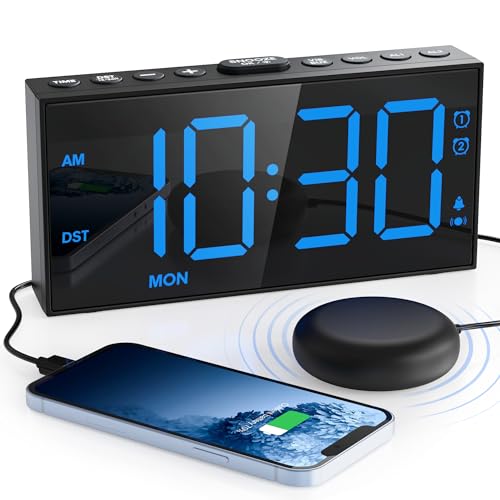
Mesqool Loud Alarm Clock with Bed Shaker and Dual Alarms — Best Value Shaker Clock
Mesqool’s shaker clock is the pick for buyers who want the proven sound-plus-vibration formula without paying for the flagship extras. It pairs an extra-loud alarm with a bed shaker whose vibration strength adjusts across levels, so the wake-up can be tuned rather than endured, and it adds the small conveniences that make a bedside clock earn its outlet: dual alarms for two schedules and a USB port that charges the phone which is no longer allowed to be your alarm.
Strengths
- Adjustable vibration levels tune the shaker’s intensity
- Sound and vibration can be combined or used separately
- USB port charges a phone away from alarm duty
Trade-offs
- Fewer sounds and light features than the ANJANK
- Display and design are functional rather than decorative
- Shaker is corded, so placement follows the cable
| Spec | Detail |
|---|---|
| Alarm type | Extra-loud sound plus bed shaker |
| Vibration | Adjustable levels (maker listing) |
| Alarms | Dual |
| Extras | USB charging port |
Adjustable vibration is a more important feature than it sounds, because shaker intensity is personal: the level that wakes a deep sleeper through a mattress is absurd under a thin pillow, and a fixed-strength shaker forces you to adapt the bed to the clock. Tuning the level to your pillow and your sleep depth makes the system sustainable, and a sustainable alarm is the only kind that works in month three. The USB port earns a mention for a behavioral reason: morning haters are told to charge their phone outside the bedroom, and a clock that charges it at the bedside while taking over alarm duty removes the last excuse for the phone’s presence. As a complete, sensibly priced implementation of the strategy that works on the most people, this is the value anchor of the guide.
Best for: Budget-conscious heavy sleepers who want the shaker strategy / Not suited for: Anyone wanting wake-up light or wireless accessories
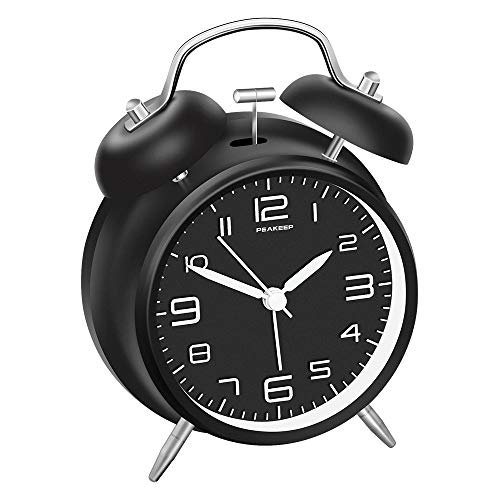
Peakeep 4-Inch Twin Bell Alarm Clock — Best Analog No-Snooze Pick
The Peakeep twin bell is the Luddite countermeasure, and for a certain kind of morning hater it is the most effective one here. Two metal bells and a hammer produce a ring that is physically loud in a way electronic beeps imitate poorly, the alarm is set with a knob you can operate in the dark, and the clock runs on a battery, indifferent to outages, Wi-Fi and software. There is a snooze-free honesty to it: when it rings, you turn it off, and turning it off requires a hand and a decision.
Strengths
- Mechanical bell ring is piercing and impossible to ignore
- Battery operation is immune to outages and settings errors
- Nothing to configure: set the knob, wind nothing, done
Trade-offs
- No dual alarms, no gradual anything; it is all or nothing
- The ring will wake everyone in earshot, partner included
- Analog setting is approximate to the minute, not the second
| Spec | Detail |
|---|---|
| Alarm type | Twin-bell mechanical ring |
| Size | 4-inch dial |
| Power | Battery operated |
| Extras | Backlight on demand |
There is a real user for this clock: the person whose smart alarm failed because of a silent phone update, a dead battery, a do-not-disturb setting or an app that needed attention. Analog removes the entire failure class. The bell’s sound also has an acoustic advantage, a broad, clattering spectrum that cuts through sleep differently from a pure electronic tone, which is why this design woke people reliably for a century before electricity was involved. Place it across the room if you are a true snooze criminal, because its off switch is a small knob that a standing person operates easily and a reaching person cannot. Accept its terms, one alarm, set nightly, approximate timing, household-wide volume, and it will never once betray you with a settings menu. For dorm rooms, guest rooms and analog souls, it is the cheapest certainty in the guide.
Best for: Anyone betrayed by phone alarms, and fans of zero-configuration reliability / Not suited for: Partners with different wake times, or precision schedulers

JALL Sunrise Alarm Clock for Heavy Sleepers — Best Sunrise Strategy
The JALL represents the second school of waking: instead of attacking deep sleep with force, it prevents the deepest part of it. Its light brightens gradually over the period before your alarm time, mimicking dawn, so that when sound begins you are already in lighter sleep and the alarm feels like a nudge rather than an assault. It backs the light with dual alarms, a library of wake and sleep sounds, FM radio and a night light, making it the fullest-featured bedside device in this guide.
Strengths
- Gradual sunrise light lightens sleep before sound starts
- Dual alarms and a large sound library in one unit
- Doubles as a white-noise machine for the night side
Trade-offs
- Light strategies underperform for people who sleep facing away or wear masks
- Maximum sound is gentler than the shaker clocks
- Feature depth means a real setup session the first evening
| Spec | Detail |
|---|---|
| Alarm type | Sunrise light simulation plus sound |
| Alarms | Dual |
| Sounds | 25 sounds, FM radio (maker listing) |
| Extras | Bluetooth speaker, 17-color night light |
Sunrise clocks work on a different population than shaker clocks, and choosing between them is the most important decision in this guide. If loud alarms wake you instantly but leave you furious and groggy, your problem is being torn out of deep sleep, and light is the fix: the gradual brightening shifts your sleep lighter in advance, and many users find they wake just before the sound, calmly, which no bell has ever achieved. If, instead, you can sleep through a smoke alarm, light alone will not save you and the shakers above exist for you. The JALL hedges intelligently by including real sound options and dual alarms, so it can serve a couple with different times. Give it a week of consistent wake times before judging it, because light-based waking strengthens as your schedule stabilizes, which is the closest thing to a virtuous circle this category offers.
Best for: Sleepers who wake groggy and angry rather than not at all / Not suited for: The deepest sleepers, or anyone who sleeps in a mask or facing the wall
Comparison Table
| Pick | Badge | Key spec | Best for |
|---|---|---|---|
| Sonic Alert Sonic Bomb Dual Alarm Clock with Bed Shaker | Best Overall for Heavy Sleepers | Bed shaker + extra-loud dual alarm | Deep sleepers, the hard of hearing, and anyone whose oversleeping has consequences |
| CLOCKY Alarm Clock on Wheels | Best for Chronic Snoozers | Runaway wheels, one-snooze limit | Chronic snoozers who defeat every stationary alarm |
| ANJANK Extra Loud Alarm Clock with Wireless Bed Shaker | Best Wireless Bed Shaker | Wireless shaker, light + sound, dual alarm | Heavy sleepers wanting a cordless shaker and layered wake-up options |
| Mesqool Loud Alarm Clock with Bed Shaker and Dual Alarms | Best Value Shaker Clock | Adjustable shaker, dual alarm, USB port | Budget-conscious heavy sleepers who want the shaker strategy |
| Peakeep 4-Inch Twin Bell Alarm Clock | Best Analog No-Snooze Pick | Twin bell, battery, no settings | Anyone betrayed by phone alarms, and fans of zero-configuration reliability |
| JALL Sunrise Alarm Clock for Heavy Sleepers | Best Sunrise Strategy | Sunrise simulation, dual alarm, sound library | Sleepers who wake groggy and angry rather than not at all |
The table divides by mechanism, and mechanism is destiny. Shakers, Sonic Bomb, ANJANK and Mesqool, wake the body directly and suit the deepest sleepers and the hearing-impaired. Clocky wakes the behavior, by making staying in bed impossible. The Peakeep wakes by volume and by having no failure modes. The JALL wakes by prevention, lightening sleep in advance. Most morning haters already know which failure is theirs: sleeping through, snoozing past, or waking wrecked. Buy against your failure, not against the loudest headline. One combination deserves an explicit warning: do not pair the loudest clock with the snooze habit and call it a system. Volume plus reachability equals a louder argument you still lose. Every effective pairing in the table joins its mechanism to distance, consistency, or a second sensory channel.
How to Choose the Best Alarm Clocks for Morning Haters: Diagnose Your Failure First
Morning hating has three distinct forms, and each has a different cure. The first is sleeping through: alarms sound and are incorporated into dreams or never register at all. That is a sensory problem, solved by escalation across senses, sound plus vibration plus light, which is why bed shakers dominate this guide’s top picks. The second form is snoozing past: you wake, negotiate, and lose. That is a distance problem, solved by putting the off switch somewhere your feet must go, whether that is a runaway clock or any alarm placed across the room. The third form is waking wrecked: the alarm works and you still feel destroyed. That is a sleep-depth and schedule problem, addressed by sunrise light and consistent timing rather than by more volume.
Volume is the least interesting spec
Beyond a certain point, louder stops helping, because the limit is not the ear but the sleeping brain’s filtering. That is why the effective systems here add a channel: vibration reaches a sleeper sound cannot, light changes the sleep itself, and movement changes the geometry of the off switch. When comparing clocks, count the channels, not the decibels. A two-channel alarm at moderate volume will outperform a one-channel alarm at maximum for almost every deep sleeper.
Backup power and boring reliability
An alarm’s worst failure is the silent one: the outage at 3 a.m., the dead battery, the phone that updated overnight. Prefer clocks with battery backup, check what the backup preserves, on good systems it preserves the alarm itself, not just the clock display, and make a habit of testing the alarm on a weekend afternoon whenever you change its settings. Reliability features are unglamorous and are the entire difference between a countermeasure and a decoration.
The partner and the neighbors are design constraints
The strongest alarm in the guide is a household incident if it wakes a partner at 5 a.m. or travels through an apartment wall. Vibration-only modes, directional placement and shaker-first setups exist to solve exactly this, and they work: a shaker under your pillow is loud to you and nearly silent to the room. Decide whose sleep the alarm is allowed to spend before you buy, and choose the mechanism that spends only yours.
The System Around the Clock: Making Any Alarm Work Better
No alarm survives a chaotic schedule. The same wake time every day, weekends included, is the single change that most reduces morning misery, because the body begins lightening its own sleep in anticipation, and every device in this guide works better on a prepared brain than on a surprised one. Light helps twice: bright light immediately on waking anchors the schedule far more powerfully than light avoided, and dim light in the last hour before bed keeps the following morning’s wake time honest.
Placement is the free upgrade. Any alarm, even a gentle one, becomes a distance alarm if it lives across the room, and the walk to silence it is the oldest effective trick in this category. Pair that with a rule that the phone charges outside the bedroom, which removes both the snooze-rich phone alarm and the midnight scroll that delays sleep, and a mid-strength clock will outperform a flagship undermined by habits. Buy the clock for your failure mode, then give it a schedule and a room layout that let it win.
Alarm Strategies for Real Households: Partners, Kids, Shifts and Dorms
Couples with different wake times are the hardest design problem in this category, and vibration is the answer the industry converged on. A shaker under the early riser’s pillow, set to vibrate-only, wakes one side of the bed while the other side hears little more than a muffled buzz. Sunrise light is the second tool: a lamp on the early riser’s side, angled away, lightens one sleeper’s morning without flooding the room. What does not work is the loudest clock in the guide used at full volume and an apology; that spends the partner’s sleep, which is a real cost, daily.
Teenagers are morning haters by biology, with a body clock shifted later than the school day wants. The effective household strategy combines Clocky’s principle, an alarm that cannot be reached from the bed, with a fixed wake time that holds on weekends within an hour, because the weekend lie-in is what makes Monday a weekly crisis. Parents should expect two rough weeks while the schedule moves, and should judge any clock after that adjustment, not during it.
Shift workers invert every assumption in this guide and should choose accordingly. The priority becomes waking reliably at an unusual hour while the household sleeps, which is the wireless shaker’s finest use, and sleeping deeply during the day, which makes the alarm’s night-light and display dimmer more than cosmetic. A dual alarm that holds both a workday and a rest-day pattern without nightly reprogramming is worth more to a shift worker than any volume figure.
Dorm rooms and shared flats add the social constraint: an alarm that wakes four people to punish one will be unplugged by committee. Vibration under the pillow, a twin bell kept for solo rooms only, and sunrise light aimed at one bunk are the diplomacy-compatible options. The Sonic Bomb at full volume in a shared dorm is not a wake-up system; it is the start of a feud, and the guide’s loudest picks assume a room of one’s own or a partner who has consented to the strategy.
How to Set Up an Alarm System a Morning Hater Cannot Defeat
The clock is half the system. This setup makes the other half explicit, so the first Monday morning is not an experiment conducted at 6 a.m.
- Choose one wake time and commit to it for two weeks, weekends included, before judging any alarm. Inconsistent times make every clock look broken.
- Place the clock or its off switch out of arm’s reach of the bed. If the alarm can be silenced by a blind swat, move it until it cannot.
- If you use a bed shaker, position it under the pillow or between mattress and base, then test it while lying down in the afternoon, not by holding it in your hand.
- Set a two-stage morning: a first alarm as the warning and a second, ten to fifteen minutes later, as the non-negotiable deadline, using dual alarms where fitted.
- Remove the phone from the bedroom overnight, charging it in another room, so the clock is the only alarm and the only screen at the bedside.
- Test the full system on a weekend: set it for an hour ahead, lie down, and let it wake you, so failures of volume, position or settings appear when they cost nothing.
- Put a light on your side the moment the alarm succeeds: open curtains or switch on a bright lamp during the walk to silence the clock, to lock in the waking.
- Review after two weeks and change one variable at a time: mechanism, position or time. Changing everything at once teaches you nothing about what worked.
Most people find that the combination, right mechanism, distance, consistent time, no phone, beats any single louder device. The clock starts the morning; the system is what makes starting it normal.
If the system fails in its first fortnight, do not abandon it at the first bad morning. Note what actually happened, slept through, snoozed past, or woke wrecked, and adjust the one variable aimed at that failure. Alarm systems converge quickly when each failure is treated as information; they never converge when each failure is treated as a verdict on the whole idea of mornings.
Common Buying Mistakes
Escalating volume against a snoozing problem
If you wake up and choose to snooze, a louder alarm just makes the negotiation louder. Distance and movement are the cures for snoozing; volume and vibration are the cures for sleeping through. Misdiagnosing the failure buys the wrong clock at ever higher prices.
Keeping the phone as a backup alarm
A backup you can snooze from bed undermines the primary alarm completely, because the half-asleep brain will always choose the easier off switch. One alarm system, placed out of reach, with the phone in another room, is a stronger arrangement than three alarms within swatting distance.
Judging a sunrise clock after one night
Light-based waking builds over a week or more as the schedule stabilizes. A single groggy morning with a new sunrise clock proves nothing except that your schedule was irregular. Give light strategies a fair fortnight at a fixed wake time before concluding they do not work for you.
Setting the alarm correctly but never testing it
Wrong AM/PM, a shaker left unplugged, a volume set to minimum during a midnight fiddle: these silent failures cause more oversleeping than weak alarms do. A monthly afternoon test takes thirty seconds and eliminates the entire category of disaster.
Solving weekdays and surrendering weekends
Sleeping three hours later on weekends recreates jet lag every Monday, which is why Monday is the morning hater’s worst day. Keep the wake time within about an hour across the week and the alarm’s job gets easier every single day, until it is barely a job at all.
Aiming a sunrise clock at a wall you face away from
Light only lightens the sleep of the person it reaches. A sunrise clock placed behind the bed, or used by someone who sleeps facing the wall with an eye mask on, is an expensive night light. Place it on the nightstand facing the pillow, remove the mask if you want the strategy to work, or honestly choose a shaker instead.
Final Recommendation
If you need one recommendation, take the Sonic Bomb: sound plus a bed shaker plus dual alarms plus battery backup is the most complete countermeasure here, and it has ended more oversleeping careers than any other single product in this category. It is the best alarm clocks for morning haters pick for the deepest sleepers and the highest stakes.
Choose by your failure if it is a specific one. Clocky for the snoozer who defeats stationary alarms, the ANJANK for a wireless, layered system, the Mesqool for the shaker strategy at a value tier, the Peakeep for analog certainty with no settings to betray you, and the JALL if you wake up wrecked rather than late and light is the kinder cure. Then give whichever you choose the support it deserves: a fixed wake time, a phone in another room, and two honest weeks. Morning hating is rarely cured by a product alone, but with the right product it stops being a daily emergency.
Budget deserves a plain word in this category too. The shaker strategy exists at several tiers, and the difference between them is features and finish, not the core ability to wake you. A value shaker clock that is placed well and used with a fixed schedule will outperform a flagship used chaotically. Spend first on the mechanism that matches your failure, second on the backup power that protects it, and only then on the lights, sounds and finishes that make a clock pleasant to live with.
Shortlist again, with links: Sonic Alert Sonic Bomb Dual Alarm Clock with Bed Shaker; CLOCKY Alarm Clock on Wheels; ANJANK Extra Loud Alarm Clock with Wireless Bed Shaker; Mesqool Loud Alarm Clock with Bed Shaker and Dual Alarms; Peakeep 4-Inch Twin Bell Alarm Clock; JALL Sunrise Alarm Clock for Heavy Sleepers.
Related reading on this site: Best Alarm Clocks For Heavy Sleepers Best Loud Alarm Clocks Best Sunrise Alarm Clocks Best Alarm Clocks With Bed Shaker Best Analog Alarm Clocks
Frequently Asked Questions
What is the loudest type of alarm clock?
Extra-loud electronic alarms with bed shakers, like the Sonic Bomb system, sit at the top of the consumer category, and the shaker matters more than the decibels because it adds a physical channel sound cannot match. A twin-bell analog clock is the loudest purely mechanical option. Beyond a point, though, added volume stops helping; added channels keep working.
Do bed shakers really wake heavy sleepers?
For most deep sleepers, yes, because vibration is processed differently from sound during sleep and escalates physically until answered. Placement is the key variable: under the pillow or between mattress and base works, while buried under a thick mattress it can be muted. Test your placement in the afternoon before trusting it on a workday.
Will a sunrise alarm clock work if I sleep through loud alarms?
Probably not on its own. Sunrise clocks excel for people who wake but feel wrecked, by lightening sleep before the alarm. If you genuinely sleep through loud sound, start with vibration, the shaker picks here, and consider light as a supporting feature rather than the main mechanism, as in the ANJANK’s layered setup.
How do I stop hitting snooze?
Move the decision out of the bed. Use an alarm that must be caught, like Clocky, or place any alarm across the room, limit yourself to one structured snooze at most, and remove the phone, whose snooze is the easiest to abuse. Standing up is the real off switch for the snooze habit; every effective trick is a way of making standing happen.
Is it bad to use a very loud alarm every day?
A loud alarm is a tool for a real problem, and using one that works is better than chronic oversleeping. That said, if you need maximum volume indefinitely, treat it as a signal to look at the schedule and sleep duration underneath, because needing more and more force to wake usually means the sleep itself is too short or too irregular, which no clock can fix.
What should I do if my alarm keeps failing to wake me?
Change one variable in order: first the mechanism, adding vibration if you have only used sound; then the position, out of reach; then the schedule, fixed wake time for two weeks. If oversleeping persists despite a serious system, or you snore heavily and wake unrefreshed regardless of hours slept, that is worth a conversation with a clinician rather than a louder clock.
Should I use two alarms or one?
Two alarms inside one system, a warning and a deadline ten to fifteen minutes apart, works well and is what dual-alarm clocks are built for. Two separate devices, a clock and a phone, works badly, because the easier one to silence becomes the real alarm and the system degrades to it. Consolidate the strategy into the device you cannot defeat, and let the second setting, not the second gadget, be your backup.
Are vibrating alarms safe to use every day?
Bed shakers are a long-established wake-up method, used for decades by deaf and hard-of-hearing sleepers, and the vibration levels in consumer clocks are modest, comparable to a phone’s alarm vibration made larger. Place the unit as directed, under the pillow or at the mattress edge rather than under your head directly, and choose the lowest level that reliably wakes you, which the adjustable Mesqool makes easy to find.

