Disclosure: airfryerkitchensupply.com is reader-supported. When you buy through links on our site, we may earn an affiliate commission at no extra cost to you.
Where to buy
Every tub below is sold on Amazon, which is where we recommend buying newborn gear: the exact model, its included sling or support, and its age guidance are clearly listed, and registry returns are simple if a gift duplicates. Most new parents start with our Best Overall pick, The First Years Sure Comfort Newborn to Toddler Tub — check price on Amazon. Parents who want a sling system should see the Fisher-Price 4-in-1 Sling ‘N Seat Tub — check price on Amazon, and small-home families the MoreFeel Collapsible Baby Bathtub — check price on Amazon. We do not print fixed prices because they change with promotions — check the current price on Amazon for the exact model named in each review.
Introduction
The best infant tubs for newborns exist to solve one nerve-wracking equation: a tiny, slippery, brand-new baby, a few inches of water, and a parent who has possibly never done this before. A good newborn tub answers it with support — a sling, net, cushion or shaped interior that cradles the baby at a safe reclined angle so your hands are free to wash gently — and with honest, simple design that fills, drains and cleans without drama. The six picks in this guide cover the main formats new parents choose between: classic convertible tubs that grow to toddlerhood, sling-and-seat systems, an in-tub support for families who prefer bathing in the main bath, and collapsible designs for small homes.
Safety frames everything here, so let us state the rules before the products. A baby in water is supervised every second, at arm’s reach, with your attention on the baby — no tub, sling or support changes that, and none is a babysitting device. Bath water should be comfortably warm, tested on the inside of your wrist or elbow before the baby goes in, and shallow for a newborn. Everything you need is gathered before the bath starts, because you do not leave to fetch it. Within those non-negotiables, the right tub makes bath time calmer for everyone — and every product and ASIN below was verified before earning a buy link.
In this guide
Quick Picks
- Best Overall: The First Years Sure Comfort Newborn to Toddler Tub — the classic convertible with a removable sling, proven by generations. Check price on Amazon
- Best Sling System: Fisher-Price 4-in-1 Sling ‘N Seat Tub — four stages from newborn sling to toddler tub, with toys included. Check price on Amazon
- Best Bath Support: Angelcare Soft-Touch Baby Bath Support — an ergonomic support that turns your main bath into a newborn bath. Check price on Amazon
- Best with Bath Net: AVIDOR Collapsible Baby Bathtub — a soft bath net, no-slip feet and a fold-flat body. Check price on Amazon
- Best for Small Homes: MoreFeel Collapsible Baby Bathtub — thermometer, floating cushion and a hooded towel in one kit. Check price on Amazon
- Best Budget Collapsible: BUNWAG Baby Bathtub — soft cushion, thermometer and no-slip feet at a friendly tier. Check price on Amazon
How These Picks Were Chosen
Newborn support decided the shortlist. Every pick had to cradle a baby who cannot yet hold up their own head — via a sling, net, cushion, contoured support or shaped recline — and hold that position securely in shallow water, because a newborn tub’s first job is to be the extra pair of hands. Stability came next: a tub or support must sit planted on its surface, with no-slip features where the design calls for them, and collapsible models had to lock open with conviction. We then judged the parent experience — filling and draining without lifting a heavy, sloshing tub, surfaces that rinse clean in seconds, storage that suits real bathrooms — because equipment that fights you gets used carelessly or not at all. Age range mattered honestly: some picks are newborn specialists, others convert to toddlerhood, and each review says which. Finally, every ASIN was cross-checked, so the tub you order is the tub reviewed, with the support pieces named in its listing actually in the box.
The 6 Best Infant Tubs for Newborns

The First Years Sure Comfort Newborn to Toddler Tub — Best Overall
The Sure Comfort is the tub that has bathed generations of newborns, and its formula remains the benchmark: a sturdy convertible tub with a removable sling that cradles a newborn above the waterline of the main basin, converting through stages as the baby grows to a toddler tub for ages 0 to 24 months. It suits first-time parents who want the proven answer, grandparents buying the registry staple, and anyone who values a design refined over decades of nursery feedback. The sling supports the baby so both your hands are free for washing — while you stay right there, hand near, eyes on the baby, as with every bath. It is a full-size tub, so the smallest bathrooms should measure and consider the collapsibles below.
Strengths
- Removable sling cradles newborns securely
- Converts through stages to a toddler tub, 0–24 months
- A proven, widely trusted design from an established baby brand
Trade-offs
- Fixed footprint — does not fold for storage
- Sling needs thorough drying after each use
- Basic styling compared with design-led rivals
Key specs: Convertible 3-in-1 tub; removable sling; newborn to toddler, ages 0–24 months; Sure Comfort design.
The Sure Comfort’s virtue is the absence of surprises. The sling clips in positively, the basin’s shape supports the stages the sling hands over to, and the whole tub rinses and drains the way a sleep-deprived parent hopes everything worked. Midwives of the internet — the experienced parents in every forum — recommend it for a reason: it removes every variable except the baby. If you want the newborn tub decision to be the easiest one on the registry, this is it, and its toddler second act means it is also one of the best-value objects in the nursery.
Best for: first-time parents and registry lists / Not suited for: bathrooms with no storage for a fixed tub
Check the current price on Amazon
Fisher-Price 4-in-1 Sling ‘N Seat Tub — Best Sling System
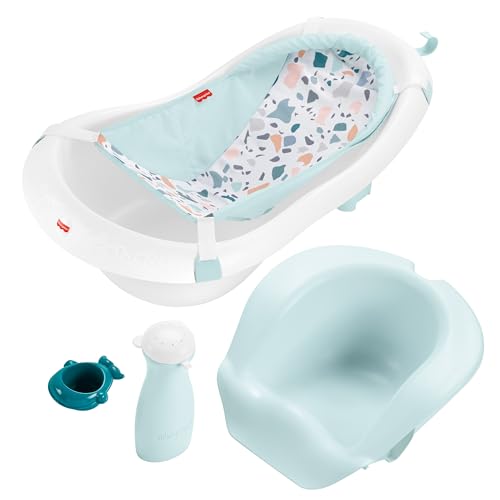
Fisher-Price’s system takes the staged idea furthest: a soft sling for the newborn stage, a removable infant support as the baby grows, and a roomy toddler tub at the end of the line — four stages in one purchase, with two toys included for the splashy months. It suits parents who like a complete, guided system, gift-givers who want to cover the whole first two years in one box, and babies who will be bathed by several caregivers, because the stages make the correct setup obvious to everyone. As with all slings, the newborn stage still means your hand stays on or beside the baby throughout — the sling positions the baby; you do the bathing.
Strengths
- Four growth stages in one system
- Removable infant support for the in-between months
- Trusted brand, with toys included for toddler stage
Trade-offs
- Stage pieces need storage between uses
- More parts to rinse than a single-piece tub
- Full-size footprint in the bathroom
Key specs: 4-in-1 Sling ‘N Seat design; removable infant support; 2 toys included; baby to toddler stages; Pacific Pebble colorway.
What the Fisher-Price understands is that the dangerous moments in baby bathing are the transitions — the week the newborn sling suddenly looks small, the month sitting wobbles begin. A staged system answers each transition with a named configuration instead of improvisation, and that structure reassures grandparents and partners as much as parents. The Pacific Pebble colorway keeps it calm-looking in a family bathroom, and the final toddler stage is genuinely roomy, so the system’s last act is not a squeeze. For households that think in systems, this is the complete one.
Best for: system lovers and multi-caregiver households / Not suited for: minimalists wanting one piece only
Check the current price on Amazon

Angelcare Soft-Touch Baby Bath Support — Best Bath Support
The Angelcare is a different format: not a tub but an ergonomic soft-touch support that sits in your main bath (or a large basin), cradling the newborn at a gentle recline in shallow water while the bundle’s rinser helps with gentle pouring. It suits families whose bathroom has a good main bath and no room for a separate tub, parents who prefer bathing the baby in the family bath from the start, and anyone who wants the quickest cleanup in this guide — rinse the support, hang it, done. The safety note matters most here: a support is used in shallow water in the main bath, with the baby supervised at arm’s reach every second, and it is never a seat to leave a baby in, in or out of water.
Strengths
- Ergonomic soft-touch cradle for newborns
- No separate tub to store — uses your main bath
- Rinses clean and dries in moments; bundle includes a rinser
Trade-offs
- Requires a suitable main bath or large basin
- Newborn-stage format — outgrown as babies sit
- Kneeling at a full-size bath is not for every back
Key specs: Soft-touch baby bath support and rinser bundle; ergonomic design; grey; for use in the main bath with shallow water.
The support format wins devoted fans for its simplicity. There is no tub to fill, empty, store or trip over — the bath you already own becomes the newborn bath with one shaped insert, and bath time can happen alongside a sibling’s in the same water-warm room, which families with two under three describe as a logistical miracle. The soft-touch surface is gentle against newborn skin and grips reassuringly rather than sliding. If your home has the bath and not the cupboard space, Angelcare’s answer is the most elegant in this guide.
Best for: main-bath bathing and storage-free homes / Not suited for: homes with only a shower, or as a toddler solution
Check the current price on Amazon
AVIDOR Collapsible Baby Bathtub — Best with Bath Net
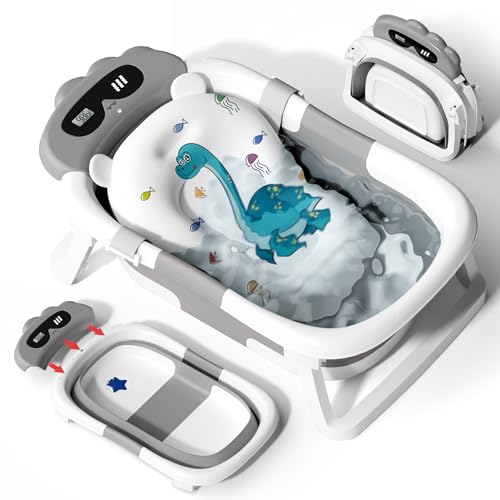
The AVIDOR pairs a collapsible body with a soft bath net that suspends a newborn gently in the water — a combination aimed squarely at nervous first baths. The net cradles the whole baby, the tub’s no-slip feet keep it planted, and when bath time ends the whole thing folds down for storage or travel, serving from newborn to toddler. It suits small homes, traveling families and grandparents keeping a bath for visits. Collapsible discipline applies: open it fully until it settles and locks before adding water, every time, and dry the net thoroughly between baths so it stays fresh.
Strengths
- Soft bath net cradles newborns gently
- Collapsible, portable design for storage and travel
- No-slip feet and newborn-to-toddler range
Trade-offs
- Net must be dried fully after each use
- Fold mechanism needs a firm setup check
- More setup than a fixed tub
Key specs: Collapsible baby bathtub; soft bath net included; no-slip feet; newborn to toddler; portable travel design.
The bath net is the AVIDOR’s argument: where a sling supports from beneath at points, a net suspends the baby in a gentle hammock that many newborns visibly relax into, and relaxed babies make for calm, quick, safe baths. Parents also praise the travel math — a real tub that folds into a suitcase corner means the baby’s bath routine survives holidays and grandparents’ houses unchanged, and routine is a newborn’s favorite thing. For a household that needs one tub to do home and away, the AVIDOR is the complete answer.
Best for: travel, small homes and net-cradle fans / Not suited for: those wanting zero setup
Check the current price on Amazon

MoreFeel Collapsible Baby Bathtub — Best for Small Homes
The MoreFeel is the reassurance kit in collapsible form: a folding tub with a built-in thermometer, a soft floating cushion for the newborn stage, and even a hooded towel in the box, plus a drain hole that empties the tub without lifting it. It suits first-time parents who want the temperature question answered visibly, small bathrooms where the tub must vanish between baths, and gift buyers who like a complete set. The thermometer guides you; your wrist or elbow still makes the final check on the water before the baby goes in, every time — that habit outlasts any gadget.
Strengths
- Built-in thermometer for quick water checks
- Soft floating cushion supports newborns
- Folds away; drain hole empties without lifting; hooded towel included
Trade-offs
- Cushion and towel add laundry to the routine
- Thermometer is a guide, not a substitute for your own check
- Collapsible body needs the lock-open check each use
Key specs: Collapsible bathtub for newborns; thermometer; floating cushion; hooded towel; drain hole; foldable travel design.
First baths are where the MoreFeel earns its fans: the thermometer takes the “is it too warm” spiral out of the first fortnight, the cushion keeps a tiny baby settled and supported, and the drain hole means nobody has to haul a full tub to the sink one-handed while holding a wet baby in the other arm — a small design decision with large safety-adjacent benefits. Folded, it slides beside the changing unit and the bathroom returns to the adults. As a complete starter system for a small home, it is hard to beat.
Best for: first-time parents in small homes / Not suited for: those wanting a single-piece fixed tub
Check the current price on Amazon

BUNWAG Baby Bathtub — Best Budget Collapsible
The BUNWAG delivers the collapsible essentials at the friendliest tier in this guide: a folding newborn-to-toddler tub with a soft cushion, a thermometer and no-slip feet, in a portable travel format. It suits budget-conscious parents, second tubs for grandparents or travel, and anyone who wants the fold-away life without paying for a premium badge. It asks the same collapsible disciplines as its pricier rivals — lock it open firmly, dry the cushion well — and gives up mainly finish and finesse rather than any part of the newborn brief.
Strengths
- Cushion and thermometer included at a budget tier
- Collapsible with no-slip feet for storage and travel
- Newborn-to-toddler service window
Trade-offs
- Finish and materials feel a step below premium picks
- Cushion care is part of the routine
- Brand support is thinner than the big names
Key specs: Collapsible newborn bathtub; soft cushion; thermometer; no-slip feet; portable travel tub.
There is a strong case that the second tub in a family’s life — the travel tub, the grandparents’ tub, the one that lives at the holiday house — should be exactly this: capable, compact and inexpensive enough that its loss or wear is a shrug rather than an event. The BUNWAG covers the newborn brief honestly, folds to nothing, and frees the budget for the main tub at home if you want to spend there instead. Many families reverse the plan and make the BUNWAG the only tub; nothing in its design argues with them.
Best for: budgets, travel and grandparents’ houses / Not suited for: buyers wanting premium finish
Check the current price on Amazon
Comparison Table
| Pick | Badge | Key spec | Best for |
|---|---|---|---|
| The First Years Sure Comfort | Best Overall | Removable sling, 0–24 months convertible | First-time parents |
| Fisher-Price 4-in-1 Sling ‘N Seat | Best Sling System | Four stages, infant support, toys | System households |
| Angelcare Soft-Touch Support | Best Bath Support | Ergonomic support for the main bath, rinser | No-storage homes |
| AVIDOR Collapsible | Best with Bath Net | Bath net, no-slip feet, folds flat | Travel and small homes |
| MoreFeel Collapsible | Best for Small Homes | Thermometer, cushion, towel, drain hole | First baths, small bathrooms |
| BUNWAG Collapsible | Best Budget Collapsible | Cushion, thermometer, no-slip feet | Budget and second tubs |
How to Choose an Infant Tub for a Newborn
Start with the support format that matches your confidence and your bathroom. Slings and nets (First Years, Fisher-Price, AVIDOR) suspend the newborn in the tub and are the most forgiving for brand-new parents. Cushions (MoreFeel, BUNWAG) float and cradle within a collapsible body and suit small homes. A bath support (Angelcare) skips the tub entirely and uses your main bath — brilliant if you have the bath and the knees for it, impossible if you have only a shower. Then decide the service window: a newborn specialist you will replace at sitting age, or a convertible that serves to toddlerhood and earns its storage space for two years.
Practicalities decide the rest. Where will it live — measure the storage before the tub arrives. How will it empty — a drain plug or a light body beats hauling a full fixed tub. How will it dry — slings, nets and cushions all need air after every bath, so a hook or rail near the bath is part of the purchase. And who else will bathe the baby — systems with obvious stages (Fisher-Price) make correct setup easy for grandparents and partners too. Finally, buy before the baby arrives if you can: the first bath comes quickly, and learning a tub’s setup with a real newborn waiting is nobody’s preferred order of events.
How to Bathe a Newborn: The Safe Routine, Step by Step
Before: Gather everything first — towel (hooded if you have one), soft washcloth, mild baby wash if you use it, a clean nappy and clothes, all within arm’s reach of the bath. Once the baby is in the water you do not leave, for anything; if the doorbell rings, it rings. The water: Fill the tub or bath with comfortably warm water — test with the inside of your wrist or elbow, where it should feel warm, never hot — and keep a newborn’s water shallow, settling their body in the sling, net, cushion or support with the head well clear. A thermometer, where fitted, is your guide; your skin is the verdict.
During: Lower the baby in slowly, feet first, keeping one hand supporting the head and shoulders whenever the baby is not fully settled in the support — and even then, stay at arm’s reach with your eyes on the baby, not the tap, not your phone. Wash gently with the cloth, top to toe, keeping the bath to a few calm minutes so the baby stays warm; pour water gently over the body with a cup or rinser to stop a chill. Talk or sing — the routine is also bonding, and a calm voice makes a calm baby. After: Lift the baby straight onto the towel, wrap, pat dry including the skin folds and cord area as your care provider has advised, dress promptly, and empty the tub immediately. Water is never left standing in a tub in a home with children, and the support pieces get rinsed and hung to dry the same hour.
Newborn Bathing Questions Every Parent Asks
Beyond the routine itself, a few practical questions come up in every first month. Frequency: newborns do not need a daily bath — a few baths a week, with gentle top-and-tail cleaning between, is the common pattern, and over-bathing can dry newborn skin; follow your own care provider’s guidance for your baby. Timing: choose a moment when the baby is calm and awake-ish and you are unhurried — many families land on the evening, where the bath becomes the first brick of a bedtime routine. The cord stump: until it falls away, follow your provider’s advice, which commonly means keeping it as dry as practical and preferring shallow water or sponge baths in the earliest days. Temperature of the room matters too — a warm bathroom and a towel ready the second the bath ends prevent the post-bath chill that makes babies cry and parents rush. None of these details needs equipment beyond this guide’s picks; they need a routine, repeated calmly, which is exactly what a good tub supports.
Matching the Tub to Your Home
The apartment with one small bathroom. Folding is survival: the MoreFeel or BUNWAG vanishes beside the changing unit, and the AVIDOR travels to grandparents without a second purchase. Measure the folded gap you actually have, not the one you wish for.
The house with a family bathroom. Fixed tubs come into their own — the First Years or Fisher-Price can live in or beside the main bath, ready in seconds, with room for a sibling audience. Storage stops being a criterion and stages become the deciding one.
The home with a big bath and no cupboard. The Angelcare support was designed for you: no tub at all, just a support that rinses and hangs behind the door, turning the bath you own into the newborn bath.
The two-home or traveling family. Duplicate the routine, not necessarily the tub: a collapsible at each base, or one AVIDOR that travels, keeps bath time identical everywhere — and identical is what a newborn calls safe.
Bath Time by Month: How the Tub’s Job Changes
Months 0–3. Everything is support and calm. The baby lies in the sling, net, cushion or support; baths are short, shallow and warm; your hand is never far from the head and shoulders. This is the stage every pick in this guide was primarily judged on, and the stage where a thermometer and a complete kit — the MoreFeel pattern — earn their keep while your confidence builds.
Months 3–6. Heads come up, kicks begin, and baths turn playful. Supports adjust, slings reposition, and the baby starts holding the experience rather than merely tolerating it. Water can be a touch deeper per the tub’s guidance, splashing is encouraged, and your supervision stays exactly as total — a stronger baby is a more mobile one, and mobile in water still means arm’s reach, always.
Sitting and beyond. Slings and newborn inserts retire; the tub becomes a small pool for a seated baby with toys, and stability and room take over from recline as the qualities that matter. Convertible tubs — First Years, Fisher-Price, the collapsibles — were bought for this second act. When a child can pull to standing in the tub, baths move toward the main bath with the same rules, and a well-kept tub gets cleaned, dried and passed to the next newborn.
Troubleshooting the First Baths
The baby cries through every bath. Work the variables in order: water temperature (recheck with your elbow — too cool is the usual culprit), room warmth, timing (a hungry or overtired baby hates everything), and speed (slow lowerings, a warm cloth laid over the tummy, a calm voice). Most babies convert within a week of consistent, warm, unhurried baths; if yours does not, mention it to your care provider rather than battling on.
The water cools before you finish. Newborn baths are meant to be short, so cool water is information, not failure: start comfortably warm, keep the bath to a few minutes, pour warm water gently over the baby as you go, and end on time. Never top up hot water with the baby in the tub.
The baby slips or slumps in the support. Stop, lift the baby out, and re-check the setup: sling tension and clip points, cushion position, the support’s placement and the water level. A support that does not hold the baby as the maker intends is not used again until the setup is right — and your hand stays the primary support throughout every bath regardless.
You feel shaky and terrified. Normal, and temporary. Bathe with a second adult present for the first weeks, use the most supportive format you own, keep baths short, and let confidence accumulate — it does, quickly, and the parent who was terrified in week one is usually the family’s bath-time expert by month two.
Accessories That Complete the Newborn Bath
A short list of supporting players makes any tub in this guide work better. A hooded towel — one rides along in the MoreFeel box — wraps a wet newborn instantly and keeps the head warm in the first crucial minute out of the water. A soft washcloth or two, reserved for the baby, handles the gentle washing; a rinse cup or the Angelcare bundle’s rinser pours water without splashes or surprises. A simple bath thermometer supports your wrist check in the early weeks, wherever the tub does not include one. A kneeling pad saves the adult’s knees at a main bath, and a small hook or rail beside the bath — for the sling, net or support to dry on — completes the system. Everything on this list is inexpensive, washable and obvious in hindsight; assemble it before the first bath and the routine runs like it was designed, because it was.
Sink Bathing and Other Alternatives, Honestly Assessed
Many newborns take their first baths in a clean sink, sometimes on a soft flower-style pad, and for the first weeks it can be the most comfortable format of all — standing height, tiny water volume, everything close. Its limits arrive with growth: sinks size out fast, taps need guarding, and the arrangement only works with the same arm’s-reach supervision as any bath. Kitchen-sink bathing also demands scrupulous cleaning of the sink before and after. Basin-on-the-floor bathing and in-shower tub placement serve some homes — a stable tub on a shower floor creates a bath in a shower-only home — with identical rules. None of these alternatives is a shortcut around the routine in this guide; they are venues for it. Choose the venue your home does best, equip it with proper newborn support, and the routine does the rest.
What the Money Buys in a Newborn Tub
The tiers divide by completeness and finish rather than by safety — every pick here supports a newborn properly, because that was the entry condition. The friendly tier, the BUNWAG, buys the collapsible essentials with a cushion and thermometer, finished plainly. The mid tier — AVIDOR, MoreFeel — buys refinement of the same ideas: better nets and cushions, drain holes, included towels, tidier folds. The established-brand tier — First Years, Fisher-Price, Angelcare — buys decades of design iteration, stage systems and support networks, in formats that do not fold. The correct question is not which tier is best but which format fits your bathroom, because a premium tub that cannot be stored will be tripped over for two years, and a budget collapsible in a big family bathroom gives up stages it never needed to. Buy the format first; the tier follows.
Registry and Gift-Buying Advice
Registries should name one tub, chosen for the parents’ actual bathroom, rather than collecting three formats from three generous relatives. The complete-kit principle travels well as a gift: the First Years with its sling, the Fisher-Price system, and the MoreFeel set all include their newborn support in the box, sparing new parents the classic second purchase. Gift-givers unsure of the home’s storage should default to a collapsible — a tub that folds is a tub that fits a life not yet rearranged around a baby. And everyone should keep receipts: babies arrive early, duplicates happen, and an easy exchange in week one is worth more than a surprise in week six. Second-hand tubs deserve the caution from our care section: accept rigid tubs you can inspect and clean completely, buy slings and cushions new where their condition cannot be verified, and never use a tub whose support pieces are missing.
Cleaning and Caring for a Baby Tub
The routine is two minutes and non-negotiable. After every bath, empty the tub completely, rinse it and its support pieces with clean water, and hang slings, nets and cushions to dry fully — a support stored damp is the one reliable way to ruin a good tub and give the next bath a musty start. Weekly, wash the tub with mild soap and a soft cloth, rinse thoroughly so no residue meets newborn skin, and air-dry open rather than folded. Check folding joints, drain plugs and sling stitching monthly; a tub is safety equipment, and worn parts retire it. Store the tub dry, out of direct damp, with its pieces together, and it will serve this baby, the next one, and the cousin after that — which is how the best tubs in this guide quietly become family institutions.
Two more habits separate calm bath households from anxious ones. The first is the dry run: before the baby’s first real bath, set the tub up completely — support fitted, water at temperature, towel laid out — and walk the routine once. Equipment surprises belong in the rehearsal, not the performance. The second is the two-adult start: for the first several baths, one adult bathes while the other hovers with the towel and the spare hands, and jobs swap once confidence settles. Neither habit costs anything, both are quietly universal among the parents who describe newborn baths as lovely, and either is worth more than any upgrade on a registry.
Common Buying Mistakes
Buying a toddler tub for a newborn. A tub without newborn support — sling, net, cushion or contoured cradle — cannot safely hold a baby who cannot support their own head. Check the newborn stage exists before anything else.
Trusting the thermometer alone. Built-in thermometers are guides. The final check is always your wrist or elbow, every bath, without exception.
Leaving the bath to fetch something. Everything is gathered before the water runs. A baby is never left in a bath unattended, not for ten seconds, not for the towel in the next room.
Overfilling “to keep the baby warm.” Newborn water stays shallow. Warmth comes from a warm room, a prompt routine and gentle pouring — not depth.
Forgetting drying and storage. Slings, nets and cushions stored damp turn musty fast. Rinse, shake and hang them after every bath, and choose a tub your bathroom can actually store.
Leaving water standing for the next bath. Empty every tub immediately after use. Stored bath water is a hazard and a hygiene failure in one.
One closing thought for the parent reading this at 3 a.m. with a registry open: the tub is the easy part. Every pick in this guide will hold your baby safely in shallow water while you learn the routine, and the routine — warm room, everything ready, water tested, hand on baby, tub emptied after — is what actually keeps bath time safe and calm. Choose the format that fits your bathroom, set it up before the baby arrives, and by the third bath you will wonder what you were nervous about.
Final Recommendation
If you take one sentence from this guide to the bathroom, take the routine: everything gathered first, water warm and shallow and tested on your own skin, the baby supported and never left for a moment, and the tub emptied the second bath time ends. The tub you choose simply makes that routine easier to keep — choose the one your home fits, and keep the routine like a promise.
For most new parents, The First Years Sure Comfort is the newborn tub to buy: proven, supportive and useful to toddlerhood. System households will love the Fisher-Price 4-in-1, main-bath families the Angelcare support, and small or traveling homes the collapsibles — the AVIDOR for its net, the MoreFeel for its complete first-bath kit, and the BUNWAG for its honest value. Whichever you choose, the routine makes the safety: everything within reach, warm shallow water tested on your skin, a hand and your full attention on the baby, and the tub emptied the moment bath time ends.
Related reading on this site: Best Chic Baby Bathtubs · Best Baby Bathtubs · Best Collapsible Baby Bathtubs · Best Baby Bath Tubs For Sinks · Best Baby Bathtubs For Small Bathrooms
Related guides
Frequently Asked Questions
When can a newborn have their first bath in a tub?
Follow your own care provider’s guidance — many families sponge-bathe for the first days, especially while the cord stump heals, and move to shallow tub baths soon after. Whenever you start, the rules are the same: warm shallow water tested on your wrist, everything within reach, and your hand and attention on the baby throughout. Practice the routine once without the baby — fill the tub, position the sling, rehearse the lift with a doll or a rolled towel — and the real first bath becomes a calmer event for everyone involved.
How warm should the water be?
Comfortably warm on the inside of your wrist or elbow — never hot. Thermometers built into tubs like the MoreFeel and BUNWAG are useful guides, particularly in the first weeks, but your own skin check is the final word before the baby goes in. Run cold water first and add warm, or mix as you fill, so no hot layer hides at the bottom; swirl the water and test again just before the baby, because a tub filled minutes ago is not the tub you tested. Keep your home’s hot water sensible as well, and never hold the baby under a running tap while the temperature settles.
How much water does a newborn bath need?
Shallow — just enough to settle the baby’s body in the sling, net, cushion or support while the head stays well clear of the water, and always comfortably below the level your tub’s own guidance recommends for the newborn stage. Depth is not warmth; a warm room, a prompt routine and gentle pouring keep a newborn comfortable. Follow the fill line or level guidance of your specific tub where it gives one, and when in doubt choose the shallower side: you can always pour warm water gently over the baby’s body during the bath, while water that starts too deep cannot be un-poured with the baby in it.
Are collapsible tubs safe for newborns?
Yes, when they are opened fully until they lock or settle firmly, used on a stable surface, and paired with their newborn cushion or net as designed. Check the lock before adding water, every single time, and supervise exactly as you would with a fixed tub. The collapsible designs in this guide — AVIDOR, MoreFeel and BUNWAG — add no-slip feet and newborn supports precisely so that folding for storage never means compromising at bath time; the parent’s part is the two-second lock check and the full drying routine afterward.
What is the difference between a sling, a net and a bath support?
A sling is a fabric hammock fitted inside a specific tub; a net suspends the baby similarly, often in collapsible tubs; a bath support is a shaped cradle that sits in your main bath instead of a separate tub. All three exist to position a newborn safely in shallow water while you bathe them — none replaces your presence. Choosing between them is mostly about your bathroom and your confidence: slings and nets come with the tub and travel with it, while a support like the Angelcare asks only for a suitable main bath and stores in almost no space at all.
Parents also ask, quietly, whether all this equipment is really necessary — and the honest answer is that a supported, supervised baby in shallow warm water is the necessity, while the tub is what makes that reliably achievable in a real bathroom at the end of a long day. That is the standard every pick in this guide was held to, and it is why none of them is merely a pretty basin.
How often should a newborn be bathed?
A few times a week is the common pattern, with gentle cleaning of face, neck folds and the nappy area daily. Follow your care provider’s advice for your baby, and remember that a calm, unhurried shorter bath beats a long one for a newborn. If bath time becomes a happy ritual, there is no harm in a brief daily splash for an older infant who loves it — the tub time is supervised play at that point — but for a newborn, quality and calm outrank frequency every time.


