Disclosure: airfryerkitchensupply.com is reader-supported. When you buy through links on our site, we may earn an affiliate commission at no extra cost to you.
Where to buy
Moving blankets are bought by the dozen and judged by weight: the pounds-per-dozen figure on the listing is the honest thickness signal, and every pick below states it. All six were confirmed through the airfry site’s Amazon listing data before being linked. Whether you are padding a rental truck for a DIY move or wrapping furniture for storage, check the current price on Amazon per pack and do the per-blanket math before ordering.
- US Cargo Control Moving Blankets 65 lbs/doz, 6-Pack — Check on Amazon
- US Cargo Control Moving Blankets 95 lbs/doz, 4-Pack — Check on Amazon
- Sure-Max Ultra Thick Pro Moving Blankets 65 lb/dz, 12-Pack — Check on Amazon
- Sure-Max Pro Economy Moving Blankets 35 lb/dz, 12-Pack — Check on Amazon
- Stalwart Heavy Duty Moving Blanket (Single) — Check on Amazon
- Amazon Basics Moving Blankets 72 x 80, 6-Pack — Check on Amazon
The best blankets for a moving truck are not really blankets — they are armor. A rental truck is a steel box that vibrates for hours, and unprotected furniture arrives with rubbed corners, scratched veneer and at least one mysterious gouge. Moving blankets, quilted pads with recycled or synthetic fill stitched between woven or non-woven skins, are what professional movers wrap around everything before it leaves the house, and they are the cheapest insurance a DIY move can buy.
The category’s one honest number is weight per dozen. A 35 lb/dz pad is a light dust-and-scratch cover; a 65 lb/dz pad is genuine furniture protection; a 95 lb/dz pad is the heavyweight pros use on pianos and antiques. Everything else — color, binding, marketing adjectives — is secondary. Pack size matters too: a one-bedroom apartment move might use a dozen pads; a family house can eat three dozen without trying, because pads also line the truck floor, fill voids so loads cannot shift, and wrap the awkward things (mirrors, art, the good dresser) that boxes cannot protect.
This guide ranks six verified moving blanket options from heavyweight professional pads to a sensible Amazon Basics set, explains how many you actually need, and shows how movers fold, wrap and secure them so the protection survives the drive.
In this guide
Quick Picks
US Cargo Control Moving Blankets 65 lbs/doz, 6-Pack — Best Overall. The sweet spot of the category: genuine 65 lb/dz professional weight, tough woven skins, in a 6-pack that covers the furniture that actually matters. Check the current price on Amazon
US Cargo Control Moving Blankets 95 lbs/doz, 4-Pack — Best Heavyweight Protection. Maximum armor: 95 lbs per dozen is the heaviest class in this guide, for the pieces whose damage would actually hurt — antiques, gloss lacquer, the piano. Check the current price on Amazon
Sure-Max Ultra Thick Pro Moving Blankets 65 lb/dz, 12-Pack — Best Value Dozen at Pro Weight. A full dozen at the professional 65 lb/dz weight — the quantity a whole house actually consumes, without dropping to flimsy pads to afford it. Check the current price on Amazon
Sure-Max Pro Economy Moving Blankets 35 lb/dz, 12-Pack — Best Budget Dozen. The honest economy dozen: 35 lb/dz pads that are perfect for lining floors, filling voids and wrapping laminate — as long as you know what light pads are for. Check the current price on Amazon
Stalwart Heavy Duty Moving Blanket (Single) — Best Single Pad / Multi-Use. A single heavy quilted pad with recycled cotton fill — for moving one appliance, padding a hand truck, or keeping in the car for whatever life loads next. Check the current price on Amazon
Amazon Basics Moving Blankets 72 x 80, 6-Pack — Best Tear-Resistant Convenience Buy. Amazon’s own set: reinforced, tear-resistant pads in a handy 6-pack — the simple default for a one-move renter who wants sturdy without studying weight classes. Check the current price on Amazon
How These Picks Were Chosen
Weight per dozen anchored every judgment, because it is the only thickness metric sellers cannot fake with adjectives. We then weighed skin material — woven polyester skins survive dragging and repeated use; non-woven skins cost less and suit one-move duty — stitching quality, since pads die at their seams, and pack economics: cost per blanket at the quantity a real move consumes.
Every product and ASIN was cross-checked against the airfry site’s Amazon listing data, matching listed titles (which state pack counts and weights) to the pads described. Only confirmed products carry Amazon links. We print no prices: check price on Amazon and divide by the blanket count to compare honestly, because a cheap 12-pack of light pads and a pricey 4-pack of heavyweights are different tools, not rivals.
We deliberately included a spread of weights and pack sizes — heavyweight 4- and 6-packs, midweight dozens, an economy dozen, a single heavy pad and a tear-resistant set — because the right answer depends on whether this is your one move or your fifth, and whether the cargo is flat-pack or heirloom.
The 6 Best Blankets for a Moving Truck

US Cargo Control Moving Blankets 65 lbs/doz, 6-Pack — Best Overall
US Cargo Control is a cargo-industry supplier, and it shows in the construction: a proper 65 lbs-per-dozen fill — the weight class working movers use daily — quilted into a durable black polyester skin that slides over furniture and survives being dragged across a truck bed. Six pads is the right count for protecting the high-value core of a typical move: dressers, tables, the good sofa, the piano if you are brave.
Strengths
- True professional weight class at 65 lbs/doz
- Woven polyester skin resists tearing and slides well during wrapping
- Reusable across many moves — a buy-once tool, not a consumable
Trade-offs
- Six pads will not cover a whole large house; plan a second pack or pair with an economy dozen
- Heavier pads are more work to fold, carry and store
- Black shows dust and chalk marks readily
Key specs: 72 x 80 inches each; 65 lbs per dozen weight class; quilted fill; black polyester skin; pack of 6.
This is the set to buy if you move every few years or own furniture worth protecting properly. The weight class is the story — at 65 lb/dz there is enough fill to absorb the rubs and knocks that destroy veneer edges in a vibrating truck, and the woven skin means the pads come home from the move ready for the next one, or for years of duty as garage and storage covers. Pair with the Sure-Max economy dozen below if your move is large: heavies on the furniture, lights in the voids.
Best for: household moves protecting real wood furniture / Not suited for: buyers needing a full dozen-plus in one pack
Check the current price on Amazon

US Cargo Control Moving Blankets 95 lbs/doz, 4-Pack — Best Heavyweight Protection
Some furniture forgives a move and some does not. High-gloss lacquer shows every rub, antique veneer chips if you look at it sternly, and piano finishes are a refinishing bill waiting to happen. For those pieces, the 95 lb/dz class exists: nearly half again the fill of a standard pro pad, in the same tough US Cargo Control construction, sold in a 4-pack sized for protecting a few precious items rather than a whole house.
Strengths
- Heaviest protection class available in this guide
- Thick fill cushions corners and edges against sustained vibration rub
- Same durable woven skin as the 65 lb/dz line
Trade-offs
- Four pads only — this is targeted protection, not whole-house coverage
- Noticeably heavy to handle, fold and carry
- Overkill for flat-pack and laminate furniture
Key specs: 72 x 80 inches each; 95 lbs per dozen weight class; quilted professional pads; black polyester; pack of 4.
Use these where the math is obvious: one pad costs little; refinishing one gloss sideboard costs a fortune. Wrap the precious pieces in the 95s, secure with stretch wrap or bands over the pad (never tape on a finish), and load them where they cannot shift. For everything else in the truck, standard 65 lb/dz pads are the rational spend — which is why this set is a complement to the pick above, not a replacement for it.
Best for: antiques, pianos, lacquered and high-gloss furniture / Not suited for: budget moves or anyone who must carry pads up many stairs
Check the current price on Amazon

Sure-Max Ultra Thick Pro Moving Blankets 65 lb/dz, 12-Pack — Best Value Dozen at Pro Weight
Most whole-house moves need a dozen pads minimum, and this Sure-Max set is how you get there at genuine pro weight without paying single-pack prices twelve times. The Ultra Thick Pro line sits at 65 lb/dz with quilted construction, sized 80 x 72, and a dozen of them covers the furniture of a typical three-bedroom move while leaving a few spare for floor lining and void filling.
Strengths
- Full dozen at true 65 lb/dz professional weight
- Best per-blanket economics at pro grade in this guide
- Enough pads to wrap furniture and still line floors and fill gaps
Trade-offs
- A dozen heavy pads is a bulky storage commitment after the move
- Skin and stitching are workmanlike rather than premium
- Heavier total pack to receive, move and fold
Key specs: 80 x 72 inches each; 65 lb per dozen weight class; quilted; pack of 12.
This is the set for the family-house move, full stop. The per-blanket cost at this weight is the best value here, and quantity has a quality of its own on moving day: nobody ever stood in a half-loaded truck wishing they had fewer pads. After the move, a dozen pro pads become storage covers, a workshop drop cloth stack, and the neighborhood’s most borrowed item. If your move is one bedroom, buy the 6-pack above instead and save the storage space.
Best for: whole-house moves needing pro weight in quantity / Not suited for: one-room moves that cannot store a dozen pads afterward
Check the current price on Amazon
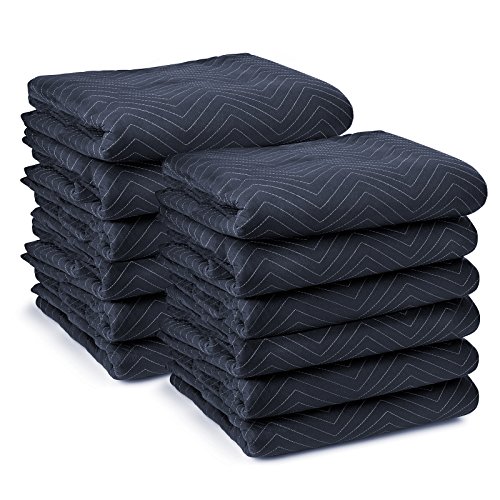
Sure-Max Pro Economy Moving Blankets 35 lb/dz, 12-Pack — Best Budget Dozen
Every well-loaded truck uses two classes of pad: heavies wrapped on furniture, lights everywhere else — lining the floor, draping over stacks, stuffing the voids that let loads shift, protecting walls and doorframes during carry-out. The Sure-Max Pro Economy dozen is built for that second job at a price that makes using twelve of them painless. They also serve as the only pads on laminate and flat-pack furniture, which needs scratch protection, not armor.
Strengths
- A dozen pads at the lowest commitment in this guide
- Ideal for floor lining, void filling and scratch protection
- Light and easy to handle, fold and drape
Trade-offs
- 35 lb/dz fill is thin — not sole protection for valuable wood or gloss finishes
- Lighter skins wear faster under repeated dragging
- Serious moves should pair these with a heavyweight set
Key specs: 80 x 72 inches each; 35 lb per dozen weight class; quilted; navy/black; pack of 12.
Bought with clear eyes, the economy dozen is one of moving’s best bargains — bought as your only protection for good furniture, it is a false economy. Our recommended pattern for a mid-size move is this dozen plus the US Cargo Control 65 lb/dz 6-pack: heavies on the pieces that matter, lights everywhere else, total coverage for less than one professional moving quote’s rounding error. That combination is the real best-buy of this guide.
Best for: void filling, floor lining, laminate furniture and one-move duty / Not suited for: sole protection for antiques or gloss finishes
Check the current price on Amazon

Stalwart Heavy Duty Moving Blanket (Single) — Best Single Pad / Multi-Use
Not every job is a house move. The Stalwart single is for the one-dresser purchase, the appliance swap, the marketplace find that must survive your hatchback. Its recycled cotton fill gives it honest padding weight, the quilting keeps the fill distributed, and at 80 x 73.5 inches it wraps most single pieces completely. Afterward it becomes the most useful cloth in the garage: drop cloth, kneeling pad, cargo liner, dog-approved trunk mat.
Strengths
- Buy exactly one — no pack commitment
- Recycled cotton fill with quilted construction
- Oversized single pad wraps most individual furniture pieces
Trade-offs
- Per-blanket cost beats nothing in the packs — you pay for singularity
- One pad protects one item; a move needs the packs above
- Cotton fill holds moisture if stored damp — dry it first
Key specs: 80 x 73.5 inches; recycled cotton filling; quilted; reusable furniture pad / drop cloth.
Think of the Stalwart as equipment, not moving supplies. Households that haul things — kids to college, furniture finds, band gear, market stock — will use a pad like this monthly for a decade. Buy it for the single-item job, keep it in the vehicle, and it quietly becomes indispensable. Just do not try to stretch one pad across a whole apartment move; that is what the dozens are for.
Best for: one-item moves, appliance duty, and life as a permanent utility pad / Not suited for: outfitting a whole move (buy packs instead)
Check the current price on Amazon

Amazon Basics Moving Blankets 72 x 80, 6-Pack — Best Tear-Resistant Convenience Buy
The Amazon Basics set trades the traditional weight-per-dozen language for a reinforced, tear-resistant build aimed at renters and one-move households. Six pads at 72 x 80 cover the core furniture of a small move, the reinforced construction shrugs off the snags and drags of rental-truck day, and the whole purchase takes thirty seconds to decide — which, in the middle of moving chaos, is a feature in itself.
Strengths
- Reinforced, tear-resistant build for rough one-move handling
- Six-pack size matches small moves and apartments
- Simple, no-homework purchase
Trade-offs
- No stated lbs/doz class — thickness must be judged on arrival, unlike the pro lines
- Mid-weight duty; pair with heavies for antiques
- Less of a lifetime tool than the woven pro pads
Key specs: 72 x 80 inches each; reinforced tear-resistant construction; black; pack of 6.
For a one-and-done move, this set is entirely defensible: sturdy enough for laminate and everyday furniture, simple to buy, easy to pass on or store afterward. Furniture lovers and repeat movers should still choose by weight class with the US Cargo Control or Sure-Max pro sets, because that number tells you exactly what protection you own. Convenience has real value during a move — just spend it knowingly.
Best for: renters and one-move buyers wanting a simple, sturdy set / Not suited for: buyers who shop strictly by pounds-per-dozen
Check the current price on Amazon
Comparison Table
| Pick | Badge | Key spec | Best for |
|---|---|---|---|
| US Cargo Control Moving Blankets 65 lbs/doz, 6-Pack | Best Overall | 72 x 80 in, 65 lbs/doz, woven polyester skin, 6-pack | household moves protecting real wood furniture |
| US Cargo Control Moving Blankets 95 lbs/doz, 4-Pack | Best Heavyweight Protection | 72 x 80 in, 95 lbs/doz — the heaviest class here, 4-pack | antiques, pianos, lacquered and high-gloss furniture |
| Sure-Max Ultra Thick Pro Moving Blankets 65 lb/dz, 12-Pack | Best Value Dozen at Pro Weight | 80 x 72 in, 65 lb/dz, full dozen pack | whole-house moves needing pro weight in quantity |
| Sure-Max Pro Economy Moving Blankets 35 lb/dz, 12-Pack | Best Budget Dozen | 80 x 72 in, 35 lb/dz light class, 12-pack | void filling, floor lining, laminate furniture and one-move duty |
| Stalwart Heavy Duty Moving Blanket (Single) | Best Single Pad / Multi-Use | 80 x 73.5 in single pad, recycled cotton fill, quilted | one-item moves, appliance duty, and life as a permanent utility pad |
| Amazon Basics Moving Blankets 72 x 80, 6-Pack | Best Tear-Resistant Convenience Buy | 72 x 80 in, reinforced tear-resistant construction, 6-pack | renters and one-move buyers wanting a simple, sturdy set |
How to Choose Moving Blankets for a Truck Move
Shop by weight per dozen first. Under about 40 lb/dz is scratch-and-dust duty: floor lining, void filling, laminate furniture. The 60–70 lb/dz band is true furniture protection and the right default for wood pieces. Above 90 lb/dz is specialty armor for gloss, antique and piano-grade cargo. A seller who will not state the weight is asking you to buy blind — the pro brands in this guide all state it.
How many blankets does a move actually need?
Count pieces, not rooms. Every wooden furniture item wants its own pad; sofas and mattresses want one to two each; then add a third again for floors, ramps and voids. A studio move runs about 6 pads, a one-bedroom 12, a family house 24–36. Running out mid-load is the common failure — pads are cheap, and leftover pads store flat, so round up.
Skin, stitching and the second life
Woven skins survive dragging and years of reuse; lighter non-woven skins suit a single move. Zigzag quilting keeps fill from migrating into lumps. And plan the second life before buying the heavy sets: pro pads serve for years as storage covers, workshop cloths and cargo liners, which is how their cost-per-use ends up lowest of all.
Loading the Truck So the Blankets Can Do Their Job
Pads protect against rubbing, not against physics. Load heavy furniture first, against the front wall of the truck, wrapped before it goes in — wrapping at the truck, not in the room, keeps pads from slipping during the carry. Distribute weight evenly side to side, build in tiers, and use spare pads to fill every void so nothing can gain momentum. A load that cannot shift cannot rub, and a load that cannot rub arrives perfect even in light pads.
Mirrors, glass and art travel on edge, padded, between mattresses or against a flat wall of furniture — never flat under weight. Finish by strapping the load in sections with the truck’s rails or your own ratchet straps, snugged over pads so straps never bite a finish directly.
The Two-Tier System: How Professional Movers Actually Allocate Pads
Watch a professional crew load a truck and you will never see them treat all pads as equal. The good pads — heavyweight, woven-skinned — go on the furniture itself, wrapped tight at the house before the piece is carried. The economy pads never touch a finish directly: they line the truck floor so wrapped pieces can be slid without scuffing the pads that matter, they drape over stacks as dust and rub shields, and above all they fill voids. A void is any gap the load can move into; a load that moves, rubs; a load that rubs, arrives damaged. Filling voids is therefore not tidiness — it is the primary damage-prevention act of the entire load, and it consumes pads by the dozen.
This is why this guide’s headline recommendation is a combination rather than a single product: a heavyweight set sized to your furniture count plus an economy dozen for the truck itself. Households that buy only heavies run out and leave the last pieces bare; households that buy only lights protect everything inadequately. The two-tier system costs less than either mistake.
Strapping completes the system. Ratchet straps or the truck’s own rails snug each tier of the load into one block, always over pads so webbing never bites a finish. Recheck strap tension after the first few miles — loads settle, straps slacken, and the two-minute stop at the first petrol station is the cheapest insurance of the whole move.
Beyond the Move: The Second Life of a Good Moving Blanket
A professional-weight pad is a tool with a decade of uses, and factoring the second life changes the buying math entirely. In storage, pads become the covers that keep dust and light off furniture in garages and spare rooms. In the workshop they are drop cloths that actually cushion, kneeling pads, and the layer between a workbench and a finished piece. In a vehicle they line cargo areas for the lifetime of hauls — furniture finds, building supplies, band equipment, the annual Christmas tree — and they deaden the rattles that make old trucks miserable.
They also serve the household in ways nobody lists: sound dampening behind a drum kit or in a makeshift recording corner, padding under a sleeping bag on a hard floor, a windbreak and ground cloth at outdoor events, protection for floors during deliveries and appliance installs. Households that own a dozen pro pads find uses monthly; households that rented pads for the move own nothing the day after.
Care is what makes the second life possible. Shake pads out after each use, spot-clean rather than machine-washing the heavy ones (a stuffed washer helps no one), dry fully before folding, and store flat or loosely rolled in a dry place. Treated so, a woven pro pad’s cost per use falls below a cent-scale figure that makes the rental alternative look faintly absurd.
Renting vs Buying, and the Rental-Truck Checklist Nobody Gives You
Rental blankets make sense in exactly one scenario: a single small move, no storage space afterward, and no hauling life ahead of you. Even then, inspect what you are handed — rental fleets include pads worn to tissue — and count them before you sign. In every other scenario the arithmetic favors buying: a dozen pads purchased outright costs roughly what renting a dozen across a long weekend and a one-way trip accumulates to, and you keep the asset.
Whichever route you take, the truck itself needs a walk-around before loading. Sweep the box — the previous renter’s gravel is your furniture’s first enemy — and lay your floor pads or cardboard before the first piece goes in. Check the ramp or liftgate operation, locate the tie-down rails, and photograph existing damage for the rental record. Load in daylight if you possibly can; most moving damage happens in the last tired hour, in the dark, with the pads already packed away.
- Sweep the truck box and line the floor before loading anything.
- Wrap furniture at the house, not at the truck, so pads stay put during the carry.
- Load heavy and wrapped first, against the front wall, heaviest pieces low.
- Fill every void with economy pads; strap each tier into a single block.
- Recheck strap tension a few miles into the drive — loads settle.
Sizing and Counting Workshop: Planning a Real Move, Room by Room
Work a real example, because abstract counts fail on moving day. A three-bedroom house typically holds: a sofa and loveseat (three pads between them), two beds’ worth of wooden frames and dressers (four to five pads), a dining table and six chairs (two pads for the table, chairs ride nested with one pad between layers), two desks and bookcases (three pads), a piano or large cabinet (two heavyweight pads), plus mirrors and art (two pads). That is roughly sixteen pads on furniture — before the truck itself asks for its share: two on the floor, two to four as void fill and tier covers. The honest total lands near two dozen, split between heavies and lights, which is why this guide’s packs and pairings are sized the way they are.
A one-bedroom apartment compresses the same logic: sofa (two), bed frame and dresser (two), table (one), desk (one), television and art (one), floor and voids (three) — ten to twelve pads, achievable with a single dozen at mixed weights or the six-plus-six pairing this guide recommends. A studio needs about six; a dorm move, four and a roll of stretch wrap. Scale by furniture, never by optimism.
Two more planning truths. First, pads are needed at both ends of the move if furniture goes into storage between homes — buy once and they cover the storage chapter too, wrapped on the pieces for the duration. Second, the day before the move is too late to discover a shortfall; count a week ahead, order then, and let the surplus become the household’s permanent hauling kit. Nobody in the history of moving has complained about owning two spare moving blankets.
And when the move is done, resist the urge to give the set away in the first flush of unpacking relief. The households that keep their pads use them within the year — for the delivery, the pickup, the kid’s first apartment. The two-tier set is not moving supplies. It is household infrastructure that happens to debut at a move.
Protecting the Difficult Pieces: Pianos, Art, Mirrors and Electronics
Some cargo gets its own protocol, and moving blankets are at the center of each. Upright pianos travel wrapped in heavyweight pads — the 95 lb/dz class in this guide — with the pad secured by straps over the wrap, the lid and fallboard locked or taped shut through padding, and the instrument moved on a piano board or heavy-duty dolly by people who have done it before; a grand piano is a professional job, full stop, and this guide’s blessing extends only to watching the pros use pads exactly like these. The blanket’s role is finish protection; the structure and the lifting are separate disciplines that should not be improvised.
Framed art and mirrors travel on edge, never flat, each piece padded front and back — a blanket folded over the frame’s face, corners given extra layers, the whole bundle standing between mattresses or against a flat furniture wall in the truck. Glass is safest where nothing can fall against it and nothing rests on it; mark the bundle’s orientation and fragility on the wrap, because at unloading time nobody remembers which stack is the mirror.
Electronics split into two camps. Televisions ideally travel in their original box with its foam; absent the box, a blanket wrap with the screen protected by a soft layer first — never a quilted pad’s rough side directly on a screen — and the set braced upright between soft furniture. Smaller electronics ride in boxes cushioned with pads cut from the economy stock’s labor: a folded light pad under and over a component in its box does the work of a fortune in foam inserts. Across all three categories the principle is constant: the pad absorbs the vibration and the rub, the structure and the loading absorb the physics, and confusing those two jobs is how precious things break in padded trucks.
Storage, Folding and Inventory: Keeping a Pad Set Ready for a Decade
A moving blanket set earns its keep between moves only if it is stored like equipment rather than aftermath. The folding standard is simple: shake out outdoors, inspect for the damp or damage that moving day hid, fold in thirds lengthwise then in half, and stack flat in a dry place — a shelf, a lidded bin, the top of the storage unit pile. Rolled storage suits the pads you grab often, like the Stalwart single in a vehicle; flat stacks suit the archive dozens. Cotton-filled pads especially must be bone dry before they are put away; the mildew that ruins a stored pad begins in the first damp week and announces itself a year later.
Inventory sounds excessive until the first time you lend pads out. Keep a count — a note in the storage bin, a line in the household spreadsheet — and mark one corner of each pad with a laundry-marker initial. Pads are the most borrowed and least returned items in the neighborhood economy; a marked, counted set comes home. Lending them is good citizenship and good strategy: the household that lends pads owns the neighborhood’s gratitude when its own piano day arrives.
Inspect annually with the same rhythm this guide prescribes for quilts: shake, air, check stitching at the corners where pads die first, and retire the genuinely worn to drop-cloth duty rather than furniture duty. A pad demoted honestly still serves; a pad trusted past its life damages the thing it wraps. Managed this way, the two-tier set recommended in this guide is a ten-to-fifteen-year asset — the final reason its purchase price, divided by its real service, makes the rental counter the most expensive place in the moving business.
When Not to Use a Moving Blanket: The Exceptions That Protect Better
Honesty about a tool includes its exclusions. Moving blankets are the wrong protection for bare, uncured finishes — a freshly lacquered or French-polished piece can imprint under any textile’s pressure and should travel only on a specialist’s advice. They are wrong for long-term storage in damp places, where their absorbency becomes the problem rather than the protection; storage in such places wants breathable-but-dry arrangements and a dehumidifier before it wants pads. And they are wrong as the sole protection for items in open or flatbed transport, where wind works wraps loose at highway speed — open loads need tarps and netting over the padding, with the pads doing the contact work underneath.
They are also the wrong tool, alone, inside shipping crates and freight: freight handling is forklift physics, and boxed-and-crated protection with foam or custom supports is the correct spend for anything irreplaceable traveling by carrier. The blanket’s kingdom is the household move and the local haul — the truck you load yourself, the storage unit you control, the delivery you supervise. Inside that kingdom it is close to perfect; at its borders, knowing where it ends is what keeps precious things safe. Every tool in this guide series earns trust the same way: by stating its limits in the same breath as its strengths.
A Short Word on Sustainability: The Pad as the Anti-Disposable
Moving generates a small mountain of single-use waste — boxes broken down, tape, plastic wrap by the acre — and the moving blanket is the honorable exception: a durable good that substitutes for disposables at every turn. A pro pad replaces the bubble wrap and paper padding that would otherwise wrap the same furniture once and landfill forever; across a decade of moves and hauls, one set displaces a genuinely embarrassing volume of single-use material. Even its construction leans the right way, with recycled fills — the Stalwart’s recycled cotton is the explicit example in this guide — turning textile waste into the padding itself.
The end of a pad’s life is equally un-wasteful: demoted pads become shop cloths, pet bedding, garden kneelers and frost covers for tender plants, and a pad is not truly finished until it has served in all of those second careers. Buying the two-tier set is therefore the rare consumer decision that is simultaneously the cheapest over time, the most protective on the day, and the lightest on the landfill. The moving industry will keep selling disposables; your household does not have to keep buying them.
The Neighbor Test
There is a simple test of whether you bought moving blankets well, and it arrives about six months after the move, when a neighbor knocks and asks whether you still have those pads. If the answer is yes — counted, marked, folded dry in their place — the purchase has already begun its second career as household infrastructure and social capital. If the pads were rented, given away in the unpacking euphoria, or ruined by damp storage, the knock teaches the lesson this guide exists to spare you. Buy the set once, keep it properly, and be the house on the street that owns the blankets. Every street needs one; the role is more rewarding than it sounds.
How to Wrap Furniture in a Moving Blanket (The Mover’s Method)
Professional wrapping is a two-minute skill that decides whether a pad actually protects. Work on the piece before it leaves the room.
- Drape the pad over the piece so the longest dimension is covered, with excess pooling at the base — corners and legs are where damage lives, so bias coverage downward.
- Fold the excess neatly at the sides like hospital corners, keeping the pad snug; a loose pad slides off in the carry and protects the floor instead.
- Secure with stretch wrap wound around the whole piece, or with moving bands — never apply tape directly to wood, lacquer or leather finishes.
- For drawers and doors, pad first, then secure them shut through the wrap; remove loose shelves and wrap them separately.
- Carry the wrapped piece with the pad as your grip surface, and set it in the truck directly into its planned position — every repositioning is a rub opportunity.
On arrival, unwrap in reverse and shake pads out outdoors; fold them dry and store them flat or rolled. A pad stored damp, especially a cotton-filled one, will smell like it forever — two minutes of care preserves a decade of usefulness.
Common Buying Mistakes
Buying by price per pack instead of weight per dozen. A cheap dozen of 35 lb/dz pads and a dozen 65 lb/dz pads are different tools. Compare the weight class first, then the price inside that class.
Running out of pads mid-load. The last, unwrapped pieces are always the ones that get damaged. Count pieces, add a third, and round up — spare pads are a storage problem, not a financial one.
Taping pads directly to furniture. Tape residue and finish damage are self-inflicted wounds. Stretch wrap or bands over the pad, every time.
Loading loose so the load can shift. No pad survives a dresser sliding two feet at every brake. Fill voids, strap in sections, and make the load one solid block.
Storing pads damp. Cotton and recycled fills mildew. Shake out, dry fully, then fold — the two-minute habit that keeps pads reusable for years.
Final Recommendation
For most household moves, buy the US Cargo Control 65 lb/dz 6-pack for the furniture that matters and the Sure-Max Pro Economy dozen for everything else — that two-tier combination is how professionals actually load a truck. Whole-house moves at pro weight throughout should take the Sure-Max Ultra Thick dozen; antiques and gloss pieces earn the US Cargo Control 95 lb/dz 4-pack; the Stalwart single covers one-item jobs for life; and the Amazon Basics set is the simple, sturdy choice for a one-move renter.
Whatever you buy, wrap before carrying, load tight, and strap in sections. The blankets do the rest.
Shop the shortlist: US Cargo Control Moving Blankets 65 lbs/doz, 6-Pack — Check on Amazon · US Cargo Control Moving Blankets 95 lbs/doz, 4-Pack — Check on Amazon · Sure-Max Ultra Thick Pro Moving Blankets 65 lb/dz, 12-Pack — Check on Amazon
Best Moving Blankets Best Furniture Pads For Moving Best Moving Supplies Best Stretch Wrap For Moving Best Hand Trucks For Moving
Related guides
Frequently Asked Questions
How many moving blankets do I need for a one-bedroom move?
About a dozen: one per wooden furniture piece, one to two for the sofa and mattress, plus spares for floor lining and void filling. A 12-pack at mixed weights covers most one-bedroom moves comfortably.
What does ‘lbs per dozen’ mean and why does it matter?
It is the total weight of twelve pads, and it is the honest measure of how much padding fill each pad contains. Around 35 lb/dz is light duty, 65 lb/dz is professional furniture grade, and 95 lb/dz is heavyweight armor.
Can moving blankets protect a piano or antiques?
Yes — that is exactly what the heavyweight 95 lb/dz class is for, combined with careful securing: pads on, stretch wrap over, no tape on finishes, and the piece loaded where it cannot shift.
Are moving blankets washable and reusable?
Pro-grade woven pads are reusable for years. Shake them out, spot clean, and dry fully before storage. Treat them as equipment: most households use the same set across several moves and countless hauling jobs.
Should I rent blankets from the truck company instead?
Rental pads are convenient but their condition and weight class vary, and rental fees for a dozen across a long move approach purchase cost. Buying makes sense if you will move again, haul furniture, or want guaranteed-clean pads.
What else can I use moving blankets for after the move?
Furniture storage covers, workshop and painting drop cloths, cargo and trunk liners, sound dampening in a pinch, and padding for anything valuable that travels in a car. A good set never really retires.
Can I wash moving blankets?
Light pads tolerate a large-capacity machine on gentle settings; heavyweight pro pads are better shaken out, spot-cleaned and hosed down outdoors, then dried fully. Whatever the method, a pad stored damp is a pad ruined.
Do moving blankets work for sound dampening or other jobs?
Yes — the same quilted mass that protects furniture absorbs sound usefully in workshops, studios and practice spaces, and serves as padding under loads, pets and projects. A pro set’s second life is long and varied.


