Disclosure: airfryerkitchensupply.com is reader-supported. When you buy through links on our site, we may earn an affiliate commission at no extra cost to you.
Where to buy
Every clock below was chosen because it can wake one sleeper without filling the room with sound: sunrise lights that brighten one side of the bed, under-pillow shakers that vibrate silently, and gentle-sound clocks with tight volume control. All six were confirmed through the airfry site’s Amazon listing data before being linked, so use the Amazon links to check the current price on Amazon and confirm the exact wake mode on the listing before you order.
- Philips SmartSleep Wake-Up Light HF3520/60 — Check on Amazon
- Hatch Restore 3 — Check on Amazon
- DreamSky Vibrating Alarm Clock (Under Pillow) — Check on Amazon
- Sonic Bomb Dual Alarm Clock with Bed Shaker — Check on Amazon
- Loftie Alarm Clock — Check on Amazon
- JALL Sunrise Alarm Clock — Check on Amazon
The best alarm clocks that don’t wake your partner solve a physics problem, not a volume problem. A conventional alarm fills the whole room with sound, so the lighter sleeper wakes first no matter how the snooze button is negotiated. The clocks that actually work for couples use a different channel entirely: light that falls mostly on one pillow, vibration delivered through the mattress or under a single pillow, or sound kept low, directional and gradual enough that it reaches the intended sleeper during a light-sleep window without blasting the other side of the bed.
Three technologies dominate this category, and they suit different couples. Sunrise simulation clocks brighten gradually over twenty to forty minutes, which works beautifully when the partner sleeps facing away or wears a sleep mask, and fails when both partners are light-sensitive. Bed shakers and under-pillow vibrators are the only truly silent option and the safest choice for shift workers, new parents trading night feeds, and anyone whose partner has finally fallen asleep at 4 a.m. Gentle-sound smart clocks sit in between: they trade absolute silence for pleasant, controllable audio and features like blackout modes that keep display light out of the room.
This guide ranks six verified clocks across those three approaches, explains honestly where each one can still disturb a partner, and walks through placement, setup and the etiquette settings — yes, there are settings for that — that make the difference between a considerate alarm and a 5:30 a.m. argument.
In this guide
Quick Picks
Philips SmartSleep Wake-Up Light HF3520/60 — Best Overall. The benchmark sunrise clock: a colored dawn simulation that climbs gradually enough to wake the sleeper on its side of the bed while a partner facing the wall often sleeps straight through it. Check the current price on Amazon
Hatch Restore 3 — Best Smart Sunrise Clock. A sunrise alarm wrapped in a full sleep-routine system: app-built evening routines, a big audio library, and a gentle light-first wake that keeps the bedroom quiet. Check the current price on Amazon
DreamSky Vibrating Alarm Clock (Under Pillow) — Best Truly Silent Alarm. A rechargeable vibrating puck that slides under your pillow and shakes you awake without a sound — the most partner-proof wake-up in this guide. Check the current price on Amazon
Sonic Bomb Dual Alarm Clock with Bed Shaker — Best for Very Deep Sleepers. Famous as an extra-loud alarm, but its partner-friendly trick is the opposite: switch the sound off and let the powerful bed shaker do all the waking. Check the current price on Amazon
Loftie Alarm Clock — Best Gentle-Sound Clock. A minimalist clock built around a two-phase alarm — a gentle rise, then a slightly firmer follow-up — with a blackout mode that keeps its face completely dark. Check the current price on Amazon
JALL Sunrise Alarm Clock — Best Budget Sunrise Clock. The sensible budget test of the sunrise idea: gradual light, dual alarms and a sound machine, at a starter tier that makes it cheap to learn whether light wakes your partner or not. Check the current price on Amazon
How These Picks Were Chosen
Each candidate had to pass one test first: a credible silent or near-silent wake path. Clocks that only offered a loud buzzer with a volume knob were cut, because a quieter buzzer is still a room-filling buzzer. From there we weighed how controllable the wake channel is — dimming range and sunrise duration on light clocks, vibration intensity and puck placement on shakers, and minimum volume and display blackout on sound clocks.
Every product name and ASIN in this article was cross-checked against the airfry site’s Amazon listing data, matching the listed title to the product described. Only listing-confirmed products carry Amazon links; anything we could not confirm is covered without a link. We do not print prices or fixed ratings anywhere in this guide — check price on Amazon for the current figure, and use the tier language in each review to position a clock before you click.
We also weighted the boring details that decide whether a clock survives month two: battery backup so a power cut does not silently cancel the alarm, dual alarms for weekday and weekend schedules, a snooze that does not require a phone, and a display that can go fully dark in a bedroom shared with a light-sensitive sleeper.
The 6 Best Alarm Clocks That Don’t Wake Your Partner

Philips SmartSleep Wake-Up Light HF3520/60 — Best Overall
This is the right first try for most couples because light is inherently directional in a way sound is not. Angle it toward your pillow, and your partner gets the spill, not the sunrise. The colored simulation moves through deep reds and oranges before reaching bright yellow-white, which feels noticeably less abrupt than cheap white-only wake lights, and the matching sunset program doubles as a wind-down routine that fades light and sound together at night.
Strengths
- Gradual colored sunrise that can be angled toward one side of the bed
- Sunset fading program helps both partners fall asleep, not just wake separately
- Tap snooze anywhere on the housing — no fumbling for a button half-asleep
Trade-offs
- Light still spills across a small room; a very light-sensitive partner will notice it
- No vibration option, so deep sleepers may sleep through a silent sunrise
- FM radio and sound quality are functional rather than hi-fi
Key specs: Sunrise simulation with multiple brightness levels; 5 natural sounds; FM radio; reading lamp function; tap snooze.
In practice the HF3520/60 works best when the couple’s sleep positions cooperate: the waking partner on the clock side, the sleeping partner turned away. Set the sunrise duration long — thirty minutes rather than ten — because a slow ramp catches you in lighter sleep and needs less peak brightness, which is exactly what keeps the other side of the bed dark enough. The optional sound backup should start at its lowest volume; treat it as insurance, not the main event. As a reading lamp it is genuinely useful, which matters because a single-purpose gadget on a crowded nightstand tends to get unplugged.
Best for: couples where one partner sleeps facing away or in a mask / Not suited for: partners who wake at the first hint of light
Check the current price on Amazon

Hatch Restore 3 — Best Smart Sunrise Clock
Choose the Restore 3 if your household already runs on routines and apps. The wake side is a proper sunrise alarm with customizable light, and the sleep side — unwind routines, meditations and a large sound library — is the real product. On-device controls keep the nightstand phone-free once the routine is set, which helps both partners: no glowing phone screen at midnight from either side of the bed.
Strengths
- Sunrise wake is fully programmable for duration, color and sound pairing
- Large library of sleep audio and guided routines in the companion app
- Simple tap controls on the device itself for night-time adjustments
Trade-offs
- Full content library sits behind the app’s membership model — check current terms on the listing
- Light-based waking shares the same spill limits as every sunrise clock
- Setup is app-first, which frustrates anyone who wants a clock that just works out of the box
Key specs: Sunrise alarm light; 80+ sleep sounds via app; meditations and routines; Putty finish.
The Restore 3 earns its place here because its sunrise is among the most adjustable on the market: if your partner stirs at light, you can stretch the ramp, cap the peak brightness lower, and lean on a soft audio finish at minimal volume. Be honest with yourself about the membership before buying — the hardware is the clock, but the content library is the ongoing product, and couples split on whether that trade is worth it. If you both end up using the wind-down routines, the shared benefit usually settles the argument.
Best for: app-comfortable sleepers who want a full wind-down and wake routine / Not suited for: buyers who refuse subscriptions or phone setup
Check the current price on Amazon
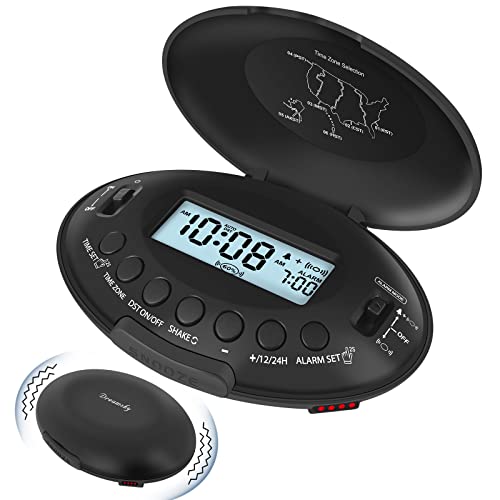
DreamSky Vibrating Alarm Clock (Under Pillow) — Best Truly Silent Alarm
When silence is non-negotiable — a nurse leaving at 4:30 a.m., a partner who has just finished a night feed, a household with a baby in the next room — vibration is the only honest answer, and this DreamSky puck is the simplest version of it. It is rechargeable and battery powered, so there is no cable to snag, and the flat puck shape stays put under most pillows better than wired shaker discs.
Strengths
- Completely silent waking — nothing for a partner to hear
- Rechargeable and cordless, so it travels and never tangles in bedding
- Auto DST removes the twice-a-year wrong-time failure
Trade-offs
- Only works if your head stays roughly over the pillow where the puck sits
- No light or sound backup if you sleep through the vibration
- Needs periodic recharging; a dead puck is a missed alarm
Key specs: Under-pillow vibrating puck; rechargeable battery; auto daylight-saving adjustment; backlit settings display.
Placement is the whole game with an under-pillow shaker. Center it under the pillow at head height, not at the corner, and if you share a bed with different firmness zones, your own pillow insulates the vibration remarkably well — most partners report feeling nothing on their side. Build a charging habit, such as topping it up every Sunday, because the failure mode of every battery alarm is silent and total. Restless sleepers who end the night diagonally should look at a mattress-placed shaker like the Sonic Bomb below instead.
Best for: shift workers and anyone who must wake in complete silence / Not suited for: restless sleepers who migrate across the bed overnight
Check the current price on Amazon

Sonic Bomb Dual Alarm Clock with Bed Shaker — Best for Very Deep Sleepers
The Sonic Bomb’s reputation is loudness, yet the reason it belongs in this guide is its shaker. Run it in vibration-only mode and the puck under the mattress delivers the strongest silent wake in this roundup — the option for people who have slept through phone alarms, sunrise lights and good intentions. Dual alarms and battery backup cover couples on different weekday and weekend schedules.
Strengths
- Strongest bed shaker here — wakes genuinely deep sleepers silently
- Vibration-only mode keeps the notorious loud buzzer out of the equation
- Dual alarms plus battery backup for reliability
Trade-offs
- On a soft shared mattress, strong vibration can transmit to the other side
- The display is bright by bedroom standards; face it away or dim it
- Overkill for light sleepers, who will find gentler options pleasanter
Key specs: Bed shaker puck; dual alarms; adjustable tone and volume with vibration-only option; battery backup.
Taming a Sonic Bomb for a shared bed is a placement exercise. Put the shaker between the mattress and base on your side only, as far toward your edge as it will stay, and test it on a weekend morning before trusting it on a workday. On platform and firm foam beds the shake stays remarkably local; on bouncy innerspring mattresses it travels, and honest couples on those beds should pick the under-pillow DreamSky instead. Used correctly, though, nothing else here wakes a truly deep sleeper with less noise.
Best for: deep sleepers who need maximum vibration and a partner who sleeps soundly once asleep / Not suited for: light-sleeping partners on a shared soft mattress
Check the current price on Amazon

Loftie Alarm Clock — Best Gentle-Sound Clock
Loftie is the pick when a little sound is acceptable but light pollution is the real enemy. Its blackout mode kills the display entirely, its night light is warm and low, and the two-phase alarm starts soft enough that a partner in deeper sleep frequently never registers the first phase at all. The sound library is included rather than rented, which keeps the ownership story simple.
Strengths
- Two-phase alarm starts genuinely gently before insisting
- Blackout mode removes display glow from the shared bedroom completely
- Large sound library included with no subscription required
Trade-offs
- Sound-based waking can never promise a partner hears nothing
- Smart features depend on Wi-Fi setup behaving itself
- Minimalist controls mean some settings live in the app
Key specs: Two-phase alarm; 100+ included sounds; Bluetooth speaker; night light; blackout display mode.
The two-phase design is smarter than it sounds. Phase one is pitched at the sleeper whose alarm it is — timed for when their sleep is lightest — and in many couples the partner simply never surfaces for it. Keep Loftie on your nightstand, angled toward your side, at the lowest volume that reliably wakes you during a test weekend. If your partner does hear phase one regularly, that is the honest signal to move to a light or vibration pick from this list rather than negotiating volume wars.
Best for: couples who accept soft sound and want zero display light / Not suited for: households needing absolute silence
Check the current price on Amazon

JALL Sunrise Alarm Clock — Best Budget Sunrise Clock
Not sure whether a sunrise clock will disturb your partner? The JALL is how you find out without committing to a premium tier. It covers the essentials — sunrise simulation, dual alarms for two schedules, a library of sounds and a multi-color night light — in a package priced for experimentation. If the concept works in your bedroom, you can upgrade later with confidence; if light wakes both of you, you have learned it cheaply.
Strengths
- Full sunrise feature set at a budget tier
- Dual alarms suit couples on different schedules
- Night light with many color options doubles as a soft evening lamp
Trade-offs
- Dimming steps are less silky than the Philips at the lowest brightness levels
- Speaker quality is fine for alarm sounds, thin for music
- Controls and menus feel budget-grade next to premium rivals
Key specs: Sunrise simulation; 25 sounds; FM radio; Bluetooth speaker; dual alarm; 17-color night light.
Judge the JALL on the one job that matters: does its light ramp wake you before it wakes your partner? Run it for a week at a thirty-minute sunrise with sound off. Most couples find the answer quickly, and that answer — not build quality or speaker fidelity — decides whether sunrise clocks belong in their bedroom at all. As a long-term keeper it is perfectly serviceable; as a diagnostic tool for your household’s sleep dynamics, it is the best value in this guide.
Best for: first-time sunrise buyers testing whether light waking suits their partner / Not suited for: buyers wanting premium build and the smoothest dimming curve
Check the current price on Amazon
Comparison Table
| Pick | Badge | Key spec | Best for |
|---|---|---|---|
| Philips SmartSleep Wake-Up Light HF3520/60 | Best Overall | Colored sunrise/sunset simulation, 5 natural sounds, tap snooze | couples where one partner sleeps facing away or in a mask |
| Hatch Restore 3 | Best Smart Sunrise Clock | App-controlled sunrise alarm, large sleep-audio library, phone-free controls | app-comfortable sleepers who want a full wind-down and wake routine |
| DreamSky Vibrating Alarm Clock (Under Pillow) | Best Truly Silent Alarm | Rechargeable under-pillow vibration, auto DST, battery powered | shift workers and anyone who must wake in complete silence |
| Sonic Bomb Dual Alarm Clock with Bed Shaker | Best for Very Deep Sleepers | Powerful bed shaker with vibration-only mode, dual alarms, battery backup | deep sleepers who need maximum vibration and a partner who sleeps soundly once asleep |
| Loftie Alarm Clock | Best Gentle-Sound Clock | Two-phase gentle alarm, blackout mode, 100+ sounds included | couples who accept soft sound and want zero display light |
| JALL Sunrise Alarm Clock | Best Budget Sunrise Clock | Sunrise simulation, 25 sounds, dual alarm, 17-color night light | first-time sunrise buyers testing whether light waking suits their partner |
How to Choose an Alarm Clock That Won’t Wake Your Partner
Start by identifying which sense you can actually use. Sound is the default and the worst choice for a shared bed, because ears do not have eyelids — any audible alarm is a shared alarm. Light is directional and blockable: a partner who sleeps facing away, or who will wear a simple sleep mask, may never notice a sunrise clock at all. Vibration is the only channel that is private by physics rather than by courtesy, which is why shift workers and parents of newborns should start there.
Match the clock to your partner’s sleep, not yours
The buyer’s sleep depth decides how much wake power you need; the partner’s sleep depth decides how much of it they will tolerate. A deep-sleeping waker with a light-sleeping partner is the hardest combination and points straight at under-pillow or mattress vibration. Two moderate sleepers can usually share a sunrise clock happily. If your partner falls asleep easily but wakes at dawn light through the window, skip light clocks entirely — their eyes are already telling you the answer.
The features that actually protect a partner
Look for control granularity: sunrise duration and peak brightness caps on light clocks, vibration intensity or at least puck placement flexibility on shakers, and a true blackout mode on anything with a display. Dual alarms matter when both partners use the same clock on different schedules. Battery backup matters because the most inconsiderate alarm is the one that fails silently and gets replaced by a panicked phone alarm at full volume.
Sunrise, Vibration or Gentle Sound: Which Wake Channel Is Right for Your Bedroom?
Sunrise clocks shine in winter and in bedrooms where the waking partner sleeps on the window side of the bed. They fail in summer when dawn arrives before the alarm, in small rooms where light bounces off pale walls onto both pillows, and with partners who sleep on their backs facing the ceiling. Expect a week of calibration: ramp length, peak brightness and clock angle all interact.
Vibration never has a bad room. Its variables are mechanical instead — mattress type, puck position and the waker’s own sleep movement. Innerspring mattresses transmit; dense foam isolates. Under-pillow pucks suit still sleepers; under-mattress shakers suit everyone else. The trade-off is feedback: a vibration alarm gives you nothing to show a partner who doubts it works, which is why a weekend test with the partner awake and observing settles most arguments.
Gentle-sound clocks are the compromise pick, and compromise means both sides give something up. They work when the partner is a moderately sound sleeper and the waker responds to low volumes. Their hidden advantage is pleasantness — waking to soft tones or nature sounds is simply nicer — and their hidden risk is volume creep, where the waker nudges the volume up over months until the partner is waking too.
The Science of Waking One Sleeper: Light, Sleep Cycles and Timing
Human sleep runs in cycles of roughly ninety minutes, moving between deep slow-wave sleep and lighter stages near dreaming. An alarm that lands in deep sleep produces the groggy, disoriented waking everyone hates; the same alarm twenty minutes later, in a light stage, feels almost voluntary. This is the hidden mechanism behind every partner-friendly technology in this guide. A sunrise clock’s long ramp works because it does not need to guess the cycle: as light gradually brightens, it begins nudging the sleeper during whatever light stage arrives within the ramp window, and the sleeper surfaces gently instead of being hauled out of the depths.
Vibration works differently. A shaker’s stimulus is strong and local, and it tends to wake the target sleeper regardless of stage — which is why deep sleepers need it — but because it produces no sound and almost no light, the partner’s cycle is never interrupted at all. The partner-protection of vibration is therefore absolute in a way light cannot match: light can be seen by two people, but a puck under one pillow is felt by one.
Timing strategy completes the picture. Couples get the best results when the earlier riser sets their alarm for the earliest acceptable time and uses the gentlest effective stimulus, reserving intensity as backup rather than default. A sunrise ramp that starts forty minutes before the deadline, a shaker set to begin five minutes before a silent phone backup — these layered, escalating designs respect both sleepers: the waker gets reliability, the partner gets the mildest possible version of events, and most mornings end at layer one.
Why weekends ruin good systems
The most common failure of a partner-friendly setup is not the clock but the calendar: a system tuned for a 6 a.m. weekday wake gets left on for Saturday, or a dual-schedule couple shares one alarm setting. Use the dual alarms most picks here provide, and treat the weekend test described earlier in this guide as a recurring ritual whenever schedules shift. Sleep systems fail socially before they fail technically.
Partner Etiquette: The Negotiation Layer No Manual Mentions
Every couple adopting a silent alarm is really negotiating a contract: one person’s start time against another person’s sleep. The technology in this guide makes that contract easy to keep, but a few agreements make it bulletproof. First, the waker owns the backup: if the silent alarm fails, the consequence should fall on the waker’s morning, not on the partner’s sleep, which is why a personal vibrating phone backup beats a loud failsafe every time. Second, snoozing is a shared cost — a shaker that fires every nine minutes is silent, but a sunrise that re-brightens or a partner who keeps getting up and returning is not, so the considerate waker disables snooze entirely or takes the first alarm as final.
Third, communicate the test results honestly. If your partner says the light wakes them, believe them and change channels — the guide you are reading exists because there are three channels, and pride in a purchase is not worth a partner’s chronic sleep loss. Sleep deprivation compounds quietly and presents as everything from irritability to unsafe driving; the stakes of getting this right are higher than the price of any clock here.
Finally, remember the asymmetry: the partner’s sleep is the product being protected, so the partner is the reviewer who matters. When they rate a setup invisible, the setup is finished. Until then, keep iterating — placement, ramp length, channel — because somewhere in the combinations in this guide is the one your household will use for a decade.
Troubleshooting: When Your Silent Alarm Stops Being Silent (or Stops Working)
Problem: the sunrise clock wakes your partner in summer. → The room is already light before the ramp starts, so both sleepers are near the surface. Shorten the ramp, cap peak brightness lower, and add blackout curtains so the clock regains control of the room’s light.
Problem: the under-pillow puck migrates overnight. → It is placed too near the pillow’s edge or the pillowcase is slippery. Center it at head height, place it inside the pillowcase rather than under the pillow, or step up to an under-mattress shaker on your side of the bed.
Problem: you sleep through vibration after a few weeks. → Adaptation is real. Vary the pattern if your clock allows it, move the puck closer to your head’s resting position, or layer a low sunrise behind the vibration so two gentle channels combine.
Problem: the clock’s display keeps your partner awake. → This is the most fixable problem in the category: use blackout mode if the clock has it, dim to minimum, or simply face the display toward the wall. A clock that cannot dim has no place in a light-sensitive bedroom, whatever its alarm virtues.
Problem: the rechargeable puck died on a workday. → Treat charging like laundry — a fixed weekly slot, ideally the same day you change the bedding. Alarms fail silently; routines are the only real battery backup.
Special Situations: Shift Workers, New Parents, Travel and Hearing Differences
Shift work is the use case that exposes every weakness in a household’s alarm arrangements, because the schedule itself rotates: the waker changes, the needed wake time migrates across the clock, and the sleeping partner may be the one who worked the night. The setups that survive shift households share two traits — they are personal rather than room-based (a puck, a wearable-adjacent shaker, a lamp on one nightstand), and they are re-programmable in seconds, because a system that takes ten minutes to reconfigure will simply not be reconfigured at 2 a.m. Dual alarms and auto-DST, minor bullet points elsewhere, become headline features here.
New parents face a compressed version of the same problem with higher stakes and worse sleep. The parent on duty is already waking to the baby; the alarm’s job is the handovers and the work starts, and its cardinal sin is waking the baby or the off-duty parent. Vibration wins this season of life outright, and many couples find the under-pillow puck becomes permanent household equipment long after the baby sleeps through — habits formed at 3 a.m. tend to stick. Keep the puck’s charging routine tied to the laundry cycle; new-parent households run on routines or not at all.
Travel splits the category by physics: light clocks stay home (they are furniture), while the DreamSky-style rechargeable puck was practically designed for a suitcase — no cable, no voltage questions, no hotel alarm roulette. Anyone who travels across time zones for work while a partner sleeps at home on a different schedule should own the puck for the road and whatever they love for the bedroom.
Hearing differences deserve a direct word, because they are common and underserved by mainstream clock design. For a sleeper who is deaf or hard of hearing, vibration and light are not partner-courtesy features — they are the alarm — and the stronger shakers in this guide, the Sonic Bomb above all, exist in this category precisely because that need is real and recurring. Couples where one partner hears alarms and the other does not will find the shaker-under-one-side arrangement solves both people’s mornings at once: the hearing partner is never woken by a sound that was never for them, and the other partner gets an alarm that works on their terms.
Across all four situations the pattern is the same: match the channel to the sleeper, keep the system personal and portable where life is irregular, and let the partner’s uninterrupted sleep be the metric. The households that get this right stop thinking about alarms entirely, which is the highest compliment a 6 a.m. technology can earn.
Buying Scenarios: Which Pick for Which Household
Scenario one: a couple in a one-bedroom flat, one partner teaching at dawn, the other working evenings. The teaching partner sleeps on the nightstand side and responds to light; the evening partner wears no mask but sleeps facing the wall. This is the Philips HF3520/60’s home turf — a long ramp, angled lamp, sound backup kept at minimum. If the first fortnight shows the light leaking into the second sleeper’s morning, the fix is not a new clock but blackout curtains and a lower peak brightness; only if that fails does the household move channels.
Scenario two: a nurse on rotating nights, a partner who teaches, a toddler in the next room. Sound is banned in both directions and light is nearly so. The DreamSky puck under the nurse’s pillow is the system, with the Sonic Bomb’s shaker as the heavy-duty alternate for the deep-sleep weeks after night shifts, when the nurse’s sleep is at its deepest exactly when the alarm matters most. The partner’s role reduces to one weekly kindness: confirming the puck went on charge on bedding day.
Scenario three: two professionals, same wake time on paper, but one springs up and one negotiates with consciousness for twenty minutes. A shared gentle system — the Loftie or the Hatch — set for the negotiator’s timeline, with the springer treating the early gentle phase as a lie-in warning rather than an alarm, often works better than two competing devices. The two-phase design exists for exactly this couple: phase one belongs to the slow riser, phase two is the household’s real deadline, and nobody’s sleep is ambushed.
Scenario four: the frequent traveler whose partner keeps home hours. The bedroom keeps its sunrise clock for home weeks; the puck travels. Trying to make one device serve both lives is how both lives end up with a mediocre alarm. Notice what every scenario shares: the decision was made by describing the household first and the products second. Do that, and the right pick in this guide is usually obvious — the reviews exist to confirm the match, not to create it.
A Note on Reliability: Backups, Batteries and Trust
An alarm is a promise, and partner-friendly alarms keep that promise quietly or not at all. Build trust in layers: the clock itself, its power backup — mains with battery backup, or a rechargeable puck on a weekly charge ritual — and, for the first fortnight and for genuinely unmissable mornings, a silent personal backup such as a phone on vibrate under the pillow’s edge. Remove the training layers as the system proves itself, but never apologize for keeping one on the mornings that matter: a flight, an exam, a shift. Reliability theater is not the goal; reliability is, and layered silent systems deliver it without ever waking the person beside you.
How to Set Up a Partner-Friendly Alarm (Placement and Test Protocol)
Whatever technology you choose, run the same one-week protocol before trusting it on a workday. Set the alarm for a weekend morning when oversleeping costs nothing, and have your partner note honestly whether they woke, stirred, or slept through. That single data point is worth more than any specification sheet.
- Place light clocks on the waker’s nightstand, angled toward their pillow, never centered between the two sleepers.
- Place shaker pucks on the waker’s side only — under their pillow, or between mattress and base at their edge of the bed.
- Start every adjustable setting at its gentlest: longest sunrise ramp, lowest sound volume, and add intensity only if the waker sleeps through.
- Enable battery backup or confirm the rechargeable puck’s charge routine before the first workday use.
- Set a silent phone vibration as a personal backup for the first two weeks, then remove it once the clock has proven itself.
After the test week, lock the settings and resist tinkering. Most partner-disturbance complaints trace back to gradual changes — a brighter cap here, a louder volume there — rather than to the clock itself. Recheck the setup when seasons change: a sunrise clock that was perfect in January competes with real dawn in June, and a shaker puck can migrate under a mattress over months of bed-making.
Common Buying Mistakes
Buying a louder alarm to solve a partner problem. Volume treats the symptom by worsening the disease. If a standard alarm wakes your partner, the answer is a different wake channel — light or vibration — not a more efficient noise.
Centering a sunrise clock between the pillows. A light placed for two people wakes two people. Sunrise clocks are personal devices; angle them like a reading lamp, not like a ceiling fixture.
Testing a new alarm for the first time on a workday. Every silent alarm has a failure mode, from a migrated puck to a forgotten charge. Discover it on a Saturday, not before a flight or a shift.
Ignoring the display. Couples fix the sound and forget the glow. A bright clock face can disturb a light-sensitive partner all night, long before the alarm sounds — blackout mode or a dimmable display is not a luxury feature.
Letting settings creep. Volume and brightness drift upward because the waker adapts. Recalibrate monthly: turn settings down until the waker just barely wakes, then stop.
Final Recommendation
For most couples, start with the Philips SmartSleep HF3520/60: its colored sunrise is the gentlest mainstream wake and the easiest to aim at one side of the bed. If silence is absolute — shift work, a newborn, a partner who has just fallen asleep — go straight to vibration: the DreamSky under-pillow puck for still sleepers, the Sonic Bomb’s shaker for deep sleepers on firm beds. The Hatch Restore 3 suits app-driven households that want a full sleep routine, the Loftie suits couples who accept soft sound but banish display light, and the JALL is the low-risk way to test whether sunrise waking works in your bedroom at all.
Whichever you choose, run the weekend test before the first workday. The right clock is the one your partner rates as invisible, not the one with the longest feature list.
Shop the shortlist: Philips SmartSleep Wake-Up Light HF3520/60 — Check on Amazon · Hatch Restore 3 — Check on Amazon · DreamSky Vibrating Alarm Clock (Under Pillow) — Check on Amazon
Best Sunrise Alarm Clocks Best Vibrating Alarm Clocks For Heavy Sleepers Best White Noise Machines For Sleep Best Alarm Clocks For Heavy Sleepers Best Bed Shaker Alarm Clocks
Frequently Asked Questions
What is the quietest way to wake up without waking my partner?
Vibration. An under-pillow puck or a bed shaker in vibration-only mode makes no sound at all, so there is nothing for your partner to hear. Sunrise light is the next quietest option, provided your partner is not light-sensitive.
Do sunrise alarm clocks really leave the other person asleep?
Often, yes — light can be aimed at one pillow, and a partner facing away receives only spill. They are not reliable with partners who sleep facing the light or who wake at natural dawn. Test for a week before relying on one.
Will a bed shaker wake my partner through the mattress?
It depends on the mattress. Dense foam and pocket-sprung bases isolate vibration well; bouncy traditional innerspring mattresses transmit it. Placing the puck at your edge of the bed and testing on a weekend gives you the real answer for your bed.
My partner wears a sleep mask. Does that change the choice?
It makes sunrise clocks much more attractive, because the mask blocks exactly the channel the clock uses. With a mask-wearing partner, a sunrise clock plus a low-volume sound finish is a very reliable combination.
Are phone alarms on vibrate a good enough substitute?
A phone under a pillow is an inconsistent shaker — it migrates, its battery dies, and its vibration pattern is weak compared with a purpose-built puck. Dedicated vibrating clocks are rechargeable, stay in place better, and are designed for daily use.
What if I am a very deep sleeper and my partner is a light sleeper?
That is the hardest pairing, and vibration is the answer: an under-pillow puck if you sleep still, or a strong bed shaker on your side of a firm mattress. Avoid sound entirely and keep light as a secondary cue only if your partner tolerates it.
Can two partners use two different silent alarms in one bed?
Yes — that is the endgame setup for couples on different schedules: a personal channel per sleeper, each waking only its owner. Two pucks or a lamp plus a puck coexist happily; two sound alarms do not.
How long do sunrise clocks take to work?
Most sleepers adapt within a few nights, and the test protocol in this guide asks for a week before judging. The ramp needs configuring once — duration and peak brightness — then the habit forms on its own.

