Disclosure: airfryerkitchensupply.com is reader-supported. When you buy through links on our site, we may earn an affiliate commission at no extra cost to you.
Where to buy
Every pick in this guide to the best wakeup light alarm clocks is sold through Amazon, so you can compare sizes, colors and current availability in one place. Use the links below to jump straight to a pick, or read the full reviews further down before you decide. Prices move around with sales and stock, so each link simply lets you check the current price on Amazon rather than us printing a number that could be out of date tomorrow.
- Philips SmartSleep Sleep and Wake-Up Light HF3650/60 — Best Overall: Check on Amazon
- Philips SmartSleep Wake-Up Light HF3520/60 — Best Classic with Radio: Check on Amazon
- Hatch Restore 3 — Best for a Full Sleep Routine: Check on Amazon
- Lumie Bodyclock Shine 300 — Best for Light Control Finesses: Check on Amazon
- REACHER Wood Grain Sunrise Alarm Clock and Sound Machine — Best Value: Check on Amazon
- Dreamegg Sunrise 1 Alarm Clock Sound Machine — Best No-App Simplicity: Check on Amazon
The best wakeup light alarm clocks solve a problem the standard alarm creates: being torn out of deep sleep by a noise your body treats as an emergency. A wake-up light works the other way around — it simulates a sunrise in your bedroom over twenty to forty minutes, gradually raising the light level so your body lightens its sleep in stages and the final sound, if you even need it, lands on someone already half awake. On a dark winter morning, the difference feels less like a feature and more like a different species of morning.
This guide compares the six designs that do it best, and they split into clear philosophies: Philips’ polished light systems, Lumie’s specialist dawn, Hatch’s full sleep-routine ecosystem, and the value hybrids from REACHER and Dreamegg that fold a sound machine into the clock. Every pick was verified against Amazon’s catalog data before earning a link, and every badge names the buyer it suits — because the right choice depends on whether your problem is the waking, the sleeping, or the whole night around both.
A framing note we keep on this site: these are comfort and routine products. They make mornings gentler and evenings calmer, and owners consistently prefer them to jarring alarms — but we make no medical claims for them, and anyone with a sleep disorder belongs in a clinician’s care, not a buying guide. Within that honest frame, a good wake-up light is one of the highest-satisfaction purchases a bedroom can receive.
Expect this guide to be as interested in what these clocks do at 10 p.m. as at 7 a.m. The category has quietly become the bedroom’s operating system — dawn simulation in the morning, reading light in the evening, wind-down and masking sound at night — and the picks below were judged as full-time bedside citizens. A clock that only alarms is competing with your phone; a clock that runs the room’s light and sound all night has already won the nightstand.
In this guide
Quick Picks
Short on time? These are the six best wakeup light alarm clocks we would point a friend to first, each chosen for a different priority. The full reviews below explain the trade-offs behind every badge.
- Philips SmartSleep Sleep and Wake-Up Light HF3650/60 — Best Overall. The most complete wake-up light Philips makes: colored sunrise and sunset simulation, multiple light and sound options, a guided wind-down breathing feature, and the polish of a flagship bedside lamp. — Check on Amazon
- Philips SmartSleep Wake-Up Light HF3520/60 — Best Classic with Radio. The long-running classic: colored sunrise and sunset simulation, five natural sounds, a real FM radio, a reading lamp and a tap snooze — the proven all-rounder that defined the category. — Check on Amazon
- Hatch Restore 3 — Best for a Full Sleep Routine. A sleep system disguised as a clock: sunrise waking, a screen-free bedtime routine with meditations and stories, 80+ sleep sounds via the Hatch Sleep app, and a putty-toned design that disappears into a calm bedroom. — Check on Amazon
- Lumie Bodyclock Shine 300 — Best for Light Control Finesses. The light purist’s choice from the British pioneers of the category: customizable sunrise and sunset durations, warm LEDs that render the dawn faithfully, and straightforward physical controls. — Check on Amazon
- REACHER Wood Grain Sunrise Alarm Clock and Sound Machine — Best Value. The budget overachiever: a wood-grain sunrise clock with a dimmable digital display, 26 sleep sounds and a built-in white noise machine — two bedside devices for the price of one modest clock. — Check on Amazon
- Dreamegg Sunrise 1 Alarm Clock Sound Machine — Best No-App Simplicity. Deliberately simple: a sunrise wake-up light with 29 soothing sounds, a 9-color dimmable night light and physical controls — and proudly no app required for anything. — Check on Amazon
How These Picks Were Chosen
Our first criterion was the light itself: a genuine sunrise simulation must start very dim and warm, build smoothly without steps or flicker, and finish bright enough to matter in a real bedroom. Clocks that are merely a lamp on a timer — a surprising number of cheap listings — were cut. Color progression mattered too: the natural dawn moves from deep warm tones to bright neutral light, and the best picks here reproduce that arc.
Next, the ecosystem around the light: sunset or wind-down features for the evening, the sound library for those who still want an audio backstop, display dimming for light-sensitive sleepers, and whether an app is required, optional or absent — a genuine preference axis, not a spec to maximize. Each candidate was cross-checked integration so the models, features and names in these reviews match real, current listings.
Finally, we weighted the morning-after test: a wake-up light succeeds if it is still in use in month six. That favored clocks that also earn their nightstand space as lamps, sound machines or routine tools, and it is why the badges below reward complete bedside citizens, not one-trick dawns.
We also deliberately included the category’s honest spread of prices and philosophies rather than six variations of one flagship. A wake-up light is a deeply personal appliance — it mediates the most vulnerable transition of your day — and the ‘best’ one is the one whose dawn, sounds and level of system match the sleeper you actually are. The reviews below are written to expose those differences plainly, trade-offs included.
The 6 Best Wakeup Light Alarm Clocks
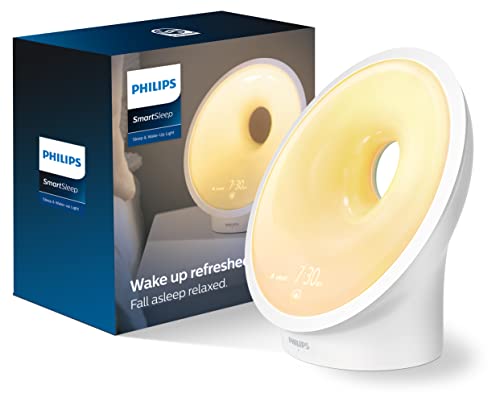
Philips SmartSleep Sleep and Wake-Up Light HF3650/60 — Best Overall
The HF3650 is the pick for people who want the wake-up light idea executed without compromise. Its sunrise builds through warm colors to a bright, daylight-like finish over a duration you choose; its sunset reverses the trick at night; and the RelaxBreathe feature paces your breathing with light pulses for a genuine wind-down ritual. It also works beautifully as a reading lamp, which matters for a device that will own your nightstand for years.
Strengths
- Full colored sunrise and sunset simulation with adjustable duration and intensity
- RelaxBreathe guided wind-down plus multiple natural sounds and FM-free audio options
- Premium build and tap controls; functions as a high-quality bedside lamp in its own right
Trade-offs
- Flagship tier pricing — this is the considered purchase of the category
- Feature depth means a real setup session; not a plug-and-go clock
- No app ecosystem, which some buyers now expect at this level
| Simulation | Colored sunrise + sunset |
| Extras | RelaxBreathe wind-down, multiple sounds |
| Model | HF3650/60 |
What separates the HF3650 from cheaper sunrise clocks is the light quality across the whole ramp: the early minutes are a deep, ember-like glow that will not blast a partner awake, and the finish is bright enough to genuinely shift a dark winter bedroom. The sunset side is not a gimmick either — used nightly, it becomes the household’s signal that the day is over. If your budget reaches the flagship tier and you want light therapy-style waking without a phone in the bedroom, this is the reference product.
Best for: light sleepers and winter-morning strugglers who want the complete sunrise/sunset system / Not suited for: buyers wanting app control or a simple budget clock

Philips SmartSleep Wake-Up Light HF3520/60 — Best Classic with Radio
Before wake-up lights were a category, there was this clock. The HF3520 pairs Philips’ colored sunrise simulation — a gradual build from red through orange to bright yellow-white — with five natural wake sounds, an FM radio for people who wake best to voices and music, and a tap-anywhere snooze that works through a half-asleep swat. It lacks the flagship’s breathing coach, but for pure waking performance it gives up very little.
Strengths
- Colored sunrise simulation with a natural, non-jarring color progression
- FM radio plus five natural sounds — the widest wake-audio choice in this guide
- Tap snooze and a proper reading-lamp mode; a decade-proven design
Trade-offs
- An older platform: no app, no Bluetooth, no sound library beyond what’s built in
- Sunset simulation is present but less elaborate than the HF3650’s wind-down system
- Display and controls reflect its generation — functional rather than sleek
| Simulation | Colored sunrise + sunset |
| Audio | 5 natural sounds + FM radio |
| Extras | Tap snooze, reading lamp |
Choose the HF3520 if radio matters to you — it is the only pick here with a real FM tuner, and for news-and-weather wakers that is not a small thing. Its sunrise remains one of the most natural in the business, because Philips has had years to tune the color curve. The honest framing is that you are buying a perfected previous flagship at a friendlier tier: fewer rituals, same excellent dawn. For many bedrooms that is exactly the right trade.
Best for: radio listeners and anyone wanting proven sunrise performance without flagship pricing / Not suited for: buyers wanting app routines, Bluetooth audio or the newest features

Hatch Restore 3 — Best for a Full Sleep Routine
The Restore 3 is built around a philosophy: the phone charges in the kitchen, and the bedroom runs on routines. From the app you build a bedtime sequence — dimming light, a meditation or story, then sleep sounds through the night — and a sunrise wake to finish. On the device itself there are no screens and no feeds, just simple touch controls. It is the pick for people whose problem is not the alarm but the whole evening that precedes it.
Strengths
- Complete routine system: wind-down content, sleep sounds and sunrise wake in one device
- Screen-free at the bedside while the app does the configuring from elsewhere
- Huge, growing audio library — 80+ sounds plus meditations and stories
Trade-offs
- The full library lives behind Hatch’s subscription model — budget for it honestly
- Setup and routine-building happen in the app; minimalists may find it a project
- As a pure alarm clock it is more than most people need
| Simulation | Sunrise alarm light |
| Audio | 80+ sleep sounds via app |
| Extras | Bedtime routines, meditations, screen-free device |
Judge the Restore 3 as a habit tool. Its sunrise is good; its real talent is restructuring the hour before sleep, which is where most people’s mornings are actually won or lost. The subscription is the honest catch — the device is the doorway and the content library is the ongoing cost, so go in with eyes open and the maths still works for the right buyer: someone actively trying to move their phone out of the bedroom and their evenings onto rails. If you only want to wake gently, the Philips picks do it for less commitment.
Best for: phone-out-of-the-bedroom converts and anyone building a deliberate sleep routine / Not suited for: one-time-purchase purists or buyers who just want a gentle alarm


Lumie Bodyclock Shine 300 — Best for Light Control Finesses
Lumie essentially invented the wake-up light, and the Bodyclock Shine 300 shows the confidence of a specialist: instead of piling on features, it perfects the light itself. You set how long your sunrise takes, the sunset mirrors it at night, and the warm LED array produces a dawn that feels like light through a curtain rather than a lamp switching on in stages. It also doubles as a fully dimmable bedside and reading light with an optional gentle audio accompaniment.
Strengths
- Customizable sunrise and sunset durations — tailor the dawn to your schedule
- Warm-spectrum LEDs produce the most natural-feeling light curve in this guide
- Simple, tactile controls; no app required for anything
Trade-offs
- A narrower feature set than the Philips flagship or Hatch — light is the whole story
- Audio options are modest compared with the sound-machine hybrids
- Availability and pricing vary more by region than the big global brands
| Simulation | Sunrise + sunset, custom duration |
| Light | Warm LEDs, fully dimmable |
| Extras | Bedside/reading/night light modes |
The Shine 300 is for the buyer who has read the whole category and concluded, correctly, that the quality of the light curve matters more than the count of features. Its gradual, warm dawn is the one most often described by owners as ‘like waking naturally’, and the customizable duration is a real ergonomic feature — a 20-minute dawn for workdays, a slower one for weekends. It will not coach your breathing or stream a podcast; it will wake you beautifully, every dark morning, for years.
Best for: light-quality purists and anyone sensitive to harsh or blue-leaning light / Not suited for: buyers wanting big sound libraries, radio or app ecosystems

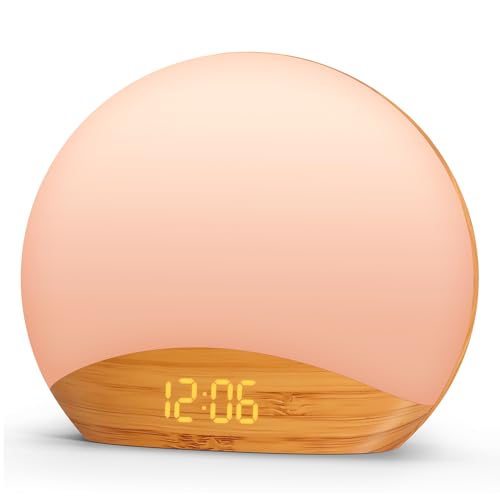
REACHER Wood Grain Sunrise Alarm Clock and Sound Machine — Best Value
REACHER’s wood-grain clock is what happens when a manufacturer reads the category’s wish list and prices it for normal humans. You get a sunrise wake-up light, a fully dimmable clock display (essential, and often botched), and a sound machine with 26 sleep sounds including white noise — a combination that usually requires two separate purchases. The wood-grain finish makes it the warmest-looking object on most nightstands, too.
Strengths
- Sunrise wake plus a genuine 26-sound sleep machine in one device
- Dimmable display that can go truly dark — light-sensitive sleepers, rejoice
- Friendly tier pricing and a finish that suits bedrooms rather than dorm desks
Trade-offs
- Sunrise brightness and color finesse trail the Philips and Lumie flagships
- Sound quality is good-for-the-size, not a match for a dedicated speaker
- Brand support and longevity are less proven than the category’s old names
| Simulation | Sunrise wake-up light |
| Audio | 26 sleep sounds, white noise |
| Display | Digital, dimmable |
The REACHER is the pick we would hand a first-time buyer who is curious about sunrise waking but not ready to commit flagship money — and, honestly, the one many of them would never bother upgrading. Its sunrise is a solid, pleasant ramp rather than a perfected dawn, and its sound machine half is legitimately useful every night, not just at waking. If the experiment sticks and winter mornings become a passion, the flagships await; if it half-sticks, this clock has still earned its place twice over.
Best for: first-time sunrise buyers, kids’ and guest rooms, and white-noise users / Not suited for: light purists wanting the most refined dawn simulation
Check the current price on Amazon

Dreamegg Sunrise 1 Alarm Clock Sound Machine — Best No-App Simplicity
The Dreamegg Sunrise 1 makes a virtue of everything it refuses to do. No app, no account, no WiFi pairing ritual — you set the alarm with buttons, choose from 29 built-in sounds, and the sunrise does its work. The 9-color night light is dimmable enough for a child’s room or a light-sensitive adult, and the whole device is sized and priced for real nightstands rather than showroom shelves.
Strengths
- No app required — full function from physical controls, forever
- 29 soothing sounds plus a 9-color dimmable night light in one compact unit
- Simple enough for kids, grandparents and the proudly tech-averse
Trade-offs
- Sunrise sophistication is a step below the Philips/Lumie light curves
- No radio and no expandability — the built-in library is the whole library
- Compact speaker limits the depth of its sound machine performance
| Simulation | Sunrise wake-up light |
| Audio | 29 soothing sounds |
| Extras | 9-color night light, no app needed |
There is a real market for a bedside device that cannot demand a firmware update, and Dreamegg serves it well. The Sunrise 1 is the pick for a child’s first alarm clock, a guest room, or any adult who has bounced off app-dependent gadgets before. Its dawn is gentle and effective rather than theatrical, its sounds cover the bases from rain to white noise, and its night light is genuinely well-judged. Simplicity is its specification, and on that spec it is close to flawless.
Best for: kids’ rooms, guest rooms and anyone who wants zero apps at the bedside / Not suited for: buyers wanting radio, streaming audio or the most advanced light simulation
Check the current price on Amazon
Comparison Table
| Pick | Badge | Key spec | Best for |
|---|---|---|---|
| Philips SmartSleep Sleep and Wake-Up Light HF3650/60 | Best Overall | Colored sunrise/sunset, RelaxBreathe, premium lamp | light sleepers and winter-morning strugglers who want the complete sunrise/sunset system |
| Philips SmartSleep Wake-Up Light HF3520/60 | Best Classic with Radio | Colored sunrise, FM radio, 5 natural sounds | radio listeners and anyone wanting proven sunrise performance without flagship pricing |
| Hatch Restore 3 | Best for a Full Sleep Routine | Routine system, 80+ sounds, sunrise wake, app-configured | phone-out-of-the-bedroom converts and anyone building a deliberate sleep routine |
| Lumie Bodyclock Shine 300 | Best for Light Control Finesses | Custom-duration sunrise/sunset, warm LEDs | light-quality purists and anyone sensitive to harsh or blue-leaning light |
| REACHER Wood Grain Sunrise Alarm Clock and Sound Machine | Best Value | Sunrise + 26-sound machine, dimmable display | first-time sunrise buyers, kids’ and guest rooms, and white-noise users |
| Dreamegg Sunrise 1 Alarm Clock Sound Machine | Best No-App Simplicity | Sunrise, 29 sounds, 9-color night light, app-free | kids’ rooms, guest rooms and anyone who wants zero apps at the bedside |
How to Choose a Wakeup Light Alarm Clock
Start with the sunrise quality, because it is the product. Look for a simulation duration you can adjust (twenty to forty minutes suits most people), a maximum brightness that can genuinely light a bedroom, and a color curve that begins warm. If you share the bed with a partner on a different schedule, a light that starts deep and dim — the Philips and Lumie pattern — disturbs them least.
Decide how much ecosystem you want
At one end sit pure lights: the Lumie and the Philips HF3520 wake you beautifully and ask nothing of your phone. In the middle, the HF3650 adds a structured wind-down. At the far end, the Hatch Restore 3 rebuilds your entire evening routine around the device, with a subscription library to match. None is objectively best — the right amount of system is the amount you will actually use nightly.
Then audit the small hours details
Display dimming is the sleeper feature of this category: a clock whose digits glow all night is working against the sleep it claims to serve, so insist on a display that dims to near-nothing, as the REACHER does. Snooze design matters too — a tap-anywhere snooze (Philips) beats hunting a button at dawn. And if you wake to radio, note that only the HF3520 here has a tuner; everyone else expects you to love their sound library.
Sunrise Duration, Brightness and Color: The Physics of a Good Dawn
Natural dawn is not a switch; it is a ramp, and your body reads the ramp. A simulation that is too short (under fifteen minutes) behaves like a lamp snapping on; too long and early light may wake you before the alarm phase entirely. Most people land between twenty and forty minutes — which is why adjustable duration, offered by the Philips and Lumie picks, is more than a bullet point.
Brightness is quoted loosely across this category, so judge by function: at full power the clock should let you see the room clearly and read comfortably — several picks double as reading lamps for exactly this reason. Color is the subtlest variable: cheaper lights jump from off to a bluish white that feels clinical, while the better simulations spend their early minutes in amber and rose, which reads to a sleeping brain as ‘morning is coming’ rather than ‘the light is on’.
A last, practical translation: if a listing quotes brightness in lux, that number is measured at a set distance and only compares meaningfully between models measured the same way. Treat lux claims as relative hints, lean on the functional test — can it serve as the room’s reading lamp at full power — and weight the shape of the ramp over the size of the peak.
Wake-Up Lights vs. Standard Alarms vs. Phone Alarms: An Honest Ranking
A phone alarm is the worst of the three for one structural reason: the phone is also everything else. The device that wakes you delivers messages, news and feeds at the exact moment your willpower is at its daily minimum, and it spends the night beside you doing the same in reverse. A standard alarm clock fixes the phone problem but keeps the startle. A wake-up light fixes both — it stages the waking and it gives the bedroom a dedicated, boring, single-purpose citizen.
The ranking flips only on reliability anxiety: for a flight-catching morning, belt and braces is rational — sunrise clock as the primary, phone alarm in the hallway as the insurance. Owners commonly run exactly that system for important days and the light alone for ordinary ones, which is a sensible peace treaty between gentleness and consequence.
How to Set Up a Wake-Up Light for Your Best Morning
A wake-up light rewards a week of deliberate setup. These steps tune the device to your actual sleep rather than its factory defaults.
Step 1: Place it at pillow distance, angled at the bed
The light needs to reach your face to work. Put the clock on the nightstand within about an arm’s length of the pillow, angled toward the bed rather than the ceiling or the opposite wall. If you share the bed, angle it toward the person it serves; the warm early stages are dim enough not to trouble a partner, and the bright finish is your alarm, not theirs.
Step 2: Set the sunrise to finish at your wake time
The simulation should reach full brightness at the moment you want to be awake, with any sound alarm set for that same moment as a backstop. Start with a thirty-minute ramp; shorten it if you find yourself waking well before the finish, lengthen it if the sound still startles you.
Step 3: Give it a two-week honest trial
Your body calibrates gradually. The first mornings may feel no different — especially if your sleep debt is large — while by the second week most users report waking nearer the light’s finish and reaching for the snooze less. Judge the clock at day fourteen, not day two, and keep your wake time consistent across weekends during the trial.
Step 4: Build the evening half
If your pick has a sunset or routine feature, use it at the same time nightly: lights down, sounds on, phone out of the room if your system supports it (the Hatch pattern). The morning improvement people credit to the sunrise is often half evening — a settled wind-down produces the lighter sleep that a dawn can then lift you out of gracefully.
Step 5: Adjust for the seasons
In summer, dawn through the window may do the light’s job for free; many owners run the clock on sound-only or move it to a child’s room until autumn. In deep winter, consider a longer ramp and a brighter finish, and place blackout curtains behind the equation — the clock should be the only dawn your bedroom believes in.
Step 6: Program the weekend separately, if your clock allows it
Many picks here support dual alarms or day-specific programs. Use them: a weekday dawn at full commitment and a weekend one an hour later with a longer, lazier ramp preserves both your routine and your rest. What you must not do is swing the wake time by three hours on Saturdays — the clock can only stage a dawn your body believes is plausible.
Why Light Wakes You Differently Than Sound
A sound alarm works on a sleeping brain like a fire bell: it triggers a startle, a spike of stress chemistry, and the groggy, heavy-headed state researchers call sleep inertia at its worst. Light works upstream of all that. Even through closed eyelids, increasing light signals your internal clock that morning is approaching; sleep lightens in stages, body temperature and alertness chemistry begin their rise, and by the time you open your eyes the transition is mostly complete. That is the whole product, and it is why owners describe the experience as ‘waking up’ rather than ‘being woken’.
The same mechanism explains the seasonal effect: winter’s late, weak dawns leave the alarm to do all the work at the darkest point of the year, which is precisely when wake-up lights earn their keep. It also explains their limit — no lamp fixes a five-hour night. These devices polish the last half hour of sleep; the hours before remain stubbornly your own responsibility.
The Sound Machine Half: Why Hybrid Clocks Took Over
Notice how many picks in this guide are also sound machines — REACHER’s 26 sounds, Dreamegg’s 29, Hatch’s 80-plus. That convergence is not feature creep; it reflects how bedrooms actually fail. Traffic, a partner’s schedule, a thin-walled apartment: masking sound through the night protects the sleep that the sunrise then ends. A single device that guards the night and stages the morning owns the nightstand outright, which is why the hybrids have become the category’s center of gravity.
If you already own a sound machine you love, the pure lights (Lumie, Philips) remain the connoisseur’s route. If you own neither, a hybrid is the rational first purchase — and the value picks here make that route inexpensive enough to be the default advice for guest rooms, teenagers and anyone furnishing a bedroom from scratch.
Buying for Kids, Teenagers and Shift Workers
Children respond to wake-up lights with an enthusiasm adults find suspicious — a dawn in the room reads as an event, not an instruction, and school mornings soften accordingly. For kids, favor the simple hybrids (Dreamegg, REACHER): physical controls they can master, a night light function for the dark hours, and sounds that make the device theirs. Teenagers are the hardest audience in sleep; the winning feature there is usually the phone-displacement argument, which makes the Hatch’s routine system a genuine contender despite its tier.
Shift workers live the category’s edge case: their dawn must happen at 4 p.m. in a blacked-out room, against a world that is awake. For them, maximum brightness and a fully convincing ramp matter most, curtains do the darkness, and the sunset feature inverts into a wind-down at 8 a.m. The Philips flagship’s strong finish and wind-down make it the shift-work pick here — a reminder that ‘morning’ is a schedule, not a time of day.
What to Do When the Sunrise Stops Working
Owners occasionally report a clock ‘stopping working’ after a few months. The light has not changed; their sleep has — usually a drift toward later nights, a growing sleep debt, or a season change that moved real dawn earlier than the simulated one, confusing the comparison. The fixes are mundane and effective: restore a consistent bedtime for a week, lengthen the ramp, raise the finish brightness, and re-angle the lamp toward the pillow after any bedroom rearrangement.
If the clock wakes you too early instead, shorten the ramp or dim the finish — waking at 80% of the simulation is the device succeeding ahead of schedule, and the correct response is to move the whole program later, not to abandon it. Treat the clock as an instrument that needs seasonal tuning, like the thermostat, and it will serve for years.
The Evening Is the Morning’s First Half
Every wake-up light review focuses on dawn, but the owners who rave loudest have usually changed their evenings too. A fixed wind-down — lights lowered at a set hour, a sunset simulation running, sounds replacing scrolls — compresses the time it takes to fall asleep and deepens the early night, which is what makes the dawn’s job possible. This is why sunset features, once dismissed as garnish, have become central to the flagship designs in this guide.
You do not need a subscription ecosystem to capture most of this. A lamp on a timer, a consistent hour, and a phone charging outside the room reproduce the structure; the devices here simply make the structure automatic, beautiful and hard to cheat. Choose the level of automation your discipline honestly requires — that self-knowledge, more than any specification, predicts whether a wake-up light changes your mornings or merely decorates them.
A Buyer’s Checklist You Can Run in Two Minutes
Before ordering, run the nightstand audit. One: is there a power socket within reach of the pillow-side table — these are mains devices, and an extension lead across the bed is a poor start. Two: measure the footprint; flagships are lamp-sized, hybrids are clock-sized, and a crowded nightstand argues for the latter. Three: decide the partner question — if two schedules share the bed, prioritize a warm, dim start and angle-ability over raw brightness.
Four: choose your audio future. If you wake to radio, only one pick here qualifies, and no sound library will substitute for the voices you actually want. Five: be honest about apps. An app-configured routine you will build once and love beats a flagship’s manual features you will never program — and the reverse is equally true. The six badges exist to make this two-minute audit end at the right product.
Common Buying Mistakes
Placing the clock across the room
Light obeys distance. A sunrise clock on a dresser three meters away delivers a fraction of its effect to your face. Nightstand, pillow distance, angled at the bed — or expect disappointment and blame the wrong variable.
Judging it after two mornings
Bodies calibrate over one to two weeks, especially when sleep debt is in play. A fair trial is fourteen consistent mornings; most returns in this category are clocks that were working on a schedule their owners never gave them.
Leaving the display at full brightness
A glowing clock face all night undermines the darkness your sleep wants. Use the dimmer — ideally to the point where the time is readable only when you look for it.
Expecting light to fix too little sleep
A sunrise clock improves how you wake, not how much you slept. If you are chronically short on hours, the clock will reveal it more gently, but the fix is an earlier night, not a brighter lamp.
Skipping the sound backstop entirely
Set a gentle sound for the sunrise’s finish even if you expect the light to wake you. Oversleeping once because a bright morning fooled your confidence is how good clocks get unplugged.
Buying the brightest clock for a small, white-walled room
Light bounces. In a small pale bedroom, a mid-brightness sunrise at close range outperforms a flagship at full power, which can feel like a floodlight by the finish. Match the lamp to the room’s size and surfaces, not to the spec sheet’s maximum.
Final Recommendation
If you want the complete, polished system, the Philips HF3650 is the best wakeup light alarm clock in this guide — the finest sunrise, a real wind-down, and a lamp you will use every evening. The HF3520 remains the connoisseur’s value: nearly the dawn, plus the only FM radio here. Light purists should look hard at the Lumie Shine 300’s customizable, warm-spectrum dawn.
For a whole sleep-routine rebuild, the Hatch Restore 3 stands alone — with its subscription understood up front. And for first-timers, kids and guest rooms, the REACHER and Dreamegg hybrids deliver the sunrise experience at a tier that needs no deliberation. Whichever you choose, give it the two-week trial and the nightstand position it needs; the first morning you wake before the sound, smiling, the category will have made its case.
One practical promise to make yourself, whichever clock arrives: keep the wake time boringly consistent for the first fortnight, including the weekend lie-in you are tempted by. Wake-up lights compound like interest — each consistent morning makes the next one easier — and the people who call them life-changing are almost always the people who gave them that consistency to work with.
- Best Overall: the Philips SmartSleep Sleep and Wake-Up Light HF3650/60 — Check on Amazon
- Best Classic with Radio: the Philips SmartSleep Wake-Up Light HF3520/60 — Check on Amazon
- Best for a Full Sleep Routine: the Hatch Restore 3 — Check on Amazon
- Best for Light Control Finesses: the Lumie Bodyclock Shine 300 — Check on Amazon
- Best Value: the REACHER Wood Grain Sunrise Alarm Clock and Sound Machine — Check on Amazon
- Best No-App Simplicity: the Dreamegg Sunrise 1 Alarm Clock Sound Machine — Check on Amazon
Keep exploring the same cluster: Best Desktop Air Purifier For Smokers Best Sunrise Alarm Clock For Heavy Sleepers Best Alarm Clocks For Heavy Sleepers Best White Noise Machines For Sleeping Best Blackout Curtains For Bedroom Best Weighted Blankets For Adults
Frequently Asked Questions
Do wake-up lights actually work for heavy sleepers?
For most, yes — with the sound backstop set. The light lightens sleep progressively, so the final sound lands on a brain that is already surfacing rather than one in deep sleep. Very heavy sleepers should choose a bright model, place it close, use a longer ramp, and keep the audio alarm enabled while they calibrate.
How long should the sunrise simulation last?
Twenty to forty minutes suits most people; thirty is the sensible starting point. Shorten the ramp if you consistently wake well before it finishes, and lengthen it if the sound alarm still feels abrupt. Adjustable duration is a feature worth having, as the Philips and Lumie picks offer.
Can a wake-up light replace my phone alarm?
That is its design intent, and for many owners it does — several picks here exist specifically to move the phone out of the bedroom. Keep the phone alarm as a silent backup in another room for the first weeks if the stakes of oversleeping are high, then retire it as confidence builds.
What is the difference between a wake-up light and a light therapy lamp?
Purpose and intensity. Wake-up lights simulate dawn at bedside brightness to stage your waking; light therapy lamps are far brighter devices used at close range for timed daytime sessions. They are cousins, not substitutes — this guide covers the bedside kind, framed strictly as comfort and routine products.
Will a wake-up light disturb my partner?
Less than a sound alarm does. The early sunrise stages are deep and dim, and angling the light toward your side localizes the bright finish. Partners commonly report sleeping through a sunrise that wakes the intended sleeper — one of the category’s most appreciated side effects.
Do I need the app or subscription models to get the benefit?
No. The core benefit is the light ramp, which the app-free Philips, Lumie and Dreamegg picks deliver fully. Apps and subscriptions buy content libraries and routine-building — valuable for the Hatch’s evening system, irrelevant to the dawn itself.
Can I use a wake-up light as my only bedside lamp?
Yes — several picks here are designed for exactly that. The Philips flagships and the Lumie offer proper reading-light modes with adjustable brightness, and the hybrids provide night-light functions. For most bedrooms, a good wake-up light legitimately replaces the lamp, which is part of how it earns its permanent place.


