Disclosure: airfryerkitchensupply.com is reader-supported. When you buy through links on our site, we may earn an affiliate commission at no extra cost to you.
Where to buy
Every quilt in this guide to the best quilts with polyfill is a current listing we verified through Amazon’s own catalogue data. Quilt sets vary by size, colour and piece count within the same listing, so buy by the full product name, confirm the bed size and set contents on the listing page, and check price on Amazon before you order. Measure your mattress and the drop you want before choosing a size — quilt sizing is where most returns in this category begin.
- Bedsure Quilts Queen Size, Grey, Basket Weave Pattern – check price on Amazon; choose the listing sold or shipped by Amazon or the brand store where available.
- Comfort Spaces Kienna Queen Quilt Bedding Set, White – check price on Amazon; choose the listing sold or shipped by Amazon or the brand store where available.
- Whale Flotilla Soft Queen Quilt Bedding Set, Red – check price on Amazon; choose the listing sold or shipped by Amazon or the brand store where available.
- Chezmoi Collection Austin King Bedspread Set, Terracotta – check price on Amazon; choose the listing sold or shipped by Amazon or the brand store where available.
- Amazon Basics Reversible Lightweight Microfiber Comforter Blanket, Full/Queen – check price on Amazon; choose the listing sold or shipped by Amazon or the brand store where available.
- Chezmoi Collection Upland 7-Piece Quilted Patchwork Comforter Set, Queen – check price on Amazon; choose the listing sold or shipped by Amazon or the brand store where available.
Quilts with polyfill — polyester fibre fill quilted inside a soft shell, usually microfibre — are the practical mainstream of modern bedding, and they earn that position honestly. Compared with cotton-filled or down quilts, a polyfill quilt is lighter for its warmth, machine washable without ceremony, quick to dry, friendly to allergy-conscious households that prefer to avoid animal fills, and consistent: the fill does not clump, shift or thin at the corners the way natural fills can when they age. The trade is breathability and hand-feel — cotton breathes better on hot nights, and nothing synthetic quite matches a great cotton quilt’s drape — which is why this guide is explicit about who polyfill suits: warm-room sleepers who want a light all-season layer, families and guest rooms that wash bedding hard and often, dorms and first apartments, and anyone who wants a finished, patterned bed without a duvet-and-insert system to manage.
Two construction families run through the picks. Traditional stitched quilts sew the layers together in patterns — basket weave, channel, patchwork — which keeps fill in place and gives the classic quilted look. Ultrasonic or pinsonic quilts bond the layers with heat-welded patterns instead of thread, which produces a smooth, modern finish with no loose threads and excellent wash durability. Both are legitimate; the choice is aesthetic and tactile. The six picks below cover the range from the category’s best-selling all-rounder to a seven-piece patchwork set, with sizes from queen staples to an oversized king bedspread, and the buying guide covers the sizing and layering decisions that determine whether a quilt delights or disappoints.
In this guide
Quick Picks
- Best Overall – Bedsure Quilt Set, Queen: a lightweight basket-weave quilted set with pillow shams, soft and breathable enough for all-season use as the bed’s main layer.
- Best Classic Coverlet – Comfort Spaces Kienna Quilt Set, Queen: a soft, lightweight summer-weight coverlet set with a clean quilted finish that layers over any bedding.
- Best Patterned Pick – Whale Flotilla Queen Quilt Set: a breathable microfibre quilt set in a rich red, with ultrasonic quilting and two shams for a finished look.
- Best Oversized King – Chezmoi Collection Austin Bedspread Set, King: a pinsonic quilted oversized bedspread that actually covers a king bed’s sides, in warm terracotta.
- Best Budget – Amazon Basics Reversible Comforter Blanket: a reversible lightweight microfibre comforter-blanket that works as a simple quilt layer at the lowest tier here.
- Best Complete Set – Chezmoi Collection Upland 7-Piece Set: a quilted patchwork comforter set with the full complement of pieces for a completely dressed bed in one purchase.
How These Picks Were Chosen
The first criterion was the fill itself: every pick is a polyester-fill quilt or quilted comforter, because that is the search’s promise, and listings were read for their construction rather than their styling photos. Second was quilting method and its consequences — stitched patterns for classic texture and fill security, ultrasonic bonding for smoothness and thread-free durability — with both families represented deliberately. Third was the layer’s honesty: these are lightweight to mid-weight pieces, and we chose ones whose weight suits their stated role, whether that is a summer coverlet, an all-season main layer or a bedspread meant to finish the bed over other bedding.
Practical ownership closed the selection: machine washability without special handling, sets that include their shams so the bed looks finished without extra orders, and sizing ranges that cover the beds people actually own, including the oversized king that standard king quilts so often fail to cover. Every product was cross-checked against Amazon’s catalogue data for this site, and only confirmed listings carry purchase links. Prices are never printed because they change constantly; check price on Amazon when you buy.
The 6 Best Quilts with Polyfill

Bedsure Quilt Set, Queen – Best Overall
Bedsure’s quilt set is the category’s reference buy: a lightweight quilt with a basket weave pattern, sold with its shams as a complete bedding set, positioned by its listing as a soft, breathable, all-season layer. The basket weave quilting is more than decoration — the stitched pattern locks the polyfill into small, even cells, so the layer stays uniform wash after wash, with no migrating fill pooling at the foot of the bed. As a main layer it suits spring through autumn in most homes and year-round in warm ones; in winter it becomes the handsome top layer over a warmer duvet. It suits the widest range of buyers in this guide: master bedrooms, guest rooms and anyone replacing a tired comforter with something lighter and neater. It does not suit cold sleepers in unheated rooms as a sole winter layer.
Strengths
- Stitched basket-weave cells keep polyfill evenly distributed through years of washing.
- Complete set with shams; the bed looks finished out of the package.
- Genuinely all-season weight — the single-layer answer for most of the year.
Trade-offs
- Microfibre shell breathes less freely than cotton on the hottest nights.
- Lightweight means a winter topper role in cold climates, not the main event.
- The woven-look pattern is subtle; buyers wanting bold print should look to the Whale Flotilla.
The Bedsure’s dominance is a lesson in fit-for-purpose: most beds, most nights, need exactly this — a light, even, washable layer that looks tailored and asks nothing. Owners who layer it properly, over a flat sheet in summer and over a duvet in winter, find it is the piece that never leaves the bed while heavier and lighter layers rotate beneath it. That constancy is what best overall means in bedding.
Best for: most bedrooms wanting one light, finished, all-season quilt set. / Not suited for: sole-layer winter warmth in cold rooms.
Check the current price on Amazon
Comfort Spaces Kienna Quilt Set, Queen – Best Classic Coverlet
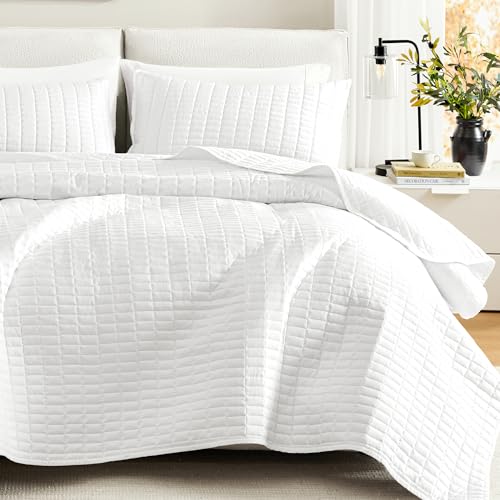
The Kienna is the classic coverlet expression of the polyfill quilt: a soft, lightweight three-piece queen set in white, quilted in a refined pattern, designed as the layer that finishes the bed — over sheets in summer as the only cover, over blankets the rest of the year as the tailored top. Coverlets are the layer hotels use to make a bed look intentional, and the Kienna brings that effect home at a friendly tier, with a smooth hand and a weight that never fights the sleeper. It suits minimalists, warm sleepers and anyone whose bedding system already has warmth covered and needs its finishing layer. It does not suit buyers wanting a single product to be both warmth and finish in a cold room.
Strengths
- The tailored, classic coverlet look in an easy white that matches everything.
- Feather-light layer that adds finish without heat.
- Three-piece set with shams for the complete dressed-bed effect.
Trade-offs
- Warmth is minimal by design; it is a layer, not a blanket substitute in winter.
- White demands a washing rhythm to stay bright.
- Less textural interest than the basket weave or patchwork picks.
Think of the Kienna as the bed’s jacket rather than its coat. Beds dressed with a coverlet read as calmer and more deliberate, and sleepers who run warm get a layer they can actually keep on all night in summer instead of kicking to the floor. In a guest room it is the single hardest-working piece you can buy, because it makes any underlying bedding look chosen.
Best for: finishing layers, warm sleepers and guest rooms. / Not suited for: sole winter coverage.
Check the current price on Amazon

Whale Flotilla Queen Quilt Set – Best Patterned Pick
Whale Flotilla’s set brings colour and the modern construction: a breathable microfibre queen quilt in a deep red, ultrasonically quilted — the pattern bonded rather than stitched — and reversible, with two shams completing the set. Ultrasonic quilting gives a smooth, contemporary finish with no thread ends to catch or break in the wash, and the bonded cells hold the polyfill as securely as stitching. The colour is the headline: where the other picks whisper, this one decorates, turning the quilt into the room’s accent. It suits buyers furnishing around a colour scheme, dorms and rentals needing personality in one purchase, and anyone bored of greige bedding. It does not suit the thread-and-texture traditionalist, or rooms where red has no echo.
Strengths
- Bold, reversible colour that carries a room’s scheme by itself.
- Ultrasonic quilting: smooth finish, no loose threads, excellent wash durability.
- Lightweight and breathable for a synthetic set, suiting all-season layering.
Trade-offs
- Bonded quilting has a flatter hand than stitched patterns.
- A strong colour is a commitment; check the room before ordering.
- Microfibre warmth ceiling applies as with all picks here.
The Whale Flotilla demonstrates what polyfill quilts do better than their natural rivals: colourfast, patterned, inexpensive personality that survives student-grade laundering. Used as the visible layer over plain sheets, it lets a rented or temporary room look designed in an afternoon. Buyers who love the construction but not the red will find the listing family offers other colourways — the recommendation is for the quilt, with this colour as its proof.
Best for: colour-led rooms, dorms, rentals and modern tastes. / Not suited for: traditional stitched-texture purists.
Check the current price on Amazon

Chezmoi Collection Austin King Bedspread Set – Best Oversized King
King quilts have a dirty secret: many are cut so economically that they end at the mattress edge, exposing the sheets and the bed’s flank like a tablecloth on the wrong table. The Austin bedspread set addresses it head-on with an oversized pinsonic quilted design in terracotta, made to drape a king bed properly. Pinsonic bonding gives the large surface a clean, quilted pattern without thread, and the bedspread format — bigger than a quilt by intention — restores the finished silhouette a king bed needs. It suits king-bed owners frustrated by skimpy coverage, and warm-toned rooms that suit terracotta’s earthiness. It does not suit queen beds, where the oversize becomes a pooling nuisance, or buyers wanting a light summer layer only.
Strengths
- Genuine oversized coverage: the king bedspread that reaches where it should.
- Pinsonic quilting keeps the large surface smooth and thread-free.
- Terracotta warmth anchors natural, earthy room schemes.
Trade-offs
- Size-specific: the oversize is a virtue only on the bed it was cut for.
- A bedspread-weight piece is a bigger wash load than a quilt.
- The colour palette is a definite scheme commitment.
Coverage is a specification, and this is the pick that treats it as one. Measure your king’s width plus the drop you want on both sides, compare with the listing’s dimensions, and the Austin’s case makes itself: a bed that looks finished from the doorway, with no flank of sheet showing. For king owners, that single correction is worth more than any pattern.
Best for: king beds needing real drape and coverage. / Not suited for: smaller beds or minimal laundry loads.
Check the current price on Amazon

Amazon Basics Reversible Microfiber Comforter Blanket – Best Budget
The Amazon Basics entry strips the polyfill quilt to its essentials: a reversible, lightweight microfibre comforter blanket in full/queen, black and grey, machine washable and all-season in the modest sense. It is less a patterned quilt set than a quilted comforter layer — no shams, no elaborate stitch pattern — and that honesty at a budget tier is its charm. It suits dorms, first apartments, spare beds, teenagers and anyone who needs a serviceable warm layer now and will dress it up later. It does not suit buyers wanting the finished, sham-matched look out of the box, or design-led bedrooms.
Strengths
- The lowest-cost route to a washable polyfill layer from a reliable basics line.
- Reversible two-tone design doubles its styling life.
- Lightweight, quick-drying and unfussy in the wash.
Trade-offs
- No shams or set pieces; the dressed-bed look needs separate purchases.
- Plainer quilting and finish than the named bedding brands here.
- Budget construction has a shorter cosmetic lifespan under hard use.
Every bedding guide needs its honest floor, and this is it: warm, washable, reversible, done. For a dorm bed or a spare room that hosts twice a year, spending beyond this is decoration money, and there is no shame in spending it later, deliberately, on the Bedsure or the Chezmoi when the room graduates. As a first polyfill layer, it teaches you your warmth preference at the lowest possible tuition.
Best for: dorms, spare beds and budget-first layering. / Not suited for: finished-look bedding sets.
Check the current price on Amazon

Chezmoi Collection Upland 7-Piece Quilted Patchwork Comforter Set – Best Complete Set
The Upland set is the one-purchase bedroom: a seven-piece quilted patchwork comforter set in black, grey and light grey, with the comforter and its accompanying pieces dressing the entire bed in a coordinated scheme. Patchwork is the oldest quilt language there is, and in polyfill and microfibre it becomes the low-maintenance version — the look of a pieced quilt with the wash-and-go reality of synthetics. The seven pieces solve the coordination problem that defeats piecemeal buying: everything matches because everything was designed together. It suits buyers furnishing a room from bare mattress, guest rooms being made over in one order, and anyone who values a finished scheme over mix-and-match freedom. It does not suit minimalists who want one layer and nothing else, or sleepers who find a full comforter weight too warm in summer.
Strengths
- A complete, coordinated bed in a single purchase — no matching guesswork.
- Patchwork character with synthetic easy care.
- Comforter weight gives the set genuine cool-weather substance.
Trade-offs
- More pieces to wash, store and keep track of than a simple quilt set.
- Comforter weight is a winter-leaning layer for warm sleepers.
- The scheme is fixed; your room decorates around it, not with it.
Room-makeover buyers are this set’s natural audience: one delivery converts a bare bed into the photograph. The patchwork’s grey scale is chosen to be liveable — dramatic enough to anchor a room, neutral enough to accept almost any wall colour — and the polyfill construction means the whole production survives the washing machine when life happens to it. Buy it as a scheme, not a blanket, and it delivers exactly that.
Best for: one-order bedroom makeovers and guest room transformations. / Not suited for: minimal single-layer buyers.
Check the current price on Amazon
Comparison Table
| Pick | Badge | Key spec | Best for |
|---|---|---|---|
| Bedsure Quilt Set Queen | Best Overall | Stitched basket weave, set with shams | All-season main layer for most beds |
| Comfort Spaces Kienna Queen | Best Classic Coverlet | Lightweight coverlet set, white | Finishing layer and warm sleepers |
| Whale Flotilla Queen Quilt Set | Best Patterned Pick | Ultrasonic quilting, reversible, red | Colour-led and modern rooms |
| Chezmoi Austin King Bedspread | Best Oversized King | Pinsonic quilted, oversized drape | King beds needing real coverage |
| Amazon Basics Comforter Blanket | Best Budget | Reversible microfibre, full/queen | Dorms and spare beds |
| Chezmoi Upland 7-Piece Set | Best Complete Set | Quilted patchwork, 7 pieces | One-purchase bedroom schemes |
How to Choose a Polyfill Quilt for Your Bed
Start with the layer’s job, because “quilt” covers three different assignments. As a main layer — the only cover over the sheet — you want the all-season middleweights like the Bedsure, with enough polyfill to matter from spring to autumn. As a finishing layer over existing warmth, the coverlet class, led by the Kienna, trades insulation for tailoring. As a bedspread, the assignment is coverage and drape, and size becomes the headline specification, as the Chezmoi Austin demonstrates. Naming the job first prevents the category’s commonest disappointment: a beautiful coverlet asked to do a comforter’s work in January.
Sizing is the second discipline, and it is arithmetic, not taste. Measure your mattress width, add twice the drop you want — to mid-mattress for a quilt over a valance, to near the floor for a bedspread — and compare the total with the listing’s stated quilt width, not the bed-size label. Depths vary: a thick modern mattress with a topper can need a size up from its nominal class. Length deserves the same check if you like the quilt folded at the foot or pulled to the pillows. The five minutes with a tape measure is the difference between the Austin’s satisfying drape and the skimpy exposure it exists to fix.
Then choose construction by temperament. Stitched quilting gives texture, tradition and a slightly softer drape; ultrasonic and pinsonic bonding give smoothness, modern patterns and thread-free wash durability. Fill weight follows your room: polyfill quilts are warm for their weight and layer gracefully, so buy the lighter piece and layer it, rather than the heaviest piece and fight it in May. Finally, respect the synthetic bargain honestly — you are trading a measure of breathability for washability, consistency and price — and mitigate the trade with cotton sheets beneath, which restore most of the skin-level breathability the microfibre shell gives up.
How to Layer and Care for a Polyfill Quilt
Layering is where a light quilt becomes a four-season system. In summer, the quilt goes directly over the flat sheet — or replaces it for the hottest weeks — as the single breathable-weight layer. In spring and autumn it sits over the sheet with a blanket beneath if your room runs cool. In winter it becomes the top layer over a duvet or heavy blanket, contributing its tailored finish and a final increment of insulation while the under-layer does the thermal heavy lifting. This rotation is why the guide favours versatile mid-light pieces: a quilt that can only be a winter blanket is unemployed half the year, while these picks work every month in some position in the stack.
Care is the polyfill quilt’s home turf. Machine wash on a gentle cycle with mild detergent — front-loading or large-capacity machines suit bulky pieces best — and avoid harsh bleach on colours and prints. Tumble dry on low to medium heat or line dry; polyfill dries fast, one of its practical advantages over cotton fill, and low heat protects the microfibre shell’s softness. Wash shams with the quilt so the set ages together and colours stay matched. Between washes, a weekly shake and air over a line or chair keeps loft and freshness, and storing the off-season layer clean, loose and dry — not vacuum-compressed for months — preserves the fill’s spring. Follow that rhythm and a polyfill quilt holds its even, tailored surface for years, which is precisely the ownership experience the construction promises.
Polyfill vs Cotton Fill vs Down: The Honest Comparison
Since this guide argues the polyfill case, it owes the alternatives their fair hearing. Cotton-filled quilts breathe better than anything synthetic, drape with a weight many sleepers love, and age into softness; their costs are slower drying, heavier washing, a tendency for fill to shift or thin with years of laundering, and prices that climb quickly for quality. Down and down-alternative comforters — and note that down-alternative is itself usually polyester, a cousin of this guide’s fill in fluffier form — deliver the highest warmth-to-weight in bedding, in a lofty format quite different from a quilt’s flat layer; they ask for duvet covers, gentler handling and a tolerance for the insert-and-cover system’s weekly wrestling match.
Polyfill quilts win their specific ground: flat, even, tailored layers that wash and dry without ceremony, hold their pattern and distribution indefinitely, cost less, and suit households — allergies, children, pets, guests, rentals — where bedding is laundered hard and often and cannot be precious. They concede peak breathability and the connoisseur’s drape. Most real households are not choosing a fill philosophy for life; they are choosing per bed. The master bed might carry cotton or down for the sleepers’ pleasure, while the guest bed, the children’s beds, the dorm bed and the rental all run polyfill for the practicality — and this guide’s picks are specced and priced for exactly those honest assignments, with the Bedsure and Kienna polished enough to hold the master bed too when the household prefers easy care everywhere.
Quilts for Guest Rooms, Dorms and Rentals: The Working Beds
The beds that work hardest in modern life are rarely the ones bedding is marketed to, and polyfill quilts are their natural uniform. A guest room bed must look finished for months of nobody, then perform for a week of somebody, then wash clean and reset without a specialist laundry bill — the Kienna coverlet and the Chezmoi Upland set divide that brief between them, the first as the tailored layer over whatever warmth the climate needs, the second as the whole dressed scheme in one delivery. A dorm bed needs a layer that survives communal machines, doubles as a sofa throw and a picnic blanket, and costs little enough to be a consumable across four years — the Amazon Basics comforter blanket’s exact design point, with the Whale Flotilla as the upgrade for students furnishing by colour.
Rentals and holiday lets sharpen the logic further: bedding there is laundered between every stay, inspected by strangers and replaced on a schedule, so consistency, colourfastness and price-per-year dominate every other virtue — synthetics’ home turf. Even in the family home, the same thinking assigns the children’s beds and the pet-shared bed to polyfill without apology. The point of this section is permission: choosing the practical fill for the working beds is not settling, it is matching the material to the mission, and it frees the budget and the tenderness for the one bed where the household decides luxury actually lives.
Common Buying Mistakes
The first mistake is buying by bed-size label without measuring, then living with a quilt that ends at the mattress edge — the king-size version of this error fills return warehouses. Second is confusing the layer classes: expecting coverlet warmth, or buying a full comforter set for a summer layer and sleeping hot until autumn. Third is assuming polyfill means inferior and overpaying for natural fill in a guest room or dorm where washability matters more than heritage — or the reverse, expecting a polyfill quilt to breathe like cotton in a hot room without cotton sheets beneath it. Fourth is washing a set piecemeal, so the quilt and shams fade at different rates and stop matching. Fifth is storing quilts compressed and damp, which flattens fill and invites mustiness that one wash may not fully forgive. Sixth is buying a full seven-piece scheme for a bed that needed one layer, or one layer for a room that needed a scheme — the picks above are organised by exactly that distinction, so let the room’s brief choose.
Quilt Patterns and What They Actually Do
The pattern on a quilt is usually sold as decoration, but each pattern in this guide is also an engineering choice about how the fill behaves. Basket weave, as on the Bedsure, stitches the layers in an interlaced grid that creates many small, stable cells; fill in small cells cannot migrate far, so the layer stays even at the corners and edges where quilts traditionally thin, and the surface gains a woven texture that hides everyday rumpling. Channel quilting — long parallel lines — drapes more fluidly and suits quilts used as throws, at the cost of letting fill drift slowly along the channels over years. Diamond and geometric stitch patterns split the difference and read as the classic quilted look most buyers picture.
The bonded patterns tell their own story. Ultrasonic designs, like the Whale Flotilla’s, weld the pattern into the surface, which produces crisper, more contemporary motifs — geometrics, damasks, florals rendered in texture rather than print — and a surface with no thread to snag on jewellery, pet claws or washing-machine hardware. Pinsonic patterns, as on the Chezmoi Austin, do similar work at bedspread scale. Patchwork stands apart: it is not a quilting pattern but a construction, pieces joined and then quilted, and in the Upland set it delivers the visual richness of a handmade quilt with machine consistency. Choosing among them is choosing how your bed reads from the doorway — woven texture, fluid drape, welded motif or pieced tradition — and how the fill will be behaving in year five. Both questions deserve the minute they take to answer before the colour swatches come out.
Styling a Bed Around a Polyfill Quilt
A quilt earns its place visually every morning when the bed is made, and a few styling disciplines make even the budget picks look intentional. The foundation is the fold: turn the quilt’s top edge down over the sheet’s top edge in one clean band, which shows both layers and gives the bed its hotel grammar, or fold the quilt to the foot third for a tailored, layered look that suits the coverlet class. Pillows follow a simple order — sleeping pillows upright against the headboard, the set’s shams in front of them, and any accent cushion last and optional; the shams included with this guide’s sets exist precisely so that middle layer matches without a separate hunt. Colour discipline does the rest: a bold quilt like the Whale Flotilla wants quiet sheets and walls, a neutral quilt like the Bedsure or Kienna accepts patterned cushions and throws, and the terracotta Austin asks for warm, natural companions rather than cool greys that fight it.
Texture is the stylist’s lever that costs nothing. The basket weave’s tactility, the waffle’s cells in neighbouring categories, patchwork’s pieced rhythm — each reads differently in morning light, and pairing the quilt with one contrasting texture, a knitted throw at the foot or linen-look curtains, gives a room depth that matched sets alone cannot. Seasonal styling follows the layering logic of the care section: the same quilt rides over white sheets in summer for a cool, spare look and over flannel and a folded blanket in winter for depth. None of this requires taste so much as sequence — quilt chosen for its job, bed made by a repeatable method, one accent allowed to speak. A polyfill quilt’s even, unwrinkled surface is secretly the stylist’s friend here: it presents a smooth field that makes every other choice look deliberate.
Final Recommendation
Most buyers should start with the Bedsure quilt set: it is the all-season, finished-looking centre of this category. Beds that already own warmth should take the Kienna coverlet as their finishing layer, colour-led rooms the Whale Flotilla, and king beds the properly oversized Chezmoi Austin. Tight budgets and spare beds are honestly served by the Amazon Basics comforter blanket, and one-order makeovers by the Chezmoi Upland set. Measure the drop, name the layer’s job, and layer with the seasons. Related guides: Best Quilts For Summer, Best Lightweight Comforters, Best Bedspreads For King Beds, Best Cotton Quilts and Best Quilt Sets For Guest Rooms.
Quilts for Children’s Beds and Family Life
Children’s beds are where polyfill quilts make their most unarguable case, and family buyers should read the category through that lens. A child’s quilt is washed at a tempo adult bedding never sees — illnesses, spills, the occasional midnight accident, the fort that migrates to the garden — and it must emerge from each cycle unchanged, because a child’s attachment to their blanket is partly attachment to its consistency. Polyfill’s even distribution, quick drying and indifference to hot washes answer that brief exactly, and its light weight matters for small sleepers who must be able to kick free and rearrange their own bed. The Amazon Basics comforter blanket and the Whale Flotilla set are the natural family picks here: one for price and disposability across the messy years, the other for the colour and pattern that make a child’s room theirs.
Family life also argues for standardising where possible. Households that run the same quilt class across children’s and guest beds wash everything together, keep one spare set that fits any bed in an emergency, and stop maintaining a mental catalogue of which bedding tolerates what. Teenagers’ rooms extend the logic — the quilt becomes throw, fort roof and study-nest lining, and durability outranks every aesthetic consideration until the day it suddenly, completely reverses. Through all of it the polyfill quilt’s flat, even, unprecious nature is the point: it is the bedding that can be loved hard by the whole household without anyone having to be careful, and in a family home that freedom is the luxury.
Quilt Longevity: Getting Five Good Years From a Polyfill Quilt
A polyfill quilt’s lifespan is decided less by its construction than by a handful of household habits, and the habits are cheap. Rotation is the first: a quilt rested a day between uses — or alternated with a second layer — recovers loft that daily compression spends, which is one more argument for the two-quilt household this guide’s layering sections keep implying. Washing rhythm is the second: wash when the quilt needs it rather than on a fixed weekly drumbeat, because every cycle costs a little surface softness, but never let a quilt go so long that body oils set into the shell, because that wash will cost more. Use enough water and room in the drum; a quilt washed cramped in a small machine emerges with compressed patches that mimic fill failure but are really laundry failure, and a laundromat’s large machine is a legitimate part of quilt ownership for king sizes.
Storage and small repairs complete the picture. Store off-season quilts clean, dry and loosely folded with air around them, and the fill’s spring survives the closet. Catch small problems early: a loose stitched seam restitched in five minutes prevents a fill leak that no later repair fully hides, and a bonded quilt’s edge nick can be sealed before it travels. Treat stains when they happen rather than at the seasonal wash, with the mildest method the mark allows. Followed together, these habits are why some households’ polyfill quilts look new at year five while identical quilts elsewhere look tired at year two — the fill was the same, and the care was the product all along.
The last consideration is timing, because bedding bought in a hurry is bedding bought twice. Quilts are at their most available — full size runs, full colour ranges — outside the frantic weeks when everyone else remembers winter exists, and a household that buys its layers in the calm months chooses from the whole catalogue rather than from what remains. Measure the beds in spring, decide the layer jobs while the current bedding’s failures are fresh in mind, and let the purchases arrive before they are needed; the first cold night of the year should find the system already layered and the household already asleep under it. That unhurried sequence — measure, assign, layer, rest — is the whole method of this guide compressed into one sentence, and it works for a dorm bed exactly as it works for a king.
Colour, too, rewards a moment’s strategy before the order. A quilt is the largest single field of colour in most bedrooms, larger than the walls’ visible share once furniture is counted, and it sets the room’s temperature in every sense: whites and pale neutrals cool and calm a room and show its light, mid-tone greys and patterns forgive the evidence of daily life, and saturated colours like the Whale Flotilla’s red or the Austin’s terracotta warm a room and anchor it. Households that photograph their room in daylight and judge the swatch against that light choose well; households that choose from a screen at midnight sometimes meet a different quilt at noon. Order the colour your mornings want to wake inside, because of every surface in the home, this is the one you will see first and last each day.
It is worth remembering, as the order is placed, that bedding is among the highest-use purchases a household makes: a quilt is touched every night, washed more than almost any garment, and seen first and last each day for years. Against that usage, the differences inside this guide — an oversized cut that truly drapes, a stitched cell that keeps its fill honest, a set whose shams actually match — compound quietly into daily satisfaction or daily faint annoyance. Choose the pick whose virtues match your bed’s actual job, and the quilt will pay its small rent of comfort and order every single night it serves, which is all any bedding has ever been asked to do.
Sleep well under it, wash it without worry, and let it finish the bed every morning with the same even, tailored surface it had on the day it arrived — that steady, unglamorous reliability is the entire case for the polyfill quilt, and it is a strong one.
Frequently Asked Questions
What is polyfill in a quilt?
Polyfill is polyester fibre fill — the synthetic loft quilted between the quilt’s shell layers. It gives even, consistent warmth, resists clumping, washes and dries easily, and avoids animal-derived materials, which is why it dominates mainstream quilts and comforters.
Are polyfill quilts warm enough for winter?
As a sole layer, the lightweight quilts in this guide suit winter only in warm rooms or for warm sleepers. Their intended winter role is as the top layer over a duvet or heavy blanket, where the system as a whole is warm and the quilt provides finish and a final layer of insulation.
What is the difference between stitched and ultrasonic quilting?
Stitched quilting sews the layers together with thread in a pattern, giving a classic textured look. Ultrasonic or pinsonic quilting bonds the layers with heat at the pattern points, giving a smooth, modern finish with no threads to break — both hold polyfill securely, and the choice is mainly aesthetic.
How do I choose the right quilt size?
Measure the mattress width and add twice the side drop you want, then compare that number with the listing’s stated dimensions rather than trusting the size label. Thick mattresses and toppers often need the next size up, and bedspreads are deliberately oversized for a near-floor drape.
Can polyfill quilts go in the washing machine?
Yes — machine washability is one of their main advantages. Use a gentle cycle, mild detergent and a machine with room for the piece to move, then tumble dry low or line dry. Wash matching shams in the same load so the set ages evenly.
Do polyfill quilts sleep hot?
They sleep warmer than equivalent cotton quilts because microfibre shells breathe less freely. For most sleepers in normal rooms this is unnoticeable, especially at the lightweight end of this guide; hot sleepers should pair the quilt with cotton sheets and choose the lightest layer class, such as a coverlet.


