Disclosure: airfryerkitchensupply.com is reader-supported. When you buy through links on our site, we may earn an affiliate commission at no extra cost to you.
Where to buy
Every pillow in this guide to the best body pillows for sacroiliac joint comfort is a current listing we verified through Amazon’s own catalogue data. Body pillows vary by size, fill and cover within the same product family, so buy by the full product name, confirm the dimensions and variant on the listing page, and check price on Amazon before you order. A pillow that arrives six inches shorter than expected is a different product for sleeping purposes.
- Coop Home Goods Original Adjustable Body Pillow, 20×54 – check price on Amazon; choose the listing sold or shipped by Amazon or the brand store where available.
- Snuggle-Pedic Body Pillow for Adults – check price on Amazon; choose the listing sold or shipped by Amazon or the brand store where available.
- Milliard Full Body Pillow, Shredded Memory Foam, 54in – check price on Amazon; choose the listing sold or shipped by Amazon or the brand store where available.
- QUEEN ROSE Body Pillow for Side Sleepers, Cooling S-Shaped Hug Pillow – check price on Amazon; choose the listing sold or shipped by Amazon or the brand store where available.
- Momcozy Pregnancy Pillow, U-Shaped Full Body Pillow, 57 Inch – check price on Amazon; choose the listing sold or shipped by Amazon or the brand store where available.
- Utopia Bedding Full Body Pillow for Side Sleepers – check price on Amazon; choose the listing sold or shipped by Amazon or the brand store where available.
People searching for the best body pillows for sacroiliac joint comfort are usually side sleepers who wake stiff and sore around the pelvis and lower back, and who have been told — by a friend, a physiotherapist or their own experimentation — that sleeping with support between the knees and along the body feels better. This guide is written in exactly those terms: comfort. A body pillow is a sleep accessory, not a medical device. Nothing here treats, fixes or diagnoses sacroiliac joint problems or any other condition, and persistent, severe or worsening pain — especially pain with numbness, weakness, fever or after an injury — belongs in a clinician’s office, not a bedding guide. What the right pillow can honestly do is support a comfortable side-sleeping position through the night: cushioning the knees, giving the top leg a resting place at a natural height, and giving the arms and torso something to settle against so you are not twisting and re-settling every hour.
Within that honest frame, the differences between pillows are real and worth shopping carefully. The mechanics are simple: when a side sleeper’s top leg slides forward and down, the pelvis rotates slightly and the whole chain settles into a twist; a pillow of the right thickness between the knees, running down between the legs, keeps the legs roughly parallel and the pelvis in a neutral, relaxed stack. Thickness and firmness are therefore the headline specifications — too thin and the legs still drop together, too soft and the pillow compresses to nothing by 2 a.m. Adjustable shredded-foam pillows lead this guide because they let you tune that thickness to your own frame, followed by contoured and U-shaped designs that add torso support, and a simple plush classic for buyers who want softness first. The buying guide explains the positioning in full, because with this purchase, how you use the pillow matters as much as which one you buy.
In this guide
Quick Picks
- Best Overall – Coop Home Goods Original Adjustable Body Pillow: a 20 x 54 inch adjustable shredded-fill pillow for back, shoulder, hip and knee support that you tune to your own body by adding or removing fill.
- Best Cooling – Snuggle-Pedic Body Pillow: breathable shredded memory foam with gel, designed to support legs, hips and belly for side sleepers without sleeping hot.
- Best Firm Support – Milliard Full Body Pillow: a firm 54-inch shredded memory foam hug pillow with a washable cover, for sleepers who find plush pillows collapse too much.
- Best Contoured Hug – QUEEN ROSE S-Shaped Body Pillow: a cooling S-shaped hug pillow shaped to follow a side sleeper’s body from shoulder to knee.
- Best Full Wrap-Around – Momcozy U-Shaped Body Pillow: a 57-inch U that supports back, legs, belly and hips on both sides, so turning over does not mean moving the pillow.
- Best Budget Plush – Utopia Bedding Full Body Pillow: a simple, plush full-length pillow for side sleepers who want softness and length at an easy price.
How These Picks Were Chosen
Selection started with the between-the-knees job, because that is the position this search is really about. We favoured pillows with enough loft and enough resistance to compression to keep the knees meaningfully separated through a whole night — shredded memory foam designs score well here because the fill supports rather than flattens — and pillows whose length, ideally the full 54 inches or more, supports the leg from knee to ankle rather than leaving the lower leg dangling off the end. Adjustability counted heavily: pelvis width and mattress firmness vary enough between sleepers that a tunable pillow fits more bodies honestly than any fixed loft can.
Second came whole-body behaviour: whether the pillow also gives the top arm a rest (which stops the shoulder rolling forward), whether the cover is removable and washable, and whether the fill sleeps hot — a pillow hugged all night is a heat decision as much as a support one, which is why two cooling designs appear. Every product was cross-checked against Amazon’s catalogue data for this site, and only confirmed listings carry purchase links. Prices are never printed because they change; check price on Amazon when you buy. And to repeat the frame once more: these are comfort judgements about sleep support, not medical evaluations, and no pillow here is presented as a treatment for anything.
The 6 Best Body Pillows for Sacroiliac Joint Comfort

Coop Home Goods Original Adjustable Body Pillow – Best Overall
The Coop Original earns the top spot on the strength of one feature that matters more for this use than any other: adjustability. The 20 x 54 inch pillow is filled with a shredded memory foam and microfibre blend that you add to or remove through the inner case, and its listing frames it for back, shoulder, hip and knee support for side sleepers. For between-the-knees comfort that adjustability is decisive — a broad-hipped sleeper on a firm mattress needs a thicker knee stack than a narrow sleeper on a soft one, and this is the pillow that becomes either. It suits methodical buyers willing to spend two or three nights dialling in their fill level. It does not suit buyers who want the pillow perfect out of the bag with no experimentation, or hot sleepers who should look at the Cool+ sibling or the Snuggle-Pedic below.
Strengths
- Adjustable fill lets you tune knee separation thickness precisely to your frame and mattress.
- Full 54-inch length supports the leg from knee through ankle.
- Shredded blend holds loft through the night better than plain fibre fill.
Trade-offs
- Finding your fill level takes a few nights of honest trial.
- Shredded foam pillows are heavier to move and wrestle into cases.
- The standard cover sleeps warmer than the range’s cooling variants.
The method that works: start with the pillow as shipped, sleep two nights, then adjust in handfuls. If your top knee still drops past the lower one, add fill; if your hips feel levered apart, remove some. Most sleepers land within three adjustments, and the pillow then holds that personal setting for months before the fill wants a fluff and a small top-up. It is the closest thing in bedding to a fitted product, and for a comfort problem defined by individual geometry, fitted wins.
Best for: side sleepers who want knee and hip support tuned to their own body. / Not suited for: no-fuss buyers or the hottest sleepers.
Check the current price on Amazon
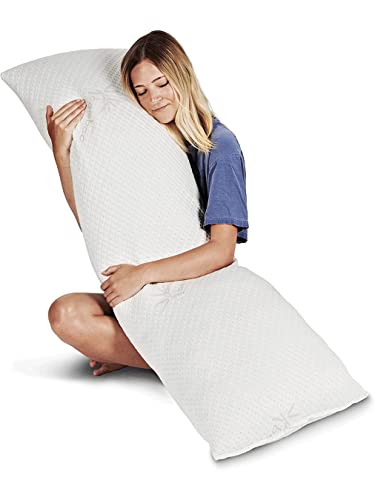
Snuggle-Pedic Body Pillow – Best Cooling
The Snuggle-Pedic answers the complaint every long pillow eventually earns: it sleeps hot. Its shredded memory foam is blended with gel and built for breathability, in a full body format its listing aims at side sleepers’ legs, belly and hips. A pillow you hug for eight hours is a significant thermal mass against your body, and in warm rooms or for warm sleepers that mass decides whether the pillow is used nightly or exiled by July. The Snuggle-Pedic’s cooling construction keeps the support of shredded foam — the knee-separating loft this guide prizes — while moving air through the fill. It suits hot sleepers, warm climates and anyone who has abandoned a body pillow for heat before. It does not suit cold sleepers who actively want a warm, dense hug.
Strengths
- Gel-blended shredded foam and a breathable build address the category’s heat problem directly.
- Supportive loft for the between-knees position without the collapse of soft fibre.
- Full-length format supports legs and torso together.
Trade-offs
- Cooling is relative — it sleeps cooler than standard foam, not cold.
- Premium tier pricing within the body pillow category.
- Shredded fill needs periodic fluffing to keep its loft even.
Judge this pillow across a week, not a night: heat discomfort is cumulative and so is its absence. Sleepers who run warm typically report that the third and fourth nights — when a standard foam pillow’s warmth has become the reason they wake — are where the Snuggle-Pedic quietly justifies itself. Paired with a breathable pillowcase, it is the set-and-forget support option for summer side sleeping.
Best for: warm sleepers needing full-length knee and hip support. / Not suited for: cold sleepers seeking maximum cosiness.
Check the current price on Amazon

Milliard Full Body Pillow – Best Firm Support
Some sleepers’ pillows fail by softness: the fill feels luxurious at bedtime and is a pancake by the small hours, knees together, pelvis twisted, purpose defeated. The Milliard is the corrective — a firm 54-inch shredded memory foam pillow with a washable cover, described as a firm hug pillow for side and back sleepers. Firm here means the knee stack stays a stack: the pillow keeps meaningful thickness under compression all night, which is the entire mechanical point for this search. It suits larger-framed sleepers, firm-mattress owners and anyone whose previous pillow compressed to nothing. It does not suit petite sleepers or plushness lovers, who may find it unyielding.
Strengths
- Firm shredded foam maintains knee separation through the whole night.
- Full 54-inch length with a washable cover for practical ownership.
- Supportive enough to double as a reading and lounging bolster.
Trade-offs
- Firmness is a genuine commitment; there is no softening adjustment beyond fluffing.
- Heavier and bulkier to handle than fibre pillows.
- May feel too thick between the knees for narrow-framed sleepers.
The Milliard makes the honest trade explicit: comfort for this use case is structural, and structure feels firm at first contact. Give it the same multi-night trial as the Coop — the body adapts to being held in alignment, and what felt unyielding on night one often feels simply correct by night four. If it remains too much, it has a second life as the household’s reading bolster, which is more than a failed soft pillow can claim.
Best for: sleepers whose pillows collapse, and larger frames needing real loft. / Not suited for: petite or plush-first sleepers.
Check the current price on Amazon

QUEEN ROSE S-Shaped Body Pillow – Best Contoured Hug
The QUEEN ROSE takes the shaping route: an S-curved hug pillow with a cooling cover, designed to follow a side sleeper’s body so the pillow meets shoulder, waist, hip and knee in one continuous line. Where straight pillows ask you to arrange them, the S-shape arrives pre-arranged — the curve cradles the torso while the lower section sits between the legs, which suits sleepers who toss a straight pillow out of position by morning. Its cooling cover suits the full-contact design, since a pillow that touches this much of you needs to manage heat. It suits restless side sleepers and anyone who likes to hug a pillow as much as lean on one. It does not suit back sleepers or buyers who want one pillow to serve several positions.
Strengths
- Contoured shape keeps support in position for restless sleepers.
- Cooling cover matches the high-contact design.
- Supports the arm and torso as well as the knees, reducing shoulder roll.
Trade-offs
- The shape is committed to one sleeping side and style.
- Less adjustable than the shredded-fill picks; the curve is the curve.
- Contoured pillows take a night or two of orientation to feel natural.
Think of the S-shape as training wheels for pillow positioning: everything the buying guide below tells you to arrange manually — torso supported, arm resting, knees separated — is built into the silhouette. Sleepers who have never kept a straight pillow in place all night are this design’s natural audience, and the cooling cover keeps the embrace from becoming a burden in warm rooms.
Best for: restless side sleepers who hug their pillow. / Not suited for: back sleepers or multi-position use.
Check the current price on Amazon
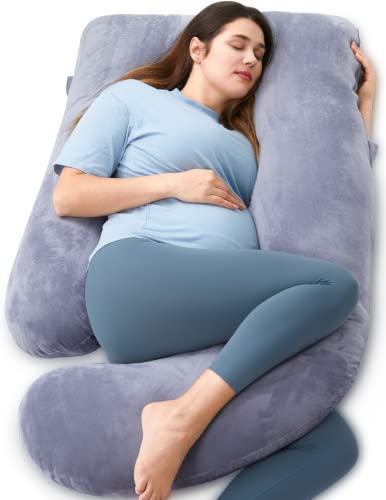
Momcozy U-Shaped Body Pillow – Best Full Wrap-Around
The Momcozy U is the maximalist answer: 57 inches of U-shaped pillow with a removable cover, supporting back, legs, belly and hips simultaneously. The U’s party trick matters for this search — when you turn over in the night, support is already on the other side. A straight pillow must be dragged across or abandoned at every turn, and many sleepers simply stop re-positioning it, losing the knee support for half the night. The U removes that failure mode entirely, and its back arm also discourages rolling flat onto the back mid-sleep. Though designed with pregnancy in mind, its support map is exactly the side-sleeper comfort map, pregnant or not. It suits committed side sleepers with the bed space to host it. It does not suit small beds, partners who resent annexation, or minimalist bedding households.
Strengths
- Support on both sides: turn over and the knee pillow is already there.
- Simultaneous back, hip and leg support in one piece.
- Removable cover keeps a big pillow practical to launder.
Trade-offs
- Occupies a serious share of the bed; partners should be consulted.
- The largest, heaviest format here to wrestle into its cover after washing.
- Full-wrap warmth is too much for some hot sleepers.
The U-shape is a commitment device, and that is its virtue: it makes the comfortable position the path of least resistance for the entire night rather than until the first turn. Households with a king bed and a determined side sleeper will find it transformative for sleep continuity; households with a double bed and a territorial partner should choose the Coop and keep the peace.
Best for: committed side sleepers who turn over often, with bed space to spare. / Not suited for: small beds or shared-bed diplomacy.
Check the current price on Amazon
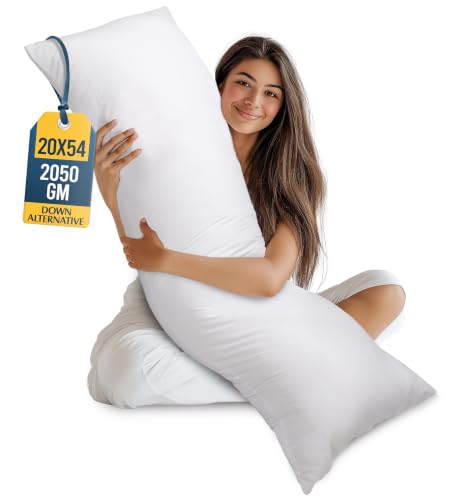
Utopia Bedding Full Body Pillow – Best Budget Plush
The Utopia is the simple classic: a plush full-length body pillow for side sleepers, soft and huggable, at the gentlest price tier in the guide. Its fill is plush rather than structural, which honestly limits its between-the-knees performance across a full night — it compresses more than the shredded foam picks — but for smaller-framed sleepers, softer mattresses and buyers whose main want is something long to hold and rest a leg over, it delivers the comfort without the investment. It suits first-time body pillow buyers testing whether the concept suits them, guest beds and plushness-first sleepers. It does not suit anyone whose previous soft pillow failed by flattening; that buyer needs the Milliard or the Coop.
Strengths
- The accessible entry point: full length and genuine plush comfort at a budget tier.
- Soft feel suits smaller frames and softer mattresses.
- Light and easy to handle, wash and move between beds.
Trade-offs
- Plush fill compresses; knee separation fades across the night.
- Not adjustable and not firm enough for larger frames.
- Shorter support lifespan than shredded foam designs.
As a diagnostic purchase the Utopia is shrewd: one month with it tells you whether body-pillow sleeping suits you at all, and if the answer is yes-but-flattening, you have learned exactly which upgrade to buy. Many households also keep it permanently as the lounging and reading pillow after graduating their night support to foam. Budget spent learning your own sleep is rarely wasted.
Best for: first-time body pillow buyers and plushness-first sleepers. / Not suited for: anyone needing firm, lasting knee support.
Check the current price on Amazon
Comparison Table
| Pick | Badge | Key spec | Best for |
|---|---|---|---|
| Coop Original Adjustable Body Pillow | Best Overall | Adjustable shredded fill, 20 x 54 in | Tuning knee and hip support to your body |
| Snuggle-Pedic Body Pillow | Best Cooling | Gel shredded foam, breathable build | Hot sleepers needing lasting loft |
| Milliard Full Body Pillow | Best Firm Support | Firm shredded memory foam, 54 in | Pillows that must not collapse |
| QUEEN ROSE S-Shaped Pillow | Best Contoured Hug | S-curve shape, cooling cover | Restless side sleepers |
| Momcozy U-Shaped Pillow | Best Full Wrap-Around | U-shape, 57 in, removable cover | Support on both sides all night |
| Utopia Bedding Body Pillow | Best Budget Plush | Plush full-length fill | First-time and softness-first buyers |
How to Choose a Body Pillow for Comfortable Side Sleeping
Begin with the position you are actually buying for. The classic supported side-sleeping arrangement has four elements: head pillow at a height that keeps the neck level, top arm resting forward on the body pillow rather than pulling the shoulder into a roll, the body pillow running between the legs from knee to ankle, and the knees separated by enough loft that the top leg rests roughly parallel instead of dropping across. A pillow purchase should be judged against that arrangement — which is why length, loft under compression and adjustability dominate this guide’s criteria, and why a short or squashy pillow fails this specific job even when it is a lovely cushion.
Thickness deserves its own paragraph because it is the most-missed specification. The right between-knees thickness depends on your pelvis width and your mattress: broader hips need more separation to keep the legs parallel, and a soft mattress that lets the lower leg sink effectively thins any pillow. This is the practical case for the Coop’s adjustability and the Milliard’s firmness — both are ways of guaranteeing the gap survives the night — and the practical warning against judging a pillow by its plumpness on the bed at 9 p.m. Judge it by what remains at 3 a.m., which reviews of your own first week will tell you honestly.
Then decide shape by behaviour. Straight pillows are versatile and partner-friendly but must be re-arranged when you turn; contoured S-shapes hold position for restless sleepers on one side; U-shapes solve the turning problem at the cost of bed territory. Fill follows: shredded memory foam for support and adjustability, gel blends for heat, plush fibre for softness and price. Covers should be removable and washable in every case — a pillow hugged nightly earns frequent washing — and cooling covers are worth their small premium for warm sleepers. Finally, keep the medical boundary clear in your own decision: buy for comfort and sleep quality, give any pillow a fair two-week trial, and if pain persists, sharpens or comes with other symptoms, let a clinician — not a bedding upgrade — take the lead.
How to Position a Body Pillow for Side Sleeping
Set the bed up in order. First your head pillow: lying on your side, your head and neck should continue the line of your spine without tilting up or dropping down; no body pillow compensates for a head pillow at the wrong height. Next, settle onto your side with your knees gently bent — a near-straight leg and a fully foetal curl both twist the pelvis more than the relaxed middle position. Slide the body pillow between your legs so it runs from just above the knees down between the ankles; separating the ankles as well as the knees is the detail that keeps the whole leg, and therefore the pelvis, in its neutral stack rather than pivoting at the knee.
Rest your top arm forward onto the pillow’s upper section, hugging it lightly, so the shoulder stays open instead of rolling forward and dragging the upper back into rotation. Your lower arm should be positioned comfortably — many sleepers rest it under the head pillow or forward on the mattress — rather than trapped under the torso, which is a common hidden cause of morning stiffness. If you use a U-shaped pillow, the arrangement simplifies: legs either side of one arm of the U, back resting toward the other, and turning over is a roll rather than a rebuild. Whichever shape you own, spend the first minutes of the night deliberately setting the position; within two weeks the arrangement becomes automatic, and the pillow stays where the night needs it. In the morning, fluff shredded fills back to loft, and wash covers on the same rhythm as your sheets — support and hygiene both live in those small habits.
Body Pillow, Knee Pillow or Wedge: Which Tool for Which Job
Shoppers in this corner of bedding often stand between three different products, and choosing clearly saves a return. A dedicated knee pillow is a small, contoured block that sits only between the knees. It is precise, cheap and takes no bed space, and for a disciplined sleeper who barely moves, it does the between-knees job alone. Its weakness is fidelity: it supports nothing else, offers the arms nothing, and a restless sleeper can dislodge it entirely by 1 a.m. A wedge pillow serves a different geometry altogether — elevating the torso or the legs — and belongs to reflux, reading and leg-elevation briefs rather than side-sleeping alignment. The body pillow is the generalist that covers the whole side-sleeping arrangement at once: knees, ankles, arm and torso in a single piece that stays engaged with the body through turns and shifts.
The honest decision tree runs like this. If your only issue is knee comfort and you sleep like a statue, the knee pillow is the efficient buy. If you wake with the pillow arrangement dismantled, hug a pillow instinctively, or want the arm and torso support as much as the knee support, the body pillow is the tool — and it is the one this guide’s picks serve. Many households end with both: the body pillow as the nightly system, a knee pillow for travel, where it packs small and preserves the habit in hotel beds. What none of these products is, to close the loop one final time, is a medical intervention; they are sleep-comfort tools of increasing scope, and persistent pain deserves professional assessment alongside whichever you choose.
Your Mattress Changes the Pillow You Need
The most overlooked variable in this purchase is already in your bedroom. A soft, conforming mattress lets the lower hip and leg sink, which effectively deepens the angle the top leg must cross to find the pillow; soft-bed sleepers generally need more between-knees loft, or a firmer pillow, to restore the parallel stack. A firm mattress holds the body on top of the surface, the lower leg stays higher, and a moderate pillow achieves the same geometry — but the firm bed also makes its own pressure at the hip, which is where a body pillow’s torso section earns its place by letting you lean and distribute weight. Couples sharing different preferences often discover the pillow quietly arbitrates: the partner on the too-firm side gains the cushioning layer the mattress withholds.
Bed size is the second environmental fact. A body pillow is a long-term resident of the bed’s geography: 54 inches of it, plus its owner. In a king, even the U-shaped Momcozy is a reasonable citizen. In a queen it is a negotiation; in a double it is an annexation, and the contoured or straight pillows are the diplomatic choices. Temperature is the third: a memory-foam mattress already sleeps warm, and pairing it with a dense foam pillow doubles the effect, which is why the cooling Snuggle-Pedic and the QUEEN ROSE’s cooling cover exist in this guide. Read the bed before the listings — mattress firmness, bed size, room warmth — and the shortlist usually narrows itself to the one or two picks that were always yours.
Common Buying Mistakes
The first mistake is buying softness for a structural job: a plush pillow that feels wonderful in the shop and compresses to a ribbon by midnight, leaving the knees together and the buyer concluding that pillows do not help. The second is buying too short — a pillow that ends at the knee leaves the lower legs to cross and pivot, undoing the alignment the top half achieved. Third is ignoring heat, then abandoning a supportive pillow in summer that a cooling design would have kept in service. Fourth is expecting a pillow to resolve pain that needs clinical attention; comfort support is a sleep aid, and treating it as a therapy delays the help that persistent sacroiliac pain deserves. Fifth is giving up after two nights: positions feel strange before they feel right, and every pick in this guide deserves the honest fortnight. Sixth is forgetting the partner and the bed size — a U-shaped pillow in a small double bed is a diplomatic incident with a removable cover.
When a Body Pillow Is Not Working: A Troubleshooting Guide
Most body pillow failures are fit failures, and they diagnose in a familiar order. If you wake with the pillow on the floor, the issue is engagement: the pillow is not part of your turning pattern, which favours the contoured and U-shaped designs that hold position or wait on both sides, over a straight pillow a restless sleeper sheds. If you wake with the pillow in place but your top leg still crossed hard over it, the loft under compression is insufficient — the fix is fill added to an adjustable pillow, or a step up to the firm class, not a different shape. If the pillow feels right at the knees but your shoulder aches, the missing piece is the arm rest: draw the pillow’s top section forward and hug it deliberately for a week, because shoulders complain about the roll, not the pillow’s absence.
Heat complaints route to the cooling picks or to a breathable cotton pillowcase before they route to abandonment; many a foam pillow has been exiled for the sins of a polyester case. Morning stiffness that persists despite a well-fitted pillow, a level head pillow and the two-week trial is information of a different kind: it says the problem may not be positional at all, and that is the point at which this guide’s recurring advice applies — let a clinician look, because bedding has reached the edge of what bedding can tell you. And if the pillow works but your partner has declared war, the diplomacy is real: a slimmer straight pillow, a bed-size conversation, or the U reserved for the weeks a partner travels have all saved both sleep and harmony. Troubleshooting, in short, is mostly tuning — and the adjustable Coop at the top of this guide exists precisely because tuning is the norm, not the exception.
Covers, Cases and Keeping a Body Pillow Fresh
A body pillow is the most intimate textile in the house — hugged for a third of every day — and its cover system decides its hygiene more than its fill does. Every pick in this guide has a removable cover, and the working rule is to wash that cover with the sheets, weekly in warm months and at least fortnightly otherwise; skin oils, sweat and the occasional midnight snack all live in the cover, and a fresh one restores the pillow’s feel more completely than any fluffing. Owning a second cover is the small luxury that makes the rule effortless, since the pillow is never left naked while laundry dries. Fabric choice matters to comfort as well as cleanliness: cotton and jersey cases breathe and feel neutral, cooling-performance cases amplify the gel fills in the Snuggle-Pedic and QUEEN ROSE, and a waterproof protector — worth it for the U-shaped Momcozy and for any pillow in a house with children, pets or night sweats — trades a whisper of breathability for insurance against the spill that would otherwise reach the fill.
The fill itself asks for rhythm rather than washing. Shredded fills should be fluffed by hand or given a short low-heat tumble as their makers allow, restoring the loft that nightly compression spends; plush fibre fills revive with a shake and an hour’s airing. Air the whole pillow in daylight periodically — sunlight and moving air are the oldest freshness technology there is — and store any off-duty pillow loose and dry, never vacuum-sealed for a season, because compressed fills forgive slowly. Attended this way, a good body pillow’s support life runs to years; neglected, even the best fill mats and flattens into the disappointment its owner then blames on the product. The pillow holds you all night; the cover-and-fluff routine is the small rent it charges.
Final Recommendation
Most side sleepers should start with the Coop Original Adjustable, because tuned thickness is the whole game for knee and pelvic comfort, and it is the only design here that fits every frame by construction. Hot sleepers should choose the Snuggle-Pedic, firmness seekers the Milliard, restless sleepers the QUEEN ROSE S-shape, and frequent turners with a big bed the Momcozy U. The Utopia remains the low-risk way to test the concept. Buy for comfort, position carefully, allow the fortnight — and let clinicians handle anything beyond comfort. Related guides: Best Body Pillows For Side Sleepers, Best Pregnancy Pillows, Best Knee Pillows For Side Sleepers, Best Pillows For Back Pain Comfort and Best Cooling Body Pillows.
Seasons of Use: Pregnancy, Recovery Periods and Growing Older
A body pillow’s working life spans the household’s changing seasons, and it is worth buying with that arc in mind. Pregnancy is the season the U-shaped designs were literally built for: as the months advance, side sleeping becomes the recommended and only comfortable position for many, and a wrap-around pillow supports belly, back and knees in one arrangement that does not need rebuilding at every turn — which is why the Momcozy’s support map appears in a guide read by many non-pregnant sleepers too. After the baby, the same pillow commonly serves feeding support and the parent’s own catch-up sleep, a second career most bedding never gets. Periods of recovery at home — after a strain, a procedure or an illness, always following the guidance of the treating clinician about positions and supports — often make side sleeping with props the comfortable arrangement, and a full-length adjustable pillow adapts to instructions a fixed cushion cannot.
Growing older writes the longest chapter. Sleep grows lighter and more position-sensitive with age, joints grow less forgiving of a twisted night, and the simple comfort of a supported, unhurried side position compounds across thousands of nights. The adjustable and firm picks in this guide suit that chapter best, because they can be re-tuned as the body and the mattress change, rather than replaced. None of this reframes the pillow as anything medical — it remains a comfort tool — but comfort, sustained across the seasons of a life, is a serious purchase, and it justifies buying the adjustable, washable, well-made version once rather than the disposable version repeatedly.
One more consideration belongs in the decision, because it decides more purchases than any specification: the trial. Bedding is a category where honest retailers expect returns, and a body pillow’s fit cannot be judged in a showroom minute or a single night. Buy from a listing whose return terms you have actually read, keep the packaging through the trial fortnight, and run the experiment properly — same position routine each night, fill adjusted in small steps, judgement made on the second week’s mornings rather than the second night’s strangeness. A pillow that survives that honest trial has earned its place in the bed; one that fails it has at least failed informatively, telling you whether the next attempt should be firmer, cooler, longer or a different shape entirely. Sleep is too large a share of life to leave its equipment to guesswork, and the trial is how the guesswork ends.
It is also fair to ask what success actually looks like, so the trial has a target. A well-fitted body pillow does not announce itself with drama; it shows up as a night with fewer position changes, a morning where the first movements feel unremarkable, and a pillow still in place when the alarm goes. Judge it by those quiet metrics across the second week, not by whether the first night felt transformative. Comfort that lasts is almost always this undramatic, in bedding as in most of the house, and the sleepers who learn to recognise quiet success stop churning through products and start sleeping — which was, from the first line of this guide, the entire point.
Budget, finally, deserves the same honesty as everything else in this guide. The spread between the Utopia and the premium adjustable and cooling designs buys real things — fill that holds loft for years, covers that manage heat, adjustability that fits one pillow to a changing body — and for a product used eight hours a night, the cost per night of even the finest pick here is trivial within a year. Spend where your diagnosis points: on firmness if pillows collapse on you, on cooling if heat exiles them, on adjustability if nothing off the shelf has ever quite fit. That is money aimed, and aimed money is what this entire category rewards.
Frequently Asked Questions
How does a body pillow help side sleepers sleep more comfortably?
By holding the supported position described in this guide: knees separated, legs roughly parallel, top arm resting forward. Without support, the top leg drops and rotates the pelvis into a twist that many sleepers find uncomfortable by morning. The pillow maintains the neutral stack passively, all night.
Is a body pillow a treatment for sacroiliac joint pain?
No. These are comfort products that support a restful sleeping position; they do not diagnose or treat sacroiliac joint conditions or any other medical issue. Persistent or severe pain, or pain with numbness, weakness or other symptoms, should be assessed by a clinician.
How thick should the pillow be between my knees?
Thick enough, after compression, to keep your top leg roughly parallel to the bottom one rather than angled down across it. Broader hips and firmer mattresses generally need more loft, which is why adjustable and firm designs feature at the top of this guide.
Straight, S-shaped or U-shaped — which is best?
Straight pillows are versatile and adjustable; S-shapes hold position for restless one-side sleepers; U-shapes keep support in place when you turn over, at the cost of bed space. Match the shape to your turning habits and your bed size rather than to any abstract ranking.
How long does it take to get used to a body pillow?
Most sleepers need one to two weeks of consistent use before the arranged position feels automatic and the comfort difference is fairly judged. Adjustable pillows also need their fill tuned during that period, in small handfuls, a night at a time.
How do I wash a body pillow?
Covers come off and wash with your bedding — every pick here has a removable cover. The pillows themselves should be fluffed regularly to restore loft; follow each maker’s guidance for the fill itself, since shredded foam and fibre fills have different washing tolerances.

