Disclosure: airfryerkitchensupply.com is reader-supported. When you buy through links on our site, we may earn an affiliate commission at no extra cost to you.
Where to buy
A smaller bathtub is a precision purchase: the tub has to fit a room that standard 60- and 72-inch models cannot, without giving up the deep, shoulders-under soak that makes a bath worth running. The six tubs below were confirmed through Amazon check and all sit between 48 and 55 inches long — genuinely compact footprints — while keeping soaking depth as their design priority. Measure your bathroom twice before ordering anything on this page, confirm drain position and door swing against the listing drawings, and check the current price on Amazon once the tape-measure work is done.
- WOODBRIDGE 48-inch Acrylic Freestanding Soaking Tub, BTA1703 — Check the current price on Amazon
- WOODBRIDGE 48-inch Japanese Soaking Tub with Seat, B0070 — Check the current price on Amazon
- Claire 48-inch Freestanding Bathtub — Check the current price on Amazon
- Empava 48-inch Air Jetted Japanese Soaking Tub — Check the current price on Amazon
- WOODBRIDGE 54-inch Acrylic Freestanding Soaking Tub, BTA1507 — Check the current price on Amazon
- DeerValley 55-inch Acrylic Freestanding Bathtub, DV-1T0582 — Check the current price on Amazon
The search for the best smaller bathtubs starts with a tape measure and a disappointment: the bathroom is 5 feet wide, the standard tub is 5 feet long, and every beautiful soaking tub in the showroom is 67 inches of impossible. The good news, which this guide exists to document, is that compact tub design has become a real discipline. Makers like Woodbridge and Empava now build 48-inch freestanding tubs that soak deeper than many full-size models, because depth — not length — is what a bath actually is. A short, deep tub asks you to sit more upright, knees bent, water to the shoulders; a long, shallow tub lets you stretch out in six inches of cooling water. Once you have experienced the first, the second stops feeling like the luxury.
Smaller tubs also carry practical virtues that rarely make the brochures. They use less water per bath, they heat a small bathroom less oppressively, they are lighter to deliver and manoeuvre through narrow doors and stairwells, and they leave floor space for storage or a larger shower in the same renovation. The honest trade is legroom and two-person bathing, and this guide will not pretend otherwise. But for the ensuite that currently has no tub at all, the flat with the alcove that fits nothing standard, or the cottage bathroom being reclaimed from a cupboard-sized shower, a well-chosen 48- to 55-inch tub is not a compromise — it is the enabling purchase.
In this guide
Quick Picks
- Best Overall — WOODBRIDGE 48-inch Freestanding Soaking Tub, BTA1703. The benchmark compact tub: 48 inches of contemporary acrylic soaking design with integrated drain and overflow. Check the current price on Amazon
- Best Deep Soak in a Tiny Footprint — WOODBRIDGE 48-inch Japanese Soaking Tub with Seat. A square-format Japanese-style tub with a pre-moulded seat for a genuinely deep, upright soak in the smallest footprint here. Check the current price on Amazon
- Best Minimalist Compact — Claire 48-inch Freestanding Bathtub. A clean-lined 48-inch tub for design-led small bathrooms that want the object to disappear into the room. Check the current price on Amazon
- Best Jetted Small Tub — Empava 48-inch Air Jetted Japanese Soaking Tub. Thirty-six air jets and a seat in a 48-inch, deep-soaking format built explicitly for small bathrooms. Check the current price on Amazon
- Best for Taller Bathers — WOODBRIDGE 54-inch Freestanding Soaking Tub, BTA1507. Six extra inches of length that taller bathers feel immediately, still a compact footprint by market standards. Check the current price on Amazon
- Best 55-inch Deep Soak — DeerValley 55-inch Freestanding Bathtub. A deep-soaking 55-inch design with centre drain and integrated overflow for rooms that can stretch slightly past 48. Check the current price on Amazon
How These Picks Were Chosen
Every tub here was cross-checked against Amazon record for airfryerkitchensupply.com before receiving a link, with exact Amazon titles logged in the sourcing notes beside this article. The brief was then applied strictly. Length had to be 55 inches or under — no quietly including a 59- or 60-inch tub and calling it small. Soaking depth had to be a design priority, because a short and shallow tub is merely small, while a short and deep tub is a soaking tub. Freestanding formats dominate the list because compact bathrooms usually need placement flexibility — against a wall, in a corner, angled — that alcove tubs cannot offer, and because freestanding acrylic is light enough to get into the flats and upper floors where small bathrooms live. Drain and overflow integration was favoured, since compact installations have the least room for plumbing improvisation.
Equally, some categories were deliberately left out. Inflatable and folding portable tubs serve renters well but are not permanent bathroom fixtures, and this guide is written for owners renovating a room. Walk-in tubs answer an accessibility brief with doors and seats at much larger footprints and budgets; they appear in this programme’s other guides. And standard 60-inch alcove tubs, however good, fail the one test this search sets. What remains is the honest compact class: real tubs, really smaller.
The 6 Best Smaller Bathtubs

WOODBRIDGE 48-inch Acrylic Freestanding Soaking Tub, BTA1703 — Best Overall
Woodbridge’s 48-inch BTA1703 is the tub that proves the compact class is serious. The contemporary oval form looks like a scaled-down version of the brand’s full-size freestanding tubs — because it is — with the same glossy acrylic finish, integrated drain and overflow in brushed nickel, and a soaking well designed around depth rather than stretch. In a small bathroom it reads as a deliberate design object rather than an apology, and it pairs naturally with a floor-mounted or wall-mounted filler. For most buyers with a genuinely small room, this is the default recommendation: the smallest footprint from a maker whose larger tubs are well established, in the format that suits the widest range of compact layouts.
Strengths
- A true 48-inch footprint that fits rooms standard tubs cannot enter.
- Soaking depth prioritised over length, so the bath feels generous.
- Integrated drain and overflow simplify a compact installation.
Trade-offs
- Legroom is seated-bath legroom; stretching out fully is not on offer.
- Freestanding format needs a filler faucet, a separate purchase to budget for.
- One-bather design, firmly.
Owners of small ensuites describe the same conversion: the room that was shower-only becomes the room with the tub everyone prefers, because a deep 48-inch soak beats a shallow 60-inch paddle. Keep the surrounding design simple — a compact tub in a calm room looks intentional, while the same tub amid visual clutter looks squeezed — and the BTA1703 will pass for a boutique-hotel choice rather than a spatial compromise.
Best for: most small bathrooms wanting a proper freestanding soak / Not suited for: bathers who prioritise stretching out full-length
Check the current price on Amazon

WOODBRIDGE 48-inch Japanese Soaking Tub with Seat, B0070 — Best Deep Soak in a Tiny Footprint
Japanese soaking tubs — ofuro — were deep and compact centuries before Western bathrooms shrank, and this square-format Woodbridge applies the original logic: a pre-moulded seat inside a tall, compact well, so you sit immersed to the shoulders in a footprint closer to a shower tray than a bathtub. For the smallest rooms on this page, and for bathers who soak for the heat and the stillness rather than to recline, it delivers the deepest experience per square foot of any pick here. The square shape also tucks into corners with an efficiency ovals cannot match.
Strengths
- Seated, shoulders-under immersion in the smallest footprint in this guide.
- Square format uses corners and tight alcoves exceptionally well.
- Less water per soak than a long tub filled to the same shoulder depth.
Trade-offs
- The upright seated posture is a different bath, not a reclined one.
- Entry and exit are over a tall side; consider mobility honestly.
- The distinctive format suits some bathroom designs and fights others.
Think of this tub as the connoisseur’s answer to a tiny bathroom. People who take soaking seriously — the long, hot, quiet kind — often prefer the ofuro posture once they have tried it, because the water coverage is total and the temperature stays even. In a compact ensuite or a converted closet bathroom, it can be the difference between a real soaking ritual and no bath at all.
Best for: serious soakers with the very smallest rooms / Not suited for: bathers who want to recline or who need low entry sides
Check the current price on Amazon

Claire 48-inch Freestanding Bathtub — Best Minimalist Compact
The Claire 48-inch tub is the design-led entry: clean lines, an unadorned silhouette and a footprint identical to the Woodbridge overall pick, aimed at bathrooms where the renovation’s aesthetic is calm minimalism. In small rooms, visual quiet is a functional quality — a simple white form against simple walls makes the room feel larger than a fussier fixture would — and this tub is chosen for exactly that discipline. It suits the increasingly common compact ensuite built into a bedroom corner or a converted box room, where the tub is visible from the bed and must earn its place as an object.
Strengths
- Minimalist form keeps small bathrooms feeling open and calm.
- True 48-inch footprint matches the most compact picks here.
- A natural fit for bedroom-visible ensuites and design-led renovations.
Trade-offs
- Fewer published frills; buyers wanting jets or seats should look to Empava or Woodbridge’s Japanese model.
- Like all freestanding tubs here, the filler faucet is separate.
- The plain aesthetic is the point — and not to every taste.
Choose the Claire when the room’s design matters as much as the soak: the flat being renovated for sale or let at the quality end, the ensuite photographed for a listing, the small bathroom in a carefully designed home. Functionally it delivers the compact freestanding brief; aesthetically it disappears, which in a small room is a compliment.
Best for: design-led compact renovations / Not suited for: buyers wanting jets, seats or traditional styling
Check the current price on Amazon

Empava 48-inch Air Jetted Japanese Soaking Tub — Best Jetted Small Tub
Empava’s 48-inch entry refuses the assumption that small means basic. It is a Japanese-style deep soaking tub — over 20 inches of soaking depth in the listing’s specification — with a seat and thirty-six air jets delivering a bubbling massage soak, in a footprint explicitly built for small bathrooms. Air jets are the right jet technology for a compact soaker: they are gentler than water jets, the system is simpler to keep clean, and the tub can still be used as a still, silent soak whenever you prefer. For buyers who feared a small bathroom meant giving up the spa idea entirely, this is the counterexample.
Strengths
- Air-jet massage in a true 48-inch, deep-soaking footprint.
- Seated Japanese format gives shoulders-under immersion.
- Still-water soaking remains available when jets are off.
Trade-offs
- Jetted systems add installation and maintenance beyond a simple soaker.
- Requires an electrical supply for the air system — plan it in the renovation.
- The seated format shares the ofuro posture trade-offs of entry height and upright soaking.
Budget and plan honestly around this tub: it needs power, it rewards a proper installation, and its owners should run the jet-cleaning routine the maker specifies. Do that, and a bathroom barely larger than a wardrobe gains the most indulgent bath on this page. In rental or resale terms, it is also the pick most likely to make a small property’s listing stand out.
Best for: spa-minded buyers with tiny bathrooms / Not suited for: minimal renovations wanting the simplest possible install
Check the current price on Amazon
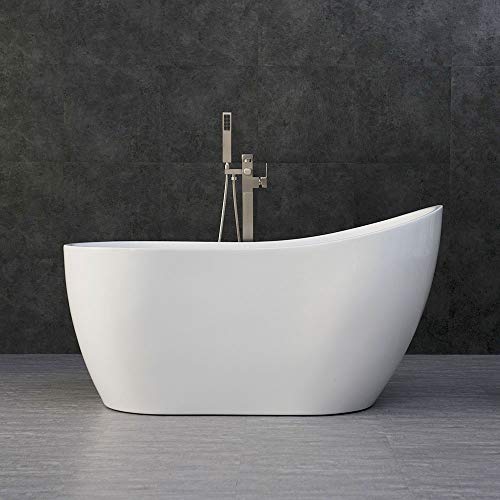
WOODBRIDGE 54-inch Freestanding Soaking Tub, BTA1507 — Best for Taller Bathers
Six inches is not much on a spec sheet and is a great deal in a bath. The 54-inch BTA1507 keeps the Woodbridge compact formula — acrylic freestanding form, integrated brushed-nickel drain and overflow — and spends its extra length exactly where taller bathers need it: knees that can extend further, a recline that feels less folded. At 54 inches it remains firmly a smaller bathtub by market standards, fitting alcoves and walls that reject 60-inch models, and for bathers around six feet tall it is often the difference between a compact tub that works and one that merely fits the room.
Strengths
- Extra length serves taller bathers without leaving the compact class.
- Same integrated drain and overflow convenience as the 48-inch Woodbridge.
- A proven model line with the brand’s established acrylic finish.
Trade-offs
- Needs six more inches of room than the smallest picks — measure honestly.
- Still not a full-stretch tub for the very tall.
- Freestanding filler faucet remains a separate purchase.
The decision rule is simple: if your room can take 54 inches without crowding the door swing or the vanity, and anyone bathing is tall, take the length. Bathing comfort is personal in a way room dimensions are not, and the bather will thank the tape measure every single evening. If the room truly cannot, the 48-inch picks lose less than tall bathers fear, thanks to their depth.
Best for: taller bathers in rooms that can stretch to 54 inches / Not suited for: the tightest 48-inch-only layouts
Check the current price on Amazon
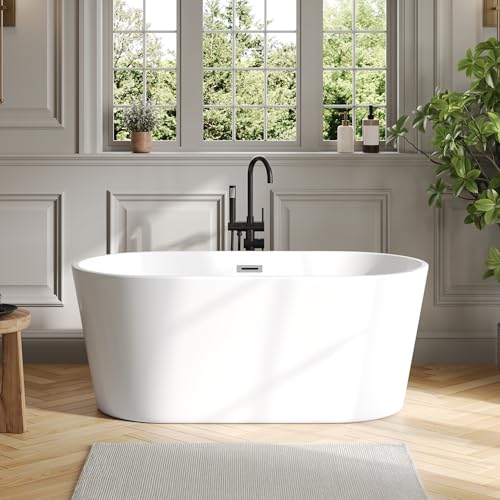
DeerValley 55-inch Acrylic Freestanding Bathtub, DV-1T0582 — Best 55-inch Deep Soak
DeerValley’s 55-inch tub closes the list at the top of the compact range: a deep-soaking freestanding design with centre drain and integrated overflow, in an ergonomic form intended to cradle a seated recline. The centre drain is a small specification with real consequences in compact rooms — it frees the tub from a fixed plumbing end, letting it sit symmetrically against a wall or centred under a window, and it means neither end of the bath is the shallow end. For a room that can give 55 inches, this is the most conventional-bath-feeling option here: the closest experience to a standard tub, at five inches less than standard.
Strengths
- Deep-soak design with centre drain for flexible, symmetric placement.
- The most standard-tub-like bathing posture in this compact list.
- Integrated overflow keeps the installation clean.
Trade-offs
- The largest footprint here; genuinely tiny rooms should stay at 48 inches.
- Centre-drain plumbing must be planned with your installer in advance.
- Less of a design statement than the Japanese-format picks.
Renovators working with a 5-foot wall that must also hold a filler and some breathing room will find the DeerValley the natural landing spot: compact on paper, generous in the water. Pair it with a wall-mounted filler to keep the floor line clean, and the room will read as a designed small bathroom rather than a standard bathroom that failed to fit.
Best for: rooms that can give 55 inches and want a familiar bath feel / Not suited for: 48-inch-only spaces
Check the current price on Amazon
Comparison Table
| Pick | Badge | Key spec | Best for |
|---|---|---|---|
| WOODBRIDGE BTA1703, 48 in | Best Overall | Acrylic freestanding soaker, integrated drain | Most small bathrooms |
| WOODBRIDGE Japanese Tub, 48 in | Best Deep Soak | Square ofuro format, pre-moulded seat | Tiniest footprints |
| Claire, 48 in | Best Minimalist Compact | Clean-lined freestanding design | Design-led ensuites |
| Empava Air Jetted, 48 in | Best Jetted Small Tub | 36 air jets, seat, deep soak | Compact spa baths |
| WOODBRIDGE BTA1507, 54 in | Best for Taller Bathers | Extra length, integrated drain | Taller bathers |
| DeerValley, 55 in | Best 55-inch Deep Soak | Centre drain, deep-soak form | Near-standard feel |
How to Choose a Smaller Bathtub
Measure first, and measure like an installer rather than an optimist. Record the room’s length and width, the exact footprint available for the tub, the door’s swing arc, the path the tub must travel from the street to the bathroom — hallway widths, stair turns, door heights — and the position of the existing drain and water supplies. Compact tubs forgive a lot, but a freestanding tub that cannot turn the corner of a Victorian staircase forgives nothing. Note the floor’s structure too: a filled compact tub concentrates real weight on a small area, and while acrylic tubs are light, water and a bather are not, so an older floor deserves a joist check during the renovation rather than after it.
Then choose your soaking posture, because at these sizes posture is the product. The reclined soak of the Woodbridge 48 and the DeerValley 55 suits bathers who read, unwind and stretch as far as the tub allows; the upright, seated soak of the Japanese-format Woodbridge and Empava suits bathers who soak deep and hot, value total immersion, and are comfortable entering over a taller side. Neither is better — but they are different baths, and choosing the wrong one is the main way compact tubs disappoint. If you can, sit in a display tub, even a full-size one of the same format, before committing.
Depth deserves a number, not an adjective. Compare the soaking depth — the distance from the tub floor to the overflow — across your shortlist, because that figure, more than length, predicts whether your shoulders go under. Width matters quietly too: compact tubs vary in interior width, and broader bathers should weight the interior dimensions over the exterior ones that dominate listings. Finally, plan the filler early. Freestanding tubs need floor-mounted or wall-mounted fillers, and in a small room the wall-mounted option usually wins, saving floor space and money; confirm the filler’s reach over the tub’s rim against the drawings before the plumbing is roughed in, not after.
How to Plan a Small-Bathroom Tub Installation
Sequence the renovation around the tub. In compact rooms the tub is the largest object and often must enter before the door frame, vanity or even some tiling is finished, so agree the delivery day with your installer and keep the tub’s packaging protection on until the room is clean. Confirm the drain position against the chosen model — centre-drain tubs like the DeerValley need the waste where the drawing says it is — and pressure-test the new plumbing before the tub is finally positioned, because access afterwards in a tight room ranges from awkward to destructive.
Ventilation is the small bathroom’s silent specification. A deep, hot soak in a tiny room produces a great deal of moisture in a small air volume, and without an effective extractor the room will suffer for it — paint, grout and eventually the tub’s own sealant lines. If the renovation touches nothing else, upgrade the fan. Lighting deserves the same thought: a compact tub area lit warmly and dimmably turns a spatial compromise into the room’s best feature, and it costs little at rough-in stage. Finally, leave yourself maintenance access — a removable bath panel equivalent for freestanding installations means knowing how you would reach the waste connection in five years, and agreeing it with the installer while they are still in the room.
Water, Heat and Running a Compact Soak
One of the compact tub’s genuine pleasures is efficiency. A 48-inch deep tub filled to shoulder depth on a seated bather typically uses less water than a long, shallow tub filled to a depth that barely covers the legs, because the seated posture displaces and needs less volume around the body. The water also stays hotter longer in a smaller volume with less surface area — though an acrylic tub of any size benefits from being filled with water a degree or two hotter than your target, to absorb the initial warming of the tub itself. Bathers who soak often will notice the utility difference across a season; households that bathe rarely will simply notice that the bath is ready sooner.
Care is equally compact. Acrylic wants non-abrasive cleaning — a soft cloth, mild detergent, and nothing scouring — and it rewards that gentleness by keeping its gloss for years. Jetted owners, Empava’s in particular, should run the maker’s cleaning cycle on schedule, because air systems that sit unused and uncleaned announce themselves. Dry the rim and the floor line after soaks in very small rooms, where splashes have nowhere to go, and the whole installation will age as gracefully as the tub itself.
Common Buying Mistakes
The cardinal mistake is buying by exterior length alone — choosing a 48-inch tub without checking its soaking depth or interior width, and receiving a tub that is small in every direction including the ones that matter. The second is forgetting the journey: measuring the bathroom but not the staircase, the hallway turn or the bathroom door itself. The third is posture blindness — ordering a Japanese seated tub for a bather who dreams of reclining, or a reclined compact for a serious deep soaker — when the formats are honestly described and simply different.
Fourth, buyers under-budget the fittings. A freestanding tub’s price is not the installation’s price: the filler, the waste work and, for jetted models, the electrical supply belong in the same spreadsheet from the start. Fifth, renovators squeeze the tub into the room at the expense of everything else — a bath you cannot clean around, dry the floor beside, or enter without climbing over the toilet is a daily irritation wearing a luxury costume. Leave the tub its breathing room, even if that means the 48-inch model instead of the 55; in small bathrooms, the space around the tub is part of the tub.
Final Recommendation
For most small bathrooms, buy the WOODBRIDGE 48-inch BTA1703 — check the current price on Amazon — and spend the money it saves over larger formats on a good wall-mounted filler and a proper extractor fan. Serious soakers in the tiniest rooms should choose the WOODBRIDGE Japanese seated tub; spa-minded buyers, the Empava air-jetted model; design-led renovations, the Claire. If the room stretches to 54 or 55 inches, taller bathers should take the WOODBRIDGE BTA1507 and everyone else the deep, centre-drain DeerValley.
Measure twice, choose the posture honestly, and the smallest room in the house can end up holding its best bath. For neighbouring bathroom projects from the same programme, see Best Acrylic Freestanding Bathtubs, Best Alcove Deepwater Bathtubs, Best 72 Bathtubs for the rooms that can take the opposite extreme, Best Freestanding Tub Fillers and Best Bathtub Caddies.
Compact Tubs in Rentals, Flats and Listed Homes
Small bathrooms concentrate in exactly the properties where renovation freedom is limited, so the compact tub’s practicalities deserve a direct word. In owned flats, the governing questions are structural and administrative: floor loading for a filled tub, any leasehold or building rules about bathroom alterations, and access for future plumbing maintenance — all answerable before purchase, and all easier with a light acrylic tub than with heavier materials. In period and listed homes, freestanding compact tubs have a quiet advantage: they sit within the room rather than being built into it, disturb less original fabric, and can in principle be removed without trace, which makes consent conversations simpler than for built-in alterations.
For landlords and sellers, a compact tub is one of the few upgrades that changes a property’s category: a shower-only flat becomes a flat with a bath, and in family and professional markets that distinction carries real weight in both rent and sale interest. The DeerValley and Claire picks, being the most conventional and the most photogenic respectively, are the usual choices for that purpose. Renters themselves, sadly, remain outside this guide’s permanent-fixture brief — but a renter’s household can still borrow the compact philosophy, measuring honestly and choosing the room’s bathing arrangement around depth rather than length, whenever their lease allows any change at all.
Pairing a Small Tub with a Small Shower
Many compact renovations face a fork: tub or shower, when the room seems to allow only one. The compact tub reopens the third option — both, honestly sized. A 48-inch tub along one wall and a modest walk-in shower enclosure can share a small room if the layout is planned as a wet-zone composition rather than as two competing fixtures: the tub freestanding where it can be walked around, the shower glass minimal, the floor one continuous waterproofed surface with a single fall to drainage. Japanese-format tubs serve this composition especially well, because their shower-tray-like footprint and seated format pair naturally with an over-tub or adjacent shower for the household’s quick mornings, reserving the soak for when it is wanted.
The households that succeed with both-fixture small bathrooms share two disciplines. They keep the palette and materials continuous, so the room reads as one designed space rather than two squeezed ones; and they spend on ventilation before decoration, because two water fixtures in a small air volume punish weak extraction quickly. Done that way, the small bathroom stops being the home’s apology and becomes, frequently, its most admired room — proof that the constraint was never the square footage but the standard sizes everyone assumed it had to contain.
Compact Tubs for Children and for Ageing in Place
Families discover a side benefit of the compact class: children are, in effect, native compact bathers. A 48-inch deep tub is a generous bath for a child — deep enough for proper play, small enough to fill quickly and to supervise closely, and economical with the hot water that family bath nights consume in quantity. The seated Japanese formats suit the family stage after that: a school-age child sits safely in the moulded seat, and the tub’s modest volume keeps the whole ritual quick on school nights. When the children grow, the same tub reverts to the adults’ deep soak without any sense that the room was designed around a phase.
At the other end of life, honesty is required. Compact freestanding tubs, with their higher sides and step-over entry, are not accessibility products, and bathers with limited mobility should look to the walk-in and seated-transfer designs covered elsewhere in this programme rather than adapting a soaker. What a compact tub can offer an older bather with full mobility is a shorter, more manageable bathing space — less distance to lower into, a seated format that some find steadier, and a room layout with room for a stool, rails fitted by a professional, and clear floor space. Any such adaptation belongs in a conversation with an occupational therapist or a qualified installer; this guide’s role is to flag the question early, while the renovation can still answer it.
The Resale and Rental Lens
Because compact bathrooms cluster in flats and smaller houses — the most traded segment of most housing markets — the compact tub decision carries a financial echo worth hearing. Estate agents consistently report that a bath, any bath, widens a small property’s buyer pool, because households with children filter listings by it; a shower-only small home excludes that demand entirely. A well-chosen compact tub, professionally installed and photographed in a calm, uncluttered room, converts the smallest room from a caveat in the listing into a feature in it. The tubs that perform best in that lens are the ones that look intentional: the Claire’s minimalism, the Woodbridge’s recognisable design language, the DeerValley’s conventional elegance.
Landlords hear a version of the same arithmetic in rent and retention: tenants stay longer in homes that bathe properly, and a compact tub is among the cheapest ways to give a small rental that quality without stealing space from anywhere else. In both cases the caution is identical — the installation must be proper, the plumbing sound, the ventilation real — because a badly fitted tub is a liability wearing the same costume. Buy the compact tub as a long-term fixture, install it as one, and the smallest room will repay the decision in use first and in value afterwards.
Styling a Small Bathroom Around a Compact Tub
A compact tub succeeds visually when the room’s design accepts its scale instead of apologising for it, and a few reliable principles govern that acceptance. Keep the large surfaces quiet: one tile or finish across floor and walls, run continuously, makes the room read larger than any feature treatment, and gives the tub’s white form a calm field to sit in. Choose the filler as jewellery — in a small room the tap is at eye level and constantly seen, so a well-finished wall-mounted filler in a metal that matches the tub’s drain lifts the whole composition more than any accessory. Lighting should layer: a soft general light for cleaning, a warmer, dimmer scene for soaking, because the same room does both jobs and a compact bath at night, lit low, is where this category’s romance actually lives.
Storage must be designed, not accumulated. Small bathrooms drown in bottles, and a compact tub surrounded by product clutter looks smaller than it is; a recessed niche, a single closed cabinet and a bath caddy across the tub — chosen slim, in a material that suits the room — keep the scene composed. Mirrors earn their reputation here honestly, doubling light and apparent depth above a compact vanity. Plants tolerate the humidity and soften the geometry. None of this requires the tub to be expensive; it requires the room to be edited, and editing is free. The compact bathrooms people photograph and envy are never the ones with the most spent in them — they are the ones where every object, starting with a well-chosen small tub, looks like it was put there on purpose.
Finally, respect the negative space. The instinct in a small room is to fill every centimetre the compact tub saved — a bigger vanity, a linen tower, a second fixture. Resist at least half of it. The floor area a 48-inch tub returns to the room is what makes the room feel generous, lets a bather move, dry and dress without choreography, and allows cleaning to be a task rather than a puzzle. Spend the saved space on air. That, more than any single product in this guide, is the design secret of the successful small bathroom: the tub is compact so that the room does not have to feel that way.
What a Compact Tub Costs to Run, Honestly
Ownership costs in this category are modest and mostly hide in three places. Water and heating are the visible ones, and here the compact tub is the frugal option in the market: smaller volumes, filled to a seated bather’s shoulders, cost less per bath than the long tubs they replace, and frequent soakers feel that difference across a year of utility bills. The second cost is the filler and fittings’ maintenance — washers, seals and a descaled shower head on the same unit — which is ordinary bathroom upkeep, no different at 48 inches than at 72. The third is time: a smaller bath fills faster, heats the room less and empties sooner, and in a busy household those minutes are a real, if unpriced, part of the running cost.
Against those savings, set the one premium the category can carry: compact models from serious makers are not always cheaper per inch than standard tubs, because they are lower-volume products built to the same standard. The honest comparison is not price per inch but price per solved problem — a room that gains a bath it could not otherwise hold, at a running cost lower than the standard article. Judged that way, the six tubs in this guide are among the better-value fixtures in any small-home renovation, and their owners’ bills, water and time alike, keep agreeing.
Delivery Day: Getting a Tub Into a Small Home
The last practical hurdle deserves its own paragraph of planning, because more compact-tub projects stumble at the front door than at the plumbing. Before ordering, walk the tub’s route with a tape measure: street door, hallway, every turn, the staircase’s narrowest point and its headroom, and the bathroom door itself. Acrylic compact tubs are light enough for two people to carry and small enough to tilt and rotate through openings that defeat standard models — one of the format’s unadvertised virtues — but the route should be proven, not hoped. On delivery day, keep the tub in its packaging until it reaches the bathroom, inspect the finish before the installers’ work begins, and photograph the drain and overflow positions against the room’s plumbing before anything is fixed. Ten unhurried minutes at this stage are the cheapest insurance in the whole renovation.
The First Soak: Testing Your New Tub Properly
When the installation is finished, resist the immediate full ceremony and run a test soak first: fill to a working depth, sit in the tub as you actually bathe, and check the three things drawings cannot tell you — whether the water reaches where you want it on your shoulders, whether the recline or seat meets your back where you expected, and whether you can reach the filler, the caddy and the door-side towel without a stretch that will annoy you nightly. Note the fill time and the temperature drop across twenty minutes, because those two numbers define your real bathing routine. Any disappointment at this stage is information for small adjustments — a moved caddy, a repositioned filler setting, a bath pillow for the recline — rather than a verdict on the tub. Compact bathing rewards this kind of calibration; the bathers who love their small tubs are the ones who tuned the ritual once, properly, at the start.
Frequently Asked Questions
Is a 48-inch bathtub big enough for an adult?
Yes, with the right expectations. A 48-inch deep soaking tub seats an adult with knees bent and water to the shoulders — the immersion is complete even though the legs do not stretch out. Bathers who define a bath by reclining full-length will find it small; bathers who define it by depth usually prefer it to a shallow standard tub.
What is the difference between a compact reclined tub and a Japanese soaking tub?
Posture. A compact reclined tub is a scaled-down Western bath: you lean back at an angle with legs extended as far as the length allows. A Japanese soaking tub seats you upright on a moulded seat in deeper water, immersing you to the shoulders in a smaller footprint. Both are genuine soaks; choose by how you actually like to sit in water.
Do smaller bathtubs use less water?
Generally yes. A compact deep tub filled to shoulder depth on a seated bather typically needs less volume than a long shallow tub, and the smaller surface area also loses heat more slowly. Exact consumption depends on the model and fill depth, but efficiency is one of the compact format’s real advantages, especially for frequent soakers.
Can a freestanding small tub go against a wall or in a corner?
Usually yes. Most compact freestanding tubs can sit close to a wall with a wall-mounted filler, and the square Japanese format is designed to use corners efficiently. Confirm the model’s clearances and the filler’s reach in the listing drawings, and leave enough room to clean around the tub — a hand’s width is the practical minimum.
What plumbing changes does a smaller tub need?
Often fewer than feared: the drain position is the key variable, and centre-drain models need the waste where the drawing specifies. Freestanding tubs need a floor- or wall-mounted filler rather than a deck-mounted one, and jetted models like the Empava also need an electrical supply. Agree all of it with your installer before ordering.
How do I keep a compact tub’s water hot for a long soak?
Fill a degree or two hotter than your target to allow for the tub warming up, fill efficiently rather than in stages, and keep the bathroom door closed so the room’s air holds its warmth. A bath caddy or cover over part of the surface during a long soak also slows heat loss noticeably in a small room.
Are acrylic compact tubs durable?
Quality acrylic is light, warm to the touch and durable when cleaned non-abrasively; it is also easier to deliver into small, upper-floor bathrooms than heavier materials. Avoid scouring cleaners, repair minor scratches with acrylic-appropriate products, and a good acrylic compact tub should serve for many years.


