Disclosure: airfryerkitchensupply.com is reader-supported. When you buy through links on our site, we may earn an affiliate commission at no extra cost to you.
Where to buy
The rugs below were chosen for one job: living under rolling chair casters without bunching, curling, or fighting the wheels. Each was verified as a real current listing. If you are comparing the best area rugs for under office chair use, the traits that matter are pile height, backing grip, and size — in that order.
- Under Desk Area Rug for Rolling Chairs, 36 x 48, Taupe — check price on Amazon
- Office Chair Mat Rug for Hardwood and Tile, 48 x 60 — check price on Amazon
- Office Chair Mat Rug for Hardwood Floor, 36 x 48, Machine Washable Black — check price on Amazon
- iCasso Office Chair Mat Rug, 36 x 48, Convex Black — check price on Amazon
- Office Chair Mat Rug for Hardwood and Tile, 36 x 48 — check price on Amazon
- DMOYEST Washable Round Area Rug, 6 ft, Abstract Low Pile — check price on Amazon
The best area rugs for under office chair setups have to survive a job description no other rug in your home faces: a loaded chair rolling back and forth across the same square of floor hundreds of times a day, five days a week, grinding casters into the pile with your full weight behind them. A beautiful living-room rug with a plush half-inch pile will fail this job within a month — the chair will feel like it is rolling through sand, the pile will mat into tracks, and the edges will start to curl into trip hazards.
What works instead is a specific profile: low pile (ideally under a quarter inch), a dense or flat weave that lets casters glide, a backing that grips hard flooring instead of skating on it, and enough size that your chair stays on the rug through its full roll-back arc. Washability has become the fourth requirement for good reason — a rug under a desk collects coffee drips, snack debris, and whatever your shoes tracked in, and a rug you cannot wash is a rug on a countdown.
The six picks below are all low-pile, under-desk rugs sold in chair-friendly sizes, most of them machine washable, spanning rectangular desk footprints, a larger 48 x 60 option for L-desks and wide rollers, and a round low-pile option for corner desks and anyone whose chair zone is a circle rather than a rectangle. Every one was verified as a current listing before it was linked.
Key Takeaways
- Low pile — a quarter inch or less — is the specification; everything else is preference.
- Size the rug to your full roll pattern, including the push-back-and-stand arc.
- These rugs are for hard floors; carpeted offices need a rigid chair mat instead.
- Let a new rug relax for hours, then a day under the chair, before judging its flatness.
In this guide
Quick Picks
Under Desk Area Rug for Rolling Chairs, 36 x 48, Taupe — Best Overall. The template for this category: a 36 x 48 washable rug at one-fifth of an inch thick, non-slip on hard floors, sized exactly to a standard desk chair zone.
Check the current price on Amazon
Office Chair Mat Rug for Hardwood and Tile, 48 x 60 — Best for Large Desks. The big-footprint option: 48 x 60 inches of low-pile, anti-slip under-desk rug for L-desks, dual-monitor sprawls, and anyone whose chair roams.
Check the current price on Amazon
Office Chair Mat Rug for Hardwood Floor, 36 x 48, Machine Washable Black — Best Washable Workhorse. A heavy-duty low-pile desk rug in black that goes in the wash when the desk zone gets grim — the practical pick for snack-at-desk households and pet-adjacent offices.
Check the current price on Amazon
iCasso Office Chair Mat Rug, 36 x 48, Convex Black — Best Shaped Fit. A convex-shaped under-desk rug that follows the natural arc of a chair zone — wider where you roll, shaped where you do not — from an office-accessories brand that designs around desks all day.
Check the current price on Amazon
Office Chair Mat Rug for Hardwood and Tile, 36 x 48 — Best Simple Alternative. The straightforward sibling of the big 48 x 60: same heavy-duty, anti-slip, low-pile recipe in the standard desk size, for buyers who want the build without the footprint.
Check the current price on Amazon
DMOYEST Washable Round Area Rug, 6 ft, Abstract Low Pile — Best Round Option. For the corner-desk and video-call crowd: a 6-foot round, washable, low-pile rug that defines the whole work zone as a circle and looks deliberate doing it.
Check the current price on Amazon
How These Picks Were Chosen
We filtered for the under-chair profile first: listings that explicitly describe a low-pile, under-desk or rolling-chair design, in sizes that cover a real chair zone — roughly 36 x 48 inches at minimum. Plush decorative rugs, however attractive, were excluded, because caster resistance is the failure mode this article exists to prevent. Each surviving candidate was then verified so the linked product is the exact rug described.
Backing was the second filter. On hardwood, tile, and laminate, an unbacked low-pile rug creeps a centimeter with every roll until it bunches against the desk legs; the picks here use non-slip backings or washable rug constructions designed to stay planted. Thickness was the third: thin enough for casters and for a chair to roll on and off the edge without a jolt, dense enough to protect the floor finish underneath.
We also weighed care honestly. A desk rug in a working home office needs vacuuming weekly and washing eventually; machine-washable picks earned their places, and the round decorative option is included with clear eyes — it is the choice for people whose chair zone is small and whose priority is how the corner looks on camera.
The 6 Best Area Rugs for Under an Office Chair

Under Desk Area Rug for Rolling Chairs, 36 x 48, Taupe — Best Overall
This is the rug most home offices actually need. At 36 x 48 inches it covers the full roll zone of a standard desk chair — forward under the desk, back to standing — while its one-fifth-inch low pile lets casters roll without the dragging resistance of a normal rug. It is washable, it is non-slip on hard floors, and the taupe colorway hides the daily evidence of a working desk better than black or cream.
Strengths
- Purpose-built dimensions and pile height for rolling chairs
- Machine washable, which a desk-zone rug will eventually need
- Non-slip backing keeps it planted on hardwood and tile
Trade-offs
- 36 x 48 suits a standard desk; wide rollers and L-desks may want the 48 x 60 class
- Thin pile means minimal cushion — this is a glide surface, not a comfort mat
- Light colors in the range will show coffee; taupe is the pragmatic pick
| Size | 36 x 48 in |
| Thickness | 1/5 in low pile |
| Backing | Non-slip |
| Care | Machine washable |
The design intelligence here is restraint. Nothing about this rug tries to be a living-room statement; every trait — the thin dense pile, the grippy back, the washable build, the desk-sized rectangle — serves the chair. Owners upgrading from a plastic chair mat usually report the same two surprises: the room looks warmer, and the chair rolls quieter, because fabric absorbs the caster chatter that hard mats amplify on wood floors.
Place it with the long edge parallel to the desk and the front edge a few inches under the desk itself, so your casters never cross the front edge in normal use. Edge crossings are where rugs eventually curl; a layout that keeps the whole roll path on the rug extends its flat life by years.
Best for: standard single-desk home offices on hard flooring / Not suited for: very wide chairs, L-shaped desks, or thick carpet underneath
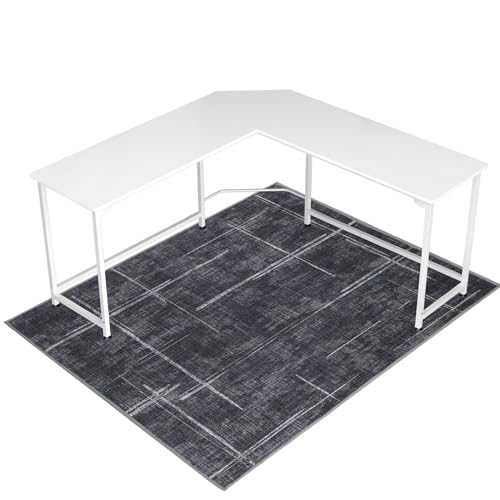
Office Chair Mat Rug for Hardwood and Tile, 48 x 60 — Best for Large Desks
Some chairs do not stay in a 36-inch lane. If you roll between an L-desk’s two wings, slide sideways to a printer, or simply have a wide chair and a long roll-back, the standard size leaves your casters dropping off the rug’s edge all day. This 48 x 60 version covers the roaming pattern, with the same low-pile, anti-slip recipe in a heavy-duty build.
Strengths
- Generous 48 x 60 coverage for L-desks and wide roll patterns
- Low pile keeps caster glide consistent across the whole surface
- Anti-slip backing sized to stay put despite the larger area
Trade-offs
- Takes longer to wash and dry than the standard size
- In a small office it can dominate the floor visually
- Overkill for a compact desk against a wall
| Size | 48 x 60 in |
| Profile | Low pile |
| Backing | Anti-slip |
| Floor types | Hardwood and tile (per listing) |
Size is a comfort feature people under-buy. Every time a caster rolls off a rug edge and back on, the edge flexes, and flexed edges are the ones that eventually stay curled. A rug that contains your entire natural roll pattern — including the unconscious sideways drift everyone does — simply lasts longer and feels calmer to work on.
Measure your pattern honestly before ordering: sit in your chair, roll everywhere you actually go in a workday, and have someone mark the extremes with tape. If the tape box fits inside 36 x 48 with margin, buy the smaller rug and save the money. If it does not, this is your pick.
Best for: L-desks, wide chairs, and restless rollers / Not suited for: compact desks in small rooms

Office Chair Mat Rug for Hardwood Floor, 36 x 48, Machine Washable Black — Best Washable Workhorse
Black is the honest color for a rug that lives under a working desk, and this heavy-duty low-pile build leans into the workhorse role: non-slip under the chair, washable when the inevitable coffee event happens, and dark enough that the in-between weeks do not look neglected. It suits offices shared with pets, kids doing homework at the same desk, and anyone whose chair zone doubles as a snack zone.
Strengths
- Machine washable heavy-duty build for real-life messes
- Black colorway hides desk-zone wear between washes
- Non-slip backing for hard floors
Trade-offs
- Black shows light pet hair and lint more than mid-tones
- Standard 36 x 48 footprint only
- Heavy-duty pile is still low, but check your caster type if you use soft rollerblade wheels
| Size | 36 x 48 in |
| Profile | Low pile, heavy duty |
| Backing | Non-slip |
| Care | Machine washable |
The washable claim is the one to interrogate in this category, because a rug that survives one wash and emerges wavy has failed at its main job. Heavy-duty washable desk rugs use low, dense pile and bound or engineered edges precisely so the wash cycle does not reshape them. Lay it flat to dry, roll it back out, and it should return to plane — that flat return is the quality signal.
If your office chair shares the room with a dog, this is also the easiest pick to keep respectable: vacuum twice a week, wash monthly, and the chair zone stops being the room’s problem area.
Best for: busy, pet-friendly, snack-friendly home offices / Not suited for: light, bright office schemes where black grounds the palette wrongly

iCasso Office Chair Mat Rug, 36 x 48, Convex Black — Best Shaped Fit
Rectangles are the default, but chair zones are not rectangles: you roll in an arc, widest in the middle of your travel, narrow at the desk itself. iCasso’s convex profile follows that arc, putting rug where casters go and trimming it where they never reach. For desks in corners and rooms where a full rectangle would crowd a walkway, the shape is a genuinely smarter fit.
Strengths
- Convex shape matches the natural roll arc of a desk chair
- Anti-slip, low-pile build for hard and tile floors
- From a brand focused on desk accessories, with matching desk gear available
Trade-offs
- Shaped rugs must be oriented correctly; a rotated install wastes the design
- Standard footprint class, so wide roamers still need the 48 x 60
- Black is the headline colorway; check the range for alternatives
| Size | 36 x 48 in class |
| Shape | Convex |
| Backing | Anti-slip |
| Profile | Low pile |
Shape sounds like a styling detail until you watch a chair work. Casters trace a fan, not a box, and the corners of a rectangular rug spend their lives being rolled onto and off at the extremes of that fan. Trimming those corners removes the most-flexed, first-to-curl material from the design entirely.
iCasso also sells the surrounding desk ecosystem, which matters if you like a coordinated setup. The rug alone justifies its place, but the option to match accessories is a small, real convenience.
Best for: corner desks and rooms where a rectangle crowds the walkway / Not suited for: symmetrical layouts that genuinely need a full rectangle

Office Chair Mat Rug for Hardwood and Tile, 36 x 48 — Best Simple Alternative
Not everyone needs the largest rug, and this standard-size version of the heavy-duty under-desk design is for the majority who do not. It covers a normal chair zone on hardwood or tile, keeps casters gliding on low pile, and grips the floor with an anti-slip back. Think of it as the no-drama default when the washable-black and convex options feel like more decision than the purchase deserves.
Strengths
- Standard size fits most single desks without crowding the room
- Heavy-duty build for daily rolling
- Works across hardwood and tile per the listing
Trade-offs
- Less distinctive than the shaped or washable-focused picks
- Standard size will not contain wide roll patterns
- Color and style range is utilitarian
| Size | 36 x 48 in |
| Profile | Low pile, heavy duty |
| Backing | Anti-slip |
| Floor types | Hardwood and tile (per listing) |
There is a real virtue in the generic done well. This rug makes no promises beyond the category’s core four — low pile, grip, coverage, durability — and for a guest-room office or a first apartment desk, that is precisely the brief. It is also the sensible spare: when the main office rug is in the wash, a second standard rug keeps the floor protected.
As with all of these, unroll it and give it a day under the chair’s weight before judging flatness. Low-pile rugs ship rolled and relax into plane; a rug that still ripples after a day of use is one to exchange, not endure.
Best for: first home offices, guest-room desks, and spare-rug duty / Not suited for: buyers who want a design feature, not just a functional surface

DMOYEST Washable Round Area Rug, 6 ft, Abstract Low Pile — Best Round Option
Some work zones are circles: a corner desk, a chair that swivels between a desk and a side table, a studio corner arranged for calls. A 6-foot round low-pile rug defines that zone in one gesture, and because it is washable and low pile, casters behave on it far better than on a typical decorative round rug. The abstract pattern also earns its keep on camera, where a plain mat reads as office equipment and this reads as a room.
Strengths
- Round format suits corner desks and swivel-based workflows
- Low pile and washable, unlike most decorative rounds
- Abstract pattern gives the work zone a finished, on-camera look
Trade-offs
- A circle wastes coverage at a straight wall desk compared with a rectangle
- Larger area to wash and dry
- Softer decorative build than the heavy-duty desk-specific rugs; heavy daily rolling will age it faster
| Size | 6 ft round |
| Profile | Low pile |
| Care | Washable |
| Pattern | Abstract |
Choose this pick with clear eyes: it trades a measure of industrial durability for integration with the room. If your chair work is a few hours a day and the space doubles as a living area, that trade is often correct — the rug you enjoy looking at, that survives the wash, beats the purely functional mat you resent. If you roll eight hours a day, the desk-specific rectangles above are the honest tools.
Position the circle so the desk’s front legs sit just off the rug and the chair’s full arc stays on it. That placement keeps the swivel zone covered and the desk stable on the floor, the best of both arrangements.
Best for: corner desks, studio corners, and work zones that appear on camera / Not suited for: eight-hour-a-day heavy rollers at straight desks
Comparison Table
Every pick is low pile — that is the entry requirement. They differ in footprint, shape, washability emphasis, and how much of the room they are meant to define.
| Pick | Badge | Key spec | Best for |
|---|---|---|---|
| Under Desk Area Rug for Rolling Chairs, 36 x 48, Taupe | Best Overall | 36 x 48 in, 1/5 in low pile, washable | standard single-desk home offices on hard flooring |
| Office Chair Mat Rug for Hardwood and Tile, 48 x 60 | Best for Large Desks | 48 x 60 in, low pile, anti-slip | L-desks, wide chairs, and restless rollers |
| Office Chair Mat Rug for Hardwood Floor, 36 x 48, Machine Washable Black | Best Washable Workhorse | 36 x 48 in, washable, heavy-duty low pile | busy, pet-friendly, snack-friendly home offices |
| iCasso Office Chair Mat Rug, 36 x 48, Convex Black | Best Shaped Fit | 36 x 48 in, convex shape, anti-slip | corner desks and rooms where a rectangle crowds the walkway |
| Office Chair Mat Rug for Hardwood and Tile, 36 x 48 | Best Simple Alternative | 36 x 48 in, heavy duty, low pile | first home offices, guest-room desks, and spare-rug duty |
| DMOYEST Washable Round Area Rug, 6 ft, Abstract Low Pile | Best Round Option | 6 ft round, low pile, washable | corner desks, studio corners, and work zones that appear on camera |
How to Choose an Area Rug for Under an Office Chair
Pile height is the whole game
Casters need a surface closer to a road than a meadow. Look for low pile — a quarter inch or less, with the desk-specific rugs in this roundup running around one-fifth of an inch — and a dense weave that does not let wheels sink and plow. If a listing leads with “plush,” “shaggy,” or “luxuriously thick,” it is a lovely rug for somewhere else. Your chair will tell you the truth within a week: rolling should feel nearly as easy as on bare floor, with just the sound dampened.
Size the rug to your roll pattern, not your desk
The standard 36 x 48 covers a chair that moves forward and back in front of a single desk. You need more — the 48 x 60 class — if you roll sideways to storage, work an L-desk, or push back and stand in one motion that carries the chair a full body-length from the desk. The failure mode of an undersized rug is edge traffic: casters climbing on and off the border dozens of times a day, which curls the border and eventually catches a wheel at exactly the wrong moment.
Backing and floor type must agree
On hardwood, tile, and laminate, the rug’s backing is its foundation: non-slip or anti-slip backs keep the rug from migrating under rolling load. On top of carpet, the problem inverts — you need a stiffer, mat-like rug that will not ripple on the soft surface beneath, and many hard-floor desk rugs will disappoint there. Match the rug to the floor it will actually sit on, and if your office is carpeted, shop the chair-mat category proper rather than forcing a rug to do a mat’s job.
Rug vs. Plastic Chair Mat: The Honest Comparison
A hard plastic or polycarbonate chair mat still wins on pure glide and on thick carpet, where its rigidity bridges the soft surface. The rug wins almost everywhere else: it protects the floor without the industrial look, it silences caster noise on hard floors instead of amplifying it, it does not crack at the edges in year three, and it can be washed rather than wiped. For the majority of home offices — hard floors, moderate hours, a room that is also a room — the low-pile rug is now the better default, which is why this category exists at all. Choose the mat when your floor is plush carpet or your rolling is truly all day; choose the rug when the office must also be a place you like being.
Casters, Wheels, and What Your Chair Does to a Rug
Not all chair wheels treat a rug equally, and knowing your caster type refines the choice. Standard twin-wheel nylon casters — the kind on most office chairs — concentrate your weight on small contact patches and are the hardest on pile; they demand the lowest, densest rugs in this roundup. Rollerblade-style polyurethane wheels spread the load and roll more kindly over everything, including slightly thicker rugs, and they are the single best upgrade a rug owner can make to an existing chair. Hard casters on a rug over hardwood also transmit a surprising amount of vibration and noise through the floor, which downstairs neighbors and sleeping households notice; the rug’s pile is your damping layer, one more reason the fabric option beats a hard mat in shared buildings.
Chair weight matters too. A heavy chair with a heavy occupant, rolling the same path eight hours a day, is an industrial application wearing home clothes. That duty cycle argues for the heavy-duty builds here and for rotating the rug 180 degrees every few months, so the roll path distributes across the surface instead of engraving one track. Lighter, part-time desk use forgives almost any low-pile choice.
Watch the chair’s own behavior as a diagnostic. If the chair drifts when you sit, the rug is too slick or the floor beneath is; if it resists and strains, the pile is too high or the rug has bunched. A correct setup disappears: the chair goes where you push it and stays where you stop, silently. Anything else is the rug asking for an adjustment — position, tape at one edge, or a different pick from this list.
Protecting the Floor You Cannot See
The floor under a desk rug lives a hidden life, and a few habits keep it a happy one. The rug protects the finish from casters — its main job — but it can also trap grit against that finish if the floor was dirty at installation, which is why the setup steps begin with cleaning. In sunny rooms, expect the floor under any rug to age differently from the exposed floor around it; rotating the rug and occasionally lifting it to clean beneath evens the story. On radiant-heated floors, thin low-pile rugs like these are the right class — they insulate far less than thick rugs — but confirm your flooring maker’s guidance if the system runs hot.
Moisture is the quiet risk. A spill at the desk that soaks through and sits under a non-slip backing can mark wood if ignored for days. The washable picks here turn that risk into a routine: lift, wash, dry fully, relay. The “dry fully” is the operative phrase — a rug returned damp to a wood floor creates the exact problem you were avoiding. In practice, wash day is the right day to vacuum the bare floor, inspect the finish, and let everything breathe before the rug goes back.
Done this way, the rug is not hiding the floor; it is stewarding it. Owners who lift and inspect quarterly keep both the rug and the hardwood in better shape than owners of bare floors whose caster damage accumulates invisibly until the chair has engraved its circles into the finish.
Making a Desk Rug Look Like a Room, Not Equipment
The aesthetic failure mode of the under-desk zone is the “cockpit” look: a rectangle of obvious office gear interrupting a residential room. A rug chosen with the room in mind dissolves that boundary. Match the rug’s tone family to the room’s textiles rather than to the desk; a taupe or warm grey that echoes a sofa or curtain makes the work zone read as a corner of the room instead of a machine parked in it. The black workhorse picks serve the opposite strategy — a defined, deliberate dark zone — which suits modern and gaming setups where the desk is meant to look like a station.
Edges and alignment do the rest. A rug aligned squarely with the desk and the room’s walls looks installed; a rug skewed two degrees looks dropped. Take the extra minute with a tape measure during setup. If the desk sits on the rug’s boundary, decide cleanly: either the desk’s front legs fully on the rug or fully off it, never one leg on the edge, which rocks the desk and chews the border. The round DMOYEST pick sidesteps the alignment question entirely, which is part of its charm in casual, multi-use rooms.
Finally, let the rug be the color decision that lets the rest of the desk stay simple. A considered under-chair rug is often the only textile a small office needs; with it in place, a plain desk and chair stop looking bare and start looking minimal. That is the difference between a workspace assembled and a workspace designed, and it costs exactly one rug.
The Two-Rug Rotation and Other Habits of Tidy Offices
Households that keep an under-desk rug looking new for years tend to run a quiet system, and the core of it is rotation. Two standard rugs — the second can be the simple alternative pick in this list — alternate monthly: one under the chair, one washed, rested, and stored flat or rolled loosely. Resting matters more than people expect; a low-pile rug given weeks off between tours recovers flatness and pile resilience that continuous duty slowly spends. The rotation also means the desk zone is never unprotected during laundry, which is when most floor damage otherwise happens.
The second habit is the weekly two-minute reset: chair off the rug, a suction pass over the surface, a glance at the edges, chair back. It is too small to feel like cleaning, which is exactly why it survives as a habit when monthly deep-clean resolutions die. The third habit is seasonal: twice a year, lift the rug entirely, clean the floor beneath, inspect both the floor finish and the rug’s backing, and relay it — possibly rotated 180 degrees to redistribute the roll path, as earlier sections advised.
None of this is fussiness; it is the arithmetic of a product that works under load every day. A rug is a wear item in a way a living-room rug never is, and treating it with a wear item’s maintenance rhythm — rotate, rest, inspect — is how a modest purchase delivers five years instead of eighteen months. The picks in this guide were chosen to survive that rhythm, particularly the washable and heavy-duty builds, whose constructions tolerate the washing the rotation demands.
What About Standing Desks, Balance Boards, and Other Desk-Zone Traffic?
Modern desk zones host more than chairs. A standing-desk user alternates between a chair and their feet, and a low-pile rug serves both modes well — firm underfoot, no squish to destabilize a long stand — though dedicated anti-fatigue mats still win for all-day standing and can be layered beside, not under, the chair zone. Balance boards and under-desk treadmills are harder cases: their point loads and lateral movement chew rug edges and demand either a hard mat zone or bare floor. If your setup includes one, size the rug for the chair alone and give the board its own territory.
Footrests, filing cabinets on casters, and the household cat’s chosen sleeping spot all make their own claims on the same square of floor. The rug tolerates all of them better than it tolerates the one thing it was not built for — a plush pile’s worth of resistance it does not have. In other words, the desk-specific rugs in this guide are generalists within the low-pile world: if it rolls, stands, or sleeps at your desk, a dense low-pile surface is the floor that treats it kindly.
The through-line of this entire guide deserves restating once, plainly: under a desk, thin is not cheap and plush is not luxury. The right rug is the one whose pile your chair cannot feel, whose size your rolling cannot escape, and whose care routine your household will actually perform. Everything else is a living-room rug in the wrong room.
A Word on Gaming Setups and Long Sessions
Gaming chairs stress an under-desk rug harder than office chairs do: the sessions are longer, the movements sharper, and the chairs themselves heavier, with wider five-star bases that roam a bigger arc when a player leans, spins, and pushes back between matches. If your desk is a gaming station, shop this list from the heavy-duty end — the washable black workhorse or the 48 x 60 for the roaming room a gaming chair needs — and expect the rug to be a consumable on a multi-year cycle rather than a permanent fixture. That expectation is not a flaw in the rugs; it is the honest physics of competitive seating.
The payoff for gamers is the same as for office workers, amplified: silence. A rug kills the caster rattle that hard floors broadcast through a house at midnight, and in shared homes that silence is a diplomatic asset worth more than the rug. Pair it with polyurethane wheels and a gaming setup becomes nearly inaudible from the next room — a specification no headset can provide for the people outside it.
How to Set Up a Rug Under Your Office Chair So It Stays Flat
Most under-chair rug complaints — curling, creeping, bunching — are installation problems, not product problems. Twenty minutes of setup prevents nearly all of them.
- Clean the floor first. Grit trapped under a non-slip backing acts like ball bearings and lets the rug travel; a swept, dry floor gives the backing its full grip.
- Unroll the rug and let it relax for several hours, ideally weighted at the corners with books. Shipping rolls set a curl memory that patience, not force, removes.
- Position the rug so the chair’s entire natural roll path stays on it, with the front edge tucked a few inches under the desk. Sit, roll everywhere you normally go, and adjust before you commit.
- Roll the chair onto the rug and spend a day working before judging. Body weight through the casters is the final flattening tool, pressing out the last ripples better than any steaming.
- Vacuum weekly with suction only or a hard-floor head — a beater bar chews low pile edges over time — and wash the rug flat-dried whenever the desk zone starts to look tired, rather than on a fixed schedule.
If an edge still lifts after a week, a strip of rug tape at that edge is a legitimate fix, not a failure. What you should not do is ignore a lifted edge: it is the one trip and caster-catch hazard in an otherwise safe setup.
Common Buying Mistakes
Buying a plush rug because it looks cozy
Comfort under a chair comes from the chair. A plush rug adds rolling resistance that strains casters, mats into visible tracks, and makes a small office feel like hard work. Low pile is not a compromise; it is the specification.
Undersizing to save money
A rug that ends mid-roll-path fails at its edges within months. Measure your actual movement and buy the size that contains it — the larger rug is cheaper than two smaller ones in sequence.
Putting a hard-floor rug on carpet
Soft carpet underneath makes a flexible rug ripple and bunch no matter how good its backing is. Carpeted offices need rigid chair mats or stiff mat-rug hybrids designed for that surface.
Skipping the relax period
Judging a rolled rug in its first hour leads to returns of perfectly good products. Give it hours to unroll and a day under the chair before deciding it will not lie flat.
Never washing it
The desk zone collects more debris per square foot than any floor in the home. A washable rug that never gets washed becomes the dingiest object in the room; the wash is the feature, so use it.
Final Recommendation
For the standard home office, the 36 x 48 taupe rug is the pick to beat: right size, right pile, washable, and quiet under the chair. Go to the 48 x 60 if your chair roams or your desk turns a corner, the washable black if your desk zone lives a messy real life, and the iCasso convex if your layout is an arc rather than a rectangle. The round DMOYEST is the choice when the work zone is also a living space that appears on camera.
Whichever you choose, respect the setup steps. A low-pile rug, correctly sized and properly settled, disappears into the workday — which is the highest praise any piece of office equipment can earn.
Start your shortlist here: Under Desk Area Rug for Rolling Chairs, 36 x 48, Taupe · Office Chair Mat Rug for Hardwood and Tile, 48 x 60 · Office Chair Mat Rug for Hardwood Floor, 36 x 48, Machine Washable Black
Keep exploring the same cluster: Best Office Chair Mats Best Area Rugs For Home Office Best Desk Chairs For Home Office Best Washable Area Rugs Best Rugs For Hardwood Floors
Frequently Asked Questions
Will a rug really let my chair roll properly?
A low-pile rug, yes — casters glide on dense, short pile almost as freely as on hard floor, and much more quietly. The rugs that fight chairs are medium and plush piles. Keep it at roughly a quarter inch or under and rolling stays easy.
What size rug do I need under my office chair?
Start with 36 x 48 inches for a standard desk and a forward-back roll pattern. Move to 48 x 60 if you roll sideways, work an L-desk, or push well back from the desk. The rug must contain your whole roll path, not just the parked chair.
Can I put one of these rugs on carpet?
These picks are designed for hard floors. On carpet, a flexible rug ripples under rolling load. For carpeted offices, choose a rigid chair mat or a stiff mat designed for carpet instead.
How do I stop the rug from curling at the edges?
Let it relax fully after unrolling, keep the whole roll path on the rug so edges are not trafficked, and use rug tape on a stubborn edge. Edge curl is almost always caused by casters repeatedly crossing the border.
How often should I wash an under-desk rug?
Whenever the desk zone looks tired — typically every month or two in a working office, sooner with pets or food at the desk. Vacuum weekly in between, with suction rather than a beater bar.
Is a rug or a plastic chair mat better for hardwood?
For most home offices, the rug: it protects the finish, silences caster noise, looks like part of the room, and can be washed. A hard mat glides slightly freer and suits very heavy all-day use, but it reads as office equipment and can crack at the edges over time.
Can I use an under-desk rug with rollerblade-style chair wheels?
Yes — polyurethane rollerblade wheels are gentler on rugs than standard nylon casters and roll beautifully on low pile. They are the best upgrade pairing for any rug in this list, especially on hardwood, where they also cut noise.
Will a rug under my chair damage my hardwood floor?
A clean-installed, non-slip rug protects hardwood from caster wear. The risks are trapped grit and trapped moisture, both handled by installing on a clean floor, lifting the rug periodically, and always relaying it fully dry after washing.
How long should an under-chair rug last?
With daily use, a quality low-pile desk rug should give several years before the roll path shows real wear. Rotating the rug periodically and owning a second rug to alternate extends that significantly, because rest restores pile and flatness.


