Disclosure: airfryerkitchensupply.com is reader-supported. When you buy through links on our site, we may earn an affiliate commission at no extra cost to you.
Where to buy
Every verified pick in this guide is sold through Amazon, where you can check the current price on Amazon, confirm the exact variant, and read the seller’s delivery and returns terms before you order. Start with the American Baby Company Cotton Jersey Toddler Sheet Set 3-Piece if you want the safest all-round choice, or jump to the Quick Picks table below and follow the Check on Amazon link beside the pick that matches your situation. Prices and stock move, so the listing — not this page — is the final word on both.
- American Baby Company Cotton Jersey Toddler Sheet Set 3-Piece — Check on Amazon
- Biloban Microfiber Toddler Sheet Set 3-Piece — Check on Amazon
- TILLYOU Muslin Crib Sheet 2-Pack — Check on Amazon
- KeaBabies Organic Cotton Crib Sheets 2-Pack — Check on Amazon
- Burt’s Bees Baby Organic Cotton Fitted Crib Sheet — Check on Amazon
- Copper Pearl Premium Knit Crib Sheet — Check on Amazon
Toddler sheets live a harder life than any other bedding in the house: they are washed constantly, slept on by a small person who treats the bed as a trampoline, a reading nook and occasionally a sick bay, and they must stay safely fitted on a 28 x 52 inch crib-size mattress through all of it. The best toddler sheets sheet sets are therefore judged on unglamorous virtues — elastic that still grips after fifty washes, fabric that softens instead of pilling, seams that survive the laundry, and complete sets that give you a fitted sheet, a flat sheet and a pillowcase in one purchase, so the bed can be remade at 2 a.m. without a linen-closet expedition.
The six verified picks cover the fabric decisions parents actually face. Cotton jersey from American Baby Company feels like a favourite t-shirt and stretches forgivingly over mattress protectors. Biloban’s microfiber set is the budget multi-set play — silky, light, and cheap enough to own in rotation. TILLYOU’s muslin and KeaBabies’ organic cotton serve the breathability-first nursery, Burt’s Bees Baby brings the organic name and the 360-degree elastic, and Copper Pearl’s premium knit is the gift-registry favourite whose prints parents actually get excited about.
One sizing fact governs everything: toddler beds use the crib mattress, 28 x 52 inches, so crib sheets and toddler sheets are the same sheets — the sets below are all that standard size, and several are sold as fitted-sheet multipacks rather than three-piece sets, a distinction the reviews state plainly because it decides what arrives in the box. Read for the fabric and the format, buy at least two sets’ worth of rotation, and your future 2 a.m. self thanks you.
In this guide
Quick Picks
| Pick | Badge | Best for | Link |
|---|---|---|---|
| American Baby Company Cotton Jersey Toddler Sheet Set 3-Piece | Best Overall Set | most toddler beds — a complete, soft, t-shirt-feel three-piece set | Check on Amazon |
| Biloban Microfiber Toddler Sheet Set 3-Piece | Best Budget Set | building a deep rotation cheaply — daycare spares, grandparents’ house, laundry insurance | Check on Amazon |
| TILLYOU Muslin Crib Sheet 2-Pack | Best Breathable | warm rooms and hot sleepers — muslin’s open weave breathes like nothing else here | Check on Amazon |
| KeaBabies Organic Cotton Crib Sheets 2-Pack | Best Organic Value | organic-first nurseries wanting certified-feel cotton in a practical two-pack | Check on Amazon |
| Burt’s Bees Baby Organic Cotton Fitted Crib Sheet | Best Single Fitted Sheet | adding one premium organic fitted sheet with full-wrap elastic to an existing rotation | Check on Amazon |
| Copper Pearl Premium Knit Crib Sheet | Best Gift and Prints | gifts and nurseries where the prints are the point — premium knit in beloved designs | Check on Amazon |
Rotation is the real purchase: toddlers generate laundry at a rate that makes a single set a hostage situation. However you mix the picks, own at least two fitted sheets per bed — three is calmer — so a clean one exists at every hour of the night. Several picks here are two-packs of fitted sheets for exactly this reason, and they pair well with one full three-piece set for the pillowcase and flat sheet.
Fit check before the first wash: a toddler fitted sheet should stretch over the mattress plus a waterproof protector — the combination nearly every toddler bed actually runs — and still tuck its elastic fully underneath. Sheets that barely fit the bare mattress will pop corners once the protector is on, and a loose sheet on a toddler bed is an annoyance at best.
How These Picks Were Chosen
Sets were shortlisted on the toddler-specific criteria: true 28 x 52 crib-mattress sizing, elastic design that survives protectors and repeated washing, fabrics that tolerate hot, frequent laundry without pilling or shrinking out of fit, and honest set composition — three-piece sets and fitted multipacks both appear here, always labelled, because parents deserve to know what is in the box before it arrives at midnight’s need.
We favoured makers with genuine nursery track records — American Baby Company, Burt’s Bees Baby, KeaBabies, Copper Pearl, TILLYOU, Biloban — whose sizing is consistent across reorders, because the second set you buy in six months must fit exactly like the first. Prints and colours were considered last and honestly: they matter to parents furnishing a nursery, and not at all to the toddler, which is a liberating fact for gift buyers.
No safety claims beyond standard fitted-sheet practice are made anywhere in this guide — safe sleep guidance belongs to your pediatrician and the crib manufacturer’s instructions, and the guide’s care section simply supports keeping sheets snug, intact and clean.
The 6 Best Toddler Sheets and Sheet Sets

American Baby Company Cotton Jersey Toddler Sheet Set 3-Piece — Best Overall Set
American Baby Company’s jersey set is the complete-set benchmark: fitted sheet, flat sheet and pillowcase in 100% cotton jersey — the knit that feels like a soft t-shirt — sized exactly for the crib mattress your toddler bed uses. It suits the parent who wants one purchase that makes the whole bed, in a fabric toddlers find instantly familiar and comforting.
Strengths
- True three-piece set — the bed is fully made from one box
- Cotton jersey stretches over mattress protectors and stays put
- Softens with washing instead of pilling
Trade-offs
- Jersey can stretch out over years of heavy use
- Not organic — choose KeaBabies or Burt’s Bees if that is a priority
- Knit fabric is cosy-warm rather than the coolest for hot rooms
Key specs: 3-piece set (fitted, flat, pillowcase), 28 x 52 inches, 100% natural cotton jersey knit
Jersey is the fabric toddlers vote for with their whole bodies: it has the give and softness of the t-shirts they wear, it does not feel cold when a small person lands on it at bedtime, and its stretch is a practical gift to parents — the fitted sheet pulls over a mattress-plus-protector stack without the wrestling match woven cotton sometimes demands at midnight.
As the rotation anchor it is hard to beat: buy two sets and the bed always has a clean, complete change, pillowcase included, which matters more than any single fabric virtue across a year of toddlerhood. It is the set we would hand a first-time parent with no further questions asked — the default, done properly, by a maker that has dressed crib mattresses for decades.
Best for: most toddler beds — a complete, soft, t-shirt-feel three-piece set / Not suited for: parents wanting organic certification
Check on Amazon — check price on Amazon for the current listing.
Biloban Microfiber Toddler Sheet Set 3-Piece — Best Budget Set
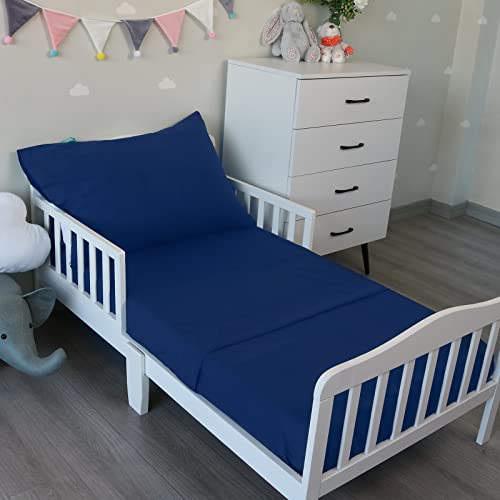
Biloban’s microfiber set is the volume play: a complete three-piece set — fitted, flat and an envelope-closure pillowcase — at the tier that lets a household own three sets for the price of one premium one. It suits daycare bags, grandparents’ cribs, travel, and the strategic parental insight that sheet emergencies do not schedule themselves.
Strengths
- Complete set at the friendliest tier in this guide
- Microfiber dries fast — same-day wash-and-remake is easy
- Envelope pillowcase stays on an active toddler’s pillow
Trade-offs
- Microfiber feels silkier and warmer than cotton — hot sleepers notice
- Synthetic fabric will not satisfy natural-fibre households
- Long-term pilling resistance is a step below good cotton
Key specs: 3-piece set (fitted, flat, envelope pillowcase), microfiber, navy
The Biloban’s case is arithmetic plus one design detail. The arithmetic: toddler laundry volume is so high that depth of rotation beats marginal fabric quality for most families, and this set’s tier buys depth. The detail: the envelope pillowcase, which keeps the pillow inside through a night of toddler athletics where open-ended cases surrender by morning — a small thing that every parent recognises as not small at all.
Microfiber’s fast drying is its second practical virtue in a high-turnover rotation: washed in the morning, it can be back on the bed by nap time without a dryer marathon. Natural-fibre purists should buy the cotton picks and buy them twice; pragmatists building a rotation across two houses will find this set quietly indispensable.
Best for: building a deep rotation cheaply — daycare spares, grandparents’ house, laundry insurance / Not suited for: parents committed to natural fibres only
Check on Amazon — check price on Amazon for the current listing.

TILLYOU Muslin Crib Sheet 2-Pack — Best Breathable
TILLYOU’s muslin two-pack is the breathability specialist: 100% cotton in the open, gauzy muslin weave that gets softer with every wash and lets air move through the sheet instead of trapping nursery warmth against a small sleeper. Note the format — two fitted sheets, no flat sheet or pillowcase — which makes it a rotation purchase, not a complete set.
Strengths
- Muslin breathes — the coolest sleep surface in this guide
- Two fitted sheets in one pack: instant rotation
- Softens noticeably with each wash, unlike most fabrics
Trade-offs
- Fitted sheets only — pair with a set for pillowcase and flat sheet
- Muslin’s open weave is delicate-feeling; follow wash guidance
- Wrinkles freely — this is a comfort fabric, not a crisp one
Key specs: 2-pack fitted sheets, 100% cotton muslin, 52 x 28 inches, Forest Green and Light Green
Hot nurseries and warm-natured toddlers are muslin’s constituency, and parents discover it the first summer night the cotton jersey feels like a blanket. The two-pack format is honestly matched to how fitted sheets are consumed: they are the component that gets washed, while flat sheets and pillowcases rotate slowly — so a fitted-only multipack is not a lesser product, it is the replenishment unit of the whole system.
Buy it alongside one complete set — the American Baby jersey is the natural partner — and you have the toddler bedding system this guide recommends: a full set for the made bed, muslin fitted spares for hot nights and emergencies, and no 2 a.m. scenario the linen shelf cannot answer.
Best for: warm rooms and hot sleepers — muslin’s open weave breathes like nothing else here / Not suited for: parents wanting a full set — this is fitted sheets only
Check on Amazon — check price on Amazon for the current listing.
KeaBabies Organic Cotton Crib Sheets 2-Pack — Best Organic Value
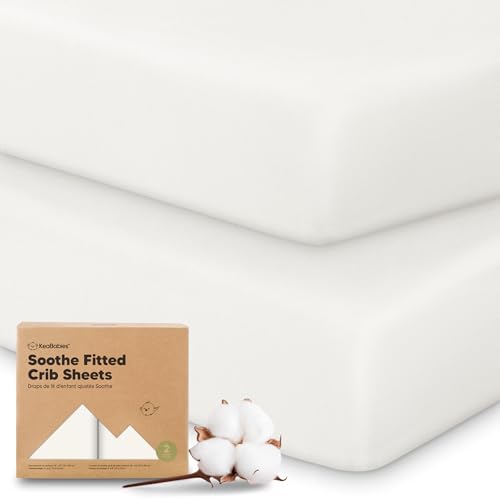
KeaBabies built its name on exactly this product: organic cotton fitted sheets in a two-pack, softly neutral, sized precisely for the standard crib mattress that toddler beds share. It suits the organic-priority nursery that still thinks practically — two sheets, because one is never enough — in a white that pairs with any blanket the child already loves.
Strengths
- Organic cotton at a two-pack value rather than a boutique single price
- Soft white neutrality matches every nursery and blanket
- Consistent sizing across reorders — rotation building is safe
Trade-offs
- Fitted only — complete the system with a three-piece set
- White shows every stain a toddler can invent
- Organic cotton costs more per sheet than the microfiber route
Key specs: 2-pack fitted sheets, organic cotton, 52 x 28 inches, Soft White
The two-pack is the tell that KeaBabies understands its customer: nobody’s toddler journey runs on a single fitted sheet, and bundling the rotation unit at an organic tier mere mortals can afford is why this brand owns so many nursery registries. The cotton itself is the soft, breathable, wash-hardy kind, and the elastic holds the mattress-plus-protector stack that real toddler beds run.
In Soft White it is also the gift-buyer pick of this guide: no colour to clash, no print to guess wrong, organic credentials to state on the card. Pair it with the Burt’s Bees fitted sheet for a three-sheet organic rotation and the nursery is, bedding-wise, finished.
Best for: organic-first nurseries wanting certified-feel cotton in a practical two-pack / Not suited for: parents needing flat sheet and pillowcase in the same box
Check on Amazon — check price on Amazon for the current listing.

Burt’s Bees Baby Organic Cotton Fitted Crib Sheet — Best Single Fitted Sheet
Burt’s Bees Baby’s fitted sheet is the premium single: organic cotton with elastic that runs the full 360 degrees around the sheet rather than only at the corners, so the fit is even, snug and resistant to the corner-popping that active toddlers engineer nightly. It suits parents upgrading a rotation one excellent sheet at a time, and gift buyers who want one beautiful, name-brand essential.
Strengths
- 360-degree elastic — the most secure fit in this guide
- Organic cotton from the nursery’s most trusted name
- Finished quality that survives the wash cycle count of toddlerhood
Trade-offs
- A single sheet at a premium tier — rotation must come from elsewhere
- Fitted only, by design
- Popular prints and colours sell through — check availability when gifting
Key specs: Single fitted sheet, organic cotton, 360-degree elastic, standard crib size
The full-wrap elastic sounds like a spec-sheet detail until you have remade a toddler bed at 2 a.m. with a sheet whose corners keep escaping: the Burt’s Bees sheet goes on once, tucks fully, and stays, because the tension is distributed around the whole perimeter instead of concentrated at four stressed corners. On a mattress with a protector — the real-world stack — that even grip is the difference between a sheet and a nightly negotiation.
As a gift it is the registry classic: one perfect essential from the name every parent recognises, in organic cotton, that will be used three nights a week for two years. Few baby gifts anywhere can promise that duty cycle, and none at this tier do it with less risk of being the wrong thing.
Best for: adding one premium organic fitted sheet with full-wrap elastic to an existing rotation / Not suited for: buyers wanting a set — this is a single fitted sheet
Check on Amazon — check price on Amazon for the current listing.

Copper Pearl Premium Knit Crib Sheet — Best Gift and Prints
Copper Pearl is the nursery’s fashion house: premium knit fitted sheets in prints — Briar here — that parents choose the way they choose wallpaper, because the crib sheet is the largest visible textile in most nurseries. It suits the design-led nursery, the photographed newborn bed, and the gift that should arrive feeling special rather than sensible.
Strengths
- Prints with genuine design appeal — the sheet as nursery decor
- Premium knit is soft, stretchy and fits protectors easily
- The gift pick most likely to delight the recipient visibly
Trade-offs
- Premium tier for a single fitted sheet
- Prints are taste — glorious when right, specific when not
- Knit’s cosiness runs warm like the jersey set
Key specs: Single fitted sheet, premium knit, standard crib mattress size, Briar print
It is easy to be cynical about paying for prints on a sheet a toddler will treat as a trampoline — until you remember the sheet is also the nursery’s backdrop for a year of photographs, first-birthday mornings and every bedtime story. Copper Pearl’s knit quality keeps the indulgence honest: the fabric is genuinely premium, the fit over protectors genuinely easy, the prints genuinely well drawn.
Buy one as the ‘good’ sheet in a rotation anchored by the plainer picks, or gift it where delight is the assignment. The toddler will be indifferent to the Briar print; the parents will not be, and in nursery economics, the parents’ delight is a real and purchasable good.
Best for: gifts and nurseries where the prints are the point — premium knit in beloved designs / Not suited for: building a budget rotation — this is the treat sheet
Check on Amazon — check price on Amazon for the current listing.
Comparison Table
| Pick | Badge | Key spec | Best for |
|---|---|---|---|
| American Baby Company Cotton Jersey Toddler Sheet Set 3-Piece | Best Overall Set | 3-piece set (fitted, flat, pillowcase), 28 x 52 inches, 100% natural cotton jersey knit | most toddler beds — a complete, soft, t-shirt-feel three-piece set |
| Biloban Microfiber Toddler Sheet Set 3-Piece | Best Budget Set | 3-piece set (fitted, flat, envelope pillowcase), microfiber, navy | building a deep rotation cheaply — daycare spares, grandparents’ house, laundry insurance |
| TILLYOU Muslin Crib Sheet 2-Pack | Best Breathable | 2-pack fitted sheets, 100% cotton muslin, 52 x 28 inches, Forest Green and Light Green | warm rooms and hot sleepers — muslin’s open weave breathes like nothing else here |
| KeaBabies Organic Cotton Crib Sheets 2-Pack | Best Organic Value | 2-pack fitted sheets, organic cotton, 52 x 28 inches, Soft White | organic-first nurseries wanting certified-feel cotton in a practical two-pack |
| Burt’s Bees Baby Organic Cotton Fitted Crib Sheet | Best Single Fitted Sheet | Single fitted sheet, organic cotton, 360-degree elastic, standard crib size | adding one premium organic fitted sheet with full-wrap elastic to an existing rotation |
| Copper Pearl Premium Knit Crib Sheet | Best Gift and Prints | Single fitted sheet, premium knit, standard crib mattress size, Briar print | gifts and nurseries where the prints are the point — premium knit in beloved designs |
How to Choose the Best Toddler Sheets and Sheet Sets
Start with the system, not the single set: a toddler bed needs a minimum of two fitted sheets in rotation and ideally three, plus at least one pillowcase and, if your toddler uses one, a flat sheet. Buy that system in whatever combination fits your budget — a complete three-piece set plus a fitted two-pack is the architecture this guide recommends — because the night a single-set household meets a stomach bug is a night nobody forgets.
Then choose fabric by nursery reality: cotton jersey for t-shirt softness and forgiving stretch, muslin for hot rooms, woven organic cotton for the natural nursery, microfiber for budget depth and fast drying. All are legitimate; the toddler will sleep on any of them, so buy for the laundry and the climate, which are the variables that actually differ.
Sizing: Toddler Beds, Crib Mattresses and the Protector Stack
Toddler beds use the standard crib mattress — 28 x 52 inches — so crib sheets and toddler sheets are interchangeable, and every pick in this guide is that size. What varies is depth tolerance: the real sleeping stack is mattress plus waterproof protector, sometimes plus a thin pad, and a fitted sheet must stretch over all of it and still tuck its elastic fully beneath. Jersey and knit sheets forgive the stack by stretching; woven sheets need honest depth — check the listing’s pocket depth where stated.
A sheet that pops a corner is not a small flaw: it bunches under a small sleeper, it signals elastic giving up, and it multiplies laundry-day friction. Test any new sheet over the full stack before the first wash, while returns are still easy, and standardise on the models that pass — consistency across reorders is why this guide favours established nursery makers.
Fabrics Compared: Jersey, Muslin, Woven Cotton and Microfiber
Jersey knit is the comfort default: soft like a t-shirt, stretchy over protectors, warm in winter. Muslin is the summer specialist: an open cotton weave that breathes, softens with washing, and feels delicate while proving durable. Woven cotton — the organic picks’ cloth — is the crisp classic: cool, smooth, long-lived, and the least forgiving of an undersized pocket. Microfiber is the pragmatist: silky, light, fast-drying and inexpensive, at the cost of warmth retention and natural-fibre feel.
None of these is the ‘best fabric’ in the abstract; each is best for a nursery. Hot room, muslin. Cold room and a comfort-seeking toddler, jersey. Organic household, woven cotton. Two houses and a daycare bag to fill, microfiber depth. The parents who struggle are the ones who buy one fabric for every season and house, then wonder why July nights go badly.
Elastic, Seams and Surviving the Laundry
Toddler sheets are washed more in two years than adult sheets are in ten, so construction is destiny. Full-perimeter elastic — Burt’s Bees’ 360-degree design is the exemplar — distributes tension and outlasts corner-only elastic, which concentrates stress exactly where toddlers bounce. Seams should be flat and finished; a sheet’s failure almost always begins at a corner seam in the wash, not in the middle of the fabric.
Care for them as a system: wash warm with the household’s ordinary detergent unless the maker directs otherwise, dry fully before storing spares — a damp folded sheet in a drawer is a mildew appointment — and retire sheets whose elastic has died rather than fighting them nightly. A toddler bed is remade too often for any component to be a struggle; ruthlessness about worn sheets is a quality-of-life policy.
How Many Sheets Does a Toddler Actually Need?
Two fitted sheets is the survivable minimum: one on the bed, one clean. Three is the comfortable standard: one on, one clean, one in the wash or the daycare bag. Families with a refluxy, potty-training or frequently ill toddler often run four and call it the best money in the nursery. Pillowcases follow the fitted sheets at roughly half the count, and flat sheets — where used at all at this age — one per bed is plenty.
Budget follows the same logic: spend first on fitted-sheet depth in a fabric you like, because that is the component consumed by real life. The premium single — a Burt’s Bees or a Copper Pearl print — earns its place as the top-up that makes the rotation pleasant, after the arithmetic of survival is covered.
Safe, Snug and Simple: Fitting Sheets on a Toddler Bed
Keep the toddler sleeping surface simple: a snug fitted sheet over the mattress and protector, fitting fully beneath with no loose fabric to bunch, is the whole brief. Check the fit whenever the stack changes — a new protector, a thicker pad — and replace any sheet that no longer grips, because a sheet that rides loose is a sheet that has finished its service.
Beyond the sheet, follow your crib and toddler bed manufacturer’s guidance and your pediatrician’s advice for the sleeping environment; this guide’s scope is choosing and caring for the sheets themselves. Within that scope the rule is uniform: snug, intact, clean, and boring — the four virtues of toddler bedding, in order.
How to Build and Run a Toddler Sheet Rotation
The rotation system below is how experienced parents make toddler bedding a non-event: the right stock, a wash rhythm, and a two-minute remake routine that works at any hour, in the dark, one-handed.
- Stock the system: one complete three-piece set, plus a two-pack of fitted sheets in your nursery’s fabric — three fitted sheets, two pillowcases, one flat sheet is the comfortable standard.
- Layer the bed for fast changes: protector on the mattress, then — the veteran’s trick — a fitted sheet, a second protector, and a second fitted sheet over it, so a night accident is fixed by stripping one layer to reveal a clean, made bed beneath.
- Run laundry on rhythm, not crisis: wash the week’s sheets together on a set day, dry fully, and return spares to the same drawer every time so any caregiver can find them at any hour.
- Wash warm per the maker’s label, skip fabric softener on protectors (it reduces their absorbency), and check elastic and corner seams each wash — retire a failing sheet before it fails at midnight.
- Keep one fitted sheet outside the bedroom rotation: in the daycare bag, the grandparents’ house, or the car kit — toddler sheet emergencies respect no geography.
- When the toddler moves to a twin bed, promote the system: the same rotation logic, the same fabric preferences, one size up — and the crib sheets retire to dolls, forts and the memory box.
None of this is complicated, and all of it is the difference between bedding as background and bedding as a recurring 2 a.m. project. Toddlers supply enough surprises; the sheets should supply none.
The 2 A.M. Standard: Bedding Judged at Its Worst Moment
All toddler bedding should be judged by a single scenario: it is 2 a.m., the toddler has been sick or has leaked through everything, you are holding a crying child with one arm, and the bed must be remade, in the dark, in minutes, with whatever the linen drawer offers. Every recommendation in this guide passes that test or fails honestly — the layered double-sheet trick works one-handed, the rotation guarantees a clean fitted sheet exists, the elastic grips without a wrestling match, and the fabrics forgive whatever the night produced in one hot wash.
This standard explains the guide’s priorities, which can look odd in daylight. Rotation depth outranks thread count because the third fitted sheet is the one that matters at 2 a.m. Elastic design outranks print because corners that pop in the dark are a special misery. Fast-drying microfiber earns its place because the sheet washed at breakfast may be needed again by nap time. Parents do not need to be told any of this twice — they need a guide that ranks it correctly the first time.
It also explains what the guide does not prioritise: nursery photography. The prettiest sheet in this guide, the Copper Pearl, is recommended as a delight layered on top of a working system, never as a substitute for one. Build for 2 a.m. first; then, with the system secure, absolutely buy the print that makes the room joyful — in that order, and never the reverse.
From Crib to Toddler Bed to Twin: The Bedding Timeline
A toddler’s bedding life runs in three acts, and the sheets in this guide serve the first two. Act one is the crib: fitted sheet only, snug over the mattress, the simplest possible surface. Act two is the toddler bed — the same mattress, the same sheets — with a pillow and pillowcase joining as the child grows, and a flat sheet or light blanket layered as they learn to keep covers on. Nothing needs rebuying at the crib-to-toddler transition, which is precisely why the standard 28 x 52 size is such a gift to parents’ budgets.
Act three, the twin bed, is where the system graduates rather than ends: the rotation logic, the fabric preferences learned across two years of laundry, and the habit of spares all transfer one size up. Families who built the toddler system properly find the twin transition is a single shopping trip, not a research project — they already know their fabric, their maker and their numbers.
The retired crib sheets have an honourable afterlife worth planning for: doll bedding, fort roofs, pet beds, car-seat protectors and the memory box. A sheet that served a thousand nights earns better than the rag bag — and the parents who layered protectors and rotated faithfully will find their sheets retire in good enough condition to serve all of those second duties, which is the final, quiet dividend of buying them well.
Prints, Colours and the Nursery Photograph Economy
It is worth being honest about why prints matter in toddler bedding, because the toddler is not the audience. The crib or toddler bed is the largest furnished surface in the nursery, its sheet the largest textile, and that sheet appears in the background — or the foreground — of a very large fraction of the photographs a family takes in a child’s first years. Parents are not being frivolous when they choose a sheet for how it looks; they are furnishing the set of their family’s early documentary record, and the Copper Pearl pick in this guide exists because that is a legitimate design decision.
The economics work best as a portfolio: plain, hard-working sheets in the rotation’s depths — whites and neutrals that match everything and show stains honestly so they can be treated — and one or two print sheets at the top of the drawer for the days that will be photographed. The print sheets get the gentle duty and the glory; the plain sheets get Tuesday. Both are doing their jobs, and a nursery budget split that way satisfies the camera and the laundry in the same purchase.
Gift buyers can exploit this division happily: a print sheet is the delightful gift, a plain two-pack is the useful one, and the parent receiving either will understand exactly what it is for. The only true error is the reverse portfolio — all prints, no depth — where the beautiful sheets are ground down by daily duty and the photographs end up featuring whichever sheet survived. Buy the system plain and the surface pretty, in that order, and both economies are served.
The 2 A.M. Standard: Bedding Judged at Its Worst Moment
All toddler bedding should be judged by a single scenario: it is 2 a.m., the toddler has been sick or has leaked through everything, you are holding a crying child with one arm, and the bed must be remade, in the dark, in minutes, with whatever the linen drawer offers. Every recommendation in this guide passes that test or fails honestly — the layered double-sheet trick works one-handed, the rotation guarantees a clean fitted sheet exists, the elastic grips without a wrestling match, and the fabrics forgive whatever the night produced in one hot wash.
This standard explains the guide’s priorities, which can look odd in daylight. Rotation depth outranks thread count because the third fitted sheet is the one that matters at 2 a.m. Elastic design outranks print because corners that pop in the dark are a special misery. Fast-drying microfiber earns its place because the sheet washed at breakfast may be needed again by nap time. Parents do not need to be told any of this twice — they need a guide that ranks it correctly the first time.
It also explains what the guide does not prioritise: nursery photography. The prettiest sheet in this guide, the Copper Pearl, is recommended as a delight layered on top of a working system, never as a substitute for one. Build for 2 a.m. first; then, with the system secure, absolutely buy the print that makes the room joyful — in that order, and never the reverse.
From Crib to Toddler Bed to Twin: The Bedding Timeline
A toddler’s bedding life runs in three acts, and the sheets in this guide serve the first two. Act one is the crib: fitted sheet only, snug over the mattress, the simplest possible surface. Act two is the toddler bed — the same mattress, the same sheets — with a pillow and pillowcase joining as the child grows, and a flat sheet or light blanket layered as they learn to keep covers on. Nothing needs rebuying at the crib-to-toddler transition, which is precisely why the standard 28 x 52 size is such a gift to parents’ budgets.
Act three, the twin bed, is where the system graduates rather than ends: the rotation logic, the fabric preferences learned across two years of laundry, and the habit of spares all transfer one size up. Families who built the toddler system properly find the twin transition is a single shopping trip, not a research project — they already know their fabric, their maker and their numbers.
The retired crib sheets have an honourable afterlife worth planning for: doll bedding, fort roofs, pet beds, car-seat protectors and the memory box. A sheet that served a thousand nights earns better than the rag bag — and the parents who layered protectors and rotated faithfully will find their sheets retire in good enough condition to serve all of those second duties, which is the final, quiet dividend of buying them well.
Common Buying Mistakes
Buying one beautiful set and stopping
A single set means every wash is urgent and every accident is a crisis. Rotation depth — at least two fitted sheets, ideally three — is the actual product; the individual set is just how you buy it. Build the system first, beautify it second.
Confusing set formats at checkout
A three-piece set, a two-pack of fitted sheets and a single fitted sheet are different purchases wearing similar photographs. Read the composition on the listing before ordering — every review in this guide states the format in its first lines for exactly this reason.
Ignoring the protector stack when judging fit
Sheets are tested by parents on bare mattresses and used on mattress-plus-protector stacks. A sheet that barely fits bare will pop corners in real use. Judge fit over the full stack, before the first wash, while returns are painless.
Letting dead elastic stay in service
A sheet whose corners escape nightly is not a minor annoyance — it bunches, it frustrates every remake, and it has simply worn out. Toddler sheets live hard and die young; retiring them on time is cheaper in sanity than any other purchase in the nursery.
Overheating the nursery with the wrong fabric
A cosy jersey or microfiber sheet in a hot room makes for a sweaty, restless toddler and a mystery parents blame on everything but the bedding. Match fabric to season — muslin exists in this guide because July is real.
Washing protectors with fabric softener
Softener coats the protector’s absorbent surface and quietly defeats it, so the next accident reaches the mattress. Wash protectors plainly, dry fully, and keep the softener for the clothes drawer where it belongs.
Final Recommendation
Build the system this way and toddler bedding disappears as a problem: the American Baby Company jersey three-piece as the complete anchor set, the TILLYOU muslin or KeaBabies organic two-pack as the fitted-sheet rotation, and the Biloban sets wherever budget depth is needed — daycare, grandparents, spares. That combination covers every season, every house and every hour of the night.
Then, if the nursery deserves a treat — and most do — add the Burt’s Bees fitted sheet for its unmatched elastic or the Copper Pearl for the print that makes the room. Buy rotation first and delight second, keep the elastic honest and the drawer stocked, and the hardest-working bedding in your house becomes the least thought about. As it should be.
Best Crib Sheets Best Toddler Bedding Sets Best Baby Blankets Best Crib Mattresses Best Toddler Pillows Best Waterproof Mattress Protectors
Frequently Asked Questions
Are toddler sheets the same size as crib sheets?
Yes. Toddler beds use the standard crib mattress, 28 x 52 inches, so crib sheets and toddler sheets are interchangeable. Every pick in this guide is that size. What matters is that the fitted sheet stretches over your mattress plus its waterproof protector and still tucks fully underneath.
How many toddler sheet sets do I need?
At minimum, two fitted sheets — one on the bed, one clean. Three is the comfortable standard once laundry rhythm and accidents are accounted for, and families often run a complete three-piece set plus a fitted two-pack, which is the system this guide recommends. Pillowcases are needed at about half the fitted-sheet count.
Which fabric is best for toddler sheets?
It depends on the nursery. Cotton jersey is soft and stretchy and suits most beds year-round; muslin breathes best for hot rooms; woven organic cotton is the crisp natural choice; microfiber is the budget and fast-drying option. Buy for your climate and laundry reality — the toddler will sleep soundly on any of them.
Why does my toddler’s sheet keep popping off the corners?
Usually one of three causes: the sheet is sized for a bare mattress but used over a protector, the elastic is corner-only and wearing out, or the sheet has shrunk or stretched past its fit. Check the fit over the full stack, prefer full-perimeter elastic when replacing, and retire sheets whose grip has gone — they do not recover.
How should toddler sheets be washed?
Warm, with ordinary detergent, per the maker’s label — toddler sheets are built for frequent washing. Dry fully before storing spares. Avoid fabric softener on waterproof protectors, since it coats their absorbent surface. Inspect elastic and seams as you fold; catching a failing sheet in daylight beats discovering it at night.
When do toddlers need a flat sheet and pillowcase?
Many toddlers use only a fitted sheet at first, adding a pillow and pillowcase as they grow into the toddler bed, and a flat sheet later still — often when they graduate to a twin. The three-piece sets here cover the full progression, which is one reason they anchor the rotation: the pieces join service as the child is ready for them.