Disclosure: airfryerkitchensupply.com is reader-supported. When you buy through links on our site, we may earn an affiliate commission at no extra cost to you.
Where to buy
Every verified pick in this guide is sold through Amazon, where you can check the current price on Amazon, confirm the exact variant, and read the seller’s delivery and returns terms before you order. Start with the Beans72 Organic Buckwheat Pillow Queen if you want the safest all-round choice, or jump to the Quick Picks table below and follow the Check on Amazon link beside the pick that matches your situation. Prices and stock move, so the listing — not this page — is the final word on both.
- Beans72 Organic Buckwheat Pillow Queen — Check on Amazon
- Beans72 Organic Buckwheat Pillow Standard — Check on Amazon
- LOFE Buckwheat Pillow 20×26 Adjustable — Check on Amazon
- LOFE Buckwheat Pillow 14×20 Adjustable — Check on Amazon
- Zen Chi Organic Buckwheat Hull Pillow 20×26 — Check on Amazon
- MIOTO Organic Buckwheat Pillow with Extra Hulls — Check on Amazon
Here is the market reality this guide owes you up front: true barley-hull pillows are genuinely scarce on Amazon. The hull-pillow shelf is dominated — overwhelmingly — by buckwheat hull pillows, the Japanese sobakawa tradition, while barley hulls appear mostly as bulk fill sold by the bag rather than as finished, ready-to-sleep pillows. So the best barley pillows search leads most buyers to a decision: buy bulk barley hulls and a pillow shell and make your own, or buy a finished buckwheat hull pillow that delivers the same essential experience — a firm, mouldable, air-circulating hull fill that you adjust by adding or removing handfuls. This guide serves both decisions honestly, and labels every pick for what it is.
All six finished pillows below are buckwheat hull pillows, verified, from the category’s established makers — Beans72, LOFE, Zen Chi and MIOTO. We have not labelled any of them ‘barley’, because they are not, and any guide that quietly substitutes one hull for another in its product names is not being straight with you. What we can say truthfully is that the sleeping experience the two hulls provide is closely related: both are firm, both mould to the head and neck and hold that shape, both breathe in a way foam never will, and both are adjusted the same way, by fill volume.
The reviews therefore judge these pillows as hull pillows — on hull quality, shell and pillowcase, adjustability, size and maker support — while the buying guide gives barley its own honest section: how barley hulls differ from buckwheat, where bulk barley fill fits the picture, and how to build a true barley pillow yourself if that is the pillow you actually want. Either way, you will finish this guide knowing exactly what you are sleeping on.
In this guide
Quick Picks
| Pick | Badge | Best for | Link |
|---|---|---|---|
| Beans72 Organic Buckwheat Pillow Queen | Best Overall Hull Pillow | most sleepers wanting the classic hull pillow in a generous queen size | Check on Amazon |
| Beans72 Organic Buckwheat Pillow Standard | Best Standard Size | standard-bed sleepers wanting the same classic hull pillow in 20 x 26 | Check on Amazon |
| LOFE Buckwheat Pillow 20×26 Adjustable | Best Adjustable | sleepers who want easy loft adjustment with an organic cotton pillowcase included | Check on Amazon |
| LOFE Buckwheat Pillow 14×20 Adjustable | Best Compact and Travel | travel, smaller sleepers, and a low-commitment first hull pillow | Check on Amazon |
| Zen Chi Organic Buckwheat Hull Pillow 20×26 | Best Traditional Sobakawa Style | traditionalists wanting the classic Japanese-style hull pillow and its cooling airflow | Check on Amazon |
| MIOTO Organic Buckwheat Pillow with Extra Hulls | Best Starter Kit | first-time hull sleepers — extra hulls and case included for tuning | Check on Amazon |
If you want a finished pillow tonight, choose among the six verified buckwheat picks by size: standard 20 x 26 for most sleepers, queen 20 x 30 for broader shoulders and bigger beds, and the compact 14 x 20 for travel, children, or a first hull-pillow experiment at a smaller commitment. Every one of them adjusts the same way — unzip, add or remove hulls, sleep, repeat until it is yours.
If you want actual barley, skip to the buying guide’s barley section: the realistic route is bulk barley hulls plus a zippered pillow shell, filled to the same loft logic as the buckwheat models. Budget an hour for the first fill and a vacuum for the hulls that escape — hull filling is a charming, slightly chaotic job, best done outdoors or over a bin.
How These Picks Were Chosen
Finished hull pillows were shortlisted on the criteria that decide hull-pillow satisfaction: hull quality and cleanliness (organic, properly cleaned hulls that do not arrive dusty), a zippered inner shell that makes adjustment genuinely easy rather than theoretically possible, an included pillowcase or a standard size that fits cases you own, and a maker with a track record in this specific, traditional product rather than a generalist bedding brand dabbling in it.
Size coverage was deliberate: a queen, two standards with different characters, a compact adjustable, a traditional sobakawa-style standard, and a standard that ships with extra hulls — because the number one hull-pillow complaint is arriving at the wrong loft with no way to correct it. Makers who include spare hulls, like MIOTO, understand the product they are selling.
The guide’s honesty about the barley-versus-buckwheat situation is a feature we are proud of, and the DIY barley route in the buying section is fully workable for readers who want the genuine article.
The 6 Best Barley Pillows and Hull Pillows
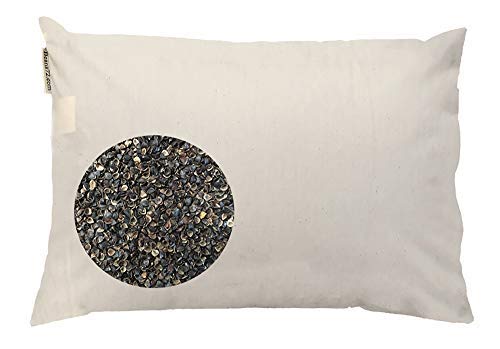
Beans72 Organic Buckwheat Pillow Queen — Best Overall Hull Pillow
Beans72 is one of the names that built the American buckwheat pillow market, and its queen is the classic article: organic hulls in a sturdy shell, at a 20 x 30 size that suits broader shoulders, restless sleepers and queen beds. It suits the buyer who wants the traditional hull pillow, done plainly and well, in the larger format.
Strengths
- Generous queen size gives restless sleepers room to stay on the pillow
- Established specialist maker with long category history
- Firm, mouldable support that holds its shape all night
Trade-offs
- It is buckwheat, not barley — see the honesty note in our intro
- Hull pillows rustle softly when you move — light sleepers take note
- Heavier than foam or fibre pillows
Key specs: Queen 20 x 30 inches, organic buckwheat hulls, US-grown fill per brand
The queen size is the right default for adults new to hull pillows: the extra width means the moulded hollow you shape for your head has margins, so turning in the night does not put you off the edge of the support. Beans72’s hulls have the clean, low-dust character that separates good hull pillows from bad ones — the fill should pour like dry sand and smell like almost nothing, and with this maker it does.
Expect the adjustment week: remove a few cups of hulls if the pillow feels like a hill, add them back if your head sinks to the mattress. That tuning is not a defect of the format — it is the format, the reason a hull pillow can fit a neck exactly when every fixed-loft foam pillow is a compromise. Give it the week and the pillow becomes oddly personal, shaped to one sleeper in a way factory pillows never are.
Best for: most sleepers wanting the classic hull pillow in a generous queen size / Not suited for: sleepers who want a soft, sink-in pillow — hulls are firm
Check on Amazon — check price on Amazon for the current listing.
Beans72 Organic Buckwheat Pillow Standard — Best Standard Size
The standard-size Beans72 is the same classic pillow in the 20 x 26 format most beds and pillowcases are built around. It suits single and double beds, guest rooms, and anyone whose existing pillowcases they love are standard size — a practical detail that decides daily satisfaction more than any other.
Strengths
- Standard size fits the pillowcases you already own
- Same trusted hull quality as the queen model
- Slightly lighter and easier to handle than the queen
Trade-offs
- Less width for very restless sleepers
- Buckwheat fill — the barley situation is explained in our guide
- Firm feel is a genuine adjustment for soft-pillow sleepers
Key specs: Standard 20 x 26 inches, organic buckwheat hulls
Everything said about the queen applies here at standard scale, with two practical differences: the standard is a little lighter to shake and reposition each morning — hull pillows like a daily plump-and-shape — and it disappears into standard bedding without a special case purchase. For a first hull pillow on a normal bed, this is the lowest-friction way in.
Side sleepers should keep generous fill for loft; back sleepers will likely remove a cup or two to let the head settle level. That asymmetry is the hull pillow’s party trick, and the standard Beans72 performs it exactly as the tradition intends — this is the sobakawa concept with American sizing and a specialist maker behind it.
Best for: standard-bed sleepers wanting the same classic hull pillow in 20 x 26 / Not suited for: king-bed sleepers who want maximum width
Check on Amazon — check price on Amazon for the current listing.

LOFE Buckwheat Pillow 20×26 Adjustable — Best Adjustable
LOFE’s standard pillow is engineered around the adjustment process itself: tartary buckwheat hulls behind an accessible zipper, an organic cotton pillowcase included, and instructions that treat adding and removing fill as the product’s main feature rather than a footnote. It suits the sleeper who knows their neck is particular and wants tuning to be effortless.
Strengths
- Adjustment is designed-in — zipper access and clear guidance
- Organic cotton pillowcase included in the box
- Tartary hulls are prized for uniformity and durability
Trade-offs
- Costs a step more than the plainest traditional models
- Buckwheat hulls, like all hulls, make a soft rustling sound
- The case is sized to this pillow — spares come from the maker
Key specs: 20 x 26 inches, tartary buckwheat hulls, organic cotton pillowcase, adjustable fill
The difference between an adjustable pillow and a pillow you can technically adjust is the difference between tuning that happens and tuning that does not. LOFE closes that gap: the zipper is reachable, the case is provided, and the whole ownership loop — sleep, judge, add or remove a handful, sleep again — takes minutes across the first week and then never needs repeating.
Tartary hulls deserve their note: smaller and harder than common buckwheat, they pack into a firmer, more stable mould and are the traditional choice in much of Asia for exactly that reason. If your complaint about pillows is that they collapse by 3 a.m., a tartary hull pillow holding the shape you set at bedtime is the direct answer.
Best for: sleepers who want easy loft adjustment with an organic cotton pillowcase included / Not suited for: anyone who will never adjust a pillow — buy pre-set simplicity instead
Check on Amazon — check price on Amazon for the current listing.
LOFE Buckwheat Pillow 14×20 Adjustable — Best Compact and Travel
The compact LOFE brings the hull pillow down to 14 x 20: a travel size, a child’s size, a lumbar-and-neck size, and — strategically — the smallest-commitment way to discover whether hull sleeping suits you before buying a full-size pillow. It packs into a suitcase corner and works in cars, planes and guest beds.
Strengths
- Travel-friendly size with the full hull-pillow experience
- Same adjustable design and organic case as its big sibling
- Excellent second pillow for neck or lumbar support
Trade-offs
- Too small as the main pillow for most adults
- Buckwheat fill — barley seekers, see our guide’s DIY route
- Compact size means less margin for restless sleepers
Key specs: 14 x 20 inches, organic buckwheat hulls, organic cotton pillowcase, adjustable
As an experiment, this pillow is perfectly designed: one week of nights on it answers the hull question — the firmness, the moulding, the soft rustle — at a fraction of a full-size commitment, and if the answer is yes, it retires gracefully into travel and support duty rather than a cupboard. If the answer is no, it still serves as a superb lumbar pillow in a desk chair.
Travellers who have found their hull pillow often refuse hotel pillows afterwards, and this is the size that makes that refusal portable. It is also the right scale for children transitioning to a real pillow, with fill removed to a low, safe loft — versatility the standard sizes cannot match.
Best for: travel, smaller sleepers, and a low-commitment first hull pillow / Not suited for: adults wanting full standard width on a main bed
Check on Amazon — check price on Amazon for the current listing.

Zen Chi Organic Buckwheat Hull Pillow 20×26 — Best Traditional Sobakawa Style
Zen Chi’s pillow is the traditionalist’s entry: organic hulls in an all-cotton cover at standard size, sold on the classic sobakawa virtues — firm moulded support and natural airflow through the hull bed that keeps the pillow cool through the night. It suits hot sleepers and anyone drawn to the original Japanese format.
Strengths
- Hull bed breathes — the coolest-sleeping pillow format there is
- All-cotton construction, nothing synthetic against the face
- Long-established model with a simple, honest design
Trade-offs
- Traditional firmness is uncompromising — tune the fill patiently
- No spare hulls included; refills are a separate purchase
- Buckwheat, as with every finished pillow in this guide
Key specs: 20 x 26 inches, organic buckwheat hulls, all-cotton cover
The cooling claim of hull pillows is real physics: air circulates between the hulls with every movement, carrying heat away instead of storing it as foam does. Hot sleepers who have never kept a pillow past July should try the format for this reason alone, and Zen Chi’s straightforward, cotton-and-hulls construction is the purest expression of it in this guide.
It is also the most traditional in feel — firm, rustling softly, demanding its week of adjustment without apology. Sleepers who meet it halfway tend to become hull-pillow people for life; sleepers who want plush should believe the description and choose a different pillow type entirely, because no amount of fill tuning makes a hull pillow soft in the foam sense.
Best for: traditionalists wanting the classic Japanese-style hull pillow and its cooling airflow / Not suited for: sleepers wanting included extras like spare hulls
Check on Amazon — check price on Amazon for the current listing.

MIOTO Organic Buckwheat Pillow with Extra Hulls — Best Starter Kit
MIOTO bundles the first-time hull sleeper’s whole starter kit: the pillow, an extra cotton pillowcase, and — the detail that matters — extra tartary hulls in the box, so tuning upward in loft needs no second order. It suits buyers who want everything required for the adjustment week in a single delivery.
Strengths
- Extra hulls included — adjust in both directions from day one
- Spare pillowcase included for laundry rotation
- Adjustable height and firmness are the product’s stated design
Trade-offs
- Newer brand than Beans72 or Zen Chi in this category
- Buckwheat hulls — the barley explanation stands
- Bundle costs a little more than a bare pillow
Key specs: Organic buckwheat hulls, extra cotton pillowcase and extra hulls included, adjustable height and firmness
The extra hulls sound like a small thing until you live the alternative: discovering on night three that you need more loft, and waiting four days for a refill bag while sleeping on a pillow you have already decided is wrong. MIOTO removes that failure mode entirely, and the spare case removes the laundry-day one. It is a thoughtfully complete package aimed at exactly the buyer most likely to abandon hull pillows for logistical rather than comfort reasons.
Build and hull quality in our assessment stand comparison with the established names, with the tartary hulls giving the firm, stable mould described in the LOFE review. For a first hull pillow bought sight unseen, the completeness of this kit makes it arguably the safest starting point in the guide.
Best for: first-time hull sleepers — extra hulls and case included for tuning / Not suited for: minimalists who want the plainest traditional package
Check on Amazon — check price on Amazon for the current listing.
Comparison Table
| Pick | Badge | Key spec | Best for |
|---|---|---|---|
| Beans72 Organic Buckwheat Pillow Queen | Best Overall Hull Pillow | Queen 20 x 30 inches, organic buckwheat hulls, US-grown fill per brand | most sleepers wanting the classic hull pillow in a generous queen size |
| Beans72 Organic Buckwheat Pillow Standard | Best Standard Size | Standard 20 x 26 inches, organic buckwheat hulls | standard-bed sleepers wanting the same classic hull pillow in 20 x 26 |
| LOFE Buckwheat Pillow 20×26 Adjustable | Best Adjustable | 20 x 26 inches, tartary buckwheat hulls, organic cotton pillowcase, adjustable fill | sleepers who want easy loft adjustment with an organic cotton pillowcase included |
| LOFE Buckwheat Pillow 14×20 Adjustable | Best Compact and Travel | 14 x 20 inches, organic buckwheat hulls, organic cotton pillowcase, adjustable | travel, smaller sleepers, and a low-commitment first hull pillow |
| Zen Chi Organic Buckwheat Hull Pillow 20×26 | Best Traditional Sobakawa Style | 20 x 26 inches, organic buckwheat hulls, all-cotton cover | traditionalists wanting the classic Japanese-style hull pillow and its cooling airflow |
| MIOTO Organic Buckwheat Pillow with Extra Hulls | Best Starter Kit | Organic buckwheat hulls, extra cotton pillowcase and extra hulls included, adjustable height and firmness | first-time hull sleepers — extra hulls and case included for tuning |
How to Choose the Best Barley Pillows — and What to Buy Instead
Decide first whether barley itself is the point, or whether the hull-pillow experience is the point. If you have slept on a barley hull pillow — they have a following in parts of Europe — and want that specific hull, the honest route today is DIY: bulk barley hulls plus a zippered cotton shell, covered in the section below. Finished barley pillows from established makers are, at the time of writing, effectively absent from the Amazon catalogue, and any listing claiming otherwise deserves a very careful read of its fill description.
If the experience is the point — firm, mouldable, breathable, adjustable — then buckwheat is not a compromise but the mainstream: it is the hull with the makers, the sizes, the spare-fill supply and the centuries of sobakawa tradition behind it. Choose among the six verified picks by size and by how complete a starter package you want, and sleep on the format that actually exists at quality.
Barley Hulls vs Buckwheat Hulls: The Real Differences
Both hulls are the inedible outer husks of a grain, cleaned and used as a free-flowing pillow fill, and both produce the format’s signature behaviour: the fill shifts under your head, locks into the shape it finds, breathes freely, and adjusts by volume. The differences are of degree. Buckwheat hulls are larger, triangular and springier, giving a slightly loftier, more resilient mould; barley hulls are smaller and rounder, packing a little denser and feeling marginally smoother and quieter in the pillow.
Longevity and supply also differ in buckwheat’s favour: quality buckwheat hulls last years before they gradually break down, and replacement fill is sold everywhere hull pillows are sold. Barley fill, bought in bulk, is inexpensive but variable in cleanliness between suppliers — sieve and air any bulk hulls before filling, whichever grain you choose, and buy from sellers who describe their cleaning process.
How to Make a True Barley Pillow Yourself
Buy two things: bulk barley hulls — roughly four to six pounds for a standard pillow, and more is better than less since adjustment is the point — and a zippered pillow shell in a tight-weave cotton, standard 20 x 26 unless you prefer another size. Fill the shell about two-thirds over a large bin or outdoors, zip it, and sleep on it for two nights before judging. Then tune: add hulls for loft and firmness, remove them for a lower, softer settle, a cup at a time.
Finish with a pillowcase over the shell — ideally two, since hulls occasionally work a fragment through a single layer — and maintain it like any hull pillow: air it monthly, keep it dry, and top up the fill as the hulls slowly compress over the years. Total effort is an hour at setup and minutes thereafter, and the result is a genuine barley pillow, which is more than the finished-pillow market currently offers.
Loft, Firmness and Sleeping Position
Hull pillows tune by position. Side sleepers need the fullest fill: the pillow must hold the head high enough to keep the neck level with the spine, and hulls excel here because the moulded shape does not collapse at 3 a.m. Back sleepers usually remove a cup or two so the head settles into a shallow cradle without the chin being pushed forward. Stomach sleepers should use very low fill or a different pillow entirely — hull firmness under a turned head is rarely comfortable.
Whatever your position, judge changes over two nights, not one, and change by small amounts. The most common hull-pillow failure is overcorrection: a pillow emptied in frustration on night one, refilled in frustration on night three, and abandoned by the weekend — when patient, incremental tuning would have arrived at the most personalised pillow the sleeper has ever owned.
Hull Pillow Care: Keeping It Clean and Long-Lived
The rule of hull care is dryness. The hulls themselves are not washed — water ruins their spring and invites mildew — while shells and cases wash normally. Air the pillow monthly in a dry, breezy spot, sun if convenient, and keep it out of steamy bathrooms between uses. A pillow protector under the case is cheap insurance against spills, which should be dealt with by removing and drying the affected hulls immediately.
Over years, hulls gradually fragment and the pillow loses loft and gains dust; that is the signal to replace the fill — a refill bag restores the pillow to new for a fraction of a new pillow’s cost, which is part of the format’s quiet economy. Makers in this guide sell or standardise their fill, so keep your pillow’s brand and size noted for the day, years from now, when the refill order is placed.
Who Should and Should Not Sleep on a Hull Pillow
Hull pillows suit sleepers who want firm, shaped, cool support and who enjoy a product they can tune — side and back sleepers especially, hot sleepers almost by definition, and anyone tired of foam pillows that start perfect and collapse by morning. They also suit the practically minded: a pillow whose fill is replaceable and whose loft is adjustable is a pillow bought once a decade, not once a year.
They do not suit sleepers who love plush sink-in softness, who are disturbed by any sound from the bed — hulls rustle softly when you move — or who want a pillow that asks nothing of them in its first week. Those sleepers should buy the best foam or down-alternative pillow they can find and sleep happily; the hull tradition will still be here, unchanged for centuries, if curiosity ever calls them back.
How to Adjust a Hull Pillow to Your Neck
Every pick in this guide adjusts the same way, and the process below — fifteen minutes spread across the first week — is what converts a firm, strange new pillow into the most personalised one you own. Work over a bin or a large bag; hulls are escape artists.
- Sleep on the pillow as delivered for the first night, and note specifically what is wrong in the morning: too high, too low, too hard at the edge, or collapsing in the middle — each has a different fix.
- For too high or too firm, remove hulls a cup at a time into a sealed bag (keep them — you may want some back), re-zip, shake the pillow to settle the fill, and sleep again before removing more.
- For too low or collapsing, add hulls — from the spares your maker included, or a refill bag — focusing the addition under where your head actually rests rather than evenly everywhere.
- Shape before you lie down: push hulls away from the centre to form a shallow hollow for your head, with a supportive ridge under your neck; hull pillows hold the shape you give them, so give them a good one.
- Side sleepers: check alignment with a mirror or a partner — ear, shoulder and hip should form a level line; add fill until they do. Back sleepers: your chin should rest neutral, neither tucked nor tilted back.
- Once the loft is right for a full week, stop adjusting. Hull pillows reward a settled routine: a daily shake and re-shape, and no further tuning until the fill ages years from now.
That is the whole craft: small changes, two nights of patience per change, and a shape set by hand each evening. Sleepers who do this once, properly, routinely describe the result as the first pillow that ever truly fit — which is precisely what five centuries of hull-pillow tradition have been saying.
The History in Your Pillow: Sobakawa and Hull Traditions
The hull pillow is not a wellness fad; it is one of the oldest pillow technologies in continuous use. In Japan, sobakawa — buckwheat hull pillows — have been slept on for centuries, valued in a hot, humid climate for exactly the properties modern sleepers rediscover: the fill breathes, it moulds, it supports the neck at a precise height, and it can be renewed indefinitely by replacing the hulls. Korean and Chinese traditions used hull and husk fills similarly, and European farm households filled pillows and mattresses with what the harvest provided — including, in grain regions, barley hulls and chaff.
That history explains the format’s stubborn survival alongside every foam technology of the last seventy years. Foam pillows are manufactured to a fixed shape and loft, and they age toward collapse; a hull pillow is maintained, like a good tool — topped up, re-tuned, refilled — and its best night can be its five-hundredth as easily as its first. The sleepers who keep hull pillows for decades are not traditionalists performing a ritual; they are owners of the only pillow whose fit improves with attention.
It also explains the barley situation honestly: barley hull pillows belonged to agricultural households that made their own bedding from their own harvest. Industrial bedding standardised on buckwheat — the hull with the best combination of size, spring and supply — and the barley pillow survived as a homemade article rather than a manufactured one. The DIY route in this guide is therefore not a workaround; it is the traditional way this pillow was always made.
Hull Pillows and Temperature: Sleeping Cool by Design
Heat is the most common reason sleepers abandon pillows, and it is the hull pillow’s home ground. A foam pillow is a block of insulation: it absorbs the head’s heat, warms through the night, and returns that warmth to the sleeper, which is why foam pillows get flipped to the cool side at 3 a.m. A hull pillow is a bed of dry shells with air between them; every movement stirs that air, carrying heat away, and the fill itself stores almost nothing. The pillow stays near room temperature all night, and there is no cool side to flip to because both sides are cool.
Cotton shells complete the system — no synthetic cover trapping a layer of warm air against the face — and the picks in this guide all use cotton for exactly this reason. Hot sleepers who also run the bedroom cool and choose breathable sheets describe hull pillows as the last piece of a puzzle they had been solving for years, one disappointing ‘cooling gel’ foam pillow at a time.
The honest limit is winter in a cold house: a hull pillow offers no insulation, and a sleeper who loves a warm, cocooned pillow in January may find it austere. A flannel pillowcase softens the first contact, and most hull sleepers adapt within the adjustment week — but the format’s character is cool and firm, and this guide would rather state it plainly than sell a pillow to the wrong sleeper.
Troubleshooting Hull Pillows: Five Fixes for Common Complaints
Most hull-pillow complaints have mechanical fixes, and they are worth trying in order before concluding the format is not for you. If the pillow feels like a brick, the fill is too high or too packed: remove a cup, then shake the pillow vigorously to loosen the hull bed before shaping it — a hull pillow that is never shaken gradually compacts into exactly the brick its owner complains about. The daily shake is not folklore; it is the maintenance the format runs on.
If your head sinks to the mattress by morning, the fill has migrated away from the centre in the night: shape a firmer ridge where your neck rests and a deeper hollow for your head, and consider that your pillow may be a size too small for how much you move — the queen Beans72 exists for restless sleepers whose standard pillows empty themselves. If the rustling bothers you, put a second pillowcase over the first and choose the smaller tartary hulls next refill; both measurably soften the sound.
If the pillow smells stale, the hulls have absorbed moisture or age: empty them into a wide tray on a dry, sunny day, air them for several hours, and refill — and if they smell of anything sour or musty after airing, replace the fill entirely, because hulls are inexpensive and a pillow’s fill is not worth negotiating with. And if your neck aches in a new place, your loft is wrong in the other direction: ache high on the neck suggests too little support, ache at the shoulders too much. Adjust a cup, sleep two nights, and let the evidence, not the first impression, decide.
The History in Your Pillow: Sobakawa and Hull Traditions
The hull pillow is not a wellness fad; it is one of the oldest pillow technologies in continuous use. In Japan, sobakawa — buckwheat hull pillows — have been slept on for centuries, valued in a hot, humid climate for exactly the properties modern sleepers rediscover: the fill breathes, it moulds, it supports the neck at a precise height, and it can be renewed indefinitely by replacing the hulls. Korean and Chinese traditions used hull and husk fills similarly, and European farm households filled pillows and mattresses with what the harvest provided — including, in grain regions, barley hulls and chaff.
That history explains the format’s stubborn survival alongside every foam technology of the last seventy years. Foam pillows are manufactured to a fixed shape and loft, and they age toward collapse; a hull pillow is maintained, like a good tool — topped up, re-tuned, refilled — and its best night can be its five-hundredth as easily as its first. The sleepers who keep hull pillows for decades are not traditionalists performing a ritual; they are owners of the only pillow whose fit improves with attention.
It also explains the barley situation honestly: barley hull pillows belonged to agricultural households that made their own bedding from their own harvest. Industrial bedding standardised on buckwheat — the hull with the best combination of size, spring and supply — and the barley pillow survived as a homemade article rather than a manufactured one. The DIY route in this guide is therefore not a workaround; it is the traditional way this pillow was always made.
Hull Pillows and Temperature: Sleeping Cool by Design
Heat is the most common reason sleepers abandon pillows, and it is the hull pillow’s home ground. A foam pillow is a block of insulation: it absorbs the head’s heat, warms through the night, and returns that warmth to the sleeper, which is why foam pillows get flipped to the cool side at 3 a.m. A hull pillow is a bed of dry shells with air between them; every movement stirs that air, carrying heat away, and the fill itself stores almost nothing. The pillow stays near room temperature all night, and there is no cool side to flip to because both sides are cool.
Cotton shells complete the system — no synthetic cover trapping a layer of warm air against the face — and the picks in this guide all use cotton for exactly this reason. Hot sleepers who also run the bedroom cool and choose breathable sheets describe hull pillows as the last piece of a puzzle they had been solving for years, one disappointing ‘cooling gel’ foam pillow at a time.
The honest limit is winter in a cold house: a hull pillow offers no insulation, and a sleeper who loves a warm, cocooned pillow in January may find it austere. A flannel pillowcase softens the first contact, and most hull sleepers adapt within the adjustment week — but the format’s character is cool and firm, and this guide would rather state it plainly than sell a pillow to the wrong sleeper.
Common Buying Mistakes
Believing a listing that calls a buckwheat pillow ‘barley’
Read the fill description, not the headline. Finished pillows on Amazon are buckwheat in essentially every case; sellers who blur the distinction in a title will blur it elsewhere too. Our picks are labelled buckwheat honestly — hold every other seller to the same standard.
Judging a hull pillow on the first night
An untuned hull pillow is an unfinished product. The adjustment week — small changes, two nights apart — is part of the purchase. Buyers who skip it return the most customisable pillow on the market complaining it was not customised.
Removing too much fill at once
A cup at a time is the rule. Hull behaviour is non-linear: the difference between perfect and flat can be two cups, and emptying half the pillow in frustration guarantees a week of yo-yoing instead of a single, converging tune.
Washing the hulls
Water destroys hull fill — it loses its spring, clumps and can mildew inside the shell. Wash shells and cases only, air the pillow dry, and treat spills by removing and drying the affected hulls. This single rule decides whether a hull pillow lasts two years or ten.
Buying the wrong size for the bed and body
A queen pillow on a twin bed crowds the sleeper; a compact travel size under an adult’s head on a main bed under-supports it. Match the pillow to the bed and the sleeper — standard for most, queen for broad shoulders and big beds, compact for travel and children.
Expecting plush softness from any hull
Hulls are firm by nature; tuning changes loft and shape, not the fundamental character. If you love sink-in softness, a hull pillow will never be your pillow, and the honest move is to choose a different fill entirely rather than fight this one’s nature.
Final Recommendation
For a finished pillow you can sleep on this week, the Beans72 queen is the classic choice and its standard-size sibling the practical one; the LOFE standard is the tuner’s pick, its compact sibling the traveller’s and the cautious experimenter’s; the Zen Chi is the traditionalist’s cool-sleeping sobakawa; and the MIOTO kit is the first-timer’s safest start, with the spare hulls and case that make the adjustment week frictionless.
And if barley itself is what you came for, you now know the truth of the market and the way through it: bulk barley hulls, a zippered cotton shell, an hour of filling, and the same tuning craft this guide teaches. That pillow — genuinely barley, fitted exactly to you — is a better outcome than any mislabelled listing could have sold you.
Best Buckwheat Pillows Best Firm Pillows Best Pillows For Side Sleepers Best Pillows For Neck Pain Comfort Best Cooling Pillows Best Organic Pillows
Frequently Asked Questions
Are barley pillows and buckwheat pillows the same thing?
No — they are filled with the hulls of different grains. But they belong to the same pillow family and behave very similarly: firm, mouldable, breathable and adjustable by fill volume. Finished barley pillows are scarce on Amazon, where buckwheat dominates; this guide labels every pick honestly and explains the DIY route to a true barley pillow.
Why are there so few real barley pillows for sale?
The finished hull-pillow market grew up around the Japanese sobakawa tradition, which uses buckwheat, and makers, sizes and refill supplies followed that demand. Barley hulls are sold mainly as bulk fill. The practical routes are a finished buckwheat pillow — the same experience — or an hour of DIY with bulk barley hulls and a zippered shell.
Are hull pillows comfortable for side sleepers?
They are among the best formats for side sleeping, because the moulded fill holds loft all night instead of collapsing: fill generously, shape a hollow for your head with a ridge under your neck, and check that ear, shoulder and hip align. Back sleepers should use less fill; stomach sleepers are usually better served by a softer, thinner pillow.
Do hull pillows make noise?
Yes, a soft rustling when you move or turn — the sound of dry hulls shifting. Most sleepers stop noticing within a few nights, and smaller tartary hulls are somewhat quieter. If you are extremely sound-sensitive or share with someone who is, try the compact size first as an experiment.
How long does a hull pillow last?
The shell lasts many years and the fill typically serves several years before gradually fragmenting and losing loft — at which point a refill bag restores the pillow for a fraction of a new pillow’s cost. Keep the fill dry, air the pillow monthly, and never wash the hulls themselves.
How firm is a hull pillow, really?
Firm — closer to a shaped sandbag than to any foam or fibre pillow, though it moulds precisely to your head and neck rather than pushing back uniformly. Tuning changes its height and shape, not its fundamental firmness. Sleepers who love plush softness should choose a different fill; sleepers who want support that holds its shape all night are exactly who hulls are for.

